

When construction work affects a shared boundary between properties, a party wall award becomes far more than simple permission to proceed. This legally binding document serves as a detailed contract that governs every aspect of the building process—from precise work schedules and payment terms to insurance requirements and access rights. Understanding The Complete Party Wall Award: What Surveyors Include and Why Each Element Matters can mean the difference between a smooth construction project and costly disputes with neighbours.
Under the Party Wall etc. Act 1996, a party wall award is a formal document prepared by qualified surveyors to protect both the building owner undertaking construction and adjoining neighbours when work may affect shared boundaries[1]. Rather than a simple approval letter, this comprehensive agreement addresses complex legal, technical, and financial considerations that safeguard all parties involved.
Key Takeaways
- A party wall award is a legally binding contract that covers work specifications, timelines, surveyor authority, access rights, and dispute resolution procedures—not just permission to build
- Schedule of Condition documentation establishes a baseline record of the adjoining property's condition, preventing disputes over pre-existing versus construction-related damage
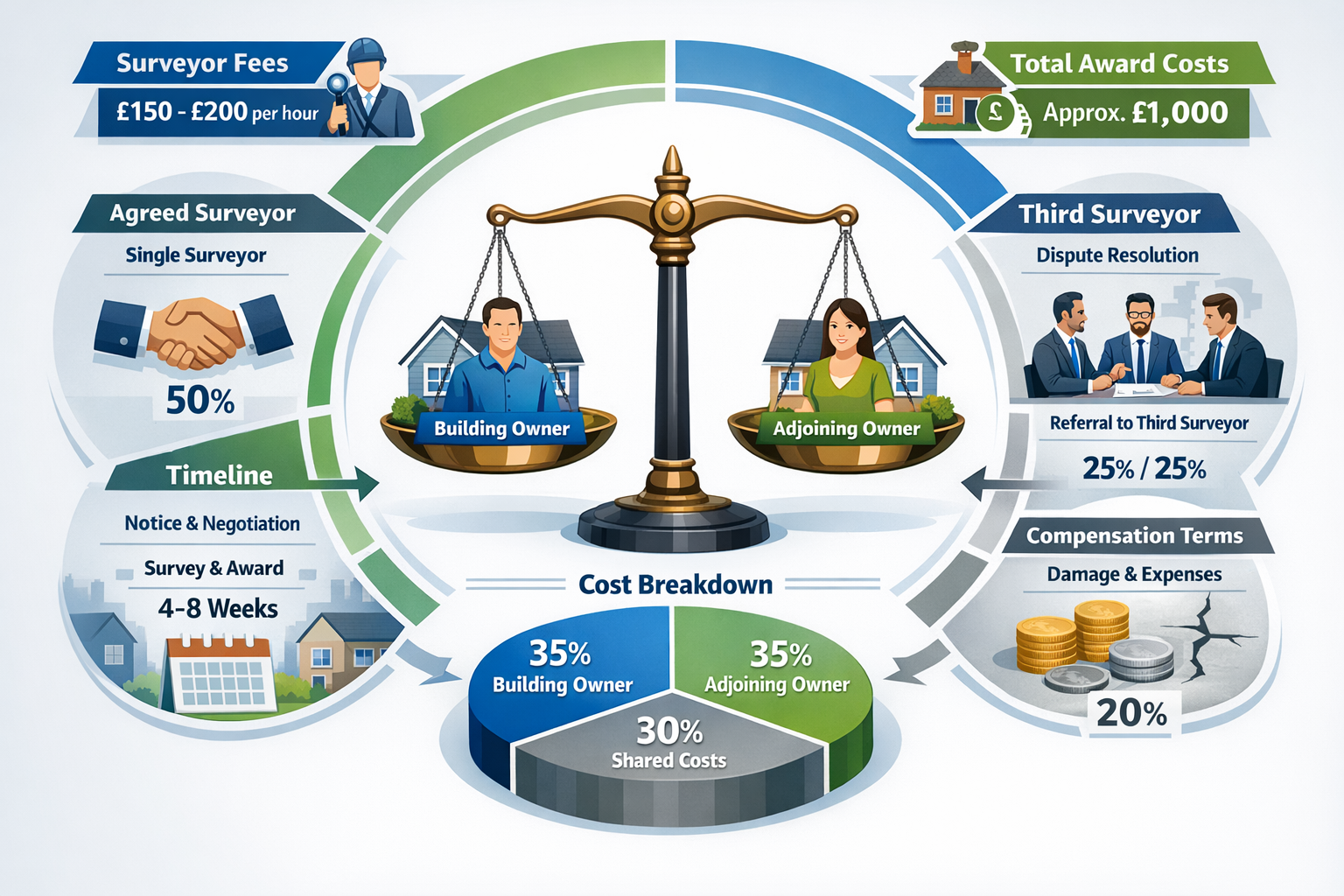
- Total costs for party wall awards in 2026 average approximately £1,000, with surveyor fees ranging from £150-£200 per hour depending on project complexity[2]
- Agreed surveyor appointments can reduce costs significantly by using one independent surveyor instead of separate representatives for each party
- Comprehensive protection measures detailed in the award include dust control, vibration limits, noise reduction, and specific compensation terms if damage occurs
Understanding the Legal Foundation of Party Wall Awards
What Triggers the Need for a Party Wall Award?
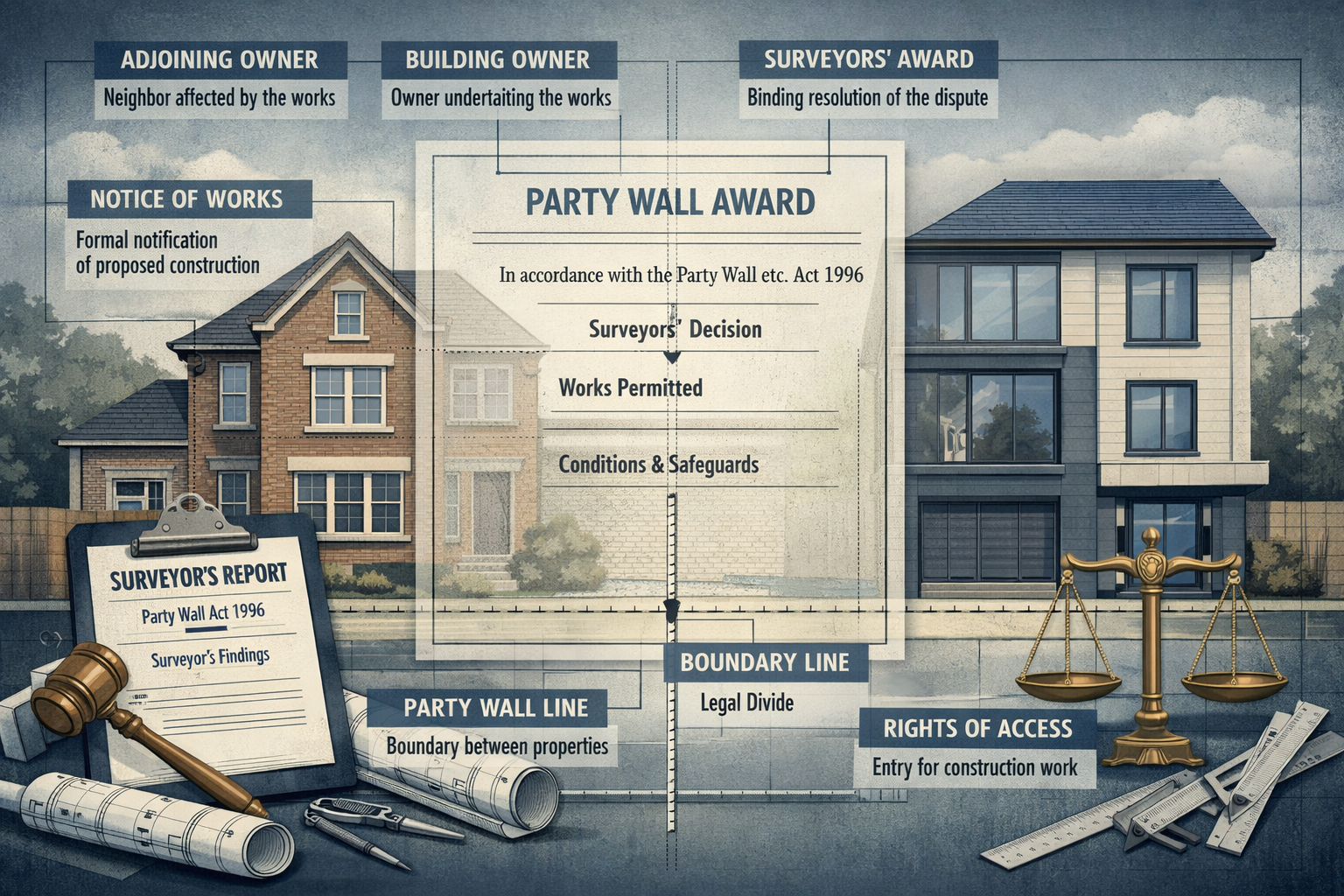
A party wall award becomes necessary when construction projects involve specific types of work affecting shared boundaries. These triggering circumstances include excavating within a specified distance of shared boundaries (typically up to six metres or to depths that might affect adjoining foundations), working directly on existing party walls, or constructing new walls positioned on boundary lines[1].
Property owners planning such work must first serve party wall notices to affected neighbours. When neighbours dissent or fail to respond within the statutory 14-day period, the formal party wall award process begins. This legal framework ensures that construction proceeds with proper safeguards rather than being blocked entirely.
The Role of Surveyors in Creating Awards
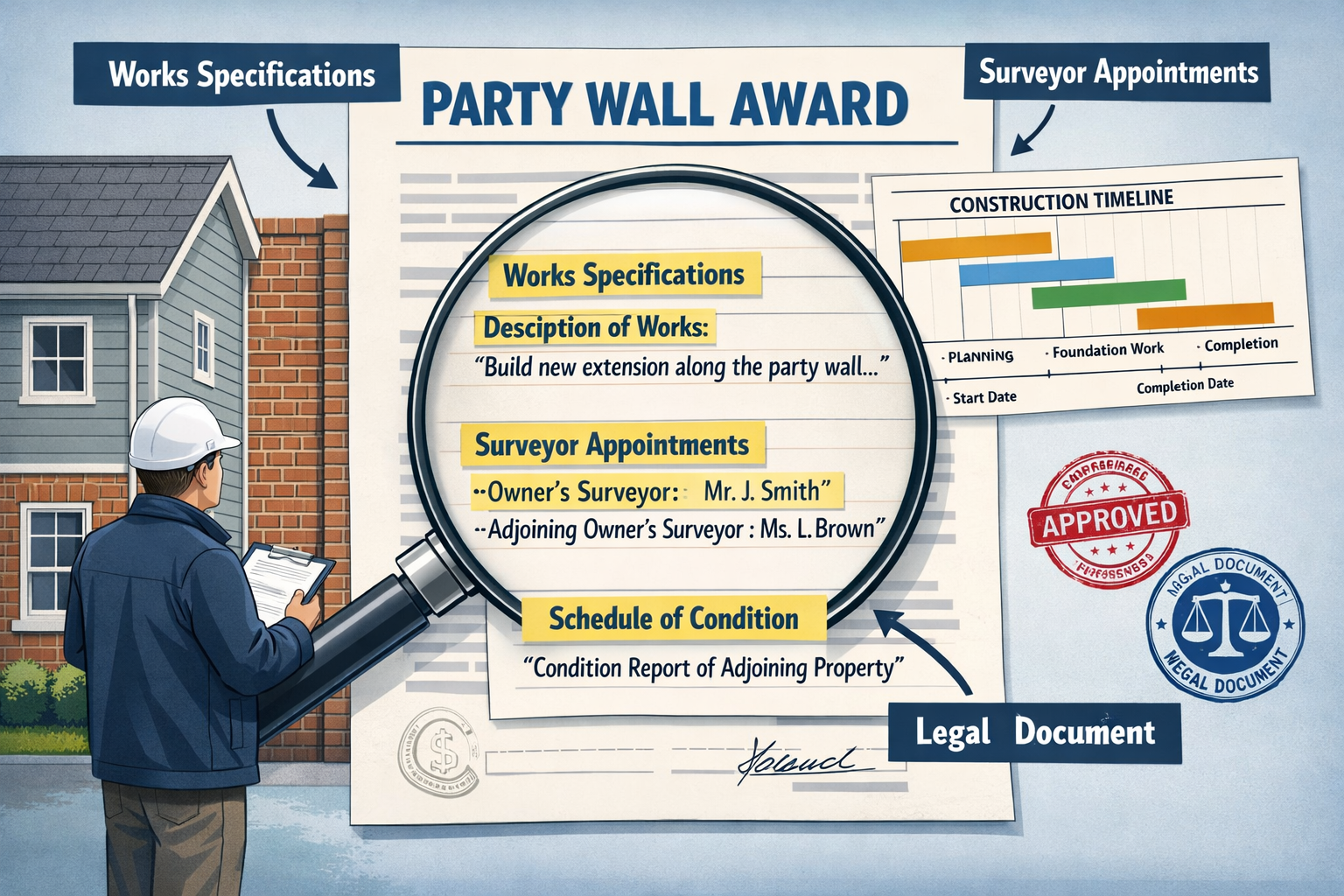
Qualified party wall surveyors possess the technical expertise and legal knowledge to prepare comprehensive awards. The award formally lists appointed surveyors and outlines their authority to make decisions and oversee the project[1]. This includes establishing procedures for appointing a third surveyor to determine solutions if disputes arise between the building owner's surveyor and the adjoining owner's surveyor.
Understanding party wall awards requires recognizing that surveyors act as impartial professionals bound by statutory duties, not simply as advocates for the party who appointed them. Their role centres on creating fair, balanced agreements that protect all stakeholders.
Core Components of The Complete Party Wall Award: What Surveyors Include
📋 Detailed Work Specifications and Timelines
Every comprehensive party wall award includes a clear description of the work to be undertaken, covering precise specifications, realistic timelines, and requirements for special construction techniques designed to minimize impact on adjoining properties[1].
These specifications typically detail:
- Exact nature of construction work (excavation depth, wall modifications, structural alterations)
- Construction methods and techniques to be employed
- Project timeline with start dates, anticipated completion, and working hours
- Special requirements for sensitive operations near the party wall
- Materials specifications to ensure compatibility and safety
The importance of detailed work descriptions cannot be overstated. Vague specifications create ambiguity that can lead to disputes, delays, and additional costs. Precise documentation ensures all parties understand exactly what work will occur and when.
🏗️ Schedule of Condition: Your Protection Baseline
A Schedule of Condition represents one of the most critical components of any party wall award. This detailed report documents the current condition of the adjoining property before construction begins, establishing an objective baseline that prevents disputes over pre-existing damage versus damage caused during construction[1].
Professional schedule of condition documentation includes:
| Component | Details |
|---|---|
| Photographic Evidence | Comprehensive images of all rooms, external walls, ceilings, and existing defects |
| Written Descriptions | Detailed notes on cracks, settlement, decoration condition, and structural elements |
| Measurements | Precise crack width measurements and location documentation |
| Date Stamps | Verified dates proving condition before work commenced |
| Professional Certification | Surveyor's signature and credentials validating the assessment |
Without this baseline documentation, disputes frequently arise when neighbours notice existing cracks or damage after construction and attribute them to the building work. The schedule of condition provides definitive proof of pre-existing conditions, protecting building owners from unfounded claims while ensuring legitimate damage can be properly identified and compensated.
🔑 Access Rights and Arrangements
Party wall awards define access arrangements allowing the property owner and contractors to enter the neighbour's property when necessary to complete work safely and effectively[1]. This often-overlooked component carries significant practical importance.
Access provisions typically specify:
- Notice periods required before entering adjoining property
- Permitted hours for access (usually aligned with construction working hours)
- Specific purposes for which access is granted
- Number of personnel allowed on the property
- Security measures to protect the neighbour's property during access
- Liability provisions covering damage during authorized access
These detailed arrangements prevent confrontations and ensure contractors can complete necessary work without legal complications. For building owners undertaking complex projects, access rights can prove essential for installing scaffolding, performing inspections, or conducting repairs that cannot be completed from their own property alone.
Protection Measures and Risk Management Elements
🛡️ Property Protection Requirements
Comprehensive party wall awards detail precautions to safeguard the adjoining property during construction, including specific limits and controls for dust, vibration, and noise[1]. These protection measures transform the award from a simple permission document into a practical risk management tool.
Dust Control Measures:
- Installation of dust barriers and protective sheeting
- Regular cleaning schedules for shared areas
- Air filtration requirements for certain operations
- Protocols for notifying neighbours before particularly dusty work
Vibration Limits:
- Maximum vibration levels measured in millimetres per second
- Monitoring equipment requirements
- Restrictions on certain equipment near party walls
- Protocols if vibration limits are exceeded
Noise Reduction Specifications:
- Permitted working hours (typically 8am-6pm weekdays)
- Weekend and holiday restrictions
- Requirements for acoustic barriers
- Limits on particularly noisy equipment
These specifications aren't merely suggestions—they represent legally enforceable requirements that contractors must follow. Violations can result in work stoppages, additional surveyor inspections, and potential compensation claims.
⚖️ Dispute Resolution Mechanisms
Even with comprehensive planning, disagreements sometimes arise during construction. Party wall awards provide formal procedures for resolving disputes that arise during the work, including mechanisms for appointing third surveyors if initial disputes cannot be resolved between the appointed surveyors[1].
The dispute resolution framework typically includes:
- Initial resolution attempts between appointed surveyors
- Documentation requirements for disputed issues
- Third surveyor selection process (usually by agreement or, failing that, by the appointing officer)
- Timeline for dispute resolution to prevent extended project delays
- Cost allocation for dispute resolution procedures
- Appeal mechanisms under the Party Wall etc. Act 1996
This structured approach ensures that disagreements don't derail entire construction projects. Rather than resorting to expensive court proceedings, parties can resolve issues through the established surveyor framework—typically faster and more cost-effectively.
For those wondering about party wall agreement options without surveyors, it's worth noting that formal awards with proper dispute resolution mechanisms often prove more valuable than informal arrangements when problems arise.
Financial Components: Costs, Compensation, and Payment Terms
💰 Understanding Party Wall Award Costs in 2026
Party wall awards currently cost approximately £1,000 in total in 2026, with surveyor fees ranging from £150-£200 per hour[2]. However, these costs vary significantly depending on location, project complexity, and the number of surveyors involved.
Cost Breakdown Factors:
- Project complexity (simple loft conversion vs. complex basement excavation)
- Number of adjoining properties affected by the work
- Geographic location (London typically commands higher fees than other regions)
- Surveyor experience and qualifications
- Schedule of condition complexity (number of rooms, property size, existing defects)
- Dispute resolution requirements (additional costs if third surveyor needed)
Building owners can potentially reduce costs through the agreed surveyor option. When neighbours dissent to a party wall notice, both homeowner and neighbour can appoint one agreed surveyor, usually within ten days, which reduces costs to a single set of fees rather than paying for separate surveyors[2]. The agreed surveyor must remain independent and cannot be the same professional the homeowner uses for their own architectural or structural work.
For detailed information on managing expenses, review our guide on how to keep party wall costs down.
💵 Compensation and Repair Terms
Party wall awards outline terms for making good or compensating the affected party if damage occurs, which may involve repair work or financial compensation[1]. These provisions represent crucial protection for adjoining owners while providing clarity for building owners about their potential liabilities.
Typical compensation provisions include:
- Repair obligations specifying who performs repairs and to what standard
- Financial compensation for damage that cannot be practically repaired
- Timeline requirements for completing repairs after construction finishes
- Quality standards ensuring repairs match original materials and finishes
- Temporary inconvenience compensation in some cases
- Professional fees for additional surveyor inspections if damage occurs
The schedule of condition becomes essential when determining compensation. By comparing the property's post-construction state to the documented baseline, surveyors can objectively identify construction-related damage versus pre-existing conditions.
📊 Who Pays for What?
Understanding payment responsibilities prevents surprises and disputes. The Party Wall etc. Act 1996 establishes that building owners typically bear all reasonable costs associated with party wall procedures, including:
- Their own surveyor's fees
- The adjoining owner's surveyor fees (when separate surveyors are appointed)
- Third surveyor fees if disputes require resolution
- Schedule of condition costs
- Award preparation and documentation
- Reasonable legal advice costs for adjoining owners
However, if a neighbour responds to a party wall notice giving written permission, there is usually no need to appoint surveyors, eliminating these costs entirely[2]. Some building owners still opt for a condition survey in these situations to minimize future dispute risk, but this represents a voluntary expense rather than a statutory requirement.
Special Provisions and Additional Award Elements
🔍 Insurance and Indemnity Requirements
Comprehensive party wall awards often specify insurance requirements for building owners and contractors. These provisions protect all parties from financial exposure if unexpected damage occurs despite proper precautions.
Common insurance specifications include:
- Minimum public liability coverage (typically £2-5 million)
- Professional indemnity insurance for contractors
- Proof of coverage requirements before work commences
- Named insured parties (often including adjoining owners)
- Notification requirements if insurance lapses during construction
📅 Working Hours and Operational Restrictions
Beyond basic noise limits, awards may include detailed operational restrictions that govern when and how work can proceed:
- Specific permitted working hours (e.g., 8am-6pm Monday-Friday, 8am-1pm Saturday)
- Bank holiday and Sunday restrictions
- Special provisions for particularly disruptive operations
- Notification requirements before commencing certain work phases
- Restrictions on deliveries and vehicle access
These provisions balance the building owner's need to complete work efficiently with the adjoining owner's right to reasonable enjoyment of their property.
🏛️ Special Construction Techniques
For complex projects, awards may mandate specific construction techniques designed to minimize risk to adjoining properties:
- Underpinning methods and sequences
- Temporary support requirements for party walls
- Excavation techniques (hand-digging vs. mechanical excavation near boundaries)
- Monitoring requirements (crack monitoring, vibration sensors, settlement gauges)
- Contingency procedures if unexpected conditions arise
These technical specifications ensure that contractors employ appropriate methods for sensitive work near shared boundaries.
When Surveyors Are and Aren't Required
Consent Scenarios: Avoiding the Award Process
Understanding when party wall awards become necessary helps property owners plan appropriately. If neighbours provide written consent to proposed work after receiving proper notice, the formal award process typically isn't required[2].
However, even with consent, prudent building owners often commission schedule of condition surveys to document the baseline property condition. This modest investment (typically £200-400) provides protection if neighbours later claim damage occurred, even when they initially consented to the work.
The Agreed Surveyor Advantage
The agreed surveyor option offers significant advantages for straightforward projects where neighbours maintain reasonable relationships. Benefits include:
- ✅ Reduced costs (one surveyor fee instead of two)
- ✅ Faster process (no need for coordination between multiple surveyors)
- ✅ Simplified communication (single point of contact)
- ✅ Maintained impartiality (agreed surveyors must remain independent)
For building owners seeking this approach, early communication with neighbours about appointing an agreed surveyor can facilitate smoother processes and better relationships throughout construction.
Practical Implications: Why Each Element Truly Matters
Real-World Scenarios Demonstrating Award Value
Scenario 1: Basement Excavation Damage
A building owner excavates a basement within three metres of the party wall. Despite precautions, minor cracking appears in the neighbour's property. The schedule of condition clearly shows these cracks didn't exist before work began. The award's compensation provisions require the building owner to repair the damage to match original finishes. Without the schedule of condition, the building owner might have faced claims for pre-existing damage, potentially costing thousands in unnecessary repairs.
Scenario 2: Access Dispute Resolution
Contractors need access to a neighbour's garden to install scaffolding for party wall work. The neighbour initially refuses, citing concerns about damage to landscaping. The award's access provisions specify permitted access, notice requirements, and liability for any damage. The surveyor mediates, ensuring contractors can proceed while establishing protection measures for the garden. Work continues without legal action or project delays.
Scenario 3: Vibration Concerns
During excavation, a neighbour complains about excessive vibration. The award specifies maximum vibration limits and requires monitoring equipment. Measurements show vibration remains within permitted levels. The objective data prevents disputes and provides reassurance to the concerned neighbour, allowing work to continue smoothly.
Long-Term Value Beyond Construction
The party wall award's value extends beyond the construction period. The document serves as:
- Permanent record of agreed work and conditions
- Reference document for future property transactions
- Evidence if disputes arise years after construction
- Template for future party wall work at the property
Property solicitors often request party wall awards during conveyancing, and their presence demonstrates that construction work proceeded properly under statutory procedures.
Regional Considerations and Local Expertise
London-Specific Factors
Party wall procedures in London carry unique considerations due to property density, construction complexity, and property values. Building owners in different areas benefit from local surveyor expertise:
- Party wall surveyors in South London understand Victorian terrace construction
- Central London specialists navigate complex basement projects in conservation areas
- West London experts handle high-value property considerations
- North London professionals address Edwardian property characteristics
- East London surveyors manage rapid development area challenges
Local expertise ensures awards address region-specific construction challenges and property characteristics effectively.
Conclusion
The Complete Party Wall Award: What Surveyors Include and Why Each Element Matters encompasses far more than simple permission to build. This comprehensive legal document serves as a detailed contract governing every aspect of construction affecting shared boundaries—from precise work specifications and protection measures to compensation terms and dispute resolution procedures.
Understanding the award's components empowers building owners to navigate party wall procedures confidently while protecting their interests and maintaining positive neighbour relationships. The schedule of condition establishes objective baselines preventing unfounded damage claims. Access provisions ensure contractors can complete necessary work. Protection measures safeguard adjoining properties. Compensation terms provide clarity about repair obligations. Dispute resolution mechanisms offer structured approaches to disagreements without expensive litigation.
Next Steps for Building Owners
If you're planning construction work that may trigger party wall procedures:
- Determine whether your work requires party wall notices by reviewing types of party wall works
- Serve proper notices to affected neighbours with adequate notice periods
- Appoint qualified surveyors if neighbours dissent or fail to respond
- Consider the agreed surveyor option to reduce costs for straightforward projects
- Commission schedule of condition surveys even if neighbours consent, for baseline protection
- Review award terms carefully before construction begins to understand all obligations
- Maintain communication with neighbours throughout the process
For building owners ready to proceed with party wall procedures, consulting experienced professionals ensures comprehensive awards that protect all parties while facilitating smooth construction projects. The modest investment in proper party wall procedures prevents costly disputes, project delays, and damaged neighbour relationships—making thorough awards invaluable for any construction affecting shared boundaries.
References
[1] Overview Of A Party Wall Award – https://iconsurveyors.co.uk/blog/overview-of-a-party-wall-award/
[2] Party Wall Agreement – https://hoa.org.uk/advice/guides-for-homeowners/i-am-improving/party-wall-agreement/
[3] Party Wall Agreements What You Need To Know – https://www.fmb.org.uk/find-a-builder/ultimate-guides-to-home-renovation/party-wall-agreements-what-you-need-to-know.html