More than 60% of loft conversion projects in England and Wales trigger mandatory party wall obligations, yet a staggering proportion of homeowners discover this requirement only after builders have mobilized to site—creating costly delays, strained neighbour relations, and potential court injunctions that halt work entirely.
Understanding Party Wall Notices for Loft Conversions: Legal Triggers, Common Errors, and Award Essentials is critical for any homeowner planning to convert unused roof space into valuable living area. The Party Wall etc. Act 1996 establishes specific legal requirements when structural work affects shared walls, and loft conversions frequently involve precisely the types of interventions that activate these obligations. This comprehensive guide explains exactly when notices become mandatory, identifies the most common mistakes that derail projects, and details what must be included in a compliant Party Wall Award.
Whether planning a simple roof light installation or a full dormer extension with steel beam insertions, knowing the legal triggers and proper procedures protects both the building owner’s project timeline and the neighbour’s property rights.
Key Takeaways
- Structural loft work triggers mandatory notices: Steel beam insertions into party walls, raising shared walls, cutting into walls for support, and chimney breast removal affecting shared stacks all require party wall notices served at least two months before work begins.
- Notice failures lead to court injunctions: Starting work without proper notices allows neighbours to seek immediate court orders stopping construction, causing significant delays and increased legal costs.
- Party Wall Awards must document essential protections: Awards prepared by qualified surveyors must specify work scope, protective measures, access arrangements, and include a Schedule of Condition documenting pre-work property state.
- Common errors include late, incorrect, or missing notices: The majority of party wall disputes arise from procedural failures rather than substantive disagreements about the work itself.
- Early surveyor involvement prevents costly delays: Engaging party wall professionals during the planning stage—once architectural drawings are complete—ensures sufficient time for proper notice service and agreement before builders arrive on site.
Understanding Legal Triggers: When Loft Conversions Require Party Wall Notices
The Party Wall etc. Act 1996 applies exclusively to England and Wales—homeowners in Scotland or Northern Ireland operate under different legal frameworks.[4] Within this jurisdiction, specific types of structural work automatically trigger notice requirements, regardless of whether neighbours object or consent to the proposed work.
Structural Interventions That Activate Notice Requirements
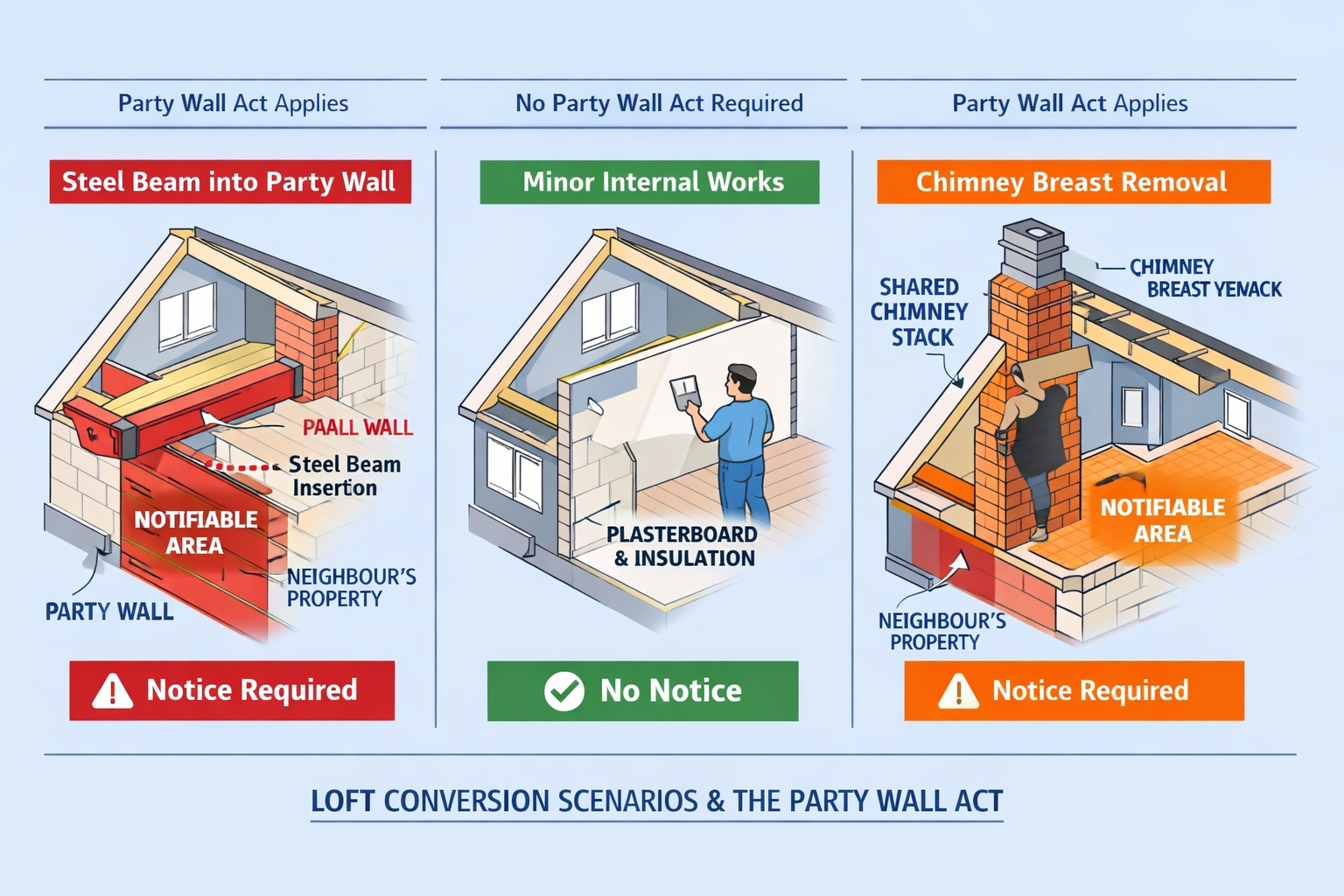
Loft conversions frequently involve several categories of work that fall squarely within the Act’s scope:
🔨 Steel Beam Insertions into Party Walls
When loft conversions require structural support, builders commonly insert steel beams into the shared party wall between semi-detached or terraced properties. This work constitutes cutting into or otherwise altering the party wall structure, triggering mandatory notice requirements under Section 2 of the Act.[2] The beam insertion creates a permanent alteration to the shared structure and requires formal agreement through the party wall process.
📏 Raising or Extending Party Walls
Many loft conversions involve raising the height of an existing party wall to accommodate increased headroom or to support a new roof structure. Any work that increases the height of a party wall—even by modest amounts—requires a party wall notice served under Section 2(2)(a) of the Act.[2] This includes building up the wall to create a parapet or to support dormer structures that extend above the original roofline.
🏗️ Cutting into Walls for Structural Support
Dormer loft conversions typically require floor joists to be inserted into or bear upon the party wall. This cutting or corbelling work—where timber or steel joists are embedded into the shared wall structure—triggers notice requirements.[2] The work physically alters the party wall’s integrity and load-bearing characteristics, bringing it within the Act’s regulatory scope.
🧱 Chimney Breast Removal Affecting Shared Stacks
Older properties often feature chimney breasts that pass through loft spaces, and homeowners frequently wish to remove these to maximize usable floor area. When a chimney breast forms part of a shared stack serving both properties, its removal requires party wall procedures.[2] The work affects the structural stability of the shared chimney structure and may impact the neighbour’s retained portions.
⛏️ Excavation Work Near Foundations
While less common in pure loft conversions, some projects involve underpinning or foundation work to support increased loads. The Act requires notices for excavation within three meters of a neighbour’s structure if the work will go deeper than the neighbour’s foundations, or within six meters if the excavation will cut a line drawn downward at 45 degrees from the bottom of the neighbour’s foundations.[2]
Work That Does NOT Require Party Wall Notices
Understanding what falls outside the Act’s scope helps homeowners avoid unnecessary procedures and costs:
- Minor internal alterations: Plastering, painting, or decorating work on party walls requires no notice[4]
- Electrical installations: Running cables or installing sockets on party walls (without cutting into the structure) needs no agreement[4]
- Non-structural drilling: Fixing kitchen units, shelving, or pictures to party walls with standard fixings does not trigger notice requirements[4]
- Roof light installations: Simple Velux-style roof windows that don’t involve structural alterations to party walls typically fall outside the Act’s scope
- Insulation and boarding: Adding insulation or plasterboard to the loft space without cutting into or loading party walls requires no formal notice
The critical distinction lies in whether the work physically alters, loads, or cuts into the party wall structure itself. Cosmetic or non-structural work remains outside the Act’s regulatory framework.
Geographic and Temporal Scope
The Party Wall etc. Act 1996 became effective on July 1, 1997, and applies to all qualifying work commenced after that date within England and Wales.[4] Properties in Scotland operate under different common law principles, while Northern Ireland has its own distinct legal framework for party wall matters.
For detailed information about types of party wall works covered by the Act, homeowners should consult with qualified party wall surveyors early in the planning process.
Common Errors in Party Wall Notices for Loft Conversions: Pitfalls That Derail Projects
The majority of party wall disputes and delays stem not from substantive disagreements about proposed work, but from procedural failures in the notice process itself. Understanding these common errors enables homeowners to avoid costly mistakes that can halt construction and damage neighbour relations.
Critical Timing Failures
⏰ Late Service of Notices
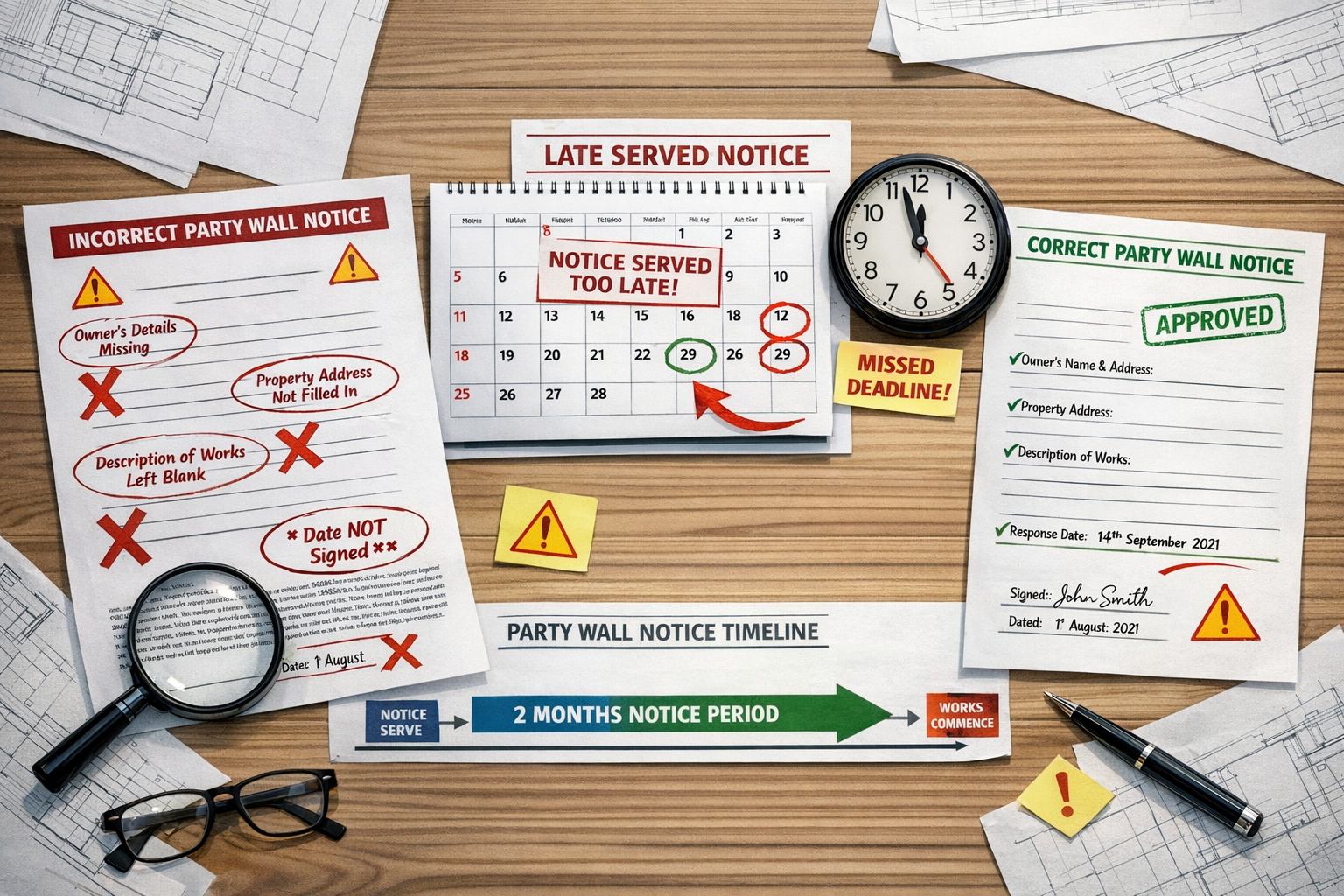
The Act requires a minimum two-month notice period before structural work begins.[1][3] This timeline is mandatory, not discretionary. Homeowners who serve notices with insufficient lead time—or worse, after builders have already mobilized—face several serious consequences:
- Neighbours can refuse consent and insist on the full statutory notice period
- Work must be postponed until proper notice periods expire
- Builder mobilization costs may be wasted as crews stand down
- Project financing timelines can be disrupted by unexpected delays
Problems commonly arise when homeowners assume planning permission approval or building control notification satisfies party wall requirements—these are entirely separate legal obligations.[3]
📅 Starting Work Before Agreement
Perhaps the most serious error involves commencing notifiable work before reaching agreement with neighbours. The Act explicitly prohibits starting any covered work before either:
- The neighbour provides written consent to the proposed work, or
- A Party Wall Award has been prepared and served by appointed surveyors[4]
Starting work prematurely exposes homeowners to significant legal risks. Neighbours can seek court injunctions to immediately stop the work, and courts take a particularly dim view of such procedural violations.[1] In some cases, courts have ordered building owners to pay for repairs to neighbouring properties that may not actually have been caused by their work—simply because the absence of a proper Schedule of Condition makes causation impossible to establish.[5]
Content and Accuracy Errors
📋 Incomplete or Incorrect Notice Information
Party wall notices must contain specific information prescribed by the Act. Common content errors include:
- Vague work descriptions: Notices stating simply “loft conversion” without detailing specific structural interventions (beam insertions, wall raising, joist cutting) lack sufficient detail
- Missing technical specifications: Failure to specify beam sizes, insertion depths, or extent of wall cutting prevents neighbours from properly assessing impact
- Incorrect property descriptions: Wrong addresses, missing flat numbers, or unclear property boundaries create confusion about which properties are affected
- Omitted commencement dates: Notices must state when work will begin—vague statements like “soon” or “when convenient” fail to satisfy statutory requirements
🏠 Failure to Identify All Affected Neighbours
In terraced properties or blocks of flats, loft conversions may affect multiple adjoining owners. Common errors include:
- Serving notice only on the immediately adjacent property while overlooking other affected neighbours
- Failing to identify and serve notices on landlords when neighbouring properties are tenanted
- Overlooking properties that share chimney stacks or roof structures even if they don’t share a direct party wall
- Missing freeholders or management companies in leasehold properties
Each affected adjoining owner must receive proper notice—failure to serve all relevant parties creates legal vulnerabilities.[3]
Surveyor Appointment and Award Errors
👷 Incorrect Surveyor Selection Process
When neighbours dissent from proposed work (or fail to respond within 14 days), the dispute resolution mechanism requires surveyor appointment. Common errors include:
- Unilateral surveyor appointment: Building owners cannot simply appoint a surveyor to act for both parties without the neighbour’s explicit agreement to that arrangement
- Lack of independence: Appointing the building owner’s architect or builder as “surveyor” violates the requirement for independent professional judgment
- Failure to follow statutory timelines: The Act prescribes specific timeframes for surveyor appointments and counter-appointments that must be observed
When disputes arise, homeowners can choose between two approaches:
- Agreed Surveyor: A single surveyor acts impartially for both parties—typically faster and less expensive[2]
- Two Surveyors: Each party appoints their own surveyor, who together appoint a Third Surveyor to resolve any disagreements—more formal but sometimes necessary for complex situations[2]
Understanding how to keep party wall costs down often involves selecting the appropriate surveyor arrangement for the specific circumstances.
📄 Deficient Award Documentation
Even when surveyors are properly appointed, Awards sometimes contain critical deficiencies:
- Missing Schedule of Condition: Failure to document the neighbouring property’s pre-work condition makes it impossible to establish causation for any subsequent damage
- Vague work descriptions: Awards must specify exactly what work is permitted—general statements create ambiguity
- Inadequate protective measures: Awards should detail specific protections (dust barriers, vibration monitoring, structural propping) appropriate to the work scope
- Unclear access provisions: Failure to specify access rights, timing, and procedures creates conflict during construction
Service and Response Errors
📮 Improper Notice Service Methods
The Act requires notices to be served properly—typically by hand delivery, recorded delivery post, or through a process server. Common service errors include:
- Sending notices by standard post without proof of delivery
- Emailing notices without the neighbour’s explicit agreement to electronic service
- Leaving notices with occupiers who are not the legal owners
- Failing to retain proof of service documentation
⏳ Misunderstanding Response Timeframes
Neighbours have 14 days from receipt of notice to respond with either consent or dissent.[2] Building owners sometimes misinterpret silence:
- Assuming no response means consent (it doesn’t—silence triggers the dispute resolution process)
- Pressuring neighbours for immediate responses before the statutory period expires
- Failing to recognize that a request for additional information or clarification constitutes engagement, not consent
For homeowners navigating these complexities in specific areas, consulting party wall surveyors in Central London or other local specialists ensures compliance with both statutory requirements and local practice conventions.
Party Wall Award Essentials for Loft Conversions: What Must Be Documented
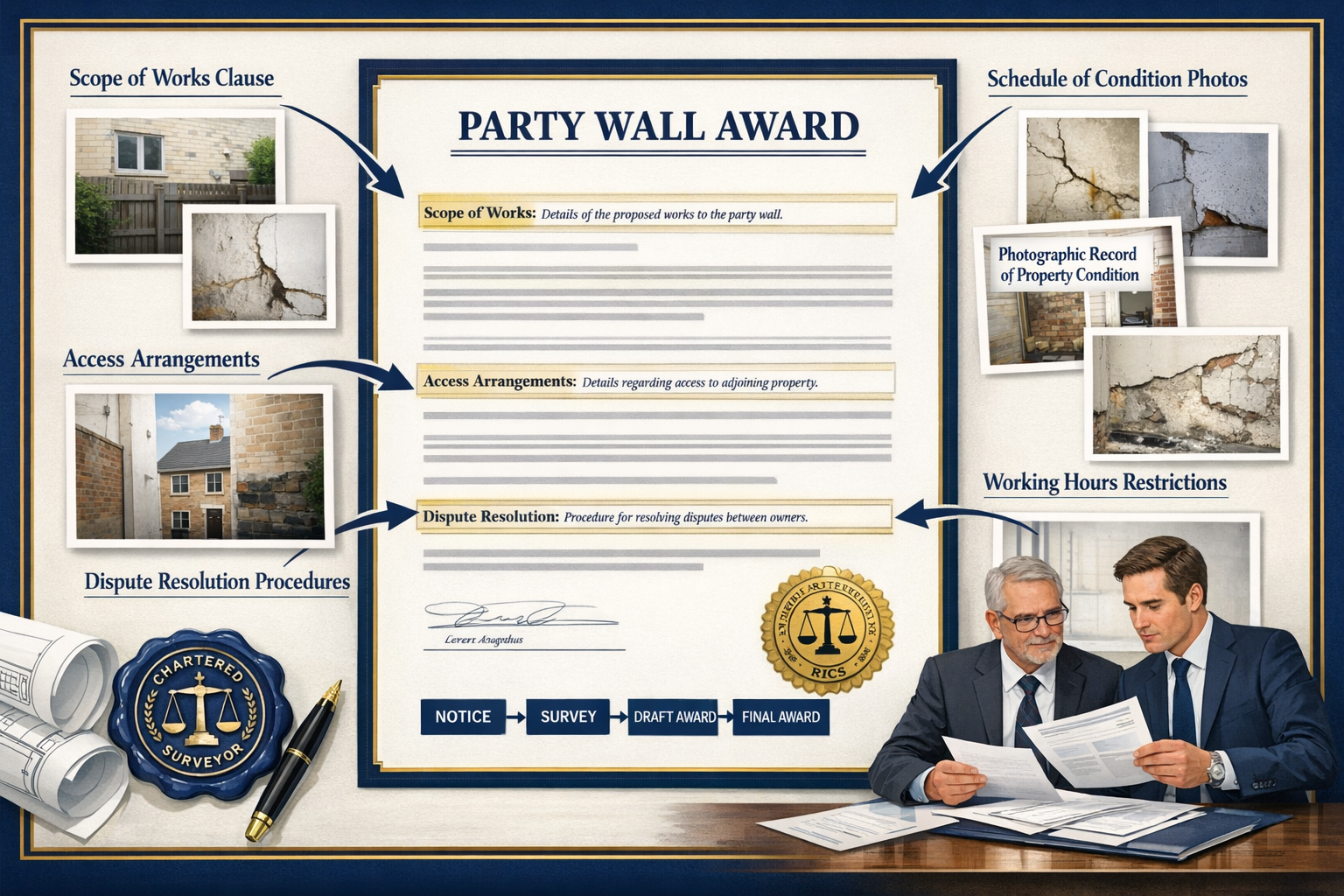
A Party Wall Award represents the formal legal document that authorizes notifiable work to proceed while protecting the interests of all parties. Understanding what must be included in a compliant Award—and why each element matters—helps homeowners ensure their loft conversion proceeds smoothly and legally.
Core Components of a Valid Party Wall Award
1. Comprehensive Work Scope Description
The Award must specify exactly what work is authorized, including:
- Precise structural interventions: Detailed descriptions of beam insertions (sizes, materials, insertion depths), wall raising (heights, materials, construction methods), and joist cutting (locations, sizes, support methods)[1]
- Work methodology: How the work will be executed, including sequence of operations and construction techniques
- Materials specifications: Types of steel, timber, concrete, or other materials to be used in the party wall work
- Drawings and plans: Reference to and incorporation of relevant architectural and structural drawings showing the work in detail
Vague descriptions create ambiguity about what is permitted and may require Award amendments if actual work differs from what was authorized.
2. Schedule of Condition
Perhaps the most critical protective element for both parties, the Schedule of Condition documents the neighbouring property’s state before work commences.[4] This detailed record typically includes:
- Photographic evidence: Comprehensive photographs of all rooms, focusing on walls, ceilings, floors, and external elevations adjacent to the building owner’s property
- Written descriptions: Detailed notes documenting existing cracks, settlement, decoration condition, and any pre-existing defects
- Measurement records: Crack width measurements, out-of-plumb measurements, and other quantifiable condition indicators
- Date and authentication: Dated records prepared by the appointed surveyor(s) and agreed by both parties
Without a proper Schedule of Condition, determining whether post-work damage was caused by the construction or existed previously becomes virtually impossible.[4] This creates significant risks for both building owners (who may be blamed for pre-existing damage) and adjoining owners (who may struggle to prove construction caused new damage).
Professional schedule of condition services ensure this documentation meets legal standards and provides effective protection.
3. Protective Measures and Working Methods
Awards must specify measures to minimize risk and inconvenience to adjoining owners:
- Structural protection: Requirements for propping, shoring, or temporary support of party walls during work
- Dust and debris control: Barriers, sheeting, or other measures to prevent migration of construction dust
- Vibration limits: Restrictions on vibration-generating activities or requirements for vibration monitoring
- Noise management: Limitations on particularly noisy operations and their timing
- Weather protection: Temporary coverings or protection for exposed party walls during construction
These provisions balance the building owner’s right to undertake permitted work with the adjoining owner’s right to protection from unnecessary damage or nuisance.
4. Access Rights and Arrangements
The Award should clearly establish:
- Access extent: What areas of the adjoining owner’s property may be accessed and for what purposes
- Access timing: Permitted hours for access (typically aligning with normal construction hours)
- Notice requirements: How much advance notice must be given before accessing adjoining property
- Supervision provisions: Whether access must be supervised by the adjoining owner or their representative
- Making good: Responsibility for reinstating any disturbance caused by access (temporary fixings, floor protection, etc.)
Clear access provisions prevent disputes during construction when time pressures and practical needs can create friction.
5. Working Hours and Timing Restrictions
To minimize disruption, Awards typically specify:
- Permitted working hours: Standard construction hours (commonly 8:00 AM to 6:00 PM weekdays, 8:00 AM to 1:00 PM Saturdays)
- Prohibited days: No work on Sundays or public holidays (unless exceptional circumstances require otherwise)
- Restricted operations: Particularly noisy or disruptive activities may be limited to specific time windows
- Completion timeline: Expected duration of work affecting the party wall
These provisions help adjoining owners plan around construction disruption while giving building owners reasonable timeframes for completion.
6. Dispute Resolution Procedures
Awards should establish clear mechanisms for addressing issues that arise during construction:
- Surveyor inspection rights: Provisions for surveyors to inspect work in progress to ensure compliance with the Award
- Complaint procedures: How adjoining owners should raise concerns about work methods, hours, or damage
- Variation procedures: Process for agreeing changes to the authorized work scope if site conditions require modifications
- Damage resolution: Procedures for assessing, agreeing, and remedying any damage caused by the works
Having these procedures in place before work begins prevents small issues from escalating into major disputes.
Standard Award Timeline and Process
Understanding the typical timeline helps homeowners plan effectively:
| Stage | Timeline | Key Activities |
|---|---|---|
| Notice Service | Day 0 | Building owner serves formal party wall notice on neighbour(s) |
| Response Period | Days 1-14 | Neighbour reviews notice and responds with consent or dissent |
| Surveyor Appointment | Days 15-30 | If disputed, surveyors are appointed by both parties |
| Property Inspection | Days 30-45 | Surveyors inspect properties and prepare Schedule of Condition |
| Award Preparation | Days 45-60 | Surveyors draft Award detailing work scope, protections, and procedures |
| Award Service | Day 60+ | Completed Award is served on both parties, authorizing work to proceed |
This timeline assumes straightforward cases—complex situations involving multiple neighbours, difficult access, or contentious issues may extend the process.[2]
Professional Surveyor Costs and Fee Responsibility
Party wall surveyor fees typically range between £1,000 and £1,500 + VAT, depending on project complexity, property location, and whether an Agreed Surveyor or Two Surveyors approach is used.[2] Important cost principles include:
- Building owner pays: The building owner undertaking the work is responsible for all reasonable surveyor fees, including both their own surveyor’s fees and the adjoining owner’s surveyor’s fees[2]
- Reasonableness standard: Fees must be reasonable and proportionate to the work involved—surveyors cannot charge excessive amounts
- Disbursements: Additional costs for Schedule of Condition photography, specialist reports, or Third Surveyor fees are typically recoverable
Understanding costs of the party wall process helps homeowners budget accurately for loft conversion projects.
When to Engage Party Wall Professionals
Early engagement proves critical for smooth project execution. Best practice involves contacting party wall surveyors:
- During planning stage: Once architectural drawings are substantially complete but before submitting planning applications[1]
- Before builder selection: Ensuring party wall timelines are factored into builder scheduling and contracts
- Minimum two months before work: Allowing sufficient time for the full notice and Award process to complete before the planned construction start date[1]
Late engagement often results in rushed processes, stressed neighbour relations, and construction delays when builders arrive on site only to discover party wall procedures remain incomplete.
For homeowners undertaking loft conversions, understanding the Party Wall etc. Act 1996 framework and engaging qualified professionals early ensures legal compliance, protects property interests, and maintains positive neighbour relations throughout the construction process.
Conclusion
Party Wall Notices for Loft Conversions: Legal Triggers, Common Errors, and Award Essentials represent critical knowledge for any homeowner planning to convert unused roof space into valuable living area. The Party Wall etc. Act 1996 establishes mandatory procedures when structural work affects shared walls—and loft conversions frequently involve precisely the types of interventions that trigger these legal obligations.
The key takeaways for successful navigation of party wall requirements include:
✅ Recognize structural triggers early: Steel beam insertions, party wall raising, joist cutting, and chimney breast removal all require formal notices served at least two months before work begins
✅ Avoid common procedural errors: Late notices, incomplete work descriptions, failure to identify all affected neighbours, and starting work before agreement represent the most frequent mistakes that derail projects
✅ Ensure comprehensive Award documentation: Valid Awards must include detailed work scope, Schedule of Condition, protective measures, access arrangements, and dispute resolution procedures
✅ Engage professionals at the planning stage: Involving qualified party wall surveyors once architectural drawings are complete—and before builders mobilize—prevents costly delays and legal complications
Actionable Next Steps
For homeowners planning loft conversions:
- Review architectural plans to identify any structural work affecting party walls—consult with your architect or structural engineer about party wall implications
- Contact a qualified party wall surveyor early in the planning process to assess notice requirements and timeline implications
- Serve notices promptly once work scope is defined, allowing the full statutory two-month minimum period before planned construction start
- Communicate proactively with neighbours about planned work, explaining the party wall process and your commitment to protecting their property
- Budget appropriately for surveyor fees (typically £1,000-£1,500 + VAT) as part of overall project costs
- Document everything throughout the process—retain copies of all notices, correspondence, and agreements
For neighbours who have received party wall notices regarding loft conversions, understanding your rights and the proper response procedures protects your property interests. Consider reviewing guidance for adjoining owners to understand your options and obligations.
The party wall process, while sometimes perceived as bureaucratic, serves essential protective functions for both building owners and their neighbours. Proper compliance ensures loft conversion projects proceed smoothly, legally, and with minimal risk of disputes or damage claims. By understanding legal triggers, avoiding common errors, and ensuring comprehensive Award documentation, homeowners can successfully navigate party wall requirements and enjoy the benefits of expanded living space without compromising neighbour relations or legal standing.
References
[1] Party Wall Surveyor Loft Conversion – biggerlivinglofts.com
[2] Do You Need A Party Wall Agreement For Loft Conversion – houricanassociates.com
[3] Party Wall Agreements A Guide For Homeowners Planning Extensions – hfwjsurveyors.com
[4] Party Wall Agreement – hoa.org.uk
[5] Party Wall Agreements What You Need To Know – fmb.org.uk
Speak to a RICS chartered party wall surveyor
Free initial consultation. Notices, awards and schedules of condition across London and nationwide.