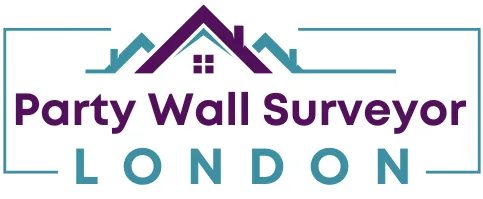
Nearly 40% of party wall notices served in London receive a dissent response, yet most property owners remain unprepared for what follows this rejection. The moment a neighbour refuses consent, a legally binding timeline activates—one that demands swift action, precise documentation, and strategic decision-making within compressed deadlines.
Understanding what happens after a party wall notice rejection: from counter-notice to award in 14 days is essential for building owners planning construction work in 2026. With property development projects facing unprecedented demand and tighter schedules, delays in the party wall process can cost thousands in contractor standby fees and project overruns. This comprehensive guide walks through every stage of the rejection process, from the initial dissent to the final award, ensuring projects stay on track.
Key Takeaways
- ⏰ Adjoining owners have exactly 14 days from receiving a party wall notice to respond with consent or dissent—silence automatically counts as rejection
- 📋 Counter-notices must outline specific concerns and can request modifications or additional safeguards within the initial response period
- 👷 Surveyor appointments trigger a 3-6 week award process that includes property inspections, documentation, and legal agreement preparation
- ⚖️ Party wall awards are legally binding documents that protect both parties and include a 14-day appeal window after issuance
- 💰 Strategic planning prevents costly delays by understanding the full timeline from notice rejection to construction commencement
Understanding the 14-Day Response Window and Automatic Dissent
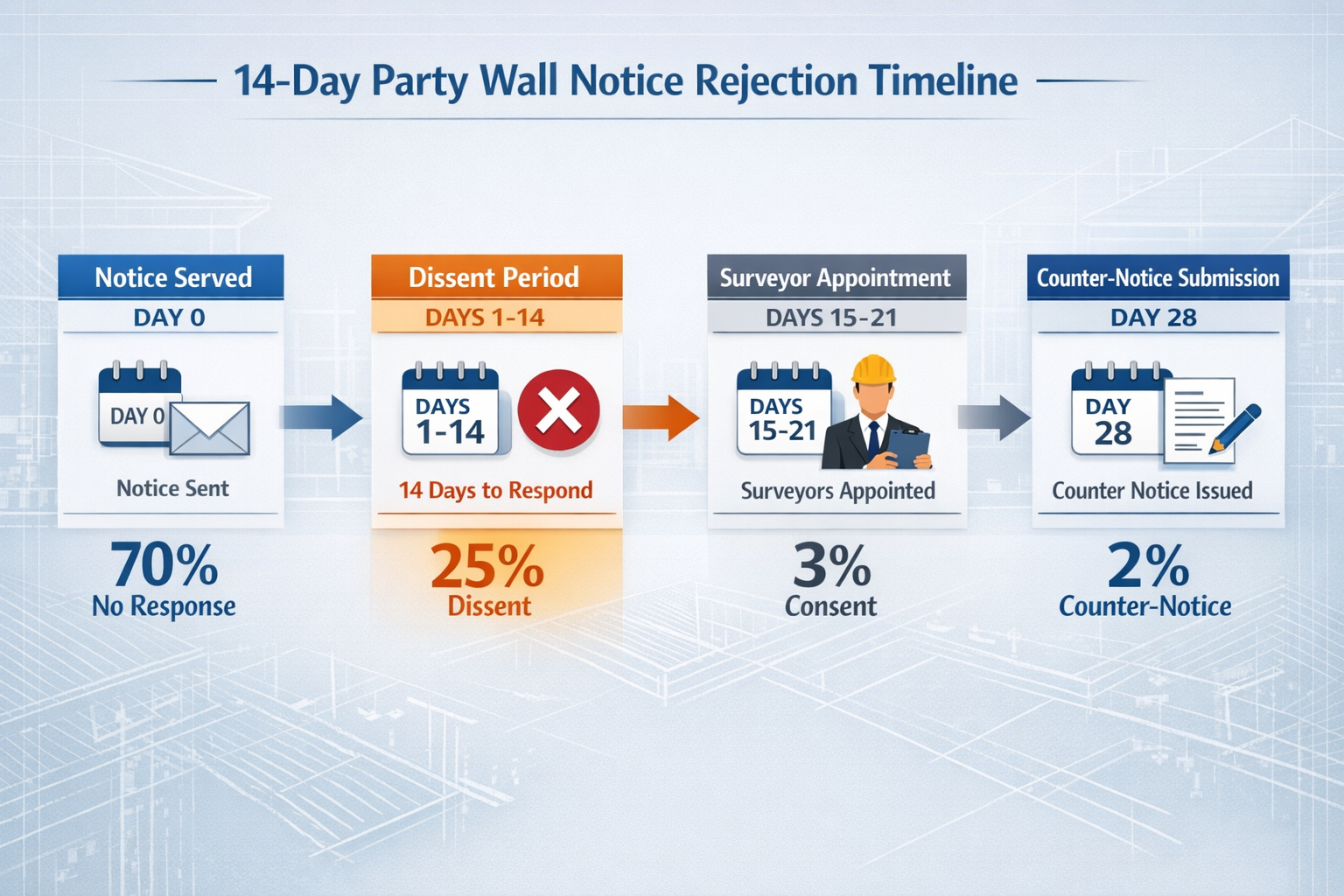
When a building owner serves a party wall notice, the adjoining owner faces a critical decision point. The 14-day response period is mandatory and non-negotiable[3]. From the moment the notice is received, the clock starts ticking, and the adjoining owner must choose one of three paths:
- Consent to the works (allowing construction to proceed as planned)
- Dissent to the works (triggering the formal dispute resolution process)
- Remain silent (which legally counts as dissent)
What Constitutes a Valid Dissent Response
Adjoining owners do not need to provide reasons for their dissent[3]. A simple written statement refusing consent is sufficient to activate the party wall dispute resolution mechanism. However, strategic adjoining owners often use this opportunity to outline concerns that will later inform the surveyor’s work.
Common reasons for dissent include:
- ✅ Concerns about structural damage to the adjoining property
- ✅ Worries about noise, dust, and disruption during construction
- ✅ Insufficient detail in the original notice
- ✅ Desire for additional protective measures
- ✅ Request for simultaneous repairs or improvements
The Automatic Dissent Rule Explained
One of the most misunderstood aspects of the Party Wall Act is the automatic dissent provision. If an adjoining owner fails to respond within the 14-day window, their silence is automatically treated as dissent[2]. This rule prevents building owners from claiming implied consent and ensures proper dispute resolution procedures are followed.
This automatic dissent mechanism protects adjoining owners who may not fully understand their rights or who miss the deadline due to circumstances beyond their control. However, it also means building owners cannot proceed with work simply because they received no response—the formal surveyor appointment process must still occur.
Expert Tip: Building owners should always plan for potential dissent when scheduling projects. The two-month advance notice requirement exists specifically to accommodate the counter-notice and award process[7].
What Happens After a Party Wall Notice Rejection: The Counter-Notice Process
Once dissent has been registered, the process moves into the counter-notice phase. This stage allows the adjoining owner to formally communicate their concerns and propose modifications to the planned works.
Timing Requirements for Counter-Notices
Formal counter-notices should be served within 14 days of the initial dissent[1]. This timeline ensures the dispute resolution process moves forward efficiently while giving the adjoining owner adequate time to review the proposed works and formulate a detailed response.
For more complex situations where the adjoining owner wishes to request modifications or additional works, a 30-day window applies[4]. This extended timeline allows for:
- Consultation with professional advisors
- Preparation of detailed technical specifications
- Cost estimates for requested modifications
- Coordination with the building owner’s plans
What to Include in a Counter-Notice
A well-drafted counter-notice serves multiple purposes. It documents specific concerns, proposes solutions, and establishes a foundation for the surveyor’s work. Essential elements include:
🔍 Detailed Concerns:
- Specific structural elements at risk
- Potential damage mechanisms
- Historical issues with the shared wall
- Existing defects that could worsen
📝 Proposed Modifications:
- Alternative construction methods
- Enhanced protective measures
- Modified work schedules
- Additional monitoring requirements
💼 Requests for Additional Works:
Adjoining owners can request that additional works be carried out simultaneously, but they must pay for these if they benefit from the work[5]. Common requests include:
| Additional Work Type | Who Pays | Typical Cost Impact |
|---|---|---|
| Repairs to shared wall | Shared equally | £500-£2,000 |
| Improvements benefiting adjoining owner only | Adjoining owner | £1,000-£5,000 |
| Enhanced soundproofing | Negotiable | £800-£3,000 |
| Structural reinforcement | Building owner | Included in project |
Understanding what party structure notices cover helps adjoining owners identify legitimate concerns versus requests that fall outside the Act’s scope.
Strategic Considerations for Counter-Notices
In 2026’s competitive construction environment, strategic counter-notices can facilitate cooperation rather than conflict. Adjoining owners should:
- Focus on legitimate concerns rather than attempting to block works entirely
- Propose practical solutions that protect their property without unreasonably delaying the project
- Request comprehensive documentation including schedules of condition
- Establish communication protocols for the construction period
- Consider long-term relationship with the neighbouring property owner
Building owners who receive well-reasoned counter-notices often find that addressing concerns proactively leads to smoother project execution and better neighbour relations.
Appointing Surveyors: The Critical Next Step After Rejection
Once dissent has been registered and counter-notices exchanged, the formal dispute resolution process begins with surveyor appointments. This stage is crucial for what happens after a party wall notice rejection: from counter-notice to award in 14 days.
Three Surveyor Appointment Options
The Party Wall Act provides three distinct mechanisms for surveyor appointment[2]:
Option 1: The Agreed Surveyor Approach ⭐
Both parties jointly appoint a single “agreed surveyor” who acts impartially to prepare the award. This approach offers several advantages:
- ✅ Lower overall costs (single surveyor fee)
- ✅ Faster award preparation
- ✅ Simplified communication
- ✅ Reduced administrative burden
Option 2: Two Surveyors Plus Third Surveyor
Each party appoints their own surveyor, with a third surveyor available if the two cannot agree:
- ✅ Independent representation for each party
- ✅ Checks and balances in the process
- ✅ Specialized expertise for complex works
- ✅ Higher confidence in impartiality
Option 3: Building Owner’s Surveyor Makes the Award
If the adjoining owner fails to appoint a surveyor within 10 days of being requested, the building owner’s surveyor can proceed alone after following proper notification procedures.
Selecting the Right Surveyor for Your Situation
Choosing an appropriate surveyor significantly impacts the award quality and timeline. Key selection criteria include:
🎯 Relevant Experience:
- Familiarity with similar work types
- Knowledge of local building practices
- Understanding of different types of party wall works
- Track record with timely award preparation
📍 Geographic Expertise:
Location matters in party wall work. A party wall surveyor in Central London brings different insights than one specializing in suburban areas. Consider surveyors with specific expertise in your area, whether that’s East London, West London, North London, or South London.
💰 Fee Structure Transparency:
Understanding costs of the party wall process upfront prevents disputes later. Reputable surveyors provide clear fee schedules covering:
- Initial appointment and consultation
- Property inspection and documentation
- Award preparation and issuance
- Post-award monitoring (if required)
- Dispute resolution (if needed)
The Surveyor’s Role in Dispute Resolution
Once appointed, surveyors have specific duties under the Act:
- Inspect both properties to understand existing conditions
- Review the proposed works in detail
- Assess potential impacts on the adjoining property
- Negotiate protective measures between parties
- Prepare the party wall award documenting agreements
- Resolve technical disputes between parties
Professional surveyors understand that their role is to facilitate agreement, not to advocate exclusively for one party. Even when appointed by a specific party, they must act fairly and in accordance with the Act’s requirements.
The Property Inspection and Documentation Phase
Following surveyor appointment, the inspection and documentation phase begins. This critical stage establishes the baseline condition of both properties and informs the protective measures included in the award.
Schedule of Condition: Your Protection Against Future Claims
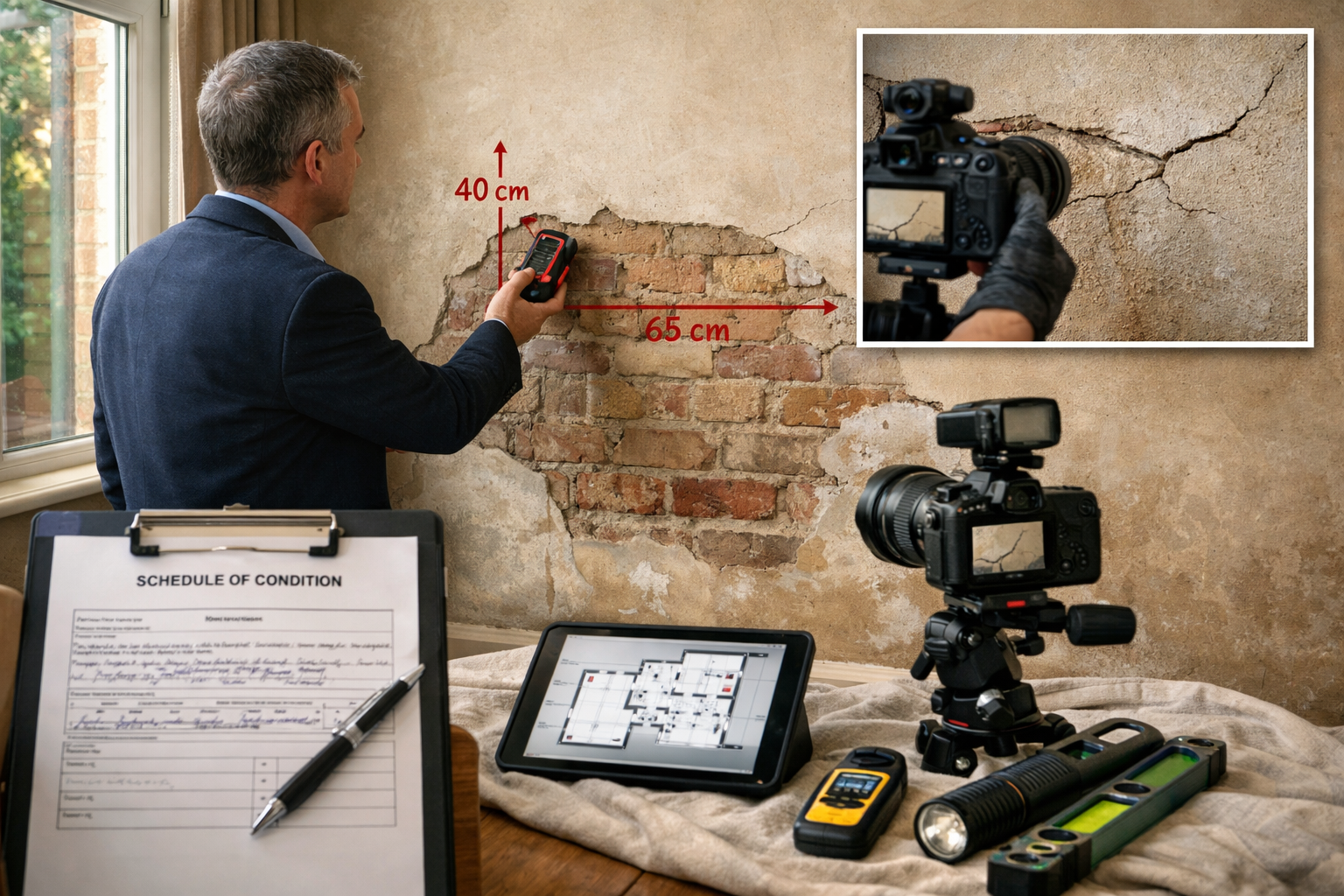
The schedule of condition represents one of the most valuable protections for both parties. This comprehensive document includes:
- 📸 Detailed photographs of all relevant areas
- 📏 Precise measurements of existing features
- 📋 Written descriptions of current property condition
- 🔍 Documentation of existing defects or damage
- 🗺️ Floor plans showing room layouts and wall locations
Creating a thorough schedule of condition typically requires 2-4 hours of on-site work, depending on property size and complexity. The surveyor will assess the works, record the current state of the property, and take photographs and measurements to support any future compensation claims[4].
What Surveyors Look for During Inspections
Professional surveyors conduct systematic inspections covering:
Structural Elements:
- Condition of the party wall itself
- Load-bearing walls and supports
- Foundation conditions (where accessible)
- Ceiling and floor structures
- Existing cracks or settlement
Finishes and Fixtures:
- Plasterwork and decorative finishes
- Fitted furniture and fixtures
- Floor coverings and conditions
- Window and door frames
- Utility installations
External Features:
- Boundary walls and fences
- Drainage systems
- External finishes
- Garden features affected by works
Timeline for Inspection and Documentation
The inspection phase typically follows this schedule:
| Stage | Timeline | Key Activities |
|---|---|---|
| Initial surveyor appointment | Days 1-3 | Formal acceptance of appointment |
| Inspection scheduling | Days 4-7 | Coordinating access with both parties |
| Property inspections | Days 8-14 | On-site documentation and photography |
| Report preparation | Days 15-21 | Compiling findings and recommendations |
| Award drafting | Days 22-35 | Preparing formal agreement document |
Understanding party wall awards and their contents helps both parties appreciate the thoroughness required during this phase.
Access Rights and Obligations
During the inspection phase, specific access rights apply:
For Surveyors:
- Right to access both properties at reasonable times
- Authority to inspect relevant areas
- Ability to take measurements and photographs
- Right to request documentation (deeds, previous surveys)
For Property Owners:
- Obligation to provide reasonable access
- Right to be present during inspections
- Ability to point out concerns or issues
- Right to receive copies of documentation
Cooperation during this phase significantly accelerates the overall timeline. Property owners who facilitate prompt access help ensure the award can be prepared within the target timeframe.
Preparing and Issuing the Party Wall Award
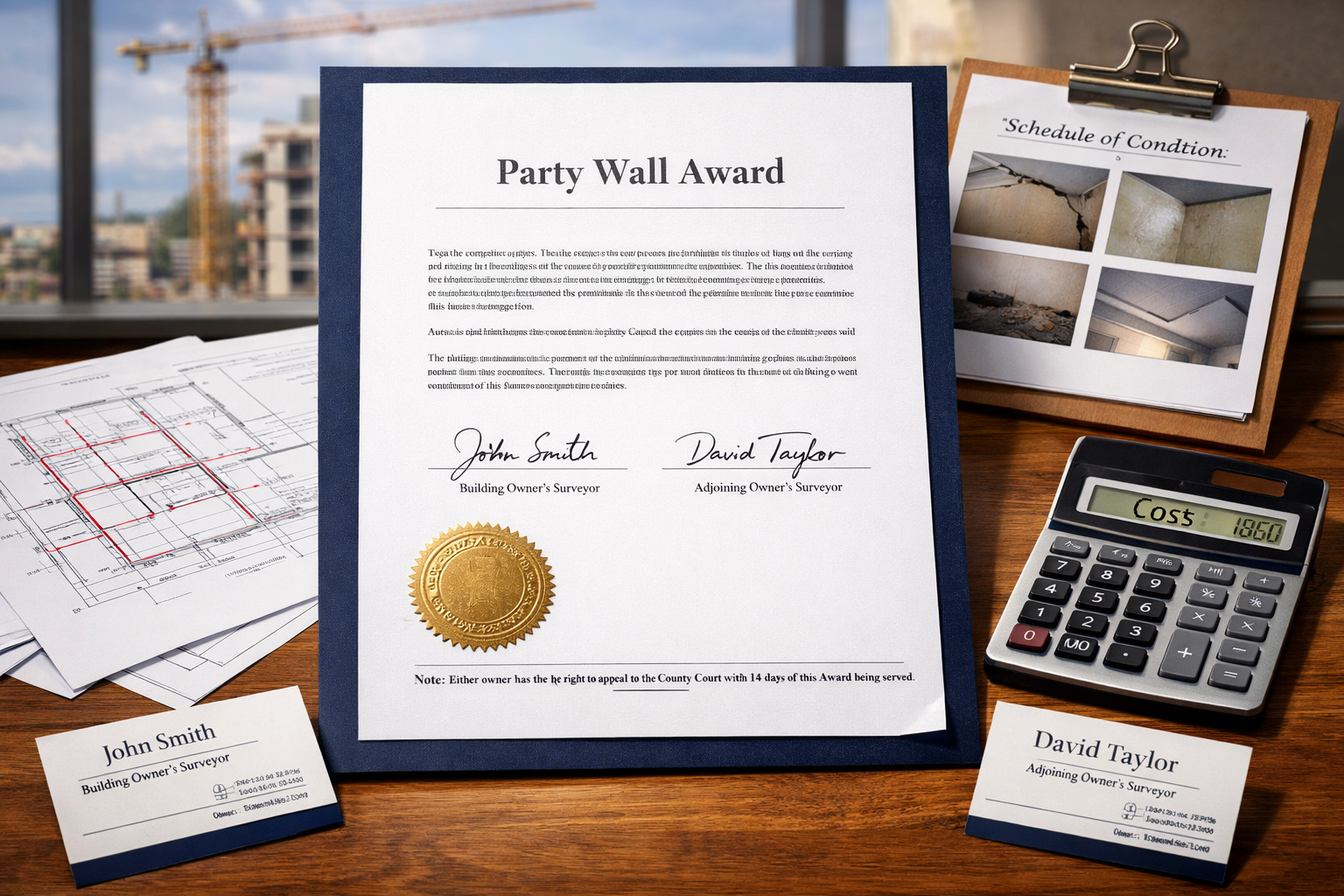
The culmination of the dispute resolution process is the party wall award—a legally binding document that governs how the works will proceed. Understanding what happens after a party wall notice rejection: from counter-notice to award in 14 days requires grasping the award’s critical role.
Standard Timeline for Award Preparation
Party wall award preparation typically takes 3-6 weeks minimum once surveyors are appointed[7]. In straightforward cases with cooperative parties, awards can be prepared toward the lower end of this range. Complex projects or delayed information can extend the timeline to 8 weeks or more.
The preparation timeline includes:
- Week 1-2: Property inspections and schedule of condition preparation
- Week 3-4: Technical review of proposed works and protective measures
- Week 5: Draft award preparation and internal review
- Week 6: Final award preparation and issuance
Essential Components of a Party Wall Award
A comprehensive party wall award must include specific elements mandated by the Act:
📄 Formal Identification:
- Names and addresses of both parties
- Property addresses and descriptions
- Details of appointed surveyor(s)
- Date of award issuance
🏗️ Works Description:
- Detailed specification of permitted works
- Construction methods and techniques
- Timeline and working hours
- Access requirements
🛡️ Protective Measures:
- Structural protection requirements
- Monitoring provisions
- Damage prevention measures
- Noise and dust control obligations
💰 Financial Provisions:
- Cost allocation for surveyor fees
- Responsibility for repair costs
- Security for expenses (if required)
- Payment terms and conditions
📅 Timing and Conditions:
- Permitted work commencement date
- Completion expectations
- Notice requirements for variations
- Inspection schedules
The Award as a Binding Legal Document
Once issued, the party wall award becomes enforceable under law[2]. This legal status provides several protections:
✅ Clarity and certainty about permitted works
✅ Defined responsibilities for both parties
✅ Dispute resolution mechanism for disagreements
✅ Legal recourse if terms are breached
✅ Protection against future claims when terms are followed
Building owners should treat the award as a construction constraint similar to planning permission or building regulations. Deviating from award terms can result in:
- Injunctions stopping work
- Compensation claims for damages
- Additional surveyor fees for variations
- Legal costs for enforcement actions
Variations and Amendments to Awards
Construction projects sometimes require modifications after the award is issued. The process for variations depends on their significance:
Minor Variations:
- Changes to working hours or access times
- Adjustments to construction methods that don’t affect outcomes
- Schedule modifications due to weather or materials
These can often be agreed informally between parties or with surveyor approval.
Major Variations:
- Significant changes to work scope
- Different construction techniques affecting the party wall
- Additional works not covered in the original notice
These require formal amendment to the award, potentially involving a new notice and agreement process.
The 14-Day Appeal Window and What Comes Next
After the award is issued, both parties enter a critical 14-day period during which they can challenge the award’s terms.
Understanding Your Right to Appeal
Both parties have exactly 14 days after the award is served to file an appeal in county court[6]. This appeal window provides a final safeguard against awards that either party considers unfair or inappropriate.
Grounds for appeal typically include:
- ❌ Procedural errors in the award process
- ❌ Surveyor exceeded their authority
- ❌ Award terms are unreasonable or unworkable
- ❌ Relevant factors were not considered
- ❌ Technical errors in the award document
The Appeal Process Explained
Filing an appeal requires submitting an appellant’s notice to the county court explaining the grounds for appeal[6]. The process involves:
- Prepare appellant’s notice with detailed grounds
- File with county court within 14-day deadline
- Serve notice on other party and surveyor(s)
- Attend preliminary hearing for case management
- Present evidence and arguments at full hearing
- Receive court judgment affirming, varying, or setting aside the award
Important considerations:
- 💰 Appeals involve additional legal costs (£2,000-£10,000+)
- ⏱️ Appeals delay project commencement by 2-6 months
- ⚖️ Courts generally defer to surveyor expertise unless clear errors exist
- 📋 Burden of proof rests with the appellant
When the Appeal Period Expires Without Challenge
If neither party appeals within the 14-day window, the award becomes final and binding. At this point:
✅ Works can commence in accordance with award terms
✅ Schedule of condition is locked in as the baseline for damage assessment
✅ Financial obligations are confirmed and enforceable
✅ Protective measures must be implemented as specified
Building owners should coordinate with contractors to ensure work begins promptly after the appeal period expires, maximizing the value of the time invested in the party wall process.
Post-Award Obligations and Ongoing Compliance
The award’s issuance doesn’t end the parties’ obligations. Throughout construction, both parties must:
Building Owner Responsibilities:
- 🔨 Follow award terms precisely
- 📸 Allow surveyor inspections during works
- 🔔 Notify adjoining owner of work commencement
- 🛠️ Implement all specified protective measures
- 📞 Respond promptly to concerns raised
Adjoining Owner Responsibilities:
- 🚪 Provide reasonable access for inspections
- 📋 Document any concerns immediately
- 🤝 Cooperate with monitoring arrangements
- ⚖️ Raise disputes through proper channels
For guidance on maintaining good relationships during construction, consider reviewing tips on keeping party wall costs down through cooperation and efficiency.
Practical Tips for Navigating Rejection and Accelerating the Award Process in 2026
With construction demand at record levels in 2026, minimizing delays in the party wall process delivers significant value. These practical strategies help building owners navigate rejection efficiently.
Proactive Strategies Before Serving Notice
Prevention beats cure in party wall matters. Before serving the initial notice:
- Conduct informal discussions with neighbours about planned works
- Provide preliminary information about project scope and timeline
- Address concerns proactively before formal notice is required
- Consider neighbour benefits that could be incorporated
- Establish positive communication patterns early
Building owners who invest time in pre-notice relationship building often receive consent rather than dissent, eliminating the need for the formal dispute process entirely.
Responding Strategically to Dissent
When dissent is received, avoid emotional reactions. Instead:
✅ Acknowledge the response promptly and professionally
✅ Request specific concerns if not already provided
✅ Propose direct discussion before formal surveyor appointment
✅ Consider reasonable accommodations to address concerns
✅ Document all communications for future reference
Some disputes can be resolved through direct negotiation, potentially allowing the adjoining owner to withdraw their dissent and provide consent, avoiding the surveyor appointment process.
Accelerating Surveyor Appointment and Award Preparation
Time-sensitive projects benefit from these acceleration strategies:
For Agreed Surveyor Appointments:
- Jointly research and pre-select qualified surveyors
- Agree on selection criteria before dissent is registered
- Contact preferred surveyor immediately upon dissent
- Provide all documentation promptly
For Two-Surveyor Appointments:
- Each party should identify their surveyor in advance
- Ensure both surveyors have compatible working styles
- Facilitate direct surveyor-to-surveyor communication
- Provide comprehensive project documentation immediately
During the Award Process:
- Schedule property inspections at surveyors’ earliest availability
- Provide immediate access to all requested information
- Respond to surveyor queries within 24-48 hours
- Review draft award sections promptly
Cost Management Throughout the Process
Understanding and managing costs prevents financial surprises:
| Cost Element | Typical Range | Who Pays |
|---|---|---|
| Building owner’s surveyor | £800-£2,500 | Building owner initially |
| Adjoining owner’s surveyor | £700-£2,000 | Building owner initially |
| Third surveyor (if needed) | £1,000-£3,000 | Shared or as awarded |
| Schedule of condition | £300-£800 | Building owner |
| Award preparation | Included in surveyor fees | Building owner |
Total typical cost: £2,000-£6,000 for standard residential projects.
Building owners ultimately bear most party wall costs, though these can sometimes be recovered through development value. Understanding the full party wall process costs helps with accurate project budgeting.
Common Mistakes to Avoid
❌ Starting work before the award is issued (can result in injunctions and additional costs)
❌ Failing to serve notice with adequate lead time (rushing the process increases errors)
❌ Providing incomplete information in the initial notice (leads to additional questions and delays)
❌ Appointing inexperienced surveyors to save money (often costs more through delays and errors)
❌ Ignoring the adjoining owner’s concerns (escalates disputes unnecessarily)
❌ Assuming silence means consent (legally treated as dissent)
❌ Deviating from award terms without formal variation (exposes to legal action)
When to Consider Professional Representation
While the Party Wall Act allows property owners to navigate the process independently, professional representation often proves valuable:
Consider engaging a building owner’s surveyor when:
- The proposed works are complex or extensive
- The adjoining property has significant value or historic features
- Previous disputes exist with the neighbour
- The project timeline is critical
- Multiple adjoining properties are affected
Adjoining owners benefit from an adjoining owner’s surveyor when:
- The proposed works are substantial or concerning
- The property has existing structural issues
- Professional documentation is needed for insurance
- The building owner’s approach seems aggressive
- Technical expertise is needed to evaluate proposals
Alternative Approaches: Can You Avoid the Formal Process?
Some property owners wonder about having a party wall agreement without a surveyor. While technically possible if both parties consent and prepare a written agreement, this approach carries risks:
Advantages:
- Lower costs (no surveyor fees)
- Faster process (no inspection delays)
- Simpler documentation
Disadvantages:
- No professional protection if disputes arise
- May lack technical detail needed for complex works
- Could be challenged later if issues emerge
- Insurance complications if damage occurs
For significant works, the surveyor-led process provides valuable protection that typically justifies the cost and time investment.
Conclusion
Understanding what happens after a party wall notice rejection: from counter-notice to award in 14 days empowers both building owners and adjoining owners to navigate this complex process efficiently. The journey from initial dissent to final award follows a clear legal framework designed to protect all parties while allowing necessary construction work to proceed.
The key stages recap:
1️⃣ 14-day response period following notice service (silence equals dissent)
2️⃣ Counter-notice submission outlining specific concerns and proposed modifications
3️⃣ Surveyor appointment using agreed surveyor or two-surveyor approach
4️⃣ Property inspection and documentation creating protective schedule of condition
5️⃣ Award preparation and issuance (typically 3-6 weeks from surveyor appointment)
6️⃣ 14-day appeal window providing final opportunity to challenge terms
7️⃣ Construction commencement following award terms precisely
In 2026’s competitive construction environment, delays cost money and opportunity. Building owners who understand the party wall rejection process can plan realistically, budget accurately, and maintain positive neighbour relationships throughout their projects. Adjoining owners who engage constructively with the process protect their properties while avoiding unnecessary conflict.
Actionable Next Steps
If you’re a building owner who has received dissent:
- ✅ Respond professionally and request specific concerns
- ✅ Identify and contact qualified surveyors immediately
- ✅ Prepare comprehensive project documentation
- ✅ Budget for 6-8 weeks from dissent to work commencement
- ✅ Consider whether direct negotiation could resolve concerns
If you’re an adjoining owner who has received notice:
- ✅ Respond within 14 days with clear dissent or consent
- ✅ Document specific concerns about the proposed works
- ✅ Research qualified surveyors to represent your interests
- ✅ Request a schedule of condition to protect your property
- ✅ Engage constructively to facilitate reasonable works
For both parties:
- ✅ Maintain professional, documented communication
- ✅ Understand your rights and obligations under the Act
- ✅ Consider long-term neighbour relationships
- ✅ Engage qualified professionals for complex matters
- ✅ Review relevant guidance on party wall act notices and how to respond
The party wall process exists to balance the building owner’s right to develop their property with the adjoining owner’s right to protection from damage. When both parties approach the process with good faith and professional guidance, even rejected notices lead to satisfactory outcomes that allow construction to proceed with appropriate safeguards in place.
Whether you’re carrying out works or your neighbour is carrying out works, understanding the rejection-to-award timeline ensures your interests are protected while minimizing delays and disputes.
References
[1] What To Do When Your Neighbour Refuses Your Party Wall Notice – as-structuraleng.co.uk
[2] Difference Between Party Wall Notices And Awards – partywallslimited.com
[3] Served Notice – partywall.expert
[4] What To Do If Served Party Wall Notice – fandt.com
[5] Party Wall Agreements What You Need To Know – fmb.org.uk
[6] If You Cant Agree – gov.uk
[7] When Is It Too Late To Obtain A Party Wall Award After Work Has Begun – adamjoseph.co.uk
Speak to a RICS chartered party wall surveyor
Free initial consultation. Notices, awards and schedules of condition across London and nationwide.