
Over 60% of underpinning disputes in England and Wales stem from improper notice procedures rather than the structural work itself. When foundations fail and properties require underpinning near shared boundaries, the legal complexities multiply exponentially—yet most property owners remain unaware of their obligations under the Party Wall etc. Act 1996 until it’s too late. Understanding the Party Wall Act for Underpinning Works: Notice Requirements and Structural Safeguards becomes essential when structural stability demands intervention at or near party walls.
Underpinning work represents one of the most significant structural interventions a property can undergo. When this work occurs adjacent to or affecting shared party structures, the Party Wall Act for Underpinning Works: Notice Requirements and Structural Safeguards framework provides the legal mechanism to protect all parties involved. This comprehensive guide examines the specific notice requirements, timelines, and protective measures that govern underpinning projects under the 1996 legislation.
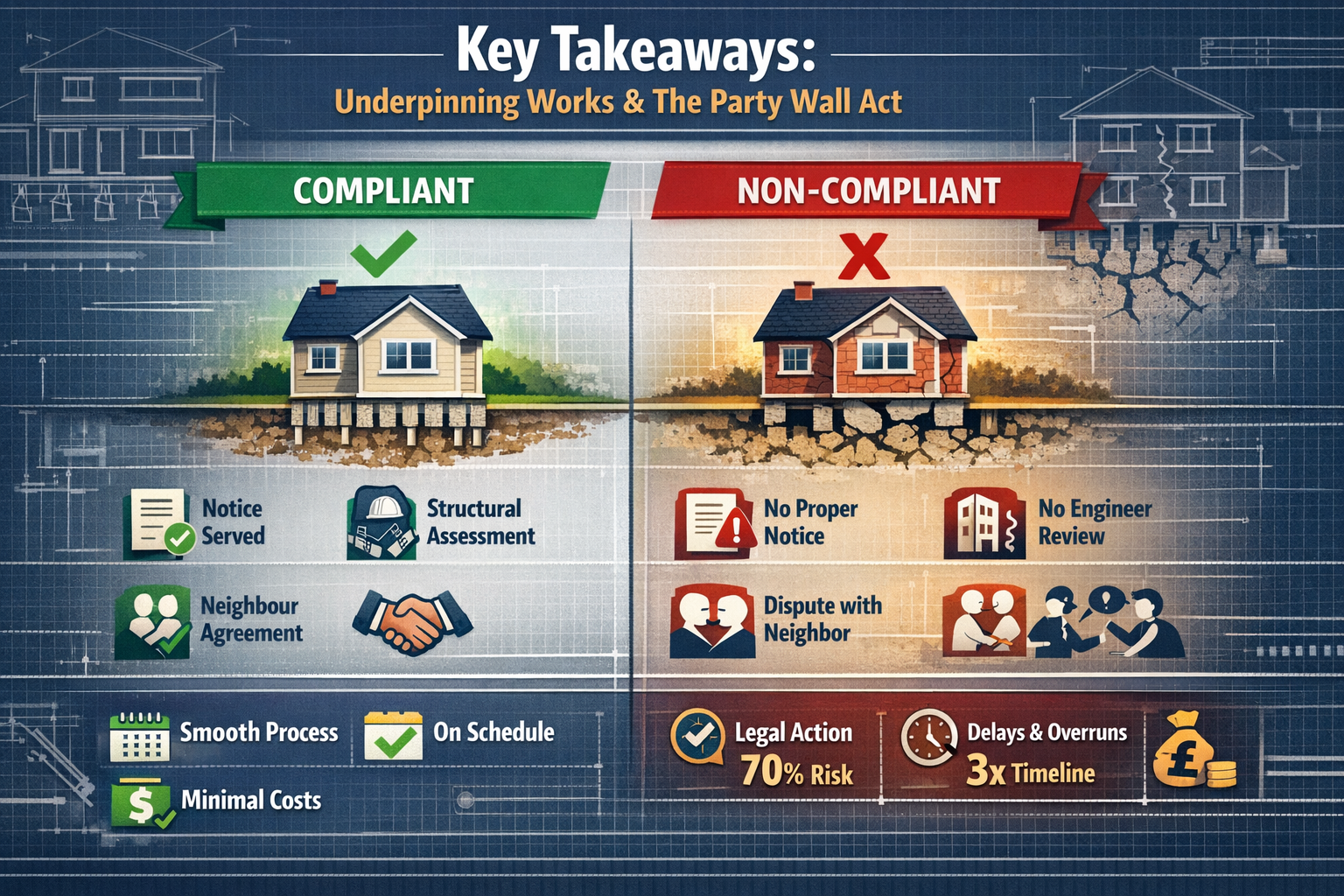
Key Takeaways
- Two-month advance notice is mandatory for underpinning work affecting party structures under Section 2 of the Party Wall Act[1][3]
- Section 6 notices apply separately when excavation occurs within 3-6 metres of neighbouring foundations, requiring one month’s notice[4][6]
- Detailed technical documentation including foundation depths, excavation plans, and structural sections must accompany all notices[6]
- Adjoining owners have 14 days to consent or dissent, triggering either simplified approval or formal surveyor appointment[5]
- Failure to serve proper notice exposes building owners to injunctions, legal disputes, and unlimited liability for structural damage[6]
Understanding Notifiable Underpinning Work Under the Party Wall Act
What Qualifies as Notifiable Underpinning
Underpinning work explicitly falls under the Party Wall etc. Act 1996 when it involves structural repairs or modifications to party structures or occurs within specified distances of neighbouring properties[4][5]. Unlike minor works such as re-plastering or shallow electrical chasing—which qualify as de minimis exceptions—underpinning carries significant structural implications that cannot bypass notification requirements[2].
The Act distinguishes underpinning into two primary categories:
🏗️ Direct Party Wall Underpinning involves strengthening or deepening foundations that support or connect to a shared party wall or party structure. This work requires a Party Structure Notice under Section 2.
📏 Adjacent Excavation Underpinning occurs when foundation work takes place within 3-6 metres of a neighbour’s structure, potentially undermining their existing foundations. This triggers Section 6 Notice requirements.
Why Underpinning Cannot Be Treated as Minor Work
The structural significance of underpinning distinguishes it from routine maintenance. When foundations are strengthened or deepened, the work:
- Alters load distribution across party structures
- Creates temporary instability during excavation phases
- Introduces vibration and ground movement risks
- Permanently changes the structural relationship between adjoining properties
According to the Party Wall Act framework, any work that affects the structural integrity or load-bearing capacity of party walls requires formal notification, regardless of the building owner’s intentions or the perceived minimal impact[2]. For guidance on what constitutes different types of party wall works, property owners should consult specialist resources.
Party Wall Act for Underpinning Works: Notice Requirements and Timeline Compliance
The Three Types of Notices and Their Application to Underpinning
The Party Wall etc. Act 1996 establishes three distinct notice types, each with specific timeframes and applications[3]:
| Notice Type | Application to Underpinning | Notice Period | Section Reference |
|---|---|---|---|
| Party Structure Notice | Underpinning directly affecting party walls or structures | 2 months | Section 2 |
| Line of Junction Notice | New foundations built on boundary lines (rare for underpinning) | 1 month | Section 1 |
| Notice of Adjacent Excavation | Excavation within 3-6m of neighbour’s structure | 1 month | Section 6 |
For most underpinning projects affecting existing party walls, building owners must serve a Party Structure Notice at least two months before commencement[1][3]. This extended timeframe allows adjoining owners adequate time to assess structural risks, commission independent advice, and arrange protective measures.
Critical Information Requirements for Valid Notices
A valid Party Wall Notice for underpinning must include specific technical details to withstand legal scrutiny[2][6]:
✅ Proposed foundation depth with precise measurements
✅ Intended location of underpinning work relative to party structures
✅ Detailed plans and sections showing excavation extent
✅ Commencement date calculated from the appropriate notice period
✅ Nature and scope of structural modifications
✅ Building owner’s contact information and property details
Notices lacking complete information remain open to legal challenge, potentially invalidating the entire procedure and exposing building owners to injunctions[2]. Property owners unfamiliar with notice preparation should review comprehensive guidance on how to serve party wall notices before proceeding.
The Section 6 Excavation Rules: 3-Metre and 6-Metre Zones
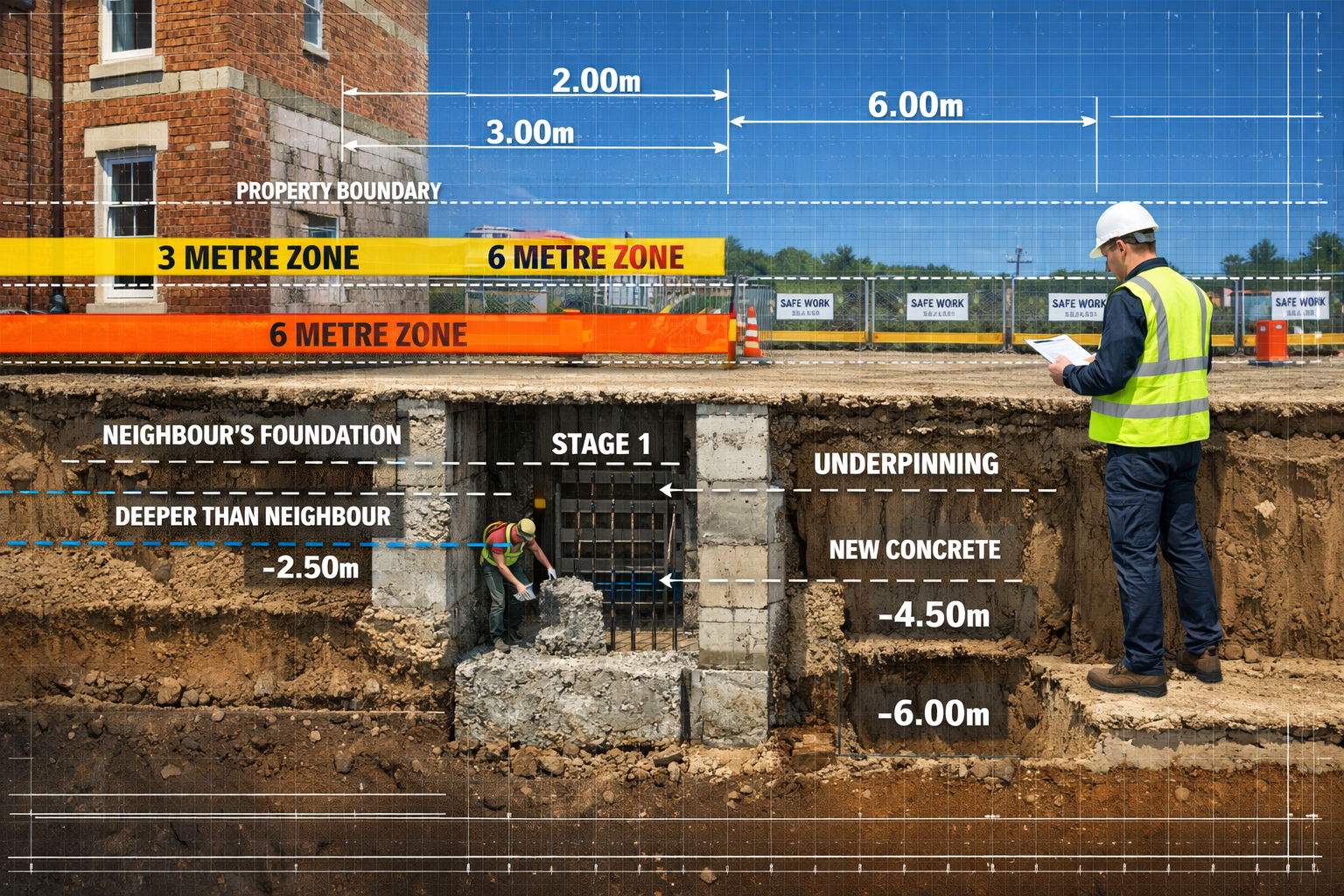
Section 6 of the Party Wall Act creates two distinct notification zones for excavation work[6]:
🔴 3-Metre Zone (High Risk)
When underpinning involves excavation within 3 metres of a neighbouring structure and the new foundation will be deeper than the neighbour’s existing foundation, a Section 6 Notice must be served one month in advance[4][6].
🟡 6-Metre Zone (Extended Risk)
Excavations between 3-6 metres from a neighbouring structure trigger Section 6 requirements if the work extends to a depth that intersects a 45-degree plane drawn downward from the bottom of the neighbour’s foundation[2][6].
These geometric rules recognize that excavation creates zones of ground disturbance extending well beyond the immediate dig site. The 6-metre rule particularly affects terraced properties and dense urban environments where multiple properties cluster together.
Responding to Party Wall Notices: The 14-Day Window
After receiving a Party Wall Notice for underpinning work, adjoining owners face a critical decision window. They must respond in writing within 14 days of the notice date, choosing one of three paths[5]:
- Written consent – Work may proceed without further formality
- Written dissent – Triggers formal Party Wall Award procedures
- No response – Legally treated as dissent after 14 days expire
Consent can bypass surveyor procedures entirely when adjoining owners provide written approval before commencement[2][4]. However, this consent should never be given without understanding the work’s implications, as it waives certain protective mechanisms. For adjoining owners uncertain about their position, understanding what party wall notices are and how to respond proves essential.
Structural Safeguards: Party Wall Awards and Protection Protocols
The Party Wall Award Process for Underpinning Projects
When adjoining owners dissent or fail to respond within 14 days, the Party Wall Act mandates a formal Party Wall Award to govern the underpinning work[5]. This legally binding document establishes:
- Permitted work scope with technical specifications
- Working hours and access arrangements
- Protective measures required during construction
- Dispute resolution procedures
- Cost allocation between parties
The Award process typically involves appointing party wall surveyors—either an Agreed Surveyor serving both parties or separate surveyors for each owner. These professionals assess structural risks, specify safeguards, and document pre-existing conditions. For detailed information on the award process, property owners should consult resources on party wall awards.
Schedule of Condition: Essential Pre-Work Documentation
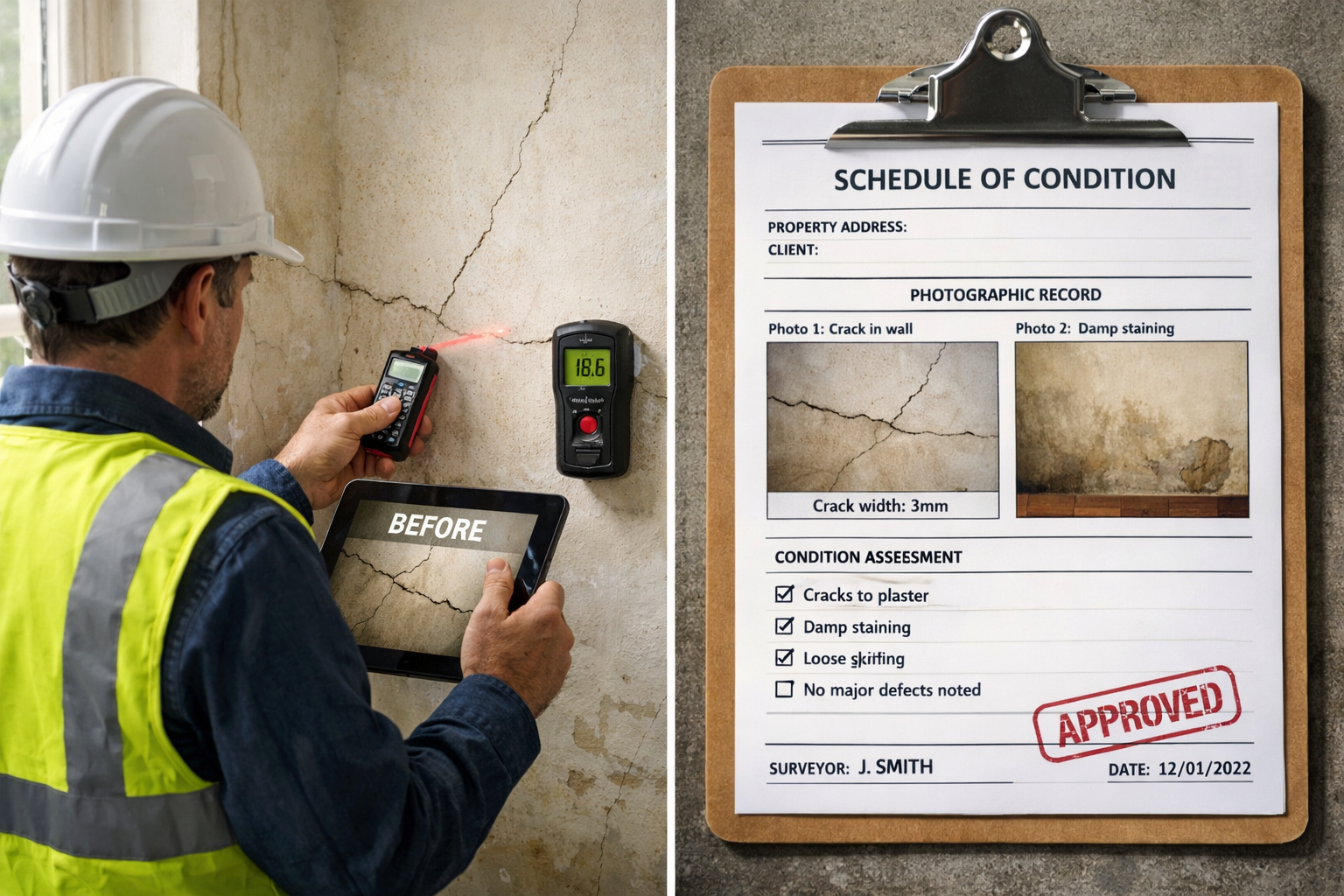
Before underpinning commences, surveyors prepare a Schedule of Condition—a comprehensive photographic and written record of the adjoining property’s existing state[7]. This document proves invaluable for:
🔍 Establishing baseline conditions before ground disturbance
📸 Documenting pre-existing cracks, settlement, and defects
⚖️ Distinguishing new damage from historical issues
💷 Supporting or refuting damage claims after work completion
The Schedule typically includes:
- Detailed room-by-room photographic surveys
- Crack width measurements in millimeters
- Descriptions of wall, ceiling, and floor conditions
- External façade and foundation inspections
- Structural movement indicators
Without this documentation, adjoining owners may struggle to prove that damage resulted from underpinning work rather than pre-existing conditions—a distinction that determines liability.
Mandatory Structural Safeguards During Underpinning
Party Wall Awards for underpinning typically specify protective measures tailored to the project’s risk profile. Common safeguards include:
Foundation Protection Measures:
- Temporary propping and support systems
- Phased excavation in short sections (typically 1-1.5 metres)
- Concrete curing periods before adjacent excavation
- Vibration monitoring during mechanical excavation
Structural Monitoring:
- Crack width monitoring gauges on critical walls
- Settlement monitoring points on adjoining structures
- Regular surveyor inspections at excavation milestones
- Photographic documentation at each work stage
Access and Notification:
- Advance notice of particularly disruptive phases
- Emergency contact protocols
- Access rights for surveyor inspections
- Progress reporting schedules
These safeguards transform underpinning from a potentially hazardous intervention into a controlled, monitored process that protects both properties.
Party Wall Act for Underpinning Works: Practical Compliance and Cost Considerations
The Real Cost of Party Wall Compliance for Underpinning
Party Wall procedures add both time and expense to underpinning projects, but these costs pale compared to litigation expenses from non-compliance. Typical costs include:
| Expense Category | Estimated Cost Range | Who Pays |
|---|---|---|
| Party Wall Notice preparation | £200-£500 | Building owner |
| Agreed Surveyor fees | £800-£1,500 | Building owner |
| Separate surveyors (both sides) | £1,500-£3,000 total | Building owner |
| Schedule of Condition | £300-£800 | Building owner |
| Monitoring and inspections | £500-£1,200 | Building owner |
Under the Act, building owners bear the reasonable costs of Party Wall procedures, including the adjoining owner’s surveyor fees[7]. While this seems financially burdensome, these costs represent insurance against far more expensive disputes. Property owners seeking to minimize expenses should review strategies for keeping party wall costs down.
Regional Variations: Party Wall Compliance Across London
While the Party Wall etc. Act 1996 applies uniformly across England and Wales, practical compliance varies by location. London’s dense Victorian and Edwardian terraces create unique challenges:
Central London properties often involve multiple adjoining owners and complex shared structures, requiring coordination across several notices. Specialists in party wall surveying in Central London navigate these complexities regularly.
North, South, East, and West London each present distinct architectural patterns—from North London’s semi-detached Edwardian homes to South London’s Victorian terraces—affecting underpinning approaches and notice requirements. Regional specialists understand these local building characteristics and their implications for Party Wall procedures.
Common Mistakes That Invalidate Party Wall Notices
Even experienced property developers occasionally make procedural errors that compromise Party Wall compliance:
❌ Insufficient notice period – Serving notice 6 weeks before underpinning when 2 months is required
❌ Incomplete technical details – Omitting foundation depths or excavation plans
❌ Wrong notice type – Using Line of Junction Notice when Party Structure Notice applies
❌ Missing Section 6 requirements – Failing to recognize when excavation rules apply
❌ Inadequate property description – Ambiguous identification of affected structures
❌ Premature commencement – Starting work before notice periods expire or Awards are finalized
Any of these errors can render notices invalid, forcing building owners to restart the process and delay construction schedules by months.
Legal Consequences of Non-Compliance with Party Wall Act for Underpinning Works
Injunctions and Work Stoppages
Commencing underpinning without serving required Party Wall Notices exposes building owners to immediate legal action. Adjoining owners can seek:
- Interim injunctions halting work until proper procedures are followed
- Mandatory injunctions requiring removal of completed work
- Damages for loss of enjoyment, property devaluation, or structural harm
Courts consistently uphold Party Wall Act requirements, viewing them as fundamental property protections. Even good-faith mistakes or ignorance of the law provide no defense against injunction applications.
Unlimited Liability for Structural Damage
Without a Party Wall Award establishing protective measures and baseline conditions, building owners assume unlimited liability for any damage to adjoining properties during or after underpinning[6]. This includes:
- Structural cracking and settlement
- Internal decoration damage
- Loss of property value
- Professional fees for structural assessment
- Temporary accommodation costs during repairs
The absence of a Schedule of Condition particularly disadvantages building owners, as they cannot prove that damage pre-existed their work. Adjoining owners effectively gain the benefit of doubt in damage disputes.
The “Deemed Dissent” Trap
Many building owners mistakenly believe that no response from adjoining owners constitutes consent. The Act explicitly treats failure to respond within 14 days as dissent, automatically triggering formal Award procedures[5]. Building owners who proceed without recognizing this deemed dissent operate outside the Act’s protections, exposing themselves to the liabilities described above.
Navigating Complex Scenarios: Multiple Adjoining Owners and Mixed-Use Properties
Terraced Properties: Cascading Notice Requirements
Victorian and Edwardian terraces present unique challenges when underpinning affects shared party walls. A single underpinning project may require:
- Separate notices to each adjoining owner (both sides of the property)
- Coordination of multiple Schedules of Condition
- Staggered work phases to minimize cumulative impact
- Extended timelines to accommodate multiple 14-day response periods
Properties in the middle of terraces face particular complexity, as underpinning one party wall may indirectly affect the opposite wall through load redistribution. Experienced surveyors assess these interconnected structural relationships when specifying safeguards.
Commercial and Mixed-Use Considerations
When underpinning affects party walls between residential and commercial properties, additional complications arise:
- Business interruption concerns requiring specific working hour restrictions
- Higher damage thresholds for commercial tenant improvements
- Multiple stakeholders including property owners, tenants, and subtenants
- Insurance implications for commercial liability policies
These scenarios benefit from early engagement with specialist party wall surveyors who understand commercial property dynamics alongside residential requirements.
When Neighbours Are Uncooperative or Unreachable
The Party Wall Act provides mechanisms for situations where adjoining owners cannot be located or refuse to engage constructively:
For unreachable owners, building owners may serve notice by:
- Registered post to the property address
- Affixing notice to a conspicuous part of the premises
- Advertising in local newspapers (in extreme cases)
For uncooperative owners, the Act allows building owners to appoint a surveyor on the adjoining owner’s behalf after reasonable attempts at engagement fail. This appointed surveyor has the same powers and duties as if directly instructed by the adjoining owner.
Conclusion: Protecting Your Property Through Proper Party Wall Compliance
The Party Wall Act for Underpinning Works: Notice Requirements and Structural Safeguards framework exists to protect all parties when structural interventions affect shared boundaries. While the two-month notice periods, technical documentation requirements, and formal Award procedures may seem bureaucratic, they prevent the far more costly and disruptive consequences of structural disputes and litigation.
Building owners planning underpinning work should recognize that Party Wall compliance represents an investment in project security rather than an obstacle. The process:
✅ Establishes clear legal authority to proceed
✅ Documents baseline conditions protecting against spurious claims
✅ Specifies protective measures minimizing actual damage risk
✅ Creates dispute resolution mechanisms avoiding court proceedings
✅ Demonstrates professional responsibility to neighbours and authorities
Actionable Next Steps for Building Owners
Before commencing underpinning work:
- Assess notice requirements – Determine whether Section 2, Section 6, or both apply to your project
- Prepare comprehensive notices – Include all required technical details, plans, and sections
- Serve notices with adequate lead time – Two months for Party Structure Notices, one month for Section 6
- Engage qualified surveyors early – Particularly for complex terraced or commercial properties
- Document everything – Maintain records of all notices, responses, and communications
- Never commence work prematurely – Wait for consent, Awards, or notice period expiration
For adjoining owners receiving notices:
- Respond within 14 days – Even if only to request more information
- Seek independent advice – Don’t rely solely on the building owner’s surveyor
- Insist on Schedule of Condition – This protects your interests in damage disputes
- Understand your rights – You can appoint your own surveyor at the building owner’s expense
- Don’t consent hastily – Written consent waives important protections
The Party Wall etc. Act 1996 provides a balanced framework that, when properly followed, allows necessary structural work while protecting neighbouring properties. Understanding and complying with the Party Wall Act for Underpinning Works: Notice Requirements and Structural Safeguards ensures that foundation improvements proceed smoothly, legally, and with minimal risk to all parties involved.
For property owners navigating these requirements in 2026, professional guidance remains invaluable. Whether carrying out works or receiving notice as a neighbour, understanding your obligations and rights under the Act protects your property investment and maintains positive neighbourly relations throughout the construction process.
References
[1] Notifiable Works – home-approved.com
[2] Party%20wall%20act – designingbuildings.co.uk
[3] Three Types Of Party Wall Notices – stokemont.com
[4] Underpinning Structural Repairs Under The Party Wall Act 1996 – adamjoseph.co.uk
[5] Party Wall My Neighbour Is Undertaking Works Which Invoke Party Wall Act – grahamkinnear.com
[6] Excavation And The Party Wall Act Navigating The 3 And 6 Metre Rules For Foundations – partywallslimited.com
[7] Party Wall Agreements What You Need To Know – fmb.org.uk
Speak to a RICS chartered party wall surveyor
Free initial consultation. Notices, awards and schedules of condition across London and nationwide.