


The global data centre industry is experiencing an unprecedented boom in 2026, with artificial intelligence and cloud computing driving investment to historic levels. As developers race to build cutting-edge facilities across the UK's most densely populated urban areas, party wall surveys for data centre expansions have become critical gatekeepers to project success. With even minor delays costing millions and neighbouring property owners increasingly aware of their rights, navigating party wall agreements has never been more complex—or more essential.
The stakes are extraordinarily high. Data centre construction projects involve massive capital expenditure, specialized infrastructure, and tight delivery schedules. When these high-value developments occur in established urban areas where properties share walls, foundations, or boundaries, the Party Wall etc. Act 1996 becomes a non-negotiable part of the development process. Understanding how to navigate party wall surveys for data centre expansions in the 2026 investment surge can mean the difference between project success and costly legal disputes.
Key Takeaways
- 📊 Historic investment levels: The UK data centre market is experiencing unprecedented growth in 2026, with demand driven by AI adoption and cloud computing expansion
- ⚖️ Legal compliance is mandatory: Data centre expansions affecting shared walls, boundaries, or excavations near neighbouring properties require proper party wall notices and agreements
- 💰 Financial stakes are enormous: Even minor party wall disputes can delay projects worth millions, making proactive surveyor engagement essential
- 🤝 Early engagement prevents disputes: Serving proper notices and appointing qualified surveyors early in the planning process significantly reduces conflict risk
- 🔍 Specialized expertise required: Data centre projects demand surveyors who understand both the Party Wall Act and the unique technical requirements of critical digital infrastructure
Understanding the 2026 Data Centre Investment Boom
Why Data Centres Are Expanding Rapidly
The UK remains one of the top three data centre markets globally, surpassed only by the USA in total number of facilities[1]. This dominant position is being reinforced in 2026 by several converging factors that are driving unprecedented expansion.
UK data usage is projected to double by 2026, primarily driven by artificial intelligence adoption and the continued expansion of cloud-based computing[1]. This exponential growth in data consumption requires physical infrastructure—massive facilities filled with servers, cooling systems, and power distribution equipment that must be located close to major population centres for optimal performance.
The investment environment has become increasingly favorable. Changes to the National Planning Policy Framework and the designation of data centres as nationally significant infrastructure are easing the planning process[1]. This regulatory support, combined with the urgent demand for AI computing capacity, has created a perfect storm of development activity.
The Urban Density Challenge
Data centres need to be located in or near major cities to minimize latency and provide fast access to end users. This requirement creates an inevitable challenge: urban areas have limited available space, and new developments frequently occur on sites adjacent to existing buildings.
When a data centre expansion involves:
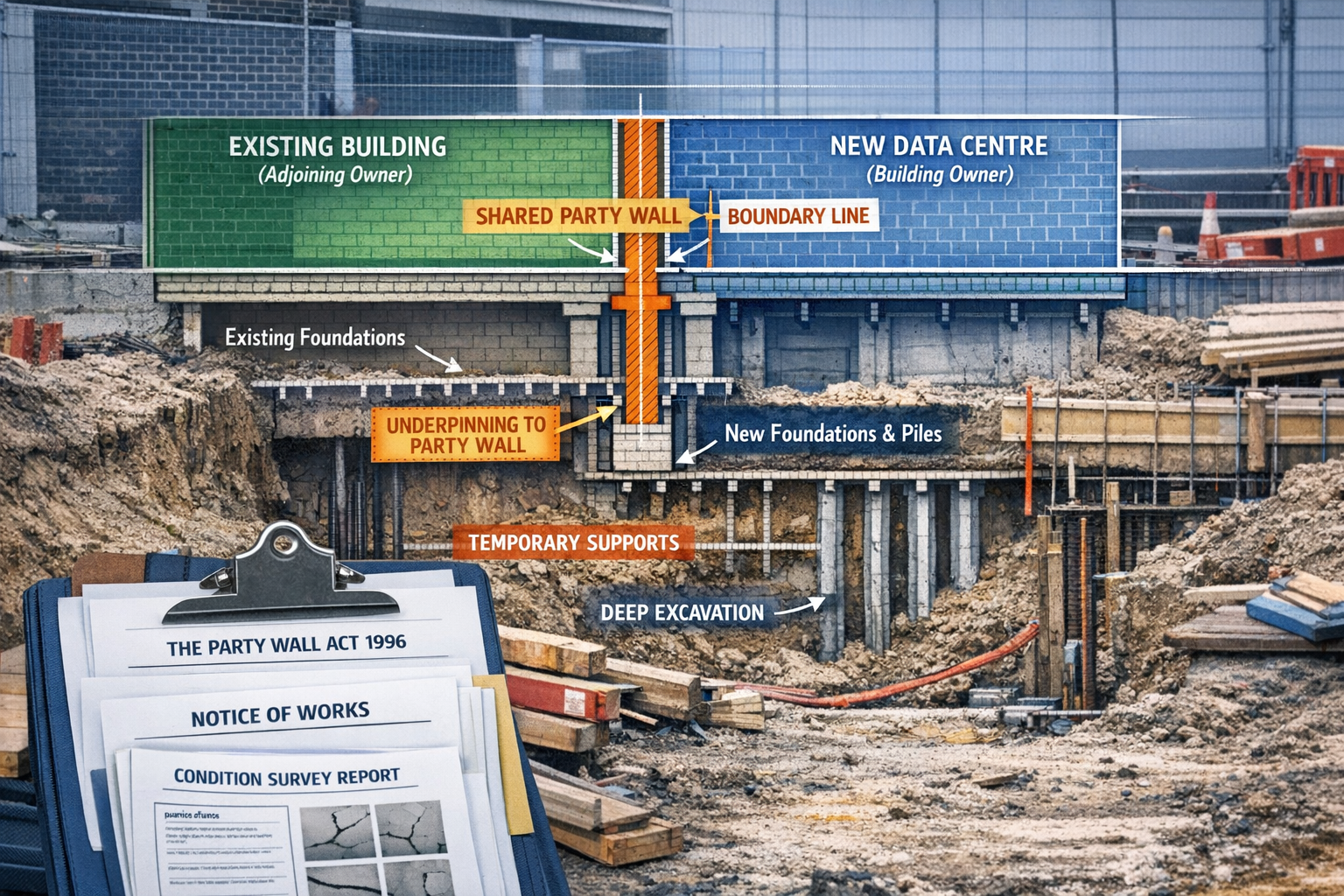
- Excavating foundations deeper than neighbouring properties
- Building on or near a shared boundary wall
- Constructing new walls at the property line
- Carrying out works that could affect the structural stability of adjacent buildings
The Party Wall etc. Act 1996 applies, and proper procedures must be followed.
Financial Implications of Delays
Data centre construction projects involve huge sums with even minor delays resulting in cost overruns into the millions[1]. The specialized nature of these facilities means that:
- 🔧 Equipment must be ordered months in advance from limited suppliers
- ⚡ Power infrastructure connections require extensive lead times
- 🏗️ Construction sequences are tightly choreographed
- 💼 Client contracts often include substantial penalties for late delivery
A party wall dispute that delays construction by even a few weeks can trigger cascading financial consequences. This reality makes proper party wall management not just a legal requirement but a critical business imperative.
Party Wall Surveys for Data Centre Expansions: Legal Framework and Requirements
When Party Wall Notices Are Required
The Party Wall etc. Act 1996 establishes three main categories of work that require formal notices:
1. Works to an Existing Party Wall or Party Structure
When a data centre expansion involves modifications to a shared wall between properties, such as:
- Cutting into the wall to insert support beams
- Raising the height of a party wall
- Demolishing and rebuilding a party structure
- Underpinning a party wall
2. Building on the Boundary Line
Constructing a new wall or building directly on or astride the boundary between properties triggers notice requirements, even if no existing party wall is present.
3. Excavation Near Neighbouring Buildings
Data centres often require deep excavations for basement plant rooms, cooling systems, and cable infrastructure. If excavation within three or six metres of a neighbouring building extends below their foundation level, party wall notices must be served.
Notice Periods and Timelines
Proper timing is essential for party wall compliance:
| Notice Type | Minimum Notice Period | When to Serve |
|---|---|---|
| Party Structure Notice | 2 months | Before works to existing party walls |
| Line of Junction Notice | 1 month | Before building new walls on boundaries |
| Adjacent Excavation Notice | 1 month | Before excavating near neighbours |
For data centre projects with tight construction schedules, these notice periods must be factored into the critical path. Failure to serve notices in time can delay the entire project start date.
The Role of Party Wall Surveyors
When a neighbouring owner receives a party wall notice, they have three options:
- Consent in writing to the proposed works
- Dissent or fail to respond within 14 days
- Appoint a surveyor to negotiate terms
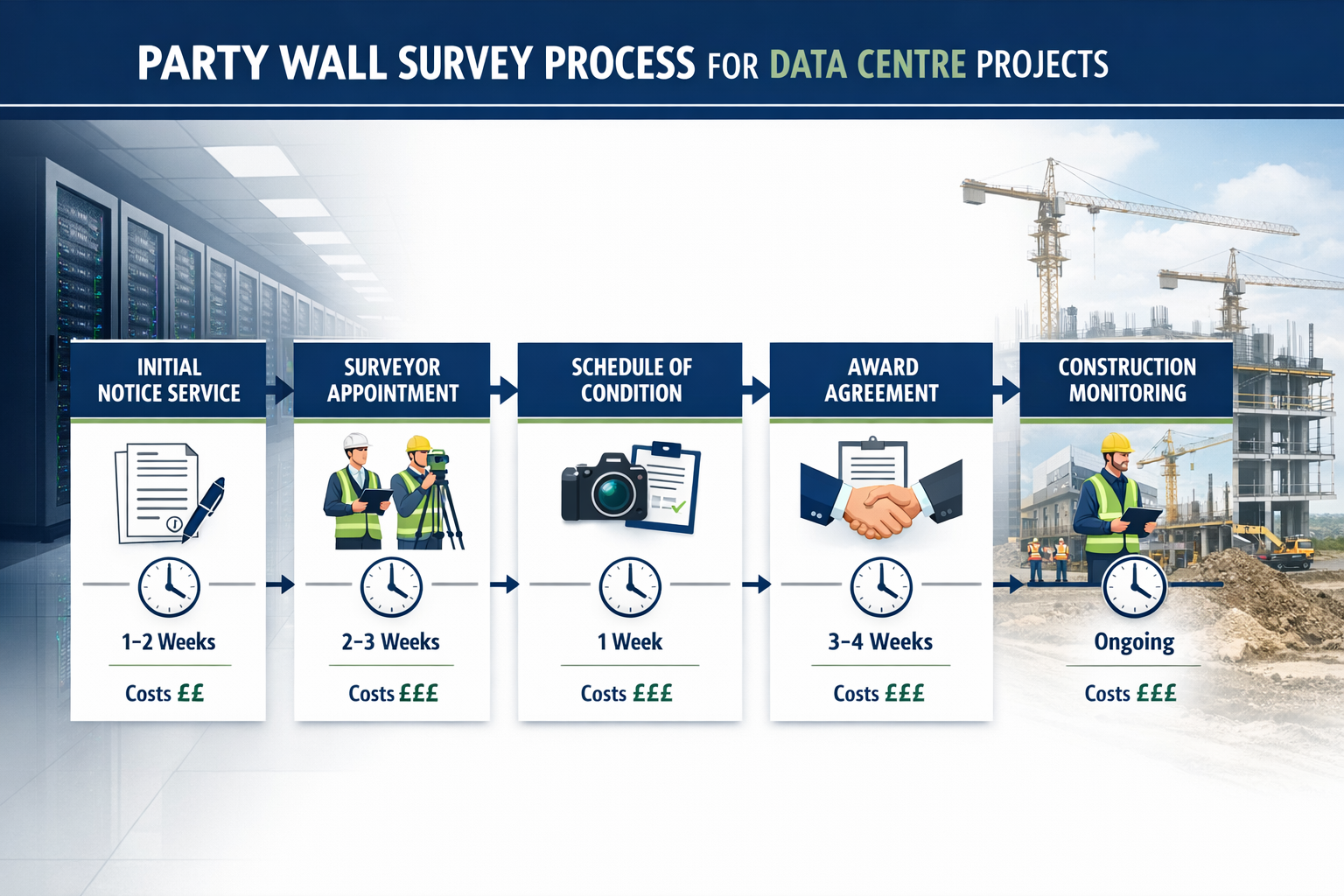
In practice, most data centre expansions involve appointing surveyors due to the complexity and value of the works. The surveyor's role includes:
✅ Preparing detailed schedules of condition documenting the pre-construction state of adjacent properties
✅ Negotiating the terms and conditions under which works can proceed
✅ Preparing a party wall award that legally binds all parties
✅ Monitoring works to ensure compliance with the agreed terms
✅ Resolving disputes that arise during construction
For guidance on the party wall process, developers can review resources on having a party wall agreement without a surveyor, though professional surveyor involvement is strongly recommended for high-value data centre projects.
Navigating Agreements in the 2026 Investment Surge: Practical Considerations
Early Engagement Strategies
The complexity of data centre construction demands proactive party wall management from the earliest planning stages. Successful developers in 2026 are adopting several best practices:
Pre-Notice Consultation
Before formally serving party wall notices, experienced developers engage in informal discussions with neighbouring property owners. This approach:
- Identifies potential concerns early
- Builds goodwill and trust
- Allows time to address objections before formal procedures begin
- Reduces the likelihood of disputes
Surveyor Selection
Choosing the right party wall surveyor is critical. For data centre projects, look for professionals with:
- 📋 Experience with large-scale commercial developments
- 🏗️ Understanding of deep excavation and foundation engineering
- 💡 Knowledge of data centre construction requirements
- 🤝 Strong negotiation and dispute resolution skills
- 📍 Local expertise (e.g., party wall surveyors in Central London, North London, East London, or South London)
Schedule of Condition: Protecting All Parties
A comprehensive schedule of condition is the foundation of effective party wall management for data centre expansions. This detailed photographic and written record documents the state of neighbouring properties before construction begins.
For data centre projects, schedules of condition should include:
🏠 Structural Elements
- Foundation condition and any existing settlement
- Wall integrity, including cracks, bulges, or deterioration
- Floor levels and any existing slopes
- Ceiling condition and structural supports
🔧 Building Services
- Existing drainage systems
- Utility connections
- HVAC systems that could be affected by vibration
📸 Documentation Standards
- High-resolution photographs with date stamps
- Detailed written descriptions
- Measurements of existing defects
- Video walkthroughs for complex spaces
This documentation protects both the building owner undertaking the data centre expansion and the adjoining owner by establishing a clear baseline. If disputes arise about alleged construction damage, the schedule provides objective evidence of pre-existing conditions.
Party Wall Awards for Data Centre Projects
The party wall award is the legally binding document that authorizes works to proceed under agreed conditions. For data centre expansions, awards typically address:
Technical Specifications
- Permitted excavation depths and methods
- Underpinning requirements and techniques
- Temporary support measures during construction
- Vibration and noise limitations
- Working hours restrictions
Protection Measures
- Monitoring requirements (vibration sensors, crack monitoring)
- Insurance requirements and coverage levels
- Emergency contact procedures
- Remediation protocols if damage occurs
Financial Arrangements
- Who pays surveyor fees (typically the building owner)
- Compensation for loss of amenity during construction
- Security deposits or performance bonds
- Procedures for handling damage claims
Understanding how to keep party wall costs down while ensuring comprehensive protection is a balancing act that experienced surveyors navigate effectively.
Managing Multi-Party Complexity
Data centre developments often involve multiple parties and stakeholders, increasing dispute risk[1]. A typical project might involve:
- 🏢 The building owner (developer or data centre operator)
- 🏘️ Multiple adjoining owners with different concerns
- 👷 Main contractor and specialized subcontractors
- 🏛️ Planning authorities and building control
- ⚡ Utility companies for power and connectivity
- 💼 Investors and financing institutions
Each party has different priorities and risk tolerances. Effective party wall management requires:
Clear Communication Protocols
Establishing who communicates what information to whom, and when. For example, adjoining owners should receive regular updates on construction progress, while detailed technical information flows between surveyors and contractors.
Coordinated Surveyor Approach
When multiple adjoining properties are affected, appointing an agreed surveyor to act for all parties can streamline the process. Alternatively, separate surveyors for each adjoining owner may be appropriate if interests diverge significantly.
Documented Decision-Making
All agreements, variations, and decisions should be documented in writing and shared with relevant parties. This creates an audit trail that prevents misunderstandings and supports dispute resolution if needed.
Special Considerations for Data Centre Construction
Deep Excavation and Foundation Challenges
Data centres require substantial below-ground infrastructure for:
- Cable entry points and distribution systems
- Cooling systems and water management
- Emergency power generation equipment
- Structural support for heavy server loads
These requirements often necessitate excavations significantly deeper than typical commercial buildings. When excavating near existing structures, several party wall considerations arise:
Underpinning Requirements
If excavation extends below neighbouring foundations, underpinning may be necessary to maintain structural stability. The party wall award should specify:
- Underpinning methodology (mass concrete, beam and base, piling)
- Sequencing to minimize risk
- Monitoring during excavation and underpinning
- Acceptance criteria for settlement
Temporary Works
Retaining walls, sheet piling, or other temporary support systems must be designed to protect adjacent properties. The award should address:
- Design standards and approval processes
- Installation methods and vibration limits
- Monitoring and inspection requirements
- Removal procedures after permanent works are complete
Vibration and Noise Management
Data centre construction involves heavy machinery, piling operations, and continuous concrete pours that can generate significant vibration and noise. Party wall awards for these projects typically include:
📊 Vibration Monitoring
- Baseline vibration surveys before works commence
- Continuous monitoring during high-risk activities
- Trigger levels that require work stoppage
- Reporting protocols to adjoining owners and surveyors
🔊 Noise Limitations
- Permitted working hours (often restricted in urban areas)
- Maximum noise levels at property boundaries
- Requirements for acoustic barriers or enclosures
- Advance notice for exceptionally noisy operations
Specialist Equipment Installation
The installation of highly specialized components and equipment in data centres creates unique party wall considerations[1]. Equipment such as:
- Massive uninterruptible power supply (UPS) systems
- Precision cooling infrastructure
- Raised floor systems with extensive cabling
- Backup generator sets
This equipment often requires:
- Crane lifts over adjoining properties (requiring separate access agreements)
- Structural modifications to party walls for service penetrations
- Vibration isolation to prevent disturbance to neighbours
- Emergency access provisions for maintenance and repairs
Party wall awards should anticipate these requirements and establish clear procedures for managing them.
Dispute Resolution and Risk Mitigation
Common Sources of Party Wall Disputes
Despite best efforts, disputes can arise during data centre construction projects. Understanding common triggers helps prevent them:
🚧 Construction Methodology Disagreements
Adjoining owners may object to proposed construction methods, particularly for deep excavations or works involving vibration. Resolution requires technical evidence and sometimes alternative methodology proposals.
💰 Cost and Compensation Issues
Disputes over surveyor fees, compensation for inconvenience, or the scope of required protective works can delay projects. Clear financial terms in the initial award prevent many of these conflicts.
📅 Timeline and Access Concerns
Adjoining owners may have concerns about construction duration, working hours, or temporary access requirements. Transparent communication and reasonable accommodations usually resolve these issues.
🔍 Damage Claims
Allegations of construction-related damage are among the most contentious disputes. Comprehensive schedules of condition and regular monitoring help distinguish pre-existing conditions from new damage.
Effective Dispute Resolution Strategies
When disputes arise, several resolution mechanisms are available:
Third Surveyor Appointment
If the building owner's surveyor and adjoining owner's surveyor cannot agree, the Party Wall etc. Act 1996 provides for appointment of a third surveyor to make a binding determination. This mechanism:
- Provides expert technical resolution
- Avoids court proceedings
- Maintains project momentum
- Is typically faster and less expensive than litigation
Mediation and Negotiation
Before invoking formal dispute resolution, experienced surveyors often facilitate mediation between parties. This collaborative approach:
- Preserves relationships between neighbours
- Allows creative solutions
- Reduces costs for all parties
- Maintains confidentiality
Legal Proceedings
As a last resort, parties can appeal third surveyor decisions to the County Court. However, this is rare in practice due to the time and expense involved. For high-value data centre projects, avoiding litigation is almost always preferable.
Insurance and Risk Transfer
Comprehensive insurance coverage is essential for data centre construction projects. Party wall awards typically require:
Professional Indemnity Insurance
Surveyors must maintain adequate PI coverage. For data centre projects, traditional coverage limits may need to be increased given the high values at stake[1].
Contractor's All Risks Insurance
Construction insurance should cover party wall damage, with adjoining owners named as interested parties. Policy limits should reflect the potential cost of repairing high-value adjacent properties.
Structural Warranty Coverage
Long-term structural warranties may be required, particularly for works involving underpinning or significant structural modifications to party walls.
The party wall award should specify minimum insurance requirements and require evidence of coverage before works commence.
Cost Management for Party Wall Surveys in Data Centre Projects
Understanding the Cost Structure
Party wall costs for data centre expansions typically include:
| Cost Component | Typical Range | Notes |
|---|---|---|
| Building Owner's Surveyor Fees | £3,000-£15,000+ | Depends on project complexity |
| Adjoining Owner's Surveyor Fees | £2,000-£10,000+ per property | Building owner typically pays |
| Schedule of Condition | £500-£2,000 per property | Comprehensive documentation |
| Third Surveyor (if required) | £2,000-£8,000 | For dispute resolution |
| Monitoring and Inspections | £1,000-£5,000+ | Ongoing during construction |
For data centre projects affecting multiple adjoining properties, total party wall costs can easily reach £50,000-£100,000 or more. While substantial, this represents a small fraction of total project costs and is essential for legal compliance and risk management.
For strategies to minimize expenses while maintaining compliance, review guidance on keeping party wall costs down.
Budgeting and Contingency Planning
Experienced developers budget for party wall costs early in the project financial model. Best practices include:
Early Cost Estimation
Engage a party wall surveyor during feasibility studies to estimate likely costs based on:
- Number of affected properties
- Complexity of proposed works
- Likelihood of disputes based on local context
- Required monitoring and protection measures
Contingency Allowances
Include contingencies of 20-30% above estimated party wall costs to account for:
- Unexpected complications during construction
- Additional properties affected by design changes
- Extended monitoring periods
- Dispute resolution costs
Phased Payment Structures
Negotiate payment terms with surveyors that align with project milestones, improving cash flow management.
Regional Considerations Across London
Data centre developments are occurring across all London regions, each with unique party wall considerations:
Central London Challenges
Party wall surveyors in Central London deal with:
- Historic buildings with sensitive structures
- High-value properties where stakes are elevated
- Complex ownership structures (leasehold, commercial tenants)
- Strict planning and conservation requirements
North London Developments
North London party wall surveyors frequently encounter:
- Mixed residential and commercial areas
- Varied building ages and construction types
- Active community engagement and awareness of rights
- Good transport links attracting data centre investment
East London Opportunities
East London has become a data centre hotspot due to:
- Available land for larger facilities
- Proximity to financial district connectivity
- Regeneration areas with supportive planning
- Mix of industrial and residential neighbours
South London Characteristics
South London party wall work involves:
- Suburban areas with residential neighbours
- Varied geological conditions affecting excavation
- Growing commercial development corridors
- Community-focused approach to neighbour relations
Understanding regional nuances helps developers anticipate challenges and select surveyors with appropriate local expertise.
Future Outlook: Party Wall Surveys in the Evolving Data Centre Landscape
Emerging Trends for 2026 and Beyond
The data centre construction boom shows no signs of slowing, and several trends will shape party wall practice:
🤖 AI-Driven Demand
Artificial intelligence applications require exponentially more computing power, driving continued data centre expansion in urban areas where party wall issues are inevitable.
♻️ Sustainability Requirements
Modern data centres incorporate advanced cooling and power management systems, often requiring deeper excavations and more complex building services that interact with party wall considerations.
⚡ Power Infrastructure Constraints
Limited electrical grid capacity in urban areas means data centres must maximize efficiency on available sites, often leading to more intensive development adjacent to existing buildings.
🏗️ Alternative Procurement Models
Traditional "single point responsibility" construction approaches are giving way to phased procurement structures[1] that may involve multiple contractors and extended timelines, complicating party wall management.
Adapting Party Wall Practice
Party wall surveyors are adapting their practice to meet data centre sector demands:
Enhanced Technical Expertise
Surveyors are developing specialized knowledge of data centre construction techniques, equipment requirements, and operational considerations.
Digital Documentation
Advanced photographic equipment, 3D scanning, and digital condition reporting are becoming standard for high-value projects, providing more comprehensive baseline documentation.
Proactive Monitoring
Real-time vibration monitoring, crack detection sensors, and automated reporting systems allow early identification of potential issues before they become disputes.
Collaborative Approaches
Recognizing the multi-party complexity of data centre projects[1], surveyors are facilitating more collaborative problem-solving rather than adversarial positioning.
Conclusion

Party wall surveys for data centre expansions have become critical enablers of the 2026 investment surge transforming the UK's digital infrastructure landscape. As demand for AI computing capacity and cloud services drives unprecedented construction activity in urban areas, understanding and properly managing party wall agreements is no longer optional—it's essential for project success.
The legal framework established by the Party Wall etc. Act 1996 provides a proven mechanism for balancing the rights of building owners to develop their properties with the rights of adjoining owners to protection from damage and disturbance. When properly implemented through qualified surveyors, comprehensive schedules of condition, and well-drafted awards, the party wall process protects all stakeholders and enables projects to proceed smoothly.
Key Success Factors
✅ Early engagement with neighbours and surveyors, well before construction begins
✅ Comprehensive documentation through detailed schedules of condition
✅ Clear communication with all stakeholders throughout the process
✅ Adequate budgeting for party wall costs and contingencies
✅ Specialist expertise from surveyors experienced with data centre projects
✅ Proactive monitoring during construction to identify issues early
✅ Collaborative dispute resolution when disagreements arise
Next Steps for Data Centre Developers
If you're planning a data centre expansion that may affect neighbouring properties:
- Assess party wall implications during initial feasibility studies
- Engage a qualified party wall surveyor with relevant experience
- Review the types of works that trigger notice requirements under the Party Wall etc. Act 1996
- Prepare and serve notices with appropriate lead time before construction
- Document existing conditions comprehensively before works commence
- Maintain open communication with adjoining owners throughout the project
- Monitor compliance with party wall award terms during construction
The unprecedented growth of data centre construction in 2026 presents both opportunities and challenges. By understanding party wall requirements, engaging qualified professionals early, and approaching the process collaboratively, developers can navigate agreements successfully and deliver the critical digital infrastructure that powers our increasingly AI-driven economy.
For expert guidance on your data centre expansion project, consider consulting with experienced party wall surveyors who understand both the legal framework and the unique technical demands of this specialized sector. The investment in proper party wall management pays dividends through reduced disputes, minimized delays, and protected relationships with the neighbours who will share your facility's boundaries for decades to come.
References
[1] Data Centres – https://www.brownejacobson.com/insights/2026-horizon-scanning-in-construction/data-centres
[2] Party Wall Surveys For Data Centre Expansions Navigating Agreements In The 2026 Investment Surge – https://nottinghillsurveyors.com/blog/party-wall-surveys-for-data-centre-expansions-navigating-agreements-in-the-2026-investment-surge
[3] Party Wall Surveys For Data Centre Expansions In The Uk Ai Boom Rics Guidance And Case Studies From 2026 Projects – https://nottinghillsurveyors.com/blog/party-wall-surveys-for-data-centre-expansions-in-the-uk-ai-boom-rics-guidance-and-case-studies-from-2026-projects