

Urban construction projects in England and Wales now face a 42% increase in party wall disputes compared to pre-2020 levels, with notice refusals becoming the primary bottleneck in high-density development zones [7]. As cities expand vertically and horizontally, understanding the streamlined pathways from notice refusal to award has become essential for building owners navigating From Notice Refusal to Award: Streamlined Paths for Party Wall Agreements in 2026 Urban Densification.
The Party Wall etc. Act 1996 provides a clear framework for resolving disputes when adjoining owners refuse or ignore party wall notices. However, the complexity of modern urban densification projects—particularly basement excavations, loft conversions, and boundary extensions—demands a sophisticated understanding of surveyor appointment procedures and award drafting protocols. This comprehensive guide walks building owners through every stage of the process, from initial notice refusal to final award execution.
Key Takeaways
- Notice refusal or non-response automatically triggers the surveyor appointment process, requiring building owners to act within specific timeframes to avoid project delays
- Streamlined award procedures in 2026 emphasize digital documentation and standardized clauses for high-density boundary works, reducing dispute resolution time by up to 30%
- Building owners must appoint surveyors within 10 days of notice refusal and can proceed with a single agreed surveyor or two separate surveyors depending on the adjoining owner's response
- Modern party wall awards for urban densification projects require specialized clauses covering deep excavations, underpinning protocols, and access arrangements tailored to terraced properties
- Proper documentation and condition surveys before commencing works protect both parties and streamline the award process in contested situations
Understanding Notice Refusal in the Party Wall Process
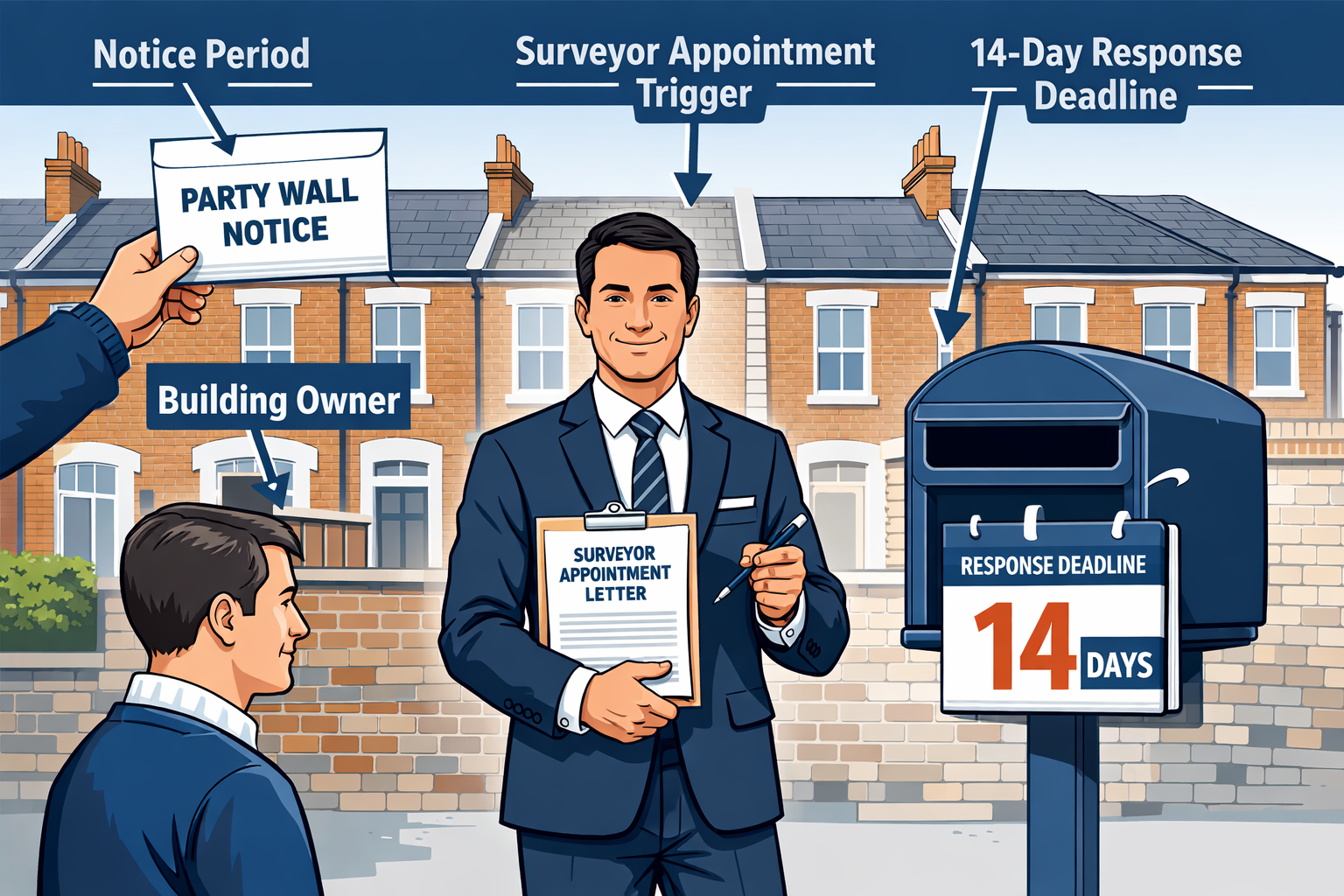
When a building owner serves a party wall notice for proposed works, the adjoining owner has 14 days to respond. Three outcomes are possible: written consent, written dissent (refusal), or no response at all. Under the Party Wall etc. Act 1996, silence equals dissent—a critical point many building owners overlook.
What Constitutes Notice Refusal?
Notice refusal occurs when:
- The adjoining owner explicitly writes to reject the proposed works ❌
- No response is received within the 14-day statutory period 📅
- The adjoining owner responds with conditions that fundamentally alter the proposed works 📝
- Partial consent is given but key elements are disputed ⚠️
According to recent industry analysis, approximately 35% of party wall notices in dense urban areas result in either explicit refusal or non-response [7]. This figure has risen significantly as urban densification accelerates, with property owners becoming increasingly protective of their rights and property values.
The Legal Implications of Non-Response
The Act treats non-response as automatic dissent to protect adjoining owners who may not understand their rights. This "deemed dissent" provision means building owners cannot simply proceed with works after 14 days of silence. Instead, the formal dispute resolution mechanism must be activated through surveyor appointment.
Key timeline considerations:
| Event | Timeframe | Action Required |
|---|---|---|
| Notice served | Day 0 | Building owner serves notice |
| Response period | Days 1-14 | Adjoining owner must respond |
| Deemed dissent | Day 15 | Non-response becomes refusal |
| Surveyor appointment | Days 15-25 | Building owner must appoint surveyor |
| Award preparation | 30-60 days | Surveyors draft and agree award |
Understanding these party wall act notices and how to respond is fundamental to avoiding costly project delays in 2026's competitive construction environment.
Navigating From Notice Refusal to Award: Streamlined Paths for Party Wall Agreements in 2026 Urban Densification
Once notice refusal occurs, building owners must immediately initiate the surveyor appointment process. This critical phase determines whether the project proceeds smoothly or becomes mired in protracted disputes. The streamlined pathways available in 2026 offer several strategic options.
Appointing Surveyors: Your Strategic Options
Building owners have two primary appointment pathways following notice refusal:
Option 1: The Agreed Surveyor Route
Both parties jointly appoint a single surveyor to act impartially. This approach offers:
✅ Cost efficiency – One set of surveyor fees split between parties
✅ Faster resolution – Single surveyor can draft award more quickly
✅ Reduced complexity – One professional manages entire process
✅ Better for straightforward works – Ideal for standard extensions or conversions
To pursue this route, the building owner should write to the adjoining owner proposing an agreed surveyor. The letter should include the surveyor's qualifications, experience with similar projects, and confirmation of their willingness to act impartially. Many building owners find success using experienced professionals from Party Wall Surveyor London who specialize in urban densification projects.
Option 2: The Two Surveyor Route
Each party appoints their own surveyor, who then jointly appoint a third surveyor to act as arbitrator if needed. This approach provides:
✅ Independent representation – Each party has dedicated advocacy
✅ Suitable for complex projects – Better for basement excavations or structural works
✅ Stronger protection – Particularly valuable when relationships are strained
✅ Professional oversight – Third surveyor ensures fairness if disagreements arise
The 10-Day Appointment Window
After notice refusal, the building owner must appoint their surveyor within 10 days and notify the adjoining owner in writing. This notification should include:
- The surveyor's full name and contact details 📞
- Professional qualifications and relevant experience 🎓
- Confirmation they are willing to act 📋
- Request for the adjoining owner to appoint their surveyor within 10 days ⏰
If the adjoining owner fails to appoint their surveyor within this second 10-day period, the building owner's surveyor can make the appointment on their behalf—a powerful provision that prevents indefinite delays.
Streamlined Appointment Procedures in 2026
Modern practice has introduced several efficiency improvements:
Digital appointment letters are now standard, with electronic service accepted under updated guidance. Building owners can serve appointment notices via email with read receipts, significantly reducing the traditional postal delays that plagued earlier processes.
Pre-vetted surveyor panels maintained by professional bodies allow faster appointments. Organizations like the Faculty of Party Wall Surveyors maintain directories of qualified professionals specializing in urban densification projects, enabling building owners to quickly identify appropriate experts for party wall awards.
Standardized appointment templates reduce administrative burden. Many surveyors now provide free downloadable party wall agreement templates that streamline the appointment process and ensure all statutory requirements are met.
Drafting Party Wall Awards for High-Density Boundary Works
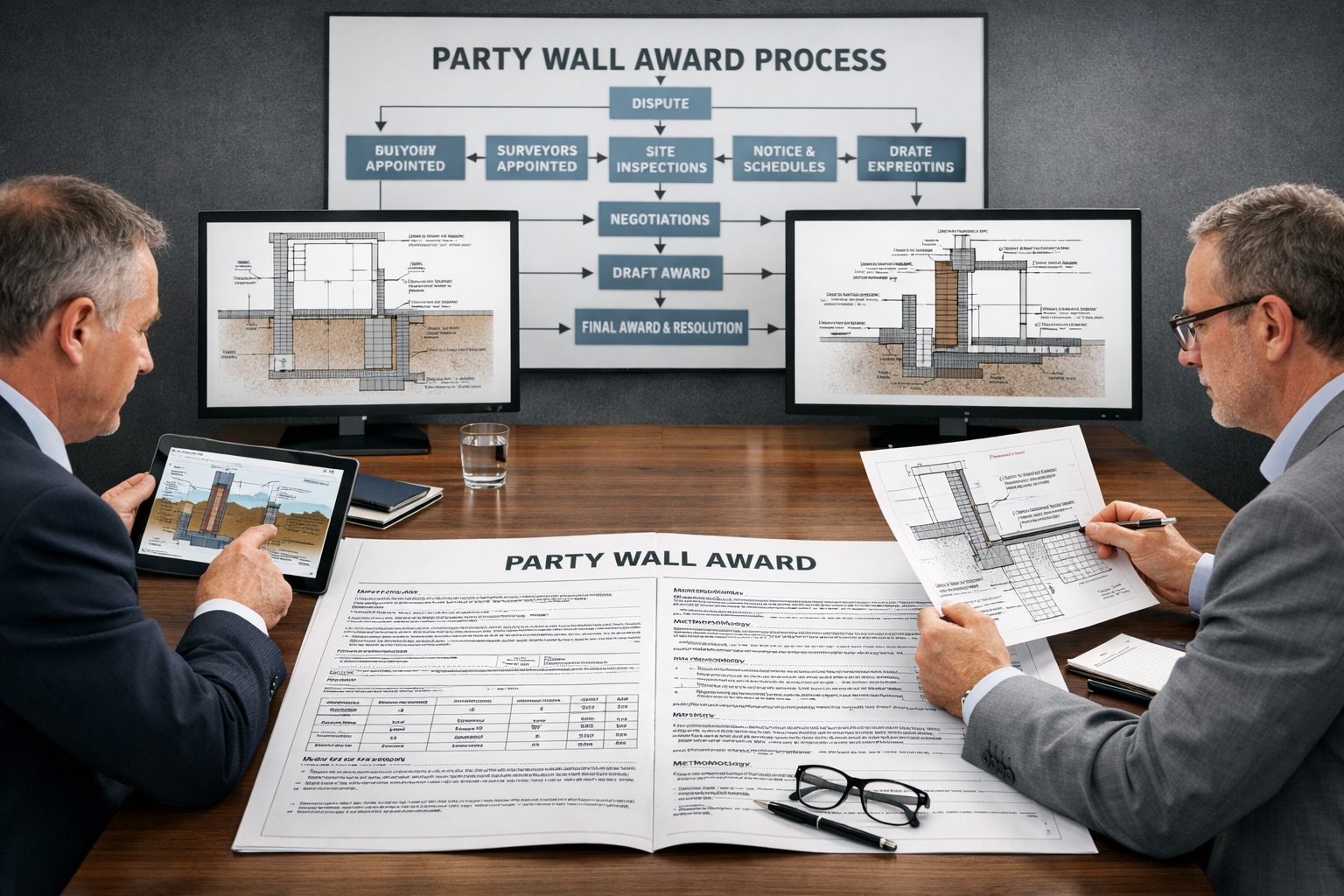
The party wall award is the legally binding document that governs how works proceed, protects both parties' interests, and establishes rights and obligations. For urban densification projects in 2026, awards must address increasingly complex technical and access challenges.
Essential Components of Modern Party Wall Awards
A comprehensive party wall award for high-density boundary works should include:
1. Detailed Description of Works
Modern awards go far beyond generic descriptions, incorporating:
- Precise excavation depths with reference to adjoining foundations 🏗️
- Underpinning specifications including materials and methodology 🔧
- Structural calculations for load-bearing party walls 📊
- Temporary support requirements during construction phases 🏋️
For basement conversions—increasingly common in dense urban areas—awards must specify excavation protocols that protect adjoining structures. Recent guidance emphasizes the importance of drafting party wall awards for basement conversions with 2026 protocols for deep excavations [6].
2. Access Provisions
High-density terraced properties present unique access challenges. Awards must clearly establish:
- Permitted access times (typically 8am-6pm weekdays) ⏰
- Access routes through adjoining property if necessary 🚪
- Notice requirements for access (usually 48 hours minimum) 📢
- Limitations on access to protect adjoining owner's privacy and security 🔒
Experienced surveyors working in areas like North London and South London have developed standardized access clauses that balance building owners' construction needs with adjoining owners' rights to quiet enjoyment.
3. Condition Surveys and Photographic Records
Pre-commencement condition surveys are mandatory for protecting both parties. The award should specify:
- Survey timing (must be completed before works commence)
- Scope of survey (internal and external areas potentially affected)
- Photographic documentation standards (high-resolution digital images)
- Access arrangements for conducting surveys
Understanding schedule of condition requirements prevents disputes about pre-existing damage versus construction-related damage. In 2026, digital condition surveys with timestamped photographs and video walkthroughs have become industry standard.
4. Cost Allocation and Payment Terms
Awards must clearly establish who pays for what:
| Cost Item | Typical Allocation | Notes |
|---|---|---|
| Surveyor fees | Building owner | Unless caused by adjoining owner's unreasonable conduct |
| Award preparation | Building owner | Including both surveyors if two appointed |
| Condition surveys | Building owner | Both pre and post-construction |
| Remedial works | Building owner | For damage caused by construction |
| Third surveyor fees | Split equally | If appointed to resolve disputes |
Modern awards include payment schedules specifying when surveyor fees are due and mechanisms for resolving fee disputes without delaying construction.
5. Special Conditions for Urban Densification Projects
2026 best practices require specialized clauses for high-density boundary works:
Underpinning protocols must address:
- Minimum depth below adjoining foundations (typically 300mm minimum)
- Sequential underpinning methodology to maintain structural stability
- Concrete specifications and curing times
- Monitoring requirements for adjoining structure movement
Excavation safeguards should include:
- Shoring and temporary support specifications
- Groundwater management and drainage provisions
- Vibration monitoring thresholds
- Emergency procedures if instability is detected
Party fence wall provisions require careful attention in terraced properties. Understanding the difference between party fence walls and boundary walls is essential for drafting appropriate award clauses.
Streamlined Award Approval Process
Once surveyors draft the award, both must sign it and serve copies on both property owners. The 2026 streamlined process includes:
Electronic award service – Digital copies with electronic signatures are now standard, reducing service time from 7-10 days to 24-48 hours.
Standardized clause libraries – Professional surveyors maintain databases of pre-approved clauses for common scenarios, dramatically reducing drafting time for standard works while allowing customization for complex projects.
Expedited dispute resolution – When appointed surveyors cannot agree, the third surveyor can now resolve specific technical disputes without redrafting the entire award, saving weeks in complex cases.
Handling Non-Compliance and Award Enforcement
Even with carefully drafted awards, building owners occasionally face challenges with adjoining owners who refuse access or dispute award terms. The 2026 framework provides clear enforcement mechanisms.

When Adjoining Owners Refuse Award Terms
If an adjoining owner disputes the award after service, they have 14 days to appeal to the county court. This appeal right is limited to specific grounds:
- The surveyor(s) exceeded their authority under the Act
- The award contains manifest errors or ambiguities
- Proper procedures were not followed in the award's preparation
- The award is fundamentally unfair or unreasonable
Appeals are rare in practice—fewer than 2% of awards are challenged in court [7]. Most disputes are resolved through the third surveyor mechanism without litigation.
Proceeding with Works Under the Award
Once the 14-day appeal period expires without challenge, the building owner can commence works immediately in accordance with the award terms. Key compliance requirements include:
✅ Providing required notice before accessing adjoining property
✅ Adhering to specified working hours and methods
✅ Completing condition surveys before commencing
✅ Maintaining insurance as specified in the award
✅ Allowing surveyor inspections during construction
Building owners should maintain detailed records of compliance, including photographs, delivery notes for specified materials, and logs of access notices provided. This documentation proves invaluable if disputes arise during construction.
Resolving Disputes During Construction
Even well-drafted awards cannot anticipate every construction challenge. When disputes arise during works, the appointed surveyor(s) can issue supplemental awards addressing:
- Unforeseen structural conditions requiring modified methodology
- Additional works needed to protect adjoining property
- Access disputes or timing conflicts
- Damage claims and remediation requirements
The streamlined 2026 process allows surveyors to issue supplemental awards within 7-14 days for urgent matters, preventing costly construction delays.
Cost Management Strategies for Building Owners
Understanding and controlling costs of party wall processes is crucial for project budgeting, particularly in high-density urban areas where property values and construction costs are elevated.
Typical Cost Breakdown
For standard urban densification projects in 2026:
Agreed surveyor route:
- Single surveyor fees: £800-£1,500 for straightforward works
- Complex projects (basements, structural alterations): £1,500-£3,500
- Condition surveys: £300-£600 per property
- Award preparation and administration: Included in surveyor fees
Two surveyor route:
- Building owner's surveyor: £1,000-£2,000
- Adjoining owner's surveyor: £1,000-£2,000 (paid by building owner)
- Third surveyor (if required): £1,500-£3,000 (split between parties)
- Condition surveys: £300-£600 per property per surveyor
Strategies for Keeping Costs Down
Smart building owners can significantly reduce party wall expenses through:
Early engagement – Discussing proposed works with neighbours before serving formal notices often leads to consent without dispute, eliminating surveyor costs entirely. Understanding how to keep party wall costs down starts with good neighbour relations.
Agreed surveyor selection – When possible, proposing an agreed surveyor reduces costs by 40-60% compared to the two-surveyor route. Choose experienced professionals who can draft comprehensive awards that prevent supplemental awards and disputes.
Clear project specifications – Providing detailed plans and specifications to surveyors upfront reduces time spent clarifying details and minimizes back-and-forth communications that increase fees.
Avoiding unnecessary surveys – For minor works unlikely to cause damage, negotiate limited condition surveys covering only potentially affected areas rather than entire properties.
Efficient communication – Responding promptly to surveyor queries and providing requested information quickly reduces billable hours and accelerates the award process.
Understanding Fee Recovery Rights
Building owners bear party wall costs as the party benefiting from the works. However, certain circumstances allow fee recovery:
- Unreasonable adjoining owner conduct – If an adjoining owner deliberately delays or obstructs the process, awards can allocate their surveyor's fees to them
- Unnecessary objections – Frivolous or vexatious objections may result in cost-shifting
- Damage caused by adjoining owner – If construction damage results from adjoining owner interference, remediation costs may be recoverable
These situations are exceptional—in standard cases, building owners should budget to cover all party wall costs as part of their project expenses.
Regional Considerations for London Urban Densification
London's unique density and property characteristics create specific challenges for party wall agreements in 2026. Understanding regional variations helps building owners navigate the process more effectively.
High-Density Hotspots
Certain London areas experience particularly high volumes of party wall works:
Central London – Central London party wall surveyors handle numerous basement excavations and luxury conversions, requiring specialized expertise in high-value property protection.
East London – East London sees significant regeneration and densification, with many terraced properties undergoing simultaneous renovation, creating complex multi-party wall scenarios.
West London – West London properties often feature period construction requiring specialist structural knowledge for party wall works on historic buildings.
Common Urban Densification Scenarios
Understanding typical types of party wall works in urban settings helps building owners prepare appropriate notices and awards:
Loft conversions – Require party wall notices for raising party walls, cutting into party walls for steel beams, and sometimes excavating for extended staircases.
Basement excavations – The most complex party wall scenario, requiring detailed underpinning protocols and extensive condition surveys. Questions about how close neighbours can build to fences become critical when excavating near boundaries.
Rear extensions – Common in terraced properties, requiring careful consideration of party fence wall rights and excavation near boundaries.
Structural alterations – Cutting into or removing chimney breasts, inserting steel beams, or other works affecting party walls require party structure notices.
Avoiding Common Pitfalls in the Award Process
Experience from thousands of party wall cases in 2026 reveals recurring mistakes that building owners should avoid:
Pitfall 1: Inadequate Initial Notices
Problem: Vague or incomplete party wall notices lead to disputes about work scope, requiring supplemental notices and delaying projects.
Solution: Serve detailed notices with comprehensive plans, specifications, and clear descriptions. Consider having a surveyor review notices before service to ensure compliance with Party Wall Act 1996 requirements.
Pitfall 2: Delayed Surveyor Appointment
Problem: Building owners wait too long after notice refusal to appoint surveyors, pushing back project start dates and increasing holding costs.
Solution: Have a surveyor identified before serving notices, allowing immediate appointment if refusal occurs. Many building owners establish relationships with surveyors during the planning phase.
Pitfall 3: Insufficient Condition Surveys
Problem: Limited pre-construction surveys fail to document existing conditions, leading to disputes about whether damage was caused by construction or pre-existed.
Solution: Insist on comprehensive condition surveys covering all potentially affected areas. Modern digital surveys with high-resolution photographs and video provide irrefutable evidence of pre-existing conditions.
Pitfall 4: Poor Communication with Adjoining Owners
Problem: Adversarial approaches create hostility, leading to disputes that could have been avoided through cooperation.
Solution: Maintain open, respectful communication throughout the process. Explain works clearly, address concerns promptly, and demonstrate commitment to protecting adjoining property. Many disputes arise from fear and uncertainty rather than genuine objections.
Pitfall 5: Proceeding Without Proper Awards
Problem: Some building owners attempt to proceed with works after notice refusal without obtaining awards, exposing themselves to injunctions and legal action.
Solution: Never commence works without either written consent or a properly served party wall award. The cost and delay of obtaining an award is minimal compared to the consequences of non-compliance. Understanding whether party wall agreements can proceed without surveyors clarifies when professional involvement is mandatory.
Future-Proofing Party Wall Agreements for 2026 and Beyond
As urban densification intensifies, party wall procedures continue evolving. Forward-thinking building owners should consider emerging trends:
Digital Documentation Standards
Electronic service, digital signatures, and cloud-based document management are becoming standard practice. Building owners should ensure their surveyors use modern documentation systems that provide:
- Timestamped proof of service and receipt
- Secure cloud storage with version control
- Mobile access for on-site reference
- Integration with project management systems
Sustainability Considerations
Modern party wall awards increasingly address environmental impacts:
- Noise and vibration monitoring with specific thresholds
- Dust control measures for excavation and demolition
- Waste management protocols for materials removed during works
- Energy efficiency requirements for party wall repairs and rebuilding
Technology Integration
Advanced monitoring technology is revolutionizing party wall protection:
- Structural monitoring systems with real-time alerts for movement or settlement
- Vibration sensors that automatically halt works if thresholds are exceeded
- Photographic documentation apps that create timestamped condition records
- 3D scanning technology for precise pre and post-construction comparisons
Building owners who embrace these technologies demonstrate commitment to protecting adjoining properties and often achieve faster award approvals with fewer disputes.
Regulatory Developments
Stay informed about potential legislative changes affecting party wall procedures. While the Party Wall etc. Act 1996 remains the primary framework, supplementary guidance and court decisions continuously refine interpretation and application. Professional surveyors maintain current knowledge of these developments and incorporate best practices into awards.
Conclusion
Navigating From Notice Refusal to Award: Streamlined Paths for Party Wall Agreements in 2026 Urban Densification requires understanding statutory procedures, strategic decision-making, and professional expertise. Building owners who master this process protect their projects from costly delays while maintaining positive neighbour relations.
The key to success lies in early preparation, professional guidance, and clear communication. By understanding the surveyor appointment process, ensuring comprehensive awards with specialized clauses for high-density boundary works, and maintaining meticulous documentation, building owners can transform potential obstacles into streamlined pathways for project success.
Actionable Next Steps
For building owners planning construction projects in 2026:
- Review your project plans to identify all party wall implications before serving notices
- Identify qualified surveyors with specific experience in urban densification projects in your area
- Prepare comprehensive notices with detailed plans and specifications to minimize disputes
- Budget appropriately for party wall costs, including surveyor fees and condition surveys
- Engage neighbours early to explain works and address concerns before formal notices
- Document everything from initial conversations through final award compliance
- Consult professionals when facing notice refusal rather than attempting DIY solutions
The urban construction landscape of 2026 demands sophisticated approaches to party wall agreements. Building owners who invest time in understanding these streamlined pathways position themselves for successful projects that respect legal obligations, protect neighbouring properties, and maintain community relationships.
Whether you're a building owner facing your first party wall situation or an experienced developer managing complex urban densification projects, the principles outlined in this guide provide the foundation for navigating from notice refusal to award with confidence and efficiency.
References
[6] Drafting Party Wall Awards For Basement Conversions 2026 Protocols For Deep Excavations Near Boundaries – https://nottinghillsurveyors.com/blog/drafting-party-wall-awards-for-basement-conversions-2026-protocols-for-deep-excavations-near-boundaries
[7] Party Wall Surveys Amid 2026 Construction Boom Handling Disputes In High Demand Uk Housing Markets – https://nottinghillsurveyors.com/blog/party-wall-surveys-amid-2026-construction-boom-handling-disputes-in-high-demand-uk-housing-markets