


More than 60% of party wall disputes in 2026 stem from misunderstandings about the dissension process and surveyor appointment timelines. When neighbours disagree about proposed building works, the Party Wall etc. Act 1996 provides a structured resolution mechanism—but many property owners remain unaware of how to navigate dissension notices efficiently or leverage surveyor strategies to avoid costly project delays.
Understanding Dissension Notices and Surveyor Resolutions: Fast-Track Paths to Party Wall Awards has become essential for building owners facing tight construction schedules in 2026's competitive property market. When an adjoining owner refuses consent or fails to respond to a party wall notice, the dissension process activates a formal dispute resolution pathway that, when handled strategically, can actually accelerate the route to a binding party wall award.
This comprehensive guide explores the mechanics of serving dissension notices, appointing surveyors, and implementing proven strategies to expedite awards—ensuring your construction project stays on schedule while maintaining legal compliance.
Key Takeaways
- Dissension triggers the formal surveyor appointment process within 14 days of notice rejection or non-response, creating a legally binding dispute resolution pathway
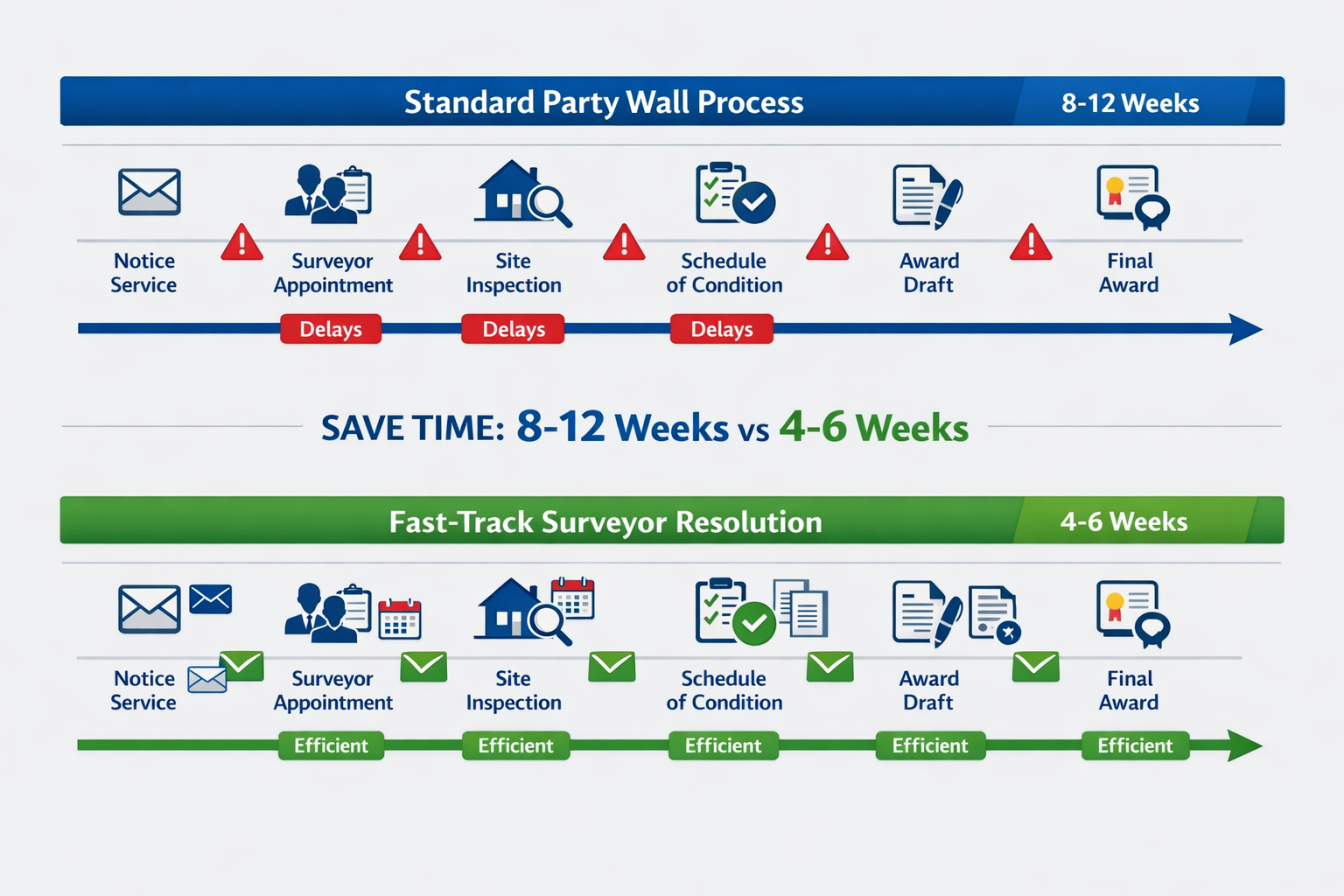
- Strategic surveyor selection and coordination can reduce award timelines from 12 weeks to as little as 4-6 weeks in straightforward cases
- Proactive communication and pre-prepared documentation are the most effective tactics for fast-tracking party wall awards in 2026's delay-prone construction environment
- Understanding the dissension notice requirements prevents procedural errors that could invalidate the entire process and restart timelines
- Agreed surveyors offer the fastest resolution route, often completing awards 30-40% quicker than separate surveyor appointments
Understanding Dissension Notices Under the Party Wall Act
What Constitutes a Dissension Notice?
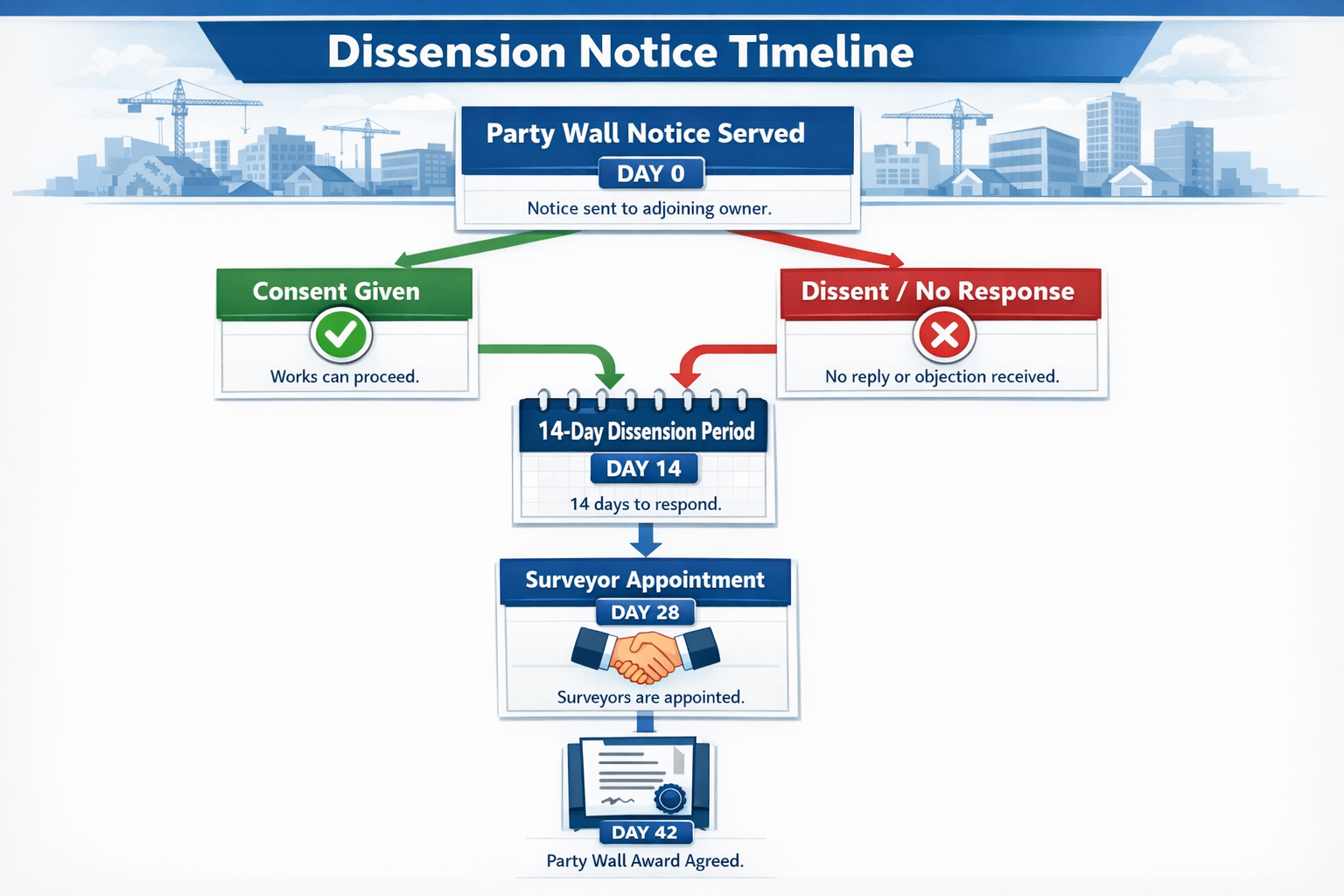
A dissension notice isn't actually a formal document that property owners serve—rather, it's the legal state that occurs when an adjoining owner either explicitly refuses consent to proposed works or fails to respond within the statutory 14-day period after receiving a party wall notice. This distinction confuses many building owners who expect to receive a formal "dissension document" from their neighbours.
According to the Party Wall etc. Act 1996, dissension occurs automatically in two scenarios:
- Express dissent: The adjoining owner sends written refusal of consent within 14 days
- Deemed dissent: The adjoining owner provides no response whatsoever within the 14-day statutory period [2]
Once dissension occurs—whether express or deemed—the building owner must initiate the surveyor appointment process immediately. Failure to do so before commencing works constitutes a breach of the Act and can result in injunctions, damages claims, and costly work stoppages [1].
The 14-Day Response Window
The statutory 14-day response period begins the day after the party wall notice is properly served. This timing is critical for project planning in 2026, as many building owners underestimate the cascading delays that occur when adjoining owners don't respond promptly.
Key timeline considerations:
- Day 0: Party wall notice served
- Day 1-14: Adjoining owner response window
- Day 15: Deemed dissent occurs if no response received
- Day 15+: Building owner must appoint surveyor or request agreed surveyor
Understanding these timelines allows building owners to plan proactively. For example, if you're planning works in North London with a target construction start date, you should serve notices at least 8-10 weeks in advance to accommodate potential dissension and award preparation.
Common Reasons for Dissension
Adjoining owners dissent for various reasons, not all of which indicate genuine opposition to the works:
Legitimate concerns:
- ⚠️ Worry about structural damage to their property
- 📋 Desire for professional documentation of existing conditions
- 💰 Concerns about noise, dust, and disruption
- 🏠 Previous negative experiences with building works
Procedural reasons:
- ❓ Uncertainty about what the notice means
- 📝 Preference for formal documentation over informal agreement
- 👨⚖️ Advice from solicitors to "never consent without a surveyor"
- ⏰ Simply being away or too busy to respond
Importantly, dissension doesn't necessarily mean conflict. Many experienced property owners in areas like South London routinely dissent to ensure proper documentation, even when they have no objection to the proposed works. This strategic dissension actually protects both parties by creating a formal record and professional oversight.
The Surveyor Appointment Process: Your Fast-Track Gateway
Three Surveyor Appointment Options
When dissension occurs, the Party Wall Act provides three distinct surveyor appointment routes, each with different implications for timeline and cost:
| Appointment Type | Description | Typical Timeline | Cost Implications |
|---|---|---|---|
| Agreed Surveyor | Single surveyor acts for both parties | 4-6 weeks | Most cost-effective |
| Separate Surveyors | Each party appoints their own surveyor | 8-12 weeks | Higher costs (two fees) |
| Third Surveyor | Appointed to resolve surveyor disputes | 12+ weeks | Highest costs (three fees) |
The agreed surveyor route represents the fastest path to a party wall award and is increasingly popular in 2026 as property owners seek to minimize delays and costs. However, it requires trust and cooperation from both parties.
Appointing an Agreed Surveyor: The Fastest Route
An agreed surveyor acts impartially for both the building owner and adjoining owner, preparing a single award that protects both parties' interests. This approach offers several advantages:
✅ Speed: Single surveyor means no coordination delays between separate professionals
✅ Cost: One surveyor fee split between parties (building owner typically pays)
✅ Efficiency: Streamlined communication and decision-making
✅ Simplicity: Single schedule of condition and award document
To appoint an agreed surveyor, the building owner should:
- Propose a qualified surveyor in writing to the adjoining owner within days of dissension
- Provide surveyor credentials including RICS membership and party wall experience
- Confirm fee structure and payment responsibility upfront
- Obtain written agreement from the adjoining owner accepting the appointment
Many building owners in 2026 proactively identify potential agreed surveyors before even serving notices, allowing them to move immediately when dissension occurs.
Separate Surveyor Appointments: When Necessary
When adjoining owners refuse an agreed surveyor—often due to previous disputes, high-value properties, or complex works—separate surveyor appointments become necessary. Each party appoints their own surveyor, who then work together to produce a joint award.
The separate surveyor process:
- Building owner appoints their surveyor (the building owner's surveyor)
- Adjoining owner appoints their surveyor (the adjoining owner's surveyor)
- Both surveyors jointly select a third surveyor (in case of future disputes)
- Surveyors coordinate inspections and prepare joint award
- Both surveyors sign the final award document
While this process takes longer, it provides additional protection for adjoining owners who may feel vulnerable or suspicious about the proposed works. In Central London high-value developments, separate surveyors are often the norm rather than the exception.
The Third Surveyor: Dispute Resolution Mechanism
The third surveyor serves as an arbitrator when the two appointed surveyors cannot agree on specific aspects of the award. Importantly, the third surveyor is selected at the beginning of the process by the two appointed surveyors, but only becomes actively involved if a dispute arises [2].
Third surveyor involvement typically adds 4-8 weeks to the process and significantly increases costs, as all three surveyors charge fees. Common disputes requiring third surveyor resolution include:
- Disagreement over the scope of protective works required
- Disputes about working hours or access arrangements
- Conflicts regarding the schedule of condition findings
- Disagreements over compensation for loss or damage
Experienced surveyors in 2026 employ various strategies to avoid third surveyor referrals, recognizing that such escalations rarely benefit either party.

Dissension Notices and Surveyor Resolutions: Strategies to Expedite Awards
Pre-Emptive Surveyor Engagement
The most effective fast-track strategy in 2026 involves engaging a party wall surveyor before serving notices. This proactive approach allows surveyors to:
📋 Review notice drafting to ensure compliance and clarity
🗓️ Plan timeline backwards from construction start date
🏗️ Assess work complexity and likely adjoining owner concerns
📞 Prepare communication strategies for different response scenarios
📸 Schedule preliminary inspections immediately upon dissension
Building owners working with experienced surveyors in areas like West London report award completion times 30-40% faster than those who wait until after dissension to engage professional help.
Streamlined Documentation and Schedules of Condition
The schedule of condition represents one of the most time-consuming elements of award preparation. Progressive surveyors in 2026 employ several techniques to accelerate this process:
Digital documentation tools:
- 📱 Tablet-based inspection apps with instant photo annotation
- 🎥 Video walkthroughs for comprehensive condition records
- ☁️ Cloud-based sharing for immediate client and surveyor access
- 🤖 AI-assisted defect categorization and description
Focused inspection protocols:
- Concentrating on areas genuinely at risk from the proposed works
- Using standardized condition templates for common property types
- Conducting joint inspections when possible to eliminate duplication
- Pre-scheduling inspection appointments before dissension occurs
These modern approaches can reduce schedule preparation time from 3-4 weeks to as little as 5-7 days in straightforward cases.
Proactive Communication Protocols
Communication delays represent the single largest cause of extended award timelines in 2026. Surveyors who implement structured communication protocols consistently deliver faster awards:
Effective communication strategies:
- 48-hour response commitments: All parties agree to respond to surveyor communications within two business days
- Scheduled progress calls: Weekly 15-minute check-ins to address concerns before they become obstacles
- Digital-first documentation: Email and cloud sharing rather than postal mail
- Pre-emptive concern addressing: Anticipating and addressing likely objections in initial communications
- Clear milestone tracking: Shared timeline documents showing progress and next steps
Building owners can facilitate these protocols by ensuring their own responsiveness and encouraging adjoining owners to engage constructively with the process. Understanding how to respond to party wall notices helps all parties participate effectively.
Template Awards and Standardized Conditions
Experienced party wall surveyors maintain libraries of template awards tailored to common work types. While each award must be customized to specific circumstances, starting from proven templates dramatically accelerates drafting:
Common template categories:
- Loft conversions with steel beam insertions
- Rear extensions with foundation excavations
- Basement excavations adjacent to party walls
- Chimney breast removal and making good
- Party wall repairs and rebuilding
These templates include pre-drafted standard conditions covering access, working hours, damage procedures, and dispute resolution—elements that rarely vary significantly between projects. Customization then focuses on property-specific details, schedules of condition, and special requirements.
In 2026, digital template systems allow surveyors to generate first-draft awards within 2-3 days of completing inspections, compared to 7-10 days for fully bespoke drafting.
Coordinating Multiple Adjoining Owners
Projects involving multiple adjoining owners—common in terraced properties throughout East London—present unique coordination challenges. Fast-track strategies include:
Simultaneous processing:
- Serving all notices on the same day
- Proposing the same agreed surveyor to all parties
- Conducting all inspections within a 48-hour window
- Drafting a single master award with party-specific schedules
Grouped communication:
- Holding joint meetings with all adjoining owners when feasible
- Sharing common information simultaneously to prevent information asymmetry
- Creating FAQ documents addressing concerns likely shared by multiple parties
Staggered approach:
- Prioritizing the most directly affected adjoining owners
- Obtaining awards sequentially based on work phasing
- Using early awards as templates for subsequent ones
The coordinated approach requires more intensive upfront planning but can reduce overall timeline by 40-50% compared to sequential processing of each adjoining owner relationship.
Navigating Common Obstacles and Delay Tactics
Unresponsive Adjoining Owners
When adjoining owners fail to respond to surveyor appointment requests after dissension, building owners face frustrating delays. The Act provides mechanisms to address this:
After 10 days of non-response to surveyor appointment request, the building owner may appoint a surveyor on behalf of the adjoining owner [2]. This surveyor acts for the adjoining owner's interests despite being appointed by the building owner—a safeguard that ensures the process continues even without active participation.
This provision prevents indefinite delays but should be used carefully:
⚠️ Document all communication attempts thoroughly before invoking this provision
📧 Use multiple contact methods (post, email, hand delivery) to demonstrate good faith
⏰ Allow reasonable time for responses, especially if adjoining owners are elderly or away
📝 Notify the appointed surveyor of the circumstances of their appointment
Surveyor Selection Disputes
Disagreements about surveyor qualifications or independence occasionally arise. In 2026, building owners can minimize these disputes by:
✅ Proposing RICS-registered surveyors with demonstrable party wall experience
✅ Offering multiple surveyor options to adjoining owners
✅ Providing transparent fee information upfront
✅ Selecting surveyors with no prior relationship to either party
✅ Avoiding surveyors who also provide other services to the building owner
When adjoining owners object to proposed surveyors without reasonable grounds, their own appointed surveyor can help mediate these concerns and move the process forward.
Award Objections and Amendments
Parties have 14 days to appeal an award to the county court after service [2]. While rare, award appeals create significant delays. Surveyors minimize appeal risk by:
- Consulting parties throughout the award preparation process
- Explaining all conditions clearly in plain language
- Addressing concerns proactively before finalizing the award
- Including reasonable conditions that balance both parties' interests
- Documenting the rationale for all significant decisions
When objections arise, experienced surveyors often resolve them through minor amendments rather than formal appeals, saving weeks or months of delay.
Cost Considerations and Fee Structures
Understanding Party Wall Surveyor Fees
Party wall surveyor fees in 2026 typically range from £700-£2,500+ depending on work complexity, property value, and geographic location. The building owner bears responsibility for all reasonable surveyor fees under the Act—including the adjoining owner's surveyor fees [3].
Typical fee structures:
- Agreed surveyor: £1,000-£1,800 for straightforward residential works
- Separate surveyors: £1,400-£3,000+ combined (both surveyors)
- Complex projects: £3,000-£7,000+ for basement excavations, multiple parties, or high-value properties
Understanding how to keep party wall costs down while maintaining quality service is essential for budget-conscious building owners.
Fast-Track Services and Premium Fees
Some surveyors offer expedited service options with premium fees, typically 20-40% above standard rates. These services include:
- 🚀 Guaranteed award completion within 3-4 weeks
- 📱 24-48 hour response commitments
- 📅 Weekend and evening inspection availability
- ⚡ Priority scheduling over standard appointments
For building owners facing penalty clauses in construction contracts or seasonal weather windows, these premium services often prove cost-effective compared to project delays.
Fee Disputes and Resolution
Fee disputes occasionally arise when adjoining owners appoint surveyors charging premium rates. Building owners concerned about fee reasonableness should:
- Request fee estimates before work begins
- Compare against market rates for similar services
- Question specific charges that seem excessive
- Seek third surveyor determination if necessary
The Act requires fees to be "reasonable"—not necessarily the lowest available, but proportionate to the work complexity and time required.
Legal Framework and Compliance Requirements
Statutory Obligations Under the Party Wall Act
The Party Wall etc. Act 1996 creates specific obligations that building owners must fulfill:
📋 Serve proper notice using prescribed forms and information
⏰ Respect statutory timelines for notice periods and responses
👷 Obtain an award before commencing notifiable works
🔍 Allow access for inspections as specified in the award
💰 Pay reasonable costs including surveyor fees and making good
Failure to comply with these obligations can result in legal action, work stoppages, and liability for damage—even damage that would have occurred anyway with proper procedures [1].
Consequences of Proceeding Without an Award
Building owners who commence works before obtaining an award face serious risks:
⚖️ Injunctions: Adjoining owners can obtain court orders stopping all work
💷 Damages: Liability for any damage, regardless of whether works caused it
🔨 Making good: Forced to remedy all defects at own expense
⏱️ Delays: Court proceedings adding months to project timelines
💰 Legal costs: Bearing both parties' legal expenses
In 2026's litigious environment, proceeding without proper awards is increasingly risky. Even when carrying out works seems straightforward, formal compliance protects building owners from disproportionate liability.
Award Validity and Enforcement
A properly prepared party wall award is legally binding on both parties and remains valid indefinitely for the specified works. Awards typically include:
- Detailed description of permitted works
- Access rights and working hours
- Schedule of condition documenting pre-work property state
- Procedures for damage claims and dispute resolution
- Surveyor contact information for ongoing oversight
Awards can be enforced through county court proceedings if either party fails to comply with specified conditions.
Practical Case Studies: Fast-Track Success Stories
Case Study 1: Terraced House Loft Conversion
Scenario: Building owner in a terraced property needed to insert steel beams into party walls for a loft conversion. Two adjoining owners, tight 6-week timeline before construction start.
Fast-track approach:
- Served notices with pre-identified agreed surveyor proposal
- Both adjoining owners accepted agreed surveyor within 5 days
- Surveyor conducted both inspections on same day
- Digital schedule of condition completed within 48 hours
- Template-based award issued 12 days after dissension
Result: Award obtained in 17 days total, construction commenced on schedule, no disputes or damage claims.
Case Study 2: Basement Excavation with Separate Surveyors
Scenario: Major basement excavation in high-value property, adjoining owner insisted on separate surveyors due to previous disputes with building owner.
Fast-track approach:
- Both surveyors agreed to weekly coordination calls
- Joint inspection scheduled within 3 days of appointments
- Surveyors used shared cloud folder for draft exchange
- Building owner maintained responsive communication
- Minor disagreements resolved through compromise rather than third surveyor referral
Result: Award completed in 6 weeks despite separate surveyors—4 weeks faster than typical separate surveyor timeline.
Case Study 3: Multiple Adjoining Owners
Scenario: Mid-terrace property with works affecting four adjoining owners (two side, two rear), mixed responses including one deemed dissent.
Fast-track approach:
- Single agreed surveyor accepted by three parties
- Fourth party's surveyor appointed after 10-day non-response
- All four inspections conducted within 72-hour window
- Master award with party-specific schedules
- Simultaneous service to all parties
Result: Four awards obtained in 5 weeks total, avoiding the 12-16 week timeline of sequential processing.
Conclusion: Mastering the Fast-Track Path
Dissension Notices and Surveyor Resolutions: Fast-Track Paths to Party Wall Awards requires strategic planning, proactive communication, and professional expertise. In 2026's delay-prone construction environment, understanding how to navigate the dissension process efficiently can mean the difference between projects that proceed on schedule and those that face costly months-long delays.
The key principles for fast-tracking party wall awards include:
🎯 Engage surveyors before serving notices to plan timelines and prepare documentation
🤝 Pursue agreed surveyor appointments whenever possible for maximum efficiency
📱 Leverage digital tools for documentation, communication, and coordination
⚡ Implement structured communication protocols with 48-hour response commitments
📋 Use template awards customized to specific circumstances
🏗️ Coordinate multiple parties simultaneously rather than sequentially
For building owners facing dissension, remember that this isn't necessarily a negative outcome—it simply activates the formal resolution process that protects all parties. With the right surveyor and approach, dissension can lead to awards in as little as 4-6 weeks for straightforward cases.
Next Steps
If you're planning building works that may trigger party wall procedures:
- Review your project timeline and work backwards to determine notice service dates
- Identify qualified party wall surveyors in your area before serving notices
- Understand the types of party wall works your project involves
- Prepare for potential dissension by budgeting time and cost for the award process
- Maintain documentation of all communications with adjoining owners
- Consider professional advice for complex projects or multiple adjoining owners
Whether you're a building owner planning works or an adjoining owner responding to notices, understanding the dissension and surveyor resolution process empowers you to navigate party wall procedures efficiently while protecting your interests.
The Party Wall Act provides a robust framework for resolving disputes and protecting property rights—when used strategically, it facilitates rather than hinders construction projects. By mastering the fast-track paths outlined in this guide, you can minimize delays, control costs, and ensure your 2026 building project proceeds smoothly from notice through to award and construction completion.
References
[1] When Is It Too Late To Obtain A Party Wall Award After Work Has Begun – https://www.adamjoseph.co.uk/when-is-it-too-late-to-obtain-a-party-wall-award-after-work-has-begun
[2] If You Cant Agree – https://www.gov.uk/party-walls-building-works/if-you-cant-agree
[3] Party Structure Notice How To Draft Serve And Respond To It – https://www.surveymerchant.com/blog/party-structure-notice-how-to-draft-serve-and-respond-to-it