

Over 73% of party wall disputes in conservation areas involve complications related to heritage restrictions that standard surveyors fail to anticipate. When historic properties share walls in protected zones, the intersection of the Party Wall etc. Act 1996 and conservation legislation creates a complex regulatory landscape that demands specialized knowledge and careful navigation.
Understanding Party Wall Notices in Conservation Areas: Heritage Constraints and Surveyor Specialisms becomes essential when planning construction work on period properties within designated heritage zones. The standard party wall process, while comprehensive, doesn't automatically account for the additional layers of consent, material specifications, and preservation requirements that conservation areas impose. Property owners who proceed without recognizing these constraints often face costly delays, enforcement action, and strained neighbor relations.
Key Takeaways
- Conservation areas require dual compliance: Party wall procedures must run parallel to heritage consent processes, not replace them
- Specialist surveyors save time and money: Conservation-experienced professionals prevent costly mistakes by understanding material restrictions and heritage requirements from the outset
- Modified awards protect historic features: Party wall agreements in conservation areas include specific clauses preserving architectural elements and mandating traditional construction methods
- Timeline extensions are standard: Expect 4-6 weeks additional processing time for heritage consultations beyond normal party wall notice periods
- Documentation requirements double: Both party wall schedules of condition and heritage impact assessments become necessary for most works
Understanding the Dual Regulatory Framework
The Party Wall Act Foundation
The Party Wall etc. Act 1996 establishes the baseline requirements for notifying adjoining owners when construction work affects shared structures. Standard procedures require serving party wall notices at least two months before commencing work on party structures or one month for boundary work [1][2].
These timelines represent the minimum legal requirement, but conservation areas add substantial complexity. The Act itself makes no distinction for heritage properties, which creates a common misconception that standard procedures suffice.
Conservation Area Overlay
Conservation areas receive designation to preserve neighborhoods of special architectural or historic interest. Within these zones, additional planning controls apply to:
- External alterations visible from public spaces
- Demolition of buildings or boundary walls
- Material changes affecting the area's character
- Tree works within conservation boundaries
The critical point: party wall consent and conservation consent are separate legal requirements. Obtaining a party wall award doesn't grant permission to proceed if heritage restrictions apply, and vice versa.
Where the Frameworks Intersect
Common types of party wall works that trigger both regulatory frameworks include:
| Work Type | Party Wall Trigger | Conservation Consideration |
|---|---|---|
| Loft conversion | Structural alterations to party wall | Roof profile changes, dormer visibility |
| Basement excavation | Underpinning within 3-6 meters | Impact on historic foundations, drainage patterns |
| Rear extension | Building on/astride boundary | Materials, design compatibility, heritage character |
| Chimney removal | Alterations to party structure | Loss of historic feature, roofline impact |
| Window replacement | Cutting into party wall | Period-appropriate design, material specifications |
Property owners must navigate both processes simultaneously, which requires coordination between party wall surveyors, conservation officers, and planning authorities.
Heritage Constraints Affecting Party Wall Procedures
Material Specifications and Traditional Methods
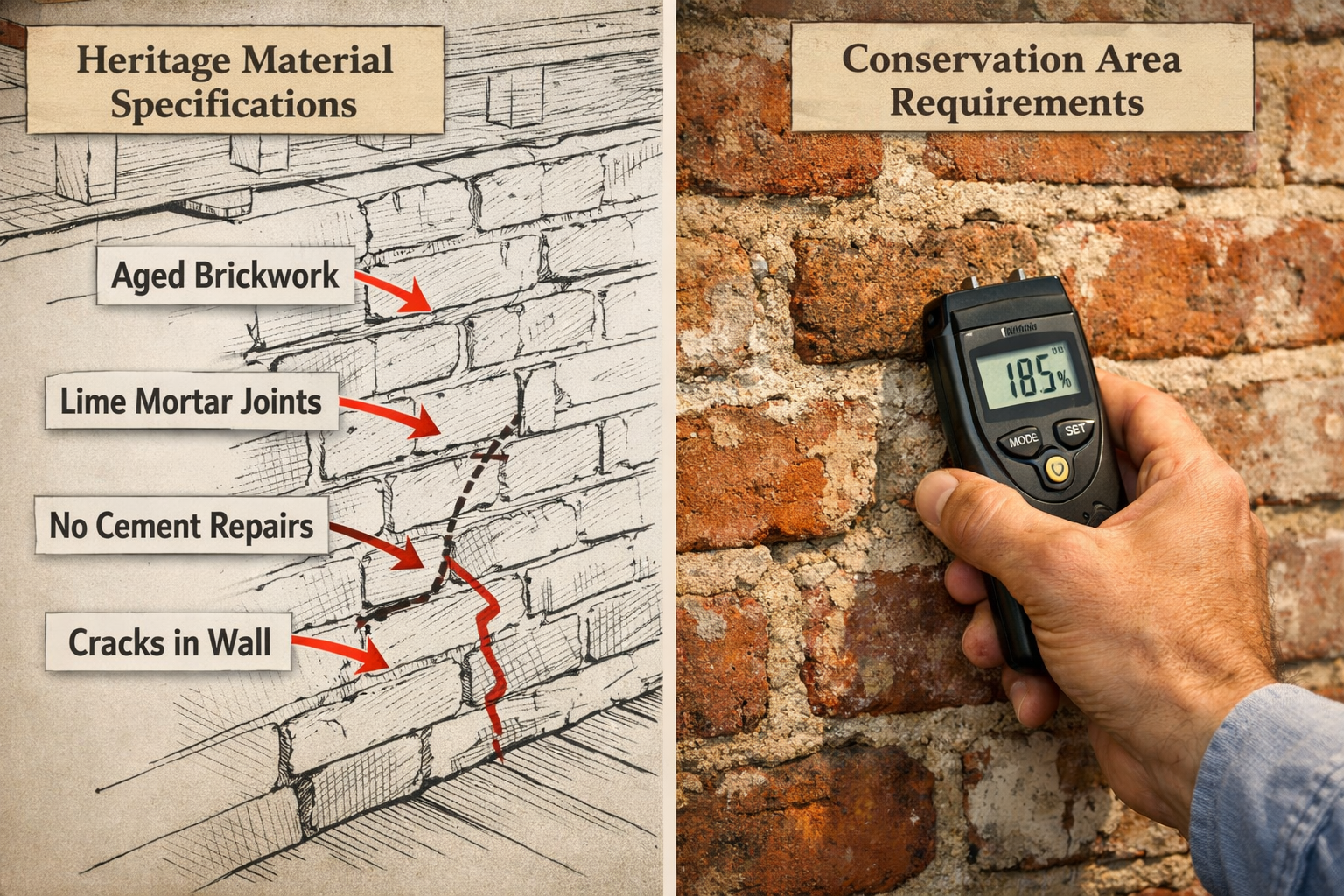
Conservation areas frequently mandate the use of traditional materials and construction techniques to preserve historic character. These requirements directly impact party wall works in several ways:
Lime mortar requirements 🏛️ – Modern cement-based mortars can damage historic brickwork through differential movement and moisture trapping. Conservation officers typically require lime mortar for repointing or repairs to party walls in period properties, which affects:
- Curing times: Lime mortar requires longer setting periods than cement
- Cost implications: Traditional materials and specialist labor increase expenses
- Surveyor specifications: Party wall awards must include specific material requirements
Brick matching obligations – When party wall work involves external alterations, conservation areas demand precise matching of:
- Historic brick dimensions and bonding patterns
- Color, texture, and weathering characteristics
- Reclaimed materials from appropriate periods
A party wall surveyor in Central London working on a Georgian terrace recently documented a case where standard engineering bricks proposed for underpinning were rejected by conservation officers, requiring sourcing of period-appropriate London stock bricks at three times the cost.
Structural Intervention Limitations
Heritage constraints often restrict how work can be performed, not just what materials are used:
Minimal intervention principle – Conservation philosophy prioritizes preserving original fabric. Party wall works must demonstrate:
- Necessity of proposed alterations
- Least damaging methodology
- Reversibility where possible
Traditional joinery preservation – Original timber joists, beams, and structural elements receive protection even when they complicate modern construction. Party wall awards in conservation areas frequently include clauses requiring:
- Retention of historic timbers where structurally viable
- Repair rather than replacement approaches
- Documentation before any removal
Foundation work restrictions – Basement excavations and underpinning near listed buildings or within conservation areas face heightened scrutiny regarding:
- Vibration limits during excavation
- Temporary works methodology
- Monitoring of adjacent historic structures
Aesthetic and Character Considerations
Party wall works that alter external appearance trigger additional conservation requirements:
Roofline integrity 📐 – Loft conversions affecting party walls must maintain:
- Historic roof profiles and pitches
- Traditional materials (slate, clay tiles)
- Minimal visibility from public vantage points
Boundary wall character – Work on party fence walls visible from streets or public spaces requires:
- Height restrictions preserving streetscape
- Coping stone and detailing consistency
- Period-appropriate railings or cappings
A party wall surveyor in North London notes that approximately 40% of party wall awards in conservation areas include specific clauses addressing external appearance, compared to less than 5% in non-designated areas.
Surveyor Specialisms for Conservation Area Works
Essential Qualifications and Experience
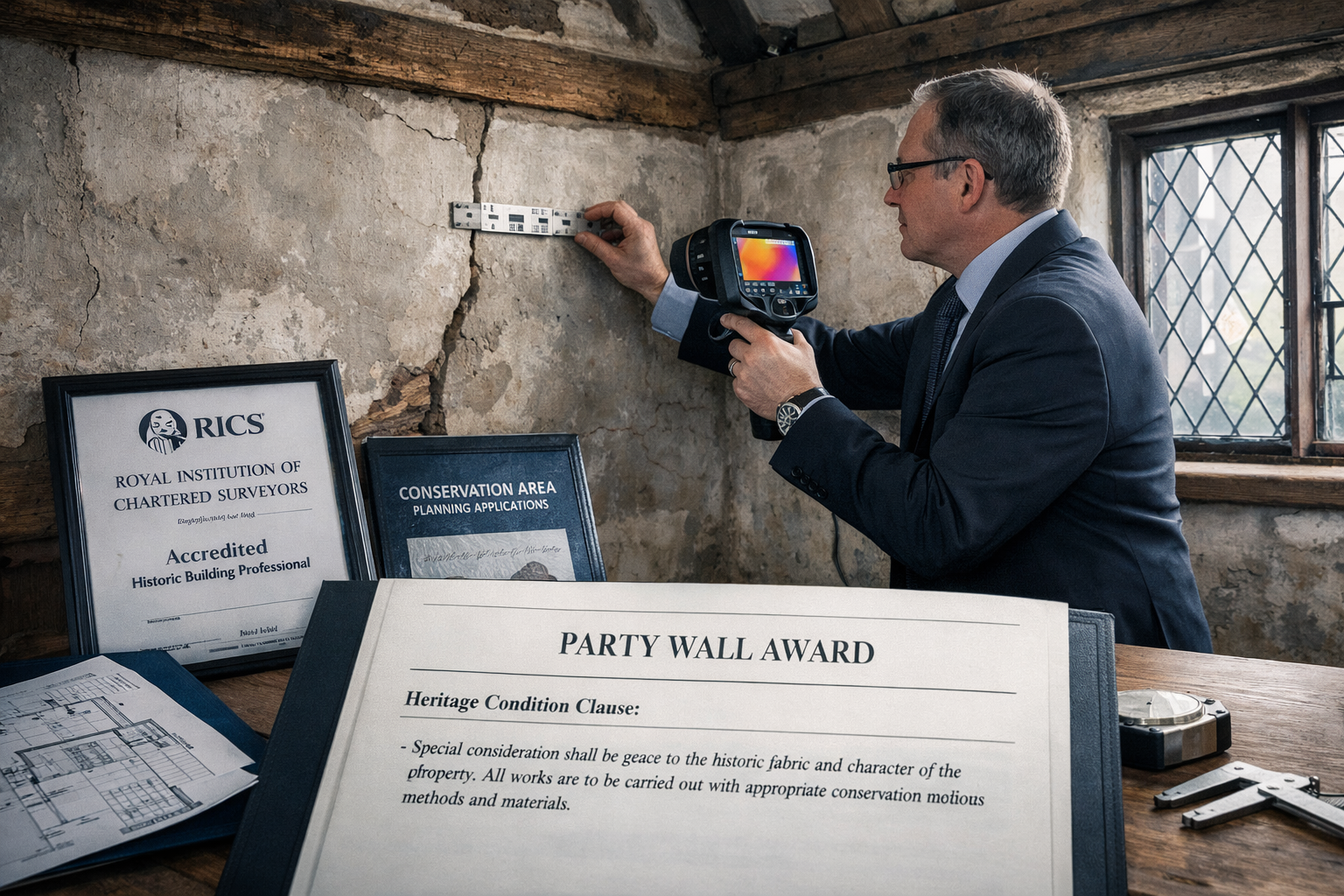
Not all party wall surveyors possess the expertise required for conservation area projects. Property owners should seek professionals with:
Conservation accreditation 🎓 – Formal qualifications demonstrating heritage expertise:
- RICS Building Conservation accreditation
- IHBC (Institute of Historic Building Conservation) membership
- Proven CPD in heritage building techniques
Local authority relationships – Experienced conservation surveyors maintain working relationships with:
- Conservation officers in relevant boroughs
- Planning departments handling heritage applications
- Historic England regional teams
A building owner's surveyor with conservation experience can anticipate objections and design solutions that satisfy both party wall requirements and heritage constraints from the outset.
Material knowledge – Specialist surveyors understand:
- Historic construction methods by period
- Traditional material properties and sourcing
- Compatible modern interventions
The Value of Dual Expertise
Surveyors combining party wall and conservation specialisms deliver significant advantages:
Integrated documentation – A single professional can prepare:
- Party wall notices compliant with statutory requirements [1]
- Heritage statements supporting conservation consent
- Schedules of condition documenting historic fabric
Coordinated timelines – Specialist surveyors sequence processes efficiently:
- Parallel submission of party wall notices and heritage applications
- Anticipation of conservation officer queries
- Realistic programming accounting for both approval tracks
Cost management – Conservation-experienced surveyors help keep party wall costs down by:
- Specifying appropriate materials initially
- Avoiding redesign after conservation rejection
- Negotiating practical solutions with all parties
Red Flags: When Standard Surveyors Fall Short
Several warning signs indicate a surveyor lacks necessary conservation expertise:
⚠️ Generic specifications – Awards that don't reference heritage requirements or traditional materials
⚠️ Unfamiliarity with conservation officers – Inability to name relevant local authority contacts
⚠️ Dismissive attitude – Treating conservation requirements as optional or secondary
⚠️ No heritage portfolio – Lack of demonstrated experience with period properties
Property owners who engage standard surveyors for conservation area work frequently encounter:
- Delayed projects when specifications require revision
- Increased costs from redesign and resubmission
- Neighbor disputes when heritage concerns aren't addressed
- Enforcement action if work proceeds without proper consent
Modified Party Wall Awards Preserving Historical Features
Specific Clauses for Heritage Protection
Party wall awards in conservation areas differ substantially from standard agreements. Specialized clauses address heritage preservation:
Material specifications section – Detailed requirements for:
- Lime mortar mix ratios and suppliers
- Brick types with specific manufacturer references
- Traditional timber species and seasoning standards
- Period-appropriate fixings and hardware
Example clause: "All repointing to party wall shall utilize NHL 3.5 hydraulic lime mortar in 3:1 ratio with sharp sand, matched to existing mortar color. No cement-based products permitted."
Methodology restrictions – Prescriptive requirements governing:
- Hand-raking of joints rather than mechanical grinding
- Vibration limits during excavation work
- Temporary support methodologies
- Working hours respecting residential amenity
Monitoring protocols – Enhanced inspection regimes including:
- Pre-commencement heritage condition surveys
- Interim inspections by conservation professionals
- Post-completion verification of traditional methods
- Photographic documentation at key stages
Case Study: Georgian Terrace Basement Excavation
A party wall surveyor in South London recently managed a complex basement excavation beneath a Grade II listed Georgian townhouse within a conservation area. The modified party wall award included:
Heritage-specific provisions:
- Retention of original 1820s brick foundation walls
- Hand excavation within 1 meter of historic fabric
- Lime-based tanking systems compatible with breathable walls
- Structural engineer with conservation accreditation
- Weekly monitoring reports to conservation officer
Result: The project proceeded without damage to historic features, maintained neighbor consent throughout, and received commendation from the local conservation team for sensitive execution.
Balancing Modern Standards with Historic Character
One of the most challenging aspects involves reconciling contemporary building regulations with heritage preservation:
Thermal performance – Modern insulation requirements can conflict with breathable wall construction. Modified awards might specify:
- Breathable insulation materials (wood fiber, lime hemp)
- Internal insulation approaches preserving external character
- Calculated acceptance of lower U-values for heritage fabric
Structural capacity – Building control requirements for load-bearing capacity sometimes exceed historic construction standards. Solutions include:
- Discreet steel reinforcement within existing sections
- Load distribution through traditional timber plates
- Engineering justification for retained historic elements
Fire safety – Updated fire regulations must be achieved without compromising character:
- Intumescent treatments for historic timbers
- Fire-resistant plasterboard behind retained lath-and-plaster
- Compartmentation respecting room layouts
A party wall surveyor in West London emphasizes that successful conservation area awards "find the middle ground where statutory safety requirements meet heritage preservation through creative specification and methodology."
Navigating the Combined Approval Process
Timeline Considerations
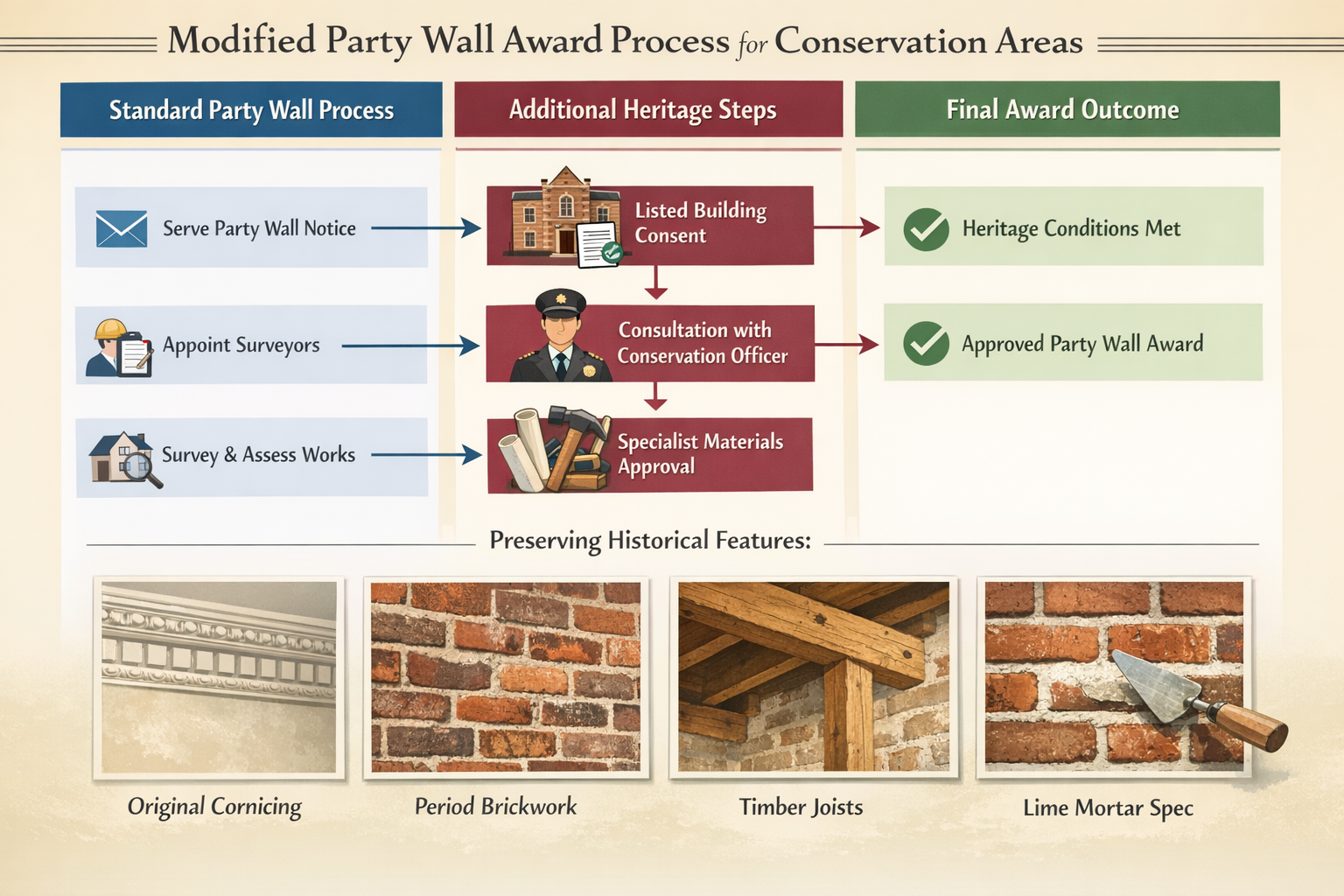
Property owners must plan for extended approval periods when conservation constraints apply:
Standard party wall timeline [2]:
- 2 months notice for party structure work
- 1 month notice for boundary work
- 14 days for adjoining owner response
Conservation area additions:
- 3-6 weeks for heritage officer review
- 21 days public consultation (if required)
- Additional time for Listed Building Consent (if applicable)
Realistic total timeline: 4-6 months from initial notice to commencement for complex conservation area projects, compared to 2-3 months for standard party wall works.
Coordinating Multiple Stakeholders
Successful projects require managing relationships with:
Primary parties:
- Building owner and adjoining owners
- Building owner's surveyor and adjoining owner's surveyor
- Agreed surveyor (if appointed)
Heritage authorities:
- Local authority conservation officer
- Planning department heritage team
- Historic England (for Grade I/II* properties)
Technical consultants:
- Structural engineers with conservation experience
- Architects familiar with heritage applications
- Specialist contractors for traditional methods
A party wall surveyor in East London recommends early consultation meetings bringing all parties together before formal notices are served, allowing heritage concerns to inform party wall specifications from the outset.
Common Pitfalls and How to Avoid Them
Pitfall #1: Sequential rather than parallel processing ❌
Many property owners complete party wall procedures before addressing conservation requirements, only to discover heritage restrictions necessitate redesign.
Solution: Engage a conservation-experienced surveyor who initiates both processes simultaneously, ensuring party wall awards incorporate heritage requirements.
Pitfall #2: Inadequate documentation ❌
Standard schedules of condition may not capture heritage features adequately, leading to disputes about damage to historic fabric.
Solution: Commission comprehensive heritage condition surveys documenting:
- Historic material composition and condition
- Period features and architectural details
- Existing defects and vulnerabilities
- Photographic and written records
Pitfall #3: Cost underestimation ❌
Budgets based on standard construction methods fail to account for traditional material costs and specialist labor.
Solution: Obtain detailed quotations from contractors experienced in conservation work, factoring in:
- Premium for traditional materials (often 30-50% higher)
- Specialist labor rates for heritage craftspeople
- Extended timelines affecting preliminary costs
- Enhanced monitoring and inspection requirements
Pitfall #4: Neighbor relations breakdown ❌
Adjoining owners in conservation areas often have heightened concerns about heritage impact and may object more readily.
Solution: Proactive communication demonstrating:
- Commitment to heritage preservation
- Detailed methodology protecting shared historic fabric
- Professional team with conservation credentials
- Willingness to address aesthetic concerns
Understanding what party wall notices are and how to respond becomes even more critical in conservation contexts where neighbor cooperation is essential.
Practical Guidance for Property Owners
When Planning Works in Conservation Areas
Step 1: Early assessment 🔍
Before committing to a project:
- Confirm conservation area designation status
- Check for listed building designation (property or adjacent)
- Review local authority conservation area appraisal
- Identify Article 4 directions removing permitted development rights
Step 2: Engage specialist professionals
Assemble a team with demonstrated conservation experience:
- Party wall surveyor with heritage accreditation
- Architect familiar with conservation applications
- Structural engineer experienced in historic buildings
- Contractor with traditional skills portfolio
Step 3: Pre-application consultation
Before serving formal notices:
- Meet with conservation officer to discuss proposals
- Obtain preliminary feedback on heritage acceptability
- Adjust designs to address conservation concerns
- Prepare heritage statement supporting applications
Step 4: Integrated notice serving
Coordinate timing of:
- Party wall notices to adjoining owners
- Planning applications (if required)
- Listed building consent applications (if applicable)
- Building control submissions
Step 5: Award negotiation
Ensure party wall awards include:
- Heritage-specific material specifications
- Traditional methodology requirements
- Enhanced monitoring provisions
- Contingency clauses for unexpected historic fabric
For Adjoining Owners Receiving Notices
If you're an adjoining owner in a conservation area:
Understand your rights 📋
The Party Wall Act protects your interests, but conservation designation provides additional grounds for concern:
- Heritage impact on shared historic fabric
- Appropriateness of proposed materials
- Long-term preservation of character
- Precedent for future works
Appoint an experienced surveyor
Your adjoining owner's surveyor should:
- Understand conservation requirements
- Recognize heritage vulnerabilities
- Negotiate protective specifications
- Ensure adequate monitoring provisions
Request heritage documentation
Beyond standard party wall information, ask for:
- Heritage statement or impact assessment
- Conservation officer correspondence
- Material specifications and sourcing
- Contractor conservation experience evidence
Consider collective benefit
Conservation area works often benefit all properties by:
- Preserving shared historic character
- Maintaining property values
- Preventing deterioration of heritage fabric
- Setting positive precedents for sympathetic alterations
While you can't refuse consent solely on heritage grounds (the Act doesn't provide that right), you can ensure the party wall award includes robust protections for historic features.
Legislative Developments in 2026
Recent developments affecting Party Wall Notices in Conservation Areas: Heritage Constraints and Surveyor Specialisms include:
Enhanced PRS compliance 🏢
The Renters' Rights Act implementation in 2026 has increased party wall notice requirements for private rented sector properties undergoing compliance works [4]. Conservation area landlords face particular challenges balancing:
- Mandatory property condition improvements
- Heritage preservation requirements
- Tenant rights during works
- Party wall obligations to neighbors
Digital submission platforms
Several London boroughs have introduced integrated digital portals in 2026 allowing simultaneous submission of:
- Party wall notices
- Conservation area consent applications
- Planning applications
- Building control notifications
This streamlining reduces administrative burden but requires careful coordination to ensure consistency across submissions.
Increased scrutiny of basement excavations
Following structural concerns in several conservation areas, local authorities have tightened requirements for basement works affecting historic terraces, including:
- Mandatory third-party monitoring by conservation-accredited structural engineers
- Enhanced party wall bond requirements
- Stricter vibration limits during excavation
- Longer notice periods for deep excavations
Property owners planning basement extensions in conservation areas should anticipate additional scrutiny and documentation requirements beyond standard party wall procedures.
Conclusion
Party Wall Notices in Conservation Areas: Heritage Constraints and Surveyor Specialisms represents a complex intersection of property law and heritage preservation that demands specialized expertise and careful navigation. The dual regulatory framework—combining Party Wall Act requirements with conservation legislation—creates challenges that standard procedures and generalist surveyors cannot adequately address.
Success in conservation area party wall projects depends on several critical factors:
✅ Early engagement with conservation-experienced professionals who understand both regulatory frameworks
✅ Integrated planning that coordinates party wall procedures with heritage consent processes from the outset
✅ Appropriate specifications incorporating traditional materials and methods that satisfy conservation requirements
✅ Enhanced documentation capturing historic fabric condition and heritage significance
✅ Realistic budgeting accounting for premium costs associated with conservation-appropriate approaches
✅ Proactive communication with adjoining owners, conservation officers, and technical consultants
The modified party wall awards that result from this specialized approach provide robust protection for historic features while enabling necessary works to proceed. By preserving architectural heritage through carefully specified interventions, property owners fulfill their stewardship responsibilities while maintaining positive neighbor relations and regulatory compliance.
Next Steps
For property owners planning works in conservation areas:
- Verify designation status through your local authority planning department
- Engage a conservation-experienced party wall surveyor before finalizing designs
- Schedule pre-application consultation with conservation officers
- Budget appropriately for traditional materials and specialist labor
- Allow extended timelines for combined approval processes
For adjoining owners receiving notices in conservation areas:
- Appoint a surveyor with heritage expertise to protect your interests
- Request comprehensive documentation including heritage assessments
- Ensure the award includes specific protections for historic fabric
- Participate constructively in preserving shared architectural heritage
The investment in specialist expertise and enhanced procedures pays dividends through smoother approvals, preserved historic character, and avoided disputes. As conservation areas continue to evolve in 2026, the importance of understanding Party Wall Notices in Conservation Areas: Heritage Constraints and Surveyor Specialisms will only increase for property owners and professionals navigating this demanding but rewarding field.
For expert guidance on party wall matters in heritage contexts, contact experienced professionals who can provide the specialized knowledge your conservation area project demands.
References
[1] How To Serve A Party Wall Notice – https://onlinearchitecturalservices.com/how-to-serve-a-party-wall-notice/
[2] Understanding Party Wall Act What Homeowners Need Know Before Renovating – https://www.partywallslimited.com/blog/understanding-party-wall-act-what-homeowners-need-know-before-renovating
[4] Party Wall Notice Requirements For Prs Database Compliance Works Surveyor Tactics Post Renters Rights Act Registration In 2026 – https://nottinghillsurveyors.com/blog/party-wall-notice-requirements-for-prs-database-compliance-works-surveyor-tactics-post-renters-rights-act-registration-in-2026