


Recent industry data reveals that building owners who opt for a single agreed surveyor can reduce their party wall procedure costs by up to 50% compared to separate surveyor appointments, with fees ranging from £900-£2,700 versus £1,800-£5,400 respectively.[2] This substantial financial difference has prompted many property owners to reconsider their approach to party wall matters in 2026, particularly as the Royal Institution of Chartered Surveyors (RICS) updates its guidance to emphasize statutory independence and impartiality.
Understanding the nuances of Joint Appointments of Party Wall Surveyors: Cost Savings and Impartiality Benefits in 2026 has become essential for anyone planning building work that affects shared walls, boundaries, or structures. Whether extending a property, excavating near a neighbour's foundation, or undertaking significant renovations, the choice between appointing a single agreed surveyor or separate surveyors carries significant financial and practical implications.

Key Takeaways
- 💰 Joint surveyor appointments typically cost 50% less than separate surveyor arrangements, with fees ranging from £900-£2,700 compared to £1,800-£5,400
- ⚖️ All party wall surveyors have a statutory duty to act impartially under the Party Wall etc. Act 1996, regardless of who appoints or pays them
- ⚡ Agreed surveyors enable faster resolution by eliminating communication layers and reducing the risk of third surveyor escalation
- 🔍 RICS guidance updates in 2026 emphasize the personal and statutory nature of surveyor appointments, addressing jurisdictional concerns
- 🤝 Strategic negotiation and proper surveyor selection can maximize both cost efficiency and protection for all parties involved
Understanding Joint Appointments of Party Wall Surveyors: Cost Savings and Impartiality Benefits in 2026
What Is an Agreed Surveyor Appointment?
Under the Party Wall etc. Act 1996, when a building owner serves a party wall notice on their neighbour, both parties have the right to appoint surveyors to oversee the works and protect their interests. An agreed surveyor (also called a joint appointment) occurs when both the building owner and adjoining owner consent to appointing the same professional to act for both parties.
This single surveyor takes on the responsibilities that would otherwise be divided between two separate professionals. They prepare the party wall award, conduct inspections, document the condition of properties through a schedule of condition, and resolve any disputes that arise during the works.
The agreed surveyor arrangement represents a streamlined approach that can deliver substantial benefits when both parties trust the appointed professional's competence and impartiality.
The Legal Framework and Statutory Duties
The Party Wall etc. Act 1996 establishes clear requirements for surveyor conduct, regardless of appointment type. All party wall surveyors must act impartially and make decisions based on the statutory framework rather than the preferences of whoever appointed them.[1]
This statutory duty means that:
- Surveyors cannot simply advocate for their appointing party's wishes
- Decisions must protect both properties and comply with legislation
- Awards must be fair, reasonable, and legally sound
- Professional standards override client instructions
Recent RICS guidance emphasizes that a party wall surveyor's appointment is personal and statutory, independent of traditional client-professional relationships.[5] This distinction addresses concerns where awards have been challenged due to surveyors acting without proper jurisdiction or failing to maintain independence.
The Financial Case for Joint Appointments of Party Wall Surveyors: Cost Savings and Impartiality Benefits in 2026
Dramatic Cost Reductions Through Single Appointments
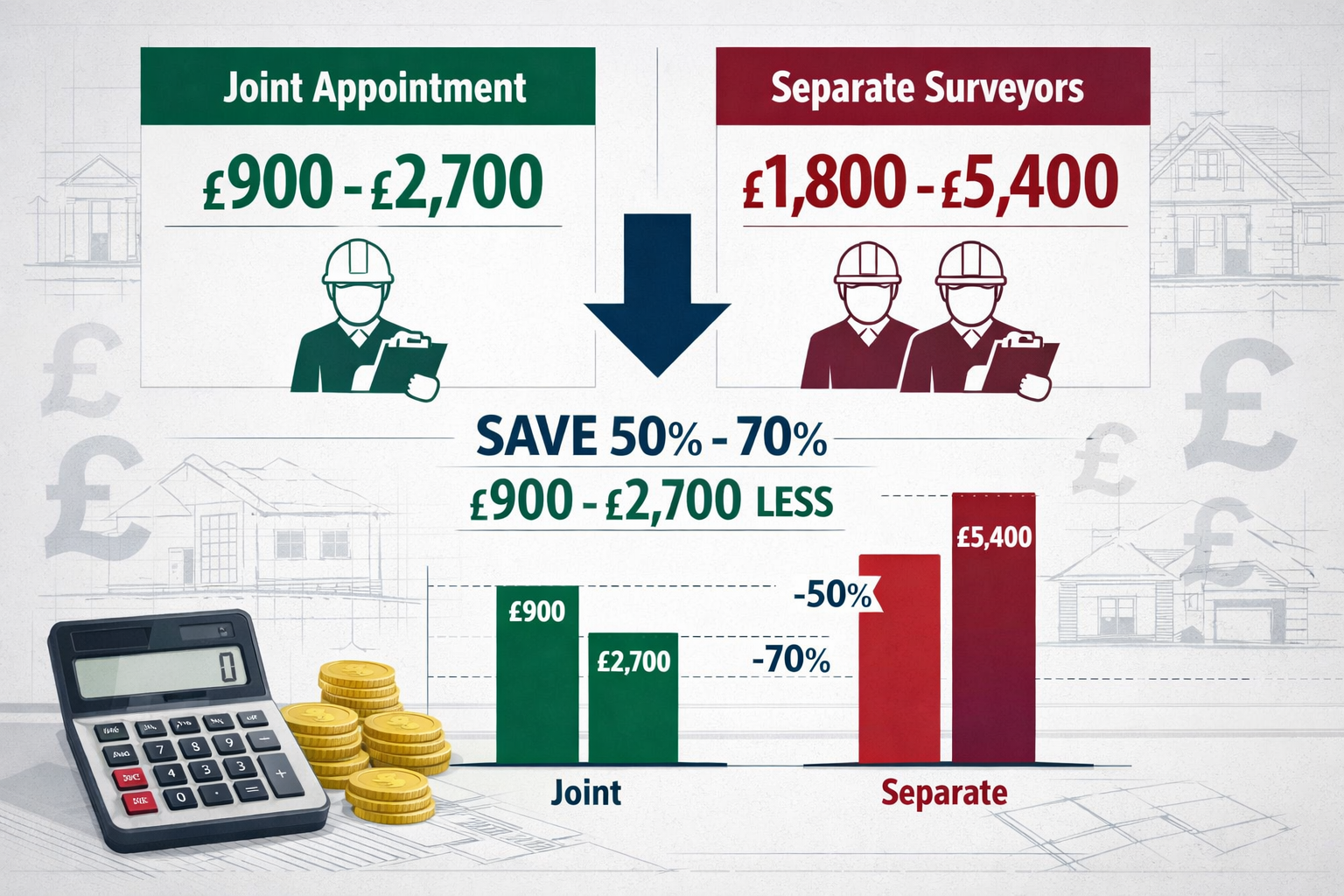
The most compelling argument for agreed surveyor appointments lies in the substantial cost savings. According to comprehensive industry data, the fee structures differ dramatically:
| Appointment Type | Cost Range | Who Pays |
|---|---|---|
| Agreed Surveyor | £900 – £2,700 | Building owner |
| Separate Surveyors | £1,800 – £5,400 | Building owner (both fees) |
| Third Surveyor Addition | Additional £1,500+ | Party whose surveyor caused escalation |
The building owner bears the full cost of party wall procedures, making the financial incentive for joint appointments particularly strong.[2] For straightforward projects like single-storey extensions or loft conversions, an agreed surveyor might charge £900-£1,500, while separate surveyors would cost £1,800-£3,000 for the same work.
For more complex projects involving structural work, excavations, or multiple types of party wall works, the savings become even more pronounced. A project that might cost £1,500-£2,700 with an agreed surveyor could escalate to £3,000-£5,400 with separate appointments.
Avoiding the Third Surveyor Trap
One often-overlooked financial benefit of agreed surveyor appointments is the elimination of third surveyor risk. When two separate surveyors cannot reach agreement on specific matters, they must jointly appoint a third surveyor to resolve the dispute.[4]
This third surveyor mechanism adds significant costs:
- ⚠️ Third surveyor fees typically start at £1,500 and increase with complexity
- 📄 Additional administrative costs for coordinating three professionals
- ⏱️ Extended timelines leading to project delays and associated costs
- 💷 The party whose surveyor's unreasonable position caused the escalation typically bears these additional fees
With an agreed surveyor appointment, this escalation pathway simply doesn't exist. The single surveyor makes decisions that both parties must accept (subject to appeal through the courts), providing cost certainty from the outset.[1]
Hidden Cost Benefits Beyond Surveyor Fees
The financial advantages of joint appointments extend beyond direct surveyor fees. Consider these additional savings:
Reduced Communication Complexity: With separate surveyors, every decision requires coordination between multiple parties. This increases time spent (and therefore fees charged) on correspondence, meetings, and negotiations.
Faster Project Commencement: Agreed surveyors can typically issue awards more quickly, allowing building work to start sooner. Construction delays cost money through extended equipment hire, contractor availability issues, and holding costs.
Lower Risk of Disputes: The streamlined decision-making process reduces opportunities for disagreements that could delay projects or require legal intervention.
For those looking to minimize expenses further, our guide on how to keep party wall costs down provides additional strategies that complement the agreed surveyor approach.
Impartiality and Fairness: Joint Appointments of Party Wall Surveyors: Cost Savings and Impartiality Benefits in 2026

The Statutory Duty of Impartiality
A common misconception about party wall surveyors is that they act as advocates for whoever appoints them. This fundamentally misunderstands the statutory framework. Every party wall surveyor, whether agreed or separately appointed, has an identical duty to act impartially under the Party Wall etc. Act 1996.[1]
This means:
✅ Protecting both properties equally from damage or structural issues
✅ Making decisions based on legislation rather than party preferences
✅ Ensuring awards are fair and reasonable to all involved
✅ Documenting conditions accurately without bias
✅ Resolving disputes based on technical merit and legal requirements
The RICS professional standards reinforce this duty, requiring surveyors to act with integrity and objectivity regardless of who pays their fees. A surveyor who fails to maintain impartiality risks professional sanctions and may produce an award that can be challenged in court.
Perception Versus Reality in Surveyor Appointments
Despite the clear statutory requirements, a perception gap often exists between what parties expect and what surveyors actually do. Building owners who pay the fees may expect "their" surveyor to favor their interests, while adjoining owners may feel disadvantaged when they don't appoint their own representative.[3]
This perception issue affects both appointment types:
With Separate Surveyors: Each party may believe their appointed surveyor will advocate for them, leading to disappointment when the surveyor makes impartial decisions that don't align with their preferences.
With Agreed Surveyors: Parties may worry about whose interests the single surveyor "really" represents, creating distrust despite the surveyor's statutory duty to act fairly.[1]
The reality is that professional party wall surveyors make decisions that often dissatisfy both parties because they prioritize statutory compliance and property protection over individual preferences.[3] Understanding this reality helps set appropriate expectations regardless of appointment type.
When Agreed Surveyors Provide Superior Impartiality
Counterintuitively, agreed surveyor appointments can sometimes deliver more genuine impartiality than separate surveyor arrangements. Here's why:
🎯 No Competitive Pressure: Separate surveyors may feel subtle pressure to appear to be "fighting" for their appointing party, even when statutory duties prevent actual advocacy. An agreed surveyor faces no such pressure.
🔍 Consistent Standards: A single surveyor applies one set of standards and interpretations consistently, rather than two surveyors potentially taking different approaches that require reconciliation.
⚡ Transparent Decision-Making: All parties see the same reasoning and rationale from one professional, rather than potentially conflicting explanations from two surveyors.
💡 Focus on Technical Merit: Without the appearance of adversarial positions, the agreed surveyor can focus purely on technical and legal requirements.
For building owners and adjoining owners alike, this streamlined approach can actually provide greater confidence in fair treatment.
The Separate Surveyor Advantage: When Two Perspectives Matter
While agreed surveyors offer many benefits, separate surveyor appointments do provide certain advantages in specific circumstances:
Complex Technical Disputes: When projects involve unusual structural challenges or innovative construction methods, multiple professional perspectives can identify issues a single surveyor might miss.[1]
Significant Property Value: For high-value properties where potential damage claims could be substantial, the additional scrutiny from separate surveyors may justify the extra cost.
Relationship Breakdown: When neighbours have existing disputes or distrust, separate surveyors can help each party feel their interests are being properly represented, even if the statutory duties remain identical.
Diverse Expertise: Different surveyors bring different specializations. Complex projects might benefit from one surveyor's structural engineering background and another's historic building expertise.
The key is matching the appointment type to the specific circumstances rather than assuming one approach is always superior.
Strategic Considerations and Negotiation Tactics for Joint Appointments of Party Wall Surveyors: Cost Savings and Impartiality Benefits in 2026
Proposing an Agreed Surveyor Appointment
For building owners seeking to maximize cost savings while maintaining fairness, proposing an agreed surveyor requires careful strategy:
1. Early Communication: Raise the agreed surveyor option when serving the initial party wall notice, explaining the cost benefits for both parties (since the building owner pays all fees, more money available for protective measures rather than surveyor fees).
2. Provide Credentials: Share the proposed surveyor's qualifications, RICS membership, experience, and references. Transparency builds trust.
3. Emphasize Statutory Duties: Explain that all surveyors have identical impartiality obligations, making the appointment type less significant than surveyor quality.
4. Offer Alternatives: Provide 2-3 qualified surveyor options for the adjoining owner to choose from, giving them agency in the selection.
5. Highlight Speed Benefits: Explain how agreed surveyors typically deliver faster awards, allowing protective measures to be documented sooner.
6. Address Concerns Proactively: Acknowledge any hesitations and explain how the statutory framework protects all parties regardless of appointment type.
What Adjoining Owners Should Consider
Adjoining owners receiving a party wall notice face an important decision about whether to consent to an agreed surveyor or appoint their own representative. Consider these factors:
✅ Consent to Agreed Surveyor When:
- The proposed surveyor has strong credentials and relevant experience
- The building works are relatively straightforward
- You have a reasonable relationship with your neighbour
- The building owner has been transparent and communicative
- You want to minimize delays to the project
❌ Appoint Your Own Surveyor When:
- The proposed surveyor lacks appropriate qualifications
- The works are complex or pose significant risks to your property
- You have concerns about the building owner's intentions
- Your property has unique features requiring specialist knowledge
- You prefer the reassurance of dedicated representation despite higher costs
Remember that even if you consent to an agreed surveyor, that surveyor must protect your property with the same diligence as if you had appointed them directly. The statutory duty doesn't change based on who suggested the appointment.
Navigating RICS Guidance Updates in 2026
The Royal Institution of Chartered Surveyors has updated its party wall practice guidance to address emerging issues and clarify professional standards.[5] Key updates relevant to agreed surveyor appointments include:
Jurisdictional Clarity: Enhanced guidance on when surveyors have proper jurisdiction to act, addressing cases where awards have been challenged due to procedural irregularities.
Independence Emphasis: Stronger language about the statutory independence of party wall surveyors, distinguishing their role from traditional client-professional relationships.
Appointment Procedures: Clearer protocols for documenting appointments, consents, and the scope of authority for agreed surveyors.
Dispute Resolution: Updated guidance on when and how surveyors should recognize the need for third surveyor involvement (for separate surveyor appointments).
Professional Standards: Reinforced requirements for continuing professional development and technical competence specific to party wall matters.
These updates strengthen the framework supporting impartial surveyor conduct, providing additional assurance for parties considering agreed surveyor appointments. When selecting a surveyor, verify they are aware of and compliant with the latest RICS guidance.
Regional Considerations Across London
Party wall procedures operate under the same legislation throughout England and Wales, but practical considerations vary by location. In London, where terraced housing and dense development make party wall matters particularly common, regional factors influence surveyor selection:
North London: Areas like Islington, Haringey, and Barnet see high volumes of loft conversions and extensions. Experienced party wall surveyors in North London understand local building styles and common issues.
South London: Boroughs including Wandsworth, Lambeth, and Southwark feature diverse property types from Victorian terraces to modern developments. Party wall surveyors in South London need versatile expertise.
East London: Rapid development in areas like Tower Hamlets and Hackney creates complex party wall scenarios. Surveyors in East London often handle new-build adjacent to historic properties.
West London: High-value properties in areas like Kensington and Hammersmith warrant experienced professionals. West London party wall surveyors understand the stakes involved.
Central London: Dense development and conservation areas create unique challenges requiring specialized knowledge from Central London surveyors.
When proposing an agreed surveyor, consider whether they have relevant experience in your specific area and property type.
Practical Steps for Implementing Joint Appointments
For Building Owners: Maximizing Success
To successfully implement an agreed surveyor appointment and realize the full cost savings and efficiency benefits:
Step 1: Select Quality Surveyors
Research and identify 2-3 highly qualified surveyors with:
- Current RICS membership
- Specific party wall expertise
- Positive client reviews and references
- Knowledge of the latest guidance updates
- Experience with your property type and planned works
Step 2: Serve Proper Notices
Ensure your party wall notices are correctly prepared and served with adequate time (typically 2 months for most works, 1 month for certain repairs).
Step 3: Communicate Proactively
Contact your neighbour before formal notice service to:
- Explain the planned works and their benefits
- Discuss the party wall process
- Propose the agreed surveyor option with clear cost comparisons
- Offer to answer questions and address concerns
Step 4: Document Everything
Keep records of all communications, notices, and agreements. Proper documentation prevents disputes and supports the surveyor's work.
Step 5: Respect the Process
Once appointed, allow the agreed surveyor to work independently. Don't pressure them for favorable decisions or attempt to influence their impartial judgment.
For comprehensive guidance on the overall process, review our detailed breakdown of the costs of party wall procedures.
For Adjoining Owners: Protecting Your Interests
If you receive a party wall notice and the building owner proposes an agreed surveyor:
Step 1: Understand Your Rights
You have 14 days to respond to the notice by either:
- Consenting to the works (ending the formal process)
- Dissenting (triggering surveyor appointments)
- Requesting modifications to the proposed works
Step 2: Evaluate the Proposed Surveyor
Research the suggested agreed surveyor:
- Verify RICS membership and qualifications
- Check reviews and professional reputation
- Confirm experience with similar projects
- Assess their communication style and accessibility
Step 3: Consider Your Circumstances
Evaluate whether an agreed surveyor suits your situation based on:
- Complexity and risk of the proposed works
- Your relationship with the building owner
- Your property's condition and value
- Your comfort level with the proposed surveyor
Step 4: Make an Informed Decision
Within the 14-day response period:
- Consent to the agreed surveyor if satisfied with their credentials
- Appoint your own surveyor if you prefer dedicated representation
- Seek independent advice if uncertain
Step 5: Engage with the Process
Regardless of appointment type:
- Respond promptly to surveyor communications
- Provide access for inspections as required
- Review draft awards carefully
- Raise concerns through proper channels
Remember that the statutory framework protects you whether you consent to an agreed surveyor or appoint your own. The key is selecting a competent professional who will fulfill their impartiality obligations.
When to Consider Alternatives
While agreed surveyor appointments offer significant benefits, certain situations warrant alternative approaches:
Appoint Separate Surveyors When:
- 🏛️ The property has historic or listed building status requiring specialist knowledge
- 💰 Potential damage claims could exceed £50,000
- 🔧 The works involve unusual or experimental construction methods
- ⚖️ Previous disputes exist between the parties
- 🏗️ The project involves multiple party wall interfaces with different risk profiles
Consider No Surveyor Appointments When:
- ✅ The adjoining owner genuinely consents to straightforward works
- 📋 Both parties have technical expertise to document conditions themselves
- 💷 The works are very minor with minimal risk
Our guide on having a party wall agreement without a surveyor explores when this approach might be appropriate, though it carries risks that should be carefully considered.
Common Pitfalls and How to Avoid Them
Pitfall 1: Assuming Cost Savings Mean Lower Quality
Some adjoining owners worry that agreed surveyors charge less because they provide inferior service or less thorough protection. This misconception confuses cost structure with service quality.
The Reality: Agreed surveyors charge less because they:
- Complete one set of inspections instead of two
- Prepare one award instead of coordinating between two surveyors
- Eliminate duplicate administrative tasks
- Avoid the communication overhead of separate appointments
The actual work product—inspections, schedules of condition, protective provisions, and awards—should be identical in quality regardless of appointment type. The cost difference reflects efficiency, not reduced thoroughness.
How to Avoid: Judge surveyors based on qualifications, experience, and references rather than fee structure. A competent agreed surveyor provides the same protection as competent separate surveyors, just more efficiently.
Pitfall 2: Selecting Surveyors Based Solely on Price
While cost savings drive interest in agreed surveyor appointments, choosing the cheapest option often proves counterproductive.
The Reality: Party wall surveyors charge fees that reflect their:
- Professional qualifications and continuing education
- Years of experience and case complexity handled
- Professional indemnity insurance coverage
- Thoroughness of inspections and documentation
- Responsiveness and communication quality
An inexperienced or underqualified surveyor charging £900 may miss critical issues that cost thousands in damage claims later. A highly qualified surveyor charging £1,800 provides better value through comprehensive protection.
How to Avoid: Focus on value rather than lowest cost. Compare surveyors based on qualifications, experience, and reputation, then select the best-qualified professional within your budget. The difference between a £1,200 and £1,800 agreed surveyor fee is negligible compared to potential damage costs.
Pitfall 3: Inadequate Communication Creating Distrust
Many agreed surveyor arrangements fail not because of the surveyor's competence, but because parties don't understand the process or feel excluded from decisions.
The Reality: Agreed surveyors must communicate with both parties equally and transparently. However, they cannot provide detailed explanations of every technical decision without creating excessive delays and costs.
How to Avoid:
- Establish clear communication protocols at the outset
- Schedule joint meetings or calls when appropriate
- Request written explanations for major decisions
- Ask questions promptly rather than letting concerns fester
- Remember that impartial decisions may not align with either party's preferences
Pitfall 4: Confusing Impartiality with Indifference
Some parties mistake a surveyor's impartial approach for lack of diligence or care about their specific concerns.
The Reality: Impartiality means making decisions based on statutory requirements and technical merit rather than party preferences. It doesn't mean ignoring legitimate concerns or failing to protect properties adequately.
How to Avoid:
- Clearly communicate specific concerns about your property
- Provide relevant documentation (previous surveys, structural reports, etc.)
- Distinguish between preferences and genuine protection needs
- Trust that statutory duties require the surveyor to address legitimate risks
- Recognize that professional judgment may differ from personal preferences
Measuring Success: Outcomes and Satisfaction
Quantifying the Benefits
Successful agreed surveyor appointments deliver measurable benefits across multiple dimensions:
Financial Outcomes:
- ✅ 40-50% reduction in surveyor fees compared to separate appointments
- ✅ Elimination of third surveyor risk and associated costs
- ✅ Faster award issuance reducing project delay costs
- ✅ More budget available for protective measures and monitoring
Timeline Outcomes:
- ✅ Awards typically issued 2-4 weeks faster than with separate surveyors
- ✅ Reduced communication delays enabling quicker decisions
- ✅ Streamlined dispute resolution without third surveyor escalation
- ✅ Earlier project commencement and completion
Relationship Outcomes:
- ✅ Collaborative approach fostering better neighbour relations
- ✅ Transparent process building trust between parties
- ✅ Reduced adversarial positioning minimizing conflict
- ✅ Shared understanding of protective measures and responsibilities
Technical Outcomes:
- ✅ Consistent standards applied throughout the project
- ✅ Clear documentation accessible to all parties
- ✅ Effective monitoring and compliance verification
- ✅ Appropriate protective provisions based on actual risks
Case Study Insights
While specific case details must remain confidential, general patterns emerge from successful agreed surveyor appointments:
Straightforward Extensions (£900-£1,500 agreed surveyor fee):
Single-storey rear extensions on terraced properties with competent builders typically proceed smoothly with agreed surveyors. The surveyor documents existing conditions, specifies protective measures (temporary support, vibration limits, working hours), and monitors compliance. Both parties receive appropriate protection at minimal cost.
Complex Structural Works (£1,500-£2,700 agreed surveyor fee):
Projects involving underpinning, structural alterations, or excavation near foundations require more intensive surveyor involvement. Agreed surveyors successfully manage these projects by conducting detailed initial inspections, specifying comprehensive protective measures, and performing regular monitoring visits. The cost savings compared to separate surveyors (£3,000-£5,400) remain substantial while providing thorough protection.
High-Value Properties (Separate surveyors often preferred):
For properties worth several million pounds where potential damage claims could be substantial, many adjoining owners prefer the reassurance of dedicated representation despite the higher costs. This represents a rational risk assessment where the additional £1,500-£2,700 for separate surveyors provides peace of mind proportionate to the property value.
Conclusion
The decision between joint and separate party wall surveyor appointments represents a critical choice that affects both financial outcomes and the quality of protection for all parties involved. Joint Appointments of Party Wall Surveyors: Cost Savings and Impartiality Benefits in 2026 offer compelling advantages for many situations, delivering 40-50% cost reductions, faster resolution timelines, and streamlined decision-making while maintaining the same statutory duty of impartiality required of all party wall surveyors.
The updated RICS guidance in 2026 reinforces the fundamental principle that all party wall surveyors—whether agreed or separately appointed—must act with complete impartiality based on statutory requirements rather than party preferences. This framework provides confidence that agreed surveyor appointments can deliver fair outcomes while maximizing efficiency and minimizing costs.
However, the optimal approach depends on specific circumstances. Complex projects, high-value properties, strained neighbour relationships, or situations requiring specialized expertise may justify the additional cost of separate surveyor appointments. The key is making an informed decision based on actual project requirements rather than misconceptions about surveyor roles.
Actionable Next Steps
For Building Owners Planning Works:
- Research qualified surveyors with current RICS membership and relevant experience in your area
- Calculate realistic budgets using our party wall costs guide to understand total expenses
- Communicate early with neighbours about planned works before formal notice service
- Prepare proper notices in accordance with statutory requirements and timelines
- Present the agreed surveyor option with clear cost comparisons and surveyor credentials
- Respect the process by allowing appointed surveyors to work independently and impartially
For Adjoining Owners Receiving Notices:
- Understand your rights and the 14-day response timeline under the Party Wall etc. Act 1996
- Evaluate proposed surveyors based on qualifications, experience, and professional reputation
- Consider your circumstances including project complexity, property value, and risk factors
- Make informed decisions about consenting to agreed surveyors or appointing your own representative
- Engage constructively with the process regardless of appointment type
- Document everything including property conditions, communications, and any concerns
For All Parties:
- Prioritize surveyor quality over minimum cost when making selections
- Maintain realistic expectations about surveyor roles and impartiality requirements
- Communicate clearly about specific concerns and protection needs
- Trust the statutory framework that requires all surveyors to protect both properties
- Focus on outcomes rather than adversarial positioning
- Seek professional advice when facing complex situations or uncertainty
The party wall process exists to enable necessary building works while protecting all affected properties. Whether through joint or separate surveyor appointments, the goal remains the same: fair, efficient, and legally compliant procedures that balance development needs with property protection. By understanding the true benefits and limitations of each approach, property owners can make strategic decisions that optimize both cost efficiency and protection in 2026 and beyond.
For location-specific guidance and experienced professionals familiar with your area's unique characteristics, explore our resources for party wall surveyors across London to find qualified experts who can guide you through the process with competence and impartiality.
References
[1] Exploring The Pros And Cons Of Agreed Surveyors Versus Separate Surveyors In Party Wall Disputes – https://www.partywalllondonlimited.com/post/exploring-the-pros-and-cons-of-agreed-surveyors-versus-separate-surveyors-in-party-wall-disputes
[2] Party Wall Surveyor Cost – https://hoa.org.uk/advice/guides-for-homeowners/i-am-improving/party-wall-surveyor-cost/
[3] The Failure Of The Agreed Surveyor Appointment – https://akt-surveyors.com/the-failure-of-the-agreed-surveyor-appointment/
[4] Appointing The Third Surveyor When Disagreements Arise And Why This Costly Step Is Necessary – https://www.partywallslimited.com/blog/appointing-the-third-surveyor-when-disagreements-arise-and-why-this-costly-step-is-necessary
[5] Rics Launches Consultation On Updated Party Wall Practice Guidance – https://www.rics.org/news-insights/rics-launches-consultation-on-updated-party-wall-practice-guidance