

Nearly 40% of disputes that end up before party wall surveyors could have been avoided — or resolved faster — if the property owners involved had understood one fundamental distinction from the start: the difference between a party wall agreement and a party wall award. These two terms are used interchangeably in everyday conversation, on builder forums, and even by some contractors. In law, however, they are not the same thing at all — and confusing them can leave building owners exposed, adjoining owners unprotected, and construction projects legally vulnerable.
Understanding the Party Wall Agreement vs Party Wall Award: What's the Difference, When Each Applies, and Why the Distinction Matters is not just a technical exercise. It has real consequences for who bears liability if damage occurs, whether works can proceed lawfully, and what rights each party can enforce. [1]

Key Takeaways 📌
- "Party wall agreement" is informal language — the Party Wall etc. Act 1996 does not define or use this term as a legal concept.
- A party wall award is a legally binding document made only by appointed surveyors under Section 10 of the Act — owners cannot make one themselves.
- Written consent from a neighbour is the closest thing to a "party wall agreement" in law — but it carries far fewer protections than a formal award.
- Dissent triggers the award process: when a neighbour does not consent, surveyors are appointed and an award is made to govern the works.
- Awards are enforceable, binding on successors in title, and can be appealed in the county court within 14 days of service.
What the Party Wall etc. Act 1996 Actually Says
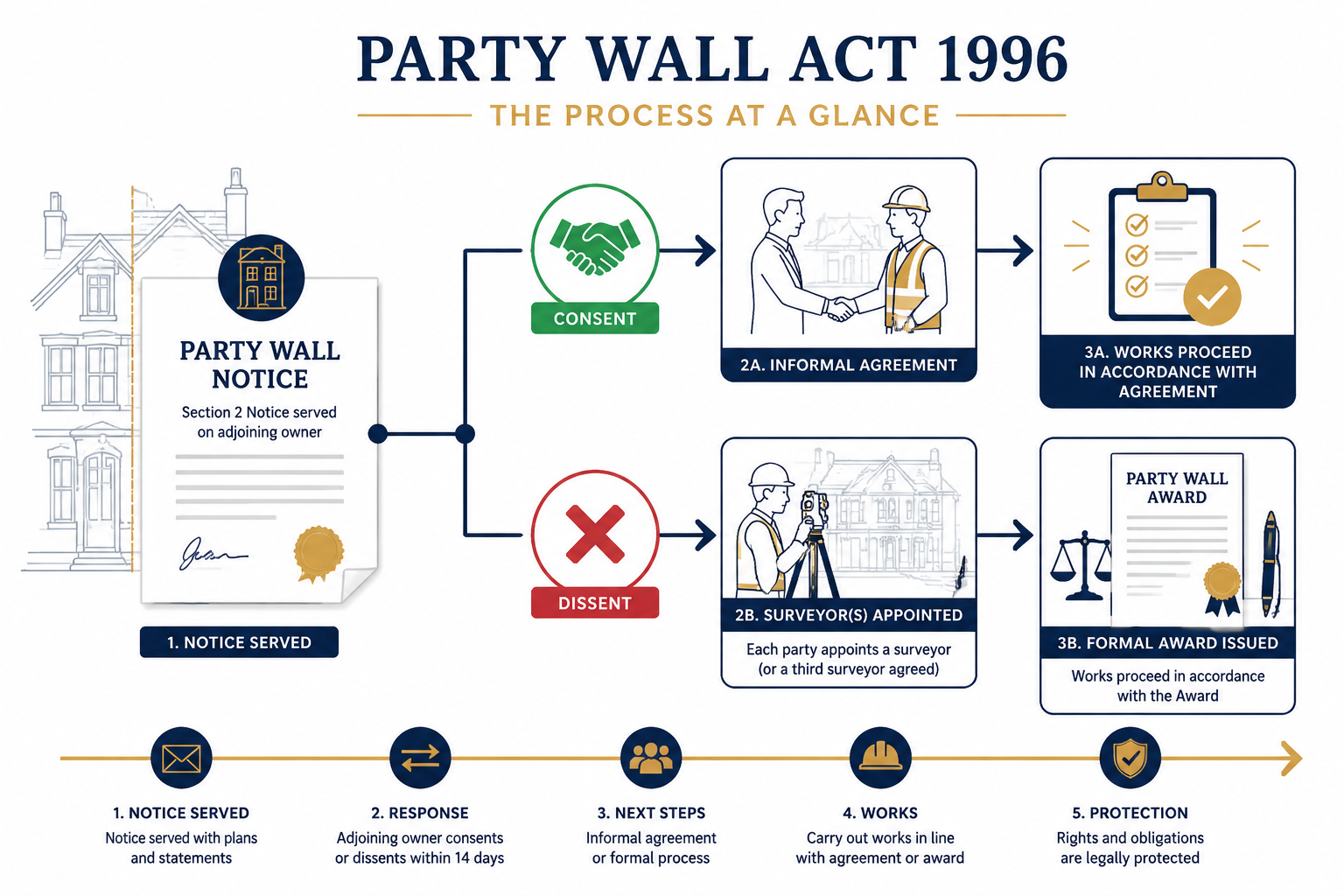
Before exploring the distinction, it helps to understand the legal framework. The Party Wall etc. Act 1996 is the statute that governs works to shared walls, boundary structures, and excavations near neighbouring buildings in England and Wales. It creates a structured process:
- The building owner serves a notice on all adjoining owners.
- The adjoining owner responds — either consenting or dissenting (or doing nothing, which counts as dissent after 14 days).
- If consent is given, works can proceed under agreed conditions.
- If dissent is given, surveyors are appointed and a party wall award is produced.
Here is the critical point: the Act itself never uses the phrase "party wall agreement." The word "award" appears throughout Section 10 of the Act as the formal legal instrument surveyors produce. The term "agreement" is informal shorthand that has crept into common usage — sometimes helpfully, sometimes dangerously. [3][7]
💬 "A document signed just by the owners, without being made by appointed party wall surveyors, simply isn't a party wall award in law." [2]
Understanding the "Party Wall Agreement": Consent in Plain Language
When people refer to a "party wall agreement," they usually mean one of two things:
1. Written Consent After a Notice
After a party wall notice is served, the adjoining owner may sign and return a consent form. This written consent allows the building owner to proceed with the notifiable works. It is sometimes called an "agreement" because both parties have, in effect, agreed to the works going ahead.
What written consent does:
- Allows works to proceed without appointing surveyors
- Saves time and money compared to the full award process
- Can include agreed conditions (e.g., working hours, access arrangements)
What written consent does NOT do:
- It does not become a party wall award
- It does not carry the same statutory enforcement powers
- It does not automatically include a schedule of condition of the adjoining property
- It does not bind future owners of the property in the same way an award does [5]
2. An Informal Written Document Between Owners
Some neighbours draft their own written document — sometimes even labelling it a "party wall award" — and sign it without involving surveyors. This has no legal standing as an award. It may have some value as a contractual agreement between those two individuals, but it does not trigger the Act's dispute-resolution protections and cannot be enforced as a statutory instrument. [2][7]
⚠️ Important: If you are carrying out works that fall under the Act, relying on an informal document instead of a proper award leaves you exposed to injunctions, claims for damages, and disputes with no clear resolution mechanism.
What a Party Wall Award Actually Is — and Who Can Make One
The Legal Definition
A party wall award is a legally binding determination produced under Section 10 of the Party Wall etc. Act 1996. It can only be made by:
- One agreed surveyor (appointed by both parties jointly), or
- Two party wall surveyors (one appointed by each owner), or
- A third surveyor (called upon when the two appointed surveyors cannot agree)
Owners themselves cannot make a valid award, even if they title their document "Award" and both sign it. The authority to make an award belongs exclusively to appointed party wall surveyors. [2][4]
What a Party Wall Award Contains
A properly drafted award is a comprehensive document. Understanding its contents helps explain why it offers far stronger protection than simple consent.
| Section of the Award | What It Covers |
|---|---|
| Property & Owner Details | Full addresses, names of building owner and adjoining owner |
| Surveyor Appointments | Names and signatures of appointed surveyors |
| Description of Works | Exact scope of the notifiable works |
| Schedule of Condition | Photographic and written record of the adjoining property's pre-works state |
| Working Hours | Permitted times for noisy or disruptive work |
| Access Arrangements | Rights of entry for surveyors and contractors |
| Methods of Work | Specific construction methods to protect the adjoining property |
| Damage Provisions | How damage will be assessed and compensated |
| Costs | Who pays the surveyors' fees |
| Dispute Procedures | How disagreements during works will be resolved |
For a detailed look at how these documents are structured, see this guide on party wall awards.
Legal Effect of a Party Wall Award
Once served, a party wall award:
- Gives the building owner the statutory right to proceed with the notified works
- Sets enforceable conditions that both parties must observe
- Is binding on successors in title — meaning it applies to future owners of both properties
- Can be appealed to the county court within 14 days of service [4][6]
This last point matters enormously. If an adjoining owner believes the award is unfair or incorrect, they have a short window to challenge it. After 14 days, the award becomes final and binding. [3]
Party Wall Agreement vs Party Wall Award: What's the Difference, When Each Applies, and Why the Distinction Matters in Practice

When Does Consent (the "Agreement") Apply?
Written consent is appropriate when:
✅ The works are straightforward and the neighbour has no concerns
✅ Both parties trust each other and have a good relationship
✅ The works carry low risk of damage to the adjoining property
✅ Both parties understand what they are consenting to
Example: A homeowner plans to build a rear extension that requires a line of junction notice. The neighbour reviews the plans, is happy with the proposal, and signs the consent form. Works proceed without surveyors.
Even in this scenario, it is worth considering whether a schedule of condition should be prepared voluntarily — because without one, proving the pre-existing state of the adjoining property becomes difficult if damage is later alleged.
When Is a Party Wall Award Required?
An award becomes necessary when:
❌ The adjoining owner dissents (or fails to respond within 14 days)
❌ The works are complex or carry significant risk
❌ There is any dispute about the scope, method, or conditions of the works
❌ The adjoining owner wants formal legal protection
Example: A building owner plans to underpin foundations near the boundary. The neighbour is worried about structural impact and dissents. Two surveyors are appointed — one by each party — and a formal award is produced governing every aspect of the works. [1][6]
The Distinction Matters for Building Owners
For building owners, the distinction matters because:
- Proceeding without proper consent or a valid award exposes them to injunctions that can halt works mid-project
- An award provides a clear legal framework that protects them if the neighbour later claims damage unrelated to the works
- The award's schedule of condition creates an objective baseline — essential evidence in any dispute
The Distinction Matters for Adjoining Owners
For adjoining owners, the distinction matters because:
- Simple consent offers no formal record of the property's pre-works condition
- An award gives them the right to appoint their own surveyor (at the building owner's expense in most cases)
- Awards include access rights, damage provisions, and dispute procedures that consent documents typically lack [5][8]
Common Misconceptions Cleared Up
❌ Misconception 1: "We signed a party wall agreement, so we're covered."
Reality: If no surveyor was involved and the document was signed only by the owners, it is not a party wall award. It may have some contractual value, but it does not carry statutory protections. [7]
❌ Misconception 2: "The Act says we need a party wall agreement."
Reality: The Act does not use this phrase. It requires notices, and — where dissent occurs — an award made by surveyors under Section 10. [3]
❌ Misconception 3: "Getting an award means we're in a dispute."
Reality: An award does not mean the parties are fighting. It is simply the formal legal mechanism the Act provides when consent is not given. Many awards are produced amicably, with both parties cooperating fully. [6][10]
❌ Misconception 4: "Consent is always faster and cheaper."
Reality: Consent is often faster and cheaper — but not always. If damage occurs and there is no schedule of condition, the resulting dispute can be far more costly than the surveyor fees saved upfront. [4]
Party Wall Agreement vs Party Wall Award: What's the Difference, When Each Applies, and Why the Distinction Matters — A Side-by-Side Comparison
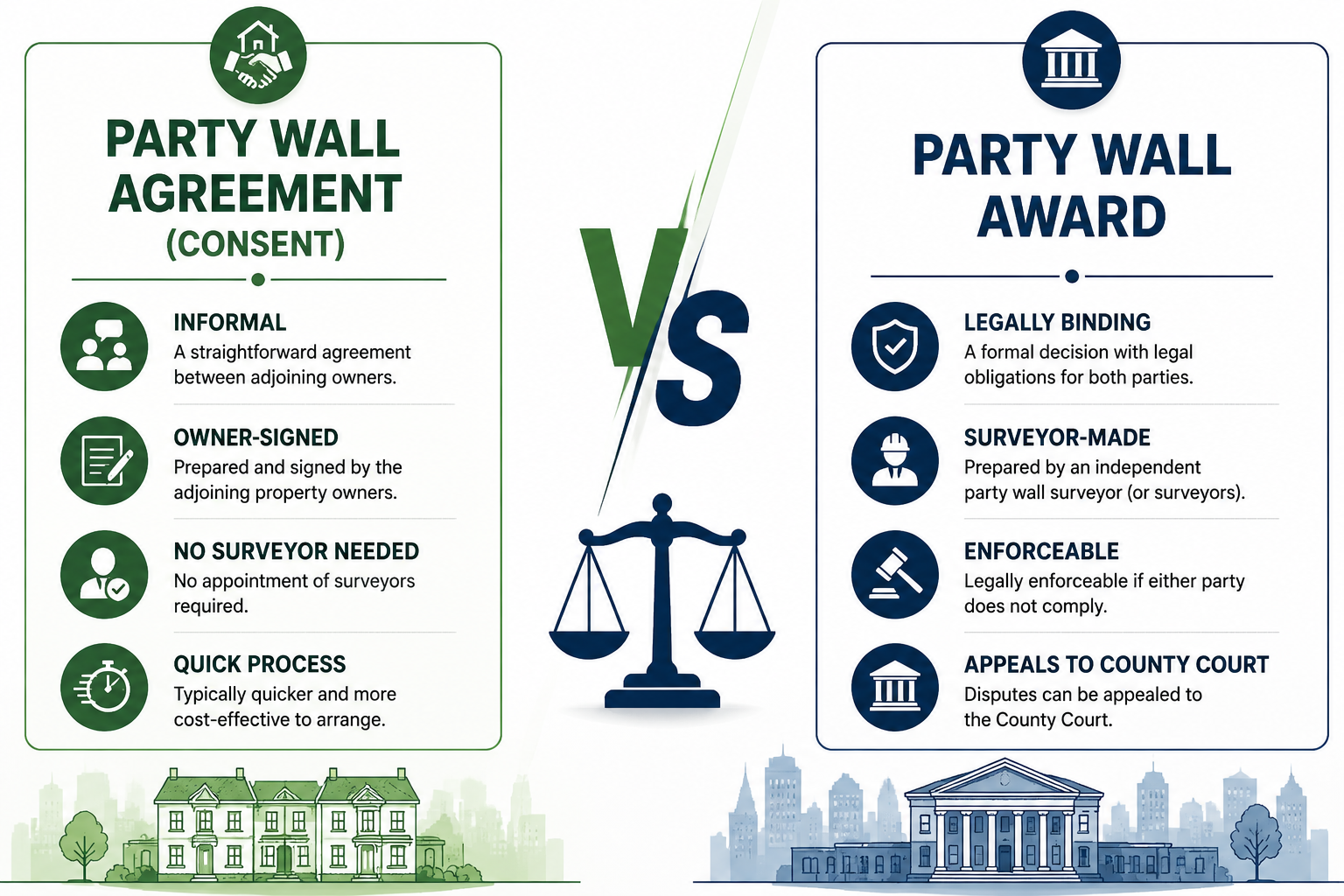
| Feature | Written Consent ("Agreement") | Party Wall Award |
|---|---|---|
| Legal basis | Informal / contractual | Section 10, Party Wall etc. Act 1996 |
| Who creates it | The owners themselves | Appointed party wall surveyor(s) only |
| Legally binding | Contractually (limited) | Fully statutory and enforceable |
| Schedule of condition | Rarely included | Standard inclusion |
| Binds successors in title | No | Yes |
| Appealable | No statutory appeal | County court, within 14 days |
| Surveyor fees | None (usually) | Typically paid by building owner |
| Dispute resolution | No formal mechanism | Built-in via third surveyor |
| Recommended for complex works | No | Yes |
The Role of Party Wall Surveyors
Understanding this distinction also clarifies why party wall surveyors exist and what they actually do. A surveyor's role is not simply to produce paperwork — it is to act impartially in the interests of the process, not of the party who appointed them. [4]
When an adjoining owner dissents, the building owner's surveyor and the adjoining owner's surveyor work together to produce an award that is fair to both sides. This is a statutory duty, not a negotiation between advocates.
For those wondering whether it is possible to proceed without a surveyor, the answer depends entirely on whether consent has been given. If the neighbour consents, no surveyor is legally required. If they dissent, surveyors must be appointed — there is no lawful shortcut. [9]
Practical Steps: What to Do in 2026
Whether planning works or responding to a neighbour's notice, here is a clear action plan:
If you are the building owner:
- Serve the correct party wall notice at least 1–2 months before works begin
- Wait for the response — consent or dissent
- If consent is received, consider commissioning a voluntary schedule of condition
- If dissent is received, appoint a surveyor promptly to begin the award process
If you are the adjoining owner:
- Read the notice carefully and seek advice if unsure
- Consider whether consent is appropriate or whether an award better protects your interests
- If dissenting, appoint your own surveyor (or agree to a single agreed surveyor)
- Review the draft award carefully before it is finalised
Conclusion: Know What You're Signing — and What You're Not
The confusion between "party wall agreement" and "party wall award" is understandable — the terms sound similar and are often used as if they mean the same thing. But the legal reality is clear: only a party wall award, made by appointed surveyors under Section 10 of the Act, carries full statutory force.
Written consent is a legitimate and often practical route — but it is not an award, and it should not be treated as one. For complex works, high-risk projects, or any situation where the adjoining owner has concerns, a formal award is not just advisable — it is the only instrument that provides genuine, enforceable protection for both sides.
Actionable next steps:
- 📋 Review the types of party wall works to confirm whether your project triggers the Act
- 📄 Download a sample party wall agreement template to understand what consent documentation looks like
- 🏗️ If works are imminent, contact a qualified party wall surveyor to confirm the correct process for your specific situation
Getting this distinction right from the outset saves time, money, and the kind of neighbour disputes that can outlast the construction works themselves.
References
[1] Difference Between Party Wall Notices And Awards – https://www.partywallslimited.com/blog/difference-between-party-wall-notices-and-awards
[2] Watch – https://www.youtube.com/watch?v=IgcNdxko46o
[3] The Difference Between A Party Wall Notice And A Party Wall Award – https://thepartywallguru.com/the-difference-between-a-party-wall-notice-and-a-party-wall-award/
[4] Party Wall Award – https://www.home-approved.com/party-wall-advice/party-wall-award/
[5] What Is A Party Wall Award Or Party Wall Agreement – https://arunassociates.co.uk/what-is-a-party-wall-award-or-party-wall-agreement/
[6] Party Wall Agreements Vs Awards When To Use Each And How To Negotiate Successfully – https://partywallsurveyorlondon.uk/blogs/party-wall-agreements-vs-awards-when-to-use-each-and-how-to-negotiate-successfully/
[7] Party Wall Agreement Vs A Party Wall Award – https://www.simplesurvey.co.uk/uncategorised/party-wall-agreement-vs-a-party-wall-award/
[8] Party Wall Act Agreement Or Award – https://www.reddit.com/r/HousingUK/comments/11vu3ia/party_wall_act_agreement_or_award/
[9] facebook – https://www.facebook.com/groups/building.regulations/posts/2095690164166469/
[10] What Is A Party Wall Award Award Vs Agreement – https://westvilleassociates.com/blog/what-is-a-party-wall-award-award-vs-agreement