


Nearly one in three party wall disputes in England and Wales involves excavation work — making it the single most contentious category under the Party Wall etc. Act 1996. Yet many building owners begin digging without ever serving the correct notice, often unaware that the law's reach extends well beyond shared walls. Understanding the principles behind serving party wall notices for excavation near neighboring foundations: depth, distance, and risk assessment basics is not just a legal formality — it is the difference between a smooth project and a costly, relationship-destroying dispute.
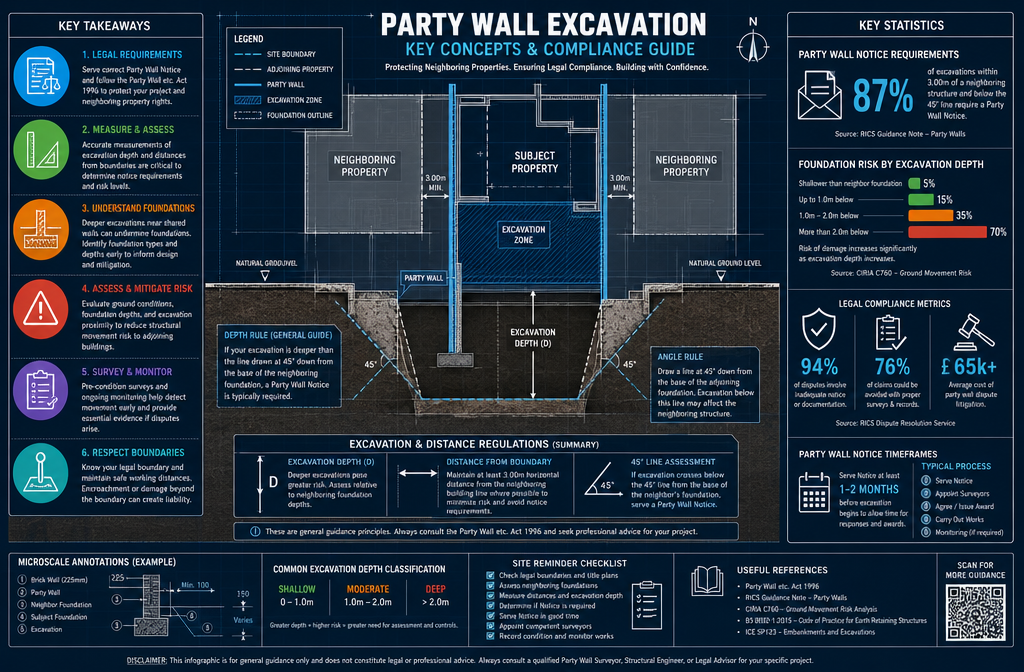
Key Takeaways 📋
- Section 6 of the Party Wall etc. Act 1996 triggers notice obligations when excavating within 3 metres or 6 metres of a neighbouring structure, depending on depth.
- The depth of your proposed foundations relative to the neighbour's existing foundations is the critical measurement — not just horizontal distance alone.
- A Schedule of Condition should be prepared before work begins to record the existing state of neighbouring properties.
- Failure to serve a valid notice can expose the building owner to injunctions, damages claims, and project delays.
- A qualified party wall surveyor is essential for accurate risk assessment and for drafting a legally sound party wall award.
What Section 6 of the Party Wall Act Actually Covers
The Party Wall etc. Act 1996 is divided into distinct sections, each addressing a different type of work. While Section 2 deals with works to existing party walls and structures, Section 6 specifically governs excavation near neighbouring buildings and structures [2].
Section 6 is triggered in two scenarios:
| Scenario | Distance from Neighbouring Structure | Condition |
|---|---|---|
| 3-metre rule | Within 3 metres horizontally | New foundations go deeper than neighbour's foundations |
| 6-metre rule | Within 6 metres horizontally | New foundations fall within a 45-degree line drawn downward from the bottom of the neighbour's foundations |
💡 Pull Quote: "The 6-metre rule catches many building owners off guard — it is not about how close you are digging, but whether your excavation undermines the load-bearing zone beneath your neighbour's foundations." [1]
The 45-degree line concept is crucial. Draw an imaginary diagonal line at 45 degrees from the base of the neighbouring foundation. If any part of your proposed excavation falls within that zone, Section 6 applies — regardless of whether your trench appears safely distant at ground level [9].
It is also worth noting that Section 6 applies to any neighbouring building or structure, not only those sharing a party wall. A detached garage, a garden outbuilding, or a boundary retaining wall can all qualify as "structures" for the purposes of the Act [4].
Serving Party Wall Notices for Excavation Near Neighboring Foundations: Depth, Distance, and Risk Assessment Basics — The Legal Process
Who Must Serve Notice?
The obligation falls entirely on the building owner — the person proposing to carry out the excavation. This applies whether the work involves a basement conversion, new extension foundations, drainage trenches, or any other below-ground construction [1].
Critically, the duty to serve notice exists even if:
- The neighbour has already verbally agreed to the works ✅
- The excavation is entirely within your own land ✅
- The neighbouring property appears structurally robust ✅
- The works are considered minor or short-term ✅ [3]
For a full breakdown of notice types and how to respond to them, see this guide on party wall act notices: what they are and how to respond.
Notice Period and Timing
Under Section 6, the building owner must serve notice at least one month before the planned start date of the excavation works. This is non-negotiable. Starting work before the notice period expires — or before a party wall award has been agreed — is a legal breach that can result in an injunction halting the project entirely [5].
What the Notice Must Include
A valid Section 6 notice must state:
- The building owner's name and address
- A description of the proposed works
- The depth of the proposed excavation
- The distance from the neighbouring structure
- Plans and sections showing the proposed foundations (where applicable)
Serving an incomplete or informal notice — such as a handwritten letter or a verbal conversation — does not satisfy the legal requirement. For guidance on what constitutes a valid notice, the party wall notices page provides a clear overview.
Neighbour's Response Options
Once served, the adjoining owner (the neighbour) has 14 days to respond. They can:
- Consent — Works proceed without a formal award (though a Schedule of Condition is still advisable)
- Dissent and agree to a single agreed surveyor — One surveyor acts for both parties
- Dissent and appoint their own surveyor — A two-surveyor process leads to a formal award
If no response is received within 14 days, a deemed dissent is triggered automatically, requiring the appointment of surveyors [7].
Risk Assessment: How Surveyors Evaluate Excavation Near Foundations
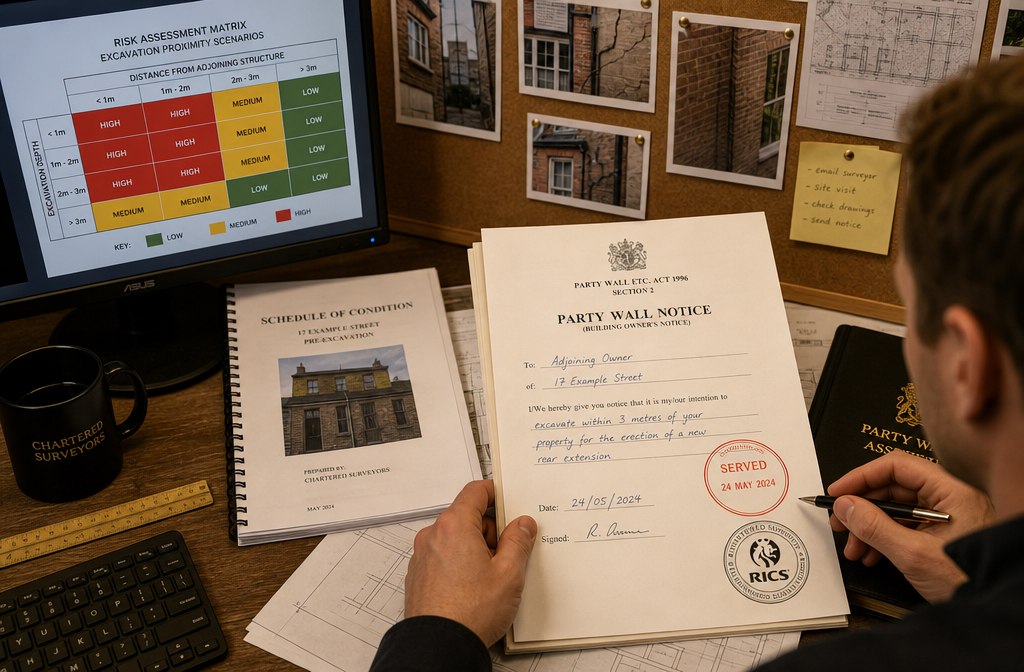
The Core Decision Points
When assessing risk, a party wall surveyor does not simply measure distance and tick a box. The evaluation is multi-layered and considers several interconnected factors [10]:
1. Relative Foundation Depths
The most critical factor. If the proposed excavation goes deeper than the neighbouring foundation, the risk of undermining increases significantly. Shallow strip foundations — common in Victorian and Edwardian terraces — are particularly vulnerable.
2. Soil Type and Ground Conditions
- Clay soils: Prone to shrinkage and swelling; lateral movement risk is high
- Sandy or loose soils: Poor load transfer; collapse risk during excavation
- Made ground: Unpredictable bearing capacity; requires careful investigation
- Rock: Generally stable; lower risk profile
3. Structural Condition of the Neighbouring Property
A building already showing signs of settlement, cracking, or poor maintenance carries a higher baseline risk. The surveyor must assess whether the proposed works could exacerbate existing vulnerabilities [6].
4. Method of Excavation
Machine excavation close to foundations carries greater vibration and disturbance risk than hand-digging. The surveyor will consider whether special precautions — such as temporary shoring, underpinning, or phased excavation — are needed.
5. Duration and Timing
Extended periods of open excavation increase risk, particularly in clay soils where moisture changes over time can cause ground movement.
The Schedule of Condition 📸
Before any excavation begins, a schedule of condition should be prepared. This is a photographic and written record of the neighbouring property's existing state — documenting every crack, defect, and area of concern before the works start.
The schedule serves a vital protective function for both parties:
- It protects the building owner from spurious damage claims
- It gives the adjoining owner a clear baseline if genuine damage occurs
🔑 Key Point: A schedule of condition is not legally mandatory in all cases, but it is considered best practice by surveyors and is strongly recommended by the RICS [5].
When Protective Measures Are Required
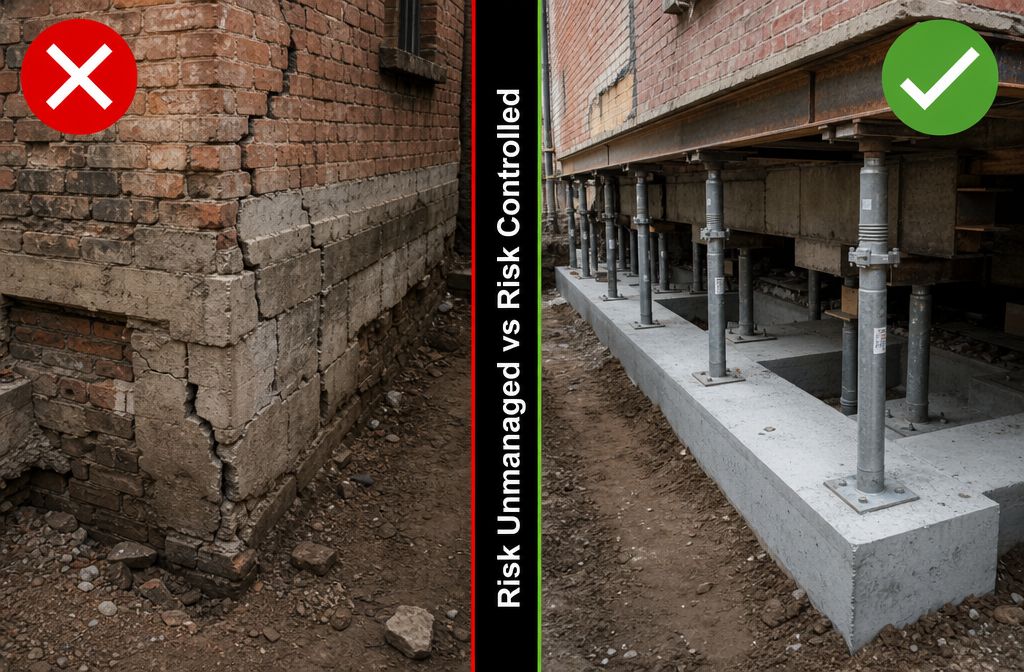
The party wall award — the formal document produced by the surveyors — will typically specify protective measures when risk is elevated. Common requirements include:
- Temporary shoring to support the neighbouring foundation during excavation
- Underpinning of the neighbouring structure before digging begins
- Monitoring of the neighbouring building during works (crack gauges, settlement pins)
- Restrictions on working hours to limit vibration disturbance
- Phased excavation to reduce the length of open trench at any one time [10]
For a detailed look at what a party wall award contains and how it protects all parties, see this resource on party wall awards.
Common Mistakes and Misunderstandings
"My Foundations Are the Same Depth — No Notice Needed"
This is one of the most persistent misunderstandings. Under the 3-metre rule, notice is only required if the new foundations go deeper than the neighbour's. However, under the 6-metre rule, the 45-degree line test applies regardless of relative depth — meaning a shallow excavation can still trigger the Act if it falls within the diagonal zone [9].
"We Agreed Verbally — That's Enough"
Verbal agreements have no legal standing under the Party Wall etc. Act 1996. A formal written notice must be served, and any consent must also be given in writing. This protects both parties if disagreements arise later [6].
"The Work Is on My Land, So the Act Doesn't Apply"
Section 6 is explicitly designed to cover excavations on your own land that could affect neighbouring structures. The Act does not require the work to be on or near a boundary — only that it falls within the prescribed distances [4].
"I Only Need a Notice If There's a Party Wall"
Section 6 operates independently of whether a party wall exists. A detached property can still be subject to Section 6 obligations if the excavation falls within the 3-metre or 6-metre zones [2]. For a clearer understanding of what constitutes a party wall versus other boundary structures, this article on party fence walls and boundary walls is a helpful reference.
Practical Guidance for Building Owners in 2026
Step-by-Step Checklist ✅
- Identify the depth of your proposed excavation
- Measure the horizontal distance from the nearest part of any neighbouring structure
- Apply the 3-metre and 6-metre tests to determine if Section 6 is triggered
- Engage a party wall surveyor early — ideally before finalising foundation design
- Serve the Section 6 notice at least one month before the planned start date
- Commission a Schedule of Condition for all neighbouring properties within the risk zone
- Obtain the party wall award before commencing excavation
- Implement any protective measures specified in the award
Building owners carrying out works should review the dedicated guidance for those carrying out works to understand their full obligations.
What Happens If You Ignore the Act?
The consequences of proceeding without serving notice are serious:
- Injunctions: Courts can halt works immediately, even mid-excavation
- Damages: The building owner may be liable for any damage caused, with no ability to rely on the Act's protective framework
- Retrospective awards: Surveyors can be appointed after works begin, but the building owner loses the procedural protections the Act provides
- Neighbour relations: Disputes that escalate to court are costly, time-consuming, and permanently damaging [7]
Cost Considerations
Many building owners hesitate to engage surveyors due to perceived cost. In reality, the cost of a party wall surveyor is modest compared to the potential liability of proceeding without one. For transparency on what to expect financially, this guide on party wall costs and the process provides a clear breakdown.
If the adjoining owner dissents and appoints their own surveyor, the building owner typically bears both surveyors' fees — another strong incentive to engage proactively and aim for consent [5].
Conclusion: Act Early, Assess Carefully, Document Everything
Serving party wall notices for excavation near neighboring foundations — and understanding the depth, distance, and risk assessment basics that underpin the process — is not bureaucratic box-ticking. It is a structured, legally-backed framework designed to protect both building owners and their neighbours from the very real risks that below-ground construction creates.
The decision points are clear: measure the depth, apply the 3-metre and 6-metre tests, assess ground conditions and structural vulnerability, and serve notice in good time. A qualified party wall surveyor brings the technical knowledge to navigate these assessments accurately and the legal expertise to produce an award that keeps the project moving safely.
Actionable Next Steps 🚀
- Before designing foundations: Consult a party wall surveyor to understand whether Section 6 will apply
- Before serving notice: Commission a structural assessment of neighbouring foundations if ground conditions are uncertain
- Before starting work: Ensure the party wall award is signed and a Schedule of Condition is in place
- During works: Maintain open communication with neighbours and implement all protective measures specified in the award
- After works: Retain all documentation in case of future claims
For professional support with excavation notices and risk assessments across London, explore the party wall surveyor services available in your area.
References
[1] Excavation And The Party Wall Act Navigating The 3 And 6 Metre Rules For Foundations – https://www.partywallslimited.com/blog/excavation-and-the-party-wall-act-navigating-the-3–and-6-metre-rules-for-foundations
[2] Party Wall Section 6 – https://www.houricanassociates.com/party-wall-news/party-wall-section-6/
[3] Party Wall Notice Excavation Still Needed Even If – https://www.reddit.com/r/DIYUK/comments/1riqi9k/party_wall_notice_excavation_still_needed_even_if/
[4] Party Wall Excavation Questions – https://collier-stevens.co.uk/faqs/party-wall-excavation-questions/
[5] Party Walls – https://www.rics.org/consumer-guides/party-walls
[6] The Party Wall Act Common Misunderstandings – https://www.peterbarry.co.uk/blog/the-party-wall-act-common-misunderstandings/
[7] Party Wall Agreement – https://hoa.org.uk/advice/guides-for-homeowners/i-am-improving/party-wall-agreement/
[9] The Party Wall Act 3 Metre Rule Explained – https://westvilleassociates.com/blog/the-party-wall-act-3-metre-rule-explained
[10] Deeper Foundations And Adjacent Excavations When Section 6 Of The Party Wall Act Really Bites – https://partywallsurveyorlondon.uk/blogs/deeper-foundations-and-adjacent-excavations-when-section-6-of-the-party-wall-act-really-bites/