


Fewer than one in three homeowners planning garden wall works in 2026 are aware that demolishing and rebuilding a shared masonry boundary wall can trigger a formal legal process under the Party Wall etc. Act 1996 — even when the project seems minor. Understanding Party Wall Agreements for Garden Walls and Fences: Notifiable Works Under the Act Explained is not just useful knowledge; it is a practical necessity for anyone extending a suburban garden, replacing a crumbling boundary wall, or excavating near a neighbour's foundations.
This article clarifies exactly which boundary structures fall under the Act, which works require a formal notice, how measurement rules determine notification obligations, and what a Party Wall Award looks like for shared garden features.
Key Takeaways
- A masonry garden wall that straddles the boundary line is a "party fence wall" under the Act and is legally protected — wooden fences are not.
- Specific works to party fence walls, including raising height, inserting damp-proof courses, and demolishing and rebuilding, are notifiable under the Act.
- Excavation within 3 metres or 6 metres of a neighbour's foundations (depending on depth) also triggers notification obligations.
- Notice periods are either one month or two months depending on the type of work proposed.
- Failing to serve a valid Party Wall Notice can result in injunctions, work stoppages, and liability for damages.
What Is a Party Fence Wall — and Does Your Garden Structure Qualify?
Before determining whether a Party Wall Agreement is needed, it is essential to understand which structures the Act actually covers. The terminology matters enormously here.
The Legal Definition Under the Act
The Party Wall etc. Act 1996 recognises two main types of shared structure relevant to gardens:
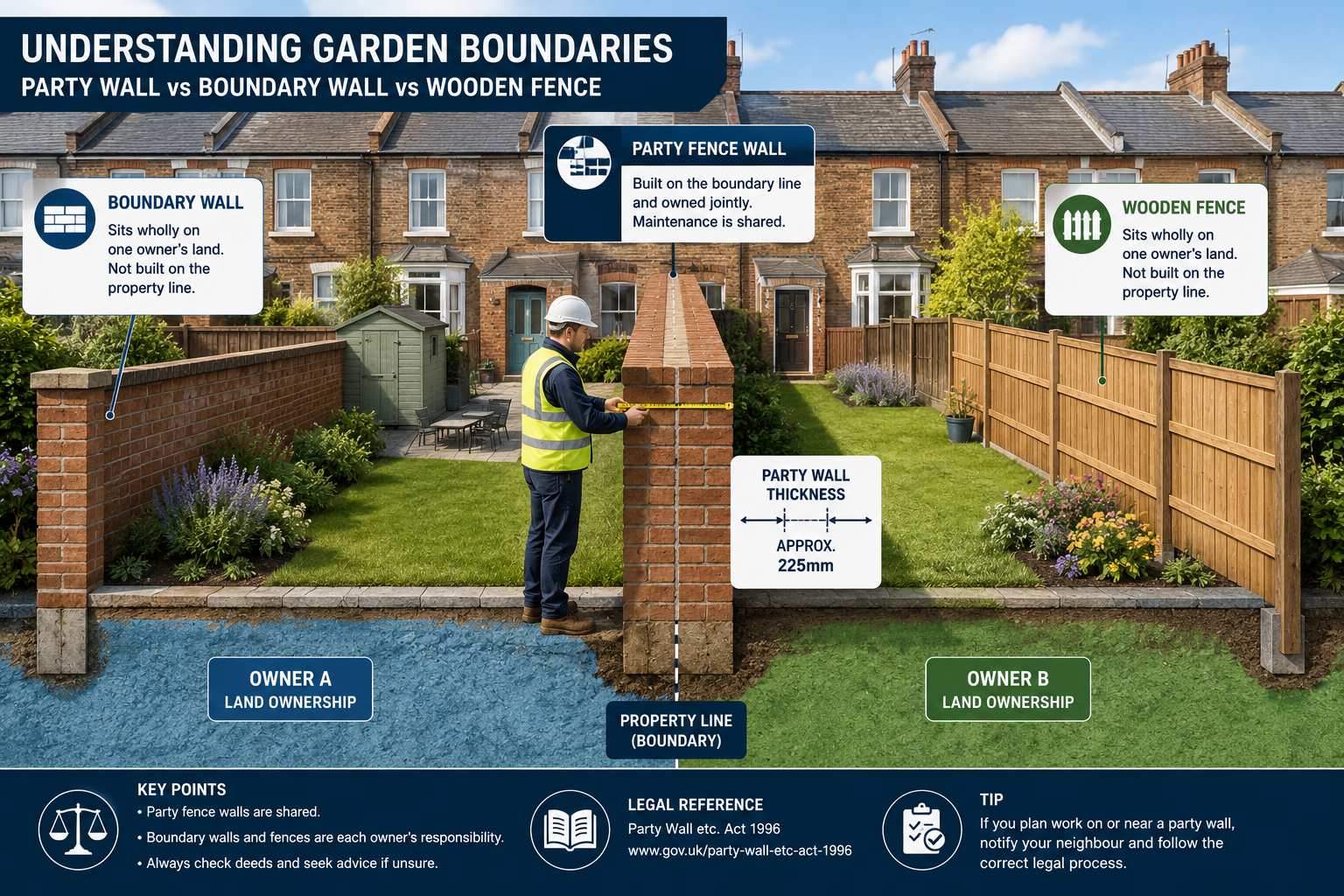
- Party wall: A wall that forms part of a building and stands on the boundary of two properties, or a wall that stands entirely on one owner's land but is used by both properties.
- Party fence wall: A wall that does not form part of a building, stands astride the boundary line, and is made of masonry — brick, block, or concrete. [1]
A garden wall that sits exactly on the boundary between two properties and is constructed from brick or concrete block is a classic party fence wall. Both neighbours share ownership of it, and both share responsibility for its maintenance. Repair costs should be divided equally between the two owners. [4]
"The key distinction is not what a structure looks like, but where it sits and what it is made of."
What the Act Does NOT Cover
This is where many homeowners are caught out. Wooden fences are explicitly excluded from the definition of a party fence wall, regardless of where they sit. [1] [6] A standard timber panel fence, even one that straddles the boundary, does not fall under the Act. Replacing or repairing a wooden fence does not require a Party Wall Notice.
Similarly, a masonry wall that sits entirely on one owner's land — even if it runs along the boundary — is a boundary wall, not a party fence wall. For a detailed breakdown of these distinctions, see this guide on the difference between a party fence wall and a boundary wall.
| Structure Type | Straddles Boundary? | Material | Covered by Act? |
|---|---|---|---|
| Party fence wall | Yes | Masonry (brick/block/concrete) | Yes |
| Boundary wall | No (sits on one side) | Any | No |
| Wooden fence | Yes or No | Timber | No |
| Garden wall attached to building | Yes | Masonry | Yes (as party wall) |
For a full explanation of the legal definition, the Party Wall etc. Act 1996 overview provides a thorough reference point.
Notifiable Works: When Garden Wall and Fence Projects Trigger the Act
Not every interaction with a party fence wall requires a formal agreement. The Act specifies particular categories of work that are "notifiable" — meaning the building owner must serve a Party Wall Notice on the adjoining owner before starting. [2]
Works to Existing Party Fence Walls
The following works on an existing party fence wall are notifiable under Section 2 of the Act:
- Demolishing and rebuilding the party fence wall
- Raising the height of the wall
- Underpinning the wall or its foundations
- Inserting a damp-proof course through the wall
- Cutting into the wall to insert beams or other structural elements
- Making good, repairing, or demolishing any chimney or flue forming part of the wall
A common suburban scenario: a homeowner wants to demolish a deteriorating shared brick garden wall and rebuild it taller to improve privacy. This is notifiable. The neighbour must receive a Party Wall Notice at least two months before work begins. [3]
Building a New Wall on or Near the Boundary
Section 1 of the Act covers situations where a building owner wishes to construct a new wall:
- Building a new party fence wall astride the boundary line: The adjoining owner must consent. If they do not consent within 14 days of receiving notice, the building owner may only build the wall on their own land, but is entitled to place foundations on the neighbour's land if necessary.
- Building a new wall up to the boundary line on your own land: A one-month notice is required. [3]
This is particularly relevant for suburban extension projects where a homeowner wants to erect a new masonry boundary feature as part of a garden redesign.
Excavation Near Adjoining Properties
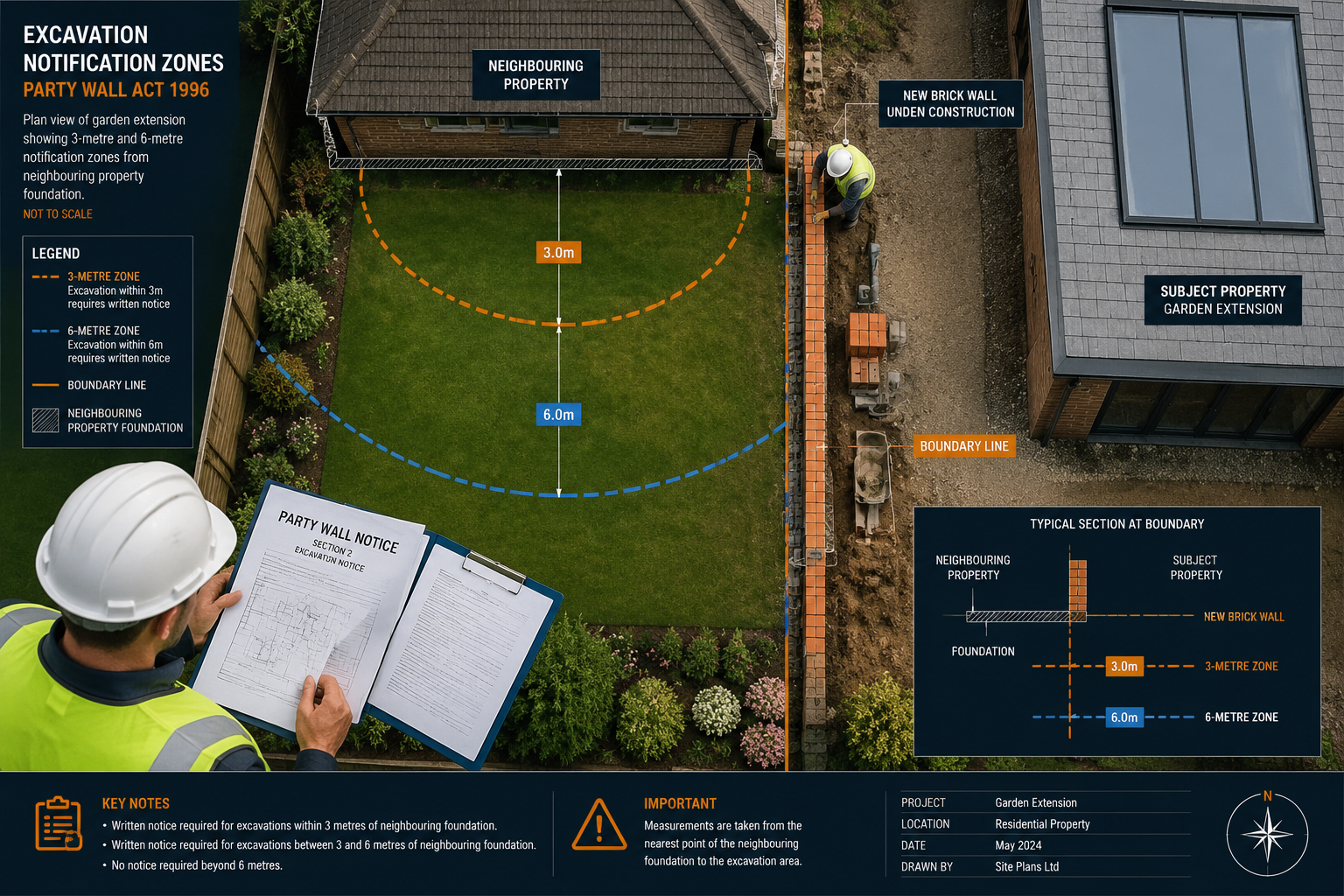
Section 6 of the Act addresses excavation works — often overlooked in garden projects but critically important. Two specific distance thresholds apply: [2]
The 3-metre rule: If excavation is planned within 3 metres of a neighbouring building or structure, and the excavation will go deeper than the bottom of the neighbour's foundations, a notice is required.
The 6-metre rule: If excavation is planned within 6 metres of a neighbouring building or structure, and the excavation would intersect a line drawn at 45 degrees downward from the bottom of the neighbour's foundations, a notice is also required.
These rules are particularly relevant when digging footings for a new garden wall, installing drainage, or creating a sunken garden or retaining wall near a shared boundary. For a one-month notice period applies for excavation works. [3]
To understand how these rules apply to specific projects, the resource on types of party wall works offers practical examples.
Works That Are NOT Notifiable
To avoid unnecessary concern, the following garden works generally do not require a Party Wall Notice:
- Painting or decorating a boundary wall on your own side
- Installing trellis or climbing plant supports on a fence entirely on your land
- Repairing a wooden fence
- Minor surface repairs to a boundary wall that do not affect its structure
- Building a garden wall entirely within your own land (though planning permission may still apply)
For guidance on height restrictions and planning considerations, the article on how high you can build a wall between neighbours is a useful companion resource.
Serving Notice, Reaching Agreement, and the Party Wall Award
Once it is established that works are notifiable, the process follows a defined sequence. Understanding this sequence helps both building owners and adjoining owners navigate the procedure with confidence.
Serving a Valid Party Wall Notice
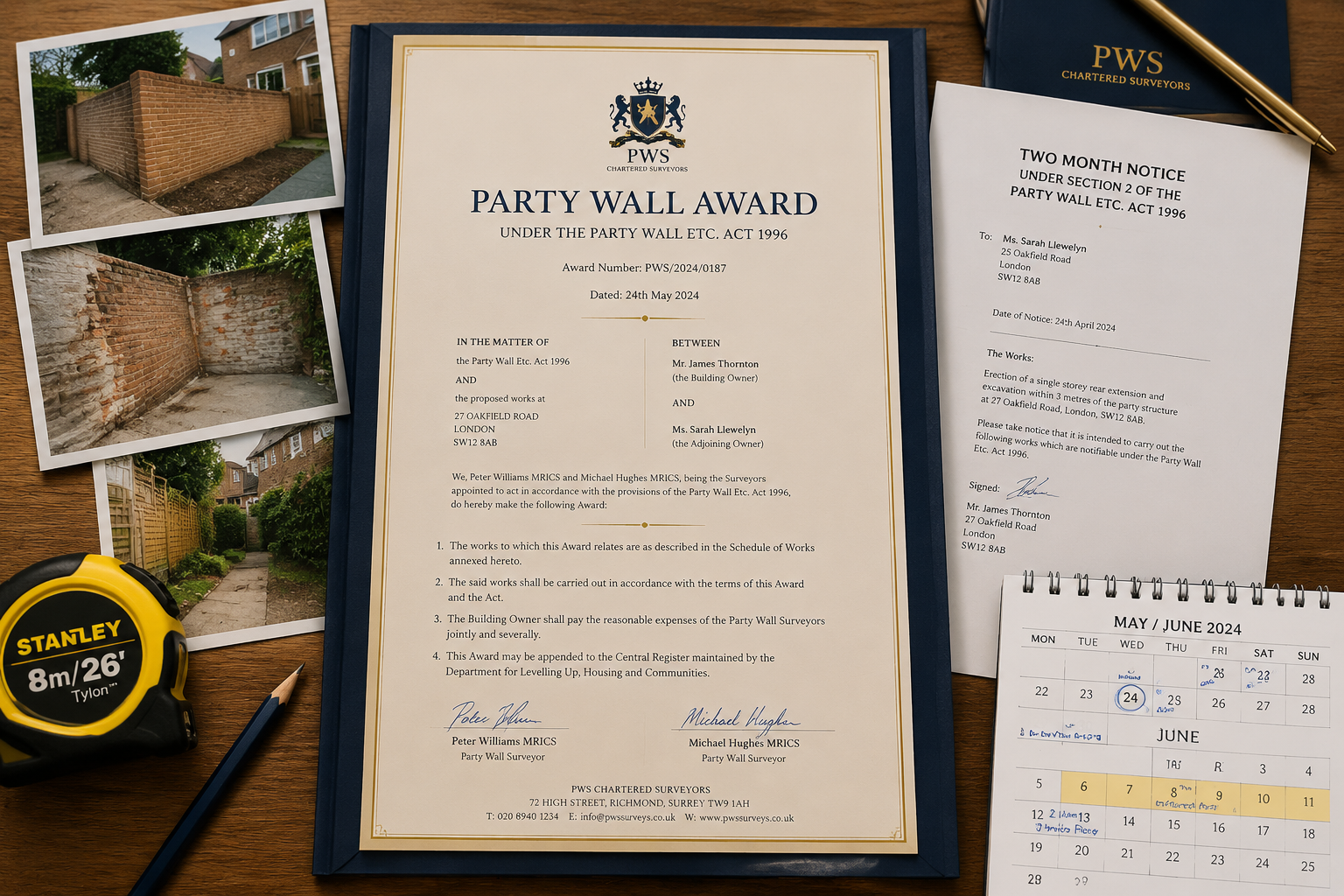
A Party Wall Notice must be served in writing and must include: [2]
- The name and address of the building owner
- A description of the proposed works
- The address of the property where works will take place
- The proposed start date
The notice must be served within the correct timeframe: two months before works begin for works to existing party walls, and one month before for new wall construction or excavation. [3] Boundary dispute reforms emphasised in 2026 have increased scrutiny on procedural compliance, making it more important than ever that notices are correctly drafted and served. [5]
For a detailed breakdown of how notices work and how to respond to one, see the guide on Party Wall Act notices and how to respond.
What Happens After Notice Is Served?
The adjoining owner has 14 days to respond. There are three possible outcomes:
- Consent: The adjoining owner agrees in writing. Works can proceed without a formal award.
- Dissent and appointment of a surveyor: A dispute is deemed to exist. Surveyors are appointed to produce a Party Wall Award.
- No response: Silence after 14 days is treated as dissent, triggering the surveyor appointment process.
Understanding the Party Wall Award for Garden Features
A Party Wall Award (also called a party wall agreement) is a legal document prepared by one or more surveyors. For garden wall projects, a typical award will include:
- A description of the permitted works
- The method and sequence of construction
- Working hours and access arrangements
- A schedule of condition recording the current state of the adjoining property
- Provisions for making good any damage caused
For example, in a suburban extension project where a homeowner demolishes a shared brick garden wall to build a higher rendered masonry boundary, the award might specify that the new wall must match the original footprint, that the neighbour's garden must be protected from debris, and that a schedule of condition is prepared before works begin.
A schedule of condition is a particularly important safeguard for adjoining owners, as it provides photographic and written evidence of the property's state before work starts.
For more detail on what these documents contain, the guide on Party Wall Awards explains the structure and legal effect of an award.
Who Pays for the Party Wall Process?
In most cases, the building owner — the person carrying out the works — bears the cost of the party wall process. This includes surveyor fees for both parties where the works are solely for the building owner's benefit. [2]
However, if the adjoining owner also benefits from the works (for example, a shared wall is repaired to the benefit of both), costs may be apportioned. For a full breakdown, the costs of the party wall process page provides transparent guidance.
Legal Consequences of Non-Compliance
Ignoring the Party Wall etc. Act 1996 when works are notifiable is not a minor oversight. The legal and financial consequences can be significant. [6]
Injunctions and Work Stoppages
An adjoining owner who discovers that notifiable works have begun without a Party Wall Notice being served can apply to the courts for an injunction. The court can order works to stop immediately. This can be extremely costly for the building owner, who may have contractors on site and materials already delivered.
Liability for Damage
Without a Party Wall Award in place, there is no agreed schedule of condition. If damage occurs to the adjoining property — a cracked wall, subsidence, or a damaged outbuilding — the building owner may face a damages claim with no documented baseline to refer to. The absence of a schedule of condition makes it very difficult to defend against such claims.
Retrospective Agreements
It is possible, in some circumstances, to reach a retrospective agreement after works have already started. However, this is a legally uncertain area and surveyors may be reluctant to produce an award for works already in progress. Prevention through proper notice is always the better approach.
Homeowners who are on the receiving end of works — as adjoining owners — can find guidance on their rights and options through the adjoining owners resource.
Conclusion
Party Wall Agreements for Garden Walls and Fences: Notifiable Works Under the Act Explained comes down to three practical questions every homeowner should ask before starting any boundary project: Is the structure a party fence wall under the Act? Are the proposed works notifiable? Has a valid notice been served within the correct timeframe?
Masonry garden walls that straddle the boundary are protected structures. Demolishing, rebuilding, raising, or underpinning them requires formal notice. Excavation within 3 or 6 metres of a neighbour's foundations triggers separate notification obligations. Wooden fences and walls sitting entirely on one owner's land generally fall outside the Act's scope.
Actionable next steps for 2026:
- Check whether your boundary wall straddles the property line and is constructed from masonry — if so, it is likely a party fence wall.
- Identify whether your proposed works fall into any notifiable category using the list in this article.
- Serve a Party Wall Notice with the correct lead time — two months for works to existing party walls, one month for new construction or excavation.
- If the neighbour dissents or does not respond, appoint a surveyor promptly to avoid delays.
- Ensure a schedule of condition is prepared before any works begin to protect both parties.
For those who need professional support, a qualified party wall surveyor can guide the process from notice to award, ensuring compliance and protecting all parties involved.
References
[1] Party Walls Building Works – https://www.gov.uk/party-walls-building-works?utm_source=openai
[2] Party Wall Act – https://www.dover.gov.uk/Planning/Building-Control/Guidance/Party-Wall-Act.aspx?utm_source=openai
[3] Faqs Party Wall Notices – https://www.partywallconsultancy.co.uk/faqs-party-wall-notices?utm_source=openai
[4] Party Fence Walls Rules Maintenance And Alterations – https://www.partywalllondonlimited.com/post/party-fence-walls-rules-maintenance-and-alterations?utm_source=openai
[5] Party Wall Act Notices For Boundary Fence Rebuilds When They Apply And Surveyor Validation Steps – https://partywallsurveyorlondon.uk/blogs/party-wall-act-notices-for-boundary-fence-rebuilds-when-they-apply-and-surveyor-validation-steps/?utm_source=openai
[6] Are Garden Walls Covered By The Party Wall Act A Comprehensive Guide – https://www.expresspartywall.com/post/are-garden-walls-covered-by-the-party-wall-act-a-comprehensive-guide?utm_source=openai
[7] Party Wall Notices For Garden Boundary Works 2026 Compliance For Fencing And Outbuildings – https://kingstonsurveyors.com/party-wall-notices-for-garden-boundary-works-2026-compliance-for-fencing-and-outbuildings/?utm_source=openai