

Nearly 40% of party wall disputes take longer to resolve than the construction work itself — often because the parties chose the wrong surveyor arrangement from the outset. The decision between an Agreed Surveyor vs Separate Surveyors carries real consequences for cost, speed, and the protection each party receives under the Party Wall etc. Act 1996. Understanding the pros, cons, and cost implications of each route is not a formality — it is one of the most consequential choices a building owner or adjoining owner will make before a single brick is moved.
Key Takeaways
- An Agreed Surveyor can reduce costs by 25% to 35% compared to separate appointments and typically speeds up the award process.
- Separate surveyors give each party independent, tailored representation — particularly valuable on high-risk or complex projects.
- The Building Owner normally pays both surveyors' fees regardless of which route is chosen.
- In 2026, an Agreed Surveyor for a loft conversion costs roughly £900 to £1,200; separate surveyors for the same project cost £1,800 to £2,400.
- Project complexity, neighbour relations, and risk level should drive the choice — not cost alone.

Understanding the Two Routes Under the Party Wall Act
Before weighing the options, it helps to understand what the Party Wall etc. Act 1996 actually requires. Once a neighbour dissents to a party wall notice — or fails to respond within the statutory 14-day window — a dispute is deemed to exist. At that point, appointing a surveyor is no longer optional; it is a legal requirement [7].
The Act provides two clear paths:
Path 1 — The Agreed Surveyor: Both the building owner and the adjoining owner jointly appoint a single surveyor to act impartially for both parties. This surveyor prepares the party wall award without the involvement of a third surveyor.
Path 2 — Separate Surveyors: Each party appoints their own surveyor. Those two surveyors then select a third surveyor in advance, who acts as a tiebreaker if the appointed surveyors cannot agree [7].
One important rule applies to both routes: no party can act as their own surveyor, even if they hold relevant professional qualifications. The Act demands impartiality, and self-appointment undermines that principle [7].
What Types of Work Trigger the Choice?
The choice between routes applies across the full range of notifiable works covered by the Act. This includes loft conversions, rear extensions, basement excavations, and work directly on or near a party wall. For a full breakdown of which projects fall under the Act, the types of party wall works page provides a useful reference.
The Agreed Surveyor: Pros, Cons, and Cost Implications Under the Party Wall Act
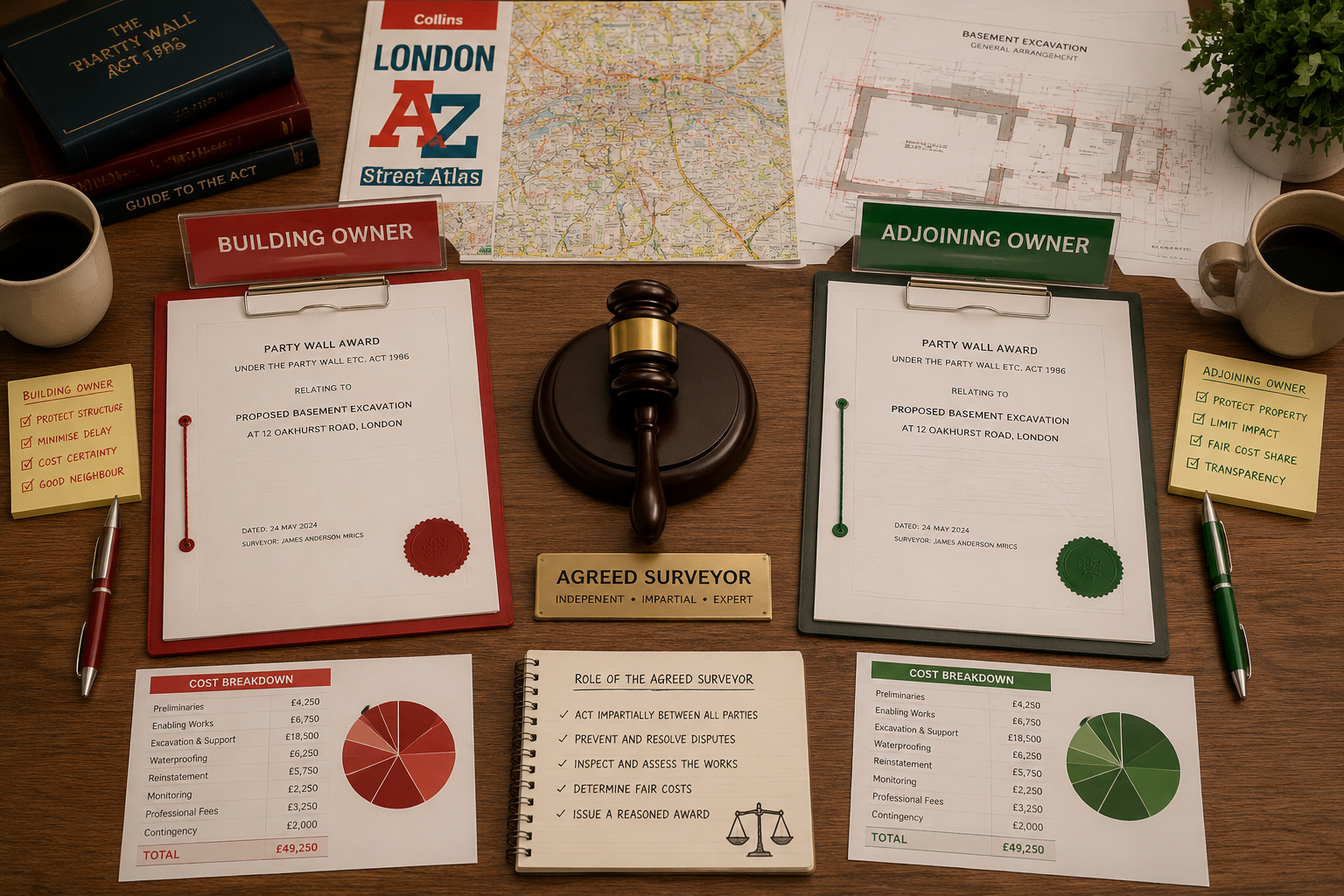
The Case For an Agreed Surveyor
The most compelling argument for a single agreed appointment is straightforward: it costs less and moves faster.
Cost savings of 25% to 35%
Research consistently shows that appointing an Agreed Surveyor reduces the total bill by approximately 25% to 35% compared to the separate surveyor route [1]. The reason is structural. When separate surveyors are appointed, the building owner is typically responsible for both surveyors' fees — meaning a single project can carry the cost of two professional hourly rates, two sets of correspondence, and two schedules of condition [5]. An Agreed Surveyor eliminates one of those fee streams entirely.
Faster resolution
Because there is only one surveyor managing the process, there is no need for inter-surveyor correspondence, negotiation, or the back-and-forth that can extend timelines significantly. The award is drafted, reviewed, and issued more quickly [2]. For building owners working to a tight construction programme, this efficiency can be as valuable as the cost saving.
Streamlined communication
A single point of contact reduces the administrative burden on both parties. There are no competing interpretations of the same facts, no delays waiting for one surveyor to respond to another's queries, and no risk of the process stalling due to professional disagreements between appointed surveyors.
The Drawbacks of an Agreed Surveyor
Perceived conflicts of interest
Although an Agreed Surveyor is legally obligated to act impartially, the perception of bias can arise — particularly if one party feels the surveyor has a closer professional relationship with the other side. This perceived conflict of interest can erode trust, especially if the project encounters problems mid-build [3].
No third surveyor safety net
This is the most significant structural limitation. When separate surveyors are appointed, a third surveyor is selected in advance to resolve any deadlock between them. With an Agreed Surveyor, that safety net does not exist. If a genuine dispute arises between the parties during the process, there is no pre-agreed mechanism to resolve it — which can complicate matters considerably [3].
Less individual advocacy
An Agreed Surveyor serves both parties simultaneously. That means neither party receives the kind of dedicated, one-sided advocacy that a separately appointed surveyor would provide. For an adjoining owner with specific concerns about structural risk, this can feel inadequate.
"The Agreed Surveyor route works best when both parties have broadly aligned interests and the project is relatively straightforward. When those conditions do not apply, the absence of independent representation can become a real problem."
Separate Surveyors: Pros, Cons, and Cost Implications Under the Party Wall Act
The Case For Separate Surveyors
Independent representation for each party
The clearest advantage of separate appointments is that each party has a surveyor working exclusively in their interest. The building owner's surveyor focuses on enabling the works to proceed efficiently. The adjoining owner's surveyor focuses on protecting the neighbouring property from damage and ensuring any compensation or remediation rights are properly recorded.
This tailored representation matters most on high-risk projects. For basement excavations in particular, separate surveyors are strongly recommended because the structural risks are significant and the adjoining owner's surveyor can independently appoint a checking engineer to review structural calculations [4].
The third surveyor mechanism
When two surveyors cannot agree, the pre-selected third surveyor steps in to resolve the deadlock. This provides a clear, legally recognised dispute resolution pathway that keeps the project moving without resorting to court proceedings [7].
Greater scrutiny of the award
Two surveyors reviewing the same project from opposing perspectives means the final party wall award is subject to greater scrutiny. Errors, omissions, or unfair conditions are more likely to be caught before the award is issued.
The Drawbacks of Separate Surveyors
Significantly higher costs
The financial case against separate surveyors is hard to ignore. Because the building owner pays both surveyors' fees, the total cost can be roughly double that of an Agreed Surveyor arrangement [5]. On a project where every pound matters, that premium is a genuine consideration.
Slower process
Two surveyors must exchange correspondence, agree on the scope of the schedule of condition, negotiate the terms of the award, and resolve any professional disagreements. Each of those steps adds time. On straightforward projects, this additional process can feel disproportionate to the complexity of the work involved.
Potential for adversarial dynamics
In some cases, separate surveyors can inadvertently escalate tensions between neighbours rather than reduce them. When each surveyor is advocating strongly for their client, the process can become more combative than necessary — particularly if the adjoining owner's surveyor takes an overly protective stance.
2026 Cost Comparison: Agreed Surveyor vs Separate Surveyors
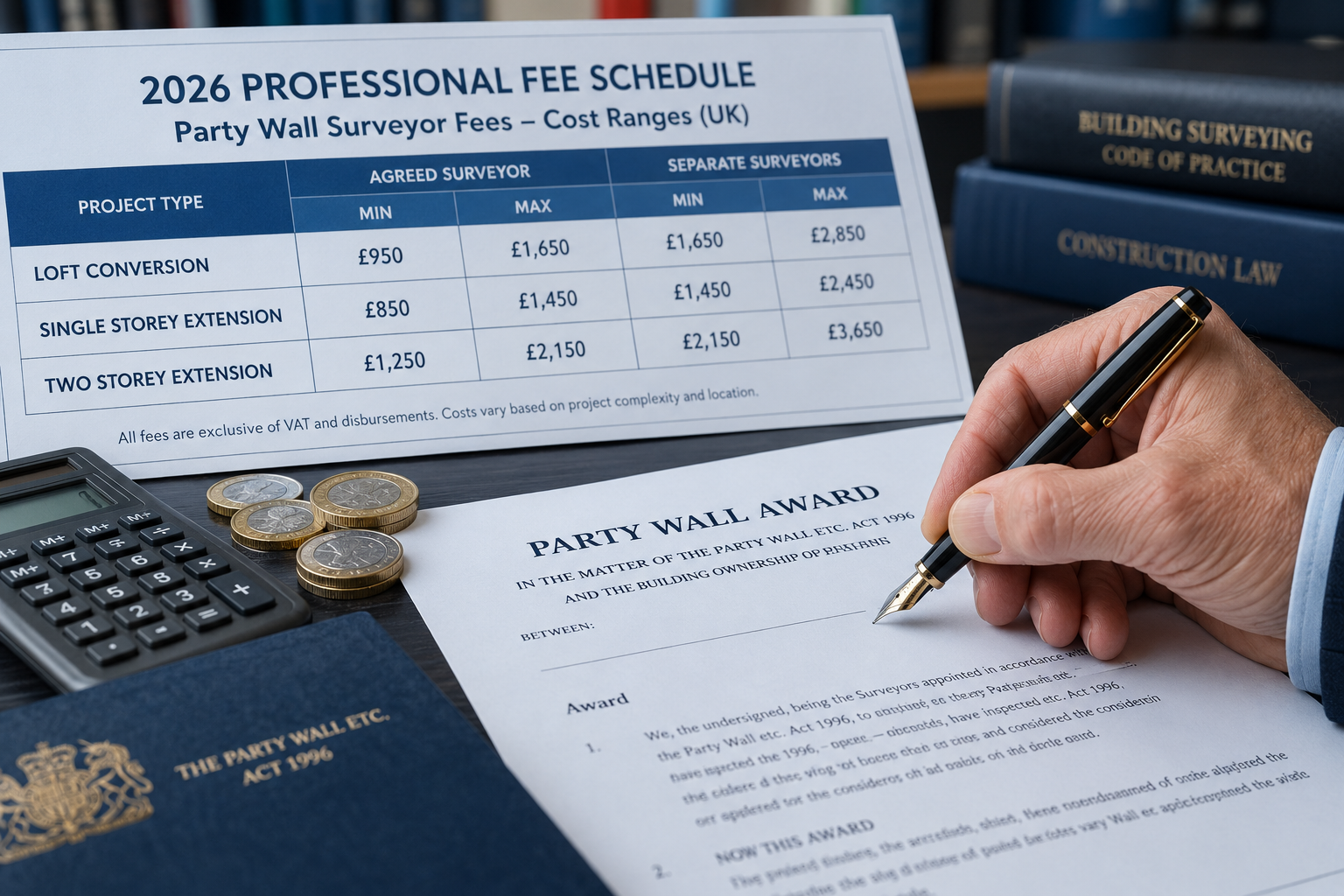
The following table sets out current 2026 fee guidance for both routes across common project types [6].
| Project Type | Agreed Surveyor | Separate Surveyors (Total) |
|---|---|---|
| Loft conversion | £900 – £1,200 | £1,800 – £2,400 |
| Rear extension | £1,200 – £1,500 | £2,400 – £3,000 |
| Basement excavation | £1,500 – £2,500+ | £3,000 – £5,000+ |
These figures represent the surveyor fees alone. They do not include the cost of a schedule of condition, which is a separate document recording the pre-existing state of the adjoining property before works begin. A schedule of condition is strongly recommended on any project where structural risk exists, regardless of which surveyor route is chosen.
For practical strategies to manage these costs, the guide on how to keep party wall costs down offers actionable advice. A detailed breakdown of the full process and associated fees is also available at the party wall costs and process page.
Who Pays?
In almost all cases, the building owner — the party carrying out the works — is responsible for paying the reasonable fees of both surveyors [5]. The adjoining owner does not typically contribute to surveyor costs unless they have requested works that go beyond what the Act requires, or unless the dispute arises from their own unreasonable conduct.
This cost allocation applies whether the parties choose an Agreed Surveyor or separate surveyors. The financial difference between the two routes falls entirely on the building owner.
When to Choose Each Route: A Practical Decision Framework
The choice between an Agreed Surveyor and separate surveyors should be driven by three factors: project complexity, risk level, and the current state of the neighbour relationship.
Choose an Agreed Surveyor When:
- The project is relatively straightforward (a loft conversion, a small rear extension, minor works to a party wall)
- Both parties have a good or neutral relationship and broadly trust each other
- Speed is a priority and the construction programme is tight
- The adjoining owner is comfortable with a shared appointment and has no specific concerns about structural risk
- Budget is a genuine constraint and the saving of 25% to 35% is material [1]
Choose Separate Surveyors When:
- The project is complex or high-risk (basement excavation, significant structural alterations, works close to foundations)
- The neighbour relationship is strained or there is an existing dispute
- The adjoining owner has specific concerns they want independently assessed
- The project involves multiple adjoining owners with different interests
- The building owner wants the additional credibility and scrutiny that two independent surveyors provide [4]
It is worth noting that the adjoining owner always has the right to appoint their own surveyor, regardless of what the building owner prefers. If an adjoining owner insists on separate representation, the building owner cannot compel them to accept an Agreed Surveyor. For adjoining owners uncertain about their rights, the adjoining owners page provides a clear explanation of the options available.
The Appeal Process
Whichever route is chosen, either party retains the right to appeal the resulting party wall award to the county court within 14 days of receiving it, if they believe the surveyor acted outside the scope of the Act or made a material error [7]. This right of appeal applies equally under both arrangements and provides an important backstop for both parties.
Conclusion
The decision between an Agreed Surveyor and separate surveyors is not a minor administrative choice — it shapes the cost, speed, and fairness of the entire party wall process. For straightforward projects where both parties are broadly aligned, an Agreed Surveyor offers genuine savings of 25% to 35% and a faster route to a completed award [1][2]. For complex or high-risk projects, or where neighbour relations are difficult, separate surveyors provide the independent representation and structured dispute resolution that the Agreed Surveyor route cannot replicate [3][4].
Actionable next steps:
- Assess the complexity and structural risk of the proposed works before deciding on a route.
- Have an honest conversation with the adjoining owner about their comfort level with a shared appointment.
- Obtain fee estimates from qualified surveyors under both routes before committing.
- Ensure a schedule of condition is prepared regardless of which route is chosen.
- Serve the correct party wall notices within the statutory timeframes — the party wall notices page explains the requirements in full.
- If in doubt, seek professional advice from a qualified party wall surveyor before the dispute formally arises.
Choosing the right route from the outset avoids the delays, costs, and tensions that can derail even well-planned construction projects.
References
[1] Party Wall Surveyor Fees London – https://www.surveyofpartywall.co.uk/party-wall-surveyor-fees-london/?utm_source=openai
[2] The Agreed Surveyor How To Save Time And Money On Your Party Wall Award – https://www.partywallslimited.com/blog/the-agreed-surveyor-how-to-save-time-and-money-on-your-party-wall-award?utm_source=openai
[3] Exploring The Pros And Cons Of Agreed Surveyors Versus Separate Surveyors In Party Wall Disputes – https://www.partywalllondonlimited.com/post/exploring-the-pros-and-cons-of-agreed-surveyors-versus-separate-surveyors-in-party-wall-disputes?utm_source=openai
[4] Basement Digs Separate Surveyors – https://www.partywallslimited.com/blog/basement-digs-separate-surveyors?utm_source=openai
[5] Who Pays For A Party Wall Surveyor A Guide To Cost Responsibilities – https://nottinghillsurveyors.com/blog/who-pays-for-a-party-wall-surveyor-a-guide-to-cost-responsibilities?utm_source=openai
[6] Party Wall Surveyor Cost – https://ourpartywall.co.uk/guides/party-wall-surveyor-cost?utm_source=openai
[7] Can I Do A Party Wall Agreement Myself Or Need A Surveyor – https://legalclarity.org/can-i-do-a-party-wall-agreement-myself-or-need-a-surveyor/?utm_source=openai