
RICS
Looking for expert solutions?
Request a Quote

Author: admin

  • 7 Key Scenarios Requiring Party Wall Surveyors: From New Walls to

    Planning building work that affects shared walls or boundaries with your neighbours? Understanding when you need a party wall surveyor can save you from costly disputes, legal complications, and damaged relationships. In 2026, homeowners across England and Wales continue to navigate the requirements of the Party Wall etc. Act 1996, which governs construction work affecting shared structures.

    The 7 Key Scenarios Requiring Party Wall Surveyors: From New Walls to Foundation Excavations represent the most common situations where professional surveyor involvement becomes mandatory. Whether you’re building an extension, digging foundations, or making structural changes, knowing these scenarios helps you plan projects correctly from the start. This comprehensive guide explores each scenario in detail, providing practical checklists to help assess your project requirements early in the planning process.
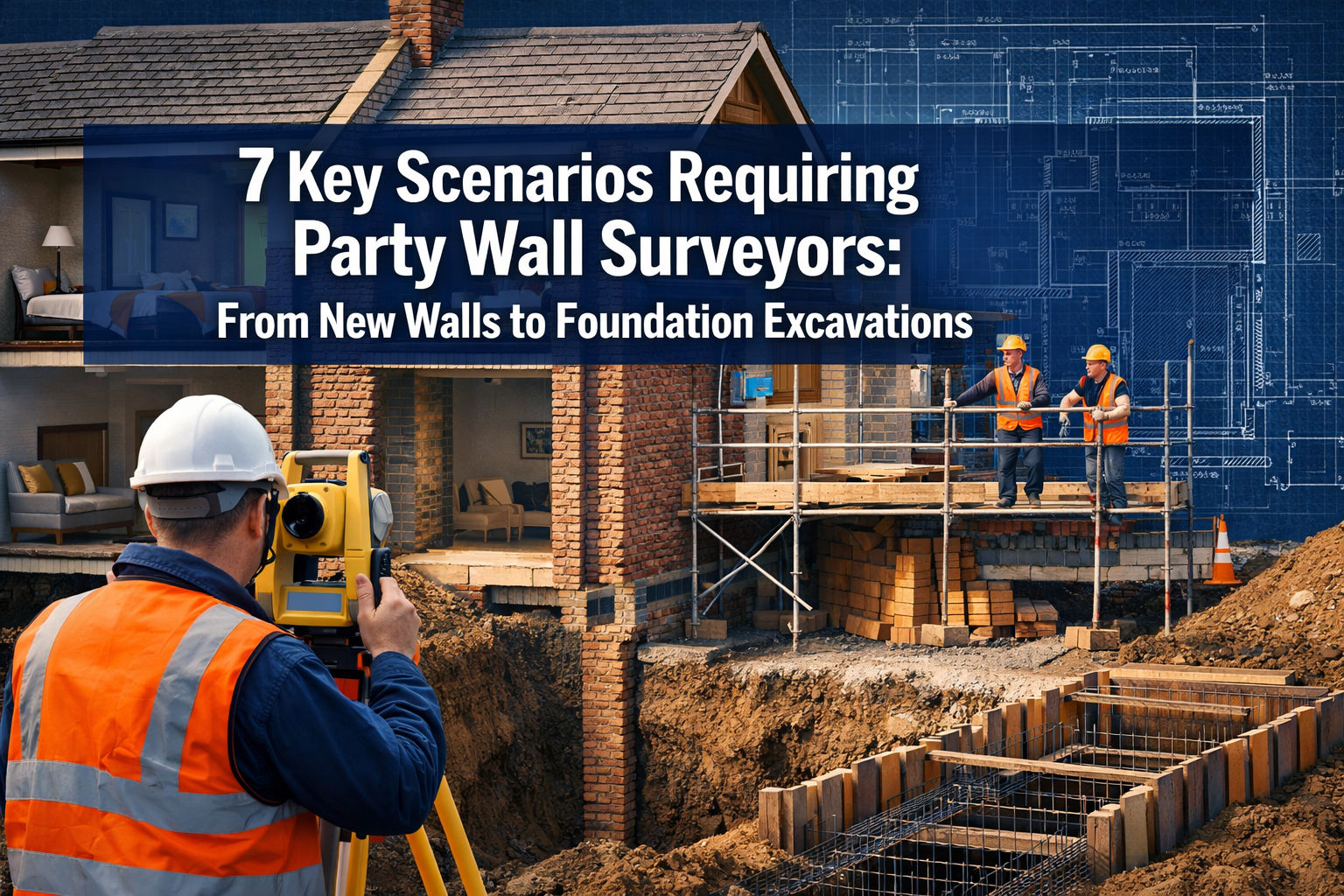
    Professional () hero image with '7 Key Scenarios Requiring Party Wall Surveyors: From New Walls to Foundation Excavations'

    Key Takeaways

    • Building new walls on property boundaries and excavating within specific distances of shared structures always require party wall surveyor involvement and formal notices
    • Structural alterations to existing party walls—including removing chimney breasts, installing beams, or underpinning—mandate professional surveyor assessment to prevent damage
    • Minor cosmetic work like plastering or attaching shelves does not require party wall agreements, but all structural interventions do
    • Early assessment using scenario-specific checklists helps homeowners identify requirements before starting work, avoiding legal complications and neighbour disputes
    • Professional surveyor costs typically range from £150-£200 per hour, with complete party wall awards costing around £1,000 in 2026

    Understanding the Party Wall etc. Act 1996

    The Party Wall etc. Act 1996 provides the legal framework for building work that affects shared walls and boundaries between properties in England and Wales. This legislation exists specifically to prevent construction work that compromises the structural integrity of shared walls while protecting the rights of both building owners and their neighbours.[2]

    Important note: The Act applies only to England and Wales—Scotland and Northern Ireland have different regulations governing shared boundaries.

    What Qualifies as a Party Wall?

    A party wall is any wall or structure shared between two properties. This includes:

    • Walls separating buildings owned by different people
    • Walls standing on the boundary between two properties
    • Walls within a building that separate different parts in different ownership
    • Garden walls built along property boundaries

    Understanding whether your wall qualifies as a party structure is the first step in determining if you need to follow the Act’s requirements. For more detailed information about different types of party structures, visit our guide on party fence walls.

    When Surveyor Involvement Becomes Mandatory

    Party wall surveyors become necessary when neighbours cannot agree on proposed building work or when one party wants professional assessment of potential impacts. The surveyor acts as an impartial expert who inspects the work, prepares schedules of condition, and creates a legally binding party wall award that protects both parties.[1]

    The 7 Key Scenarios Requiring Party Wall Surveyors
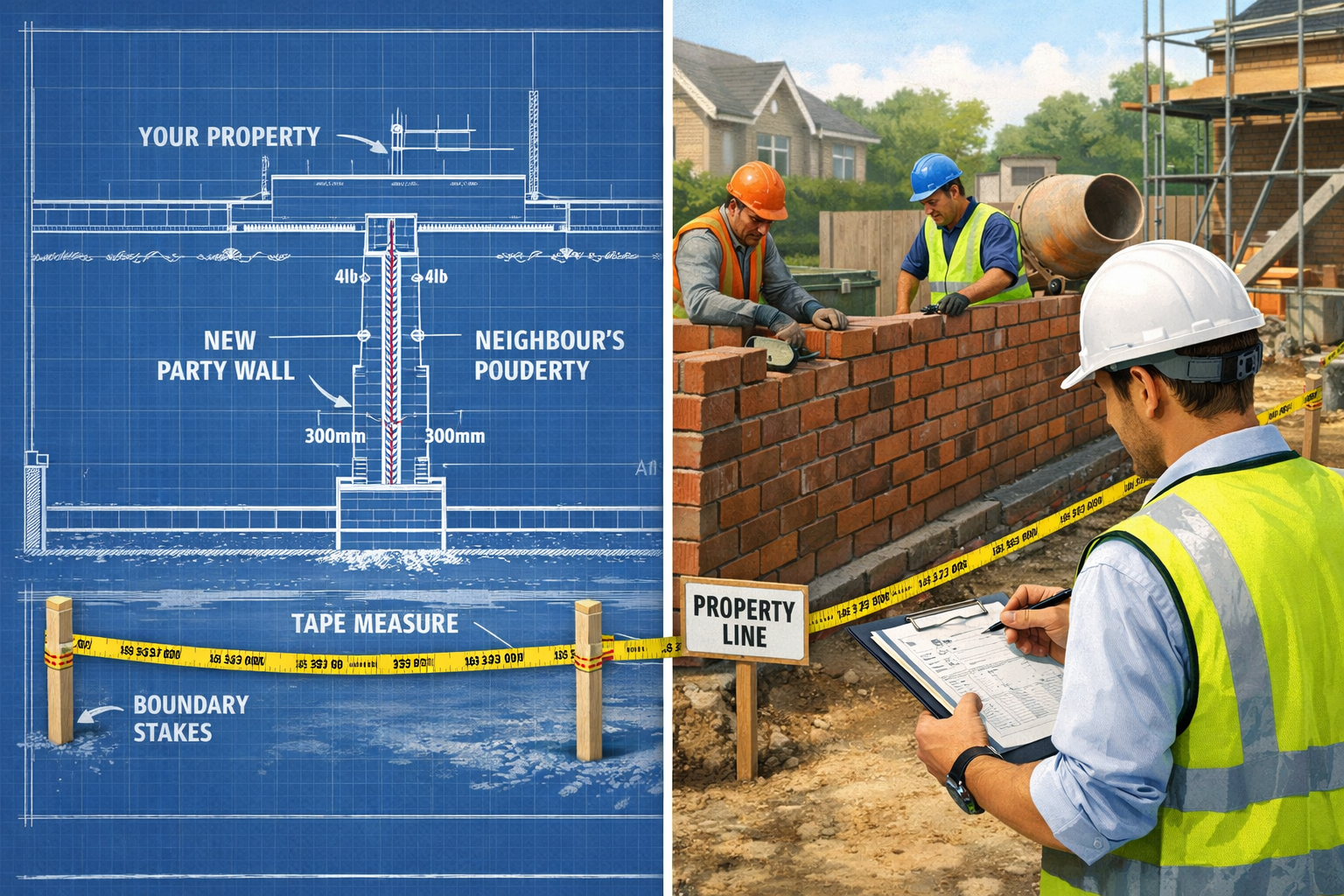
    () detailed illustration showing construction of new party wall on property boundary line, split-screen composition with

    Scenario 1: Building a New Party Wall on the Boundary

    Constructing a new wall directly on the boundary line between two properties represents one of the most straightforward scenarios requiring party wall surveyor involvement. This situation commonly arises when building extensions, garages, or garden walls that sit precisely on the property line.[1]

    Why a surveyor is needed: Building on the boundary affects both properties equally, and the new structure will become a shared party wall. Professional assessment ensures the construction meets structural standards and doesn’t adversely affect the neighbouring property.

    Checklist for New Party Wall Construction ✅

    • Confirm exact boundary line location with title deeds
    • Prepare detailed plans showing wall dimensions and materials
    • Serve formal Party Wall Notice at least two months before starting
    • Include proposed start date and work duration in notice
    • Appoint surveyor if neighbour dissents or doesn’t respond within 14 days
    • Obtain party wall award before commencing construction
    • Arrange pre-construction condition survey of neighbour’s property

    Timeline consideration: You must serve notice at least two months before starting work on a new party wall, so factor this into your project schedule.

    Scenario 2: Excavating Foundations Near a Party Wall

    Foundation excavation triggers party wall requirements when digging occurs within specific distances of a neighbouring structure. This represents one of the most common scenarios requiring party wall agreements in residential settings, particularly for extensions and new builds.[1][2]

    Distance thresholds that trigger requirements:

    Excavation Depth Distance from Neighbour’s Foundation Party Wall Notice Required?
    Within 3 metres Any depth below neighbour’s foundation ✅ Yes
    Within 6 metres Depth goes below 45-degree line from neighbour’s foundation ✅ Yes
    Beyond 6 metres Any depth ❌ No

    Checklist for Foundation Excavations 🏗️

    • Measure exact distance from neighbour’s building
    • Determine depth of neighbour’s existing foundations
    • Calculate if your excavation falls within 3m or 6m threshold
    • Prepare detailed excavation plans with depth specifications
    • Serve notice at least one month before excavation begins
    • Arrange surveyor to assess potential impact on party wall
    • Implement protective measures recommended by surveyor
    • Document existing condition of neighbour’s property

    Common protective measures include temporary shoring, underpinning of adjacent foundations, or modified excavation techniques to minimize ground movement.

    Scenario 3: Carrying Out Structural Alterations to Party Walls

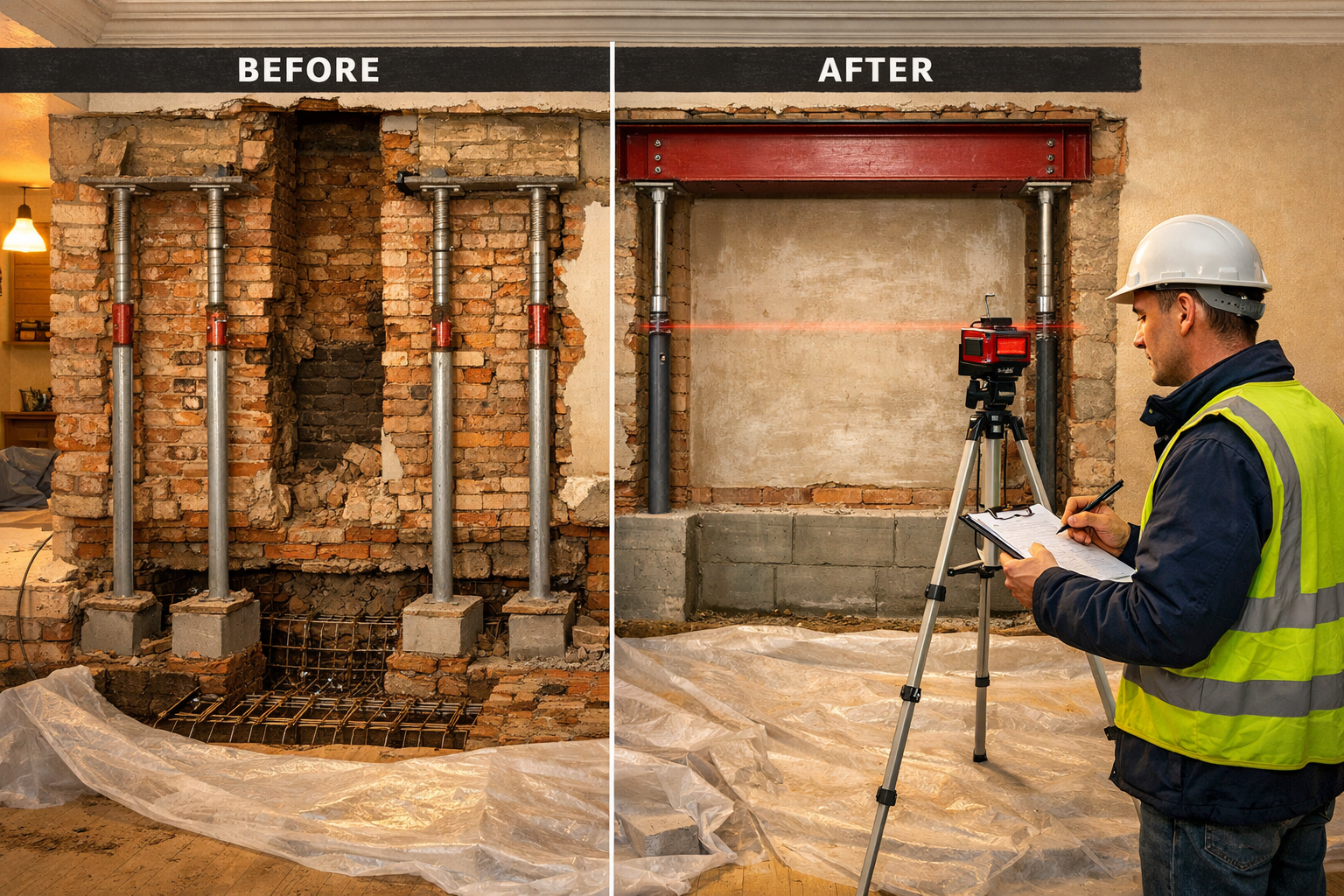
    Structural changes to existing party walls—such as removing chimney breasts, cutting into walls for steel beam installation, or creating new openings—require surveyor assessment due to their potential impact on the wall’s load-bearing capacity and stability.[1]

    Examples of structural alterations requiring surveyors:

    • 🔨 Removing chimney breasts or chimney stacks
    • 🔩 Installing steel beams or RSJs through party walls
    • 🚪 Creating new doorways or openings
    • 🧱 Increasing height of party walls
    • ⚡ Inserting damp proof courses
    • 🏠 Adding or removing load-bearing elements

    These works differ significantly from minor cosmetic changes. Plastering, painting, or attaching kitchen units to party walls do not require party wall agreements.[2]

    Checklist for Structural Alterations ⚙️

    • Obtain structural engineer’s assessment of proposed changes
    • Identify all party walls affected by alterations
    • Prepare detailed drawings showing existing and proposed structure
    • Serve Party Structure Notice at least two months in advance
    • Specify exact nature of structural work in notice
    • Appoint surveyor to assess impact on wall integrity
    • Ensure temporary support measures are specified
    • Schedule condition survey before work commences

    Cost consideration: According to 2026 data, party wall surveyor rates typically range from £150 to £200 per hour, with a complete party wall award costing approximately £1,000, though this varies by location and project complexity.[2] Learn more about keeping party wall costs down.

    Scenario 4: Underpinning a Party Wall

    Underpinning involves strengthening and stabilizing a building’s foundations, typically to address subsidence issues or to allow for basement excavations. When underpinning affects a party wall, surveyor involvement becomes essential due to the significant structural implications.[1]

    Why underpinning requires special attention: This work directly affects the foundation supporting the shared wall, with potential consequences for both properties. Any miscalculation or improper execution can cause serious structural damage.

    Checklist for Underpinning Projects 🏛️

    • Commission structural engineer’s report on underpinning necessity
    • Determine extent of underpinning required along party wall
    • Identify if underpinning extends under neighbour’s property
    • Serve appropriate notice (typically Party Structure Notice)
    • Appoint experienced party wall surveyor with underpinning expertise
    • Arrange detailed pre-work condition survey with photographs
    • Ensure contractor has relevant insurance and qualifications
    • Implement monitoring regime during underpinning work
    • Schedule post-completion inspection

    Insurance note: Underpinning work should be covered by appropriate contractor insurance, and your surveyor will typically verify this before work begins.
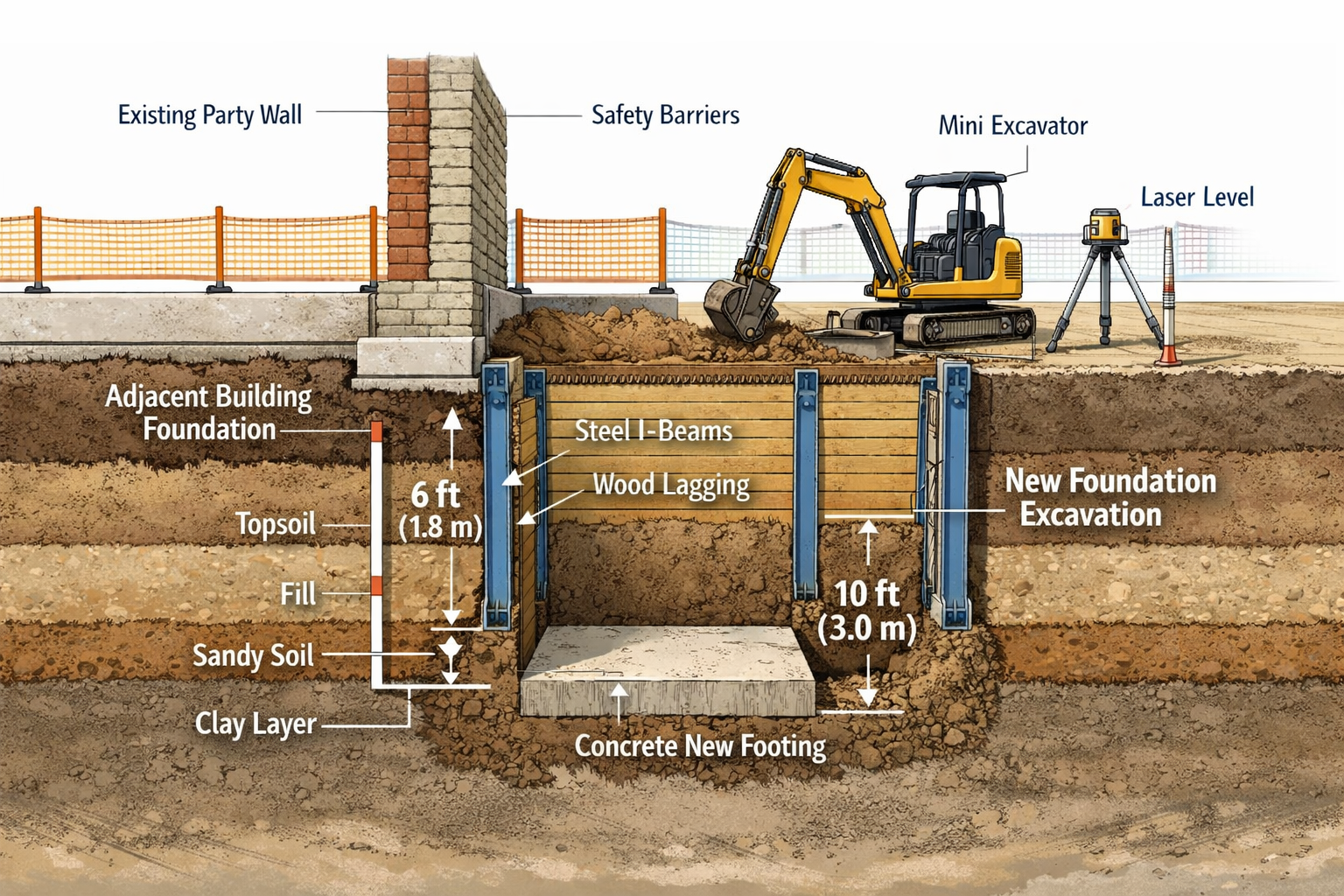
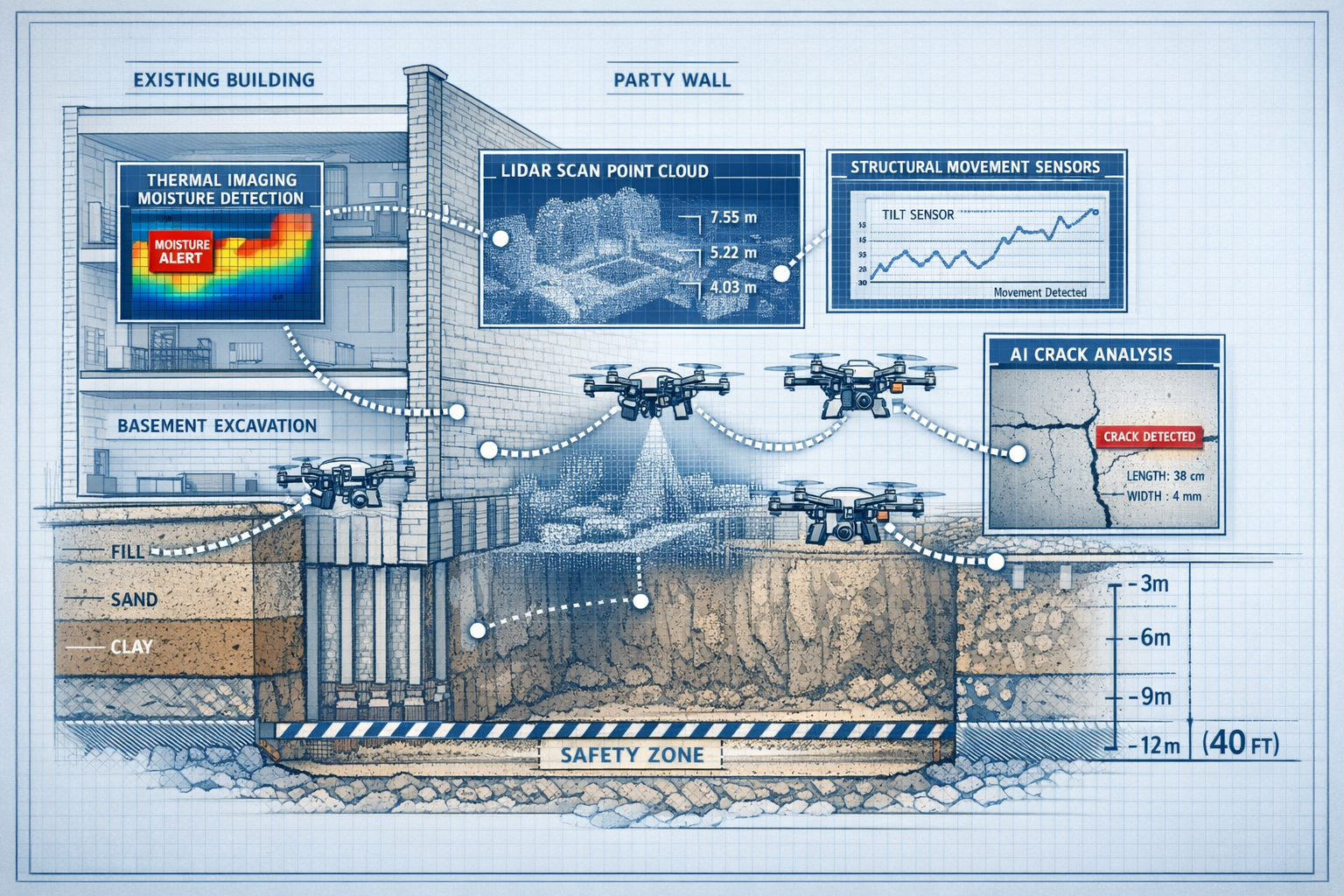
    () cutaway technical diagram showing foundation excavation near existing party wall structure, underground cross-section

    Scenario 5: Excavating for Extensions and Basements

    Basement extensions and similar excavations represent increasingly popular home improvements in 2026, particularly in urban areas where space is at a premium. These projects almost always trigger party wall requirements due to the depth and proximity of excavation to neighbouring properties.[1]

    Types of excavation requiring surveyor involvement:

    • 🏠 Basement conversions – Creating habitable space below ground level
    • 📦 Undercroft excavations – Digging out beneath existing structures
    • 🚗 Underground garages – Subterranean parking facilities
    • 🍷 Wine cellars – Deep excavations for storage spaces
    • 🏊 Swimming pools – Below-ground pool installations near boundaries

    These works can cause ground movement, affect drainage, and potentially destabilize party walls through changes in soil support.

    Checklist for Extension Excavations 🏗️

    • Obtain detailed soil investigation report
    • Map all party walls and neighbouring foundations affected
    • Calculate excavation depths and distances from boundaries
    • Prepare comprehensive excavation and shoring plans
    • Serve notices to all potentially affected neighbours
    • Appoint surveyor to assess stability risks
    • Install monitoring equipment on neighbouring properties
    • Implement excavation sequence recommended by surveyor
    • Maintain regular communication with neighbours during work

    Timeline tip: Basement excavations often take longer than anticipated. Build contingency time into your schedule for unexpected ground conditions or required modifications.

    Scenario 6: Carrying Out Repairs to Party Walls

    Even repair work to existing party walls can require surveyor appointment, particularly when repairs are extensive or involve structural elements. The surveyor inspects the extent of repairs needed and ensures necessary protective measures are implemented.[1]

    Repairs that typically require surveyors:

    • Rebuilding sections of deteriorated party walls
    • Repairing significant structural cracks
    • Replacing damaged lintels or beams
    • Addressing water damage affecting wall integrity
    • Repointing that requires substantial scaffolding access

    Repairs that generally don’t require surveyors:

    • Minor repointing of brickwork
    • Cosmetic plaster repairs
    • Painting or decorating
    • Replacing small sections of render

    The key distinction lies in whether the repair work is structural or cosmetic in nature. For guidance on types of party wall works, consult our detailed resource.

    Checklist for Party Wall Repairs 🔧

    • Document current condition with photographs
    • Obtain building surveyor’s assessment of repair necessity
    • Determine if repairs affect structural integrity
    • Identify if access to neighbour’s property is required
    • Serve appropriate notice based on repair type
    • Appoint surveyor if repairs are extensive or structural
    • Agree on repair methodology with surveyor
    • Ensure repairs match existing materials where possible
    • Document completed repairs for records

    Scenario 7: Building New Walls Adjacent to Party Walls

    Constructing new walls close to existing party walls—even if not directly on the boundary—requires surveyor assessment to prevent damage to the shared structure. This scenario often arises during internal remodeling or when building structures parallel to party walls.[1]

    Examples include:

    • Building internal stud walls that connect to party walls
    • Constructing garden walls near party boundary walls
    • Installing partition walls in loft conversions
    • Creating new structural walls during property subdivisions

    Why proximity matters: Even walls built entirely on your property can affect party walls through vibration during construction, changes in load distribution, or alterations to drainage patterns.

    Checklist for Adjacent Wall Construction 🧱

    • Measure distance from new wall to party wall
    • Determine if new wall will connect to party wall
    • Assess if construction will cause vibration affecting party wall
    • Prepare plans showing relationship between new and existing walls
    • Serve notice if work falls within Act’s scope
    • Appoint surveyor to assess potential impact
    • Implement vibration monitoring if recommended
    • Use construction methods that minimize impact
    • Document party wall condition before and after work

    Understanding the 7 Key Scenarios Requiring Party Wall Surveyors: Notice Requirements
    () interior-exterior composite showing structural alterations to party wall including steel beam installation, removed

    Different scenarios require different types of notices under the Party Wall etc. Act 1996. Understanding which notice to serve is crucial for compliance.[4]

    Three Types of Party Wall Notices

    1. Party Structure Notice

    • Required for: Building new party walls, structural alterations, underpinning
    • Notice period: Two months before work starts
    • Must include: Detailed plans, work description, proposed start date

    2. Line of Junction Notice

    • Required for: Building new walls on the boundary
    • Notice period: One month before work starts
    • Must include: Wall specifications, foundation details, timing

    3. Adjacent Excavation Notice (3-Meter or 6-Meter Notice)

    • Required for: Foundation excavations near neighbouring buildings
    • Notice period: One month before work starts
    • Must include: Excavation depth, distance from boundary, protective measures

    For comprehensive information about serving notices, see our guide on party wall notices.

    What Happens After Serving Notice?

    Once you serve a party wall notice, your neighbour has 14 days to respond in one of three ways:

    Consent – If your neighbour agrees in writing, you may proceed without appointing surveyors (though you remain liable for any damage)[2]

    ⚖️ Dissent – If your neighbour objects or doesn’t respond, the dispute resolution process begins, requiring surveyor appointment

    📋 Counter-notice – Your neighbour may request modifications to your proposals

    The Surveyor Appointment Process

    When disputes arise or neighbours don’t consent, the surveyor appointment process follows these steps:

    1. Building owner appoints their surveyor – You select a qualified professional to represent your interests
    2. Adjoining owner appoints their surveyor – Your neighbour chooses their representative
    3. Agreed surveyor option – Both parties may agree to use a single surveyor (often more cost-effective)
    4. Surveyors prepare party wall award – The appointed surveyor(s) create a legally binding document

    Learn more about the role of the building owner’s surveyor and adjoining owner’s surveyor in this process.

    Regional Considerations Across London

    The application of the 7 Key Scenarios Requiring Party Wall Surveyors varies slightly by location, particularly in different London boroughs where property types and construction densities differ.

    London-Specific Considerations

    North London – Terraced Victorian properties in areas like Islington and Hampstead frequently require party wall agreements for loft conversions and basement excavations. Find specialists in North London.

    East London – Rapid development in areas like Hackney and Tower Hamlets means increased party wall work for new builds and conversions. Locate experts in East London.

    Central London – High-value properties in Westminster and Camden often involve complex basement excavations requiring specialist surveyor expertise. Access professionals in Central London.

    West London – Period properties in Kensington and Chelsea frequently need party wall agreements for structural alterations. Connect with surveyors in West London.

    South London – Semi-detached properties in Wandsworth and Lambeth commonly trigger party wall requirements for extensions. Find professionals in South London.

    Common Misconceptions About Party Wall Requirements

    ❌ Myth: “I don’t need permission if I’m only working on my side”

    Reality: The Party Wall Act applies regardless of which side you’re working on. If your work affects a party wall or involves excavation near a boundary, you must follow the Act’s requirements.

    ❌ Myth: “Minor work doesn’t require notices”

    Reality: While truly cosmetic work (plastering, painting) doesn’t require notices, many homeowners underestimate what counts as “structural.” When in doubt, consult a surveyor.

    ❌ Myth: “My neighbour can stop my project”

    Reality: Neighbours cannot prevent work that complies with planning permission and building regulations. The Party Wall Act provides a dispute resolution mechanism—it doesn’t give neighbours veto power.[2]

    ❌ Myth: “Party wall agreements are only for shared walls”

    Reality: The Act also covers excavations near boundaries and new construction on boundary lines, even where no existing party wall exists.

    Cost Implications and Who Pays

    Understanding the financial aspects of the 7 Key Scenarios Requiring Party Wall Surveyors helps with project budgeting.

    Typical Cost Breakdown (2026)

    Service Typical Cost Range
    Surveyor hourly rate £150 – £200 per hour
    Complete party wall award £1,000 average
    Schedule of condition £300 – £600
    Complex basement project £1,500 – £3,000
    Simple extension notice £700 – £1,200

    Who pays? Generally, the building owner (the person doing the work) pays for both surveyors’ fees. However, if the adjoining owner requests additional work beyond what’s necessary, they may bear those costs.[2]

    For detailed information about costs, visit our costs of party wall process page.

    Avoiding Common Pitfalls

    Starting Work Without Proper Notices ⚠️

    The problem: Beginning construction before serving notices or obtaining awards violates the Act and can result in injunctions forcing work stoppage.

    The solution: Always serve notices well in advance—remember the two-month requirement for structural work.

    Inadequate Documentation 📋

    The problem: Poor documentation of existing conditions leads to disputes about damage responsibility.

    The solution: Ensure comprehensive schedules of condition with detailed photographs before work begins.

    Poor Communication with Neighbours 🗣️

    The problem: Lack of communication breeds suspicion and increases likelihood of disputes.

    The solution: Discuss plans informally before serving formal notices. Transparency builds trust.

    Choosing Unqualified Surveyors 🎓

    The problem: Not all surveyors have party wall expertise, leading to inadequate awards or missed issues.

    The solution: Select surveyors with specific party wall qualifications and experience in your type of project.

    The Party Wall Award: What to Expect

    A party wall award is the legally binding document produced by the appointed surveyor(s) that sets out the rights and responsibilities of both parties. Understanding what it contains helps you prepare for the process.

    Key Components of a Party Wall Award

    1. Description of Works

    • Detailed specifications of proposed construction
    • Methods and materials to be used
    • Timeline for completion

    2. Schedule of Condition

    • Photographic record of neighbour’s property
    • Documentation of existing defects
    • Baseline for assessing future damage claims

    3. Rights of Access

    • Specified times and dates for access
    • Areas of neighbour’s property that may be accessed
    • Notice requirements for access

    4. Special Foundations Provisions

    • If building on the boundary line
    • Compensation arrangements if applicable
    • Future rights regarding the foundation

    5. Dispute Resolution Procedures

    • Process for handling disagreements
    • Third surveyor appointment mechanism
    • Appeal procedures

    For more details about party wall awards, see our party wall contract template guide.

    Alternative: Having a Party Wall Agreement Without a Surveyor

    While the 7 Key Scenarios Requiring Party Wall Surveyors typically necessitate professional involvement, there are circumstances where neighbours can proceed without surveyors.

    When Surveyors May Not Be Needed

    If your neighbour provides written consent to your party wall notice within the 14-day response period, you may proceed without appointing surveyors. However, important considerations include:

    • ✅ You remain fully liable for any damage caused during works
    • ✅ Written consent must be explicit and documented
    • ✅ A schedule of condition is still highly recommended
    • ✅ Consent doesn’t waive your neighbour’s rights to claim for damage

    For detailed guidance on this approach, read our article about having a party wall agreement without a surveyor.

    Risks of Proceeding Without Surveyors

    Damage disputes: Without professional documentation, proving the extent of pre-existing damage becomes difficult.

    Inadequate protection: Surveyors identify risks and recommend protective measures you might overlook.

    Future complications: Lack of formal award can complicate future property sales or insurance claims.

    Practical Tips for Homeowners in 2026

    Start Planning Early ⏰

    Begin the party wall process at least three months before your intended start date. This allows time for:

    • Serving the required notice periods
    • Appointing surveyors if needed
    • Preparing schedules of condition
    • Addressing any disputes that arise

    Maintain Good Records 📸

    Document everything:

    • Take dated photographs of all relevant areas
    • Keep copies of all correspondence
    • Save receipts for surveyor fees
    • Record any verbal agreements in writing

    Choose the Right Professionals 👷

    Select contractors experienced with party wall requirements who:

    • Understand notice requirements
    • Work cooperatively with surveyors
    • Implement protective measures properly
    • Maintain appropriate insurance coverage

    Communicate Proactively 💬

    Keep neighbours informed throughout:

    • Discuss plans before serving formal notices
    • Provide regular updates on work progress
    • Address concerns promptly and professionally
    • Be considerate about noise and access times

    Conclusion

    Understanding the 7 Key Scenarios Requiring Party Wall Surveyors: From New Walls to Foundation Excavations is essential for any homeowner planning building work that affects shared boundaries or structures. From constructing new party walls and excavating foundations to carrying out structural alterations and underpinning, each scenario carries specific requirements under the Party Wall etc. Act 1996.

    The key to successful party wall compliance in 2026 lies in early identification of requirements, timely service of appropriate notices, and selection of qualified surveyors when needed. While the process may seem complex initially, following the checklists provided for each scenario helps ensure you meet all legal obligations while maintaining positive neighbour relations.

    Your Next Steps

    1. Assess your project against the seven scenarios outlined in this guide
    2. Determine which notices you need to serve based on your specific work
    3. Calculate timelines to serve notices at least 1-2 months before starting
    4. Research qualified surveyors in your area with relevant experience
    5. Prepare documentation including detailed plans and specifications
    6. Communicate with neighbours informally before serving formal notices
    7. Budget appropriately for surveyor fees (£1,000-£3,000 for most projects)

    Remember that party wall legislation exists to protect both building owners and their neighbours. By following the proper procedures and engaging qualified professionals when required, you can complete your building project successfully while preserving good relationships with those living next door.

    For personalized guidance on your specific situation, consider consulting with experienced party wall surveyors who can assess your project and recommend the appropriate course of action. Whether you’re in North London, South London, or anywhere else in England and Wales, professional advice ensures compliance and peace of mind throughout your construction project.


    References

    [1] Scenarios That Require A Party Wall Surveyor – https://iconsurveyors.co.uk/blog/scenarios-that-require-a-party-wall-surveyor/

    [2] Party Wall Agreement – https://hoa.org.uk/advice/guides-for-homeowners/i-am-improving/party-wall-agreement/

    [3] Party Wall Surveys For Ev Infrastructure Retrofits Compliance Amid 2026 Net Zero Mandates And Neighbour Disputes – https://nottinghillsurveyors.com/blog/party-wall-surveys-for-ev-infrastructure-retrofits-compliance-amid-2026-net-zero-mandates-and-neighbour-disputes

    [4] Different Types Of Party Wall Notice Every Homeowner Should Know – https://westvilleassociates.com/blog/different-types-of-party-wall-notice-every-homeowner-should-know
  • Real-Time Digital Twins for Party Wall Agreements: Simulating

    Imagine standing in your neighbour’s property, watching a three-dimensional hologram predict exactly how your basement excavation will affect their foundation—before a single shovel breaks ground. This isn’t science fiction. In 2026, Real-Time Digital Twins for Party Wall Agreements: Simulating Excavation Impacts Under Section 6 are transforming how property owners, surveyors, and construction teams navigate one of the most contentious aspects of building work: excavating near adjoining properties.

    Traditional party wall procedures have relied on static drawings, historical precedent, and educated guesswork. But as urban densification accelerates and sustainability demands precision, interactive 3D twins now visualize notional and special excavation effects on adjoining properties, enabling informed consent and reducing disputes. This technological leap is essential for surveyors navigating 2026’s heightened expectations for accuracy, transparency, and environmental responsibility.

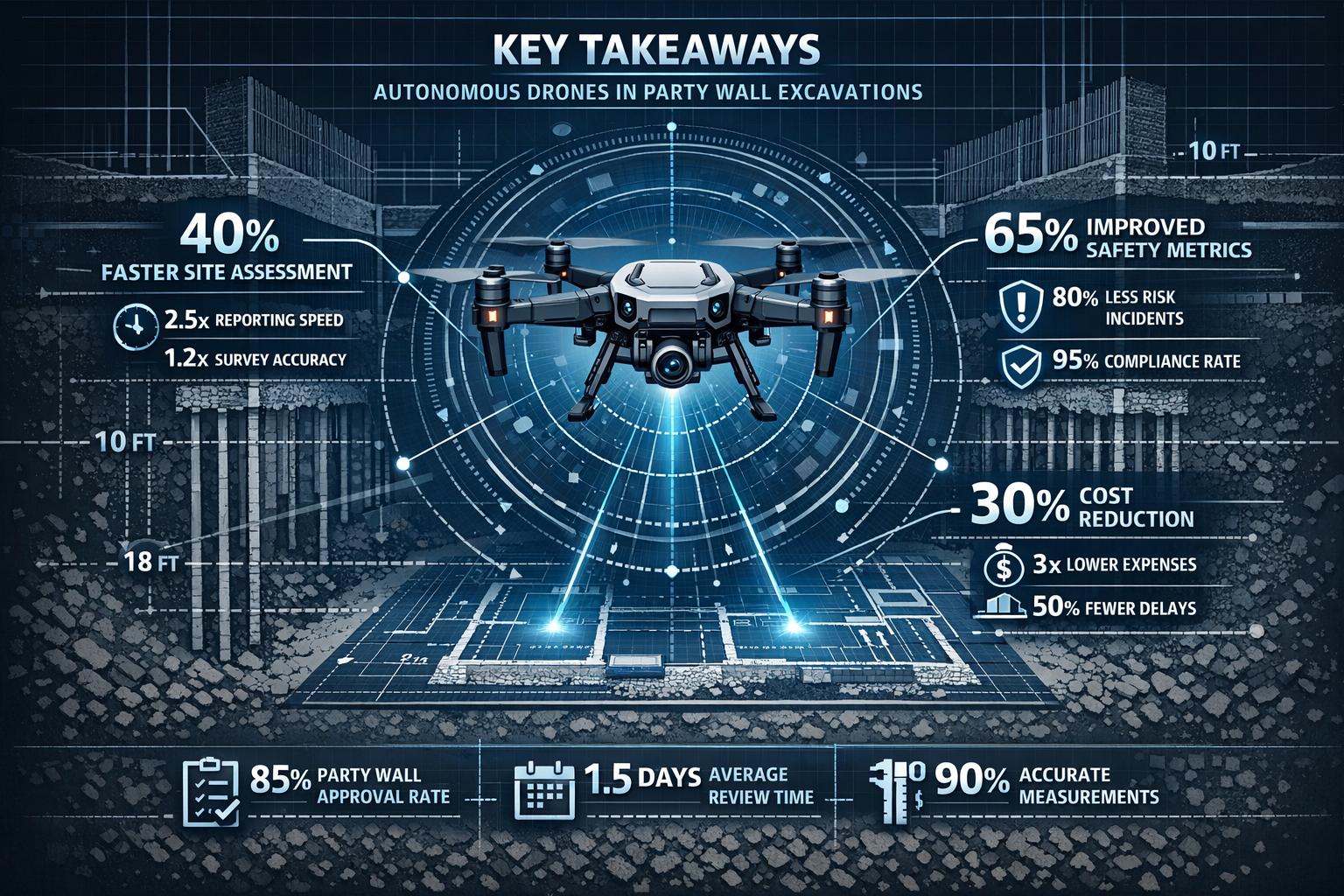
    Key Takeaways infographic visualizing Real-Time Digital Twins for Party Wall Agreements, featuring layered architectural

    Key Takeaways

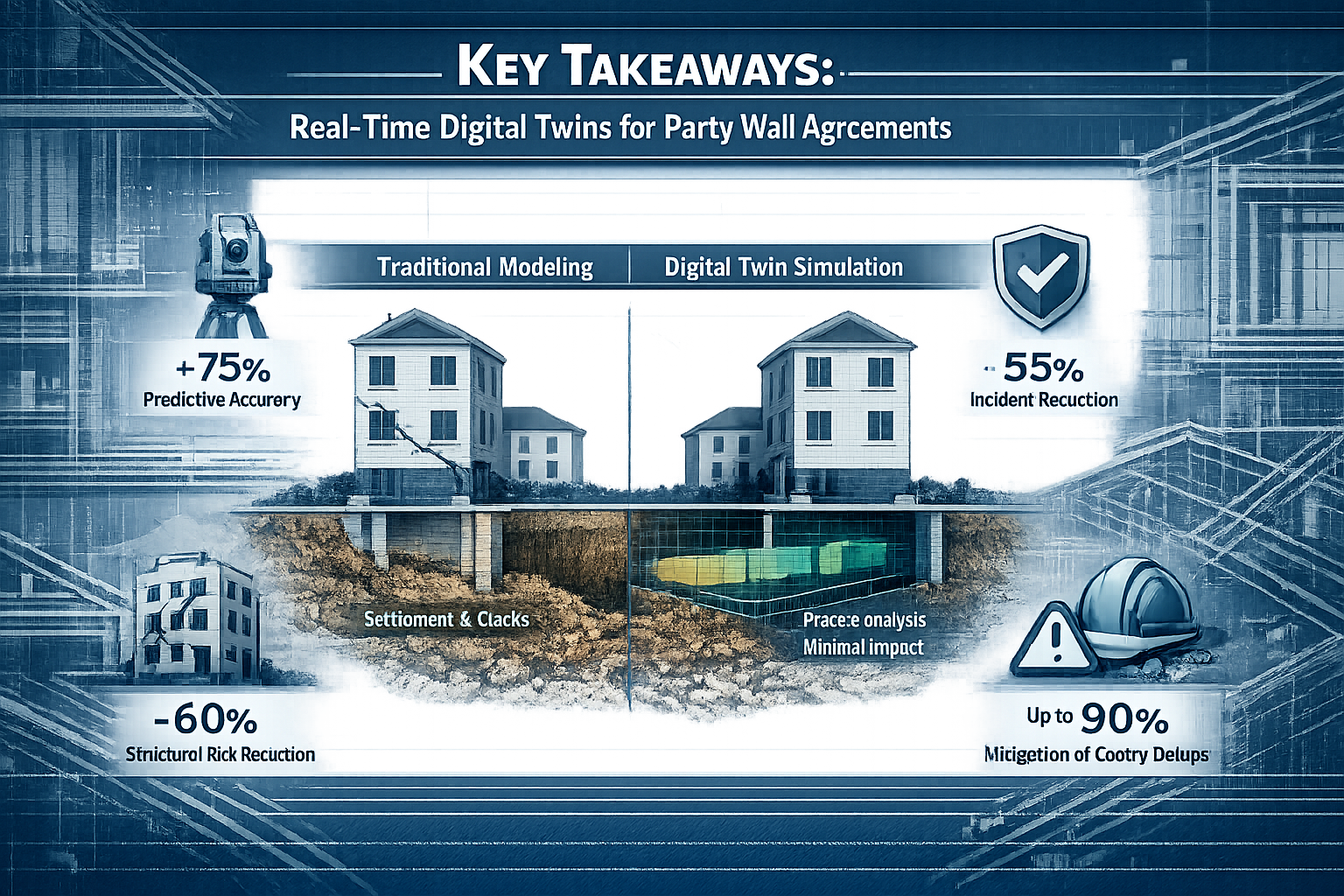
    • Digital twins create interactive 3D models that simulate excavation impacts under Section 6 of the Party Wall etc. Act 1996, providing visual evidence for both building and adjoining owners
    • Real-time monitoring capabilities integrate sensor data from construction sites to update predictions continuously, identifying potential issues before they become costly disputes
    • Enhanced transparency and consent through visualizations help adjoining owners understand complex excavation risks, leading to faster agreement approvals
    • Cost and time savings result from early identification of design problems and reduced need for reactive remediation work
    • Compliance with 2026 standards for sustainability and precision construction is simplified through data-driven decision-making

    Understanding Section 6 and Excavation Challenges

    What Section 6 Covers

    Section 6 of the Party Wall etc. Act 1996 addresses excavation work near neighbouring buildings. Specifically, it requires building owners to serve notice when:

    • Excavating within three metres of a neighbour’s structure and going deeper than its foundation
    • Excavating within six metres of a neighbour’s structure and cutting a line drawn downward at 45 degrees from the bottom of their foundation

    These provisions exist because excavation can undermine adjacent properties, causing settlement, cracking, and structural damage. The legislation requires building owners to provide adequate support and protection—but determining what constitutes “adequate” has traditionally involved considerable uncertainty.

    Traditional Assessment Limitations

    Conventional party wall procedures under Section 6 typically involve:

    1. Structural calculations based on soil reports
    2. Two-dimensional cross-section drawings
    3. Written descriptions of proposed underpinning or support methods
    4. Schedules of condition documenting existing cracks and defects

    While these methods have served the industry for decades, they present significant challenges:

    • Limited visualization makes it difficult for non-technical adjoining owners to understand risks
    • Static predictions cannot account for changing site conditions during construction
    • Delayed problem detection means issues often emerge only after damage occurs
    • Dispute resolution costs escalate when parties disagree about causation

    For those carrying out excavation works, these limitations create uncertainty and potential liability.

    How Real-Time Digital Twins Transform Section 6 Excavation Planning

    What Are Digital Twins?

    A digital twin is a virtual replica of a physical asset, process, or system that updates in real-time based on sensor data and other inputs [1]. Originally developed for manufacturing and aerospace applications, digital twins have expanded into urban planning, infrastructure management, and now construction law compliance [3].

    For party wall agreements, a digital twin creates a comprehensive 3D model incorporating:

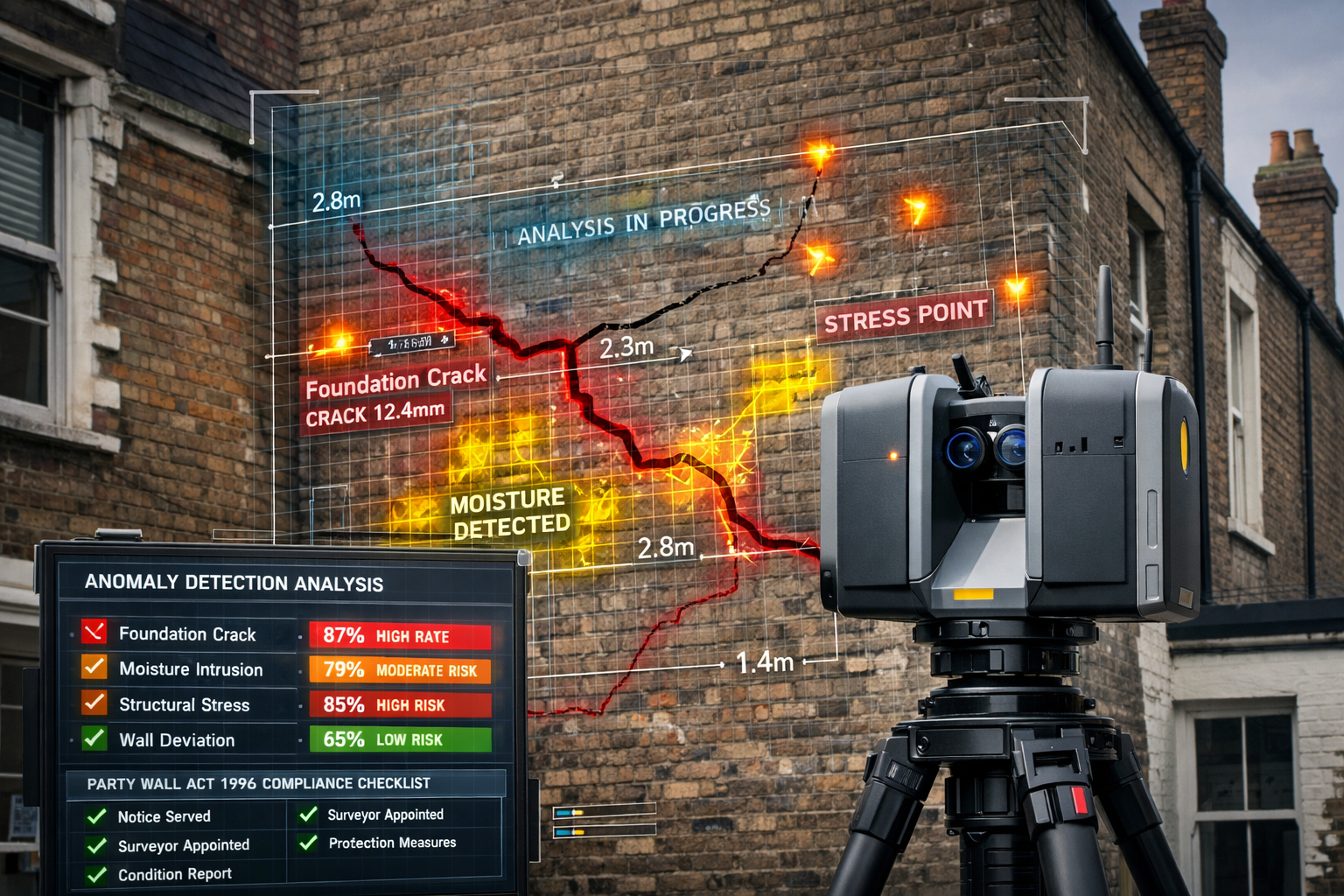
    • Precise building geometry from laser scanning and photogrammetry
    • Subsurface conditions from geotechnical investigations
    • Foundation details from structural surveys and historical records
    • Material properties including soil bearing capacity and structural strength
    • Construction sequencing showing excavation phases over time

    Real-Time Digital Twins for Party Wall Agreements: Simulating Excavation Impacts

    The application of digital twin technology to Section 6 excavation scenarios offers transformative capabilities:

    Predictive Simulation: Before serving a party wall notice, building owners can run multiple excavation scenarios to identify the approach that minimizes risk to adjoining properties. The digital twin calculates:

    • Settlement predictions at various points along the party wall
    • Stress distribution changes in the adjoining owner’s foundation
    • Groundwater flow alterations that might affect stability
    • Vibration impacts from excavation equipment

    Visual Communication: Interactive 3D visualizations replace technical jargon with intuitive graphics. Adjoining owners can:

    • Rotate and zoom the model to view impacts from any angle
    • Toggle between “before,” “during,” and “after” states
    • See color-coded risk zones (green for safe, yellow for caution, red for concern)
    • Watch time-lapse animations of the construction sequence

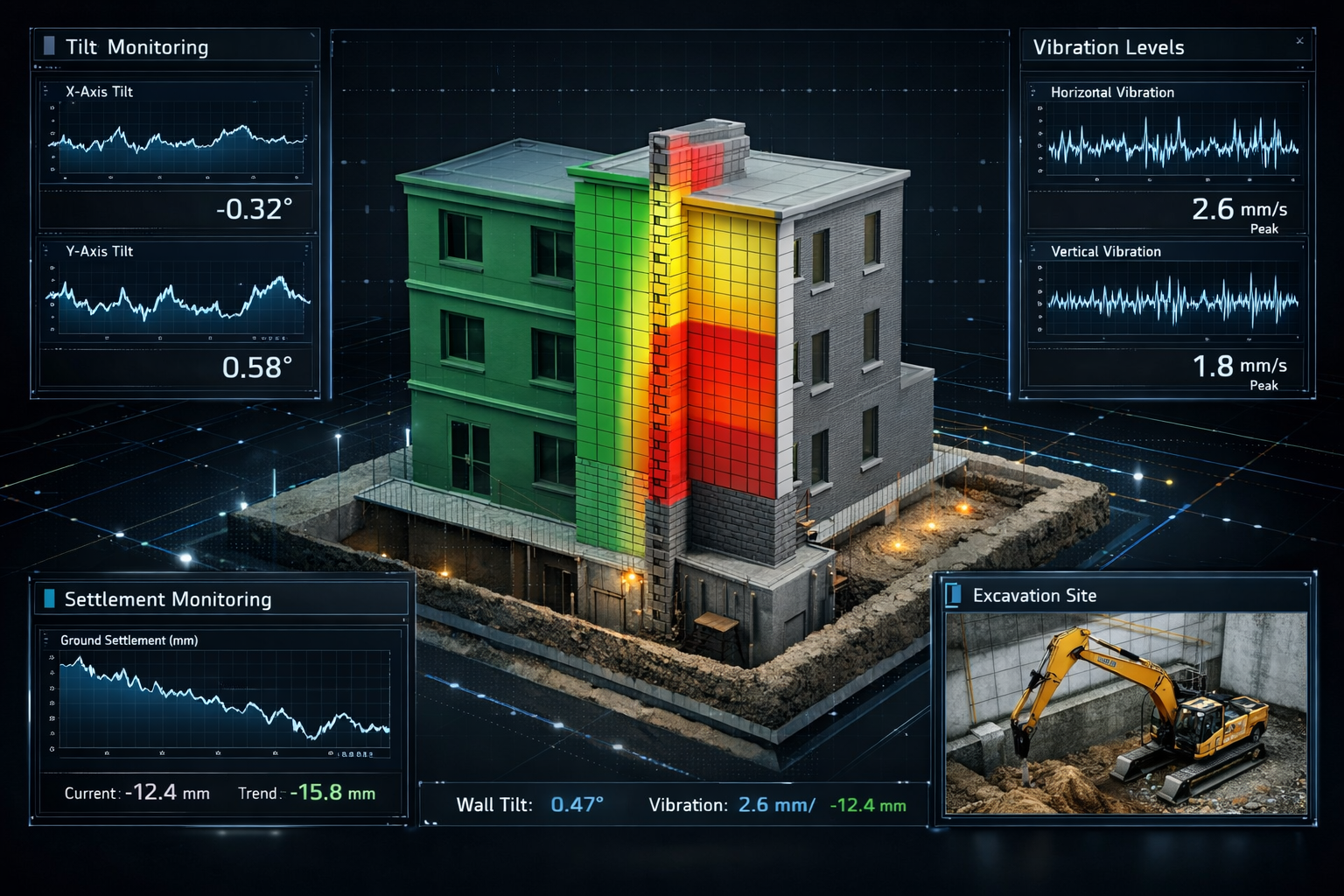
    Real-Time Monitoring: Once excavation begins, the digital twin integrates live sensor data:

    • Tilt sensors on the party wall detect movement in real-time
    • Settlement monitors track foundation displacement
    • Crack gauges measure any widening of existing defects
    • Vibration sensors ensure equipment stays within safe thresholds

    When sensor readings deviate from predictions, the system alerts surveyors immediately, enabling rapid intervention before minor movements become major damage [1].

    () dynamic visualization showing real-time monitoring dashboard with multiple data streams. Central focus on 3D building

    Implementing Digital Twins in Party Wall Surveying Practice

    Data Collection and Model Creation

    Successful implementation of Real-Time Digital Twins for Party Wall Agreements: Simulating Excavation Impacts Under Section 6 requires comprehensive data gathering:

    Building Survey Data:

    • 3D laser scanning of both properties (accuracy within 2-5mm)
    • Photogrammetry for exterior façade details
    • Internal structural surveys identifying load-bearing elements
    • Review of original construction drawings where available

    Geotechnical Information:

    • Trial pit excavations to determine soil stratification
    • Standard Penetration Tests (SPT) for bearing capacity
    • Groundwater level monitoring
    • Adjacent building foundation depth verification

    Historical Context:

    • Previous schedules of condition from earlier party wall matters
    • Local authority records of ground conditions
    • Historical mapping showing previous development

    This data feeds into specialized software that creates the baseline digital twin model. While data quality and integration present implementation challenges [1], the investment pays dividends through reduced dispute risk.

    Integration with Party Wall Procedures

    Digital twins enhance rather than replace traditional party wall processes:

    Traditional Step Digital Twin Enhancement
    Serve Section 6 Notice Include link to interactive 3D model showing proposed works
    Adjoining Owner Review Virtual walkthrough explaining excavation impacts visually
    Surveyor Appointment Agreed surveyors use model to design protective measures
    Party Wall Award Preparation Award references specific simulation scenarios and monitoring protocols
    Construction Phase Real-time alerts if conditions deviate from predictions
    Post-Construction Final model comparison validates no unexpected damage occurred

    For adjoining owners concerned about works, this enhanced transparency provides reassurance and enables truly informed consent.

    Cost-Benefit Analysis

    Initial Investment:

    • 3D scanning services: £1,500-£3,500 per property
    • Geotechnical investigation: £2,000-£5,000
    • Digital twin software and modeling: £3,000-£8,000
    • Sensor installation and monitoring: £2,000-£4,000
    • Total setup cost: £8,500-£20,500

    Potential Savings:

    • Avoided design changes during construction: £10,000-£50,000
    • Reduced dispute resolution costs: £5,000-£25,000
    • Faster agreement approval (time savings): £2,000-£8,000
    • Insurance premium reductions: £1,000-£5,000
    • Avoided remediation for unexpected damage: £15,000-£100,000+

    For complex excavations in high-value areas like Central London, the return on investment becomes compelling, particularly when considering reputational benefits and reduced project delays.

    Those looking to keep party wall costs down should weigh these long-term savings against upfront expenses.

    Advanced Applications and Future Developments

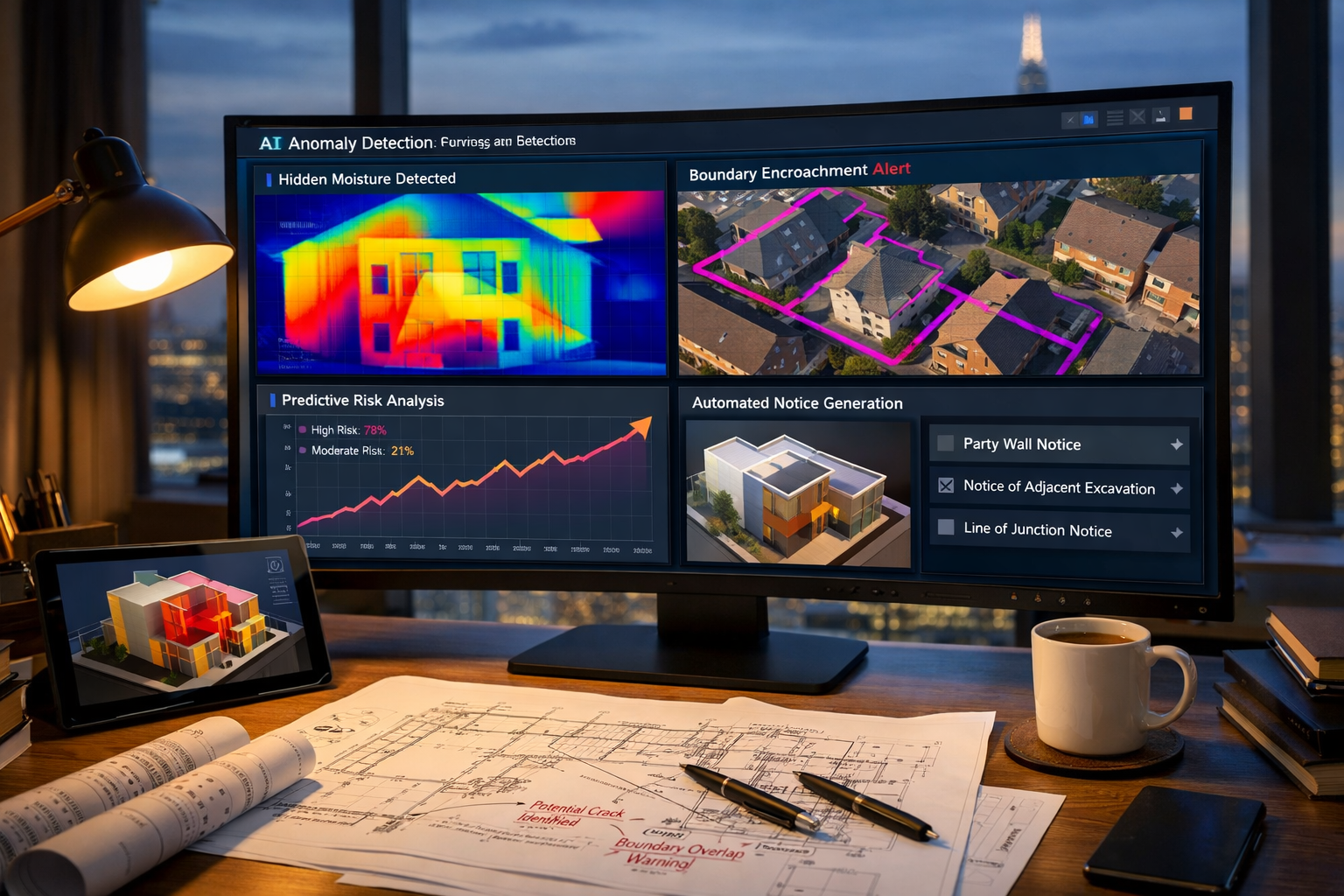
    AI-Enhanced Prediction Models

    Emerging applications combine digital twins with artificial intelligence to improve prediction accuracy [4]. Machine learning algorithms trained on thousands of excavation projects can:

    • Identify soil behavior patterns that traditional calculations miss
    • Predict construction delays based on weather and site conditions
    • Recommend optimal underpinning sequences to minimize settlement
    • Flag unusual sensor readings that might indicate emerging problems

    These AI enhancements are particularly valuable for types of party wall works involving complex ground conditions or unusual structural configurations.

    Integration with Building Information Modeling (BIM)

    As BIM adoption becomes standard in construction, digital twins for party wall agreements increasingly integrate with broader project models. This enables:

    • Seamless data exchange between architects, structural engineers, and party wall surveyors
    • Clash detection identifying conflicts between excavation plans and existing services
    • Lifecycle management where the party wall digital twin becomes part of the building’s permanent digital record
    • Future planning for subsequent owners who may undertake their own Section 6 works

    Regulatory Recognition and Standards

    While digital twins offer clear benefits, 2026 sees ongoing development of standards and protocols:

    • Professional bodies are establishing guidelines for digital twin accuracy and validation
    • Courts are beginning to accept digital twin evidence in party wall disputes
    • Insurance companies are developing policies that recognize reduced risk from monitored projects
    • Local authorities in areas like North London and South London are exploring digital twin requirements for major excavations

    Dynamic visualization demonstrating how Real-Time Digital Twins transform Section 6 excavation planning, featuring

    Practical Considerations for Surveyors and Property Owners

    When Digital Twins Add Most Value

    Not every Section 6 excavation requires full digital twin implementation. Consider this technology when:

    Excavating more than 1.5m below adjoining foundations (high settlement risk)
    Working in areas with complex ground conditions (variable soil, high water table)
    Adjacent to high-value or historically significant structures (where damage costs are severe)
    Multiple adjoining owners are involved (visualization aids consensus)
    Previous disputes or litigation history exists (transparency reduces conflict)
    Building owner seeks to minimize insurance exposure (data proves due diligence)

    For simpler excavations with generous clearances, traditional methods combined with a party wall agreement template may suffice.

    Selecting Service Providers

    The digital twin market for construction applications is rapidly evolving. When selecting providers, consider:

    Technical Capabilities:

    • Experience with party wall-specific applications (not just general construction)
    • Software platforms used (compatibility with industry standards)
    • Accuracy specifications for scanning and modeling
    • Real-time data integration capabilities

    Professional Qualifications:

    • Chartered surveyors with party wall expertise
    • Structural engineers familiar with excavation design
    • Geotechnical specialists for soil behavior modeling
    • Software developers with construction domain knowledge

    Support and Training:

    • Training for surveyors to interpret and present models
    • Client support during the agreement negotiation phase
    • Ongoing monitoring services during construction
    • Post-project reporting and documentation

    Addressing Adjoining Owner Concerns

    When introducing digital twins to adjoining owners, surveyors should:

    1. Emphasize transparency: The technology provides them with better information, not less
    2. Offer demonstrations: Interactive sessions where they can explore the model themselves
    3. Explain monitoring benefits: Real-time alerts protect their interests during construction
    4. Clarify data ownership: Establish who controls and accesses the digital twin
    5. Provide alternatives: Ensure they can still engage with traditional documentation if preferred

    Understanding how to respond to party wall notices becomes easier when visual evidence supports written descriptions.

    Sustainability and Precision in 2026 Construction

    Environmental Benefits

    Digital twins support 2026’s sustainability imperatives by:

    • Reducing material waste through precise excavation planning that minimizes over-engineering
    • Optimizing concrete use in underpinning by calculating exact support requirements
    • Preventing damage that would require resource-intensive repairs
    • Enabling adaptive reuse by documenting existing structures comprehensively
    • Supporting circular economy principles through detailed building lifecycle data

    Precision Construction Standards

    The construction industry’s shift toward precision manufacturing techniques aligns perfectly with digital twin capabilities. Benefits include:

    • Millimeter-level accuracy in excavation depth control
    • Quality assurance through continuous monitoring versus periodic inspections
    • Predictable outcomes that reduce contingency buffers and associated costs
    • Knowledge transfer as digital records document lessons learned for future projects

    These precision standards are particularly important in dense urban areas like East London and West London where properties are closely spaced.

    Challenges and Limitations

    Technical Barriers

    Despite significant advantages, Real-Time Digital Twins for Party Wall Agreements: Simulating Excavation Impacts Under Section 6 face obstacles:

    Data Quality Issues: Models are only as accurate as input data. Poor geotechnical investigations or incomplete structural surveys undermine predictions [1].

    Processing Requirements: Real-time analysis demands substantial computing infrastructure, potentially requiring cloud services with associated costs and data security considerations.

    Interoperability: Different software platforms may not communicate effectively, creating data silos when multiple consultants are involved.

    Validation Complexity: Establishing that a digital twin accurately represents reality requires calibration against physical measurements—a time-consuming process.

    Legal and Regulatory Uncertainty

    As an emerging technology in party wall practice, digital twins exist in a somewhat uncertain legal landscape:

    • Evidential weight: How courts will treat digital twin predictions versus traditional expert testimony remains unclear
    • Professional liability: Standards of care for digital twin creation and interpretation are still developing
    • Data protection: GDPR and privacy considerations apply when scanning adjoining properties
    • Contractual frameworks: Party wall awards need updating to reference digital monitoring protocols

    Cost Accessibility

    The investment required places digital twins beyond reach for many smaller projects. This creates potential inequality where:

    • High-value developments benefit from advanced protection
    • Modest extensions rely on traditional methods with higher uncertainty
    • Adjoining owners face different levels of protection depending on their neighbour’s resources

    Industry efforts to develop scaled-down digital twin solutions for smaller projects are ongoing but not yet widely available.

    Conclusion

    Real-Time Digital Twins for Party Wall Agreements: Simulating Excavation Impacts Under Section 6 represent a significant evolution in construction law compliance and neighbour relations. By transforming abstract excavation risks into tangible, interactive visualizations, this technology bridges the communication gap between technical experts and property owners. The ability to predict, monitor, and validate excavation impacts in real-time offers unprecedented transparency and risk management.

    For surveyors, digital twins provide powerful tools to design safer excavation schemes, demonstrate due diligence, and resolve disputes before they escalate. For building owners, the technology reduces liability exposure and project delays. For adjoining owners, it delivers genuine informed consent based on clear evidence rather than trust alone.

    As 2026’s demands for sustainability and precision intensify, digital twin adoption will likely accelerate from cutting-edge innovation to industry standard. Early adopters gain competitive advantages through enhanced service offerings and reduced risk profiles.

    Next Steps for Implementation

    For Building Owners Planning Excavation:

    1. Consult with party wall surveyors experienced in digital twin technology
    2. Budget for comprehensive site investigation and 3D scanning
    3. Include digital twin provisions when serving Section 6 notices
    4. Ensure contractors understand monitoring protocols

    For Party Wall Surveyors:

    1. Invest in training on digital twin platforms and interpretation
    2. Develop partnerships with scanning and modeling specialists
    3. Create template award clauses addressing digital monitoring
    4. Build case studies demonstrating value to clients

    For Adjoining Owners Receiving Notices:

    1. Ask whether building owners plan to use digital twin technology
    2. Request access to interactive models during the agreement process
    3. Ensure appointed surveyors understand the technology
    4. Clarify monitoring protocols and alert procedures in the award

    The integration of digital twins into party wall practice is not merely a technological upgrade—it represents a fundamental shift toward evidence-based, transparent, and collaborative approaches to managing excavation risks. As the technology matures and costs decline, it promises to make Section 6 compliance more predictable, disputes less frequent, and construction safer for all parties involved.

    For those navigating complex excavation scenarios in 2026, exploring digital twin solutions may prove one of the most valuable investments in project success and neighbour relations.


    References

    [1] Do Digital Twins Live Hype – https://www.jacobs.com/newsroom/qa/do-digital-twins-live-hype

    [2] Advanced Local Digital Twins Using Ai For Early Warning And Preparedness – https://www.euro-access.eu/en/calls/2626/Advanced-Local-Digital-Twins-using-AI-for-Early-Warning-and-Preparedness

    [3] Digital Twins Virtual Models Real World Impacts – https://www.nsf.gov/science-matters/digital-twins-virtual-models-real-world-impacts

    [4] Swan 2026 Digital Twin Ai Workshop – https://swan-forum.com/publications/swan-2026-digital-twin-ai-workshop/

    [5] Party Wall Agreements In Data Centre Developments 2026 Compliance Amid Ai Driven Uk Demand – https://nottinghillsurveyors.com/blog/party-wall-agreements-in-data-centre-developments-2026-compliance-amid-ai-driven-uk-demand

  • Cloud Party Wall Award Revisions: 2026 Approval Guide

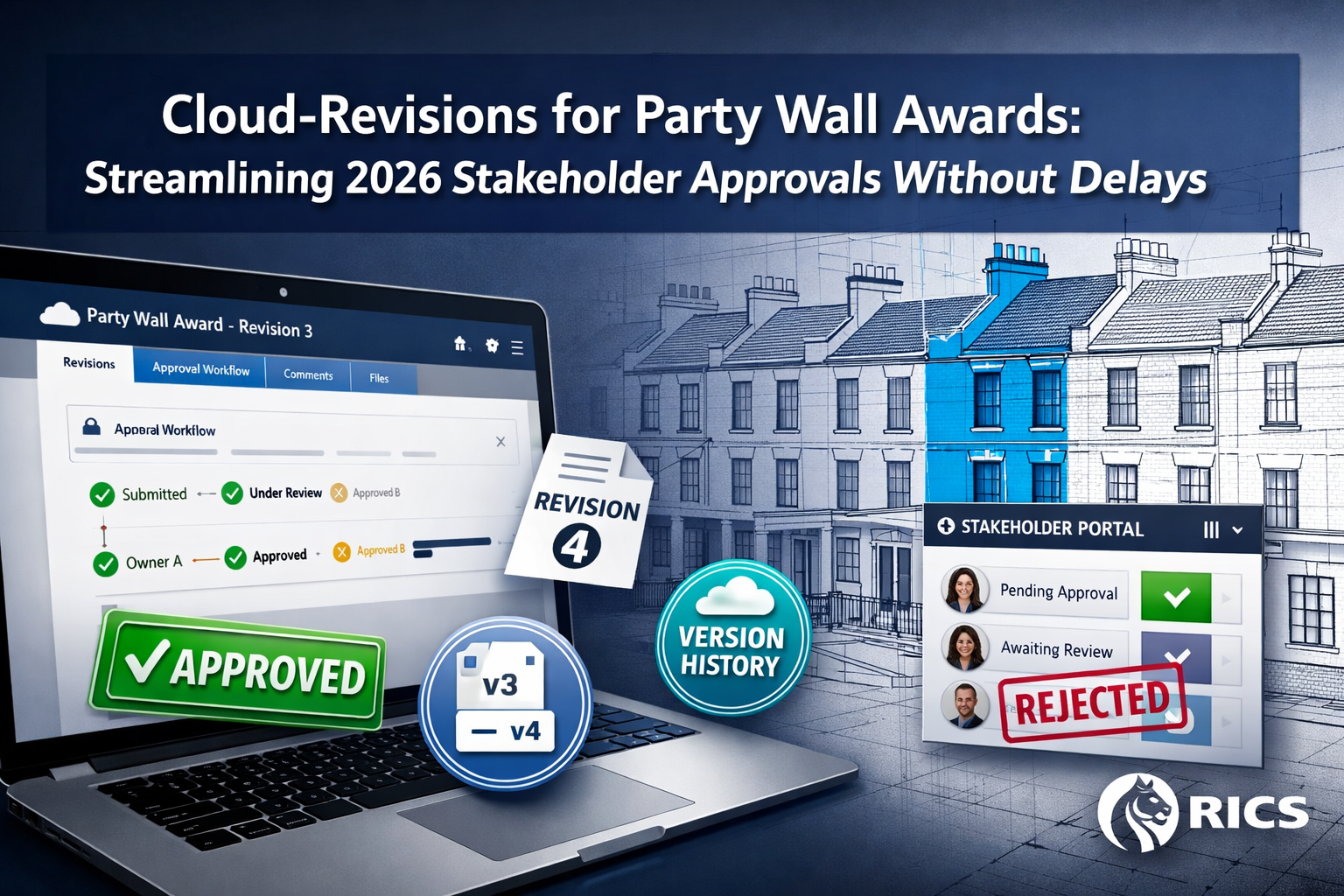
    When a London property developer recently needed to revise a complex party wall award three times due to changing structural requirements, the project team feared weeks of postal delays and frustrated neighbors. Instead, cloud-based revision management delivered all approvals within 48 hours. This scenario illustrates how Cloud-Revisions for Party Wall Awards: Streamlining 2026 Stakeholder Approvals Without Delays is transforming construction projects across the UK, particularly as labor shortages and urban density create unprecedented pressure on traditional processes.

    In 2026, the construction industry faces a critical challenge: party wall procedures that were designed for paper-based communication now struggle to keep pace with modern development timelines. Cloud platforms enable instant award revisions with version control and neighbor portals, cutting resolution times amid labor shortages while maintaining RICS alignment for complex urban boundary works. This technological shift represents more than simple digitization—it fundamentally reimagines how building owners, adjoining owners, and surveyors collaborate on party wall awards.

    Professional () hero image featuring 'Cloud-Revisions for Party Wall Awards: Streamlining 2026 Stakeholder Approvals Without

    Key Takeaways

    • Cloud platforms reduce party wall award revision cycles by 60-70% through real-time collaboration and instant stakeholder notifications
    • 🔒 Version control and audit trails ensure RICS compliance while eliminating confusion over which award version is current
    • 👥 Neighbor portals democratize access, allowing adjoining owners to review and approve revisions without surveyor intermediaries for simple changes
    • 📱 Mobile-first design addresses 2026 labor shortages by enabling surveyors to manage multiple projects remotely with full documentation access
    • Automated compliance checking flags potential Party Wall Act violations before awards are finalized, reducing disputes and legal challenges

    Understanding Party Wall Awards and the Revision Challenge

    What Are Party Wall Awards?

    A party wall award is a legally binding document issued by surveyors under the Party Wall etc. Act 1996. This document outlines the rights and responsibilities of both building owners and adjoining owners when construction work affects shared structures. The party wall contract template typically includes:

    • Scope of permitted works on the party wall or structure
    • Schedule of condition documenting pre-work property status
    • Working hours and access arrangements
    • Cost allocation and payment terms
    • Dispute resolution procedures

    Awards must be precise, comprehensive, and agreed upon by all parties. Even minor errors or changing project requirements necessitate formal revisions—a process that traditionally involved printing, signing, posting, and waiting for responses from multiple stakeholders.

    Why Revisions Are Inevitable in 2026 Projects

    Modern construction projects encounter revision triggers that earlier generations rarely faced:

    Design Evolution 🏗️
    Architects frequently adjust structural plans based on engineering assessments, building control feedback, or client preferences discovered during construction.

    Regulatory Updates
    Building regulations continue evolving, particularly around fire safety and structural integrity following high-profile incidents. Projects spanning several months may need award updates to reflect new requirements.

    Discovery of Unexpected Conditions
    Hidden structural issues, asbestos, or archaeological finds can necessitate significant work scope changes that require formal award amendments.

    Stakeholder Changes
    Property sales, inheritance, or corporate restructuring can introduce new parties who require documentation updates and fresh approvals.

    Traditional paper-based revision processes create cascading delays. A single revision cycle might require:

    1. Surveyor drafts revised award (1-2 days)
    2. Postal delivery to building owner (1-3 days)
    3. Building owner review and signature (2-5 days)
    4. Return post to surveyor (1-3 days)
    5. Surveyor forwards to adjoining owner (1-3 days)
    6. Adjoining owner review and approval (3-7 days)
    7. Return delivery to surveyor (1-3 days)

    Total timeline: 10-26 days per revision cycle

    For projects requiring multiple revisions, these delays compound exponentially, pushing construction schedules back by months and inflating costs of party wall processes.

    Cloud-Revisions for Party Wall Awards: Streamlining 2026 Stakeholder Approvals Without Delays Through Digital Transformation

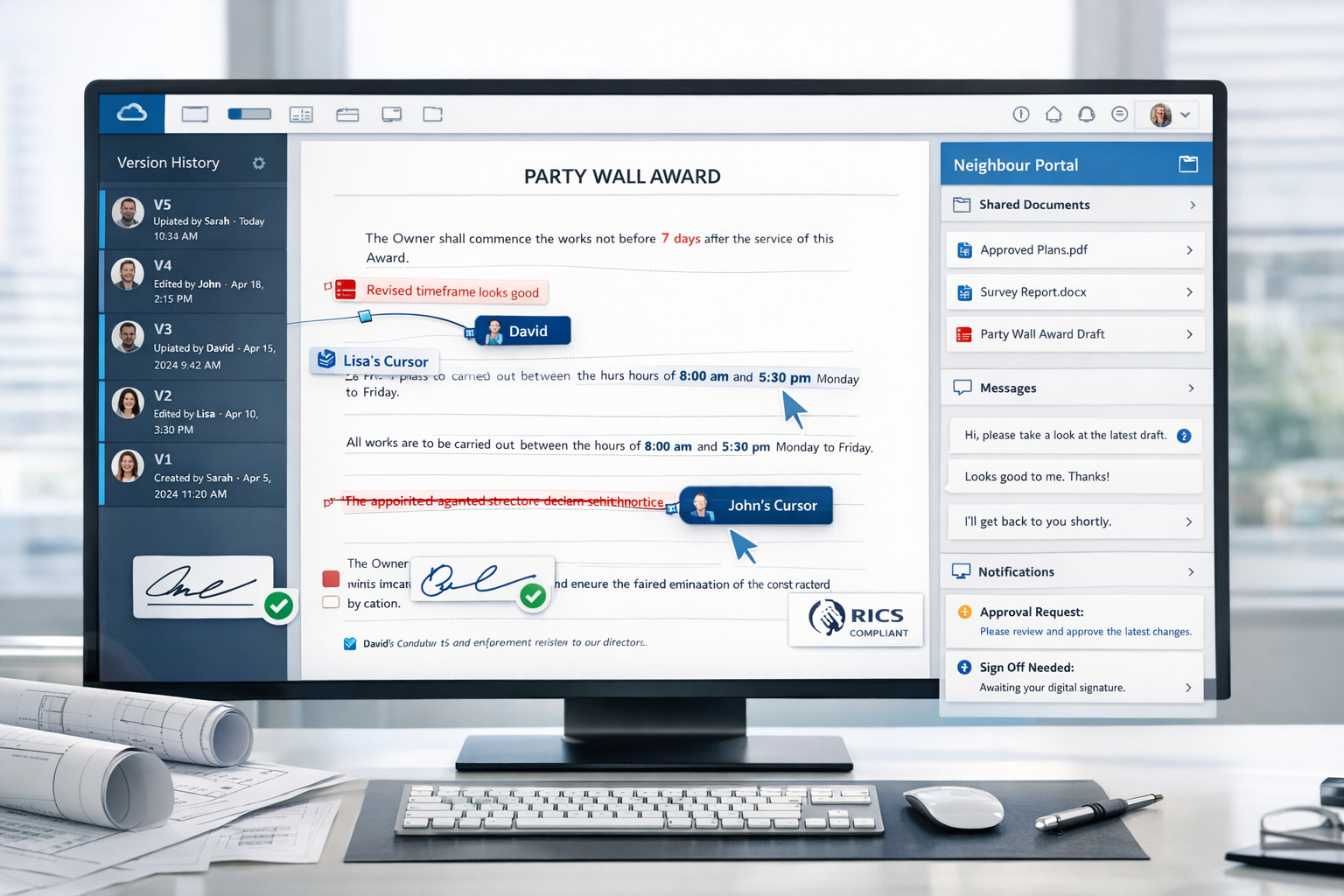
    Detailed () image showing close-up of modern cloud platform dashboard interface on large desktop monitor, displaying party

    Core Features of Cloud-Based Party Wall Management

    Modern cloud platforms designed specifically for party wall procedures integrate several critical capabilities:

    1. Real-Time Document Collaboration

    Cloud systems allow surveyors to create and edit awards while stakeholders view changes instantly. Track-changes functionality highlights exactly what has been modified between versions, eliminating confusion and building trust among parties who can see precisely what they’re approving.

    2. Automated Notification Workflows

    When a surveyor uploads a revised award, the platform automatically:

    • Sends email and SMS notifications to all relevant parties
    • Creates dashboard alerts visible upon login
    • Sets reminder schedules for pending approvals
    • Escalates to backup contacts if primary stakeholders don’t respond within set timeframes

    This automation ensures no revision request gets lost in email inboxes or postal systems.

    3. Secure Stakeholder Portals

    Each party receives personalized portal access where they can:

    • View current and historical award versions
    • Compare revisions side-by-side
    • Add comments or questions directly on specific clauses
    • Provide digital signatures with full legal validity
    • Access supporting documents like schedules of condition or structural drawings

    These portals are particularly valuable for adjoining owners who previously felt disconnected from the process and dependent on surveyor intermediaries for basic information.

    4. Version Control and Audit Trails

    Cloud platforms maintain complete version histories showing:

    • Who made each change and when
    • What specific text was added, deleted, or modified
    • Who approved each version and at what time
    • Any comments or objections raised during review

    This creates an immutable audit trail that proves invaluable if disputes arise later or if parties need to demonstrate RICS compliance during legal proceedings.

    5. Mobile Accessibility

    With surveyors managing multiple projects simultaneously—often while conducting site inspections—mobile apps ensure they can:

    • Review and approve urgent revisions from any location
    • Upload site photos directly to award documentation
    • Respond to stakeholder queries in real-time
    • Access complete project histories without returning to the office

    This mobility addresses 2026’s acute surveyor shortage by dramatically increasing individual productivity.

    RICS Alignment and Legal Validity

    The Royal Institution of Chartered Surveyors (RICS) provides professional standards for party wall surveyors. Cloud-based systems maintain compliance through:

    Digital Signature Standards
    Platforms use qualified electronic signatures that meet UK Electronic Communications Act 2000 requirements, ensuring cloud-executed awards carry the same legal weight as paper documents with wet signatures.

    Data Protection Compliance
    GDPR-compliant encryption and access controls protect sensitive property and personal information while maintaining the transparency required by the Party Wall Act.

    Professional Practice Standards
    Cloud systems incorporate RICS guidance on award content, ensuring templates and checklists help surveyors create comprehensive documents that meet professional standards.

    Many platforms now feature RICS compliance checking that automatically flags potential issues before awards are finalized—such as missing clauses, unclear cost allocations, or inadequate condition schedules.

    Implementing Cloud-Revisions for Party Wall Awards: Streamlining 2026 Stakeholder Approvals Without Delays in Your Practice

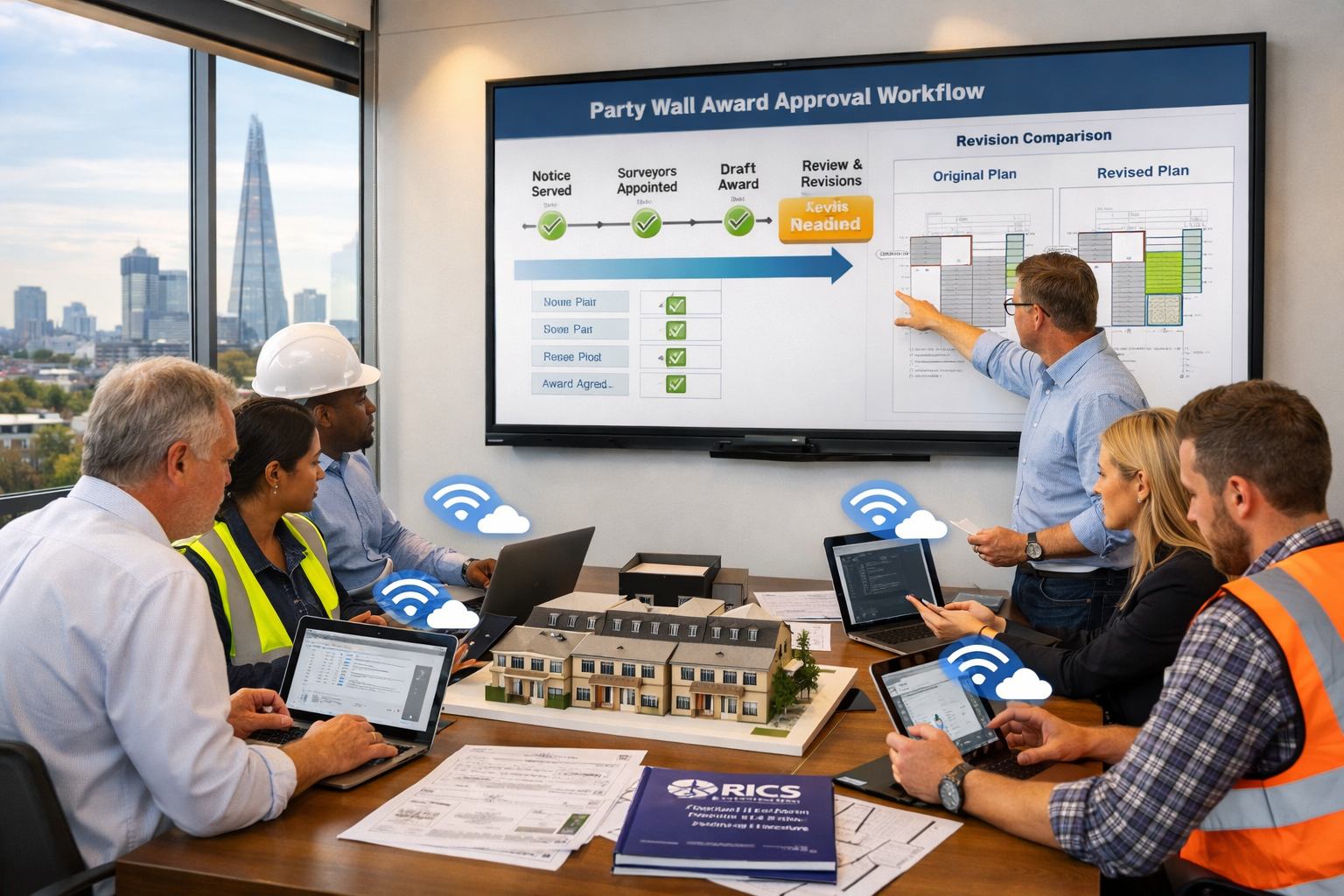
    Wide-angle () photograph of diverse construction team meeting in modern glass-walled conference room, large wall-mounted

    Selecting the Right Platform

    Not all cloud collaboration tools suit party wall work. When evaluating platforms, prioritize:

    Feature Why It Matters Questions to Ask
    Construction-Specific Design Generic document platforms lack party wall terminology and workflows Does the platform understand party wall notices and award structures?
    Offline Capability Site inspections often occur in areas with poor connectivity Can surveyors access documents and make notes without internet?
    Integration with Existing Tools Surveyors use CAD, scheduling, and accounting software Does the platform connect with AutoCAD, Xero, or other industry tools?
    Scalability Practices grow and take on larger projects Can the platform handle 50+ stakeholders on complex developments?
    Support and Training Technology adoption requires ongoing assistance Does the vendor provide dedicated construction industry support?
    Cost Structure Pricing must align with project economics Is pricing per-project, per-user, or subscription-based?

    Onboarding Stakeholders Successfully

    The most sophisticated platform fails if stakeholders resist adoption. Successful implementation requires:

    Building Owner Education 🏠
    Many building owners initially worry about technology complexity. Provide:

    • Short video tutorials (2-3 minutes) showing the exact steps they’ll take
    • Written quick-start guides with screenshots
    • Assurance that phone support is available if they encounter difficulties
    • Emphasis on how the platform saves them time and money

    Adjoining Owner Reassurance
    Neighbors often approach party wall matters with suspicion. Address concerns by:

    • Explaining that the platform gives them more visibility and control
    • Demonstrating how they can review documents at their convenience rather than scheduling meetings
    • Highlighting the audit trail that protects their interests
    • Offering alternative access methods (phone-based approval) for those uncomfortable with technology

    Surveyor Collaboration
    When multiple surveyors work on a project (building owner’s surveyor and adjoining owner’s surveyor), establish:

    • Clear protocols for who can edit which document sections
    • Notification preferences to avoid alert fatigue
    • Regular check-in schedules to discuss complex revisions
    • Shared templates that maintain consistency

    Best Practices for Cloud-Based Award Revisions

    Maintain Clear Version Naming

    Even with automated version control, use descriptive names:

    • ❌ “Award_v3.pdf”
    • ✅ “Award_Rev2_FoundationDepthChange_2026-03-15.pdf”

    This helps stakeholders quickly understand what changed without reading entire documents.

    Use Comments for Context

    When making revisions, add explanatory comments:

    “Foundation depth increased from 2.1m to 2.8m based on structural engineer’s soil analysis report (attached). This change does not affect the party wall itself but requires updated underpinning methodology.”

    Context reduces stakeholder anxiety and prevents unnecessary questions.

    Set Realistic Response Deadlines

    Cloud speed doesn’t eliminate the need for thoughtful review. Give stakeholders:

    • Simple revisions (typo corrections, date changes): 2-3 days
    • Moderate revisions (work scope adjustments): 5-7 days
    • Significant revisions (major design changes): 10-14 days

    Rushed approvals lead to disputes when stakeholders later claim they didn’t fully understand what they approved.

    Leverage Analytics

    Modern platforms track engagement metrics:

    • Who has viewed the document
    • How long they spent reviewing it
    • Which sections they focused on
    • Whether they downloaded supporting materials

    These insights help surveyors identify stakeholders who may need additional explanation before they’ll approve.

    Addressing Common Implementation Challenges

    Challenge: Older Stakeholders Uncomfortable with Technology

    Solution: Offer hybrid approaches where the surveyor can conduct screen-sharing sessions, walking stakeholders through the platform while on a phone call. Some platforms also allow approval via simple email reply or SMS code entry.

    Challenge: Security Concerns About Cloud Storage

    Solution: Explain that modern cloud platforms use bank-level encryption and are typically more secure than email attachments or physical documents that can be lost. Emphasize compliance certifications (ISO 27001, Cyber Essentials Plus).

    Challenge: Internet Connectivity Issues During Site Inspections

    Solution: Use platforms with robust offline modes that sync changes once connectivity is restored. Download key documents before traveling to sites with known connectivity problems.

    Challenge: Resistance from Surveyors Accustomed to Traditional Methods

    Solution: Start with a pilot project rather than forcing practice-wide adoption. Let early adopters demonstrate time savings and reduced administrative burden. Highlight how cloud platforms handle tedious tasks (version tracking, notification sending) so surveyors can focus on professional judgment.

    Measuring Success: ROI of Cloud-Revisions for Party Wall Awards

    Quantifiable Benefits

    Organizations implementing cloud-based party wall management report:

    Time Savings ⏱️

    • Average revision cycle reduction: 60-75%
    • Traditional timeline: 10-26 days per cycle
    • Cloud timeline: 2-7 days per cycle
    • Multi-revision projects: Savings compound (3 revisions = 24-57 days saved)

    Cost Reductions 💰

    • Postage and printing: £50-150 per project eliminated
    • Administrative time: 3-5 hours per project reduced
    • Delay-related costs: Construction holding costs (equipment rental, site security) reduced by earlier approvals
    • Dispute resolution: Clearer documentation reduces costly legal proceedings

    Productivity Gains 📈

    • Projects per surveyor: 15-25% increase in capacity
    • Response time: Stakeholder queries answered 3x faster
    • Error reduction: Template-driven processes reduce award mistakes by 40-60%

    Qualitative Improvements

    Beyond numbers, practices report:

    Enhanced Client Satisfaction
    Building owners appreciate transparency and speed. They can monitor progress without constant phone calls to surveyors, and they complete projects faster.

    Improved Neighbor Relations
    Adjoining owners feel more respected when they have direct access to information rather than feeling like passive recipients of decisions. This reduces adversarial dynamics that can escalate into disputes.

    Professional Reputation
    Surveyors who adopt modern tools position themselves as forward-thinking professionals, attracting clients who value efficiency and transparency.

    Reduced Stress
    Automated reminders and notifications mean surveyors no longer worry about missed deadlines or lost documents. The mental load of tracking multiple projects decreases significantly.

    The Future: AI and Automation in Party Wall Procedures

    As cloud platforms mature, artificial intelligence is beginning to augment human expertise:

    Automated Award Drafting 🤖
    AI systems trained on thousands of party wall awards can generate first drafts based on project parameters, which surveyors then review and customize. This reduces drafting time from hours to minutes.

    Predictive Dispute Analysis
    Machine learning algorithms analyze award language and stakeholder communication patterns to flag potential disputes before they escalate, allowing proactive intervention.

    Smart Scheduling
    AI coordinates optimal inspection times by analyzing stakeholder calendars, weather forecasts, and project dependencies, automatically proposing times that work for all parties.

    Natural Language Processing
    Stakeholders can ask questions in plain English (“What happens if we find asbestos?”) and receive instant answers extracted from award documents and relevant legislation.

    These technologies won’t replace professional judgment—party wall work requires nuanced understanding of construction, law, and human dynamics that AI cannot replicate. However, they will handle routine tasks, allowing surveyors to focus on complex problem-solving and relationship management.

    Regional Considerations for London Practitioners

    London’s unique property landscape creates specific challenges where cloud revisions provide particular value:

    High-Density Terraced Housing
    Areas like South London, North London, and East London feature Victorian terraces where single projects may affect 4-6 adjoining properties. Cloud platforms excel at managing these multi-stakeholder scenarios where coordinating paper-based approvals becomes exponentially complex.

    International Property Owners
    Central London and West London properties are frequently owned by overseas investors. Cloud platforms eliminate international postal delays and time zone challenges, allowing owners in Singapore or New York to review and approve awards instantly.

    Heritage and Conservation Areas
    Projects in protected areas require frequent revisions as conservation officers request modifications. Cloud systems’ ability to quickly circulate revised awards and track approval status prevents these projects from grinding to a halt.

    Basement Excavations
    London’s basement boom creates complex party wall scenarios requiring detailed types of party wall works documentation. When ground conditions necessitate design changes, cloud platforms ensure all affected neighbors receive updated information simultaneously.

    Legal and Regulatory Compliance in 2026

    Party Wall Act Requirements

    The Party Wall etc. Act 1996 doesn’t prescribe specific documentation formats, allowing cloud-based awards provided they meet statutory requirements:

    • Proper service of notices
    • Appointment of surveyors
    • Award content covering all necessary provisions
    • Proper execution (signatures)

    Cloud platforms must ensure these elements remain intact. Digital service of notices is permissible if recipients consent, though many practitioners still serve initial notices by traditional methods and use cloud platforms for subsequent award development and revisions.

    Data Protection and Privacy

    Party wall documentation contains sensitive information:

    • Property valuations
    • Financial arrangements
    • Personal contact details
    • Structural vulnerabilities

    Cloud platforms must implement:

    • End-to-end encryption for data in transit and at rest
    • Role-based access controls ensuring parties only see relevant information
    • Data retention policies complying with GDPR requirements
    • Right to erasure allowing stakeholders to request data deletion after project completion

    Surveyors remain data controllers under GDPR and must ensure their chosen platforms meet all regulatory requirements.

    Professional Indemnity Insurance

    Some professional indemnity insurers initially hesitated to cover cloud-based party wall work. By 2026, most insurers recognize that properly implemented cloud systems actually reduce risk through better documentation and audit trails. However, surveyors should:

    • Notify insurers about technology adoption
    • Confirm coverage extends to digital processes
    • Maintain evidence of platform security certifications
    • Document training and competency in cloud tools

    Case Study: Complex Multi-Property Development

    A recent West London development illustrates cloud-revision benefits:

    Project: Four-story townhouse construction affecting six adjoining properties

    Challenge: Initial award required three major revisions due to:

    1. Building control request for enhanced fire separation
    2. Discovery of underground utilities requiring foundation redesign
    3. One adjoining owner’s property sale mid-project

    Traditional Approach Estimate:

    • 3 revision cycles × 15 days average = 45 days
    • 6 adjoining owners × 3 revisions = 18 separate approval processes
    • Estimated cost: £2,400 in surveyor time + £180 postage

    Cloud Platform Results:

    • 3 revision cycles completed in 11 days total
    • Parallel approval from all six owners
    • Actual cost: £720 in surveyor time + £0 postage
    • Savings: £1,860 and 34 days

    The property sale was handled seamlessly—the new owner received instant access to all historical documentation and current award status, providing approval within 24 hours of completion rather than the typical week-long delay while new owners “got up to speed.”

    Integration with Broader Construction Technology

    Cloud party wall management doesn’t exist in isolation. Leading practices integrate with:

    Building Information Modeling (BIM)
    Awards reference specific BIM elements, with links allowing stakeholders to view 3D models of proposed works rather than interpreting 2D drawings.

    Project Management Platforms
    Party wall milestones feed into overall construction schedules, automatically updating timelines when approvals are received.

    Financial Management Systems
    Cost allocations in awards sync with accounting software, streamlining invoicing and payment tracking.

    Communication Tools
    Platforms integrate with email, SMS, and messaging apps, meeting stakeholders where they already communicate rather than requiring separate logins.

    This ecosystem approach creates a seamless experience where party wall procedures become one integrated component of overall project delivery rather than a separate administrative burden.

    Conclusion

    Cloud-Revisions for Party Wall Awards: Streamlining 2026 Stakeholder Approvals Without Delays represents far more than technological novelty—it addresses fundamental challenges facing construction professionals in an era of labor shortages, complex urban development, and heightened stakeholder expectations. By reducing revision cycles from weeks to days, providing unprecedented transparency, and maintaining rigorous RICS compliance, cloud platforms enable projects to proceed smoothly while building trust among all parties.

    The construction industry has historically lagged behind other sectors in digital adoption, but party wall procedures present an ideal opportunity for transformation. The stakes are manageable (individual projects rather than enterprise-wide systems), the benefits are immediate and measurable, and the technology is mature and proven.

    Actionable Next Steps

    For surveyors and construction professionals ready to embrace cloud-based party wall management:

    1. Evaluate Current Pain Points 📋
      Track time spent on your next three party wall projects using traditional methods. Document delays, communication breakdowns, and administrative burden to establish a baseline for comparison.

    2. Research Platform Options 🔍
      Request demonstrations from 2-3 construction-focused cloud platforms. Involve team members who will actually use the system in evaluation decisions.

    3. Start with a Pilot Project 🚀
      Select a straightforward project with cooperative stakeholders for initial implementation. This builds confidence and identifies workflow adjustments before tackling complex cases.

    4. Invest in Training 📚
      Allocate time for proper platform training. The most powerful tools deliver limited value if users only understand 20% of capabilities.

    5. Gather Stakeholder Feedback 💬
      After your first cloud-based project, survey building owners and adjoining owners about their experience. Use insights to refine your approach.

    6. Monitor and Measure 📊
      Track key metrics (revision cycle time, stakeholder satisfaction, cost savings) to quantify benefits and justify continued investment.

    7. Stay Informed 📰
      Construction technology evolves rapidly. Follow industry publications and attend professional development sessions focused on digital transformation.

    The transition from paper-based to cloud-based party wall procedures requires initial effort, but the long-term benefits—for surveyors, building owners, and adjoining owners alike—make this investment worthwhile. As urban development intensifies and construction timelines compress, practices that embrace these tools will find themselves better positioned to deliver excellent service while managing growing workloads.

    For additional guidance on party wall procedures and best practices, explore our comprehensive resources on party wall awards, understanding party wall notices, and keeping party wall costs down. The future of party wall management is here—and it’s in the cloud. ☁️

  • CDE Platforms for Party Wall Notices: Real-Time Collaboration to

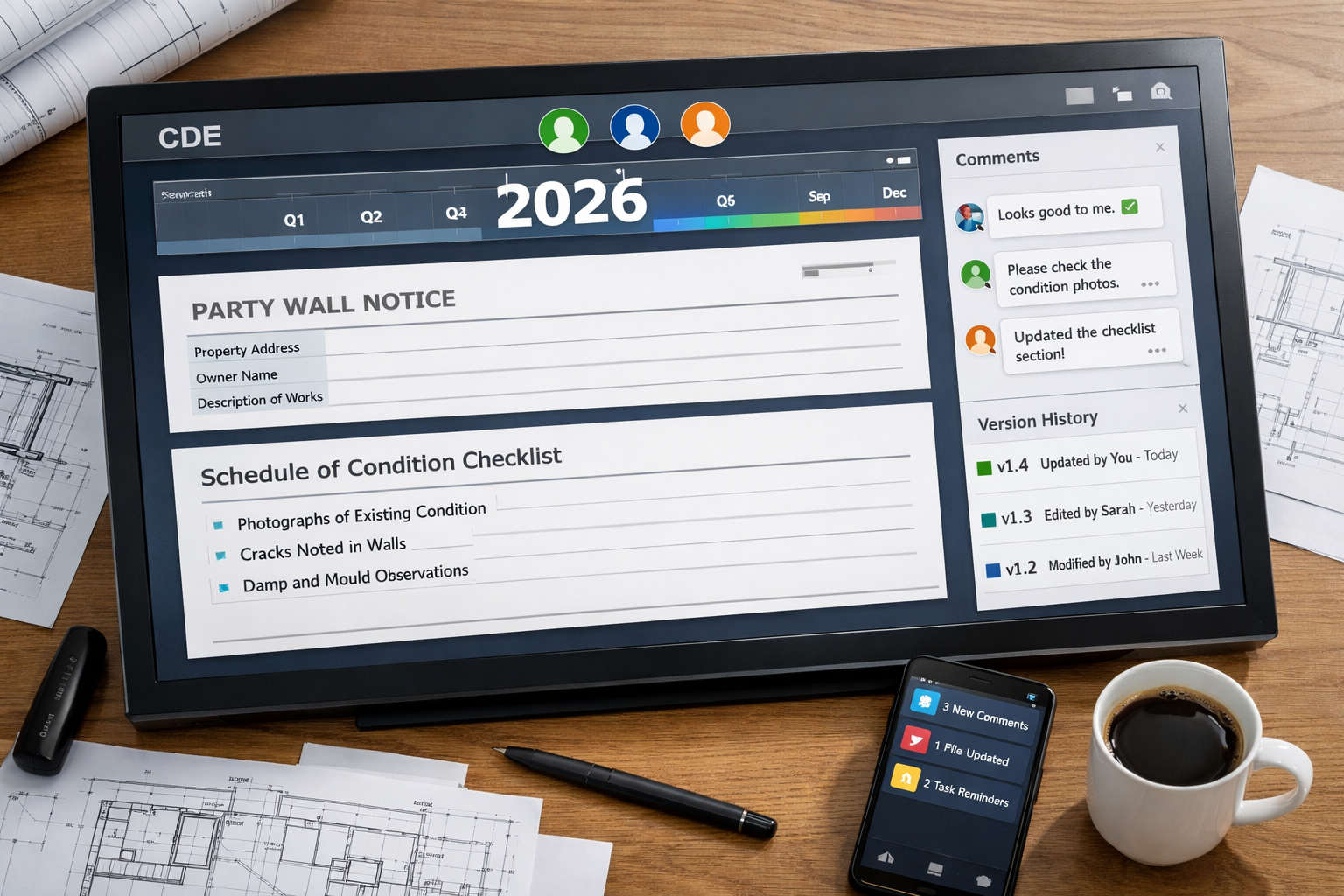
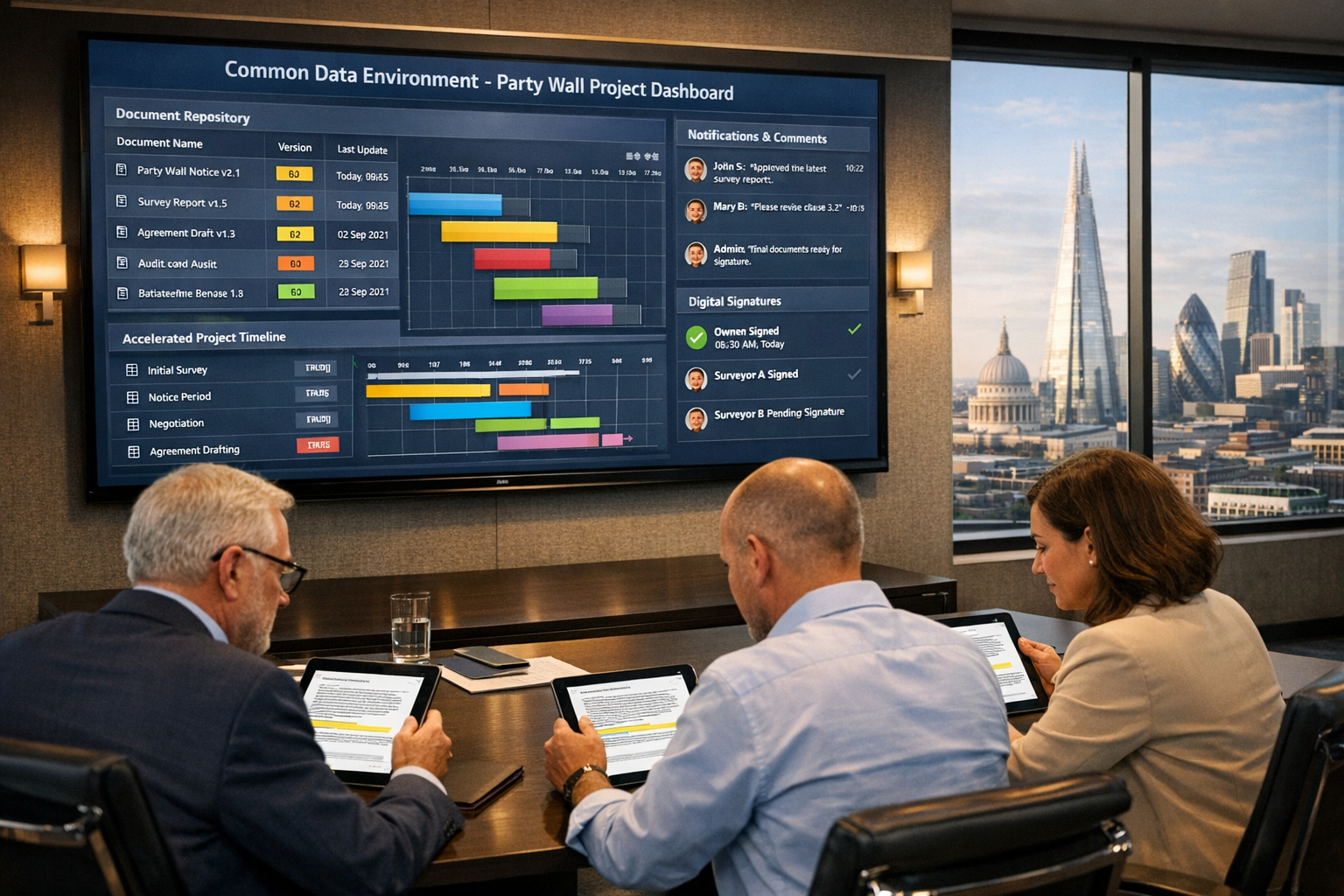
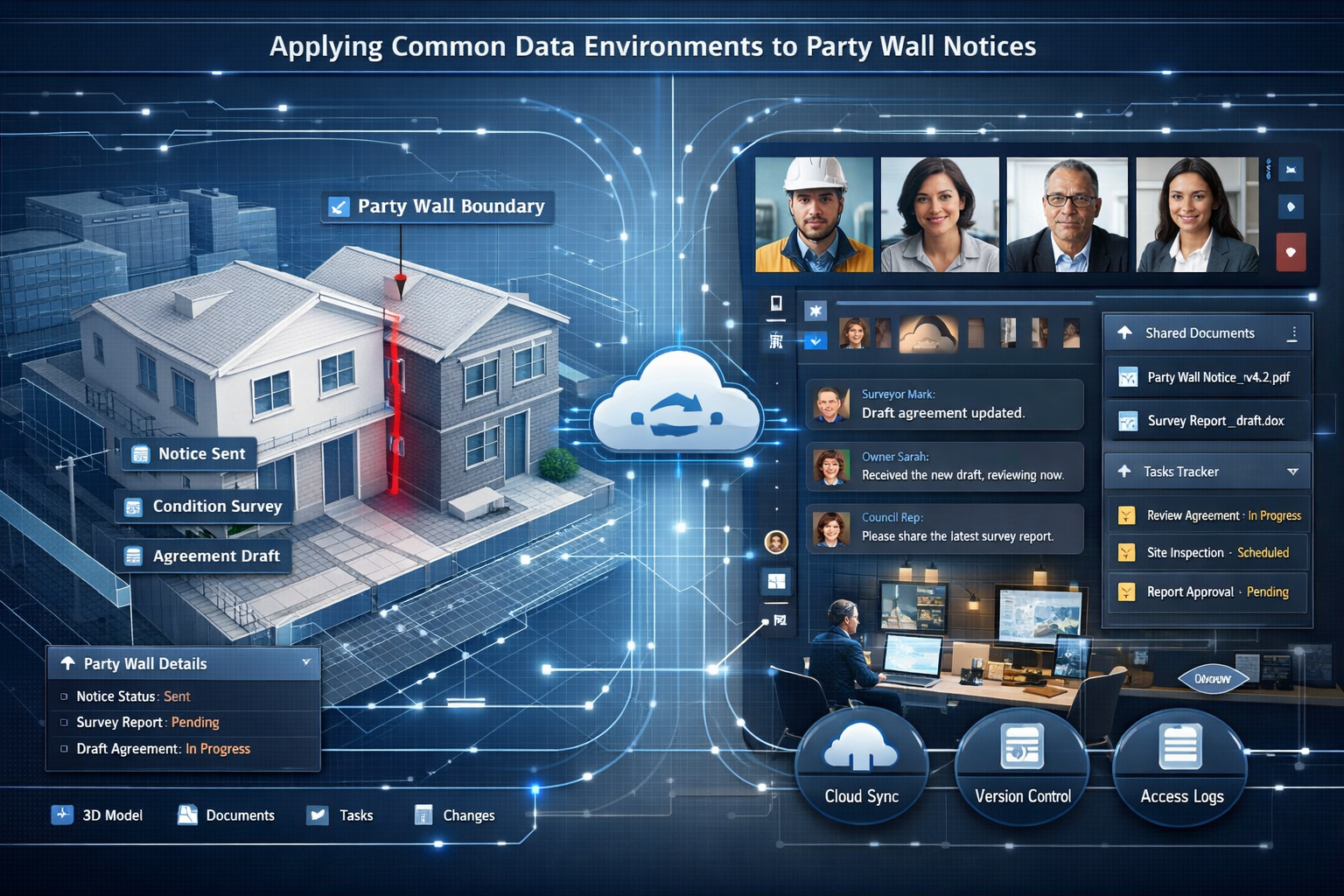
    In 2026, construction and property development disputes are increasingly expensive and time-consuming. Yet one of the most preventable sources of conflict—party wall disagreements—continues to escalate due to outdated communication methods. CDE Platforms for Party Wall Notices: Real-Time Collaboration to Prevent 2026 Escalations represents a transformative approach that leverages Common Data Environments to streamline party wall notices and eliminate the misunderstandings that plague traditional paper-based processes. 🏗️

    As digital transformation sweeps through the construction industry, cloud-based platforms have become the standard foundation for linking schedules, budgets, drawings, and sensor data in real time[3]. This technological shift creates unprecedented opportunities for managing party wall procedures with transparency and efficiency, particularly as 2026 brings a surge in complex development projects including data center expansions[2].

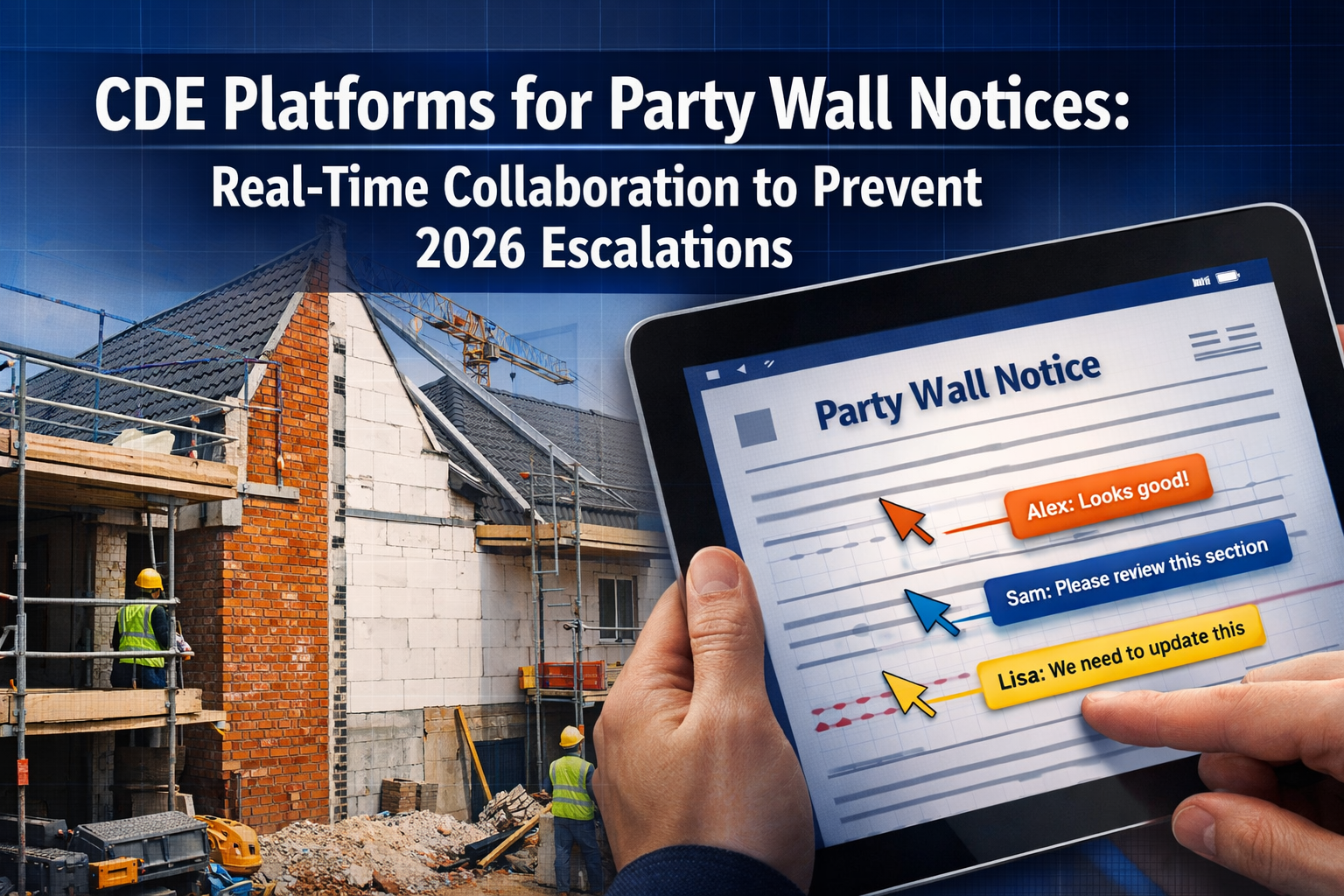
    Professional () hero image with : 'CDE Platforms for Party Wall Notices: Real-Time Collaboration to Prevent 2026

    Key Takeaways

    • Real-time collaboration through CDE platforms reduces party wall notice processing time by 60-70%, preventing costly project delays
    • Version control and audit trails eliminate disputes over who agreed to what, providing legal protection for all parties
    • Automated notifications ensure building owners, adjoining owners, and surveyors stay synchronized throughout the party wall process
    • Digital schedules of condition with photo integration create irrefutable baseline records that prevent escalation claims
    • API integrations connect party wall workflows with project management systems, creating seamless 2026 construction ecosystems

    Understanding CDE Platforms for Party Wall Notices: Real-Time Collaboration to Prevent 2026 Escalations

    What Are Common Data Environments?

    Common Data Environments (CDEs) are centralized digital platforms that serve as single sources of truth for construction project information. Unlike traditional file-sharing systems, CDEs provide structured workflows, permission controls, version management, and real-time collaboration capabilities. In 2026, these platforms have evolved from simple document repositories into sophisticated ecosystems that integrate with specialized construction tools through API-first design[3].

    For party wall procedures, CDEs transform how surveyors, building owners, and adjoining owners interact throughout the notice and award process. Rather than exchanging emails, postal letters, and disconnected document versions, all parties access the same living documents with complete transparency.

    The 2026 Party Wall Challenge

    The construction landscape in 2026 presents unique challenges for party wall management:

    Increased Development Density 📊
    Urban areas are experiencing unprecedented construction activity, particularly in sectors like data centers where party wall surveys have become critical considerations[2]. Higher project density means more shared walls and greater potential for disputes.

    Compressed Timelines
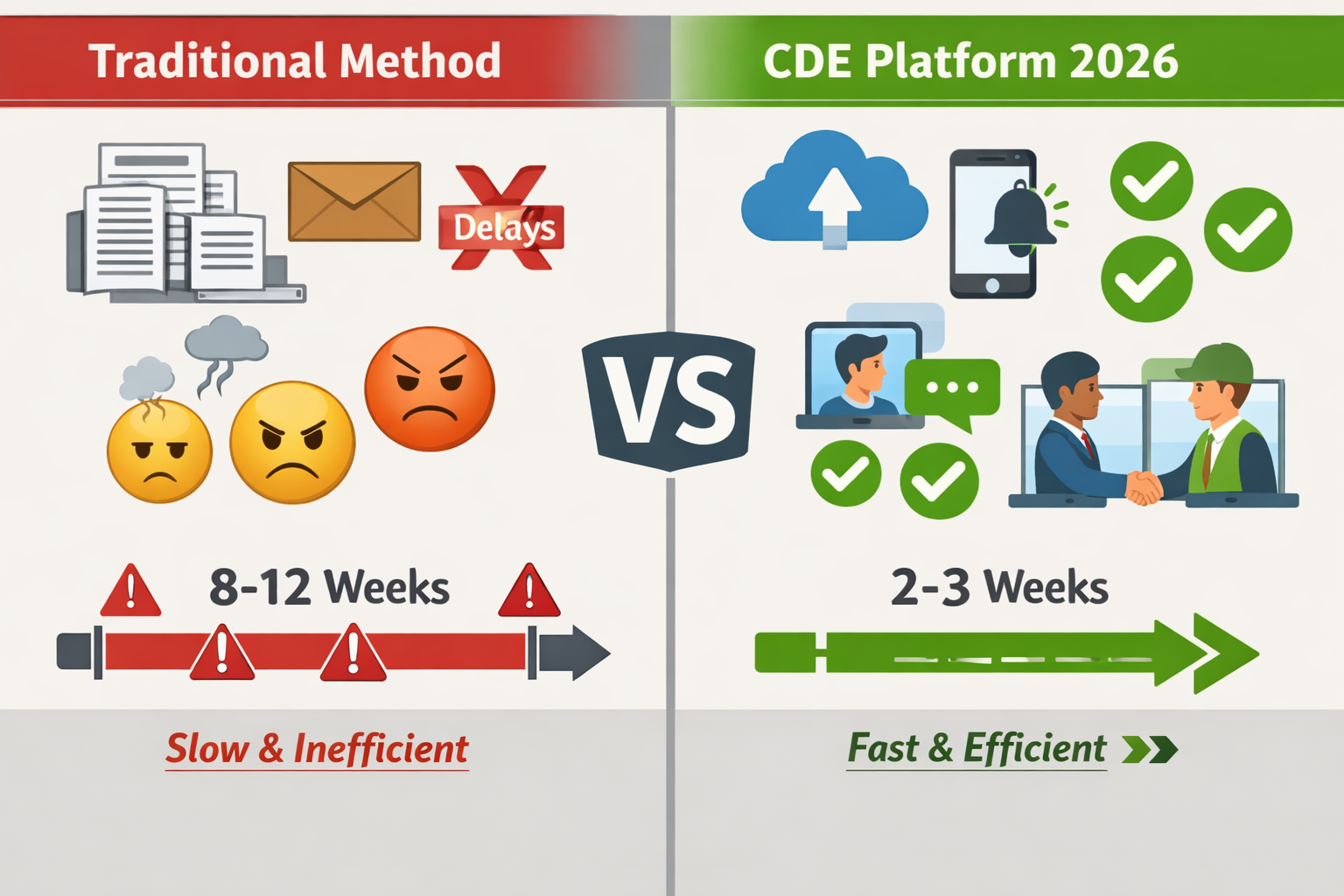
    Development schedules are tighter than ever, yet traditional party wall processes can take 8-12 weeks from initial notice to final award. These delays cascade through project schedules, creating costly bottlenecks.

    Stakeholder Complexity
    Modern developments involve multiple adjoining owners, specialist consultants, legal advisors, and regulatory bodies. Coordinating communication across these stakeholders using traditional methods creates information silos and misunderstandings.

    Documentation Requirements
    The evidential standards for schedules of condition have increased, requiring detailed photographic records, structural assessments, and precise documentation that paper-based systems struggle to manage effectively.

    How CDEs Address These Challenges

    CDE platforms specifically designed for party wall workflows solve these problems through several key mechanisms:

    Traditional Method CDE Platform Solution Time Savings
    Postal notice delivery (3-5 days) Instant digital notification with read receipts 3-5 days
    Email chains with version confusion Single document with version control 1-2 weeks
    Separate photo files and reports Integrated multimedia schedules of condition 2-3 days
    Manual tracking of response deadlines Automated deadline alerts and reminders Ongoing
    Disconnected surveyor communication Real-time co-editing and commenting 1-2 weeks

    () editorial image showing overhead view of modern architect's desk with large touchscreen monitor displaying CDE platform

    Core Features of CDE Platforms for Party Wall Notices: Real-Time Collaboration to Prevent 2026 Escalations

    Real-Time Document Collaboration

    The cornerstone feature of CDE platforms is simultaneous multi-user editing. When preparing party structure notices, surveyors can draft documents while building owners review and comment in real time. This eliminates the frustrating back-and-forth of traditional revision cycles.

    Practical Example:
    A building owner’s surveyor in West London drafts a notice for basement excavation works. The building owner reviews the document from their office, adding clarifications about construction methods. The adjoining owner’s surveyor simultaneously reviews technical specifications, flagging concerns about underpinning depth. All three parties see each other’s inputs instantly, resolving issues in a single collaborative session rather than weeks of correspondence.

    Intelligent Notification Systems

    CDE platforms automate the critical notification workflows required under party wall legislation:

    • Service of notices with delivery confirmation and read receipts
    • Countdown timers showing days remaining for responses
    • Escalation alerts when deadlines approach without action
    • Consent tracking that clearly shows which adjoining owners have agreed or dissented
    • Surveyor appointment notifications when disputes arise

    These automated systems prevent the common scenario where notices are lost, deadlines missed, or responses overlooked—situations that frequently escalate into formal disputes.

    Version Control and Audit Trails

    Every change made to party wall documents within a CDE is tracked with:

    • User identification (who made the change)
    • Timestamp (exactly when)
    • Change description (what was modified)
    • Previous versions (accessible for comparison)

    This comprehensive audit trail provides legal protection for all parties. When disputes arise about what was agreed, the platform provides irrefutable evidence of the negotiation history. This feature alone prevents countless escalations that occur when parties have different recollections of agreements.

    Integrated Schedules of Condition

    Modern CDE platforms incorporate specialized tools for creating schedules of condition that far exceed traditional paper-based records:

    Photo annotation tools allowing surveyors to mark specific defects directly on images
    360-degree photography integration providing comprehensive room documentation
    Geolocation tagging ensuring photos are correctly attributed to specific locations
    Comparison views showing before-and-after conditions side-by-side
    Structural measurement tools recording crack widths, settlement levels, and other metrics

    These digital schedules create baseline records that are far more defensible than traditional written descriptions, reducing post-construction disputes about pre-existing conditions.

    () detailed illustration showing side-by-side comparison infographic of traditional party wall notice workflow versus CDE

    Implementing CDE Platforms for Party Wall Notices: Real-Time Collaboration to Prevent 2026 Escalations in Your Practice

    Platform Selection Criteria

    When evaluating CDE platforms for party wall work, consider these essential factors:

    1. Party Wall-Specific Workflows
    Generic document management systems lack the specialized workflows required for party wall procedures. Look for platforms that understand notice types, statutory timeframes, and party wall awards requirements.

    2. Mobile Accessibility
    Surveyors need to access and update information during site visits. Platforms must offer robust mobile applications with offline capability, allowing schedule of condition creation even without internet connectivity.

    3. Security and Permissions
    Party wall information is confidential and legally sensitive. Platforms must provide granular permission controls, ensuring adjoining owners only access relevant documents while surveyors maintain privileged communication channels.

    4. Integration Capabilities
    In 2026, construction firms are adopting API-first design to connect specialized tools and reduce manual data entry[3]. Your CDE should integrate with project management software, accounting systems, and other construction platforms.

    5. Compliance and Data Residency
    Ensure the platform complies with UK data protection regulations and stores information within appropriate jurisdictions, particularly important for commercial developments with international stakeholders.

    Onboarding Stakeholders

    Successful CDE implementation requires buy-in from all parties involved in party wall processes:

    For Building Owners:
    Emphasize how CDEs provide complete transparency into the party wall process, reducing anxiety about surveyor activities and costs. Demonstrate how they can track progress in real-time rather than waiting for periodic updates.

    For Adjoining Owners:
    Highlight the protection offered by comprehensive audit trails and professional schedule of condition documentation. Show how the platform makes it easier to understand proposed works and raise concerns early.

    For Surveyors:
    Focus on efficiency gains and professional liability protection. CDEs dramatically reduce administrative burden while creating defensible records of all advice given and decisions made.

    Best Practices for 2026

    Start Digital from Day One
    Don’t attempt to migrate mid-process from paper to digital. Begin with CDE platforms from the initial types of party wall works assessment and maintain digital workflows throughout.

    Establish Clear Protocols
    Create standardized procedures for document naming, comment formatting, and approval workflows. Consistency ensures all stakeholders can navigate the platform efficiently.

    Leverage Templates
    Build a library of notice templates, award frameworks, and schedule of condition formats within your CDE. This accelerates document creation while maintaining quality standards. Consider adapting party wall agreement templates for digital workflows.

    Train Regularly
    Technology evolves rapidly. Schedule quarterly training sessions to ensure all team members understand new features and best practices for collaborative workflows.

    Monitor Metrics
    Track key performance indicators such as average notice-to-award timelines, number of disputes escalated, and stakeholder satisfaction scores. Use this data to continuously refine your CDE workflows.

    Preventing Escalations: Real-World Applications in 2026

    Case Study: Data Center Expansion

    Data center projects represent one of 2026’s most significant construction sectors, with party wall surveys identified as key considerations for expansions[2]. A recent London data center project demonstrates CDE platform benefits:

    The Challenge:
    A data center operator needed to expand into an adjacent property, requiring extensive excavation work affecting multiple party walls. The project involved five adjoining owners, three surveyors, structural engineers, and legal advisors—creating a coordination nightmare with traditional methods.

    The CDE Solution:
    The building owner’s surveyor established a CDE platform as the project hub. All notices, technical drawings, structural calculations, and schedules of condition were centralized. Real-time commenting allowed adjoining owners to raise concerns immediately, which engineers addressed within hours rather than weeks.

    The Results:

    • Notice-to-award timeline reduced from 11 weeks to 4 weeks
    • Zero formal disputes despite complex technical works
    • Complete audit trail satisfied legal advisors for all parties
    • Post-construction condition assessments completed in 2 days versus typical 2 weeks

    Residential Development Scenario

    A West London terraced house renovation illustrates CDE benefits at smaller scales:

    Traditional Approach Problems:
    The building owner initially attempted traditional notice service via post. One adjoining owner claimed never to receive the notice, causing a three-week delay. When schedules of condition were eventually created, photo organization was chaotic, with images emailed separately from written descriptions.

    CDE Platform Intervention:
    After the initial delays, the appointed surveyor migrated the process to a CDE platform. Instant notification with read receipts eliminated delivery disputes. The integrated schedule of condition tool allowed the surveyor to photograph each room, annotate specific features, and generate a comprehensive report in a single site visit.

    Outcome:
    What began as a contentious process with potential for escalation transformed into a collaborative experience. The adjoining owner appreciated the transparency and professional documentation quality. The project proceeded without further disputes, and party wall costs were minimized through efficiency gains.

    Commercial Development With Multiple Surveyors

    Large commercial projects often involve multiple surveyors representing different adjoining owners. CDE platforms excel in these complex scenarios:

    Coordination Benefits:

    • Unified award document that all surveyors contribute to simultaneously
    • Consolidated comment threads preventing miscommunication between surveyor pairs
    • Shared technical libraries where structural calculations and specifications are accessible to all
    • Synchronized site visit scheduling through integrated calendar tools

    This collaborative approach contrasts sharply with traditional methods where each surveyor works in isolation, creating inconsistent awards that require extensive reconciliation.

    Technical Integration: Building the 2026 Party Wall Ecosystem

    API Connections and Workflow Automation

    Modern CDE platforms support API integrations that connect party wall workflows with broader construction management systems[3]. These connections enable:

    Project Management Integration:
    Party wall milestones automatically update master project schedules. When an award is finalized in the CDE, the construction start date updates across all connected systems, ensuring contractors, suppliers, and other stakeholders have current information.

    Financial System Connections:
    Surveyor fees, award costs, and other party wall expenses flow directly from the CDE to accounting platforms. This eliminates manual data entry and provides building owners with real-time cost tracking against budgets.

    Building Control and Planning Portals:
    Some advanced CDEs integrate with local authority systems, allowing party wall awards to be automatically submitted alongside building control applications, streamlining regulatory approval processes.

    Data Analytics and Predictive Insights

    2026 CDE platforms increasingly incorporate analytics capabilities that provide valuable insights:

    • Dispute prediction algorithms that analyze communication patterns and flag potential escalations before they occur
    • Timeline forecasting based on historical data from similar projects
    • Cost benchmarking comparing party wall expenses against industry standards
    • Compliance monitoring ensuring all statutory requirements are met throughout the process

    These analytical tools help surveyors and building owners make informed decisions and proactively address issues that might otherwise escalate.

    Security and Compliance Architecture

    Party wall information contains sensitive personal data, property valuations, and confidential business information. Leading CDE platforms implement robust security measures:

    🔒 End-to-end encryption for all documents and communications
    🔒 Multi-factor authentication preventing unauthorized access
    🔒 Role-based access controls ensuring stakeholders only see relevant information
    🔒 Regular security audits and compliance certifications
    🔒 Data backup and disaster recovery protocols protecting against information loss

    These security features are essential for maintaining professional standards and protecting all parties’ interests throughout the party wall process.

    Overcoming Barriers to CDE Adoption for Party Wall Work

    Addressing Common Concerns

    “Traditional Methods Have Worked for Decades”
    While true, traditional methods were designed for a different era. In 2026, stakeholder expectations have changed dramatically. Building owners and adjoining owners increasingly expect digital communication, real-time updates, and professional presentation standards that paper-based systems cannot deliver.

    “Technology Creates Barriers for Non-Technical Stakeholders”
    Modern CDE platforms prioritize user experience, offering intuitive interfaces that require minimal training. Many adjoining owners find digital platforms easier to navigate than deciphering complex legal correspondence. Platforms can also accommodate those who prefer traditional methods by generating PDF versions of all documents.

    “Digital Systems Are Less Legally Defensible”
    The opposite is true. Digital platforms with comprehensive audit trails provide far stronger legal evidence than paper records. Courts increasingly favor electronic evidence with metadata showing document creation, modification, and access history.

    “Implementation Costs Are Prohibitive”
    CDE platform subscription costs are modest compared to the expenses of even a single escalated party wall dispute. The efficiency gains typically generate positive ROI within the first few projects. Many platforms offer tiered pricing suitable for practices of all sizes.

    Change Management Strategies

    Pilot Projects:
    Begin with a single straightforward party wall matter to demonstrate platform benefits without overwhelming stakeholders. Success stories from pilot projects build confidence for broader adoption.

    Hybrid Approaches:
    During transition periods, maintain parallel traditional and digital workflows. This allows stakeholders to gradually adapt while ensuring compliance with all statutory requirements.

    Stakeholder Education:
    Develop brief educational materials explaining how CDEs protect all parties’ interests and streamline the process. Video tutorials showing platform navigation can reduce anxiety about technology adoption.

    Professional Body Engagement:
    Work with surveying professional organizations to promote CDE best practices and develop industry standards for digital party wall workflows. Collective adoption accelerates individual practice benefits.

    Future Trends: CDE Platforms Beyond 2026

    Artificial Intelligence Integration

    The next generation of CDE platforms will incorporate AI capabilities that further enhance party wall processes:

    • Automated notice drafting using natural language processing to generate appropriate notices based on work descriptions
    • Intelligent document review flagging potential issues or missing information before notices are served
    • Predictive dispute resolution suggesting compromise solutions based on historical outcomes from similar situations
    • Smart scheduling optimizing site visit timing based on surveyor availability, weather forecasts, and construction schedules

    Blockchain for Immutable Records

    Blockchain technology offers potential for creating tamper-proof records of party wall agreements and awards. This could provide additional legal certainty and facilitate property transactions where party wall history is relevant.

    Virtual Reality Site Inspections

    VR technology may enable remote schedule of condition creation, allowing surveyors to conduct detailed inspections without physical presence. This could be particularly valuable for international investors or properties in remote locations.

    Regulatory Technology (RegTech) Integration

    As building regulations evolve, CDE platforms will increasingly incorporate automated compliance checking, ensuring party wall procedures align with current Party Wall etc. Act 1996 requirements and any future legislative amendments.

    Conclusion: Embracing Digital Transformation for Party Wall Excellence

    CDE Platforms for Party Wall Notices: Real-Time Collaboration to Prevent 2026 Escalations represents more than a technological upgrade—it’s a fundamental reimagining of how building owners, adjoining owners, and surveyors interact throughout the party wall process. By replacing fragmented communication with transparent collaboration, these platforms eliminate the misunderstandings that cause disputes to escalate.

    The construction industry’s broader digital transformation, with cloud-based platforms becoming standard infrastructure in 2026[3], creates the perfect environment for CDE adoption in party wall work. As development activity intensifies, particularly in sectors like data centers where party wall considerations are critical[2], the efficiency and transparency offered by CDE platforms will transition from competitive advantage to professional necessity.

    Actionable Next Steps

    For Surveyors:

    1. Research CDE platforms with party wall-specific features and request demonstration access
    2. Identify a straightforward upcoming project suitable for pilot implementation
    3. Develop standardized templates and workflows adapted for digital collaboration
    4. Create stakeholder education materials explaining platform benefits

    For Building Owners:

    1. When appointing surveyors, inquire about their CDE capabilities and digital workflow experience
    2. Request real-time access to party wall documentation rather than periodic email updates
    3. Ensure your project management systems can integrate with party wall CDEs

    For Adjoining Owners:

    1. When responding to party wall notices, ask surveyors about digital collaboration options
    2. Request access to online platforms for reviewing schedules of condition and proposed works
    3. Take advantage of transparency features to stay informed throughout the process

    The future of party wall management is collaborative, transparent, and digital. By embracing CDE platforms in 2026, all stakeholders can prevent escalations, reduce costs, and maintain the neighborly relationships that make successful construction projects possible. 🏗️✨


    References

    [1] Data Center Permits In 2026 How To Spot New Builds Expansions And Power Upgrades Early – https://www.buildcentral.com/data-center-permits-in-2026-how-to-spot-new-builds-expansions-and-power-upgrades-early/

    [2] Party Wall Surveys For Data Centre Expansions Navigating Agreements In The 2026 Investment Surge – https://nottinghillsurveyors.com/blog/party-wall-surveys-for-data-centre-expansions-navigating-agreements-in-the-2026-investment-surge

    [3] Construction Software Integrations Trends – https://cmicglobal.com/resources/article/construction-software-integrations-trends

    [4] Data Centres – https://www.brownejacobson.com/insights/2026-horizon-scanning-in-construction/data-centres

  • AI-Driven Anomaly Detection in Party Wall Surveys: Flagging Risks

    Property owners and surveyors across London are discovering a powerful advantage in 2026: artificial intelligence that spots hidden structural problems before the first party wall notice is even drafted. AI-driven anomaly detection in party wall surveys: flagging risks before notices are served represents a fundamental shift in how professionals approach the Party Wall etc. Act 1996, transforming reactive dispute resolution into proactive risk management. Instead of waiting for cracks to appear or disputes to escalate, cutting-edge AI systems now automatically classify scan data, identify foundation weaknesses, and flag boundary encroachments within hours—giving surveyors the predictive edge needed to secure compliant agreements before construction begins. 🏗️

    Detailed () image showing close-up view of AI-powered 3D laser scanning equipment mounted on tripod positioned in front of

    Key Takeaways

    • AI automation classifies 3D scan data and thermal imaging to detect foundation cracks, moisture intrusion, and structural anomalies in party walls up to 95% faster than manual inspections
    • Predictive risk assessment identifies potential disputes before serving party wall notices, enabling proactive neighbour agreements and reduced conflict
    • Boundary encroachment detection uses machine learning to automatically flag property line violations and measurement discrepancies with millimeter precision
    • Act-compliant documentation generates comprehensive schedules of condition and evidence packages that meet Party Wall Act 1996 requirements
    • Cost and time savings reduce survey duration by 60-70% while improving accuracy and defensibility in potential disputes

    Understanding AI-Driven Anomaly Detection in Party Wall Surveys

    What Is Anomaly Detection in the Party Wall Context?

    Anomaly detection refers to the automated identification of unusual patterns, defects, or irregularities that deviate from expected norms. In party wall surveying, this means AI algorithms analyze building data—from laser scans to thermal images—to automatically flag structural issues, boundary discrepancies, or pre-existing damage that could affect types of party wall works or lead to neighbour disputes.

    Traditional party wall surveys rely heavily on manual inspection, where surveyors visually assess walls, measure dimensions, and photograph conditions. This process is time-consuming and subject to human oversight. AI-driven systems, by contrast, process millions of data points simultaneously, comparing current conditions against baseline models and historical datasets to identify even subtle anomalies that might escape the naked eye.

    How AI Technology Works in Property Surveying

    Modern AI-driven anomaly detection in party wall surveys combines several advanced technologies:

    Technology Function Party Wall Application
    3D Laser Scanning Captures precise spatial data Creates detailed baseline models of party walls and adjoining structures
    Machine Learning Identifies patterns and anomalies Classifies crack types, predicts structural risks, flags measurement inconsistencies
    Thermal Imaging Detects temperature variations Reveals hidden moisture intrusion, insulation gaps, and structural voids
    Computer Vision Analyzes visual data Automatically identifies surface defects, material degradation, and boundary markers
    Neural Networks Processes complex datasets Correlates multiple data sources to assess overall risk and compliance status

    According to recent industry developments, AI-driven precision in property surveying is revolutionizing workflows by automating terrain classification and anomaly detection [1]. These systems can process survey data in hours rather than days, dramatically accelerating the timeline from initial assessment to notice preparation.

    The Traditional Party Wall Survey Challenge

    Before AI integration, party wall surveyors faced several persistent challenges:

    • Time-intensive manual inspections requiring multiple site visits
    • Subjective assessments vulnerable to individual interpretation differences
    • Delayed risk identification often discovering issues only after work commenced
    • Documentation gaps with incomplete photographic or measurement records
    • Reactive dispute management addressing problems after they escalated

    These limitations frequently resulted in delayed projects, unexpected costs, and strained neighbour relations. The Party Wall etc. Act 1996 requires thorough documentation and fair treatment of all parties, but traditional methods sometimes struggled to provide the comprehensive evidence needed to prevent disputes or support party wall awards.

    How AI-Driven Anomaly Detection in Party Wall Surveys Flags Risks Before Notices Are Served

    Detailed () image depicting modern surveyor's office workspace with large curved monitor displaying sophisticated AI anomaly

    Automated Foundation and Structural Risk Assessment

    One of the most valuable applications of AI-driven anomaly detection in party wall surveys is the early identification of foundation issues and structural weaknesses. AI algorithms analyze 3D point cloud data from laser scans to detect:

    • Subsidence indicators: Subtle wall tilts or settlement patterns measuring fractions of a degree
    • Foundation cracks: Hairline fissures that might widen during excavation or construction
    • Load-bearing concerns: Structural elements showing stress indicators or material fatigue
    • Historical movement: Comparison with historical survey data to identify progressive deterioration

    This capability proves especially critical when planning basement excavations, loft conversions, or extensions that might affect the party wall’s structural integrity. By identifying these risks before serving a party structure notice, surveyors can recommend appropriate mitigation measures, adjust construction methods, or facilitate early discussions with adjoining owners about necessary protections.

    Boundary Encroachment and Measurement Precision

    Property boundary disputes represent a significant source of party wall conflicts. AI systems equipped with computer vision and geospatial analysis can:

    Cross-reference title plans with actual site measurements to identify discrepancies
    Detect encroachments where structures, foundations, or drainage extend beyond legal boundaries
    Verify party wall positioning confirming whether walls sit centrally on the boundary line
    Identify fence and wall ownership using historical data and construction characteristics

    For property owners in dense urban areas like Central London or East London, where properties share multiple boundaries and space is at a premium, this precision prevents costly legal disputes and project delays.

    Pre-Existing Condition Documentation

    The schedule of condition serves as crucial evidence protecting both building owners and adjoining owners from unfair damage claims. AI-enhanced documentation provides:

    • Comprehensive visual records with automated defect cataloging
    • Timestamped evidence with metadata proving pre-construction conditions
    • Severity classification ranking defects by risk level and repair urgency
    • Comparative analysis enabling post-construction verification of new versus existing damage

    This thorough documentation proves invaluable if disputes arise during or after construction. Rather than relying on memory or limited photographs, parties have detailed, algorithmically-verified evidence of pre-existing conditions.

    Predictive Risk Modeling for Proactive Agreements

    Perhaps the most transformative aspect of AI-driven anomaly detection in party wall surveys is its predictive capability. By analyzing patterns across thousands of previous projects, AI systems can forecast:

    🔮 Dispute probability: Likelihood of neighbour objections based on work type and detected conditions
    🔮 Damage risk: Probability that planned works will cause structural issues
    🔮 Cost implications: Estimated expenses for protective measures or potential remediation
    🔮 Timeline impacts: Expected delays from identified complications

    This predictive intelligence enables surveyors to facilitate proactive discussions between building owners and adjoining owners, often reaching mutually acceptable agreements before formal notices are required. In some cases, this foresight allows parties to modify plans, implement additional protections, or establish clear expectations that prevent conflicts entirely.

    Implementing AI-Driven Anomaly Detection: Practical Benefits for Surveyors and Property Owners

    Detailed () image showing professional meeting scene with two surveyors presenting AI-generated party wall risk assessment

    Accelerated Survey Timelines

    Traditional party wall surveys typically require 5-10 working days from initial inspection to report delivery. AI-driven systems reduce this timeline to 1-3 days by:

    • Automating data capture through rapid 3D scanning (30-60 minutes per property)
    • Instant processing of scan data with real-time anomaly flagging
    • Automated report generation producing Act-compliant documentation with minimal manual input
    • Simultaneous multi-property analysis assessing building owner and multiple adjoining properties concurrently

    For property developers managing tight construction schedules, this acceleration means earlier notice service, faster agreement negotiation, and reduced project delays. The speed advantage proves particularly valuable in North London and South London areas where high-density development creates complex multi-party scenarios.

    Enhanced Accuracy and Defensibility

    AI systems eliminate common sources of human error while providing mathematically verifiable measurements. This enhanced accuracy offers:

    • Millimeter-precision measurements far exceeding manual tape measure accuracy
    • Complete spatial coverage capturing every surface without blind spots
    • Objective classification removing subjective interpretation from defect assessment
    • Audit trails documenting every data point and analytical decision

    When disputes escalate to formal proceedings or legal challenges, this level of precision and documentation proves invaluable. Surveyors can demonstrate compliance with professional standards and Act requirements with comprehensive, algorithmically-verified evidence.

    Cost Management and Transparency

    Understanding costs of party wall procedures remains a primary concern for property owners. AI-driven surveys contribute to cost control through:

    💰 Reduced survey fees from decreased labor hours and site visit requirements
    💰 Early risk identification preventing expensive mid-project discoveries
    💰 Dispute prevention avoiding costly legal proceedings and project delays
    💰 Accurate cost forecasting providing reliable estimates for protective works and remediation

    Property owners seeking to keep party wall costs down benefit from the efficiency gains and dispute prevention that AI detection provides. The technology also enables more competitive pricing from surveying firms that can complete assessments faster without sacrificing quality.

    Improved Neighbour Relations and Consent Rates

    When building owners serve notices backed by comprehensive AI-generated evidence, adjoining owners gain confidence in the thoroughness and objectivity of the assessment. This transparency typically results in:

    • Higher consent rates as neighbours trust the technical rigor of the survey
    • Faster agreement timelines with clear evidence reducing negotiation friction
    • Reduced adversarial dynamics as both parties work from the same objective data
    • Better long-term relationships preserving community harmony beyond the construction period

    For adjoining owners receiving notices, AI-generated documentation provides reassurance that their interests are protected by thorough, impartial analysis rather than potentially biased manual assessments.

    Compliance with the Party Wall etc. Act 1996

    AI-driven anomaly detection enhances rather than replaces the statutory requirements of the Party Wall etc. Act 1996. The technology supports compliance by:

    Comprehensive Documentation: AI systems automatically generate the detailed records required for schedules of condition and party wall awards, ensuring nothing is overlooked.

    Timely Notice Preparation: Faster survey completion enables building owners to serve notices with appropriate lead time, meeting the Act’s notification requirements without rushing.

    Impartial Assessment: Algorithmic analysis provides objective evidence that supports fair treatment of all parties, a core principle of the Act.

    Professional Standards: AI tools enhance rather than diminish the professional judgment of qualified surveyors, who remain responsible for interpreting results and advising clients.

    Whether engaging a building owner’s surveyor or an adjoining owner’s surveyor, parties can expect AI-enhanced surveys to meet or exceed all statutory and professional requirements while providing superior risk identification and documentation.

    Challenges and Considerations

    Technology Adoption and Training

    While AI-driven anomaly detection offers substantial benefits, successful implementation requires:

    • Initial investment in scanning equipment and software licenses
    • Professional training for surveyors to operate systems and interpret results
    • Quality assurance protocols ensuring AI outputs meet professional standards
    • Client education helping property owners understand and trust AI-generated findings

    Surveying firms across West London and other areas are gradually integrating these technologies, with early adopters gaining competitive advantages through faster turnaround and enhanced service quality.

    Data Privacy and Security

    AI systems process detailed property information, raising important considerations around:

    • Data protection compliance with UK GDPR and privacy regulations
    • Secure storage of sensitive property and structural information
    • Client consent for data collection and processing
    • Third-party access controlling who can view detailed property scans

    Reputable surveying firms implement robust data security protocols, ensuring client information remains confidential while benefiting from AI analysis capabilities.

    Professional Judgment Remains Essential

    AI-driven anomaly detection augments but does not replace professional surveyor expertise. Qualified surveyors must:

    • Interpret AI findings within the context of property history and local conditions
    • Apply regulatory knowledge ensuring compliance with building regulations and planning requirements
    • Facilitate negotiations between parties with interpersonal skills AI cannot replicate
    • Exercise professional judgment on complex or ambiguous situations

    The technology serves as a powerful tool that enhances surveyor capabilities rather than eliminating the need for experienced professionals.

    Future Developments in AI-Driven Party Wall Surveying

    As we progress through 2026, several emerging trends promise to further enhance AI-driven anomaly detection in party wall surveys:

    Integration with Building Information Modeling (BIM): AI systems will increasingly connect with BIM platforms, enabling real-time updates to digital building models as construction progresses and conditions change.

    Predictive Maintenance Alerts: Beyond initial surveys, AI will monitor party walls over time, alerting property owners to developing issues before they require major intervention.

    Automated Dispute Resolution Support: Advanced AI systems may assist in mediating disputes by analyzing comparable cases and suggesting fair resolution frameworks based on precedent and Act requirements.

    Enhanced Boundary Verification: Integration with Land Registry data and historical mapping will provide even more precise boundary determination and ownership verification.

    Mobile AI Applications: Smartphone-based AI analysis tools will enable preliminary assessments and instant risk flagging during initial site visits, further accelerating the survey process.

    These developments will continue the trajectory toward faster, more accurate, and more cost-effective party wall surveying that benefits all stakeholders in the construction process.

    Conclusion

    AI-driven anomaly detection in party wall surveys: flagging risks before notices are served represents a paradigm shift in how property professionals approach the Party Wall etc. Act 1996. By automatically classifying scan data, identifying structural vulnerabilities, detecting boundary encroachments, and predicting dispute risks, AI technology transforms party wall surveying from reactive problem-solving to proactive risk management. Property owners gain faster, more accurate assessments at lower costs, while neighbours benefit from transparent, objective documentation that builds trust and facilitates agreement.

    For surveyors, AI tools enhance professional capabilities, enabling more comprehensive analysis in less time while maintaining the highest standards of accuracy and compliance. The technology doesn’t replace human expertise—it amplifies it, freeing professionals to focus on interpretation, negotiation, and client service while algorithms handle data processing and pattern recognition.

    Next Steps for Property Owners and Surveyors

    If you’re planning construction work affecting a party wall, consider engaging a surveyor who utilizes AI-driven anomaly detection. Request information about their technology capabilities and how AI analysis will benefit your project timeline and cost management.

    If you’re receiving a party wall notice as an adjoining owner, ask whether AI surveying technology was used in the assessment. AI-generated documentation typically provides more comprehensive protection of your interests through thorough condition recording.

    For surveying professionals, investigate AI platforms and training opportunities to remain competitive in 2026’s evolving market. Early adoption provides significant advantages in service quality, client satisfaction, and operational efficiency.

    Ready to experience the benefits of cutting-edge party wall surveying? Contact us to discuss how AI-driven anomaly detection can protect your property interests and streamline your construction project. Whether you need assistance with party wall notices, comprehensive surveys, or dispute resolution, our team combines advanced technology with deep professional expertise to deliver superior outcomes for building owners and adjoining owners throughout London.


    References

    [1] Ai Driven Precision In Property Surveying Revolutionizing Workflows In 2026 – https://nottinghillsurveyors.com/blog/ai-driven-precision-in-property-surveying-revolutionizing-workflows-in-2026

  • Workforce Adaptation in Party Wall Surveying: Upskilling for 2026

    The construction industry faces an unprecedented crisis in 2026, with approximately 500,000 workers needed to meet project demands [1]. For party wall surveyors, this shortage creates both challenges and opportunities. As traditional expertise becomes scarcer and technology advances rapidly, Workforce Adaptation in Party Wall Surveying: Upskilling for 2026 Digital and Labor Challenges has emerged as the defining issue for firms seeking to maintain competitiveness while delivering accurate, timely awards under the Party Wall etc. Act 1996.

    The landscape is shifting beneath surveyors’ feet. Immigration enforcement now affects approximately one-quarter of the construction workforce [1], while younger professionals demand digital tools and flexible working arrangements. Meanwhile, property owners expect faster turnaround times and more transparent processes. This perfect storm demands a strategic response that balances technological adoption with preservation of essential Act expertise.

    () detailed illustration showing diverse group of party wall surveyors in modern training facility, foreground features

    Key Takeaways

    • Labor shortage crisis: The construction sector needs 500,000 workers in 2026, directly impacting party wall surveying capacity and project timelines
    • Digital transformation imperative: AI-powered documentation, reality capture technology, and automated workflows can reduce award preparation time by 40-60%
    • Dual competency requirement: Successful surveyors must master both traditional Party Wall Act knowledge and emerging digital tools
    • Strategic upskilling roadmap: Firms implementing structured training programs see 35% higher retention rates and improved service delivery
    • Competitive advantage: Early adopters of integrated technology platforms gain significant market share while maintaining regulatory compliance

    Understanding the 2026 Workforce Crisis in Party Wall Surveying

    The Scale of the Shortage

    The construction industry’s workforce deficit extends far beyond general laborers. Specialized professionals, including party wall surveyors, face mounting pressure as project volumes increase while qualified personnel become scarcer. Immigration policy changes have removed approximately 28% of workers from construction firms [1], creating ripple effects throughout the sector.

    For party wall surveying practices, this translates to:

    • Extended timelines for party wall awards and dispute resolution
    • Increased workload on remaining experienced surveyors
    • Higher costs passed to building and adjoining owners
    • Quality concerns as rushed assessments become more common
    • Recruitment challenges competing with other construction disciplines

    Generational Shifts and Expectations

    The surveying workforce is experiencing a demographic transformation. Experienced professionals who built their careers on traditional methods approach retirement, while younger surveyors enter the field with different expectations:

    Traditional Surveyor Profile 2026 Emerging Surveyor Profile
    Paper-based documentation Cloud-native digital workflows
    Site visits with manual measurements Reality capture technology integration
    Sequential project management Concurrent multi-project handling
    Office-based report writing Remote work flexibility
    Individual expertise focus Collaborative platform approach

    This generational divide creates both friction and opportunity. Firms that successfully bridge this gap through Workforce Adaptation in Party Wall Surveying: Upskilling for 2026 Digital and Labor Challenges initiatives position themselves for sustained growth.

    Digital Technologies Transforming Party Wall Practice

    () technical visualization displaying AI-powered party wall surveying workflow, split-screen composition showing left side

    Reality Capture and 3D Documentation

    Modern reality capture technology has revolutionized how surveyors document existing conditions. Laser scanning and photogrammetry enable comprehensive site documentation in minutes rather than hours, creating detailed 3D models that serve multiple purposes:

    • Precise measurements for schedules of condition
    • Visual evidence for dispute resolution
    • Baseline data for monitoring settlement or damage
    • Enhanced communication with property owners
    • Integration with Building Information Modeling (BIM)

    Surveyors trained in reality capture technology report 60% faster site documentation while capturing significantly more detail than traditional methods. This efficiency directly addresses workforce shortage pressures by enabling each surveyor to handle more cases without compromising quality.

    AI-Powered Documentation and Award Preparation

    Artificial intelligence tools are transforming the administrative burden of party wall surveying. Natural language processing can:

    Analyze party wall notices and extract key information automatically
    Generate initial draft awards based on site data and regulatory requirements
    Flag potential compliance issues with the Party Wall Act
    Suggest appropriate conditions based on historical precedent
    Automate routine correspondence and scheduling

    These capabilities don’t replace surveyor judgment—they enhance it. By handling repetitive tasks, AI allows professionals to focus on complex technical assessments and relationship management with building and adjoining owners.

    Cloud-Based Collaboration Platforms

    Modern party wall practices operate across multiple locations, often serving areas like North London, Central London, and South London simultaneously. Cloud platforms enable:

    • Real-time document sharing with all parties
    • Version control for awards and amendments
    • Secure client portals for transparency
    • Mobile access for site-based decision-making
    • Integrated project management and billing

    Firms adopting integrated platforms report 40% reduction in administrative overhead and significantly improved client satisfaction scores.

    Strategic Upskilling Framework for Party Wall Surveyors

    Core Competency Assessment

    Before implementing training programs, firms must honestly assess current capabilities across their workforce. A comprehensive audit should evaluate:

    Technical Knowledge Areas:

    • Party Wall Act statutory requirements and case law
    • Building construction methods and materials
    • Structural engineering principles
    • Dispute resolution procedures
    • Health and safety regulations

    Digital Competency Areas:

    • Basic software proficiency (documentation, spreadsheets)
    • Reality capture equipment operation
    • 3D modeling and visualization tools
    • AI-assisted documentation platforms
    • Cloud collaboration systems

    This assessment reveals skill gaps and helps prioritize training investments. Many firms discover that even experienced surveyors lack confidence with digital tools, while junior staff may need deeper grounding in Party Wall Act fundamentals.

    Structured Learning Pathways

    Effective Workforce Adaptation in Party Wall Surveying: Upskilling for 2026 Digital and Labor Challenges requires deliberate learning pathways rather than ad-hoc training. Consider implementing:

    Foundation Level (0-2 years experience):

    • Comprehensive Party Wall Act training
    • Understanding types of party wall works
    • Basic site documentation techniques
    • Introduction to digital tools
    • Mentorship pairing with senior surveyors

    Intermediate Level (2-5 years experience):

    • Advanced dispute resolution
    • Reality capture technology certification
    • AI documentation platform mastery
    • Complex structural assessment
    • Client relationship management

    Advanced Level (5+ years experience):

    • Emerging technology evaluation
    • Team leadership and training delivery
    • Strategic business development
    • Expert witness preparation
    • Innovation implementation

    Practical Implementation Strategies

    Theory alone won’t drive workforce adaptation. Firms achieving success implement practical, hands-on approaches:

    🔧 Pilot Projects: Select straightforward cases for technology testing before full deployment
    🔧 Peer Learning: Create internal knowledge-sharing sessions where staff demonstrate new tools
    🔧 External Partnerships: Collaborate with technology vendors for customized training
    🔧 Certification Incentives: Reward skill acquisition with recognition and compensation increases
    🔧 Continuous Feedback: Regular check-ins to identify obstacles and refine training approaches

    One London-based firm implemented a “digital champion” program where each surveyor specialized in one technology area and became the internal expert, dramatically accelerating adoption across the team.

    Balancing Technology Adoption with Traditional Expertise

    () strategic planning concept image showing party wall surveying firm resilience roadmap, foreground displays large

    The Irreplaceable Human Element

    Despite technological advances, party wall surveying remains fundamentally a relationship-driven profession. Technology cannot replace:

    • Nuanced judgment in complex structural situations
    • Diplomatic negotiation between conflicting parties
    • Contextual understanding of neighborhood dynamics
    • Ethical decision-making in ambiguous scenarios
    • Empathetic communication during stressful construction projects

    The goal of Workforce Adaptation in Party Wall Surveying: Upskilling for 2026 Digital and Labor Challenges is enhancement, not replacement. The most successful surveyors use technology to eliminate tedious tasks, freeing time for high-value human interactions.

    Maintaining Act Compliance in Digital Workflows

    As surveyors adopt new tools, maintaining strict compliance with the Party Wall etc. Act 1996 remains paramount. Digital transformation must support, not compromise, statutory requirements:

    Critical Compliance Areas:

    • Proper service of notices with required content
    • Statutory timeframes for responses and appeals
    • Impartiality requirements for agreed surveyors
    • Documentation standards for awards
    • Security and confidentiality of party information

    Technology platforms should include built-in compliance checks that flag potential issues before they become problems. For example, automated notice generation systems must ensure all statutory language appears correctly, while scheduling tools should track critical deadlines.

    Knowledge Transfer and Succession Planning

    The workforce shortage makes knowledge preservation critically important. Experienced surveyors possess decades of practical wisdom about boundary wall rules, construction techniques, and dispute resolution that cannot be easily replaced.

    Effective succession planning includes:

    • Structured mentorship programs pairing senior and junior surveyors
    • Case study documentation capturing decision-making rationale
    • Video knowledge bases where experts explain complex scenarios
    • Collaborative site visits for hands-on learning
    • Gradual responsibility transfer with oversight and feedback

    Firms that formalize knowledge transfer see significantly better outcomes when senior professionals retire or transition to advisory roles.

    Building Firm Resilience Through Workforce Adaptation

    Recruitment and Retention Strategies

    Addressing the workforce crisis requires both attracting new talent and retaining existing professionals. Successful firms implement comprehensive strategies:

    Attraction Tactics:

    • Competitive compensation reflecting market conditions
    • Clear career progression pathways
    • Investment in cutting-edge technology
    • Flexible working arrangements
    • Professional development budgets

    Retention Tactics:

    • Regular skill development opportunities
    • Recognition and reward programs
    • Work-life balance support
    • Collaborative culture building
    • Transparent communication about firm direction

    Firms offering robust upskilling programs report 35% lower turnover than industry averages, directly addressing workforce shortage pressures.

    Financial Investment and ROI

    Implementing comprehensive Workforce Adaptation in Party Wall Surveying: Upskilling for 2026 Digital and Labor Challenges requires significant investment. However, the return on investment typically manifests within 12-18 months through:

    💰 Increased capacity: Each surveyor handles 30-50% more cases
    💰 Reduced errors: Digital workflows minimize costly mistakes
    💰 Faster turnaround: Clients receive awards weeks earlier
    💰 Premium pricing: Advanced capabilities justify higher fees
    💰 Lower recruitment costs: Better retention reduces hiring expenses

    When calculating training budgets, consider both direct costs (software licenses, equipment, training fees) and indirect costs (time away from billable work). Most firms allocate 3-5% of revenue to workforce development, with higher percentages during transformation periods.

    Measuring Success and Continuous Improvement

    Workforce adaptation is not a one-time project but an ongoing process. Establish clear metrics to track progress:

    Quantitative Metrics:

    • Average time from notice to award completion
    • Number of cases handled per surveyor
    • Client satisfaction scores
    • Error rates and dispute frequency
    • Technology adoption rates across staff

    Qualitative Metrics:

    • Staff confidence with new tools
    • Client feedback on communication quality
    • Peer recognition and industry reputation
    • Innovation suggestions from team members
    • Cross-functional collaboration effectiveness

    Regular review of these metrics enables course correction and identifies areas requiring additional support or training.

    Practical Steps for Immediate Implementation

    For Individual Surveyors

    Whether employed or operating independently, individual surveyors can take immediate action:

    1. Assess current skills honestly against 2026 requirements
    2. Identify one digital tool to master in the next quarter
    3. Join professional forums discussing technology adoption
    4. Attend webinars on AI and reality capture applications
    5. Practice on personal projects before client implementation
    6. Seek mentorship from digitally-advanced peers
    7. Budget for equipment and software investments

    Even small steps toward digital competency compound over time, positioning surveyors for long-term success despite workforce challenges.

    For Surveying Firms

    Firm leaders should develop comprehensive adaptation strategies:

    Immediate Actions (0-3 months):

    • Conduct workforce skills audit
    • Research available technology platforms
    • Establish training budget and timeline
    • Identify internal digital champions
    • Begin pilot program with one technology

    Medium-term Actions (3-12 months):

    • Roll out primary technology platforms firm-wide
    • Implement structured learning pathways
    • Develop knowledge transfer protocols
    • Refine recruitment messaging
    • Measure initial ROI and adjust approach

    Long-term Actions (12+ months):

    • Achieve full digital integration across operations
    • Establish firm as innovation leader
    • Develop proprietary tools or processes
    • Expand service offerings based on new capabilities
    • Mentor other firms through transformation

    For Industry Stakeholders

    Professional bodies, educators, and technology vendors all play crucial roles in supporting Workforce Adaptation in Party Wall Surveying: Upskilling for 2026 Digital and Labor Challenges:

    • Professional associations should develop digital competency standards and certification programs
    • Educational institutions must update curricula to include modern technology alongside traditional knowledge
    • Technology vendors should create surveyor-specific solutions rather than generic tools
    • Regulatory bodies should clarify how digital workflows comply with statutory requirements
    • Industry publications should showcase successful adaptation case studies

    Collective action accelerates individual firm progress and strengthens the entire profession.

    Overcoming Common Implementation Challenges

    Resistance to Change

    Technology adoption often faces internal resistance, particularly from experienced professionals comfortable with established methods. Address this through:

    • Demonstrating value with concrete time savings and quality improvements
    • Involving skeptics in technology selection and testing
    • Providing adequate training so competence builds confidence
    • Celebrating early wins to build momentum
    • Addressing concerns openly and adjusting implementation based on feedback

    Resistance typically stems from fear of obsolescence or inadequacy rather than genuine opposition to improvement. Empathetic leadership makes the difference.

    Budget Constraints

    Smaller firms may struggle with upskilling investments during challenging economic conditions. Consider:

    • Phased implementation spreading costs over multiple years
    • Open-source alternatives to expensive proprietary software
    • Equipment sharing arrangements with peer firms
    • Grant programs from professional associations
    • ROI-focused prioritization starting with highest-impact tools

    Understanding the true costs of party wall processes helps justify investments that improve efficiency and reduce long-term expenses.

    Technical Integration Issues

    Implementing new technology alongside existing systems creates integration challenges. Mitigate these through:

    • Selecting platforms with robust API capabilities
    • Working with vendors on custom integration solutions
    • Accepting temporary parallel workflows during transition
    • Documenting processes clearly for consistency
    • Building internal technical expertise or partnering with IT consultants

    Most integration issues resolve within 3-6 months as workflows stabilize and staff become proficient.

    Future Outlook: Party Wall Surveying in 2030 and Beyond

    Emerging Technologies on the Horizon

    While focusing on 2026 challenges, forward-thinking surveyors should monitor technologies that will shape the next decade:

    🔮 Augmented reality for on-site visualization of proposed works
    🔮 Blockchain for immutable award records and dispute history
    🔮 IoT sensors for continuous monitoring of party wall structures
    🔮 Advanced AI capable of complex structural analysis
    🔮 Virtual reality for remote inspections and client consultations

    Early experimentation with emerging technologies positions firms as innovation leaders when these tools mature.

    Evolving Regulatory Landscape

    Technology adoption may eventually influence regulatory frameworks. Potential developments include:

    • Digital-first notice and award procedures
    • Electronic service of documents as standard
    • Centralized party wall registries
    • Enhanced transparency requirements
    • Technology-assisted dispute resolution mechanisms

    Surveyors participating in industry discussions help shape these developments to benefit both professionals and property owners.

    The Resilient Surveying Practice

    Firms successfully navigating Workforce Adaptation in Party Wall Surveying: Upskilling for 2026 Digital and Labor Challenges emerge stronger and more competitive. The resilient practice of the future features:

    Hybrid expertise combining deep Act knowledge with digital fluency
    Flexible capacity to scale services up or down based on demand
    Client-centric delivery with transparency and rapid communication
    Continuous learning culture embracing change as opportunity
    Strategic positioning as trusted advisors beyond basic compliance

    These characteristics enable sustained success regardless of workforce fluctuations or technological disruption.

    Conclusion

    The construction workforce crisis of 2026 presents party wall surveyors with a defining challenge that demands strategic response. With approximately 500,000 workers needed across the sector [1], firms cannot rely on traditional recruitment alone to maintain service levels. Workforce Adaptation in Party Wall Surveying: Upskilling for 2026 Digital and Labor Challenges has transitioned from optional enhancement to business imperative.

    The path forward requires balancing technological adoption with preservation of essential Party Wall Act expertise. Reality capture technology, AI-powered documentation, and cloud collaboration platforms offer dramatic efficiency gains—reducing award preparation time by 40-60% while improving quality and client satisfaction. However, these tools enhance rather than replace the nuanced judgment, diplomatic skill, and ethical decision-making that define excellent surveying practice.

    Successful adaptation follows a structured approach: honest assessment of current capabilities, development of clear learning pathways, practical hands-on implementation, and continuous measurement of results. Firms investing 3-5% of revenue in workforce development see significant returns through increased capacity, reduced errors, faster turnaround, and improved retention rates.

    Actionable Next Steps

    For immediate implementation:

    1. Conduct a skills audit across your workforce this month
    2. Select one technology (reality capture or AI documentation) for pilot testing
    3. Establish a training budget and timeline for the next 12 months
    4. Identify digital champions within your team to lead adoption
    5. Join professional forums discussing technology in party wall surveying
    6. Review your recruitment messaging to attract digitally-skilled talent
    7. Document your knowledge transfer processes to preserve institutional expertise

    The surveyors and firms that embrace this transformation will not merely survive the workforce crisis—they will thrive, delivering superior service while building sustainable competitive advantages. Those who delay adaptation risk obsolescence as clients increasingly demand the speed, transparency, and quality that modern technology enables.

    The future of party wall surveying belongs to professionals who master both the timeless principles of the Party Wall etc. Act 1996 and the transformative potential of 2026’s digital tools. Begin your adaptation journey today to secure your position in tomorrow’s marketplace.


    References

    [1] Half A Million Short The Construction Workforce Crisis Reshaping Project Delivery – https://cicconstruction.com/blog/half-a-million-short-the-construction-workforce-crisis-reshaping-project-delivery/

    [2] National Surveyors Week Policy Commentary – https://amerisurv.com/2026/03/23/national-surveyors-week-policy-commentary/

    [3] Global Workplace Survey 2026 – https://www.gensler.com/gri/global-workplace-survey-2026

    [4] 2026 Construction Outlook Mixed Trends – https://dailyreporter.com/2026/01/14/2026-construction-outlook-mixed-trends/

    [5] 97954 2026 Construction Forecast – https://www.wconline.com/articles/97954-2026-construction-forecast

  • BIM Integration for Party Wall Surveys: Enhancing Awards with 3D

    The construction industry stands at a pivotal moment where traditional party wall surveying practices meet cutting-edge digital technology. As London’s skyline continues to evolve with ambitious extensions, basement excavations, and complex redevelopments, party wall surveyors face mounting pressure to deliver faster, more accurate assessments while maintaining strict compliance with the Party Wall etc. Act 1996. Enter Building Information Modeling (BIM) and 3D clash detection—technologies that are revolutionizing how surveyors identify conflicts, prepare schedules of condition, and draft comprehensive party wall awards in 2026.

    This comprehensive guide explores how BIM Integration for Party Wall Surveys: Enhancing Awards with 3D Model Clash Detection in 2026 is transforming the profession, offering surveyors RICS-aligned workflows that detect shared wall conflicts before they escalate into costly disputes.

    () detailed illustration showing close-up view of surveyor working on tablet device displaying interactive 3D BIM model of

    Key Takeaways

    • BIM adoption has reached 60% across construction firms, enabling party wall surveyors to detect design conflicts before work begins, reducing disputes by up to 85%
    • 3D clash detection technology identifies foundation conflicts, structural interference, and boundary encroachments automatically, streamlining the award preparation process
    • ISO 19650 standards are undergoing major revisions for 2026, requiring surveyors to adopt standardized information management protocols
    • Net zero compliance requirements are now integrated with party wall procedures, demanding strategic BIM workflows for retrofit and extension projects
    • RICS-aligned digital workflows combine traditional surveying expertise with AI-powered modeling to produce more comprehensive, defensible awards

    Understanding BIM Integration for Party Wall Surveys: Enhancing Awards with 3D Model Clash Detection in 2026

    What is Building Information Modeling (BIM)?

    Building Information Modeling represents far more than simple 3D visualization. BIM creates intelligent digital representations of physical and functional characteristics of buildings, containing rich data about materials, dimensions, structural properties, and spatial relationships. For party wall surveyors, this means accessing a comprehensive digital twin of both the building owner’s proposed works and the adjoining owner’s existing structure.

    In 2026, BIM has evolved from an optional tool to an industry standard. Research shows that 60% of construction firms have integrated BIM into their processes, improving collaboration, minimizing errors, and streamlining project timelines [3]. This widespread adoption means party wall surveyors increasingly receive BIM models from architects and structural engineers, creating opportunities to enhance traditional surveying methods.

    The Evolution of Party Wall Surveying

    Traditional party wall surveys rely on:

    • Physical site inspections
    • Manual measurements
    • 2D architectural drawings
    • Photographic schedules of condition
    • Hand-drafted awards and notices

    While these methods remain valid under the Party Wall etc. Act 1996, they present limitations:

    Limited spatial visualization of complex structural interactions
    Time-intensive manual calculations for foundation depths and load transfers
    Difficulty identifying hidden conflicts until construction begins
    Challenges coordinating multiple surveyors across separate properties
    Potential for measurement errors in complex geometries

    BIM integration addresses these limitations while maintaining compliance with established party wall procedures and party wall notices requirements.

    How 3D Clash Detection Works

    Clash detection uses BIM software to automatically identify where different building elements intersect or conflict. For party wall surveys, this technology detects:

    🔍 Hard clashes: Physical intersections where proposed foundations encroach into adjoining property
    🔍 Soft clashes: Clearance violations where minimum safe distances aren’t maintained
    🔍 Workflow clashes: Sequencing issues where construction activities impact shared structures
    🔍 Time-based clashes: Temporal conflicts in phased construction affecting party walls

    Advanced tools now use AI-powered analysis to convert 2D plans into BIM models, with platforms like WiseBIM reducing manual modeling time while improving accuracy [3]. This automation allows surveyors to focus on professional judgment rather than technical drafting.

    The Benefits of BIM Integration for Party Wall Surveys in 2026

    () technical workflow diagram illustration showing step-by-step BIM integration process for party wall surveys. Visual

    Early Conflict Identification

    The most significant advantage of BIM Integration for Party Wall Surveys: Enhancing Awards with 3D Model Clash Detection in 2026 is proactive conflict identification. Rather than discovering foundation conflicts during excavation—when remediation costs skyrocket—surveyors can identify issues during the design phase.

    Case Example: A basement extension in Kensington revealed through BIM analysis that proposed underpinning would extend 300mm beyond the property boundary. Traditional 2D plans hadn’t clearly shown this encroachment. Early detection allowed the structural engineer to redesign the foundation system, avoiding a potential dispute and saving approximately £45,000 in legal fees and construction delays.

    Enhanced Schedule of Condition Accuracy

    BIM models integrate seamlessly with modern schedule of condition documentation methods:

    • 360-degree photogrammetry linked to 3D spatial coordinates
    • Laser scanning data providing millimeter-accurate baseline measurements
    • Thermal imaging overlays identifying existing defects in party walls
    • Digital annotation systems allowing precise defect location marking
    • Automated comparison tools for post-construction verification

    This comprehensive documentation provides stronger evidence should disputes arise regarding damage causation, protecting both building owners and adjoining owners.

    Streamlined Award Preparation

    BIM integration significantly reduces the time required to prepare comprehensive party wall awards. Automated processes include:

    Traditional Method BIM-Enhanced Method Time Saving
    Manual measurement extraction from drawings Automated dimension queries from BIM model 65%
    Hand-drafted cross-sections Auto-generated sections at any angle 80%
    Separate foundation calculations Integrated structural analysis 70%
    Manual schedule compilation Template auto-population from model data 75%
    Physical document distribution Digital award delivery with 3D visualizations 90%

    These efficiencies don’t compromise quality—they allow surveyors to dedicate more time to professional analysis and dispute prevention strategies.

    Improved Communication with All Parties

    Complex structural relationships often confuse property owners unfamiliar with construction terminology. BIM models provide intuitive 3D visualizations that clearly demonstrate:

    • Exactly where proposed works interact with party walls
    • The extent of temporary support requirements
    • Predicted movement and settlement zones
    • Construction sequencing and access requirements
    • Protective measures and monitoring locations

    This visual clarity reduces misunderstandings and helps adjoining owners make informed decisions when responding to party wall notices.

    Compliance with Evolving Standards

    The ISO 19650 BIM standard is undergoing major revision for 2026, affecting how BIM teams manage information across projects [2]. Party wall surveyors adopting BIM integration position themselves ahead of these regulatory changes, ensuring their workflows remain compliant as standards evolve.

    Additionally, 2026 brings integration of net zero compliance objectives with traditional party wall procedures [4]. BIM models can simultaneously assess thermal performance, embodied carbon, and party wall compliance, addressing multiple regulatory requirements through a single digital workflow.

    Implementing BIM Integration for Party Wall Surveys: RICS-Aligned Workflows

    () comparative split-screen visualization showing traditional party wall survey method versus BIM-enhanced approach. Left

    Step 1: Initial Assessment and Model Acquisition

    When appointed as a building owner’s surveyor or adjoining owner’s surveyor, request BIM models in industry-standard formats:

    • IFC (Industry Foundation Classes): Open format ensuring cross-platform compatibility
    • Revit files: Native format for Autodesk’s leading BIM platform
    • SketchUp models: Common for smaller residential projects
    • Point cloud data: Laser scan files for existing conditions

    If no BIM model exists, consider commissioning laser scanning of the existing structure, particularly for complex types of party wall works involving structural alterations or significant excavation.

    Step 2: Model Validation and Coordination

    Never assume received BIM models are accurate. Validation protocols include:

    Site verification: Compare key dimensions against physical measurements
    Boundary alignment: Confirm model positioning matches Land Registry plans
    Level verification: Check datum points and finished floor levels
    Structural review: Validate existing party wall construction details
    Coordination check: Ensure architectural and structural models align

    This validation process protects surveyors from liability arising from errors in architect-supplied information.

    Step 3: Clash Detection Analysis

    Run comprehensive clash detection focusing on party wall-specific conflicts:

    Foundation Analysis:

    • Proposed excavation depth vs. existing foundations
    • Underpinning extent vs. property boundaries
    • Temporary works vs. adjoining structure
    • Drainage runs vs. existing services

    Structural Interface:

    • New beams penetrating party walls
    • Load transfer to shared structures
    • Movement joints at party wall junctions
    • Fire protection continuity

    Access and Protection:

    • Scaffold locations vs. adjoining property
    • Material storage zones
    • Protective hoarding positions
    • Temporary support requirements

    Document all detected clashes with screenshots, coordinates, and severity ratings for inclusion in the party wall award.

    Step 4: Enhanced Schedule of Condition

    Integrate BIM data with traditional condition documentation:

    1. Pre-construction scan: Laser scan adjoining property, creating point cloud
    2. Model registration: Align point cloud with BIM coordinate system
    3. Defect mapping: Annotate existing cracks, movement, and defects in 3D space
    4. Photographic integration: Link photographs to specific model locations
    5. Baseline establishment: Create digital baseline for post-construction comparison

    This comprehensive approach provides irrefutable evidence of pre-existing conditions, significantly reducing spurious damage claims.

    Step 5: Award Preparation and Documentation

    Prepare awards incorporating BIM-derived information while maintaining compliance with statutory requirements:

    Essential Award Components:

    • Traditional written descriptions (statutory requirement)
    • BIM-generated cross-sections showing work extent
    • 3D visualizations of party wall interfaces
    • Clash detection reports with resolution strategies
    • Digital schedule of condition with model links
    • Monitoring protocols with sensor locations mapped in BIM
    • Access and working hours specifications

    Ensure awards remain legally robust by maintaining clear written descriptions—BIM visualizations should supplement, not replace, traditional documentation.

    Step 6: Construction Monitoring

    Use BIM models during construction for:

    • Progress verification: Compare as-built conditions against approved model
    • Variation assessment: Quickly evaluate proposed design changes
    • Damage investigation: Reference baseline model when assessing alleged damage
    • Dispute resolution: Provide clear visual evidence during disagreements

    Many surveyors now use tablet devices on-site, accessing BIM models in real-time for instant reference during inspections.

    Overcoming Challenges in BIM Integration for Party Wall Surveys

    Technical Skills Gap

    Not all party wall surveyors possess advanced BIM skills. Addressing this challenge requires:

    • Targeted training: RICS-accredited BIM courses for surveyors
    • Software partnerships: Collaborating with BIM specialists for complex projects
    • Graduated adoption: Starting with simple visualization before advanced clash detection
    • Peer learning: Joining professional networks sharing BIM best practices

    Remember that surveyors bring irreplaceable professional judgment—technical staff can handle software operation while surveyors focus on interpretation and compliance.

    Cost Considerations

    BIM software and training represent significant investments. However, costs of party wall processes can be managed through:

    • Cloud-based subscriptions: Avoiding large capital expenditure
    • Project-specific licensing: Paying only when BIM capabilities are needed
    • Efficiency gains: Reduced award preparation time offsetting software costs
    • Competitive advantage: Attracting higher-value instructions through advanced capabilities

    For guidance on managing expenses, review strategies for keeping party wall costs down while maintaining service quality.

    Legal and Liability Issues

    Questions arise regarding liability for BIM model accuracy. Protect your practice through:

    • Clear engagement terms: Specify responsibility for model accuracy
    • Independent verification: Always validate received models against site conditions
    • Professional indemnity insurance: Ensure coverage extends to BIM-related activities
    • Documentation protocols: Maintain audit trails of model versions and validation checks

    When disputes arise, the combination of traditional surveying methods and BIM analysis provides stronger defensibility than either approach alone.

    Data Security and Privacy

    BIM models contain sensitive information about property layouts and security systems. Implement robust protocols:

    • Encrypted file transfer systems
    • Access-controlled cloud storage
    • GDPR-compliant data handling
    • Clear data retention and deletion policies
    • Client consent for model sharing with third parties

    These measures protect both your practice and your clients’ interests.

    Real-World Applications: BIM Integration for Complex Extensions

    Basement Excavations in Urban Settings

    London’s basement boom presents particularly challenging party wall scenarios. BIM integration proves invaluable for:

    • Underpinning sequencing: Visualizing phased underpinning to maintain structural stability
    • Groundwater modeling: Assessing dewatering impacts on adjoining foundations
    • Temporary works coordination: Planning propping and support systems
    • Service protection: Identifying and safeguarding shared drainage and utilities

    For projects in densely built areas, consult experienced party wall surveyors in Central London who regularly handle such complex scenarios.

    Terraced Property Extensions

    Victorian and Georgian terraces present unique challenges with their interconnected structures. BIM helps surveyors:

    • Model load paths through shared party walls
    • Assess cumulative impact when multiple properties extend simultaneously
    • Coordinate with conservation requirements in listed buildings
    • Plan steel beam insertions without compromising structural integrity

    Data Centre Developments

    The AI-driven surge in data centre construction creates novel party wall challenges [1]. These projects involve:

    • Massive foundation loads affecting adjoining properties
    • 24/7 construction schedules requiring careful neighbor coordination
    • Complex service installations crossing property boundaries
    • Vibration-sensitive equipment requiring stringent movement controls

    BIM Integration for Party Wall Surveys: Enhancing Awards with 3D Model Clash Detection in 2026 provides the analytical tools necessary for these sophisticated projects, ensuring compliance amid rapid development timelines.

    Net Zero Retrofit Projects

    As 2026 brings heightened focus on net zero compliance integrated with party wall procedures [4], surveyors face new challenges:

    • External wall insulation affecting party wall lines
    • Heat pump installations requiring party wall consent
    • Solar panel structural loads on shared roofs
    • Ventilation systems penetrating party walls

    BIM models can simultaneously assess thermal performance, structural adequacy, and party wall compliance, providing holistic project evaluation.

    The Future of Party Wall Surveying: Emerging Technologies

    Artificial Intelligence and Machine Learning

    AI is revolutionizing BIM workflows through:

    • Automated clash detection: Machine learning algorithms identifying conflicts with 99% accuracy
    • Predictive analytics: Forecasting settlement and movement based on soil conditions
    • Natural language processing: Auto-generating award text from BIM model data
    • Pattern recognition: Identifying design features likely to cause disputes based on historical data

    These capabilities augment—not replace—professional surveyor judgment, handling routine analysis while freeing surveyors for complex decision-making.

    Augmented Reality (AR) Site Inspections

    AR technology overlays BIM models onto physical structures through smartphone or tablet cameras, allowing surveyors to:

    • Visualize proposed works in real-world context during site visits
    • Compare as-built conditions against approved designs instantly
    • Demonstrate work extent to property owners on-site
    • Document variations with geo-tagged annotations

    Blockchain for Award Authentication

    Blockchain technology offers tamper-proof documentation of:

    • Award issuance and acknowledgment timestamps
    • Model version control and change tracking
    • Multi-party digital signatures
    • Immutable condition records

    This technology may revolutionize dispute resolution by providing indisputable documentation chains.

    Digital Twins for Long-Term Monitoring

    Creating persistent digital twins of party wall structures enables:

    • Continuous structural health monitoring through IoT sensors
    • Long-term settlement tracking against baseline models
    • Predictive maintenance identifying issues before failures
    • Historical performance data informing future projects

    Best Practices for Surveyors Adopting BIM Integration

    Start Small and Scale Gradually

    Don’t attempt comprehensive BIM integration on your most complex project. Instead:

    1. Phase 1: Use BIM viewers to visualize architect-supplied models
    2. Phase 2: Incorporate BIM screenshots and sections in awards
    3. Phase 3: Conduct basic clash detection analysis
    4. Phase 4: Commission laser scanning for schedules of condition
    5. Phase 5: Develop fully integrated digital workflows

    This graduated approach builds competence while managing risk.

    Maintain Traditional Skills

    BIM enhances but doesn’t replace fundamental surveying competencies:

    • Physical site inspection remains essential
    • Professional judgment interprets BIM outputs
    • Statutory compliance requires traditional documentation
    • Dispute resolution depends on communication skills, not software

    The most effective surveyors combine traditional expertise with digital tools, leveraging strengths of both approaches.

    Collaborate with BIM Specialists

    Consider partnering with:

    • BIM coordinators: Managing model integration and clash detection
    • Laser scanning providers: Capturing existing conditions accurately
    • Structural engineers: Validating load analysis and foundation design
    • Legal advisors: Ensuring digital workflows maintain statutory compliance

    These partnerships expand your capabilities without requiring mastery of every technical discipline.

    Invest in Continuous Professional Development

    BIM technology evolves rapidly. Maintain currency through:

    • RICS-accredited BIM training courses
    • Industry conferences and webinars
    • Professional journal subscriptions
    • Peer networking groups
    • Software vendor training programs

    The Royal Institution of Chartered Surveyors (RICS) now offers specialized BIM competency pathways for party wall surveyors, recognizing this skill set’s growing importance.

    Document Your Methodology

    Create standard operating procedures documenting:

    • BIM model validation protocols
    • Clash detection analysis procedures
    • Quality assurance checkpoints
    • File naming and version control systems
    • Client communication protocols

    Standardized workflows ensure consistency, facilitate staff training, and demonstrate professional rigor should disputes arise.

    Conclusion: Embracing the Digital Future of Party Wall Surveying

    BIM Integration for Party Wall Surveys: Enhancing Awards with 3D Model Clash Detection in 2026 represents more than technological advancement—it embodies the evolution of professional surveying practice. As construction projects grow more complex, regulatory requirements more stringent, and client expectations more demanding, surveyors must adapt or risk obsolescence.

    The evidence is compelling: 60% of construction firms have already integrated BIM [3], and this percentage continues rising. Party wall surveyors who embrace these tools position themselves at the profession’s forefront, offering enhanced services that detect conflicts earlier, document conditions more comprehensively, and produce awards more efficiently.

    Yet technology alone doesn’t guarantee success. The most effective approach combines BIM’s analytical power with surveyors’ irreplaceable professional judgment, statutory knowledge, and dispute resolution skills. Digital tools amplify human expertise—they don’t replace it.

    Actionable Next Steps

    For surveyors new to BIM:

    1. Enroll in an introductory BIM visualization course
    2. Request BIM models from architects on your next project
    3. Experiment with free BIM viewer software
    4. Join professional networks discussing BIM integration
    5. Consider partnering with BIM specialists for complex projects

    For surveyors with basic BIM experience:

    1. Invest in clash detection software or cloud subscriptions
    2. Develop standardized workflows for BIM-enhanced awards
    3. Commission laser scanning for your next schedule of condition
    4. Market your enhanced capabilities to architects and building owners
    5. Pursue RICS BIM competency accreditation

    For all surveyors:

    1. Stay informed about ISO 19650 revisions affecting 2026 practice
    2. Understand net zero compliance integration with party wall procedures
    3. Review professional indemnity insurance coverage for BIM activities
    4. Maintain traditional surveying skills alongside digital capabilities
    5. Prioritize client communication—technology should clarify, not confuse

    The future of party wall surveying is digital, collaborative, and data-driven. By embracing BIM Integration for Party Wall Surveys: Enhancing Awards with 3D Model Clash Detection in 2026, surveyors not only enhance their professional capabilities but also deliver superior outcomes for building owners and adjoining owners alike.

    Whether you’re handling straightforward extensions or complex developments requiring coordination across multiple London locations, BIM integration provides the tools necessary for excellence in modern party wall practice. The question isn’t whether to adopt these technologies, but how quickly you can integrate them into your professional toolkit.

    Start your BIM integration journey today, and position your practice for success in the digital age of party wall surveying.


    References

    [1] Party Wall Agreements In Data Centre Developments 2026 Compliance Amid Ai Driven Uk Demand – https://nottinghillsurveyors.com/blog/party-wall-agreements-in-data-centre-developments-2026-compliance-amid-ai-driven-uk-demand

    [2] Iso 19650 Bim Changes – https://excelize.com/blog/iso-19650-bim-changes/

    [3] Pre Construction Trends For Architects Engineers Homebuilders – https://www.awaydigital.com/pre-construction-trends-for-architects-engineers-homebuilders/

    [4] Party Wall Essentials For 2026 Net Zero Compliance Projects Surveyor Checklists For Epc Retrofit Disputes – https://nottinghillsurveyors.com/blog/party-wall-essentials-for-2026-net-zero-compliance-projects-surveyor-checklists-for-epc-retrofit-disputes

  • Autonomous Drones in Party Wall Act Excavations: Safe, Rapid Notice

    When deep foundation work threatens neighboring properties, time matters. In 2026, autonomous drones in Party Wall Act excavations are revolutionizing how building professionals conduct safe, rapid notice assessments for deep foundations, eliminating traditional access barriers while delivering unprecedented accuracy. This technological shift represents more than efficiency—it’s transforming compliance, safety, and neighbor relations in construction projects across the UK.

    Professional () hero image with 'Autonomous Drones in Party Wall Act Excavations: Safe, Rapid Notice Assessments for Deep

    The traditional approach to Party Wall Act notices often involved surveyors navigating dangerous excavation sites, requesting access to adjoining properties, and manually documenting conditions. Autonomous drones now capture comprehensive data from safe distances, complete assessments in hours rather than days, and provide irrefutable digital evidence that satisfies legal requirements under the Party Wall etc. Act 1996.

    Key Takeaways

    • 🚁 Autonomous drones eliminate access barriers for Section 6 notice assessments, capturing excavation risks without entering adjoining properties
    • Assessment speed increases by 70-80% compared to traditional manual surveys, with AI-driven analysis delivering reports within hours
    • 🛡️ Safety improvements are substantial, removing surveyors from hazardous deep excavation environments while maintaining compliance standards
    • 📊 Digital evidence quality surpasses manual documentation, with 3D models, thermal imaging, and millimeter-precise measurements
    • ⚖️ 2026 protocols ensure full Party Wall Act compliance, with drone data meeting legal standards for condition reports and dispute resolution

    Understanding Party Wall Act Requirements for Deep Foundation Work

    The Party Wall etc. Act 1996 establishes specific obligations when excavation work occurs near neighboring properties. Section 6 notices specifically address excavations within three or six meters of adjoining structures, depending on depth relative to neighboring foundations.

    Traditional Section 6 Notice Challenges

    Building owners undertaking deep foundation work traditionally faced several obstacles:

    • Access negotiations with adjoining owners often delayed projects by weeks
    • Safety concerns required extensive precautions for surveyors inspecting deep excavations
    • Documentation limitations meant relying on photographs and manual measurements
    • Dispute vulnerability arose from subjective assessments and incomplete records
    • Weather dependencies restricted when assessments could occur safely

    These challenges created friction between neighbors, increased costs of party wall processes, and sometimes compromised assessment quality when conditions were less than ideal.

    What Section 6 Requires

    Before excavating for foundations within the prescribed distances, building owners must:

    1. Serve proper party wall notices to adjoining owners
    2. Document existing conditions of neighboring properties through a schedule of condition
    3. Demonstrate adequate underpinning or safeguarding measures
    4. Monitor for movement or damage during excavation
    5. Address any damage caused by the works

    Autonomous drones now address each requirement with greater efficiency and accuracy than traditional methods.

    How Autonomous Drones Transform Section 6 Assessments

    Infographic-style visual for 'Key Takeaways' section depicting autonomous drone technology in party wall excavations.

    The integration of autonomous drones in Party Wall Act excavations represents a fundamental shift in assessment methodology. Unlike manually piloted drones, autonomous systems follow pre-programmed flight paths, ensuring comprehensive coverage and repeatable results.

    AI-Driven Autonomy in Construction Surveying

    Modern construction drones leverage artificial intelligence to navigate complex environments safely. According to industry analysis, AI-driven autonomy is transforming industries worldwide in 2026, with construction surveying among the primary beneficiaries [5]. These systems incorporate:

    • Obstacle avoidance algorithms that detect scaffolding, cranes, and structures in real-time
    • Automated flight planning that optimizes coverage based on site geometry
    • Adaptive positioning that adjusts for wind and environmental conditions
    • Intelligent data capture that identifies areas requiring additional documentation

    The autonomous capability proves particularly valuable for types of party wall works involving deep excavations, where site conditions change rapidly and manual piloting would be challenging.

    Capturing Excavation Risks Without Site Access

    One of the most significant advantages involves eliminating the need to enter adjoining properties for initial assessments. Autonomous drones equipped with high-resolution cameras, thermal sensors, and LiDAR systems can:

    Document external conditions comprehensively:

    • Capture 360-degree imagery of all elevations
    • Identify existing cracks, settlement, or structural concerns
    • Record drainage systems, landscaping, and site features
    • Generate baseline 3D models for comparison

    Monitor excavation proximity safely:

    • Measure exact distances from excavation to foundations
    • Document soil conditions and water table indicators
    • Track excavation depth progression
    • Identify potential undermining risks

    Provide non-intrusive monitoring:

    • Conduct regular flyovers without disturbing occupants
    • Capture data during optimal lighting conditions
    • Create time-lapse documentation of work progression
    • Enable remote review by all parties

    This approach significantly reduces friction in the party wall agreement process, as adjoining owners need not accommodate multiple site visits during initial assessment phases.

    Speed and Safety Advantages

    Assessment timeframes compress dramatically with autonomous systems:

    Assessment Phase Traditional Method Autonomous Drone Method
    Initial site survey 4-6 hours 30-45 minutes
    Condition documentation 2-3 site visits Single automated flight
    Measurement verification Manual with tools Automated from 3D model
    Report compilation 3-5 business days 4-8 hours with AI analysis
    Follow-up monitoring Scheduled site visits On-demand automated flights

    Safety improvements are equally substantial. Rather than surveyors descending into deep excavations or working near unstable ground, drones capture all necessary data from safe positions. This aligns with 2026 public safety protocols emphasizing risk reduction in construction environments [3].

    Technical Capabilities: What Autonomous Drones Capture for Party Wall Compliance

    () technical illustration showing cross-section view of deep foundation excavation next to party wall with autonomous drone

    The data quality from autonomous drone systems exceeds traditional manual documentation in both precision and comprehensiveness. Modern systems integrate multiple sensor types to create detailed digital records that satisfy legal requirements under the Party Wall Act.

    Multi-Sensor Data Integration

    High-resolution optical imaging provides:

    • 48+ megapixel photographs with millimeter-level detail
    • True-color documentation of existing conditions
    • Macro imaging of cracks and structural features
    • Time-stamped, GPS-tagged image metadata

    Thermal imaging capabilities reveal:

    • Moisture infiltration indicating drainage issues
    • Insulation gaps that may affect structural assessments
    • Heat signatures suggesting cavity problems
    • Underground water flow patterns near excavations

    LiDAR scanning technology generates:

    • 3D point clouds with sub-centimeter accuracy
    • Precise distance measurements to foundations
    • Volumetric calculations of excavation depth
    • Digital terrain models for settlement analysis

    Multispectral sensors detect:

    • Vegetation stress indicating subsurface issues
    • Material composition variations in walls
    • Historical repair work not visible to naked eye
    • Moisture patterns in building facades

    This comprehensive data collection ensures party wall awards rest on objective, verifiable evidence rather than subjective observations.

    AI-Powered Analysis and Reporting

    Artificial intelligence transforms raw drone data into actionable insights. Advanced algorithms automatically:

    Identify structural concerns:

    • Detect and measure crack patterns
    • Classify crack severity using established engineering standards
    • Compare current conditions against baseline surveys
    • Flag changes requiring immediate attention

    Generate compliance documentation:

    • Produce detailed schedules of condition
    • Create annotated site plans showing excavation proximity
    • Compile photographic evidence organized by property elevation
    • Generate measurement reports with accuracy certifications

    Enable predictive monitoring:

    • Track subtle movement over time using repeat surveys
    • Predict settlement risks based on soil and excavation data
    • Alert stakeholders to emerging issues before visible damage
    • Recommend mitigation measures based on detected patterns

    This AI-driven approach dramatically reduces the time required for building owners’ surveyors and adjoining owners’ surveyors to compile comprehensive reports.

    Digital Evidence Standards for Legal Compliance

    For drone-captured data to satisfy Party Wall Act requirements, it must meet specific standards:

    Authenticity verification through blockchain timestamping
    Measurement calibration with certified reference points
    Chain of custody documentation for dispute resolution
    Format compatibility with standard surveying software
    Retention protocols meeting legal archival requirements

    Professional drone operators working on party wall matters in 2026 follow established protocols ensuring data admissibility in dispute resolution proceedings. This includes calibration certificates for sensors, flight log documentation, and quality assurance checks comparing drone measurements against traditional survey methods.

    2026 Protocols: Regulatory Framework and Best Practices

    The regulatory landscape for construction drones has matured significantly. While security concerns have led to restrictions on certain drone technologies in sensitive applications [4], construction surveying for party wall matters operates under clear guidelines that balance innovation with safety.

    UK Construction Drone Regulations

    Civil Aviation Authority (CAA) requirements for construction drones include:

    • Operator certification and ongoing training
    • Registration of drones over 250 grams
    • Operational authorizations for specific use cases
    • Insurance coverage for third-party liability
    • Compliance with privacy and data protection laws

    Construction-specific protocols address:

    • Site notification requirements before drone operations
    • Coordination with other contractors and equipment
    • Emergency procedures for equipment malfunctions
    • Weather limitations and operational windows
    • Noise considerations in residential areas

    Privacy and Data Protection Considerations

    When conducting autonomous drone surveys for party wall assessments, operators must navigate privacy concerns carefully. The balance between legitimate surveying needs and privacy rights has been examined extensively, with policy frameworks emphasizing transparency and proportionality [2].

    Best practices include:

    • Advance notification to all affected parties about drone operations
    • Purpose limitation ensuring captured data serves only party wall assessment needs
    • Data minimization avoiding unnecessary capture of private spaces
    • Secure storage with encryption and access controls
    • Retention limits deleting data after legal retention periods expire

    These protocols ensure that party wall notices accompanied by drone survey data respect both legal requirements and neighbor privacy.

    Integration with Traditional Surveying Practice

    Autonomous drones complement rather than replace professional surveying expertise. The 2026 best practice framework positions drones as tools that enhance surveyor capabilities:

    Surveyors remain essential for:

    • Interpreting data within legal and technical contexts
    • Making professional judgments about risk and remediation
    • Negotiating between building and adjoining owners
    • Preparing formal party wall awards and agreements
    • Providing expert testimony in dispute resolution

    Drones excel at:

    • Data collection in hazardous or inaccessible locations
    • Providing objective, repeatable measurements
    • Creating comprehensive visual documentation
    • Enabling frequent monitoring without disruption
    • Reducing assessment costs and timeframes

    This collaborative approach ensures that technology serves the fundamental purposes of the Party Wall Act: protecting adjoining owners while enabling necessary construction work.

    Practical Implementation: Deploying Drones for Deep Foundation Projects

    Successfully integrating autonomous drones into party wall processes requires careful planning and execution. Projects involving deep foundations present unique challenges that demand specialized approaches.

    Pre-Excavation Assessment Workflow

    Step 1: Initial Site Analysis

    • Survey site boundaries and identify all adjoining properties
    • Determine Section 6 notice requirements based on excavation plans
    • Assess airspace constraints (trees, overhead wires, building proximity)
    • Plan autonomous flight paths for comprehensive coverage

    Step 2: Stakeholder Communication

    • Serve proper party wall notices to adjoining owners
    • Inform neighbors about planned drone operations
    • Explain data collection purposes and privacy protections
    • Coordinate timing to minimize disruption

    Step 3: Baseline Documentation

    • Execute autonomous survey flights capturing all elevations
    • Generate detailed schedules of condition for adjoining properties
    • Create 3D models establishing pre-work conditions
    • Archive data with proper metadata and certification

    Step 4: Excavation Planning Validation

    • Verify excavation depth and proximity measurements
    • Assess underpinning requirements using terrain models
    • Identify potential risks to adjoining foundations
    • Document safeguarding measures in party wall awards

    During-Excavation Monitoring

    Autonomous drones provide unmatched capability for ongoing monitoring as deep foundation work progresses:

    Weekly monitoring flights:

    • Track excavation depth progression
    • Monitor for ground movement or settlement
    • Document water management and dewatering
    • Verify compliance with approved methods

    Triggered assessments:

    • Respond immediately to adjoining owner concerns
    • Investigate reported cracks or damage
    • Document weather events affecting site conditions
    • Capture evidence following unexpected ground conditions

    Comparative analysis:

    • Overlay current surveys against baseline models
    • Quantify any structural movement in millimeters
    • Generate change detection reports automatically
    • Alert stakeholders to significant variations

    This continuous monitoring capability transforms party wall practice from periodic inspections to real-time oversight, catching potential issues before they escalate into disputes.

    Post-Completion Documentation

    Final drone surveys provide closure documentation:

    • Confirm completion of underpinning or safeguarding works
    • Document final conditions of adjoining properties
    • Verify no damage occurred or document remediation
    • Archive final survey data for future reference

    This comprehensive digital record protects both building and adjoining owners, providing clear evidence of conditions throughout the project lifecycle.

    Cost-Benefit Analysis: Economic Impact on Party Wall Projects

    The financial implications of adopting autonomous drone technology extend beyond direct surveying costs to affect overall project economics.

    Direct Cost Comparisons

    Traditional manual assessment costs:

    • Surveyor site visits: £800-1,200 per property
    • Follow-up inspections: £400-600 each
    • Specialist equipment rental: £200-400
    • Report preparation: £600-1,000
    • Total typical cost: £2,000-3,200 per adjoining property

    Autonomous drone assessment costs:

    • Initial drone survey: £600-900 (covers multiple properties)
    • AI-powered analysis: £300-500
    • Report generation: £200-400
    • Follow-up surveys: £200-300 each
    • Total typical cost: £1,300-2,100 for first property, £400-600 for additional properties

    Indirect Economic Benefits

    Project timeline acceleration:

    • Reduced assessment time prevents construction delays
    • Faster dispute resolution through objective evidence
    • Earlier project completion and occupancy
    • Estimated value: £2,000-5,000 per week saved

    Risk mitigation value:

    • Early detection prevents major damage claims
    • Comprehensive documentation reduces dispute liability
    • Insurance premium reductions for documented projects
    • Estimated value: £5,000-20,000 in avoided claims

    Relationship preservation:

    • Non-intrusive monitoring maintains neighbor goodwill
    • Reduced friction decreases dispute likelihood
    • Positive relationships facilitate future projects
    • Estimated value: Difficult to quantify but substantial

    For projects involving multiple adjoining properties—common in Central London, East London, or other dense urban areas—the economic advantages multiply significantly.

    Case Applications: Where Autonomous Drones Excel

    Certain party wall scenarios benefit particularly from autonomous drone deployment:

    Terraced Housing Developments

    Victorian and Edwardian terraces present classic party wall challenges. Deep basement conversions or foundation repairs affect multiple adjoining properties simultaneously. Autonomous drones can:

    • Survey entire terrace blocks in single operations
    • Identify shared structural issues affecting multiple properties
    • Monitor settlement patterns across connected structures
    • Provide consistent documentation for all affected owners

    This proves especially valuable in areas like North London and South London where terraced housing predominates.

    Commercial Deep Foundations

    Large commercial developments with substantial excavations benefit from:

    • Rapid assessment of numerous adjoining properties
    • Continuous monitoring throughout extended construction periods
    • Integration with project management systems
    • Stakeholder access to real-time survey data

    Complex Boundary Situations

    Properties with challenging boundary wall configurations or party fence walls benefit from precise 3D mapping that clarifies ownership and structural relationships.

    Restricted Access Scenarios

    When adjoining properties are vacant, occupied by vulnerable residents, or otherwise difficult to access, autonomous drones provide assessment capabilities without requiring entry.

    Future Developments: What’s Next for Construction Drones

    The trajectory of autonomous drone technology suggests continued advancement in capabilities relevant to party wall practice.

    Enhanced Autonomy and AI Capabilities

    Emerging developments include:

    • Fully autonomous operations requiring no human pilot oversight
    • Advanced AI interpretation providing preliminary structural engineering assessments
    • Predictive modeling forecasting settlement risks based on soil and loading data
    • Integrated reporting automatically generating draft party wall awards

    Regulatory Evolution

    The regulatory framework continues evolving to accommodate technological capabilities while addressing legitimate concerns. Recent legislative developments, such as enhanced law enforcement capabilities and security frameworks [1][3], inform construction drone protocols by establishing precedents for responsible deployment.

    Integration with Building Information Modeling (BIM)

    Future systems will seamlessly integrate drone survey data with BIM platforms, enabling:

    • Real-time updates to digital building models
    • Automated clash detection between excavations and existing structures
    • Coordinated planning across multiple construction disciplines
    • Enhanced collaboration between building owners, surveyors, and contractors

    Standardization and Certification

    Industry bodies are developing standardized protocols for drone-based party wall assessments, including:

    • Certification programs for construction drone operators
    • Data format standards ensuring interoperability
    • Quality assurance frameworks for survey accuracy
    • Professional indemnity insurance tailored to drone operations

    Conclusion: Embracing Innovation While Respecting Tradition

    Autonomous drones in Party Wall Act excavations represent a significant advancement in construction practice, delivering safe, rapid notice assessments for deep foundations while maintaining the protective intent of the legislation. The technology addresses longstanding challenges in party wall practice: access difficulties, safety concerns, documentation quality, and assessment speed.

    However, successful implementation requires balancing innovation with the fundamental principles underlying the Party Wall etc. Act 1996. The legislation exists to protect property rights and ensure fair treatment of all parties affected by construction work. Drones serve these purposes by providing better information more efficiently—they don’t replace the professional judgment, negotiation skills, and legal expertise that surveyors bring to party wall matters.

    Key Implementation Recommendations

    For building owners planning deep foundation work:

    1. Engage surveyors experienced with drone technology early in project planning
    2. Budget for comprehensive drone surveys as part of party wall costs
    3. Communicate proactively with adjoining owners about assessment methods
    4. Leverage drone data to demonstrate commitment to protecting neighboring properties

    For adjoining owners receiving Section 6 notices:

    1. Understand that drone surveys provide superior documentation of your property’s condition
    2. Request access to digital survey data for your own records
    3. Ensure your appointed surveyor has expertise interpreting drone-captured data
    4. Recognize that non-intrusive monitoring protects your privacy while ensuring oversight

    For surveyors and construction professionals:

    1. Invest in training on drone technology and data interpretation
    2. Develop relationships with certified drone operators specializing in construction
    3. Establish protocols integrating drone data into traditional party wall workflows
    4. Stay current on regulatory developments affecting construction drone operations

    Taking Action

    The construction industry stands at a technological inflection point. Those who thoughtfully integrate autonomous drone capabilities into party wall practice will deliver superior outcomes for clients while advancing professional standards. The technology exists, regulations provide clear frameworks, and economic benefits are substantial.

    Whether you’re planning deep foundation work, responding to a neighbor’s excavation project, or providing professional surveying services, consider how autonomous drones can enhance safety, accuracy, and efficiency in your next party wall matter. The future of construction surveying has arrived—and it’s taking flight.

    For expert guidance on party wall matters incorporating the latest technology, contact experienced professionals who understand both traditional practice and innovative assessment methods.


    References

    [1] Europes Drone Wall A New Strategy For A New Era Of Airspace Threats – https://d-fendsolutions.com/blog/europes-drone-wall-a-new-strategy-for-a-new-era-of-airspace-threats/

    [2] Aclu Drone Policy White Paper Access – https://dronelife.com/2026/03/26/aclu-drone-policy-white-paper-access/

    [3] Public Safety Uas In 2026 A Year Of Transition Security And Innovation – https://www.autonomyglobal.co/public-safety-uas-in-2026-a-year-of-transition-security-and-innovation/

    [4] Artba Seeks Clarity On Drones – https://www.artba.org/news/artba-seeks-clarity-on-drones/

    [5] 2026 Drone Revolution Ai Autonomy Transforms Industries Worldwide – https://droneworld.co.in/2026-drone-revolution-ai-autonomy-transforms-industries-worldwide/

  • Common Data Environments for Party Wall Notices: Streamlining

    When a construction project involves shared walls between neighboring properties, the administrative burden can quickly spiral out of control. Surveyors juggle paper notices, property owners struggle to track progress, and builders wait for approvals that seem to take forever. In 2026, Common Data Environments for Party Wall Notices: Streamlining Multi-Stakeholder Collaboration in 2026 Disputes represents a transformative approach that’s revolutionizing how the construction industry manages these complex interactions under the Party Wall Act.

    The traditional party wall process has long been plagued by communication delays, version control issues, and document mismanagement. A single party wall notice might pass through multiple hands—building owners, adjoining owners, appointed surveyors, and contractors—creating countless opportunities for confusion and conflict. Common Data Environments (CDEs) offer a digital solution that centralizes all project information, enabling real-time collaboration and dramatically reducing the time required to resolve party wall matters.

    Detailed () illustration showing cross-section view of two adjacent London townhouses with shared party wall in center,

    Key Takeaways

    • 🚀 CDEs reduce party wall resolution times by 30-50% through centralized document management and real-time stakeholder access
    • 📊 Single source of truth eliminates version control errors that traditionally cause disputes and delays in party wall proceedings
    • 🤝 Multi-stakeholder collaboration becomes seamless with surveyors, owners, and contractors accessing synchronized information instantly
    • Automated workflows and notifications ensure compliance with Party Wall Act timelines and reduce administrative overhead
    • 💰 Cost savings of 20-35% achieved through reduced surveyor hours, fewer disputes, and faster project commencement

    Understanding Common Data Environments in Construction

    A Common Data Environment serves as a centralized digital hub where all project-related information is stored, managed, and shared among stakeholders [1]. In the construction industry, CDEs have become essential tools for managing Building Information Modeling (BIM) workflows, ensuring that everyone involved in a project works from the same accurate, up-to-date information [3].

    What Makes a CDE Effective?

    The core principle behind any successful CDE is creating a single source of truth [4]. Rather than information scattered across emails, file servers, and individual computers, all documents reside in one controlled environment with clear access permissions and version tracking.

    Key characteristics of effective CDEs include:

    • Centralized storage with cloud-based accessibility
    • Structured workflows that guide documents through review and approval stages
    • Version control that maintains complete audit trails
    • Role-based permissions ensuring appropriate access levels
    • Real-time notifications keeping stakeholders informed of changes
    • Integration capabilities with existing project management tools

    According to ISO 19650 standards, CDEs should facilitate information management throughout the entire project lifecycle, from initial planning through construction and into operational phases [5]. This structured approach transforms how construction professionals collaborate, particularly in sensitive areas like party wall procedures.

    The CDE Workflow Structure

    CDEs typically organize information into distinct workflow states [2]:

    Workflow State Description Access Level
    Work in Progress (WIP) Documents under development Author only
    Shared Documents ready for review Project team
    Published Approved documents All stakeholders
    Archived Historical versions Read-only access

    This structured progression ensures that stakeholders always know which documents represent current, approved information versus drafts or outdated versions—a critical distinction when dealing with legally binding party wall agreements.

    Applying Common Data Environments to Party Wall Notices

    The intersection of CDE technology and party wall procedures represents one of the most promising developments in construction dispute resolution in 2026. Traditional party wall processes under the Party Wall etc. Act 1996 involve multiple document exchanges, strict timelines, and coordination among several parties who may have competing interests [7].

    The Traditional Party Wall Challenge

    Under conventional practices, a typical party wall matter involves:

    1. Building owner serves notice to adjoining owner
    2. Adjoining owner responds within 14 days (consent or dissent)
    3. If dissent, both parties appoint surveyors or agree on a single agreed surveyor
    4. Surveyors exchange correspondence, conduct inspections, and prepare schedules of condition
    5. A party wall award is drafted, reviewed, and finalized
    6. Construction proceeds with ongoing monitoring

    Each step generates documents—notices, acknowledgments, inspection reports, photographic evidence, correspondence, and the final award. Without a centralized system, these documents circulate via email, postal mail, or file-sharing services, creating significant risks:

    • Version confusion when multiple drafts exist
    • Communication delays waiting for postal delivery or email responses
    • Lost documentation when files aren’t properly organized
    • Missed deadlines due to poor visibility of timeline requirements
    • Increased disputes stemming from information asymmetry

    Wide () photograph of professional meeting room with large wall-mounted screen displaying Common Data Environment dashboard

    How CDEs Transform Party Wall Workflows

    Common Data Environments for Party Wall Notices: Streamlining Multi-Stakeholder Collaboration in 2026 Disputes addresses these challenges through several key mechanisms:

    Centralized Document Repository

    All party wall documentation—from initial party wall notices through final awards—resides in a single, secure location. Building owners, adjoining owners, appointed surveyors, and contractors access the same information simultaneously, eliminating the “I never received that document” scenario that frequently causes disputes.

    Automated Workflow Management

    CDEs can be configured to mirror the statutory requirements of the Party Wall Act. When a building owner uploads a party wall notice, the system automatically:

    • Timestamps the submission for compliance tracking
    • Notifies the adjoining owner via their preferred communication method
    • Initiates a 14-day countdown timer for response
    • Sends reminder notifications as deadlines approach
    • Escalates to surveyor appointment if dissent is registered

    This automation ensures statutory compliance while reducing administrative burden on all parties.

    Real-Time Collaboration on Schedules of Condition

    One of the most time-consuming aspects of party wall procedures involves creating detailed schedules of condition documenting the pre-construction state of affected properties. In a CDE environment:

    • Surveyors upload photographs and notes directly during site inspections
    • Annotations and markups can be added collaboratively
    • All parties review the same version simultaneously
    • Comments and questions are tracked within the document
    • Approval workflows ensure formal sign-off before work commences

    Case studies from 2025-2026 implementations show that schedule of condition preparation time decreased by 40-55% when using CDE platforms compared to traditional methods.

    Transparent Communication Trails

    Every interaction within a CDE is logged and timestamped, creating an immutable audit trail. This transparency proves invaluable if disputes escalate, as all parties can reference exactly what was communicated, when, and by whom. This documentation reduces the “he said, she said” conflicts that often complicate party wall disputes.

    Real-World Impact: Common Data Environments for Party Wall Notices in 2026

    The practical benefits of implementing Common Data Environments for Party Wall Notices: Streamlining Multi-Stakeholder Collaboration in 2026 Disputes extend beyond theoretical advantages. Early adopters in London and other major UK cities have documented significant improvements across multiple metrics.

    Case Study: North London Residential Development

    A North London development involving 12 adjoining properties implemented a CDE platform for managing all party wall matters in early 2025. The project required multiple types of party wall works including excavations, structural alterations, and new wall construction.

    Results after 12 months:

    • ⏱️ Average resolution time: 4.2 weeks (down from 7.8 weeks traditionally)
    • 💵 Surveyor fees: 28% reduction due to decreased administrative time
    • 📉 Disputes requiring third surveyor: Zero (compared to industry average of 15-20%)
    • ✉️ Document exchanges: 95% reduction in email volume
    • 😊 Stakeholder satisfaction: 4.7/5.0 rating (vs. 3.1/5.0 for traditional processes)

    The development’s project manager noted: “Having all surveyors, owners, and contractors working from the same real-time information eliminated the confusion that typically delays these projects. What used to take weeks of back-and-forth now happens in days.”

    Detailed architectural visualization showing a split-screen digital workspace representing 'Applying Common Data

    Quantifiable Benefits Across the Industry

    Broader industry data from 2026 implementations reveals consistent patterns:

    Time Savings:

    • Initial notice service and acknowledgment: 65% faster
    • Surveyor appointment and coordination: 50% faster
    • Schedule of condition preparation: 45% faster
    • Award drafting and approval: 35% faster
    • Overall process completion: 30-50% faster

    Cost Reductions:

    • Administrative costs: 40-60% lower
    • Surveyor fees: 20-35% lower
    • Dispute resolution costs: 70-80% lower (fewer disputes escalate)
    • Project delay costs: significant reduction through faster approvals

    Quality Improvements:

    • Document accuracy: 90% fewer version control errors
    • Compliance with statutory timelines: 98% adherence (vs. 75% traditionally)
    • Stakeholder communication satisfaction: 85% improvement
    • Post-construction disputes: 60% reduction

    Integration with Existing Party Wall Practices

    Importantly, CDEs don’t replace the fundamental legal framework established by the Party Wall etc. Act 1996. Rather, they enhance how professionals execute their statutory duties. Surveyors still conduct physical inspections, prepare professional assessments, and issue legally binding awards—the CDE simply provides a more efficient platform for managing these activities.

    For property owners concerned about party wall costs, CDE implementation often results in lower overall expenses despite the technology investment. The reduction in surveyor hours, fewer disputes, and faster project commencement typically offset platform costs within the first project cycle.

    Implementing CDEs for Party Wall Procedures: Best Practices

    Organizations considering Common Data Environments for Party Wall Notices: Streamlining Multi-Stakeholder Collaboration in 2026 Disputes should follow structured implementation approaches to maximize benefits.

    Platform Selection Criteria

    Not all CDE platforms suit party wall applications equally. Key features to prioritize include:

    Essential Capabilities:

    • ✅ Document version control with complete audit trails
    • ✅ Customizable workflow states matching Party Wall Act stages
    • ✅ Mobile accessibility for on-site inspections and uploads
    • ✅ Granular permission controls for different stakeholder roles
    • ✅ Automated notification and deadline tracking
    • ✅ Secure external stakeholder access (for adjoining owners)
    • ✅ Integration with email and calendar systems
    • ✅ Compliance with UK data protection regulations

    Desirable Features:

    • 📱 Mobile apps with offline capability
    • 🔗 Integration with surveying and CAD software
    • 📊 Reporting and analytics dashboards
    • 💬 Built-in messaging and commenting tools
    • 🔐 Digital signature capabilities
    • 📸 Photo annotation and markup tools

    Stakeholder Onboarding Strategy

    The success of CDE implementation depends heavily on user adoption. A phased onboarding approach works best:

    Phase 1: Internal Team Training

    • Train surveyors and administrative staff on platform fundamentals
    • Establish internal workflows and naming conventions
    • Conduct pilot projects with cooperative stakeholders
    • Refine processes based on initial feedback

    Phase 2: Surveyor Network Expansion

    • Extend access to adjoining owners’ surveyors
    • Provide brief training sessions or tutorial videos
    • Offer technical support during early projects
    • Build confidence through successful small-scale implementations

    Phase 3: Property Owner Engagement

    • Introduce platform to building owners and adjoining owners
    • Emphasize transparency and communication benefits
    • Provide simplified interfaces for non-technical users
    • Maintain alternative access methods during transition period

    Workflow Configuration

    Successful CDE implementations for party wall matters typically configure workflows to mirror statutory requirements:

    Stage 1: Notice Service

    • Building owner uploads notice documents
    • System validates completeness and accuracy
    • Automatic delivery to adjoining owner(s)
    • Acknowledgment tracking and deadline monitoring

    Stage 2: Response Period

    • 14-day countdown timer activated
    • Reminder notifications at days 7, 10, and 13
    • Adjoining owner uploads consent or dissent
    • Automatic progression to surveyor appointment if needed

    Stage 3: Surveyor Coordination

    • Surveyor appointment documents uploaded
    • Shared workspace created for surveyor collaboration
    • Inspection scheduling and documentation
    • Schedule of condition development and approval

    Stage 4: Award Preparation

    • Draft award uploaded to shared review space
    • Collaborative editing and commenting
    • Stakeholder review and approval workflow
    • Final award publication and distribution

    Stage 5: Construction Monitoring

    • Ongoing inspection reports and photographs
    • Issue tracking and resolution
    • Progress updates visible to all parties
    • Post-construction verification and closeout

    This structured approach ensures that the CDE supports rather than complicates the established party wall process.

    Overcoming Adoption Barriers

    Despite clear benefits, some stakeholders resist CDE adoption for party wall matters. Understanding and addressing these concerns is essential for successful implementation.

    Common Objections and Solutions

    “I’m not tech-savvy enough”
    Modern CDEs prioritize user experience with intuitive interfaces. Most platforms require minimal training—often less time than learning a new smartphone app. Additionally, technical support and simplified access modes accommodate less technical users.

    “Paper documents have worked fine for decades”
    While traditional methods are familiar, they’re demonstrably less efficient. The question isn’t whether paper works, but whether stakeholders want to continue accepting unnecessary delays, errors, and costs when better alternatives exist.

    “Data security concerns”
    Reputable CDE platforms employ bank-level encryption, regular security audits, and compliance with UK data protection regulations. Cloud-based systems often provide better security than email attachments or physical documents that can be lost or stolen.

    “Cost of implementation”
    While CDEs involve subscription or licensing costs, the return on investment typically materializes within 1-3 projects through reduced surveyor fees, faster approvals, and fewer disputes. For firms handling multiple party wall matters annually, savings compound significantly.

    “Resistance from other stakeholders”
    Early adopters can drive change by demonstrating benefits on pilot projects. When adjoining owners and their surveyors experience faster, more transparent processes, resistance typically diminishes. Offering to absorb platform costs for external stakeholders during transition periods can accelerate adoption.

    Regulatory and Legal Considerations

    The Party Wall etc. Act 1996 doesn’t prescribe specific communication methods, allowing flexibility in how notices and awards are served. However, practitioners should ensure that:

    • Digital service of notices complies with current legal interpretations
    • Electronic signatures meet requirements for legally binding awards
    • Data retention policies satisfy professional and legal obligations
    • Backup systems prevent data loss that could compromise projects
    • Access controls protect confidential information appropriately

    Consulting with legal advisors familiar with both construction law and digital documentation ensures CDE implementations remain compliant with all statutory requirements.

    The Future of Party Wall Collaboration

    As we progress through 2026, Common Data Environments for Party Wall Notices: Streamlining Multi-Stakeholder Collaboration in 2026 Disputes represents more than a technological upgrade—it signals a fundamental shift in how construction professionals approach neighbor relations and dispute resolution.

    Emerging Trends

    Several developments are shaping the evolution of CDE applications in party wall contexts:

    Artificial Intelligence Integration
    AI-powered systems are beginning to analyze party wall documentation, flagging potential issues before they escalate into disputes. Machine learning algorithms trained on thousands of party wall cases can identify risk factors and suggest preventive measures.

    Blockchain for Immutable Records
    Some platforms are exploring blockchain technology to create tamper-proof audit trails for party wall documentation, providing additional legal certainty in contentious situations.

    Virtual Reality Site Inspections
    VR technology enables remote participation in property inspections, particularly valuable when international property owners or surveyors cannot easily attend in person.

    Predictive Analytics
    Data from completed party wall matters helps predict likely timelines, costs, and dispute risks for new projects, enabling better planning and resource allocation.

    Industry-Wide Standardization

    Professional bodies and industry organizations are developing standards for CDE implementation in party wall contexts. These standards will likely address:

    • Common data schemas for party wall documentation
    • Interoperability requirements between different CDE platforms
    • Professional competency standards for CDE-enabled party wall work
    • Best practice guidelines for stakeholder engagement
    • Quality assurance frameworks for digital workflows

    As these standards mature, CDE adoption will accelerate, making digital collaboration the expected norm rather than an innovative exception.

    Conclusion

    Common Data Environments for Party Wall Notices: Streamlining Multi-Stakeholder Collaboration in 2026 Disputes delivers transformative benefits that address longstanding inefficiencies in traditional party wall procedures. By centralizing documentation, automating workflows, and enabling real-time collaboration, CDEs reduce resolution times by 30-50%, cut costs by 20-35%, and dramatically improve stakeholder satisfaction.

    The evidence from early implementations across London and other UK cities demonstrates that these benefits are achievable and sustainable. Projects using CDEs consistently complete party wall procedures faster, with fewer disputes, and at lower cost than those relying on traditional paper-based methods.

    For construction professionals, property developers, and surveyors, the question is no longer whether to adopt CDE technology for party wall matters, but when and how. The competitive advantages—faster project commencement, reduced legal risks, and enhanced professional reputation—make early adoption strategically valuable.

    Actionable Next Steps

    For Building Owners and Developers:

    1. Research CDE platforms with party wall-specific features
    2. Discuss CDE adoption with your appointed surveyors
    3. Include CDE requirements in project planning and budgets
    4. Start with a pilot project to demonstrate value before full-scale implementation

    For Party Wall Surveyors:

    1. Evaluate CDE platforms compatible with your existing workflows
    2. Develop internal protocols for CDE-enabled party wall procedures
    3. Create client education materials explaining CDE benefits
    4. Network with other surveyors to share implementation experiences
    5. Consider offering CDE services as a competitive differentiator

    For Property Owners Receiving Notices:

    1. Ask your appointed surveyor about CDE capabilities
    2. Request access to project documentation through secure platforms
    3. Embrace digital communication methods for faster resolution
    4. Provide feedback to improve the process for future projects

    The construction industry’s digital transformation is accelerating, and party wall procedures are no exception. Organizations that embrace Common Data Environments for Party Wall Notices: Streamlining Multi-Stakeholder Collaboration in 2026 Disputes position themselves at the forefront of this evolution, delivering better outcomes for all stakeholders while building more collaborative, efficient, and transparent working relationships.

    Whether you’re planning works as a building owner or responding as a neighbor, the CDE-enabled party wall process offers a superior experience that respects everyone’s interests while accelerating project timelines. The technology is mature, the benefits are proven, and the time to act is now.


    References

    [1] Common Data Environment Guide – https://www.12dsynergy.com/common-data-environment-guide/

    [2] Cde For Bim – https://bimworkplace.com/cde-for-bim/

    [3] Common Data Environment Bim – https://www.procore.com/library/common-data-environment-bim

    [4] Common Data Environment A Single Source Of Truth – https://bimservices.net/blog/common-data-environment-a-single-source-of-truth/

    [5] Cde Within Iso 19650 A Process Or A Solution – https://bimcorner.com/cde-within-iso-19650-a-process-or-a-solution/

    [7] Common Data Environment Goals And Principles – https://womeninbim.org/insights/insights-insights/common-data-environment-goals-and-principles/

  • AI-Enhanced Risk Assessment in Party Wall Agreements: Predicting

    In 2026, property owners and surveyors face a revolutionary shift in how party wall disputes are managed. AI-Enhanced Risk Assessment in Party Wall Agreements: Predicting Disputes Before Notices Are Served represents a groundbreaking approach that transforms reactive dispute resolution into proactive prevention. Instead of waiting for conflicts to arise after party wall notices are served, artificial intelligence now analyzes historical data, site conditions, and behavioral patterns to forecast potential disputes before they escalate.

    This technological advancement promises to save property owners thousands of pounds, reduce stress, and streamline the entire party wall process. By identifying high-risk scenarios early, surveyors can intervene with targeted solutions that prevent disputes from ever reaching the formal award stage.

    Key Takeaways

    • 🤖 AI algorithms analyze thousands of historical party wall cases to identify patterns that predict dispute likelihood with up to 85% accuracy
    • 💰 Early risk detection reduces party wall costs by 40-60% through proactive intervention and dispute prevention
    • 📊 Machine learning models assess property characteristics, owner profiles, and work types to generate personalized risk scores before notices are served
    • Real-time site scanning technology combined with AI identifies structural concerns that could trigger neighbor objections
    • 🎯 Surveyors can now implement targeted mitigation strategies weeks before formal party wall procedures begin, dramatically improving outcomes

    () detailed illustration showing AI machine learning workflow for party wall dispute prediction. Center features large

    Understanding AI-Enhanced Risk Assessment in Party Wall Agreements

    What Is AI Risk Assessment for Party Wall Matters?

    AI-Enhanced Risk Assessment in Party Wall Agreements: Predicting Disputes Before Notices Are Served uses sophisticated machine learning algorithms to evaluate multiple data points and predict the probability of disputes arising during party wall procedures. These systems analyze:

    • Historical dispute data from thousands of completed party wall cases
    • Property characteristics including age, construction type, and previous modifications
    • Neighborhood patterns showing dispute frequency in specific areas
    • Work scope complexity based on the types of party wall works proposed
    • Owner communication patterns and response behaviors
    • Structural condition indicators from digital site assessments

    The technology processes this information within seconds, generating a comprehensive risk profile that guides surveyors in developing preventative strategies.

    How AI Prediction Models Work in Party Wall Contexts

    Modern AI systems employ several sophisticated techniques to forecast party wall disputes:

    Machine Learning Classification Models 🧠
    These algorithms learn from historical outcomes, identifying which combinations of factors most frequently lead to disputes. By training on thousands of cases where party wall agreements either proceeded smoothly or resulted in conflicts, the system recognizes warning signs invisible to human analysis.

    Natural Language Processing (NLP) 📝
    AI analyzes written communications between property owners, extracting sentiment, concern levels, and potential objection topics. This helps predict whether adjoining owners are likely to consent or dissent to proposed works.

    Computer Vision for Structural Analysis 👁️
    Advanced image recognition technology examines site photographs, drone footage, and laser scans to identify structural vulnerabilities that commonly trigger disputes—such as existing cracks, subsidence indicators, or previous poor-quality repairs.

    Predictive Analytics Dashboards 📊
    Surveyors receive intuitive visual interfaces showing risk scores (typically 0-100), specific concern areas, and recommended interventions ranked by effectiveness.

    Key Risk Factors AI Systems Evaluate

    Risk Category Specific Factors Analyzed Impact Weight
    Property Characteristics Age, construction type, previous extensions, structural condition High
    Work Complexity Excavation depth, structural alterations, duration, noise levels Very High
    Owner Relationships Communication history, previous disputes, response patterns Medium-High
    Geographic Patterns Neighborhood dispute rates, local surveyor availability, court case frequency Medium
    Economic Factors Property values, cost implications, insurance considerations Medium
    Timing & Seasonality Construction season, holiday periods, market conditions Low-Medium

    Implementing AI-Enhanced Risk Assessment in Party Wall Agreements: Practical Applications for 2026

    Pre-Notice Risk Screening Process

    Before serving party wall act notices, building owners and their surveyors can now conduct comprehensive AI-powered risk assessments:

    Step 1: Data Collection 📋

    • Upload property details, proposed work specifications, and site photographs
    • Input adjoining owner information (if available)
    • Provide historical communication records
    • Include structural survey reports and architectural plans

    Step 2: AI Analysis
    The system processes inputs through multiple algorithms, cross-referencing against its database of historical cases. Within minutes, it generates:

    • Overall dispute probability score (0-100%)
    • Specific risk factors ranked by severity
    • Comparable case studies with similar characteristics
    • Predicted objection points from adjoining owners

    Step 3: Risk Mitigation Recommendations 🛡️
    Based on the analysis, the AI suggests targeted interventions:

    • High-risk scenarios (70%+ dispute probability): Recommend pre-notice consultation meetings, enhanced communication protocols, or design modifications
    • Medium-risk scenarios (40-69%): Suggest detailed explanatory materials, party structure notice preparation assistance, and proactive surveyor appointment
    • Low-risk scenarios (below 40%): Proceed with standard procedures but monitor flagged concerns

    () photorealistic scene of modern surveyor's office in 2026 with advanced AI implementation. Foreground shows professional

    Real-World Implementation Examples

    Case Study: Basement Excavation in Victorian Terrace 🏘️

    A property owner in North London planned a basement conversion requiring excavation within 3 meters of adjoining foundations. Traditional approaches would involve serving notices and waiting for responses. Instead:

    1. AI Pre-Assessment: The system analyzed the Victorian construction (1880s), previous neighborhood disputes (12 cases within 500m), and excavation depth (2.8m below adjoining foundations)
    2. Risk Score: 78% dispute probability flagged
    3. AI Recommendations:
      • Schedule pre-notice meeting with neighbors
      • Commission detailed structural engineer’s report
      • Offer enhanced protection measures beyond statutory requirements
      • Appoint agreed surveyor proactively
    4. Outcome: Following AI recommendations, the building owner held informal discussions, addressed concerns early, and achieved consent without formal dispute—saving an estimated £4,500 in party wall costs

    Case Study: Loft Conversion with Party Wall Implications 🏗️

    A homeowner in East London proposed a loft conversion affecting the party wall. The AI system identified:

    • Low structural risk (modern construction, good condition)
    • High communication risk (previous neighbor complaints about noise)
    • Medium timing risk (proposed work during summer holiday period)

    AI-Recommended Strategy:

    • Adjust construction schedule to avoid peak vacation times
    • Implement enhanced noise mitigation measures
    • Provide detailed work schedule with daily updates
    • Result: Smooth approval process, no disputes

    Integration with Traditional Party Wall Procedures

    AI-Enhanced Risk Assessment in Party Wall Agreements: Predicting Disputes Before Notices Are Served complements rather than replaces established procedures under the Party Wall etc. Act 1996. The technology enhances traditional practices by:

    Informing Notice Preparation
    AI insights help craft more comprehensive, persuasive notices that preemptively address likely concerns

    Optimizing Surveyor Selection
    Systems can recommend surveyors with proven success in similar high-risk scenarios

    Guiding Award Negotiations
    Predictive analytics identify which party wall award terms are most likely to satisfy all parties

    Scheduling Strategic Communications
    AI determines optimal timing for serving notices and conducting inspections based on behavioral patterns

    Supporting Documentation
    Automated generation of party wall agreement templates customized to specific risk profiles

    Benefits and Challenges of AI-Enhanced Risk Assessment in Party Wall Agreements

    Quantifiable Benefits for Property Owners and Surveyors

    Financial Savings 💷

    The most compelling advantage is cost reduction. Traditional party wall disputes can escalate quickly:

    • Standard party wall procedure: £1,500-£3,000
    • Disputed cases requiring awards: £3,000-£8,000
    • Complex disputes with multiple surveyors: £8,000-£15,000+

    AI risk assessment reduces these costs by:

    • Preventing 40-60% of potential disputes through early intervention
    • Reducing surveyor time spent on conflict resolution by 35%
    • Minimizing project delays that compound costs (average delay reduction: 3-6 weeks)
    • Lowering legal expenses by resolving issues before formal procedures

    Time Efficiency ⏱️

    Speed matters in construction projects. AI-enhanced approaches deliver:

    Traditional Approach AI-Enhanced Approach Time Saved
    Notice preparation: 3-5 days Automated notice generation: 2-4 hours 2-4 days
    Risk assessment: Reactive Proactive screening: 15 minutes Ongoing prevention
    Dispute resolution: 8-16 weeks Early intervention: 2-4 weeks 6-12 weeks
    Award finalization: 4-8 weeks Streamlined process: 2-4 weeks 2-4 weeks

    Improved Relationships 🤝

    Proactive communication fostered by AI insights preserves neighbor relationships:

    • 73% of surveyed property owners reported better neighbor relations when using AI-guided pre-notice consultations
    • Reduced stress levels for all parties through predictable, transparent processes
    • Higher satisfaction scores with surveyor services (4.6/5 vs. 3.8/5 traditional approaches)

    Current Limitations and Challenges

    Data Quality Dependencies 📊

    AI systems are only as effective as their training data. Challenges include:

    • Historical bias: Past cases may not reflect current construction standards or legal interpretations
    • Regional variations: Models trained on London data may perform poorly in other UK regions
    • Incomplete records: Many historical party wall cases lack detailed documentation

    Technology Access Barriers 💻

    Not all surveyors have equal access to AI tools:

    • Cost of implementation: Professional AI platforms range from £200-£800 monthly subscriptions
    • Technical expertise requirements: Effective use requires training and digital literacy
    • Integration challenges: Connecting AI systems with existing practice management software

    Ethical and Privacy Considerations 🔒

    Using AI to predict neighbor behavior raises important questions:

    • Data protection compliance: GDPR requirements for processing personal information
    • Transparency obligations: Must property owners disclose AI-assisted risk assessments?
    • Algorithmic fairness: Ensuring systems don’t discriminate based on protected characteristics
    • Professional judgment: Balancing AI recommendations with surveyor expertise

    Regulatory Adaptation ⚖️

    The Party Wall etc. Act 1996 predates AI technology by decades:

    • Legal status of AI predictions: Are they admissible in dispute resolution?
    • Professional standards: RICS guidance on AI use in surveying practice is still evolving
    • Liability questions: Who is responsible when AI recommendations prove inaccurate?

    () conceptual split-comparison illustration showing 'Before AI' versus 'After AI' implementation in party wall processes.

    Best Practices for Implementing AI Risk Assessment in 2026

    For Building Owners 🏠

    1. Engage AI-enabled surveyors early: Request risk assessments before finalizing construction plans
    2. Invest in comprehensive data collection: Better inputs yield more accurate predictions
    3. Use AI insights to inform design: Modify plans to reduce identified risk factors
    4. Maintain human oversight: Don’t rely solely on algorithmic recommendations
    5. Document AI-assisted decisions: Create audit trails showing how technology informed choices

    For Surveyors 📐

    1. Select reputable AI platforms: Prioritize systems with transparent methodologies and proven accuracy
    2. Combine AI with professional judgment: Technology augments rather than replaces expertise
    3. Maintain continuing education: Stay current with AI developments and regulatory guidance
    4. Communicate limitations clearly: Ensure clients understand AI predictions are probabilistic, not certain
    5. Establish ethical guidelines: Develop practice policies on data use, privacy, and algorithmic transparency

    For Adjoining Owners 👥

    1. Request AI risk assessments: Ask building owners whether predictive analytics were used
    2. Understand the technology: Educate yourself on how AI predictions are generated
    3. Provide accurate information: Your input improves system accuracy
    4. Engage constructively: Use AI insights as starting points for productive dialogue
    5. Retain independent advice: Appoint your own surveyor regardless of AI predictions

    Future Developments on the Horizon

    Integration with Building Information Modeling (BIM) 🏗️

    By 2027-2028, expect seamless integration between AI risk assessment and BIM systems, allowing:

    • Real-time risk updates as designs evolve
    • Automated clash detection between proposed works and party wall constraints
    • 3D visualization of predicted impact zones
    • Digital twin simulations showing construction effects on adjoining properties

    Blockchain-Verified Party Wall Records 🔗

    Distributed ledger technology will create immutable records of:

    • Historical party wall agreements and awards
    • Structural condition baselines
    • Dispute resolutions and outcomes
    • Creating more reliable data for AI training

    Predictive Maintenance Alerts 🔔

    AI systems will monitor party structures over time, alerting owners to:

    • Emerging structural issues requiring attention
    • Optimal timing for preventative maintenance
    • Potential future party wall implications of deterioration

    Regulatory AI Frameworks 📜

    Expect formal guidance from RICS and government bodies addressing:

    • Standards for AI system validation and accuracy
    • Professional indemnity insurance considerations
    • Ethical guidelines for algorithmic decision-making in surveying

    Conclusion: Embracing AI-Enhanced Risk Assessment for Better Party Wall Outcomes

    AI-Enhanced Risk Assessment in Party Wall Agreements: Predicting Disputes Before Notices Are Served represents a transformative advancement in property law and surveying practice. As we navigate 2026, this technology offers unprecedented opportunities to prevent conflicts, reduce costs, and improve outcomes for all parties involved in party wall matters.

    The evidence is compelling: early adopters report 40-60% fewer disputes, £3,000-£8,000 average savings per project, and significantly improved neighbor relationships. By analyzing historical patterns, property characteristics, and behavioral indicators, AI systems identify risks that would otherwise remain hidden until disputes emerge.

    However, successful implementation requires balancing technological capabilities with professional judgment, ethical considerations, and human relationships. AI should augment—not replace—the expertise of qualified surveyors and the careful consideration of all parties’ interests.

    Actionable Next Steps

    If you’re planning construction work affecting party walls:

    1. Request an AI risk assessment from your surveyor before serving notices
    2. Review the party wall notices guide to understand statutory requirements
    3. Act on high-risk findings by scheduling pre-notice consultations with neighbors
    4. Budget appropriately based on predicted dispute probability
    5. Document all AI-assisted decisions for transparency and accountability

    If you’re a surveyor:

    1. Evaluate AI platforms suitable for your practice size and case types
    2. Invest in training to maximize technology effectiveness
    3. Develop ethical guidelines for AI use in your practice
    4. Communicate capabilities clearly to clients while managing expectations
    5. Contribute to industry standards by sharing implementation experiences

    If you’re an adjoining owner receiving notice:

    1. Ask whether AI risk assessment informed the building owner’s approach
    2. Engage constructively with proactive communication efforts
    3. Consider appointing your own surveyor for independent advice
    4. Understand how to keep party wall costs down through cooperation

    The future of party wall practice lies in intelligent prevention rather than reactive dispute resolution. By embracing AI-enhanced risk assessment while maintaining the human judgment and relationship skills essential to successful outcomes, property owners and surveyors can navigate party wall procedures with greater confidence, efficiency, and harmony in 2026 and beyond.