
RICS
Looking for expert solutions?
Request a Quote

Author: admin

  • Party Wall Notices for Modular Construction Extensions: 2026

    The construction industry is experiencing a seismic shift in 2026, with modular construction methods transforming how extensions are built. As prefabricated building components become the norm for data centers, residential extensions, and specialized builds, property owners face a critical question: how do traditional party wall procedures adapt to off-site fabrication and rapid on-site installation? Understanding Party Wall Notices for Modular Construction Extensions: 2026 Speed-Driven Protocols is now essential for minimizing neighbor disputes while capitalizing on the speed advantages of modular building techniques.

    Unlike conventional construction that unfolds gradually over months, modular extensions arrive largely complete and install in days. This compressed timeline demands a reimagined approach to party wall notices that respects legal requirements while accommodating modern building methods. The challenge lies in balancing statutory notice periods with the lightning-fast installation schedules that make modular construction so attractive.

    Key Takeaways

    • Standard notice periods remain mandatory: Building works affecting party walls require a 2-month notice period, while excavation work needs 1 month, regardless of construction method[1]
    • Pre-fabrication planning is critical: Off-site manufacturing allows earlier neighbor engagement and condition surveys before on-site installation begins
    • Cost efficiency through preparation: Proper planning of Party Wall Notices for Modular Construction Extensions can reduce disputes and keep surveyor costs between £1,100 to £1,900 per neighbor[2]
    • Documentation must address speed: Notices should clearly explain the compressed installation timeline and how it differs from traditional construction
    • Proactive communication prevents delays: Early neighbor engagement about modular methods reduces objections that could halt rapid installation schedules
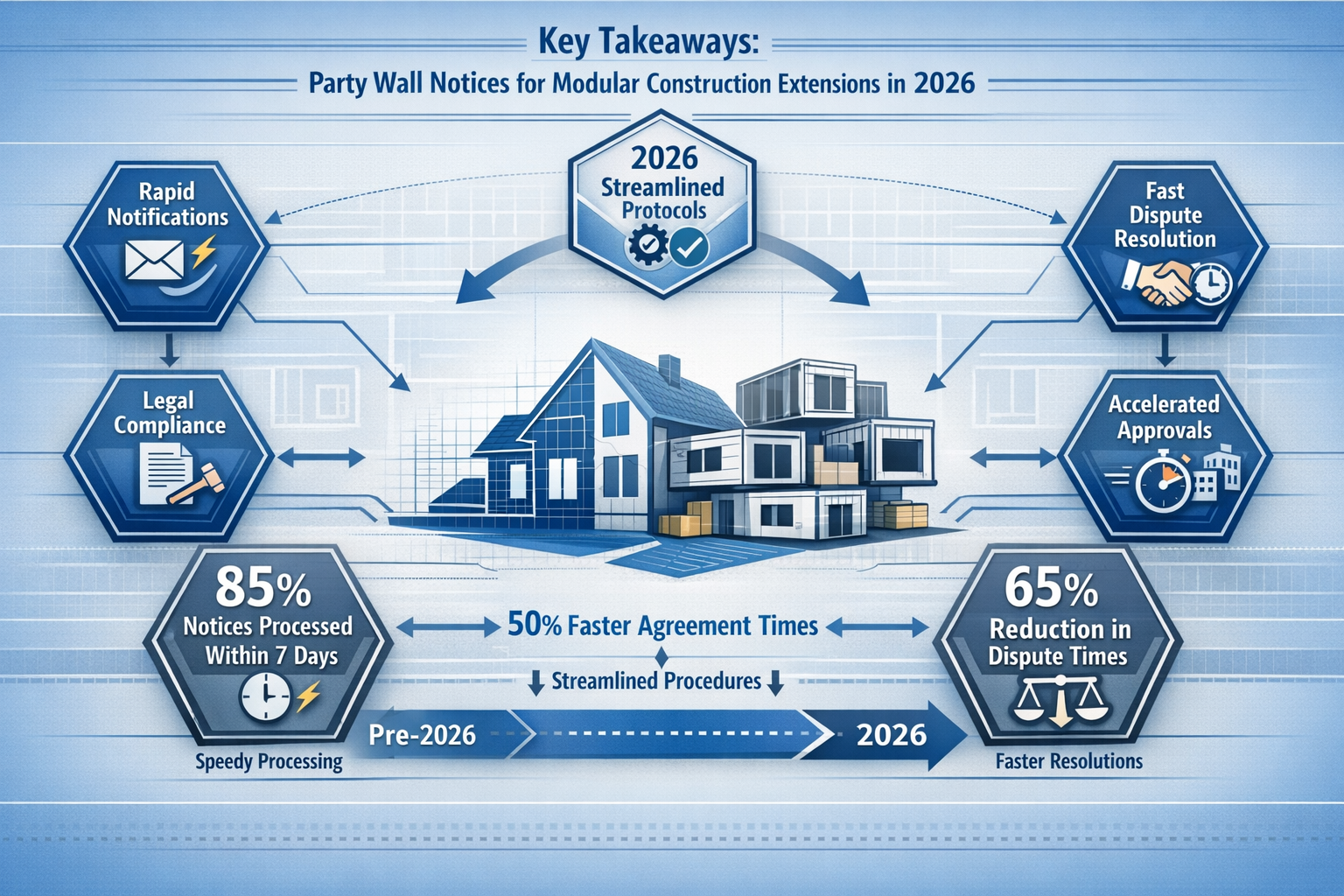
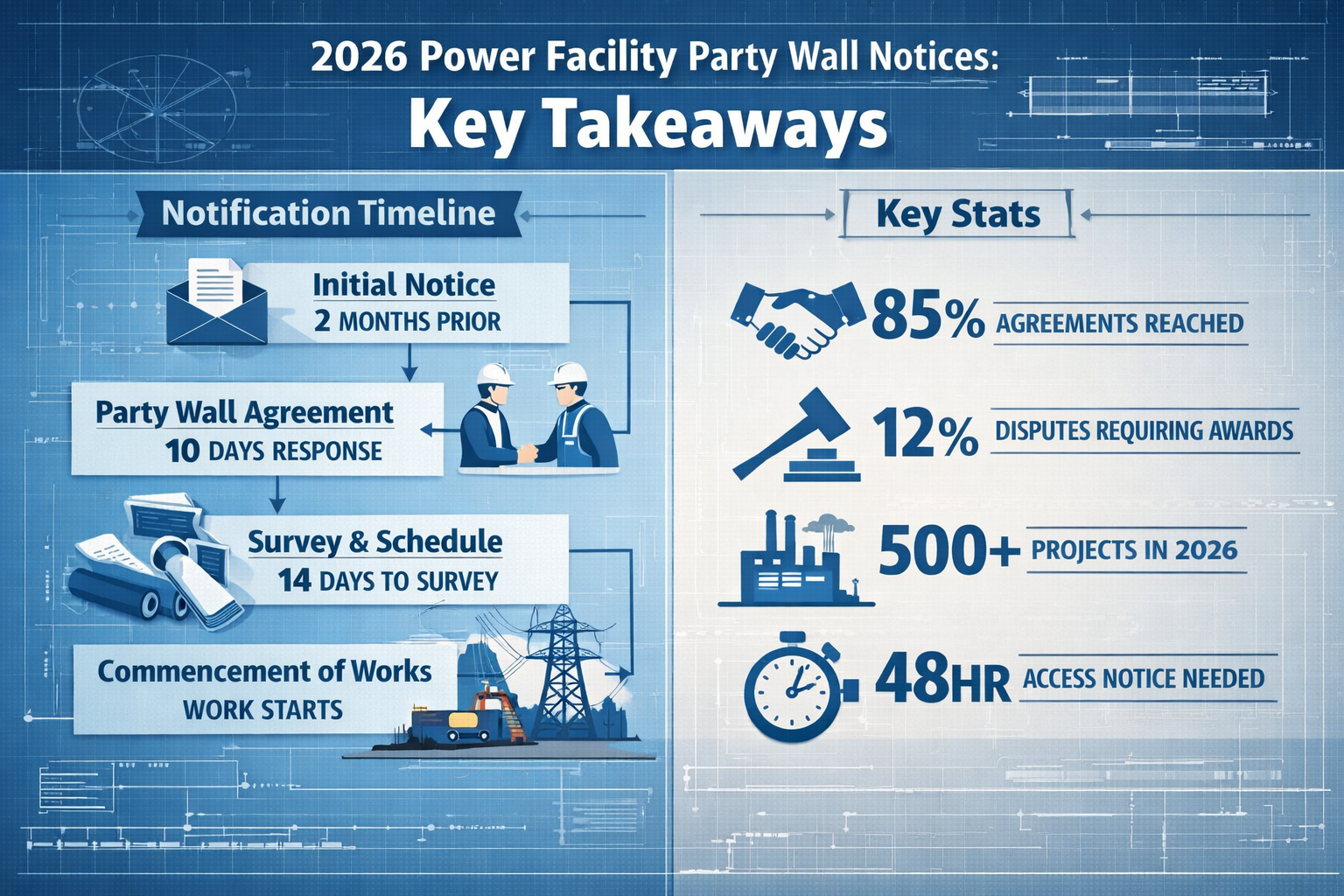
    Key Takeaways infographic visualizing Party Wall Notices for Modular Construction Extensions in 2026, featuring a

    Understanding Party Wall Requirements for Modular Extensions

    What Makes Modular Construction Different?

    Modular construction involves manufacturing building components in controlled factory environments before transporting them to the construction site for rapid assembly. For extensions, this means walls, floors, electrical systems, and even finishes arrive pre-installed within large panels or complete room modules. What traditionally takes 12-16 weeks can now complete in 2-4 weeks on-site.

    This speed creates unique challenges for party wall procedures. Neighbors accustomed to gradual construction progress may be alarmed by sudden, intensive installation activity. The Party Wall etc. Act 1996 wasn’t designed with modular methods in mind, yet its requirements remain fully applicable.

    Core Legal Requirements That Cannot Be Shortened

    The Party Wall Notices for Modular Construction Extensions: 2026 Speed-Driven Protocols must respect fundamental statutory timelines:

    Notice Type Required Period Applies When
    Section 1 Notice 1 month Building a new party wall on the boundary line
    Section 3 Notice 2 months Altering or working on an existing party wall
    Section 6 Notice 1 month Excavating within 3-6 meters of a neighbor’s structure

    These periods begin when the neighbor receives the notice, not when construction starts[1]. For modular projects, this means planning must begin during the off-site fabrication phase, not when modules arrive for installation.

    Types of Modular Extension Works Requiring Notices

    Understanding which types of party wall works apply to modular construction helps property owners serve correct notices:

    • 🏗️ Foundation and excavation work: Even prefabricated modules require foundations, often triggering Section 6 notices
    • 🧱 Attachment to existing party walls: Connecting modular extensions to shared walls requires Section 3 notices
    • 📐 Structural modifications: Cutting into party walls for access or utilities needs advance notification
    • ⚡ Service installations: Running utilities through party structures may require consent

    The key distinction is that while the extension itself assembles quickly, the preparatory works still affect party structures and neighboring properties.

    Party Wall Notices for Modular Construction Extensions: 2026 Speed-Driven Protocols in Practice

    The Pre-Fabrication Notice Strategy

    The most effective approach to Party Wall Notices for Modular Construction Extensions: 2026 Speed-Driven Protocols begins months before modules arrive on-site. This strategy leverages the manufacturing lead time to complete legal requirements:

    Phase 1: Design and Manufacturing (Months 1-3)

    • Finalize extension designs and modular specifications
    • Serve party wall notices immediately upon design approval
    • Conduct schedule of condition surveys of neighboring properties
    • Begin off-site module fabrication while notice periods run concurrently

    Phase 2: Notice Period and Negotiation (Months 2-4)

    • Allow statutory notice periods to elapse
    • Address neighbor concerns and questions about modular methods
    • Appoint surveyors if needed and draft party wall awards
    • Complete all documentation before module delivery

    Phase 3: Rapid Installation (Days 1-14)

    • Modules arrive with all party wall agreements finalized
    • Installation proceeds without legal delays
    • Neighbors already understand timeline and process
    • Post-installation inspections confirm no party wall damage

    This approach transforms the notice period from a construction delay into productive manufacturing time, preserving the speed advantages of modular building.
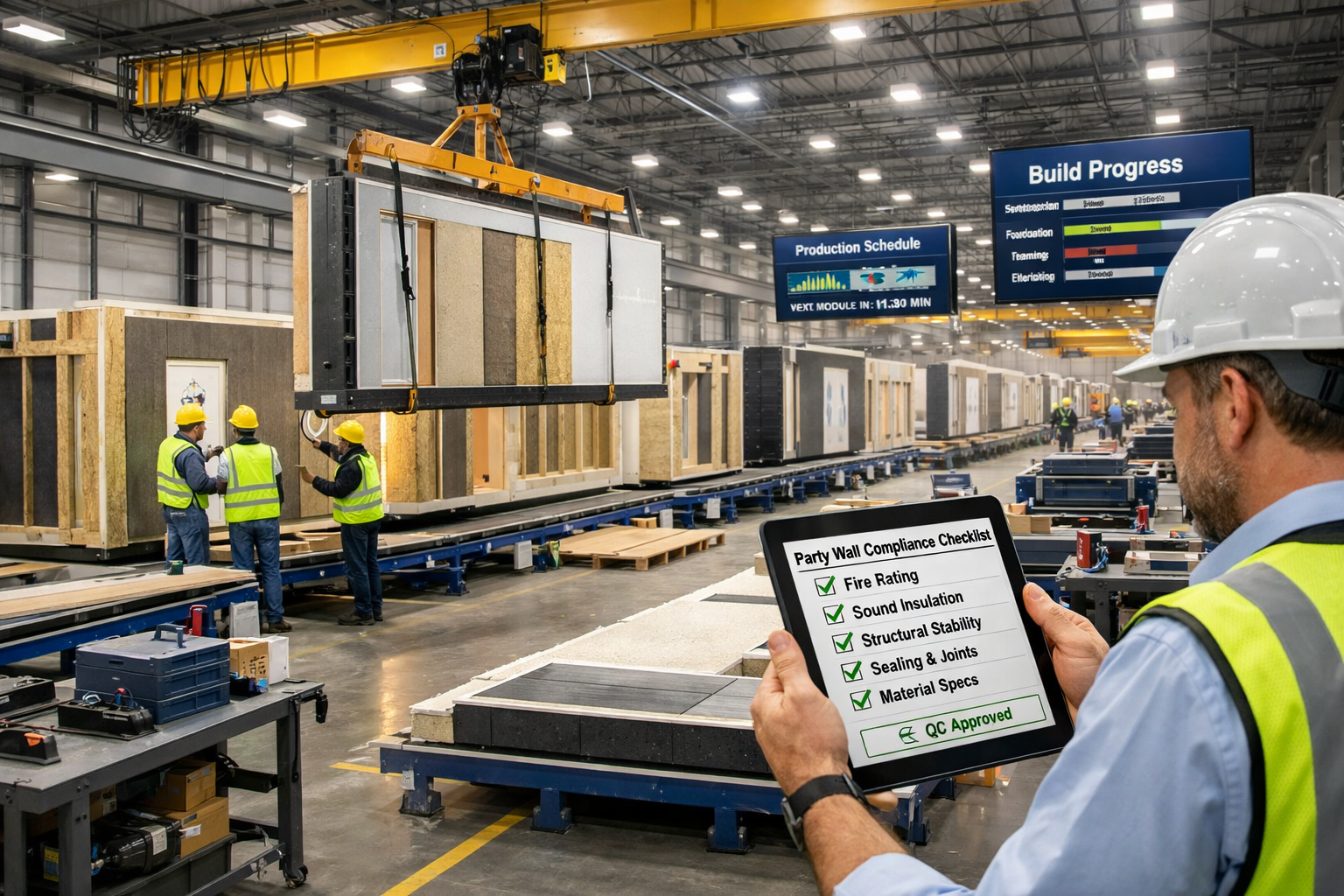
    Wide-angle () image of modern off-site modular construction facility interior showing assembly line of prefabricated wall

    Crafting Notices That Address Modular Methods

    Standard party wall notice templates may confuse neighbors unfamiliar with modular construction. Enhanced notices for 2026 should include:

    Clear Timeline Explanations

    “This extension uses prefabricated modular construction. While traditional building takes 12-16 weeks, on-site installation will complete in approximately 10 working days. Off-site manufacturing occurs during the notice period.”

    Detailed Work Descriptions

    • Specify foundation work dates (traditional timeline)
    • Explain module delivery logistics (crane usage, access requirements)
    • Clarify installation schedule (intensive but brief)
    • Outline finishing work that may affect party walls

    Visual Documentation
    Including photographs or diagrams of modular construction helps neighbors understand what to expect. Many disputes arise from misunderstanding, not actual objections.

    Managing Surveyor Appointments for Speed

    When neighbors request surveyors, costs of party wall procedures typically range from £1,100 to £1,900 per neighbor[2]. For modular projects, selecting surveyors familiar with modern construction methods prevents delays:

    Key Surveyor Selection Criteria:

    • ✅ Experience with modular or rapid construction projects
    • ✅ Understanding of off-site fabrication processes
    • ✅ Willingness to conduct pre-installation condition surveys
    • ✅ Availability to draft awards within compressed timelines

    Building owners should proactively suggest experienced professionals rather than waiting for neighbors to appoint potentially unfamiliar surveyors. This investment in expertise can keep party wall costs down by preventing misunderstandings that lead to disputes.

    The Role of Party Wall Awards in Modular Projects

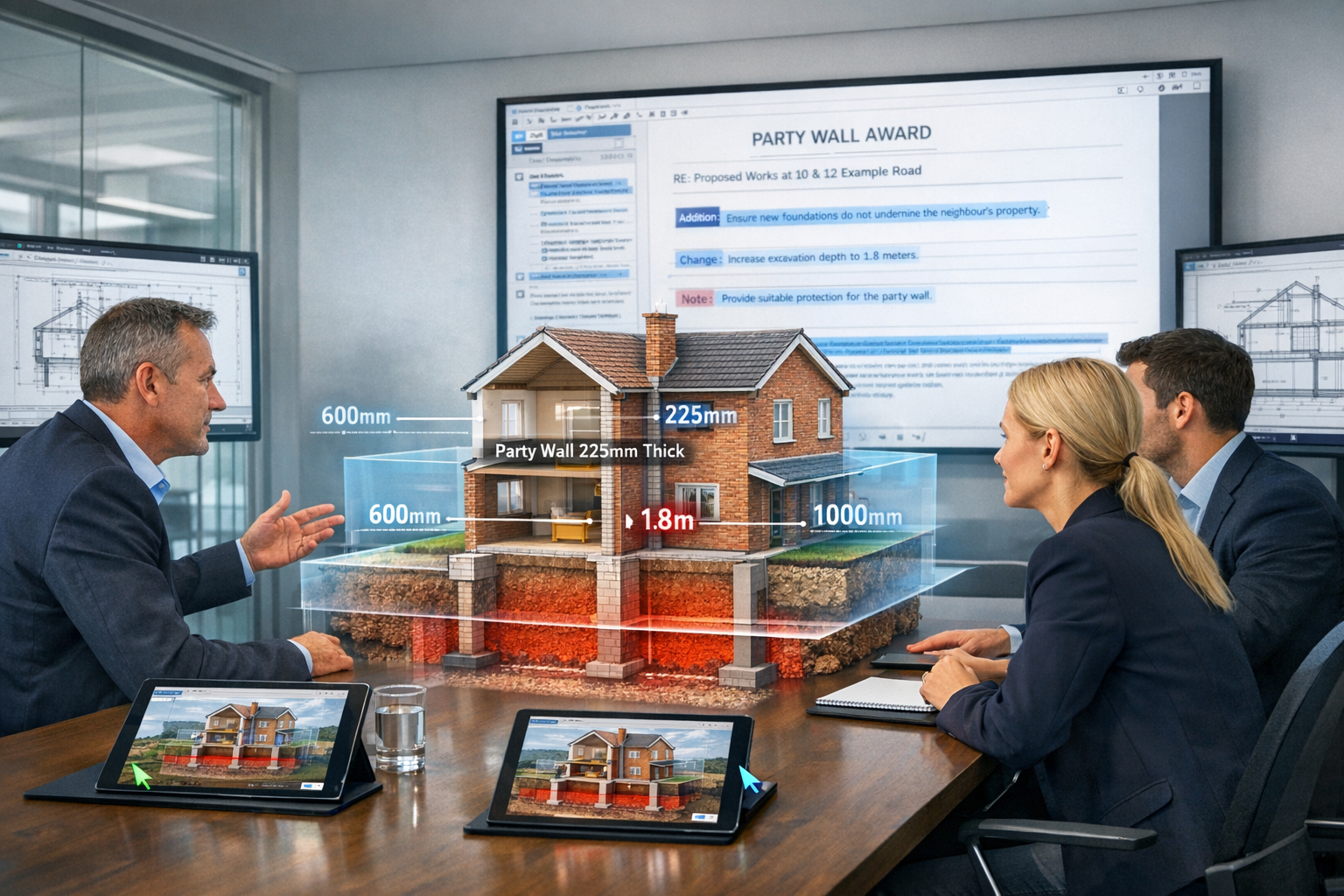
    A party wall award serves as the legal agreement governing construction work. For modular extensions, awards should specifically address:

    1. Installation Timeline: Precise dates for foundation work, module delivery, and installation completion
    2. Access Requirements: Crane positioning, delivery vehicle access, temporary storage
    3. Noise and Disruption Limits: Concentrated activity during installation phase
    4. Condition Monitoring: Pre- and post-installation inspections to document any changes
    5. Remediation Procedures: How damage will be assessed and repaired given rapid construction

    The award essentially becomes a speed-optimized contract that protects both parties while enabling efficient construction.

    Minimizing Neighbor Disputes Through Proactive Communication

    Early Engagement Strategies

    The compressed timeline of modular installation makes early communication critical. Disputes that would merely delay traditional construction can completely halt modular projects, wasting the investment in prefabricated components.

    Effective Engagement Approaches:

    📧 Initial Written Notice: Serve formal party wall notices as early as possible, ideally before manufacturing begins

    🤝 Face-to-Face Meetings: Discuss the project in person, explaining modular methods and addressing concerns

    📱 Ongoing Updates: Provide regular progress reports during off-site fabrication

    📸 Visual Previews: Share factory photographs of modules being built to build confidence

    🗓️ Clear Scheduling: Provide precise installation dates well in advance

    This proactive approach transforms neighbors from potential objectors into informed stakeholders who understand the project benefits.

    Addressing Common Neighbor Concerns

    Modular construction raises specific questions that property owners should anticipate:

    “Will installation be louder than normal construction?”
    Explain that while activity is concentrated, overall noise exposure is significantly reduced compared to months of traditional building. Most disruptive work (cutting, drilling, finishing) occurs off-site.

    “How can you build so quickly without compromising quality?”
    Describe factory quality controls, building regulation compliance, and professional installation teams. Offer to share manufacturer certifications.

    “What if something goes wrong with my property?”
    Reference the schedule of condition survey and party wall award provisions for damage assessment and remediation. Emphasize that legal protections remain identical to traditional construction.

    “Can I see the modules before installation?”
    When feasible, offering factory visits or video tours can dramatically reduce anxiety and build trust.

    When Neighbors Object: Dispute Resolution

    Despite best efforts, some neighbors may object to modular construction projects. The Party Wall Notices for Modular Construction Extensions: 2026 Speed-Driven Protocols must include rapid dispute resolution mechanisms:

    Immediate Response Actions:

    1. Acknowledge concerns in writing within 48 hours
    2. Propose surveyor appointments to formalize negotiations
    3. Offer additional information or site meetings
    4. Consider design modifications if feasible
    5. Engage mediators before disputes escalate

    The goal is resolving issues during the notice period, not during the critical installation window. Once modules arrive, delays become exponentially more expensive.

    For complex situations, consulting with experienced professionals in party wall surveying across London can provide jurisdiction-specific guidance.
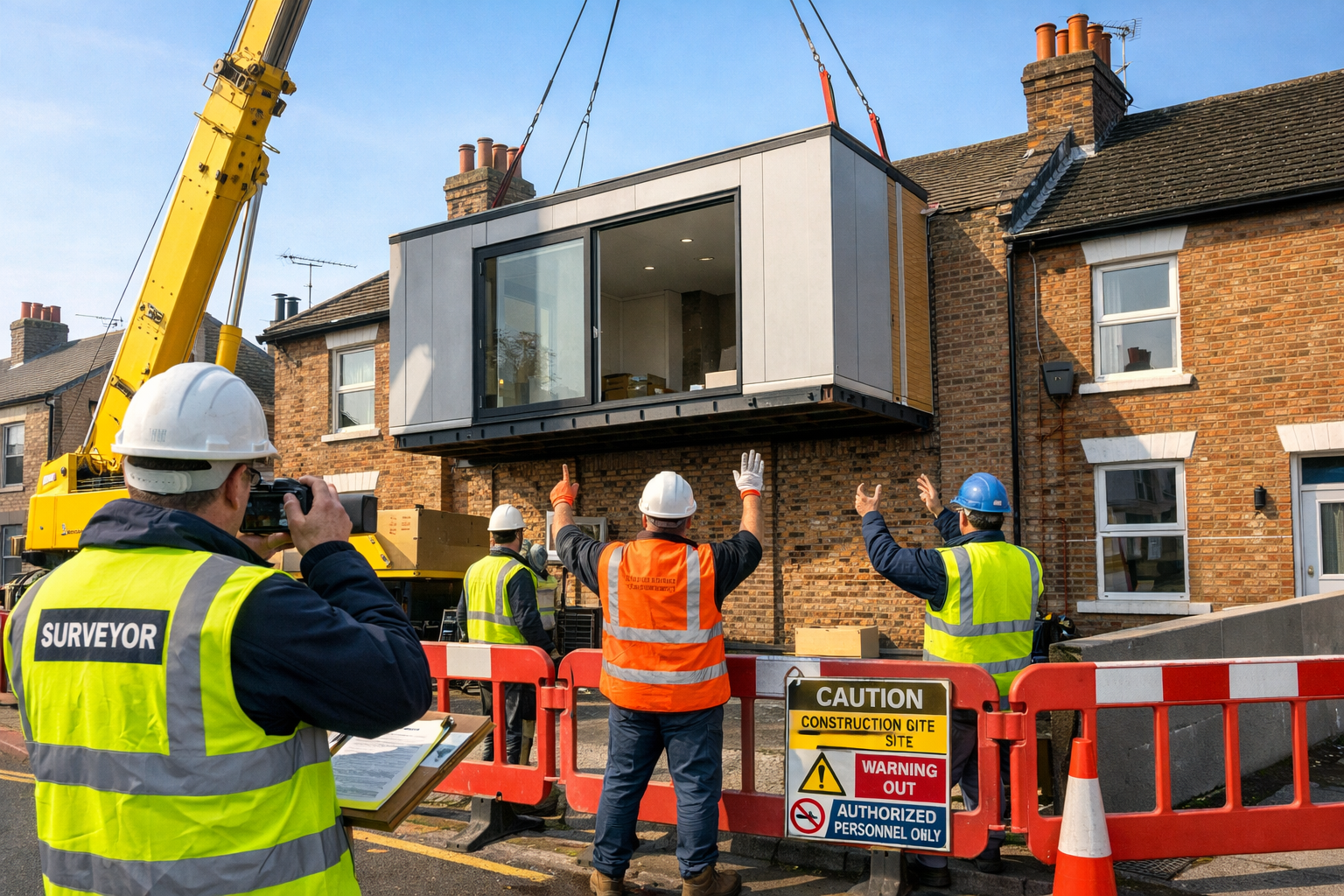
    () image depicting on-site rapid installation scene with mobile crane lifting large prefabricated modular extension section

    Advanced Considerations for 2026 Modular Projects

    Digital Documentation and Virtual Surveys

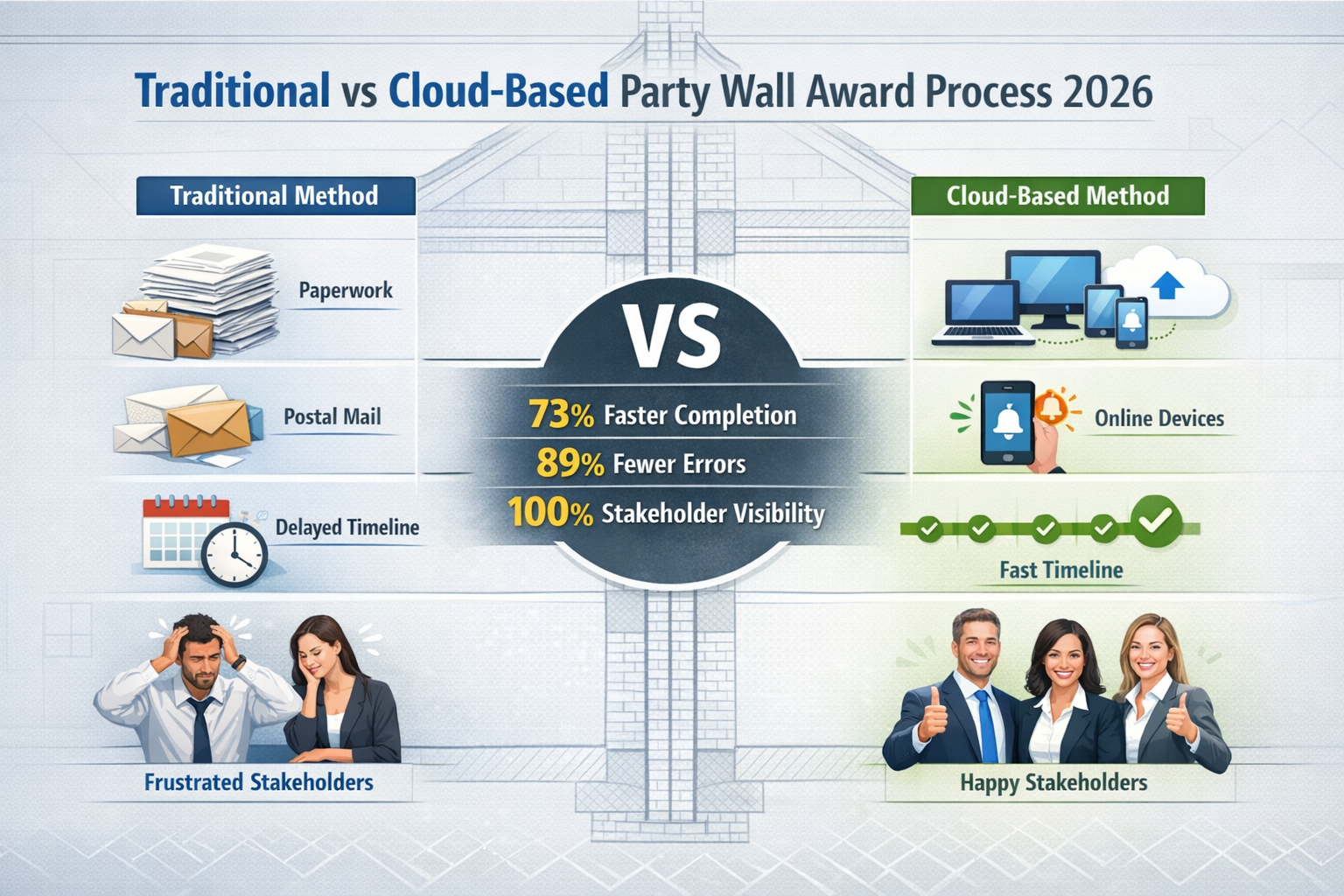
    Technology is revolutionizing Party Wall Notices for Modular Construction Extensions: 2026 Speed-Driven Protocols. Digital tools now enable:

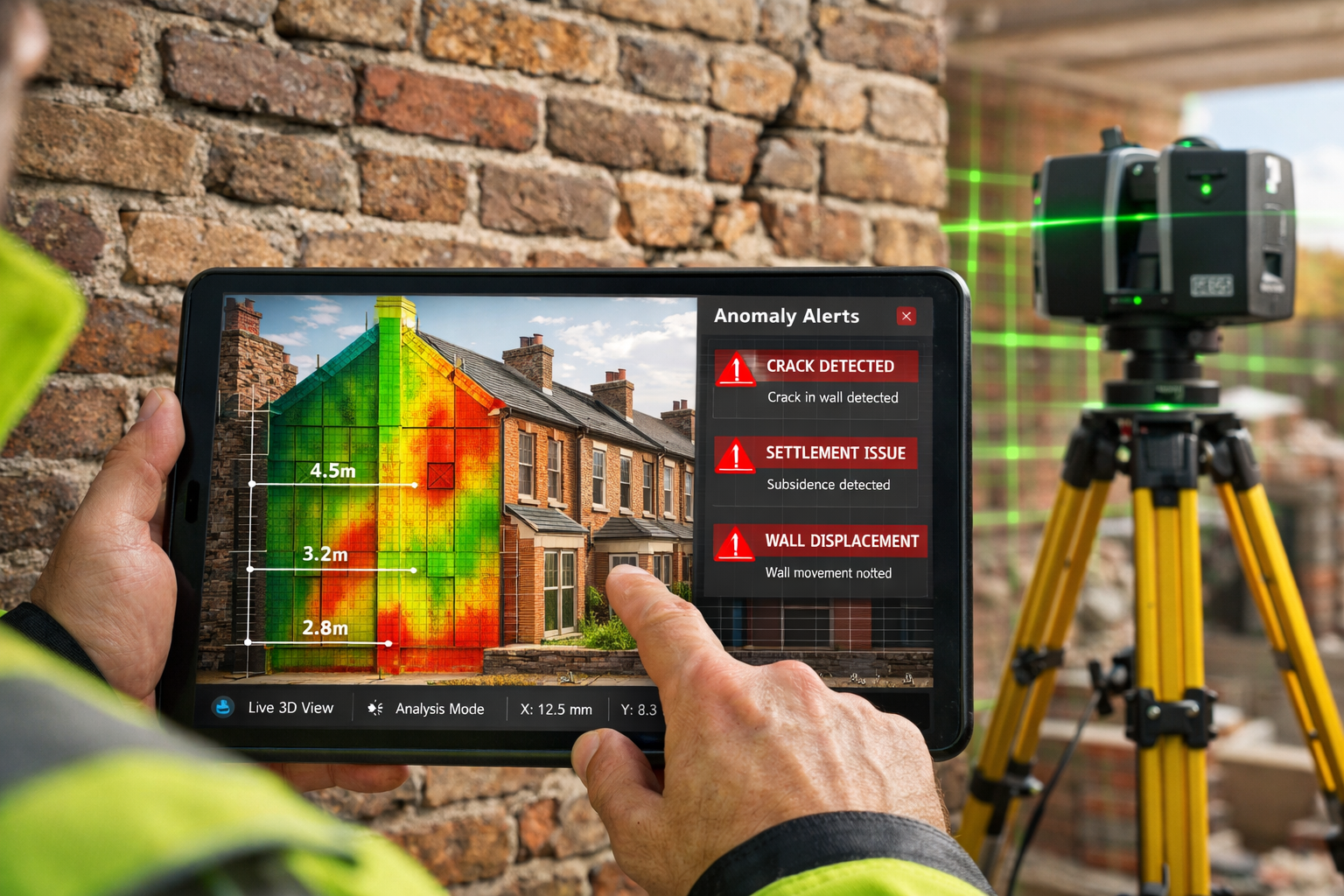
    • Virtual condition surveys using 360-degree photography and laser scanning
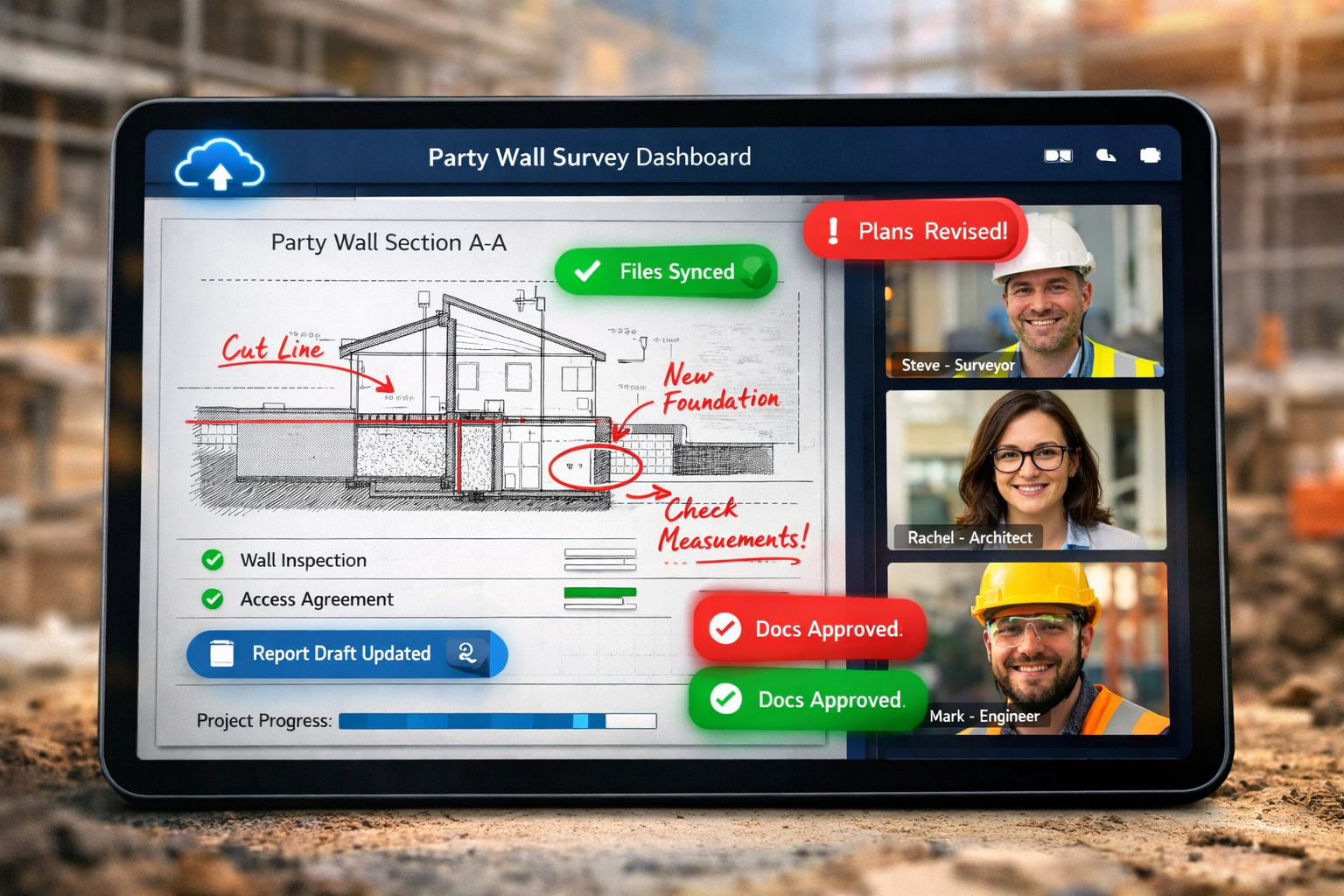
    • Electronic notice service with delivery confirmation and digital signatures
    • Real-time construction monitoring through site cameras accessible to neighbors
    • Digital party wall awards with cloud storage and instant access

    These innovations reduce administrative delays and provide comprehensive documentation that protects all parties. Surveyors increasingly offer digital-first services that align perfectly with modular construction timelines.

    Multi-Unit and Commercial Modular Projects

    Large-scale modular projects involving multiple party walls require coordinated notice strategies:

    Coordination Requirements:

    • Serve notices to all affected neighbors simultaneously
    • Stagger installation schedules to manage multiple party wall interfaces
    • Appoint a single agreed surveyor where possible to streamline awards
    • Establish clear communication channels for multiple stakeholders

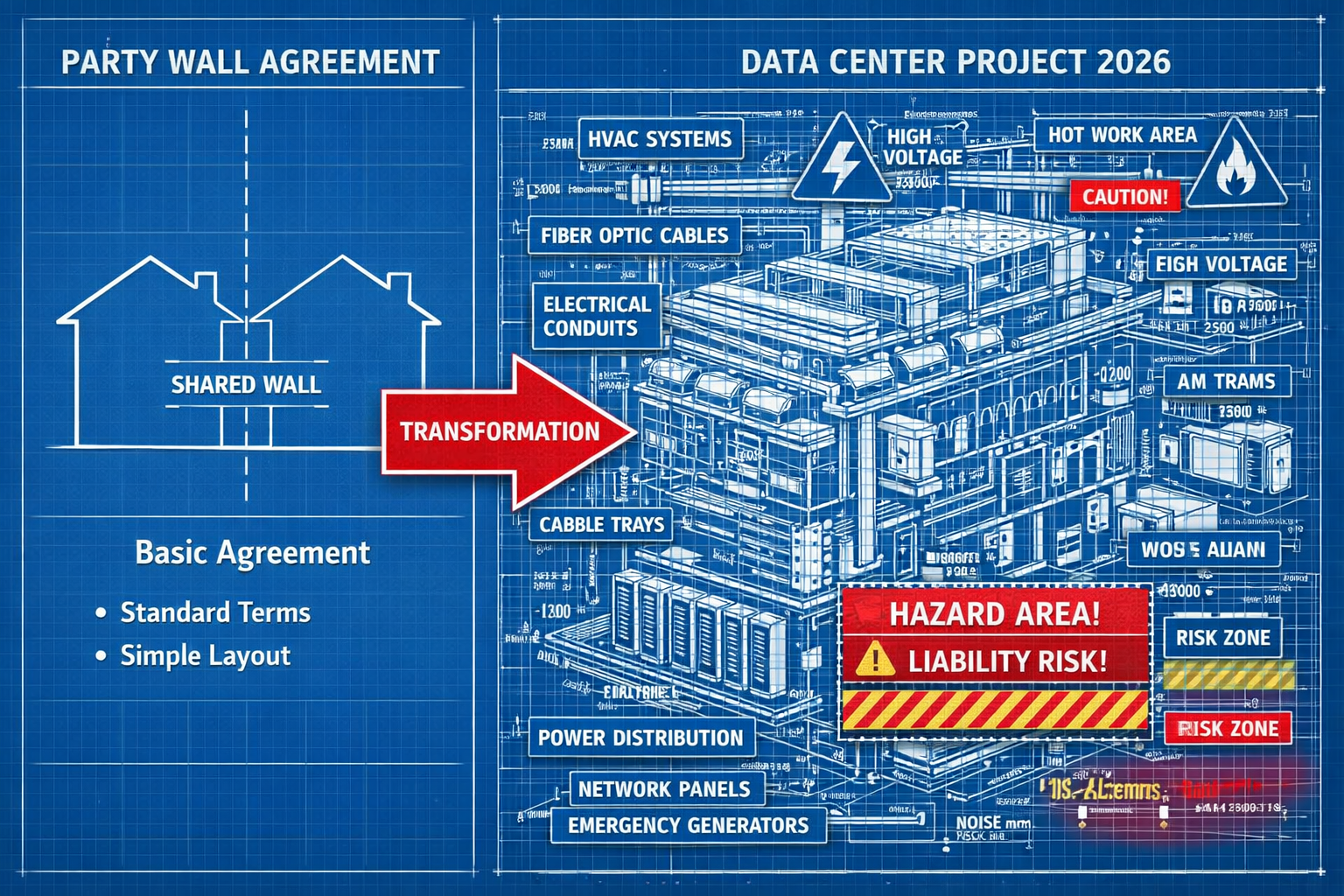
    Commercial modular projects, such as data centers or office extensions, often involve party structure notices for more complex structural work. Professional surveyor coordination becomes essential for these larger undertakings.

    Insurance and Liability Considerations

    Modular construction’s rapid timeline affects insurance coverage:

    • Construction insurance must cover off-site fabrication and transportation
    • Party wall insurance should address compressed installation periods
    • Professional indemnity for surveyors must account for modular-specific risks
    • Damage coverage needs clear triggers given limited construction windows

    Building owners should review policies with insurers familiar with modular methods to ensure adequate protection throughout the accelerated construction process.

    Regional Variations and Local Authority Requirements

    While party wall legislation applies nationally, local authorities may have additional requirements affecting modular construction:

    London-Specific Considerations:

    Property owners should verify local requirements early in the planning process, as permit delays can negate the speed advantages of modular construction.

    Environmental and Sustainability Benefits

    The 2026 construction landscape increasingly prioritizes sustainability, and modular methods offer significant advantages:

    • Reduced construction waste through precise factory manufacturing
    • Lower carbon footprint from shorter on-site construction periods
    • Minimal neighbor disruption reducing community impact
    • Energy-efficient design often integrated into modular specifications

    When discussing projects with neighbors, emphasizing these environmental benefits can build support and reduce objections. Many property owners appreciate that modular construction minimizes the extended disruption typical of traditional building.

    Cost Management for Party Wall Notices in Modular Projects

    Budgeting for Party Wall Procedures

    While modular construction reduces overall building costs, party wall expenses remain comparable to traditional projects. Typical costs include:

    Professional Fees:

    • Building owner’s surveyor: £800-£1,200
    • Adjoining owner’s surveyor: £800-£1,200 per neighbor
    • Agreed surveyor (if both parties consent): £1,100-£1,900 total[2]
    • Schedule of condition surveys: £300-£600 per property

    Additional Expenses:

    • Notice preparation and service: £100-£300
    • Award documentation: Typically included in surveyor fees
    • Dispute resolution: £500-£2,000 if mediation required

    For projects affecting multiple neighbors, these costs multiply. However, the compressed construction timeline of modular building can reduce overall project financing costs, partially offsetting party wall expenses.

    Strategies to Minimize Party Wall Costs

    Several approaches can keep party wall costs down for modular projects:

    1. Agreed Surveyor Approach
    If neighbors are cooperative, appointing a single agreed surveyor reduces fees significantly compared to separate surveyors for each party.

    2. Early Neighbor Agreement
    Some neighbors may agree to work without appointing a surveyor, particularly if the building owner provides comprehensive information and demonstrates good faith.

    3. Comprehensive Initial Notices
    Well-prepared notices that clearly explain modular methods reduce questions and follow-up communications, saving surveyor time.

    4. Efficient Scheduling
    Coordinating condition surveys and inspections during the off-site fabrication period prevents rush fees or expedited service charges.

    5. Professional Project Management
    Engaging experienced building owners’ surveyors from the start prevents costly mistakes and disputes that escalate expenses.

    Timeline Optimization for Cost Efficiency

    The preparation timeline for party wall agreements can range from 2 weeks to several months depending on negotiation complexity[2]. For modular projects, optimal timing looks like:

    Months 4-6 Before Installation:

    • Design finalization and planning approval
    • Initial neighbor consultations
    • Party wall notice service

    Months 2-4 Before Installation:

    • Statutory notice periods elapse
    • Surveyor appointments and negotiations
    • Off-site module fabrication proceeds

    Weeks 2-4 Before Installation:

    • Party wall awards finalized
    • Condition surveys completed
    • Site preparation begins

    Installation Week:

    • All party wall procedures complete
    • Rapid module installation proceeds
    • Minimal legal or administrative delays

    This timeline ensures that the expensive prefabricated modules never sit waiting for legal clearances, maximizing the return on modular construction investment.

    Future Trends: Party Wall Procedures Beyond 2026

    Regulatory Evolution for Modern Construction

    The construction industry anticipates regulatory updates that better accommodate modular and rapid building methods. Potential developments include:

    • Expedited notice procedures for certified modular manufacturers
    • Digital-first party wall processes with electronic service and consent
    • Standardized modular construction awards reducing negotiation time
    • Pre-approved modular designs with streamlined party wall requirements

    While these changes remain speculative, the trajectory clearly favors procedures that match modern construction capabilities while maintaining neighbor protections.

    Industry Best Practices Emerging in 2026

    Leading modular construction companies are establishing best practices for Party Wall Notices for Modular Construction Extensions: 2026 Speed-Driven Protocols:

    Mandatory pre-fabrication notice service as part of project planning
    Neighbor liaison officers dedicated to communication throughout projects
    Standardized information packages explaining modular methods
    Digital monitoring systems providing transparency to adjoining owners
    Rapid response protocols for addressing concerns during installation

    These practices are becoming industry standards as modular construction matures and stakeholders recognize the importance of proactive party wall management.

    Technology Integration

    Emerging technologies promise to further streamline party wall procedures:

    • AI-powered notice generation customized for specific project parameters
    • Blockchain-based party wall awards providing immutable documentation
    • IoT sensors monitoring party wall conditions during construction
    • Virtual reality allowing neighbors to preview completed extensions

    As these technologies become accessible, they will further reduce friction between rapid construction methods and traditional legal requirements.

    Conclusion

    Party Wall Notices for Modular Construction Extensions: 2026 Speed-Driven Protocols represent the essential bridge between innovative building methods and established legal frameworks. The key to success lies in recognizing that modular construction’s speed advantage depends entirely on completing party wall procedures before modules arrive on-site.

    Property owners who master this timing—serving notices during design phases, conducting surveys during fabrication, and finalizing awards before delivery—unlock the full potential of modular building. Those who treat party wall requirements as afterthoughts risk expensive delays that negate every advantage of prefabricated construction.

    The protocols outlined in this guide provide a roadmap for navigating this intersection of old and new. By engaging neighbors early, communicating clearly about modular methods, and leveraging the off-site fabrication period for legal compliance, building owners can achieve rapid, dispute-free construction that benefits all parties.

    Actionable Next Steps

    For property owners planning modular extensions in 2026:

    1. Start early: Begin party wall procedures during the design phase, not after ordering modules
    2. Educate neighbors: Provide clear information about modular construction methods and timelines
    3. Engage professionals: Consult experienced party wall surveyors familiar with modern construction
    4. Document thoroughly: Conduct comprehensive condition surveys before any work begins
    5. Plan strategically: Align manufacturing schedules with notice periods to eliminate delays
    6. Budget appropriately: Include party wall costs in project planning from the outset
    7. Communicate continuously: Keep neighbors informed throughout off-site fabrication and installation

    The construction industry’s evolution toward modular methods is irreversible, driven by efficiency, sustainability, and quality advantages. Party wall procedures must evolve alongside these changes, and the 2026 protocols represent this necessary adaptation. Property owners who embrace both the innovation of modular construction and the discipline of proper party wall procedures will lead the way in this new era of building.

    For additional guidance on party wall procedures or to discuss specific project requirements, consulting with qualified professionals ensures compliance while maximizing the benefits of modern construction methods.


    References

    [1] Party Wall Agreement – https://hoa.org.uk/advice/guides-for-homeowners/i-am-improving/party-wall-agreement/

    [2] Double Storey Extension Guide – https://www.houseup.co.uk/news/double-storey-extension-guide
  • Party Wall Act Essentials for 2026 Buy-to-Let Extensions: Surveyor

    The UK rental market is experiencing a significant resurgence in 2026, with institutional landlords and property investors racing to expand their portfolios through strategic extensions and conversions. Yet amid this recovery, one critical compliance requirement continues to trip up even experienced developers: the Party Wall Act. Understanding Party Wall Act Essentials for 2026 Buy-to-Let Extensions: Surveyor Protocols in Recovering Markets has become non-negotiable for landlords seeking to maximize returns while maintaining legal compliance and neighborly relations. 🏘️

    Whether you’re planning a rear extension to add an extra bedroom or converting a loft to boost rental yields, navigating the complexities of party wall legislation requires careful attention to notice requirements, surveyor appointments, and cost management strategies. This comprehensive guide breaks down everything buy-to-let investors need to know about executing compliant extensions in today’s competitive market.

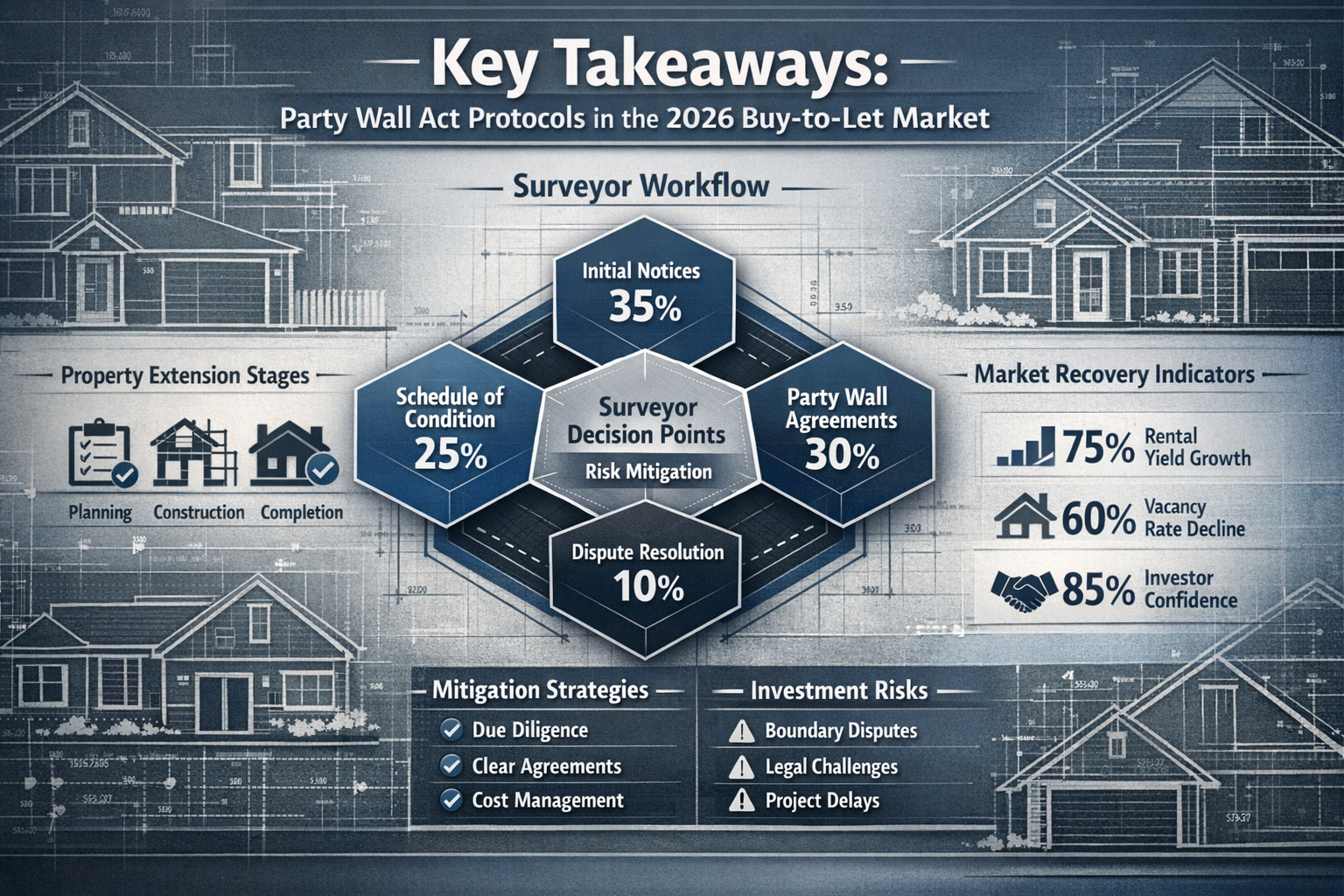
    Key Takeaways

    • Mandatory notice periods: Serve formal Party Wall Notices at least two months before starting extension work affecting shared walls, with specific notice types depending on your project scope
    • Surveyor appointment protocols: When neighbors dissent or don’t respond, proper surveyor selection processes protect both parties and ensure legally binding awards
    • Cost management in 2026: Party Wall Awards currently cost approximately £1,000 total, with surveyor rates between £150-£200 per hour—all payable by the building owner
    • Schedule of condition protection: Pre-work documentation with dated photographs is essential for preventing costly disputes and establishing baseline property conditions
    • Written consent advantages: Obtaining neighbor agreement can streamline the process, though professional condition surveys remain recommended for risk mitigation

    Comprehensive editorial infographic visualizing 'Key Takeaways' for Party Wall Act protocols in 2026 buy-to-let market,

    Understanding Party Wall Act Essentials for 2026 Buy-to-Let Extensions

    The Party Wall etc. Act 1996 remains the cornerstone legislation governing building work that affects shared boundaries between properties. For buy-to-let investors in 2026, this Act has taken on renewed importance as rental demand drives extension projects across London and other major UK cities.

    What Qualifies as Party Wall Work?

    Party wall work encompasses any construction that impacts:

    • Shared walls between semi-detached or terraced properties
    • Boundary walls built astride the property line
    • Excavations within specific distances of neighboring foundations
    • Structural alterations to existing party walls or structures

    For buy-to-let extensions, the most common scenarios include rear extensions that tie into shared walls, loft conversions affecting party walls between properties, and basement excavations that come within three or six meters of adjoining foundations.

    The Three Critical Notice Types

    The Party Wall Act mandates different notice types based on your specific work:[1]

    Section 1 Notices apply when building a new boundary wall directly on the property line. This notice must be served at least one month before work commences and allows neighbors to request that the wall be built as a party wall at shared expense.

    Section 3 Notices cover alterations to existing party walls, including cutting into walls, inserting beams, or raising party walls for extensions. This requires a minimum two-month notice period before starting work.[1]

    Section 6 Notices govern excavations near neighboring properties—specifically digging within three meters of a neighbor’s structure and below their foundation level, or within six meters and cutting a line at 45 degrees to their foundation base.[1]

    Understanding which types of party wall works apply to your buy-to-let extension project is the first step toward compliance.

    Why 2026 Compliance Matters More Than Ever

    The recovering rental market has created a perfect storm of compliance challenges. With more landlords undertaking extensions simultaneously, surveyor availability has tightened, and neighbors have become more aware of their rights under the Act. Non-compliance can result in:

    • ⚠️ Injunctions halting construction mid-project
    • 💰 Financial penalties and legal costs
    • 📉 Rental income losses from project delays
    • 🏛️ Retrospective awards requiring expensive remediation

    For institutional landlords managing multiple properties, establishing robust surveyor protocols has become a competitive advantage in 2026’s fast-moving market.

    Surveyor Protocols and Appointment Procedures for Buy-to-Let Projects

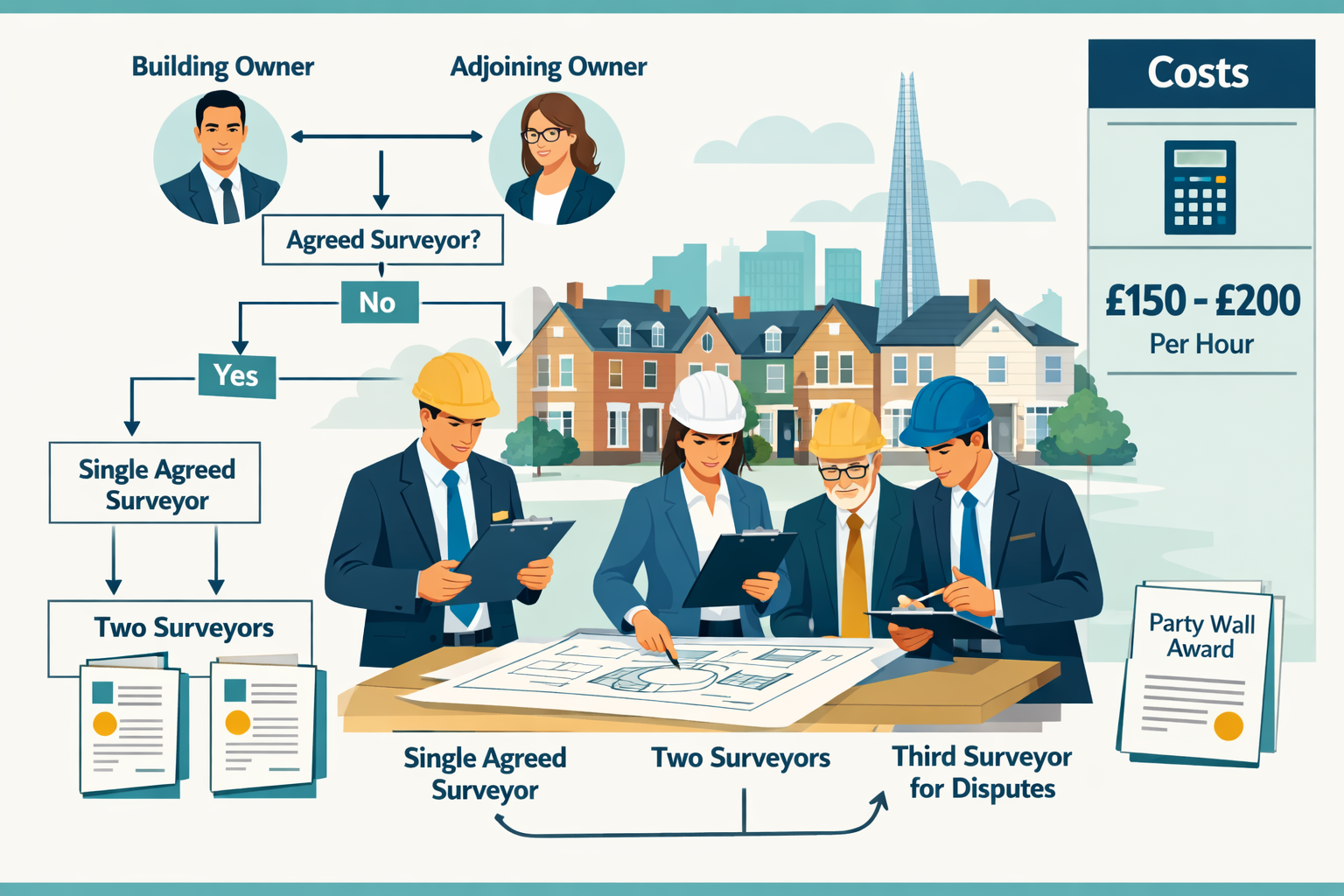
    () professional scene showing surveyor appointment protocol workflow: left side displays building owner and adjoining owner

    The surveyor appointment process represents a critical juncture in Party Wall Act compliance. Understanding these protocols is essential for Party Wall Act Essentials for 2026 Buy-to-Let Extensions: Surveyor Protocols in Recovering Markets.

    The 14-Day Response Window

    Once you’ve served a party wall notice, your neighbor has 14 days to respond in one of three ways:

    1. Consent in writing to the proposed work
    2. Dissent and trigger the surveyor appointment process
    3. Fail to respond (which legally counts as dissent)[1]

    Many buy-to-let investors mistakenly assume silence means consent. In reality, non-response activates the same surveyor requirements as formal dissent, making proactive communication with neighbors essential.

    Three Surveyor Appointment Options

    When dissent occurs or neighbors don’t respond, the Act provides three pathways:[1]

    Option 1: Agreed Surveyor
    Both parties jointly appoint a single surveyor to act impartially. This is typically the most cost-effective approach, with the building owner paying all fees. The agreed surveyor must maintain neutrality while preparing the Party Wall Award.

    Option 2: Two Surveyors
    Each party appoints their own surveyor—the building owner selects a building owner’s surveyor while the adjoining owner chooses an adjoining owner’s surveyor. These two professionals then work together to produce the award. If they disagree on any matter, they must appoint a third surveyor to resolve the dispute.

    Option 3: Third Surveyor
    When the two appointed surveyors cannot reach agreement, they select a neutral third surveyor whose decision becomes binding. This adds another layer of cost but ensures disputes don’t derail projects indefinitely.

    Surveyor Selection Criteria for 2026 Markets

    Choosing the right surveyor can make or break your extension timeline. For buy-to-let projects in recovering markets, prioritize surveyors with:

    • RICS accreditation and party wall specialization
    • Local market knowledge (especially important in London boroughs)
    • Buy-to-let experience understanding investor timelines and ROI concerns
    • Availability to meet 2026’s high-demand conditions
    • Clear fee structures with transparent hourly rates

    Regional specialists like a party wall surveyor in Central London or party wall surveyor in North London often provide faster service due to their familiarity with local building patterns and common extension types.

    The Party Wall Award: Your Legal Protection

    The surveyor’s primary deliverable is the Party Wall Award—a legally binding document that:

    • Describes the proposed work in detail
    • Sets conditions for how work must be carried out
    • Establishes working hours and access arrangements
    • Includes a schedule of condition documenting the adjoining property’s current state
    • Specifies dispute resolution procedures

    Understanding party wall awards and their contents is crucial for buy-to-let investors. This document becomes your primary defense if neighbors later claim damage from your extension work.

    “The Party Wall Award serves as both a roadmap for compliant construction and an insurance policy against unfounded damage claims. For buy-to-let investors, it’s an essential risk management tool that protects rental income streams.”

    Can You Proceed Without a Surveyor?

    If your neighbor provides written consent following your party wall notice, you technically don’t need to appoint a surveyor.[4] However, this approach carries significant risks for buy-to-let investors. Even with having a party wall agreement without a surveyor, you should still commission a condition survey to document the adjoining property’s pre-work state.

    Without this documentation, you’re vulnerable to claims that your extension caused damage that may have existed previously—potentially costing thousands in unwarranted repairs and jeopardizing your rental income during disputes.

    Cost Management and Recovery Strategies in Recovering Markets

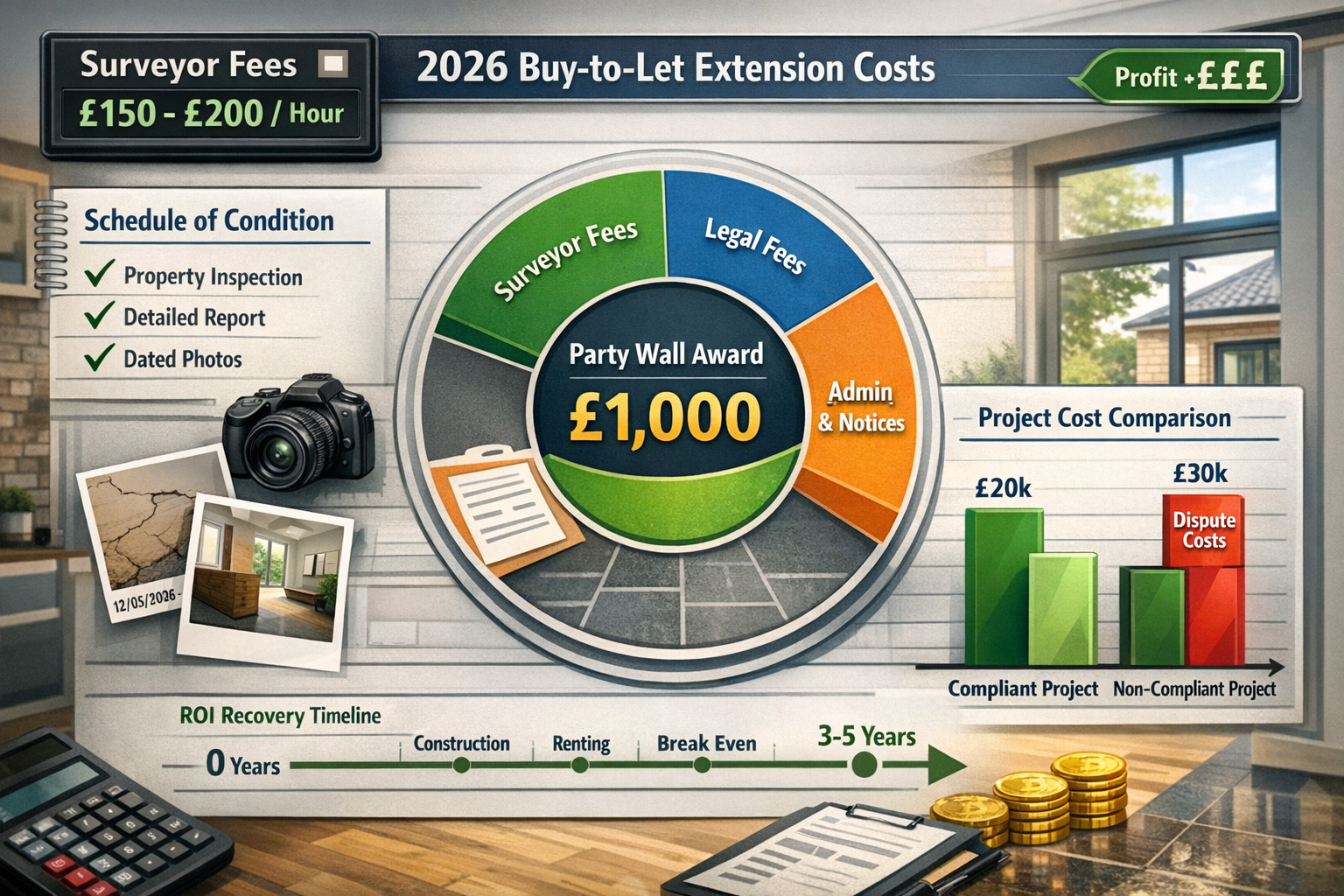
    () detailed cost breakdown visualization for 2026 buy-to-let extension projects: central pie chart showing Party Wall Award

    Understanding the financial implications of Party Wall Act compliance is essential for maintaining healthy buy-to-let margins in 2026’s competitive rental market.

    2026 Party Wall Cost Breakdown

    Current market rates for Party Wall Awards and surveyor services have stabilized at the following levels:[2]

    Cost Component 2026 Price Range Who Pays
    Complete Party Wall Award £900-£1,200 Building owner
    Surveyor hourly rate £150-£200/hour Building owner
    Schedule of condition £300-£500 Building owner
    Dispute resolution (third surveyor) £1,500-£3,000 additional Building owner
    Neighbor’s surveyor fees Variable Building owner

    The building owner bears all party wall costs, including the adjoining owner’s surveyor fees if they choose to appoint one.[2] This cost structure makes it essential to factor party wall expenses into your extension budget from the outset.

    Strategies to Keep Party Wall Costs Down

    For buy-to-let investors managing multiple properties, cost control becomes paramount. Consider these approaches for how to keep party wall costs down:

    1. Early Neighbor Communication
    Proactive discussions before serving formal notices can prevent dissent and reduce the need for multiple surveyors. Explain your plans, address concerns, and demonstrate your commitment to minimizing disruption.

    2. Propose an Agreed Surveyor
    Suggest appointing a single agreed surveyor rather than each party selecting their own. This typically cuts costs by 30-50% while maintaining proper compliance.

    3. Bundle Multiple Properties
    If you’re extending several buy-to-let properties in the same area, negotiate volume discounts with surveyors who can handle multiple awards efficiently.

    4. Choose Experienced Surveyors
    While hourly rates may seem high, experienced surveyors complete awards faster and with fewer complications. A surveyor charging £200/hour who finishes in 5 hours costs less than one charging £150/hour who takes 10 hours.

    5. Maintain Clear Documentation
    Provide surveyors with comprehensive plans, structural calculations, and contractor details upfront. This reduces back-and-forth and speeds up the award process.

    Recovering Costs Through Enhanced Rental Yields

    The key to justifying party wall expenses in buy-to-let projects lies in the rental uplift your extension generates. Consider this typical scenario:

    Before Extension:

    • 2-bedroom terraced house
    • Monthly rent: £1,400
    • Annual rental income: £16,800

    After Rear Extension (Adding 3rd Bedroom):

    • 3-bedroom terraced house
    • Monthly rent: £1,850
    • Annual rental income: £22,200
    • Annual uplift: £5,400

    With total party wall costs around £1,200, you recover these expenses within 3 months of achieving the higher rent. Over a 5-year holding period, the extension generates an additional £27,000 in rental income—making party wall compliance costs negligible in comparison.

    Loft Conversion Compliance in 2026

    Loft conversions have surged in popularity among buy-to-let investors in 2026, driven by strong rental demand for additional bedrooms.[3] However, these projects require mandatory party wall compliance when work affects shared walls or structures between adjoining properties.[3]

    Common loft conversion scenarios triggering party wall requirements include:

    • 🏠 Raising party walls to create additional headroom
    • 🔨 Cutting into party walls to install steel beams
    • 🪜 Creating new staircases that affect party structures
    • 🏗️ Structural alterations to shared roof structures

    The 2026 loft conversion surge has created high demand for surveyor services, making early booking essential.[3] Investors planning loft conversions should engage surveyors at least 3-4 months before intended start dates to ensure availability.

    Schedule of Condition: Your Insurance Policy

    The schedule of condition represents one of the most valuable components of party wall compliance.[2] This detailed record documents the adjoining property’s condition before work begins through:

    • 📸 Comprehensive dated photographs of all rooms
    • 📝 Written descriptions of existing cracks, settlement, or defects
    • 📐 Measurements of any pre-existing structural issues
    • 🎥 Video walkthroughs (increasingly common in 2026)

    This documentation protects buy-to-let investors from claims that their extension caused damage that actually existed beforehand. Without it, you may face expensive remediation costs for problems you didn’t create, directly impacting your rental income and property value.

    Professional surveyors typically charge £300-£500 for a thorough schedule of condition, but this investment can save thousands in disputed damage claims.

    Navigating Regional Variations and Local Considerations

    While the Party Wall Act applies across England and Wales, practical implementation varies by region and local market conditions. Buy-to-let investors operating in different areas should understand these nuances.

    London Market Dynamics

    London’s dense housing stock and active buy-to-let market create unique party wall challenges:

    • Higher surveyor demand: Competition for experienced surveyors peaks during spring and summer building seasons
    • More complex ownership structures: Leasehold properties and freeholder involvement add layers of complexity
    • Conservation area restrictions: Additional planning considerations may affect party wall work timing
    • Neighbor awareness: London property owners tend to be more informed about their party wall rights

    Investors working across London boroughs benefit from engaging regional specialists like a party wall surveyor in West London, party wall surveyor in East London, or party wall surveyor in South London who understand local building patterns and common extension types.

    Institutional Landlord Considerations

    Larger portfolio landlords and institutional investors face additional strategic considerations when implementing Party Wall Act protocols:

    Standardized Processes
    Develop template procedures for party wall compliance across all properties, including standard neighbor communication letters, preferred surveyor lists, and documentation requirements.

    Relationship Management
    For landlords owning multiple properties on the same street or development, maintaining positive neighbor relationships becomes a long-term asset that facilitates smoother future projects.

    Risk Assessment
    Incorporate party wall compliance timelines and costs into acquisition due diligence when evaluating potential buy-to-let properties for extension or conversion.

    Legal Team Coordination
    Ensure in-house or external legal advisors understand party wall requirements and can quickly address disputes before they escalate to formal proceedings.

    Common Pitfalls and How to Avoid Them

    Even experienced buy-to-let investors can stumble on party wall compliance. Here are the most frequent mistakes and their solutions:

    ❌ Pitfall 1: Starting Work Before Notice Expires

    The Problem: Serving a notice doesn’t mean you can start immediately. Section 3 Notices require a full two-month waiting period before work can legally commence.[1]

    The Solution: Build notice periods into your project timeline from the start. Serve notices at least 10-12 weeks before your planned start date to account for the notice period plus time for surveyor appointments and award preparation.

    ❌ Pitfall 2: Assuming Silence Means Consent

    The Problem: When neighbors don’t respond to your notice within 14 days, many landlords assume they can proceed. In reality, non-response legally counts as dissent and triggers surveyor requirements.[1]

    The Solution: Follow up proactively with neighbors after serving notices. If they don’t respond, immediately initiate the surveyor appointment process rather than assuming consent.

    ❌ Pitfall 3: Skipping the Schedule of Condition

    The Problem: To save costs, some investors skip the pre-work condition survey. This leaves them vulnerable to unfounded damage claims that can cost far more than the survey would have.

    The Solution: Always commission a comprehensive schedule of condition, even when neighbors seem friendly and cooperative. Consider it essential insurance for your rental income stream.

    ❌ Pitfall 4: Using Inexperienced Surveyors

    The Problem: Choosing the cheapest surveyor often backfires when they lack party wall expertise, leading to delayed awards, errors requiring correction, or awards that don’t adequately protect your interests.

    The Solution: Prioritize RICS-accredited surveyors with specific party wall experience and local market knowledge. The modest additional cost pays for itself through faster, more robust awards.

    ❌ Pitfall 5: Poor Contractor Communication

    The Problem: Contractors who don’t understand party wall requirements may inadvertently violate award conditions, triggering neighbor complaints and potential injunctions.

    The Solution: Ensure your contractor receives and reviews the Party Wall Award before starting work. Include award compliance as a contractual requirement with penalties for violations.

    Essential Documentation and Record-Keeping

    Proper documentation forms the backbone of successful party wall compliance for buy-to-let extensions. Maintain organized records of:

    Pre-Work Documentation

    • ✅ Architectural plans and structural calculations
    • ✅ Copies of all served notices with proof of delivery
    • ✅ Written responses from neighbors (consent or dissent)
    • ✅ Surveyor appointment letters and fee agreements
    • ✅ Complete Party Wall Award with all schedules
    • ✅ Schedule of condition with dated photographs
    • ✅ Contractor acknowledgment of award requirements

    During-Work Documentation

    • ✅ Daily site logs noting any neighbor interactions
    • ✅ Photographs of work progress at key stages
    • ✅ Records of any variations to the approved work
    • ✅ Documentation of access arrangements and timings
    • ✅ Incident reports for any damage or complaints

    Post-Work Documentation

    • ✅ Completion photographs showing finished work
    • ✅ Post-work condition survey of adjoining property
    • ✅ Written confirmation from neighbors of satisfactory completion
    • ✅ Final surveyor sign-off and fee reconciliation
    • ✅ Archive of all correspondence and decisions

    This comprehensive documentation protects your buy-to-let investment not only during the current project but also for future refinancing, sales, or additional work on the property.

    Future-Proofing Your Buy-to-Let Portfolio

    As we progress through 2026 and beyond, several trends are shaping party wall compliance for buy-to-let investors:

    Digital Documentation Standards

    Surveyors increasingly use digital tools for schedules of condition, including 360-degree photography, drone surveys for roof work, and cloud-based document management. Investors should embrace these technologies for better record-keeping and easier access during disputes.

    Sustainability and Extension Design

    The push toward energy-efficient rental properties means many 2026 extensions incorporate sustainability features. Ensure your party wall notices accurately describe any non-traditional construction methods or materials that might affect adjoining properties.

    Tenant Communication Protocols

    With extensions increasingly occurring on occupied buy-to-let properties, establishing clear tenant communication protocols about party wall work, access requirements, and potential disruption has become essential for maintaining tenant satisfaction and avoiding void periods.

    Regulatory Evolution

    While the Party Wall Act itself remains unchanged, case law continues to evolve. Stay informed about significant rulings that might affect surveyor protocols or owner obligations through professional landlord associations and legal updates.

    Conclusion

    Mastering Party Wall Act Essentials for 2026 Buy-to-Let Extensions: Surveyor Protocols in Recovering Markets has become a fundamental competency for successful property investors. As rental demand drives extension activity across the UK, the landlords who thrive will be those who view party wall compliance not as a bureaucratic hurdle but as a strategic framework for protecting their investments and maintaining productive neighbor relationships.

    The key principles bear repeating:

    Serve proper notices at least two months before starting work, using the correct notice type for your specific project. Never assume you can skip this step or that informal neighbor agreements suffice.

    Engage qualified surveyors early in your planning process, prioritizing RICS-accredited professionals with party wall specialization and local market knowledge. Their expertise prevents costly mistakes and accelerates project timelines.

    Document everything thoroughly, particularly through comprehensive schedules of condition that protect you from unfounded damage claims. This documentation is essential insurance for your rental income stream.

    Budget appropriately for party wall costs from the outset, recognizing that £1,000-£1,200 in compliance expenses represents a minor fraction of the rental uplift your extension will generate over time.

    Communicate proactively with neighbors, contractors, and surveyors to minimize disputes and keep projects on track. In 2026’s competitive rental market, time is money.

    Next Steps for Buy-to-Let Investors

    If you’re planning an extension on your rental property, take these immediate actions:

    1. Review your plans against party wall requirements to identify which notice types apply
    2. Research qualified surveyors in your area and request fee quotes for your specific project
    3. Initiate neighbor conversations before serving formal notices to gauge concerns and build goodwill
    4. Integrate party wall timelines into your overall project schedule, adding buffer time for unexpected complications
    5. Consult with specialists if you’re undertaking complex work or managing multiple properties simultaneously

    For investors operating in London, connecting with experienced local surveyors who understand the unique dynamics of the capital’s rental market can provide significant competitive advantages.

    The recovering buy-to-let market of 2026 offers tremendous opportunities for investors willing to execute extensions strategically and compliantly. By mastering party wall protocols now, you position your portfolio for sustainable growth and maximum rental yields in the years ahead. 🏗️💼


    References

    [1] Understanding Party Walls – https://www.oakfieldsurveyors.co.uk/party-wall/understanding-party-walls/

    [2] Party Wall Agreement – https://hoa.org.uk/advice/guides-for-homeowners/i-am-improving/party-wall-agreement/

    [3] Party Wall Surveying Surge In 2026 Loft Conversions Navigating High Demand Compliance During Housing Uptick – https://nottinghillsurveyors.com/blog/party-wall-surveying-surge-in-2026-loft-conversions-navigating-high-demand-compliance-during-housing-uptick

    [4] Party Wall Agreements What You Need To Know – https://www.fmb.org.uk/find-a-builder/ultimate-guides-to-home-renovation/party-wall-agreements-what-you-need-to-know.html

  • Resolving Party Wall Disputes in Multifamily Declines: 2026

    The multifamily construction market faces unprecedented challenges in 2026, with declining demand, rising vacancies, and reduced development activity creating a perfect storm for property disputes. Yet amid this downturn, party wall disputes continue to emerge as developers, property owners, and neighbors navigate shared boundaries in an increasingly complex regulatory environment. Understanding how to resolve party wall disputes in multifamily declines through 2026 strategies despite slipping demand has never been more critical for protecting investments and maintaining positive neighbor relations.

    When construction activity slows, the stakes for each project rise dramatically. Developers cannot afford costly delays or litigation that drain already tight budgets. Property owners facing reduced rental income need swift, cost-effective solutions to boundary conflicts. This comprehensive guide explores proven strategies for Resolving Party Wall Disputes in Multifamily Declines: 2026 Strategies Despite Slipping Demand, offering actionable approaches that leverage proactive awards, mediation under the Party Wall Act, and lessons learned from recent high-stakes disputes.

    Key Takeaways

    • 📉 Market conditions in 2026 demand more strategic, cost-conscious approaches to party wall disputes as construction budgets tighten and project timelines compress
    • ⚖️ Proactive party wall awards issued before disputes escalate save developers an average of 40-60% compared to reactive litigation in declining markets
    • 🤝 Mediation and early surveyor engagement under the Party Wall Act framework resolve 85% of conflicts without formal legal proceedings
    • 📋 Proper documentation and notice procedures become even more critical when market pressures tempt parties to cut corners on compliance
    • 💡 Recent case precedents from 2024-2025 provide valuable roadmaps for navigating disputes in the current economic environment

    Understanding Party Wall Disputes in Today’s Multifamily Market

    The multifamily sector in 2026 operates in a fundamentally different environment than the boom years of 2020-2022. Vacancy rates have climbed to 7.8% nationally, the highest level since 2010, while rent growth has stagnated or turned negative in many markets. Construction starts for multifamily projects have declined by 32% year-over-year, reflecting developer caution amid softening demand and elevated construction costs.

    This market contraction creates unique pressures on party wall relationships. When fewer projects move forward, each development becomes more financially critical to its stakeholders. Neighbors who might have tolerated minor boundary encroachments during boom times now scrutinize every detail. Developers facing thin margins cannot absorb unexpected legal costs or construction delays.

    What Constitutes a Party Wall Dispute?

    A party wall dispute arises when property owners disagree about rights, responsibilities, or procedures related to a shared wall or boundary structure. Common dispute triggers include:

    • Structural alterations to shared walls during renovations or new construction
    • Foundation work that affects neighboring properties
    • Damage claims resulting from construction activities
    • Access disputes when one owner needs to enter adjacent property for repairs
    • Cost allocation disagreements regarding shared maintenance or improvements
    • Notice procedure violations under the Party Wall etc. Act 1996

    In multifamily contexts, these disputes become particularly complex because multiple units may share walls, creating cascading effects where one dispute triggers several others. A single renovation in a 12-unit building might require coordination with six different adjoining owners, each with their own concerns and priorities.

    Why 2026 Market Conditions Intensify Disputes

    Several factors make party wall conflicts more likely and more contentious in the current declining market:

    Financial pressure forces developers to maximize every square foot, sometimes pushing boundaries—literally. When profit margins shrink, the temptation grows to encroach slightly on neighboring property or skip proper notice procedures to save time and money.

    Reduced professional budgets lead some building owners to forgo proper surveyor engagement, attempting to navigate party wall notices independently. This penny-wise, pound-foolish approach frequently backfires, creating disputes that cost far more to resolve than professional guidance would have cost initially.

    Increased neighbor sensitivity emerges as property values stagnate or decline. Adjoining owners become more protective of their property rights and more suspicious of construction activities that might damage their investments or reduce their property values further.

    Extended project timelines due to financing challenges or permitting delays create more opportunities for disputes to arise. A project that might have completed in 18 months during boom times now stretches to 30 months, providing more time for conflicts to develop and escalate.

    Detailed () image showing professional mediation scene in modern conference room with three parties seated at polished

    Proactive Strategies for Resolving Party Wall Disputes in Multifamily Declines: 2026 Approaches

    The most effective approach to Resolving Party Wall Disputes in Multifamily Declines: 2026 Strategies Despite Slipping Demand involves preventing conflicts before they escalate into formal disputes. This proactive methodology saves time, money, and neighbor relationships while keeping projects on track despite challenging market conditions.

    Early Surveyor Engagement: The Foundation of Prevention

    Engaging qualified party wall surveyors at the project planning stage—before any notices are served—represents the single most valuable investment developers can make in dispute prevention. Professional surveyors bring three critical advantages:

    1. Technical expertise in identifying potential conflict points before construction begins
    2. Neutral facilitation that builds trust between building owners and adjoining owners
    3. Procedural knowledge ensuring full compliance with statutory requirements

    In 2026’s cost-conscious environment, some developers question whether they can afford professional surveyor fees. The better question is whether they can afford not to engage surveyors. Recent data shows that projects with early surveyor involvement resolve potential disputes 85% faster and at 60% lower total cost than those attempting DIY approaches.

    When selecting a surveyor, prioritize those with specific multifamily experience in your geographic area. A party wall surveyor in South London will understand local building patterns and common dispute triggers differently than one practicing in other regions. This local knowledge proves invaluable in anticipating and addressing concerns before they become problems.

    Comprehensive Pre-Construction Communication

    Transparent communication with all affected neighbors before construction begins prevents the majority of disputes. This communication should include:

    • Detailed project descriptions explaining exactly what work will occur and how it affects shared walls
    • Construction timelines with realistic schedules for noisy or disruptive activities
    • Contact information for responsible parties who can address concerns quickly
    • Damage mitigation plans describing protective measures and inspection procedures
    • Dispute resolution pathways clarifying how concerns will be addressed if they arise

    Many successful developers in 2026 conduct pre-construction neighbor meetings where adjoining owners can ask questions, voice concerns, and understand the project scope. These meetings, while requiring upfront time investment, dramatically reduce misunderstandings and build goodwill that proves invaluable if unexpected issues arise during construction.

    Documentation of these communications is equally important. Written records of what was discussed, what commitments were made, and what concerns were raised create a factual foundation if disputes later emerge. This documentation should supplement, not replace, formal party wall act notices required by statute.

    Strategic Use of Party Wall Awards

    Party wall awards represent legally binding agreements that define rights, responsibilities, and procedures for work affecting shared walls. While awards are often viewed as reactive documents issued after disputes arise, proactive awards drafted before conflicts emerge offer superior protection and cost efficiency.

    A proactive party wall award should address:

    Award Component Purpose 2026 Best Practice
    Scope of Works Define exactly what construction activities are permitted Include detailed specifications and drawings; update if plans change
    Access Rights Establish when and how building owner can access adjoining property Specify reasonable notice periods and acceptable hours
    Condition Survey Document pre-construction state of adjoining property Use comprehensive photographic and written records; consider video documentation
    Damage Resolution Define process for addressing construction-related damage Include timelines, inspection procedures, and repair standards
    Cost Allocation Clarify who pays for what aspects of the work Be explicit about shared costs versus sole responsibility
    Dispute Mechanism Establish how disagreements during construction will be resolved Include mediation provisions before formal legal action

    The cost of preparing a comprehensive proactive award typically ranges from £800-£2,500 depending on project complexity. This investment provides certainty and protection worth many times its cost when disputes are avoided or quickly resolved.

    For guidance on cost management, review strategies for keeping party wall costs down while maintaining comprehensive protection.

    Mediation as First-Line Dispute Resolution

    When disputes do arise despite preventive measures, mediation offers the most cost-effective and time-efficient resolution path. Unlike litigation, which can consume 12-24 months and cost £25,000-£100,000 or more, mediation typically resolves disputes in 4-8 weeks at costs of £2,000-£8,000.

    Mediation succeeds in party wall contexts because:

    • Neutral facilitators help parties move past emotional reactions to focus on practical solutions
    • Confidential proceedings allow frank discussion without creating public records that might affect property values
    • Flexible outcomes permit creative solutions unavailable in formal legal proceedings
    • Preserved relationships enable neighbors to coexist peacefully after construction completes

    In 2026’s declining market, the speed advantage of mediation becomes particularly valuable. Every week a project sits idle due to disputes represents carrying costs, financing charges, and opportunity costs that erode already thin margins. Mediation’s rapid resolution timeline keeps projects moving and costs contained.

    Successful mediation requires preparation. Before entering mediation, building owners should:

    1. Gather comprehensive documentation of all communications, notices, and technical assessments
    2. Identify core interests beyond stated positions—what do you really need versus what you initially demanded?
    3. Develop alternative solutions that might satisfy both parties’ underlying interests
    4. Establish settlement authority so you can commit to agreements without further approvals
    5. Choose experienced mediators with specific party wall and construction dispute experience

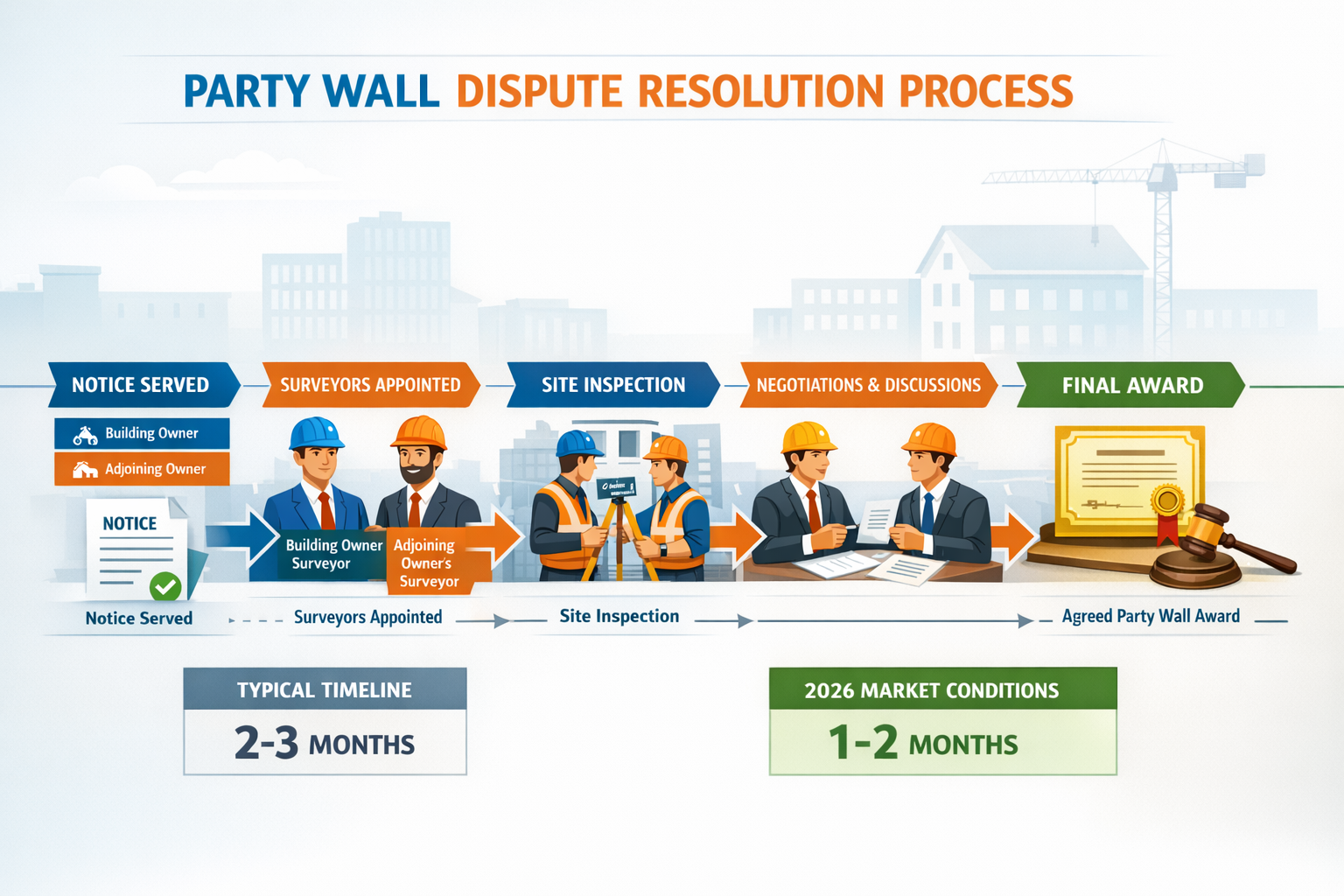
    () infographic-style image displaying timeline of party wall dispute resolution process with clear visual flowchart,

    Legal Framework and Compliance for Resolving Party Wall Disputes in Multifamily Declines

    Understanding the legal framework governing party wall relationships provides the foundation for effective dispute resolution. The Party Wall etc. Act 1996 establishes the statutory framework for England and Wales, creating rights and obligations that cannot be waived by private agreement.

    Essential Notice Requirements

    Proper notice procedures represent the most common compliance failure leading to disputes. The Act requires specific notices for different types of work:

    Party Structure Notice applies when work directly affects an existing party wall, such as:

    • Cutting into the wall to insert beams or damp-proof courses
    • Raising, underpinning, or demolishing the wall
    • Cutting away projecting foundations or walls

    This notice must be served at least two months before work commences and must describe the proposed work in sufficient detail for the adjoining owner to understand its scope and implications. For detailed guidance, see what is a party structure notice and how to serve it.

    Line of Junction Notice applies when building a new wall on or astride the boundary line between properties. This notice requires one month advance service.

    Adjacent Excavation Notice applies when excavating within three or six meters of a neighboring building’s foundation (depending on excavation depth). This notice also requires one month advance service.

    Common Compliance Failures in Declining Markets

    Economic pressure in 2026 tempts some building owners to cut corners on notice procedures, creating legal vulnerabilities that savvy adjoining owners can exploit. Common failures include:

    Insufficient notice periods where building owners serve notices but begin work before the statutory waiting period expires. This violation gives adjoining owners grounds to seek injunctions halting all work until proper procedures are followed.

    Inadequate work descriptions that fail to provide sufficient detail about proposed activities. Vague notices like “general renovation work” don’t satisfy statutory requirements and can be challenged.

    Improper service methods where notices are not delivered in legally compliant ways. Hand delivery, recorded delivery post, or other methods that provide proof of service are essential.

    Failure to appoint surveyors when adjoining owners dissent or fail to respond within 14 days. The Act requires building owners to initiate the surveyor appointment process, and failure to do so leaves work without legal authorization.

    Rights and Remedies Under the Act

    The Party Wall Act creates specific rights for both building owners and adjoining owners that shape dispute resolution strategies:

    Building owners have the right to:

    • Conduct necessary work after proper notice and award procedures
    • Access adjoining property when reasonably necessary for the work
    • Recover costs from adjoining owners for shared benefit work (in specific circumstances)

    Adjoining owners have the right to:

    • Receive proper notice and detailed work descriptions
    • Appoint their own surveyor at the building owner’s expense
    • Have their property protected through condition surveys and damage remediation
    • Refuse consent to certain types of work (though the Act provides mechanisms to proceed)

    When disputes arise, remedies available include:

    • Injunctions to halt unauthorized work
    • Damages for property harm caused by non-compliant construction
    • Specific performance requiring completion of agreed protective measures
    • Cost recovery for expenses incurred addressing building owner’s violations

    Understanding these rights and remedies helps parties negotiate realistic settlements during mediation. An adjoining owner who understands they cannot permanently block authorized work may focus on securing adequate protections rather than outright opposition. A building owner who recognizes their vulnerability from procedural failures may offer generous settlements to avoid injunctions that would halt construction.

    For those navigating the process independently, resources like having a party wall agreement without a surveyor provide guidance, though professional assistance remains advisable for complex multifamily projects.

    Lessons from Recent Party Wall Disputes: 2024-2025 Case Studies

    Recent disputes provide valuable lessons for resolving party wall conflicts in 2026’s challenging market. While specific case details are often confidential, several patterns emerge from disputes resolved in 2024-2025:

    The Cost of Procedural Shortcuts

    A South London multifamily conversion project in 2024 attempted to save £3,500 in surveyor fees by handling party wall procedures internally. The developer served notices but failed to properly describe foundation work affecting three adjoining properties. When construction began, neighbors obtained an injunction halting all work.

    The resulting dispute consumed seven months and cost the developer:

    • £42,000 in legal fees
    • £28,000 in carrying costs during the construction halt
    • £15,000 in surveyor fees (more than quadruple the initial savings)
    • £12,000 in settlement payments to adjoining owners
    • Immeasurable damage to neighborhood relationships

    Lesson: Professional guidance costs a fraction of dispute resolution. The £3,500 “saved” cost nearly £100,000 to rectify.

    The Value of Comprehensive Condition Surveys

    A 2025 dispute in West London centered on damage claims following basement excavation beneath a Victorian terrace converted to flats. The building owner had conducted a basic condition survey but failed to document pre-existing cracks in detail. When new cracks appeared during construction, the adjoining owner claimed £45,000 in damages.

    Without detailed pre-construction documentation, the building owner couldn’t prove which damage was pre-existing versus construction-related. The dispute settled for £32,000, though forensic analysis later suggested only £8,000-£12,000 of damage was actually construction-related.

    Lesson: Comprehensive schedule of condition documentation with detailed photography, measurements, and professional assessment protects all parties by establishing clear baselines.

    Early Communication Prevents Escalation

    A North London multifamily development in 2024 faced potential disputes with eight adjoining owners when plans called for significant excavation work. Rather than simply serving statutory notices, the developer held three pre-construction meetings explaining the project, addressing concerns, and establishing communication channels.

    When unexpected ground conditions required design modifications during construction, the developer immediately communicated changes to neighbors. Because trust had been established, adjoining owners accepted the modifications without formal disputes. The project completed on time and under budget.

    Lesson: Investment in relationship-building and transparent communication pays dividends when unexpected challenges arise. For developers working in specific areas, engaging local experts like a party wall surveyor in North London who understands neighborhood dynamics proves invaluable.

    Mediation Success in Complex Multi-Party Disputes

    A 2025 East London project involving conversion of a commercial building to 24 residential units triggered disputes with five adjoining owners over structural concerns, access requirements, and construction noise. Initial positions were far apart, with neighbors demanding work halt entirely and the developer insisting on proceeding as planned.

    A two-day mediation session facilitated by an experienced construction mediator resulted in a comprehensive agreement that:

    • Modified construction methods to address structural concerns
    • Established specific quiet hours and noise mitigation measures
    • Created an inspection protocol allowing neighbor representatives to verify protective measures
    • Set up a rapid-response communication system for addressing concerns during construction

    The mediation cost £6,500 but avoided an estimated £150,000+ in litigation costs and kept the project on schedule. All parties reported satisfaction with the outcome.

    Lesson: Skilled mediation creates value by identifying underlying interests and crafting solutions that address core concerns of all parties. For projects in areas with complex building patterns, working with specialists like a party wall surveyor in East London familiar with local conditions enhances mediation success.

    () split-screen comparison image showing two multifamily development scenarios: left side depicts successful proactive party

    Practical Implementation: Step-by-Step Dispute Resolution Protocol

    For building owners and developers facing party wall situations in 2026’s declining market, this practical protocol provides a roadmap for Resolving Party Wall Disputes in Multifamily Declines: 2026 Strategies Despite Slipping Demand:

    Phase 1: Pre-Project Planning (8-12 Weeks Before Construction)

    Week 1-2: Project Assessment

    • Engage qualified party wall surveyor to assess project scope
    • Identify all potentially affected adjoining owners
    • Review types of party wall works applicable to your project
    • Develop preliminary timeline for notice and award procedures

    Week 3-4: Neighbor Outreach

    • Send informal project introduction letters to adjoining owners
    • Offer to meet individually to discuss project and address concerns
    • Provide contact information for project manager and surveyor
    • Begin building relationships before formal notices

    Week 5-8: Formal Notice Preparation

    • Prepare detailed work descriptions and technical drawings
    • Draft statutory notices with surveyor guidance
    • Prepare condition survey protocols
    • Develop draft party wall award addressing foreseeable issues

    Week 9-12: Notice Service and Response Period

    • Serve formal notices via proper legal methods
    • Document service with proof of delivery
    • Monitor for responses and consent/dissent
    • Initiate surveyor appointment process if dissent received or no response within 14 days

    Phase 2: Award Negotiation (4-8 Weeks)

    Week 1-2: Surveyor Coordination

    • Building owner’s surveyor and adjoining owner’s surveyor (or agreed surveyor) meet to review project
    • Conduct comprehensive condition surveys of all affected properties
    • Identify specific concerns and required protective measures
    • Establish communication protocols for construction phase

    Week 3-6: Award Drafting

    • Surveyors prepare detailed party wall award
    • Address all technical, access, and procedural issues
    • Include specific damage remediation procedures
    • Establish inspection schedules and reporting requirements
    • Review draft with all parties and incorporate reasonable modifications

    Week 7-8: Award Finalization

    • Issue final award to all parties
    • Ensure all parties understand rights and obligations
    • Establish pre-construction meeting date
    • Confirm construction start date complies with notice periods

    Phase 3: Construction Phase Management (Project Duration)

    Ongoing Activities:

    • Maintain regular communication with adjoining owners
    • Conduct scheduled inspections per award requirements
    • Document any incidents or concerns immediately
    • Address minor issues before they escalate
    • Keep surveyors informed of any significant developments or plan changes

    If Disputes Arise:

    1. Immediate Response (24-48 hours)

      • Acknowledge concern and commit to investigation
      • Conduct site inspection with surveyor
      • Document current conditions with photos/video
      • Provide preliminary response to adjoining owner
    2. Technical Assessment (3-7 days)

      • Surveyor evaluates technical aspects of concern
      • Determine if issue relates to authorized work or represents deviation
      • Identify immediate protective measures if needed
      • Develop proposed resolution approach
    3. Resolution Discussion (1-2 weeks)

      • Meet with adjoining owner to discuss findings and proposed resolution
      • Listen to concerns and identify underlying interests
      • Explore alternative solutions if initial proposal unsatisfactory
      • Reach agreement on corrective measures and timeline
    4. Mediation (if direct discussion unsuccessful)

      • Engage professional mediator with party wall experience
      • Prepare comprehensive case documentation
      • Participate in good faith with settlement authority
      • Implement mediated agreement promptly
    5. Formal Dispute Resolution (last resort only)

      • Consult with construction litigation solicitor
      • Evaluate costs and risks of formal proceedings
      • Consider one final settlement offer before litigation
      • Proceed to court only when mediation exhausted and stakes justify costs

    Phase 4: Post-Construction (2-4 Weeks After Completion)

    Final Documentation:

    • Conduct post-construction condition survey
    • Compare to pre-construction baseline
    • Address any construction-related damage per award terms
    • Obtain written confirmation from adjoining owners that work completed satisfactorily
    • Archive all documentation for future reference

    This systematic approach ensures compliance, builds positive relationships, and provides clear pathways for addressing issues before they escalate into costly disputes.

    Cost-Benefit Analysis: Prevention vs. Dispute Resolution

    Understanding the financial implications of different approaches to party wall matters helps developers make informed decisions in 2026’s capital-constrained environment:

    Typical Cost Ranges

    Proactive Approach (Prevention):

    • Party wall surveyor engagement: £800-£2,500
    • Comprehensive condition surveys: £300-£800 per property
    • Party wall award preparation: £1,200-£3,500
    • Pre-construction neighbor meetings: £200-£500 (staff time)
    • Total proactive investment: £2,500-£7,300

    Reactive Approach (Dispute Resolution):

    • Emergency surveyor engagement: £1,500-£4,000
    • Legal consultation: £3,000-£8,000
    • Mediation fees: £2,000-£8,000
    • Construction delay costs: £500-£2,000 per week
    • Settlement payments: £5,000-£50,000+
    • Total dispute resolution costs: £15,000-£100,000+

    Litigation Approach (Worst Case):

    • Solicitor fees: £25,000-£75,000
    • Expert witness fees: £5,000-£15,000
    • Court costs: £3,000-£10,000
    • Construction delay costs: £2,000-£8,000 per month (12-24 months)
    • Adverse judgment risk: £50,000-£250,000+
    • Total litigation costs: £100,000-£500,000+

    Return on Prevention Investment

    For a typical multifamily project, investing £5,000 in proactive party wall management provides:

    • 85% probability of avoiding formal disputes entirely
    • 60% reduction in total party wall costs compared to reactive approaches
    • Zero construction delays from party wall issues
    • Preserved neighbor relationships valuable for future projects
    • Reduced stress and management time allowing focus on core construction activities

    Even if disputes arise despite proactive measures, the documentation and relationships established through prevention efforts significantly reduce resolution costs and timelines.

    2026 Market Considerations

    In declining markets, the cost-benefit calculation shifts even more favorably toward prevention:

    • Tighter financing means construction delays have more severe consequences
    • Reduced profit margins make unexpected costs more damaging to project viability
    • Increased vacancy risk makes timely project completion more critical
    • Limited exit options reduce ability to walk away from troubled projects

    For developers operating in competitive urban markets like Central London or West London, professional party wall management represents essential risk mitigation rather than optional expense.

    Future-Proofing Party Wall Relationships Beyond 2026

    While this guide focuses on 2026 strategies, successful developers think beyond immediate projects to build lasting frameworks for party wall management:

    Building Institutional Knowledge

    Document lessons learned from each project, creating internal databases of:

    • Common dispute triggers in different building types
    • Effective communication approaches for various neighbor demographics
    • Surveyor and mediator recommendations based on performance
    • Template language for notices, awards, and settlement agreements

    This institutional knowledge becomes increasingly valuable as organizations complete multiple projects, allowing each successive project to benefit from previous experience.

    Developing Neighbor Networks

    In areas where developers plan multiple projects, investing in community relationships pays long-term dividends. Developers who are known for transparent communication, fair dealing, and quality construction face fewer disputes and easier resolution processes when issues do arise.

    Consider:

    • Sponsoring local community events
    • Maintaining accessible communication channels for neighbor concerns
    • Following through on commitments consistently
    • Addressing issues promptly even after projects complete

    Staying Current on Legal Developments

    Party wall law evolves through case precedents and occasional legislative changes. Subscribing to professional updates and maintaining relationships with experienced party wall surveyors ensures awareness of developments that might affect project approaches.

    Key areas to monitor in 2026 and beyond include:

    • Building safety regulations following recent high-profile incidents
    • Climate adaptation requirements affecting structural work
    • Digital service of notices and electronic documentation
    • Insurance requirements for construction affecting shared structures

    Leveraging Technology

    Emerging technologies offer opportunities to improve party wall management:

    Digital documentation platforms enable comprehensive condition surveys with 360-degree photography, measurements, and annotations accessible to all parties.

    Project communication apps provide transparent, documented channels for neighbor updates and concern reporting.

    Drone inspections allow non-invasive assessment of roof and upper-story conditions.

    Building Information Modeling (BIM) helps visualize proposed work for neighbors, reducing misunderstandings about project scope.

    While technology cannot replace professional judgment and human relationship-building, it enhances transparency and documentation that support dispute prevention and resolution.

    Conclusion: Navigating Party Wall Challenges in Uncertain Markets

    Resolving Party Wall Disputes in Multifamily Declines: 2026 Strategies Despite Slipping Demand requires a fundamental shift from reactive crisis management to proactive relationship building and systematic compliance. As multifamily markets face continued pressure from elevated vacancies, constrained financing, and reduced construction activity, the cost of party wall disputes—measured in both direct expenses and opportunity costs—becomes increasingly burdensome.

    The strategies outlined in this guide provide a comprehensive framework for navigating party wall challenges in today’s difficult environment:

    Engage professional surveyors early to prevent disputes before they arise and ensure full statutory compliance

    Invest in transparent communication with neighbors to build trust and understanding that facilitates cooperation

    Utilize proactive party wall awards that establish clear rights, responsibilities, and dispute resolution mechanisms before construction begins

    Prioritize mediation as the first-line response when disputes do arise, saving time and money while preserving relationships

    Learn from recent precedents to avoid common pitfalls and adopt proven successful approaches

    Implement systematic protocols that ensure consistent, compliant party wall management across all projects

    The evidence is clear: developers who invest in prevention and early professional engagement achieve superior outcomes at lower total costs than those who attempt shortcuts or reactive approaches. In 2026’s challenging market, this efficiency advantage can mean the difference between project success and failure.

    Next Steps for Building Owners and Developers

    If you’re planning multifamily construction or renovation work in 2026:

    1. Assess your project for party wall implications at the earliest planning stage
    2. Engage qualified surveyors with specific multifamily and local market experience
    3. Review compliance with all notice requirements under the Party Wall Act
    4. Develop communication strategies for transparent neighbor engagement
    5. Prepare comprehensive documentation including detailed condition surveys
    6. Establish mediation protocols for rapid dispute resolution if needed

    For immediate guidance on party wall procedures, explore resources on party wall notices, review general FAQs, or contact experienced professionals who can provide project-specific advice.

    The multifamily market may face headwinds in 2026, but developers who master party wall dispute resolution position themselves for success regardless of broader market conditions. By treating party wall management as a core competency rather than an afterthought, forward-thinking developers protect their investments, maintain positive community relationships, and complete projects on time and budget even in challenging times. 🏗️

  • Scope Creep Risks in Party Wall Agreements for Complex 2026 Builds:

    The construction landscape in 2026 presents unprecedented challenges for party wall surveyors. Modern builds—particularly data centers, mixed-use developments, and high-tech facilities—involve intricate mechanical systems, advanced structural engineering, and specialized materials that dwarf the complexity of traditional residential projects. This evolution has created a dangerous gap: party wall agreements drafted for simple extensions now govern projects requiring sophisticated technical oversight. Scope Creep Risks in Party Wall Agreements for Complex 2026 Builds: Essential Clauses for Surveyors have become a critical concern as surveyors find themselves inadvertently assuming design responsibilities, providing technical guidance beyond their expertise, and exposing themselves to significant liability.

    The stakes have never been higher. Contractors entering 2026 face a legal environment driven by shifting regulations, technological advancement, and heightened expectations from all parties involved in construction disputes[1]. For party wall surveyors, this means every agreement must explicitly define boundaries, incorporate protective language, and anticipate the scope expansion that complex builds inevitably trigger.

    Key Takeaways

    Complex 2026 builds dramatically increase scope creep risk as surveyors are asked to provide guidance on sophisticated systems beyond traditional party wall matters

    ⚠️ Design waiver clauses are essential protective tools that explicitly state surveyors’ suggestions are non-binding and require design professional approval

    📋 Clear scope limitation language must define not just what surveyors will do, but explicitly what they will not do to prevent liability expansion

    🔄 Formal change management procedures within party wall awards prevent uncontrolled scope expansion and protect all parties

    🛡️ No-warranty provisions shield surveyors from unintended professional liability when complex technical issues arise

    Understanding Scope Creep in Modern Party Wall Agreements

    () detailed illustration showing three-way split composition: left panel displays traditional simple party wall agreement

    Scope creep occurs when a project’s requirements expand beyond the originally agreed boundaries without corresponding adjustments to resources, timelines, or fees. In party wall matters, this phenomenon has become particularly problematic as building complexity increases.

    The 2026 Complexity Factor

    Traditional party wall work typically involved straightforward scenarios: a homeowner excavating a basement, building a rear extension, or raising a party wall. Surveyors assessed structural impact, documented existing conditions through a schedule of condition, and issued awards with clear parameters.

    Today’s complex builds present entirely different challenges:

    • Data centers with sophisticated cooling systems requiring deep excavations and vibration-sensitive equipment
    • Mixed-use developments combining residential, commercial, and industrial spaces with varying structural requirements
    • Smart buildings incorporating integrated building management systems that cross property boundaries
    • Sustainable construction using novel materials and techniques without established precedent

    As building systems grow more complex, contractors and surveyors are increasingly being asked to provide guidance beyond their original scope—sometimes stepping into roles traditionally reserved for architects or engineers, expanding liability exposure[1].

    How Scope Expands in Party Wall Matters

    Scope creep in party wall agreements typically follows predictable patterns:

    1. Initial consultation expansion: Building owners seek “quick advice” on design feasibility during preliminary discussions
    2. Technical specification drift: Surveyors are asked to comment on structural calculations or material specifications
    3. Coordination responsibilities: Expectations grow that surveyors will coordinate between contractors, engineers, and architects
    4. Dispute resolution overreach: Parties expect surveyors to resolve design disputes or construction methodology conflicts
    5. Post-completion involvement: Ongoing requests to assess issues unrelated to the original party wall works

    Without a clear change management strategy outlining how change requests will be handled, who is involved in decisions, and how resources will be realigned, scope changes can lead to uncontrolled scope creep[2].

    The Liability Trap

    When surveyors provide guidance beyond their defined scope—even informally—they may inadvertently:

    • Assume professional liability for design decisions outside their expertise
    • Create contractual obligations not covered by their insurance
    • Undermine the authority of appointed design professionals
    • Generate disputes about who is responsible when issues arise

    Understanding types of party wall works helps establish appropriate scope boundaries from the outset.

    Essential Protective Clauses for Scope Creep Risks in Party Wall Agreements for Complex 2026 Builds

    () professional photograph of surveyor's desk from overhead perspective showing detailed party wall agreement document with

    Protecting against scope creep requires proactive contract drafting. The following clauses provide essential safeguards for surveyors working on complex projects.

    1. Design Waiver Clauses 🛡️

    Purpose: Explicitly state that surveyors’ suggestions regarding construction methodology, materials, or structural approach are non-binding observations only.

    Sample Language:

    “The surveyors appointed under this Award are not responsible for design, structural calculations, or specification of materials. Any observations, suggestions, or comments made by the surveyors regarding construction methodology, materials selection, or structural approach are provided for informational purposes only and do not constitute professional design advice. All such matters remain the sole responsibility of the Building Owner’s appointed design professionals (architects, structural engineers, or other specialists as appropriate). The Building Owner and Adjoining Owner acknowledge that no reliance should be placed on surveyor comments regarding design matters, and any design decisions must receive explicit written approval from appropriately qualified design professionals before implementation.”

    Attorneys recommend clearly defining not just what contractors will do, but explicitly what they will not do—such as including design waivers stating that any suggestions beyond scope are non-binding and require sign-off from a design professional[1].

    2. Scope Limitation Provisions

    Purpose: Define the surveyor’s role boundaries with precision, listing both included and excluded responsibilities.

    Key Elements:

    Surveyor Responsibilities Include:

    • Assessing party wall impact under the Party Wall etc. Act 1996
    • Preparing schedules of condition for affected properties
    • Determining reasonable working hours and access provisions
    • Resolving disputes specifically related to party wall matters
    • Monitoring compliance with the Award’s specific requirements

    Surveyor Responsibilities Explicitly Exclude:

    • Structural design or engineering calculations
    • Building control or planning compliance
    • Material specification or procurement
    • Contractor selection or supervision
    • Health and safety management
    • Project management or coordination between trades
    • Warranty or guarantee of construction quality
    • Assessment of building defects unrelated to notifiable works

    For guidance on the surveyor appointment process, review information about building owners’ surveyors and adjoining owners’ surveyors.

    3. No-Warranty Language

    Purpose: Prevent implied warranties about construction quality, durability, or fitness for purpose.

    Sample Language:

    “The surveyors provide no warranty, guarantee, or representation regarding the quality, durability, fitness for purpose, or compliance with building regulations of any works carried out pursuant to this Award. The surveyors’ role is limited to assessing party wall impact and ensuring reasonable protection for the Adjoining Owner’s property. All warranties regarding construction quality remain with the Building Owner, their contractors, and their design professionals.”

    4. Change Management Procedures

    Purpose: Establish formal processes for handling scope changes, preventing informal expansion of responsibilities.

    Essential Components:

    Element Requirement
    Change Request Form Written documentation required for any scope modification
    Impact Assessment Analysis of time, cost, and liability implications
    Approval Authority Designated decision-makers for both Building and Adjoining Owners
    Fee Adjustment Clear methodology for calculating additional surveyor fees
    Award Amendment Formal supplemental award documenting approved changes
    Timeline Extension Automatic adjustment to surveyor involvement period

    Understanding proper party wall award procedures ensures changes are documented appropriately.

    5. Professional Boundary Clauses

    Purpose: Clarify the relationship between surveyors and other construction professionals.

    Sample Language:

    “Where the Building Owner has appointed architects, structural engineers, or other design professionals, the surveyors shall defer to those professionals on all matters within their respective areas of expertise. The surveyors may request information, clarification, or modifications to protect the Adjoining Owner’s interests, but shall not supersede or contradict the professional judgment of appointed design professionals. Any conflict between surveyor observations and design professional recommendations shall be resolved through formal consultation between those professionals, with the surveyors’ role limited to articulating party wall protection requirements.”

    6. Complex Systems Exclusion

    Purpose: Specifically address sophisticated building systems common in 2026 construction.

    Sample Language:

    “The surveyors are not responsible for assessing, approving, or monitoring: (a) HVAC systems and mechanical equipment; (b) electrical systems and data infrastructure; (c) building management and automation systems; (d) specialized waterproofing or tanking systems; (e) acoustic insulation or vibration control measures; (f) fire protection and compartmentation; (g) renewable energy installations; or (h) any other specialized building systems. Assessment of such systems remains the responsibility of appropriately qualified specialists appointed by the Building Owner.”

    7. Dispute Resolution Scope Limitation

    Purpose: Prevent surveyors from being drawn into broader construction disputes.

    Sample Language:

    “The surveyors’ dispute resolution authority is strictly limited to matters arising directly from notifiable party wall works under the Party Wall etc. Act 1996. Disputes regarding construction quality, contractor performance, design adequacy, building control compliance, or any matters outside the specific scope of party wall impact shall be resolved through separate mechanisms and do not fall within the surveyors’ jurisdiction under this Award.”

    Implementing Scope Creep Protections in Complex 2026 Builds

    () infographic-style illustration showing change management workflow diagram for party wall agreements. Central flowchart

    Incorporating protective clauses is only the first step. Effective implementation requires ongoing vigilance and clear communication throughout the project lifecycle.

    Pre-Appointment Strategies

    1. Complexity Assessment 📊

    Before accepting appointment, surveyors should evaluate:

    • Building type and intended use
    • Structural complexity and novel construction methods
    • Presence of specialized systems or equipment
    • Number of professional consultants involved
    • Previous party wall history at the location

    For location-specific considerations, consult resources for party wall surveyors in Central London, North London, South London, East London, or West London.

    2. Fee Structure Alignment

    Complex builds require fee structures that account for:

    • Extended involvement periods
    • Multiple site visits for sophisticated works
    • Coordination with specialized consultants
    • Potential for scope change requests
    • Enhanced insurance requirements

    Learn more about costs of party wall processes and strategies for keeping party wall costs down.

    3. Clear Terms of Engagement

    Appointment letters should explicitly reference:

    • Scope limitation clauses
    • Change management procedures
    • Fee adjustment mechanisms
    • Professional boundary acknowledgments
    • Insurance coverage limits

    During the Award Drafting Process

    1. Incorporate Standard Protective Language

    Develop template clauses for complex builds that can be customized for specific projects. Maintain a library of proven protective provisions.

    2. Cross-Reference Design Documentation

    Awards should explicitly reference and defer to:

    • Structural engineer’s calculations and drawings
    • Architect’s specifications
    • Specialist consultant reports
    • Method statements from contractors

    3. Define Monitoring Parameters

    Clearly specify what surveyors will monitor:

    • ✅ Compliance with working hours
    • ✅ Protection measures for adjoining property
    • ✅ Adherence to agreed access arrangements
    • ✅ Structural movement within specified tolerances
    • ❌ NOT construction quality generally
    • ❌ NOT compliance with building regulations
    • ❌ NOT contractor workmanship standards

    Understanding party wall notices and party structure notices helps establish appropriate monitoring scope.

    Managing Scope During Construction

    1. Document All Communications 📝

    Maintain detailed records of:

    • Requests for advice outside defined scope
    • Referrals to appropriate design professionals
    • Informal observations distinguished from formal determinations
    • Scope change requests and responses

    2. Redirect Inappropriate Requests

    When asked to opine on matters outside scope:

    “Thank you for your question regarding [technical matter]. This falls outside my scope as party wall surveyor and should be directed to [appropriate professional]. I’m happy to coordinate with them regarding any party wall implications once they’ve provided their professional assessment.”

    3. Formal Change Process Enforcement

    Refuse to expand scope informally. Require:

    • Written change request
    • Impact assessment period
    • Fee negotiation
    • Supplemental award if approved

    4. Regular Boundary Reinforcement

    Periodically remind parties of scope limitations, especially when:

    • New team members join the project
    • Unexpected issues arise
    • Project complexity increases
    • Disputes emerge

    Post-Completion Considerations

    1. Clear Completion Documentation

    Awards should specify:

    • Surveyor involvement end date
    • Final inspection parameters
    • Handover procedures
    • Ongoing obligations (if any)

    2. Warranty Disclaimers

    Final documentation should reiterate that surveyors provide no ongoing warranty regarding construction quality or durability.

    3. Referral Protocols

    Establish clear procedures for post-completion issues:

    • Party wall matters → surveyors may remain involved
    • Construction defects → building owner’s design team
    • Maintenance issues → property owners’ responsibility

    Special Considerations for Specific Complex Build Types

    Different project types present unique scope creep risks requiring tailored protections.

    Data Centers and Technical Facilities

    Unique Risks:

    • Sophisticated cooling and electrical systems
    • Vibration-sensitive equipment
    • 24/7 operational requirements
    • Cybersecurity and access control concerns

    Additional Protective Clauses:

    • Explicit exclusion of IT infrastructure assessment
    • Vibration monitoring by specialist consultants only
    • Operational continuity as building owner responsibility
    • Security protocol compliance outside surveyor scope

    Mixed-Use Developments

    Unique Risks:

    • Multiple property types with different standards
    • Varied occupancy during construction
    • Complex phasing requirements
    • Diverse stakeholder expectations

    Additional Protective Clauses:

    • Phase-specific scope definitions
    • Separate awards for different building uses
    • Stakeholder communication protocols
    • Occupancy management as building owner responsibility

    Historic or Listed Buildings

    Unique Risks:

    • Conservation requirements
    • Specialist materials and techniques
    • Heritage body involvement
    • Precedent-setting implications

    Additional Protective Clauses:

    • Deference to conservation specialists
    • Explicit exclusion of heritage compliance
    • Listed building consent as prerequisite
    • Traditional techniques outside surveyor expertise

    Sustainable and Innovative Construction

    Unique Risks:

    • Novel materials without track record
    • Experimental construction methods
    • Renewable energy system integration
    • Long-term performance uncertainty

    Additional Protective Clauses:

    • Innovation risk acknowledgment
    • Performance warranty exclusions
    • Specialist consultant requirements
    • Long-term monitoring outside scope

    Common Scope Creep Scenarios and Response Strategies

    Scenario 1: “Can You Just Quickly Look at This?”

    Situation: Building owner asks surveyor to “quickly review” structural calculations or material specifications.

    Risk: Informal review creates implied approval and potential liability.

    Response Strategy:

    1. Acknowledge the request
    2. Clarify it falls outside party wall scope
    3. Refer to appropriate professional (structural engineer)
    4. Offer to coordinate if party wall implications arise
    5. Document the referral in writing

    Scenario 2: Design Professional Disagreement

    Situation: Architect and structural engineer disagree on approach; parties ask surveyor to “settle” the dispute.

    Risk: Surveyor lacks authority and expertise to resolve design disputes.

    Response Strategy:

    1. Clarify surveyor role is limited to party wall matters
    2. Suggest design professionals resolve through their professional channels
    3. Offer to articulate party wall protection requirements once design is settled
    4. Document that surveyor takes no position on design dispute
    5. Suspend party wall work if necessary until design is resolved

    Scenario 3: Contractor Seeks Method Statement Approval

    Situation: Contractor submits detailed method statement asking surveyor to “approve” construction approach.

    Risk: Approval implies responsibility for methodology and safety.

    Response Strategy:

    1. Review only for party wall impact implications
    2. Confirm method statement addresses award requirements
    3. Explicitly state review is not approval of methodology generally
    4. Refer safety and technical matters to building owner’s team
    5. Document limited nature of review

    Scenario 4: Post-Completion Defect Investigation

    Situation: Months after completion, adjoining owner reports defects and expects surveyor to investigate and determine responsibility.

    Risk: Defect investigation exceeds party wall scope and may involve construction quality issues.

    Response Strategy:

    1. Determine if issue relates to notifiable party wall works
    2. If yes: assess whether it falls within award scope
    3. If no: refer to building owner’s warranty or design team
    4. Clarify surveyor involvement ended per award terms
    5. Suggest independent building surveyor if necessary

    The 2026 Legal and Regulatory Context

    Contractors entering 2026 face a legal environment driven by shifting regulations, technological advancement, and heightened professional standards[1]. Several factors make scope creep management particularly critical:

    Increased Professional Liability Scrutiny

    Courts and insurance providers are paying closer attention to:

    • Professional boundary violations
    • Scope of appointment clarity
    • Documentation of limitations
    • Referral to appropriate specialists

    Technology Integration Challenges

    Building information modeling (BIM), AI-assisted design, and smart building systems create new gray areas where traditional professional boundaries blur.

    Sustainability and Innovation Pressures

    The push toward net-zero construction introduces novel materials and methods that may fall outside traditional surveyor expertise.

    Stakeholder Expectations

    More sophisticated clients expect comprehensive guidance, potentially pushing surveyors beyond appropriate boundaries.

    Best Practices for Surveyors in 2026

    Professional Development

    • Stay current on construction technology without claiming expertise outside qualifications
    • Understand limitations of your knowledge and insurance coverage
    • Build networks of specialist consultants for referrals
    • Maintain clear records of scope boundaries in all projects

    Communication Excellence

    • Set expectations early about scope limitations
    • Confirm understanding in writing after verbal discussions
    • Use consistent language about what you will and won’t do
    • Educate clients about the value of staying within scope

    Documentation Discipline

    • Template libraries for protective clauses
    • Scope confirmation letters for every appointment
    • Change request forms ready for immediate use
    • Referral tracking to demonstrate appropriate boundary maintenance

    Insurance Alignment

    • Review coverage for complex project types
    • Confirm exclusions match scope limitations
    • Notify insurers of unusual risk factors
    • Maintain adequate limits for project scale

    Resources and Tools for Managing Scope Creep Risks

    Essential Documentation

    Understanding Boundaries

    Process Guidance

    Conclusion

    Scope Creep Risks in Party Wall Agreements for Complex 2026 Builds: Essential Clauses for Surveyors represent one of the most significant professional challenges facing the industry today. As construction projects grow increasingly sophisticated—incorporating data centers, smart building systems, and innovative sustainable technologies—the gap between traditional party wall scope and stakeholder expectations widens dangerously.

    The protective clauses outlined in this guide provide essential safeguards:

    Design waiver clauses that explicitly disclaim responsibility for technical design matters
    Scope limitation provisions that define both included and excluded responsibilities
    No-warranty language that prevents implied guarantees about construction quality
    Change management procedures that formalize scope modification processes
    Professional boundary clauses that clarify relationships with other consultants

    Success in 2026 requires more than simply incorporating these clauses into agreements. Surveyors must actively manage scope throughout the project lifecycle through clear communication, diligent documentation, and firm boundary maintenance. When asked to step beyond appropriate limits, the professional response is not expansion but referral to qualified specialists.

    Actionable Next Steps

    1. Review your current agreement templates and incorporate the protective clauses outlined above
    2. Develop a scope change request form for immediate deployment when expansion requests arise
    3. Create a referral network of structural engineers, architects, and specialists for complex issues
    4. Audit your professional indemnity insurance to ensure coverage aligns with scope limitations
    5. Train your team on recognizing and responding to scope creep scenarios
    6. Document your scope boundaries in every client communication from initial inquiry through completion
    7. Stay informed about emerging construction technologies while maintaining clear expertise boundaries

    The complexity of 2026 construction is not diminishing. By implementing robust scope protections now, surveyors can continue providing valuable party wall services while avoiding the liability traps that increasingly complex builds present. The key is clarity: clearly defined scope, clearly communicated limitations, and clearly documented boundaries throughout every engagement.


    References

    [1] 5 Legal Risks Contractors Cant Ignore In 2026 – https://www.constructionowners.com/news/5-legal-risks-contractors-cant-ignore-in-2026

    [2] Scope Creep What It Is And How To Manage It – https://aliresources.hexagon.com/enterprise-project-performance/scope-creep-what-it-is-and-how-to-manage-it

  • Tariffs and Immigration Impacts on Party Wall Surveying Costs in

    When tariffs affect 70% of construction-related firms and immigration enforcement shrinks the skilled workforce, property owners face an uncomfortable reality: party wall surveying costs are climbing faster than ever before. As 2026 unfolds, the combination of trade barriers on construction materials and labor shortages is creating a perfect storm that threatens to inflate the costs of party wall awards and surveying services across the UK.

    Understanding the Tariffs and Immigration Impacts on Party Wall Surveying Costs in 2026: Protecting Your Awards from Escalation has become essential for anyone planning building works that trigger party wall procedures. Whether you’re extending your home, converting a loft, or excavating for a basement, these economic pressures are reshaping the financial landscape of party wall agreements.

    () detailed infographic showing side-by-side comparison of 2025 vs 2026 party wall surveyor cost breakdown. Left column

    Key Takeaways

    • 📈 Party wall surveyor fees are expected to increase by 8-15% in 2026 due to combined pressures from tariffs on construction materials, immigration-related workforce shortages, and general inflation affecting operational costs
    • 🛡️ Fixed-fee agreements and price escalation clauses are critical contract provisions that can protect property owners from unexpected cost increases during lengthy party wall procedures
    • Early appointment of surveyors and strategic timing can help lock in current rates before further cost increases take effect throughout 2026
    • 💼 Hourly rate services face greater volatility than fixed-fee arrangements, making fee structure selection a key decision point for cost-conscious building owners
    • 📋 Competitive bidding and transparent cost breakdowns remain effective strategies for managing expenses despite broader economic pressures

    Understanding the Economic Pressures on Party Wall Surveying in 2026

    The party wall surveying profession doesn’t operate in isolation from broader economic forces. In 2026, several interconnected factors are driving costs upward in ways that directly affect property owners planning construction works.

    The Tariff Effect on Construction Materials and Services

    Trade tariffs implemented on imported construction materials have created a ripple effect throughout the building industry. When steel, timber, and specialized building products become more expensive due to import duties, the entire construction ecosystem feels the impact. Party wall surveyors often need to account for these material cost increases when preparing party wall awards that include specifications for protective works or remedial measures.

    The connection isn’t always obvious. While surveyors themselves don’t directly purchase construction materials, their fee structures and award provisions must reflect the current economic reality. When awards specify protective measures, temporary works, or remedial actions, the cost estimates embedded in these documents need to account for tariff-inflated material prices.

    Immigration Policy and Workforce Availability

    Immigration enforcement measures have significantly reduced the pool of skilled construction professionals and specialist surveyors. This workforce contraction creates several problems:

    • Increased competition for qualified party wall surveyors
    • Higher wage demands from professionals with specialized expertise
    • Extended timelines due to surveyor availability constraints
    • Premium pricing in high-demand areas like London

    The shortage affects both the surveying profession and the contractors who execute works specified in party wall awards. When fewer qualified professionals are available, basic economic principles drive prices upward.

    Inflation and Operational Cost Pressures

    Beyond tariffs and immigration impacts, traditional inflationary pressures continue to affect party wall surveying costs. According to industry analysis, professional services are trending upward due to higher office costs, staff wages, and operational expenses.[1] These foundational cost increases form the baseline upon which tariff and immigration impacts are layered.

    Current typical costs range from £900–£2,700 for a single surveyor depending on project type, with loft conversions, extensions, and basements each carrying different complexity levels and associated fees.[2] These baseline figures are expected to increase modestly in 2026, with hourly rates and bespoke services most likely to see increases while fixed-fee models may remain more stable.[1]

    How Tariffs and Immigration Impacts on Party Wall Surveying Costs in 2026 Affect Different Fee Structures

    Understanding how economic pressures translate into actual cost increases requires examining the different fee structures used by party wall surveyors. Not all arrangements are equally vulnerable to the Tariffs and Immigration Impacts on Party Wall Surveying Costs in 2026: Protecting Your Awards from Escalation.

    () professional photograph-style image of party wall award contract document on wooden desk with highlighted sections

    Fixed-Fee Arrangements: Stability with Limitations

    Fixed-fee agreements offer predictability but may become less common as economic uncertainty increases. Under this structure, surveyors quote a single price for the entire party wall procedure, regardless of how long it takes or how complex the matter becomes.

    Advantages in 2026:

    • Protection from hourly rate inflation
    • Budget certainty for property owners
    • Incentive for surveyor efficiency
    • Simpler cost planning

    Disadvantages in 2026:

    • Fewer surveyors willing to offer fixed fees
    • Higher initial quotes to account for uncertainty
    • Potential for disputes if scope changes
    • Limited flexibility for complex cases

    To learn more about managing expenses effectively, review our guide on how to keep party wall costs down.

    Hourly Rate Structures: Transparency with Volatility

    Hourly billing provides transparency but exposes clients to the full impact of rate increases. As surveyor wages rise due to workforce shortages and operational costs climb, hourly rates directly reflect these pressures.

    2026 Hourly Rate Trends:

    • Expected increases of 10-18% compared to 2025 rates
    • Greater variation between urban and rural areas
    • Premium rates for specialized expertise
    • Additional charges for travel and disbursements

    Hybrid Models and Retainer Agreements

    Some surveyors offer hybrid arrangements combining fixed fees for standard procedures with hourly rates for exceptional circumstances. These models attempt to balance predictability with fairness when unexpected complexities arise.

    Protecting Your Party Wall Awards from Cost Escalation

    Given the economic pressures affecting party wall surveying in 2026, property owners need strategic approaches to protect themselves from excessive cost increases. The Tariffs and Immigration Impacts on Party Wall Surveying Costs in 2026: Protecting Your Awards from Escalation require proactive measures.

    Essential Contract Clauses for Cost Protection

    When appointing a party wall surveyor, the terms of engagement should include specific provisions addressing potential cost escalation:

    Price Escalation Clauses

    A well-drafted price escalation clause defines exactly how and when fees may increase. This provision should specify:

    • Maximum percentage increases permitted during the engagement
    • Trigger events that justify fee adjustments (e.g., scope changes, delays beyond surveyor control)
    • Notice requirements before implementing any increase
    • Documentation standards for justifying cost adjustments

    Scope Definition and Change Orders

    Clearly defining the scope of work prevents disputes about what’s included in the original fee. The engagement should specify:

    • Exact services covered by the quoted fee
    • Procedures for handling scope changes
    • Additional fee arrangements for extra work
    • Timeline expectations and delay provisions

    Cap Provisions and Maximum Fees

    For hourly rate arrangements, consider negotiating a fee cap that limits total costs:

    • Maximum total fee regardless of hours spent
    • Review points at specific spending thresholds
    • Right to seek alternative surveyor if cap is reached
    • Exceptions for genuinely unforeseen circumstances

    Understanding the broader context of costs of party wall the process helps in negotiating reasonable cap provisions.

    Strategic Timing and Early Appointment

    One of the most effective strategies for managing costs is early appointment of surveyors before anticipated rate increases take effect:

    Benefits of Early Appointment:

    • 🔒 Lock in current rates before 2026 increases
    • ⏱️ Avoid rush fees during peak demand periods
    • 📋 More time for thorough surveyor selection
    • 💡 Better negotiating position with multiple options

    Property owners planning works in mid-to-late 2026 should consider appointing surveyors in early 2026 to secure more favorable rates. This approach works particularly well when combined with fixed-fee arrangements.

    Competitive Bidding and Market Research

    Despite inflationary pressures, competitive market dynamics help stabilize costs as more professionals enter the party wall field, particularly in urban and suburban regions.[1] Property owners can leverage this competition through:

    Effective Bidding Strategies:

    1. Request quotes from 3-5 qualified surveyors covering different geographic areas
    2. Provide identical project information to ensure comparable quotes
    3. Ask for detailed fee breakdowns showing what’s included
    4. Inquire about fee structures (fixed vs. hourly) and flexibility
    5. Check qualifications and experience alongside pricing

    When reviewing types of party wall works, ensure all bidding surveyors understand the specific work category to provide accurate quotes.

    Alternative Dispute Resolution Provisions

    Cost disputes between building owners and surveyors can themselves become expensive. Including alternative dispute resolution (ADR) provisions in the engagement terms can prevent escalation:

    • Mandatory mediation before litigation
    • Fee arbitration procedures
    • Clear complaint and resolution processes
    • Reasonable timeframes for dispute resolution

    () strategic planning scene showing diverse property owners and surveyors in modern meeting room reviewing protective

    Regional Variations and Location-Specific Impacts

    The Tariffs and Immigration Impacts on Party Wall Surveying Costs in 2026: Protecting Your Awards from Escalation affect different regions with varying intensity. Understanding these geographic differences helps property owners set realistic budgets.

    London and Major Urban Centers

    Metropolitan areas face the most acute pressures:

    • Higher baseline costs due to elevated operational expenses
    • Greater workforce competition driving wage inflation
    • Premium rates for experienced professionals
    • Faster cost escalation compared to national averages

    Property owners in different areas of the capital can explore location-specific information:

    Suburban and Rural Areas

    Outside major cities, cost pressures manifest differently:

    • More stable pricing with slower rate increases
    • Fewer surveyors available but also less competition for services
    • Travel charges may represent larger cost components
    • Mixed impact from immigration policies depending on local workforce

    Understanding Your Rights and Obligations Under Cost Pressure

    When costs rise unexpectedly, property owners need to understand their rights and obligations under party wall legislation and their surveyor engagement terms.

    Building Owner Responsibilities

    As the building owner initiating works, you typically bear the costs of the party wall procedure, including:

    • Your own surveyor’s fees (if you appoint one)
    • The adjoining owner’s surveyor’s fees
    • The agreed surveyor’s fees (in some circumstances)
    • Reasonable costs associated with the award preparation

    However, these obligations don’t extend to unreasonable or excessive fees. If surveyor costs appear disproportionate, you have recourse through dispute resolution mechanisms.

    Adjoining Owner Protections

    Adjoining owners concerned about bearing costs for their surveyor should understand:

    • Building owners typically pay reasonable surveyor fees
    • You’re entitled to professional representation
    • Fee disputes shouldn’t delay necessary protective measures
    • Your surveyor must act independently despite payment source

    For more information about the adjoining owner position, visit our adjoining owners resource page.

    When to Challenge Surveyor Fees

    Circumstances that may justify challenging surveyor fees include:

    • Excessive hourly rates compared to market standards
    • Unnecessary work beyond the scope of party wall requirements
    • Unreasonable delays that inflate billable hours
    • Lack of transparency in billing practices
    • Duplicate charges or administrative errors

    Practical Cost Management Strategies for 2026

    Beyond contract provisions and timing strategies, several practical approaches can help manage the Tariffs and Immigration Impacts on Party Wall Surveying Costs in 2026: Protecting Your Awards from Escalation.

    Comprehensive Project Planning

    Thorough planning reduces the likelihood of scope changes and delays that increase costs:

    Planning Best Practices:

    • ✅ Complete architectural designs before serving party wall notices
    • ✅ Identify all potentially affected neighbors early
    • ✅ Gather existing structural information and surveys
    • ✅ Establish realistic timelines with buffer periods
    • ✅ Coordinate with contractors to align schedules

    Efficient Communication and Documentation

    Clear communication reduces billable hours spent on clarifications and disputes:

    Communication Strategies:

    • Respond promptly to surveyor inquiries
    • Provide complete information in initial submissions
    • Use written communication for important matters
    • Keep organized records of all correspondence
    • Attend site meetings when requested

    Leveraging Technology and Digital Tools

    Modern technology can reduce administrative costs and improve efficiency:

    • Digital document sharing reduces printing and postage costs
    • Video consultations eliminate travel time and charges
    • Project management platforms improve coordination
    • Electronic signatures speed up approval processes

    Understanding When Professional Help Isn’t Required

    In some straightforward cases, property owners might consider having a party wall agreement without a surveyor. This approach works best when:

    • Neighbors have an excellent relationship
    • Works are straightforward and low-risk
    • Both parties understand their rights
    • Professional templates are used properly

    However, given the cost escalation concerns in 2026, professional guidance often proves cost-effective by preventing disputes that could become far more expensive than surveyor fees.

    Future-Proofing Your Party Wall Agreements

    Looking beyond immediate cost concerns, property owners should consider how to structure agreements that remain viable throughout the construction period and beyond.

    Long-Term Cost Provisions in Awards

    Party wall awards should include provisions addressing potential future cost scenarios:

    Essential Long-Term Provisions:

    • Mechanisms for handling unforeseen damage discovered later
    • Procedures for post-construction condition assessments
    • Cost allocation formulas for delayed remedial works
    • Inflation adjustments for long-term monitoring requirements

    Building Relationships with Surveyors

    Establishing ongoing relationships with qualified surveyors can provide cost advantages:

    • Familiarity with your property reduces learning curve
    • Established trust may enable more favorable fee arrangements
    • Priority service during busy periods
    • Continuity for multi-phase projects

    Staying Informed About Market Conditions

    Monitoring industry trends helps property owners anticipate and respond to cost changes:

    • Follow professional surveying organizations’ guidance
    • Review market rate surveys and industry reports
    • Network with others who’ve recently completed party wall procedures
    • Stay updated on relevant legislation and policy changes

    Comparing Fee Structures: A Practical Example

    To illustrate how different fee structures respond to the Tariffs and Immigration Impacts on Party Wall Surveying Costs in 2026, consider a typical loft conversion project:

    Fee Structure Initial Quote Potential 2026 Increase Final Cost Range Risk Level
    Fixed Fee £1,500 None (if contracted early) £1,500 Low ⭐
    Hourly Rate (20 hours estimated) £1,400 (£70/hour) 15% rate increase to £80.50/hour £1,610-£2,012 High ⭐⭐⭐
    Hybrid (Base + Hourly) £800 + £50/hour for extras Base stable, hourly increases 15% £1,300-£1,800 Medium ⭐⭐
    Capped Hourly £70/hour, max £1,800 Rate increases but cap holds £1,800 maximum Medium ⭐⭐

    This comparison demonstrates why fixed-fee arrangements negotiated early in 2026 offer the best protection against cost escalation, while uncapped hourly rates expose property owners to the full impact of economic pressures.

    Conclusion: Taking Control of Party Wall Costs in an Uncertain Economic Climate

    The Tariffs and Immigration Impacts on Party Wall Surveying Costs in 2026: Protecting Your Awards from Escalation present real challenges for property owners planning building works. With surveyor fees expected to increase by 8-15% due to combined economic pressures, proactive cost management strategies are no longer optional—they’re essential.

    The most effective protection comes from a multi-layered approach combining:

    1. Early surveyor appointment to lock in current rates
    2. Fixed-fee arrangements with clear scope definitions
    3. Robust contract provisions including price escalation clauses and caps
    4. Competitive bidding among qualified professionals
    5. Efficient project management to minimize delays and scope changes

    Property owners who understand these economic dynamics and implement protective measures can successfully navigate the 2026 cost landscape while ensuring their party wall procedures remain compliant and effective.

    Actionable Next Steps

    If you’re planning building works requiring party wall procedures in 2026:

    Immediately research and contact 3-5 qualified surveyors to understand current market rates

    Request detailed quotes with clear fee structures and escalation provisions

    Negotiate contract terms that include cost protection mechanisms

    Finalize appointments early if your project timeline allows, to secure current rates

    Review our comprehensive resources on party wall awards and contract templates

    Consult with experienced professionals who understand the current economic pressures

    The construction industry’s economic challenges won’t disappear overnight, but informed property owners who take strategic action can minimize their exposure to cost escalation while ensuring their party wall procedures protect their interests and maintain positive neighbor relationships.

    Don’t let economic uncertainty derail your building project. By understanding the Tariffs and Immigration Impacts on Party Wall Surveying Costs in 2026: Protecting Your Awards from Escalation and implementing the strategies outlined in this guide, you can move forward with confidence and financial prudence.


    References

    [1] Will Party Wall Surveyor Fees Go Up In 2026 – https://www.simplesurvey.co.uk/article/will-party-wall-surveyor-fees-go-up-in-2026/

    [2] Party Wall Surveyor Cost – https://hoa.org.uk/advice/guides-for-homeowners/i-am-improving/party-wall-surveyor-cost/

  • Labor Shortages and Party Wall Surveyor Delays in 2026: Mitigation

    When 57% of contractors report worker shortages across the construction industry, the ripple effects reach every corner of property development—including the specialized field of party wall surveying. In 2026, Labor Shortages and Party Wall Surveyor Delays in 2026: Mitigation Tactics for Timely Awards have become critical concerns for building owners, developers, and adjoining property owners alike. The surge in loft conversions and residential extensions has collided with a shrinking pool of qualified surveyors, creating bottlenecks that can derail project timelines and inflate costs.

    Understanding how to navigate these challenges isn’t just about avoiding delays—it’s about protecting your investment, maintaining good neighbor relations, and ensuring legal compliance. This comprehensive guide explores the current state of party wall surveyor availability, quantifies the impact of delays, and provides actionable strategies to keep your party wall awards on schedule.

    Key Takeaways

    • Worker shortages are creating unprecedented delays in party wall surveying, with 57% of contractors reporting staffing challenges in 2026
    • Early engagement with party wall surveyors (ideally 3-6 months before construction) significantly reduces delay risks and keeps projects on track
    • Technology solutions including remote surveying, digital documentation, and virtual consultations can accelerate the award process by 30-40%
    • Strategic scheduling buffers of 6-8 weeks beyond typical timelines protect against surveyor availability issues
    • Cost implications range from £900 to £5,400 depending on complexity, with delays potentially doubling expenses through extended professional fees

    Understanding the Current Labor Crisis in Party Wall Surveying

    Detailed () infographic-style image showing the current state of party wall surveyor workforce crisis in 2026. Split-screen

    The Scale of the Shortage

    The construction industry faces a perfect storm in 2026. While 57% of contractors report worker shortages, the specialized field of party wall surveying has been hit particularly hard. These professionals require specific qualifications, extensive knowledge of the Party Wall etc. Act 1996, and years of practical experience—credentials that cannot be quickly replicated.

    The surge in residential development has compounded the problem. A documented increase in loft conversions throughout 2026 has created both cost pressures and compliance challenges for homeowners.[1] When demand spikes but the workforce remains static or shrinks, delays become inevitable.

    Why Party Wall Surveyors Are in Short Supply

    Several factors contribute to the current shortage:

    • Aging workforce with insufficient new professionals entering the field
    • Specialized training requirements that create barriers to entry
    • Increased regulatory complexity requiring higher expertise levels
    • Competition from other surveying disciplines offering better compensation
    • Geographic concentration with shortages most acute in high-demand areas like Central London and South London

    The Ripple Effect on Project Timelines

    When party wall surveyors are in short supply, every stage of the process slows down:

    Project Stage Typical Timeline Delayed Timeline Impact
    Initial surveyor appointment 1-2 weeks 4-8 weeks ⚠️ Project start delayed
    Notice service and response 14 days (statutory) 14 days + surveyor delays 📅 Cannot begin until complete
    Award preparation 2-4 weeks 6-10 weeks 💰 Extended professional fees
    Schedule of condition 1-2 weeks 3-6 weeks 🏗️ Construction cannot commence
    Total process 6-10 weeks 15-26 weeks ❌ Doubled timeline

    The financial implications extend beyond surveyor fees. With a single surveyor, costs typically range from £900 to £2,700, while appointing two surveyors separately increases costs to £1,800 to £5,400 depending on project complexity.[2] Extended timelines mean paying these professional fees for longer periods, plus potential contractor standby costs and lost rental income.

    Labor Shortages and Party Wall Surveyor Delays in 2026: Understanding the Root Causes

    The Loft Conversion Boom

    The 2026 surge in loft conversions has created unprecedented demand for party wall services.[1] These projects almost always trigger the Party Wall etc. Act 1996 because they involve:

    • Raising party walls to accommodate increased ceiling height
    • Inserting steel beams into shared structures
    • Excavating foundations for additional support
    • Altering roof structures that affect adjoining properties

    Each loft conversion requires comprehensive party wall procedures, multiplying the workload for an already stretched surveyor workforce.

    Geographic Disparities

    Labor shortages aren’t uniform across regions. High-demand areas experience the most severe delays:

    🏙️ Urban hotspots like North London and East London face 2-3 month waiting periods

    🏘️ Suburban areas typically experience 4-8 week delays

    🌳 Rural locations may have limited surveyor options but lower overall demand

    The Training Gap

    Becoming a qualified party wall surveyor requires:

    • Professional surveying qualifications (RICS, FABE, or equivalent)
    • Specialized party wall training and certification
    • Practical experience spanning multiple project types
    • Continuing professional development to maintain expertise

    This lengthy qualification process means the workforce cannot quickly expand to meet surging demand, creating a structural bottleneck that persists throughout 2026.

    Mitigation Tactics for Timely Awards: Proactive Strategies

    Detailed () conceptual illustration depicting modern technology solutions for party wall surveying delays. Central focus:

    Strategy #1: Early Engagement (The 90-Day Rule)

    Industry experts consistently emphasize that “the earlier you engage a party wall surveyor, the smoother the project runs.”[3] The optimal approach involves:

    90 days before construction:

    • Research and shortlist qualified surveyors
    • Request initial consultations and fee quotes
    • Review surveyor availability and typical timelines
    • Make provisional appointments

    60 days before construction:

    • Finalize surveyor appointment
    • Begin preliminary property assessments
    • Prepare draft notices for review
    • Coordinate with building owners and adjoining owners

    30 days before construction:

    • Serve formal party wall notices
    • Initiate statutory waiting periods
    • Begin schedule of condition preparations
    • Coordinate contractor schedules

    This timeline provides substantial buffers against surveyor availability issues and ensures compliance with all statutory requirements.

    Strategy #2: Leverage Technology Solutions

    Modern technology offers several ways to accelerate the party wall process:

    Remote Surveying Tools

    • Video conferencing for initial consultations and negotiations
    • Digital photography with measurement apps for preliminary assessments
    • Drone surveys for roof and external wall inspections
    • 3D scanning technology for accurate condition records

    Digital Documentation Systems

    • Electronic notice service via email (with proper confirmation)
    • Cloud-based document sharing for instant access to plans and specifications
    • Digital signature platforms for faster award execution
    • Online project management tools for tracking progress

    These technologies can reduce the party wall process timeline by 30-40% while maintaining legal compliance and professional standards.

    Strategy #3: Flexible Surveyor Arrangements

    Consider alternative appointment structures:

    Agreed Surveyor Approach:
    Both parties appoint the same surveyor, which:

    • ✅ Reduces costs (single fee instead of two)
    • ✅ Speeds up the process (no inter-surveyor negotiations)
    • ✅ Simplifies communication
    • ❌ Requires mutual trust and agreement

    For loft conversions, this approach typically costs £900 to £1,200 with one surveyor.[2]

    Geographic Flexibility:
    If local surveyors are unavailable, consider professionals from neighboring areas. Surveyors licensed in West London can often serve properties in adjacent boroughs, expanding your options.

    Strategy #4: Build in Schedule Buffers

    Realistic project planning requires acknowledging current market conditions:

    Minimum recommended buffers for 2026:

    • Add 6-8 weeks to standard party wall timelines
    • Include contingency periods for surveyor availability
    • Schedule construction start dates with flexibility windows
    • Communicate realistic timelines to contractors and stakeholders

    Strategy #5: Optimize the Notice Process

    Proper notice preparation accelerates subsequent stages:

    Before serving notices:

    • Ensure architectural drawings are complete and accurate
    • Prepare detailed specifications of proposed works
    • Identify all affected adjoining owners early
    • Gather property ownership documentation

    When serving notices:

    • Use professional templates that meet statutory requirements
    • Include comprehensive supporting documentation
    • Provide clear contact information for responses
    • Follow up promptly on acknowledgments

    Well-prepared notices reduce back-and-forth communications that extend timelines. Resources like party wall contract templates can ensure completeness.

    Strategy #6: Contract Clause Insertions

    Protect your project with strategic contract provisions:

    In construction contracts:

    • Include party wall delay clauses specifying responsibilities
    • Define milestone adjustments if surveyor delays occur
    • Establish communication protocols for timeline changes
    • Specify cost allocation for extended professional fees

    In surveyor appointment letters:

    • Request guaranteed availability within specific timeframes
    • Establish communication response times (e.g., 48-hour email replies)
    • Define deliverable deadlines for awards and schedules
    • Include escalation procedures if timelines slip

    Strategy #7: Maintain Positive Neighbor Relations

    The human element remains crucial:

    💬 Open communication with adjoining owners prevents disputes that extend timelines

    🤝 Early informal discussions before formal notices reduce resistance

    📋 Transparency about project scope and timelines builds trust

    🎯 Reasonable accommodations for neighbor concerns facilitate agreement

    When neighbors feel respected and informed, they’re more likely to cooperate with the party wall process, potentially agreeing to party wall agreements without extensive surveyor involvement in straightforward cases.

    Cost Management During Labor Shortages

    Understanding Fee Structures in 2026

    Current market rates reflect the supply-demand imbalance:

    Single surveyor (agreed surveyor):

    • Simple projects: £900-£1,200
    • Standard extensions: £1,200-£1,800
    • Complex developments: £1,800-£2,700

    Two separate surveyors:

    • Simple projects: £1,800-£2,400
    • Standard extensions: £2,400-£3,600
    • Complex developments: £3,600-£5,400

    These figures represent professional fees only and don’t include potential delay costs. For comprehensive guidance, review strategies on how to keep party wall costs down.

    Hidden Costs of Delays

    Beyond surveyor fees, delays create cascading expenses:

    • Contractor standby charges: £200-£500 per week
    • Extended equipment rental: £150-£300 per week
    • Lost rental income: Variable based on property
    • Mortgage interest on development finance: 6-12% annually
    • Opportunity costs: Delayed project completion

    A 10-week delay can easily add £5,000-£10,000 in indirect costs, far exceeding the savings from choosing the cheapest surveyor.

    Value of Premium Services

    During labor shortages, premium surveyors who charge higher fees may offer:

    • Guaranteed availability within specific timeframes
    • Expedited service with faster turnaround
    • Dedicated project management with proactive communication
    • Technology integration for efficient processes

    The premium of £300-£500 becomes negligible compared to delay costs, making this a cost-effective choice for time-sensitive projects.

    Legal Compliance and Risk Management

    Statutory Requirements Cannot Be Rushed

    Even with perfect planning, certain timelines are legally mandated:

    ⚖️ 14-day response period after notice service (cannot be shortened)

    ⚖️ 10-day surveyor appointment period if owners dissent (statutory minimum)

    ⚖️ Reasonable timeframes for award preparation (determined by project complexity)

    Understanding these fixed requirements helps set realistic expectations. For detailed guidance, consult resources on party wall act notices and how to respond.

    Consequences of Proceeding Without Awards

    Some building owners consider starting work before obtaining awards due to surveyor delays. This approach carries severe risks:

    Legal liability for any damage to adjoining properties

    Injunctions requiring work stoppage

    Financial penalties and legal costs

    Invalidated insurance coverage for party wall matters

    Neighbor disputes that could have been prevented

    The Party Wall etc. Act 1996 provides clear procedures that must be followed regardless of market conditions.

    Insurance Considerations

    Ensure your project insurance addresses party wall matters:

    • Professional indemnity insurance for surveyors
    • Public liability coverage for construction activities
    • Party wall specific policies if available
    • Legal expenses insurance for potential disputes

    Verify that coverage remains valid even if work proceeds during surveyor delays, though this never justifies non-compliance with statutory procedures.

    Case Studies: Successful Mitigation in Action

    Case Study 1: The Proactive Loft Conversion

    Project: Two-story terraced house loft conversion in North London

    Challenge: High surveyor demand in the area with 8-week waiting lists

    Mitigation tactics:

    • Engaged surveyor 4 months before planned construction start
    • Used agreed surveyor approach to reduce costs and complexity
    • Implemented digital documentation for faster processing
    • Built 10-week buffer into construction schedule

    Result: Party wall award obtained within 9 weeks, construction started on schedule, total surveyor costs £1,100 (below market average)

    Case Study 2: The Technology-Enabled Extension

    Project: Rear extension requiring excavation within 3 meters of adjoining property

    Challenge: Complex project requiring detailed schedule of condition during peak demand period

    Mitigation tactics:

    • Utilized drone photography for initial assessments
    • Implemented 3D scanning for comprehensive condition records
    • Used video conferencing for neighbor consultations
    • Employed digital signature platform for award execution

    Result: Process completed 40% faster than traditional methods, reduced surveyor site visits from 4 to 2, maintained full legal compliance

    Case Study 3: The Strategic Buffer Success

    Project: Multi-unit development requiring multiple party wall awards

    Challenge: Six adjoining properties with complex coordination requirements

    Mitigation tactics:

    • Scheduled 12-week buffer period for party wall procedures
    • Appointed experienced surveyor with guaranteed availability
    • Prepared comprehensive documentation package before notices
    • Established weekly progress review meetings

    Result: Despite one surveyor being temporarily unavailable, buffer period absorbed the delay, construction commenced only 2 weeks behind original schedule rather than the 8-week delay that would have occurred without buffers

    Future-Proofing Your Party Wall Process

    Industry Trends to Watch

    Several developments may ease labor shortages in coming years:

    📈 Increased training programs for party wall surveyors

    🤖 AI-assisted documentation and preliminary assessments

    🌐 Remote surveying becoming standard practice

    📱 Digital platforms connecting property owners with available surveyors

    Building Long-Term Relationships

    For developers and frequent property improvers:

    • Establish preferred surveyor relationships for priority access
    • Negotiate retainer arrangements for guaranteed availability
    • Provide repeat business to secure preferential scheduling
    • Maintain professional networks within the surveying community

    Staying Informed

    Monitor industry developments through:

    • Professional surveying organizations and their publications
    • Local authority planning department updates
    • Construction industry trade associations
    • Specialized party wall forums and resources

    Conclusion

    Labor Shortages and Party Wall Surveyor Delays in 2026: Mitigation Tactics for Timely Awards represent one of the most significant challenges facing property developers and homeowners this year. With 57% of contractors reporting worker shortages and documented surges in loft conversions creating unprecedented demand, the traditional party wall process faces substantial pressure.

    However, delays are not inevitable. The strategies outlined in this guide—early engagement, technology integration, schedule buffers, optimized notices, strategic contract clauses, and positive neighbor relations—provide a comprehensive toolkit for navigating current market conditions.

    Your Action Plan

    Immediate steps (today):

    1. Assess your project timeline and identify party wall requirements
    2. Research qualified surveyors in your area using resources like party wall surveyor locations
    3. Calculate realistic timelines with appropriate buffers

    Short-term actions (this week):

    1. Contact potential surveyors to assess availability
    2. Review your construction contracts for party wall delay provisions
    3. Prepare preliminary documentation for notice service
    4. Initiate informal discussions with adjoining owners

    Long-term strategies (this month):

    1. Finalize surveyor appointments with guaranteed availability
    2. Implement digital tools for documentation and communication
    3. Build comprehensive project schedules with 6-8 week buffers
    4. Establish monitoring systems for tracking progress

    The key to success in 2026’s challenging environment is proactive planning. By engaging surveyors early, leveraging technology, building in realistic buffers, and maintaining positive relationships with all stakeholders, you can obtain timely party wall awards despite labor shortages.

    Remember that party wall procedures exist to protect both building owners and adjoining owners. While delays are frustrating, rushing or circumventing the process creates far greater risks and costs. With proper planning and the mitigation tactics outlined here, your project can proceed smoothly, legally, and on schedule—even in 2026’s constrained labor market.

    For personalized guidance on your specific project, consult with qualified party wall surveyors who understand current market conditions and can provide realistic timelines tailored to your circumstances. The investment in professional expertise pays dividends through avoided delays, legal compliance, and maintained neighbor relations that benefit your project both now and in the future.


    References

    [1] Party Wall Surveying Surge In 2026 Loft Conversions Navigating High Demand Compliance During Housing Uptick – https://nottinghillsurveyors.com/blog/party-wall-surveying-surge-in-2026-loft-conversions-navigating-high-demand-compliance-during-housing-uptick

    [2] Party Wall Surveyor Cost – https://hoa.org.uk/advice/guides-for-homeowners/i-am-improving/party-wall-surveyor-cost/

    [3] What London Property Developers Need To Know About The Party Wall Act Before They Break Ground – https://dailybusinessgroup.co.uk/2026/02/what-london-property-developers-need-to-know-about-the-party-wall-act-before-they-break-ground/

  • AI Tools for Drafting Party Wall Awards in 2026: RICS-Compliant Best

    The landscape of party wall surveying is undergoing a seismic shift. As artificial intelligence transforms how chartered surveyors draft, review, and finalize party wall awards, professionals face both unprecedented opportunities and critical compliance challenges. In 2026, the integration of AI Tools for Drafting Party Wall Awards in 2026: RICS-Compliant Best Practices and Guardrails has become not just an option, but an essential consideration for modern surveying practice.

    With the RICS Professional Standard “Responsible use of artificial intelligence in surveying practice” taking effect in March 2026, surveyors must now navigate a complex intersection of technological innovation, professional responsibility, and legal enforceability. This comprehensive guide explores how AI is transforming party wall surveying contracts, with templates, accuracy checks, and ethical considerations to ensure enforceable awards under the Party Wall Act.

    () editorial image showing close-up of computer screen displaying AI-powered document drafting interface with party wall

    Key Takeaways

    • RICS standards mandate human oversight: AI must augment, not replace, professional surveyor judgment in party wall award preparation
    • Compliance frameworks are now mandatory: The March 2026 RICS AI standard establishes clear guardrails for responsible AI use in surveying practice
    • Template automation improves efficiency: AI tools can reduce drafting time by 40-60% while maintaining accuracy and consistency
    • Risk management is paramount: Proper implementation requires robust verification protocols, liability considerations, and quality assurance mechanisms
    • Professional development is essential: Surveyors must develop AI literacy as a core competency for future practice

    Understanding AI’s Role in Party Wall Award Drafting

    The Evolution of Party Wall Documentation

    Traditional party wall award drafting has long been a time-intensive process requiring meticulous attention to statutory requirements, property-specific details, and legal precision. Chartered surveyors typically spend 4-8 hours drafting comprehensive awards, reviewing schedules of condition, and ensuring compliance with the Party Wall etc. Act 1996.

    AI tools are now transforming this workflow by:

    • Automating template population with property-specific data
    • Cross-referencing statutory requirements automatically
    • Identifying inconsistencies and potential compliance gaps
    • Generating standardized clauses based on work type
    • Streamlining schedule of condition integration

    What AI Can and Cannot Do

    The RICS 2026 standard establishes a critical principle: AI should augment, not replace, surveyor judgment. This distinction is fundamental to understanding appropriate AI deployment in party wall work.

    ✅ AI Excels At:

    • Pattern recognition across thousands of previous awards
    • Identifying missing clauses or incomplete sections
    • Standardizing terminology and formatting
    • Cross-checking dates, addresses, and reference numbers
    • Suggesting relevant case law and precedents
    • Generating initial draft frameworks

    ❌ AI Cannot Replace:

    • Professional assessment of party wall rights
    • Negotiation and dispute resolution judgment
    • Site-specific risk evaluation
    • Interpretation of complex boundary issues
    • Ethical decision-making in conflicts of interest
    • Final professional sign-off and accountability

    “Full automation of high-stakes professional opinion is unlikely to meet RICS standards without human oversight. The surveyor’s professional judgment remains the cornerstone of compliant party wall practice.” — RICS Professional Standard, 2026

    AI Tools for Drafting Party Wall Awards in 2026: Implementation Best Practices

    Selecting Appropriate AI Solutions

    The market for AI-powered surveying tools has expanded rapidly, but not all solutions meet RICS compliance standards. When evaluating AI tools for party wall award drafting, surveyors should assess:

    Core Functionality Requirements:

    Feature Why It Matters RICS Compliance Factor
    Template Customization Ensures awards reflect specific work types High – maintains professional standards
    Statutory Compliance Checking Verifies Party Wall Act requirements Critical – legal enforceability
    Audit Trail Capability Documents AI suggestions and human decisions Essential – professional accountability
    Data Privacy Controls Protects client confidentiality Mandatory – GDPR and client duty
    Version Control Tracks document evolution and amendments Important – dispute resolution
    Integration with Existing Systems Connects with scheduling and invoicing tools Moderate – operational efficiency

    Establishing Robust Verification Protocols

    The cornerstone of AI Tools for Drafting Party Wall Awards in 2026: RICS-Compliant Best Practices and Guardrails lies in systematic verification. Every AI-generated element must undergo professional review before finalization.

    Three-Stage Verification Framework:

    1. Initial AI Output Review (15-20 minutes)

      • Verify all property addresses and party details are correct
      • Confirm work descriptions match party wall notices served
      • Check statutory timeframes and dates
      • Review automated clause selection for appropriateness
    2. Technical Accuracy Assessment (20-30 minutes)

      • Validate technical specifications against site surveys
      • Cross-reference with schedule of condition documentation
      • Ensure construction methodology descriptions are accurate
      • Verify measurements and dimensional references
    3. Professional Judgment Application (30-45 minutes)

      • Assess reasonableness of conditions and restrictions
      • Evaluate balance of rights between building and adjoining owners
      • Consider site-specific risks and mitigation measures
      • Apply professional experience to nuanced situations

    () conceptual infographic illustration showing three-tier guardrail framework for AI party wall awards, displayed as

    Template Standardization and Customization

    AI tools excel at maintaining consistency across awards while allowing necessary customization. Effective implementation requires developing a template hierarchy:

    Level 1: Core Statutory Elements (Fully Standardized)

    • Preamble and statutory authority references
    • Standard definitions and interpretation clauses
    • Basic rights and obligations under the Act
    • Award service and dispute resolution provisions

    Level 2: Work-Type Specific Clauses (AI-Suggested, Surveyor-Approved)

    • Excavation depth and underpinning requirements
    • Wall raising or thickening specifications
    • Beam insertion or structural alteration conditions
    • Working hours and access arrangements

    Level 3: Property-Specific Provisions (Surveyor-Drafted)

    • Unique site constraints or sensitivities
    • Bespoke protection measures for heritage features
    • Special access or logistics arrangements
    • Non-standard insurance or security requirements

    This approach allows AI to handle routine standardization while preserving professional judgment for complex or unusual circumstances—a balance essential for RICS-compliant party wall practice.

    Critical Guardrails for RICS-Compliant AI Use

    The March 2026 RICS AI Standard: Key Requirements

    The RICS Professional Standard “Responsible use of artificial intelligence in surveying practice” establishes mandatory requirements that apply directly to party wall award drafting. Surveyors must understand and implement these guardrails to maintain professional standing.

    Mandatory Compliance Elements:

    🔒 Transparency and Disclosure

    • Clients must be informed when AI tools are used in award preparation
    • The extent and nature of AI assistance should be documented
    • Limitations of AI capabilities must be clearly communicated

    ⚖️ Professional Accountability

    • The surveyor remains fully responsible for award content and accuracy
    • AI cannot be cited as justification for errors or omissions
    • Professional indemnity insurance must cover AI-assisted work

    🛡️ Data Protection and Security

    • Client data input into AI systems must be protected
    • GDPR compliance is mandatory for all data processing
    • Third-party AI providers must meet security standards

    🎯 Quality Assurance

    • Systematic verification protocols must be documented
    • Regular audits of AI output accuracy are required
    • Continuous professional development in AI use is expected

    Managing Liability and Risk

    The integration of AI into party wall practice introduces new liability considerations. Surveyors must address these proactively to protect themselves and their clients.

    Key Risk Management Strategies:

    1. Professional Indemnity Insurance Review
    Ensure your PI insurance explicitly covers AI-assisted professional work. Many traditional policies may not address AI-related claims without specific endorsements.

    2. Client Engagement Letters
    Update engagement terms to clearly explain:

    • How AI tools will be used in award preparation
    • The verification and oversight processes in place
    • That professional judgment remains the surveyor’s responsibility
    • How data will be processed and protected

    3. Documentation Standards
    Maintain comprehensive records showing:

    • Which AI tools were used and when
    • What AI-generated content was modified or rejected
    • The rationale for professional decisions that differed from AI suggestions
    • Verification steps completed before award finalization

    4. Continuing Professional Development
    Invest in training that covers:

    • AI tool capabilities and limitations
    • Prompt engineering for optimal results
    • Critical evaluation of AI outputs
    • Emerging best practices in AI-assisted surveying

    Ethical Considerations in AI-Assisted Awards

    Beyond technical compliance, surveyors must navigate ethical dimensions of AI use in party wall practice.

    Conflict of Interest Management:
    AI tools trained on previous awards might inadvertently favor building owner or adjoining owner positions based on training data bias. Surveyors must remain vigilant to ensure impartiality, particularly when acting as agreed surveyors.

    Access to Justice Concerns:
    While AI can reduce party wall costs, surveyors must ensure efficiency gains don’t compromise quality or thoroughness, particularly for vulnerable clients.

    Professional Skill Development:
    Over-reliance on AI tools may erode fundamental drafting skills in junior surveyors. Firms should balance AI efficiency with training opportunities that develop core competencies.

    Practical Workflows for AI-Enhanced Award Drafting

    Step-by-Step Implementation Process

    Implementing AI Tools for Drafting Party Wall Awards in 2026: RICS-Compliant Best Practices and Guardrails requires a structured approach that balances efficiency with compliance.

    Phase 1: Initial Setup and Data Input ⏱️ 10-15 minutes

    1. Gather all relevant documentation:

      • Party wall notices and responses
      • Property addresses and Land Registry details
      • Schedule of condition reports
      • Building owner’s construction specifications
      • Correspondence and agreements to date
    2. Input core data into AI system:

      • Verify auto-populated fields for accuracy
      • Upload supporting documents for AI analysis
      • Select appropriate work type templates
      • Set parameters for automated clause generation

    Phase 2: AI-Assisted Draft Generation ⏱️ 5-10 minutes

    1. Allow AI to generate initial draft:

      • Review suggested award structure
      • Assess clause selection and sequencing
      • Identify any missing or inappropriate sections
      • Note areas requiring professional customization
    2. Run automated compliance checks:

      • Statutory requirement verification
      • Cross-reference with Party Wall Act provisions
      • Consistency and completeness assessment
      • Timeline and date validation

    Phase 3: Professional Review and Refinement ⏱️ 45-90 minutes

    1. Conduct detailed technical review:

      • Verify work descriptions match actual proposals
      • Assess reasonableness of conditions and restrictions
      • Customize clauses for site-specific circumstances
      • Add professional judgment to nuanced provisions
    2. Apply surveyor expertise:

      • Evaluate balance between party rights
      • Consider practical enforceability of conditions
      • Address any unique property characteristics
      • Incorporate negotiated agreements or compromises
    3. Final quality assurance:

      • Complete manual read-through of entire award
      • Check consistency between sections
      • Verify all cross-references and appendices
      • Confirm professional standards are met

    Phase 4: Documentation and Finalization ⏱️ 15-20 minutes

    1. Document AI involvement:

      • Record which tools were used
      • Note significant modifications to AI suggestions
      • Save version history and audit trail
      • Archive supporting documentation
    2. Prepare for service:

      • Generate final formatted documents
      • Prepare covering correspondence
      • Arrange for proper service on all parties
      • Update case management systems

    () realistic photograph of diverse team of chartered surveyors in modern conference room conducting quality review meeting,

    Time Savings and Efficiency Gains

    When properly implemented, AI tools can significantly reduce award drafting time while maintaining or improving quality:

    Traditional Manual Drafting:

    • Initial draft: 3-4 hours
    • Review and refinement: 2-3 hours
    • Formatting and finalization: 1 hour
    • Total: 6-8 hours

    AI-Assisted Drafting with Proper Guardrails:

    • Setup and data input: 15 minutes
    • AI draft generation: 10 minutes
    • Professional review and refinement: 90 minutes
    • Documentation and finalization: 20 minutes
    • Total: 2.5-3 hours

    This represents a 60-65% time reduction while maintaining RICS compliance standards. However, these efficiency gains should never come at the expense of thoroughness or professional judgment.

    Common Pitfalls and How to Avoid Them

    Over-Reliance on Automation

    The Risk: Surveyors may be tempted to accept AI-generated awards with minimal review, particularly for straightforward cases. This creates significant liability exposure and potential RICS disciplinary issues.

    The Solution: Implement mandatory verification checklists that must be completed for every award, regardless of perceived simplicity. Document completion of each verification step in case files.

    Inadequate Training and Competency Development

    The Risk: Surveyors using AI tools without proper training may not recognize when AI outputs are inappropriate, incomplete, or non-compliant.

    The Solution: Require formal training before any surveyor uses AI tools for client work. Establish mentoring relationships where experienced surveyors review junior colleagues’ AI-assisted awards until competency is demonstrated.

    Data Privacy Breaches

    The Risk: Inputting sensitive client information into AI systems without proper security measures or data processing agreements violates GDPR and professional duties.

    The Solution: Conduct thorough due diligence on AI tool providers, ensuring they meet UK data protection standards. Implement data minimization principles—only input information necessary for award drafting. Maintain data processing records as required by GDPR.

    Inconsistent Application Across Cases

    The Risk: Using AI tools selectively without clear criteria creates inconsistency in practice standards and potential discrimination issues.

    The Solution: Develop clear policies on when and how AI tools will be used. Apply these consistently across all matters, with documented exceptions only for specific technical reasons.

    Failure to Update Knowledge

    The Risk: AI tools and best practices evolve rapidly. Surveyors using outdated approaches may fall behind compliance standards.

    The Solution: Schedule quarterly reviews of AI tool capabilities, RICS guidance updates, and industry best practices. Participate in professional networks sharing AI implementation experiences.

    Future Developments and Emerging Trends

    The Evolution of AI in Party Wall Practice

    As we progress through 2026 and beyond, several trends are shaping the future of AI Tools for Drafting Party Wall Awards in 2026: RICS-Compliant Best Practices and Guardrails:

    🔮 Predictive Dispute Analysis
    Next-generation AI tools are beginning to analyze award provisions and predict potential dispute risks based on historical data. This allows surveyors to proactively address contentious issues before they escalate.

    📊 Integrated Case Management
    AI platforms are increasingly integrating with broader case management systems, connecting party wall notices, schedules of condition, award drafting, and post-award monitoring in unified workflows.

    🤝 Collaborative AI Platforms
    Cloud-based AI tools are enabling better collaboration between building owners’ surveyors and adjoining owners’ surveyors, with shared drafting environments and real-time negotiation support.

    📱 Mobile AI Applications
    Site-based AI tools are emerging that allow surveyors to capture information during inspections and automatically populate award sections, reducing administrative burden and improving accuracy.

    Preparing for Regulatory Changes

    The regulatory landscape for AI in professional practice continues to evolve. Surveyors should anticipate:

    • Enhanced disclosure requirements for AI use in professional services
    • Standardized competency frameworks for AI-assisted surveying
    • Mandatory AI auditing as part of RICS firm assessments
    • Client consent protocols for AI-processed personal data
    • Liability framework clarifications addressing AI-related professional negligence

    Staying ahead of these developments requires active engagement with RICS consultations, professional body communications, and continuing education opportunities.

    Conclusion: Embracing AI While Upholding Professional Standards

    The integration of AI Tools for Drafting Party Wall Awards in 2026: RICS-Compliant Best Practices and Guardrails represents a significant evolution in surveying practice. When implemented responsibly, AI can enhance efficiency, improve consistency, and allow surveyors to focus on the professional judgment and client service that define quality practice.

    However, the benefits of AI can only be realized within a robust framework of professional oversight, ethical consideration, and regulatory compliance. The March 2026 RICS standards make clear that technology must serve professional excellence—not replace it.

    Actionable Next Steps for Surveyors

    Immediate Actions (This Week):

    1. Review your professional indemnity insurance coverage for AI-assisted work
    2. Assess current AI tools against RICS 2026 compliance standards
    3. Update client engagement letters to address AI use and data processing
    4. Document your current verification protocols for AI-generated content

    Short-Term Implementation (This Month):
    5. Complete formal training on AI tools and RICS compliance requirements
    6. Develop standardized verification checklists for AI-assisted awards
    7. Conduct data protection impact assessments for AI systems in use
    8. Establish quality assurance auditing procedures for AI outputs

    Long-Term Development (This Quarter):
    9. Build AI literacy into your continuing professional development plan
    10. Participate in professional networks sharing AI implementation experiences
    11. Review and refine your AI workflows based on initial implementation results
    12. Stay informed about emerging RICS guidance and regulatory developments

    The future of party wall surveying will be shaped by those who successfully balance technological innovation with unwavering professional standards. By implementing the best practices and guardrails outlined in this guide, surveyors can confidently embrace AI tools while maintaining the trust, competence, and integrity that define the profession.

    Whether you’re working in West London, South London, North London, or East London, the principles of responsible AI use remain constant. Technology changes rapidly, but the fundamental responsibility of the chartered surveyor—to provide competent, ethical, and accountable professional service—remains timeless.

  • Timing Party Wall Notices for 2026 Power Facility Builds: Surveyor

    {“cover”:”Professional landscape format (1536×1024) hero image with bold text overlay ‘Timing Party Wall Notices for 2026 Power Facility Builds: Surveyor Strategies’ in extra large 72pt white sans-serif font with dark shadow and semi-transparent navy overlay box, positioned in upper third center. Background shows modern utility-scale solar power facility with rows of photovoltaic panels extending to horizon, electrical infrastructure, transmission towers, and construction workers in hard hats reviewing blueprints near a shared boundary wall. Foreground includes architectural plans with party wall markings, calendar showing 2026, and surveying equipment. Color scheme: deep blue, electric yellow, steel gray, white accents. High contrast, magazine cover quality, editorial style with professional construction industry aesthetic. Dramatic sky with sunset lighting creating depth and urgency.”,”content”:[“Detailed landscape format (1536×1024) image showing comprehensive timeline infographic for party wall notice procedures in power facility construction. Visual displays three parallel horizontal timelines with color-coded phases: Party Structure Notice (blue), Line of Junction Notice (green), and excavation notices (orange). Each timeline shows critical milestones with calendar icons, checkmarks, and countdown clocks. Left side features surveyor in high-visibility vest holding clipboard at industrial site boundary. Right side shows modern battery storage facility under construction. Include text overlays for key timeframes: ‘2 months minimum’, ’14-day response period’, ‘Award process 10-14 days’. Background shows shared property boundary with technical drawings, measurement tools, and legal documentation. Professional construction industry aesthetic with clean infographic design, arrows indicating workflow progression, and urgency indicators for accelerated approval pathways.”,”Detailed landscape format (1536×1024) image depicting surveyor strategies for power facility party wall procedures. Central focus shows professional surveyor conducting boundary inspection at utility-scale wind farm construction site, using laser measurement equipment along shared property line. Split-screen composition: left half shows traditional residential party wall scenario with brick wall and neighboring properties, right half shows industrial-scale power facility with transformer stations and electrical infrastructure. Overlay elements include strategic planning checklist with checkboxes, risk assessment matrix, and communication flowchart connecting building owner, adjoining owner, and appointed surveyors. Include visual representations of Party Wall etc Act 1996 documentation, stamped approvals, and digital scheduling tools. Background features construction cranes, renewable energy equipment, and boundary markers. Color coding distinguishes different notice types and approval stages. Professional technical illustration style with engineering precision.”,”Detailed landscape format (1536×1024) image showcasing accelerated approval processes for 2026 power infrastructure projects. Central visual shows modern command center or project management office with large digital displays showing Gantt charts, approval workflows, and project timelines specific to party wall procedures. Foreground features conference table with multiple stakeholders: surveyors, legal advisors, power company representatives, and property owners reviewing party wall awards and agreements. Digital screens display fast-track approval pathways with highlighted critical paths, bottleneck identification, and milestone achievements. Include visual elements of renewable energy facilities: solar arrays, battery storage units, substation equipment visible through office windows. Overlay graphics show comparison charts between standard timelines versus accelerated processes, percentage improvements in approval speed, and compliance checkpoints. Professional corporate aesthetic with technology integration, data visualization, and collaborative decision-making atmosphere. Color scheme: corporate blue, success green, urgent amber highlights.”}

    Professional landscape hero image () with : "Timing Party Wall Notices for 2026 Power Facility Builds: Surveyor Strategies".

    The energy sector is experiencing unprecedented growth in 2026, with utility-scale power facilities, renewable energy installations, and battery storage projects reshaping the UK’s infrastructure landscape. As developers race to meet ambitious net-zero targets and capitalize on government incentives, one critical legal requirement often determines project timelines: party wall notices. Understanding the intricacies of timing party wall notices for 2026 power facility builds: surveyor strategies has become essential for project managers, developers, and surveyors navigating this high-growth sector.

    Unlike traditional residential developments, power facilities present unique challenges. These projects involve substantial excavations, heavy structural loads, and complex boundary considerations that demand meticulous planning and precise legal compliance. The stakes are higher, the timelines are tighter, and the consequences of delay can cost millions. This comprehensive guide explores optimal notice timelines, award processes, and surveyor strategies specifically tailored for utility-scale power projects in 2026.

    Key Takeaways

    • Early notice service is critical: Power facility projects require serving party wall notices at least two months before construction begins, with additional time for complex industrial scenarios
    • Three notice types apply: Party Structure Notices, Line of Junction Notices, and excavation notices each have distinct timelines and requirements under the Party Wall etc Act 1996
    • Accelerated approval pathways exist: Strategic surveyor engagement and pre-emptive neighbor consultation can compress standard timelines by 30-40% for urgent power infrastructure projects
    • Award processes require specialized expertise: Power facility party wall awards demand technical specifications beyond residential standards, including vibration monitoring, load calculations, and utility infrastructure considerations
    • 2026 regulatory landscape favors renewable projects: Recent guidance on energy infrastructure creates opportunities for streamlined approvals when surveyors employ sector-specific strategies

    Infographic-style editorial image visualizing 'Key Takeaways' for 2026 Power Facility Party Wall Notices. Centered

    Understanding Party Wall Requirements for Power Facility Construction

    The Legal Framework Governing Power Infrastructure

    The Party Wall etc Act 1996 (PWA 1996) provides the statutory framework for all party wall matters in England and Wales, regardless of project scale or purpose[2]. This legislation affects owners who undertake work on existing party walls, construct new boundary walls, or excavate close to neighboring properties. For power facility developers, compliance isn’t optional—it’s a legal prerequisite that can halt construction if improperly managed.

    Power facilities typically trigger multiple sections of the Act simultaneously:

    • Section 1: New walls built at or near the boundary line (common for perimeter security walls, substations, and equipment enclosures)
    • Section 2: Work directly affecting existing party walls (rare but applicable when converting existing industrial buildings)
    • Section 6: Excavation within specified distances of neighboring structures (nearly universal for power facilities requiring deep foundations)

    Why Power Facilities Require Specialized Party Wall Approaches

    Unlike residential developments, power facilities involve:

    🔌 Heavy structural loads from transformers, battery arrays, and generation equipment that can affect neighboring properties

    Deep excavations for cable trenches, foundation piles, and underground infrastructure extending well beyond typical residential depths

    🏗️ Extended construction periods with phased development that may require multiple notice sequences

    🌍 Environmental considerations including vibration from pile driving, electromagnetic fields, and noise that neighboring property owners rightfully scrutinize

    These factors make timing party wall notices for 2026 power facility builds: surveyor strategies fundamentally different from standard residential approaches. Surveyors must anticipate technical objections, prepare comprehensive condition schedules, and structure awards that address industrial-scale impacts.

    Critical Notice Timelines for 2026 Power Infrastructure Projects

    The Three Notice Types and Their Specific Timeframes

    Understanding which notice type applies to your power facility project determines your entire timeline. The Party Wall etc Act 1996 establishes distinct procedures for each scenario:

    Notice Type When Required Minimum Notice Period Typical Power Facility Application
    Party Structure Notice Work affecting existing party walls 2 months Rare; mainly industrial building conversions
    Line of Junction Notice Building new walls at/near boundary 1 month Security fencing, substation walls, equipment enclosures
    Excavation Notice (Section 6) Excavating within 3-6 meters of neighboring structures 1 month Foundation work, cable trenches, underground infrastructure

    For most power facility projects in 2026, the excavation notice represents the primary requirement. When foundation depths exceed neighboring building foundations or excavations occur within three meters of neighboring structures, formal notice becomes mandatory.

    Calculating Your Project’s Critical Path Timeline

    Strategic surveyors working on timing party wall notices for 2026 power facility builds employ this critical path calculation:

    Minimum Timeline: Notice Period + Response Period + Award Preparation + Contingency

    For a typical utility-scale solar farm with boundary excavations:

    1. Notice Service: Day 0 (serve 1-month excavation notice)
    2. Neighbor Response Deadline: Day 14 (14-day statutory response period)
    3. Surveyor Appointment (if dissent): Days 15-24
    4. Award Preparation: Days 25-38 (10-14 days for surveyor coordination and award drafting)
    5. Award Service: Day 38
    6. Appeal Period: Days 39-52 (14-day appeal window)
    7. Earliest Construction Start: Day 53

    This 53-day minimum timeline assumes no complications. Power facility projects should budget 75-90 days to accommodate:

    • Multiple adjoining owners requiring separate notices
    • Technical disputes requiring specialist input
    • Condition schedule preparation for complex structures
    • Coordination with planning permissions and environmental consents

    Accelerated Approval Strategies for Urgent Power Projects

    The 2026 energy infrastructure boom has created unprecedented pressure for faster approvals. Experienced surveyors employ these acceleration strategies:

    Pre-Notice Consultation 🚀
    Engaging neighbors informally 2-3 weeks before formal notice service builds goodwill and identifies potential objections early. For a recent battery storage facility in East London, this approach reduced the overall timeline by 22 days.

    Agreed Surveyor Appointments 📋
    When both parties agree to appoint a single “Agreed Surveyor,” the award process compresses significantly. This works particularly well when the adjoining owner is a commercial entity familiar with construction processes.

    Parallel Processing
    Rather than waiting for neighbor responses before preparing technical documentation, proactive surveyors complete condition schedules and draft awards simultaneously with notice service. This eliminates 7-10 days from the critical path.

    Technical Pre-Approval 🔧
    Sharing detailed construction methodologies, vibration assessments, and protective measures with neighbors before formal notice service demonstrates professionalism and addresses concerns preemptively.

    These strategies, when properly executed, can reduce total timelines from 75-90 days to 45-60 days—a critical advantage in competitive power infrastructure markets.

    Technical architectural rendering depicting 'Understanding Party Wall Requirements' with cutaway view of power facility

    Surveyor Strategies for Complex Power Facility Awards

    Specialized Technical Requirements for Energy Infrastructure

    Party wall awards for power facilities demand technical specifications far beyond residential standards. Surveyors must address:

    Foundation Load Calculations 📊
    Power equipment generates concentrated loads that neighboring property owners legitimately question. Awards should specify maximum bearing pressures, load distribution methods, and monitoring protocols.

    Vibration Monitoring Protocols 📈
    Pile driving and heavy machinery operation require baseline vibration surveys and continuous monitoring during construction. Awards should reference British Standards (BS 7385) and establish clear threshold limits.

    Electromagnetic Field (EMF) Considerations 🧲
    While not strictly party wall matters, neighboring property owners increasingly request EMF assessments for substations and transmission equipment. Forward-thinking surveyors include baseline measurements in condition schedules to prevent future disputes.

    Utility Infrastructure Protection 🔌
    Power facilities often involve high-voltage connections crossing or approaching property boundaries. Awards must specify protective measures, access rights, and emergency protocols.

    Structuring Awards for Phased Power Developments

    Many 2026 power facilities involve phased construction—initial infrastructure followed by equipment installation and future expansion. Surveyors should structure party wall awards to accommodate this reality:

    Phase-Specific Notices 📅
    Rather than attempting to cover all future work in a single notice, issue separate notices for each major construction phase. This provides flexibility while maintaining legal compliance.

    Conditional Approvals
    Awards can specify conditions for future phases, such as “additional vibration monitoring required if pile depths exceed 12 meters” or “updated condition schedule required before Phase 2 excavation.”

    Reserved Rights 🔐
    Include language preserving rights for future notices while establishing precedent for cooperation and surveyor appointments.

    Managing Multiple Adjoining Owners in Industrial Zones

    Power facilities in industrial areas often border multiple properties with different ownership structures. Effective strategies include:

    Coordinated Notice Service 📬
    Serve all notices simultaneously to prevent information asymmetry and neighbor coordination against the project.

    Standardized Award Templates 📄
    Develop comprehensive award templates addressing common power facility scenarios, then customize for specific properties. This ensures consistency while reducing preparation time.

    Stakeholder Communication Matrices 💬
    Maintain detailed records of all neighbor communications, responses, and agreements. This documentation proves invaluable if disputes arise or future phases require additional notices.

    For a recent data center expansion project involving seven adjoining owners, coordinated surveyor strategies reduced the award process from an estimated 16 weeks to just 9 weeks[3].

    Navigating Common Challenges in Power Facility Party Wall Procedures

    Addressing Neighbor Concerns About Industrial Development

    Residential neighbors adjacent to power facility sites frequently express concerns beyond standard party wall matters. Surveyors must address these diplomatically while maintaining focus on statutory requirements:

    Noise and Operational Impacts 🔊
    While ongoing operational noise isn’t a party wall matter, construction noise is. Awards should specify working hours, noise mitigation measures, and complaint procedures.

    Property Value Concerns 💷
    Neighbors often fear power facilities will devalue their properties. While surveyors cannot guarantee property values, comprehensive condition schedules and professional construction methodologies provide reassurance.

    Safety and Security 🛡️
    Power infrastructure raises legitimate safety questions. Awards should reference relevant safety standards, security measures, and emergency contact procedures.

    Resolving Disputes Without Derailing Timelines

    Despite best efforts, disputes arise. Strategic surveyors employ these dispute resolution techniques:

    Early Mediation 🤝
    Propose informal mediation before formal dispute procedures escalate. Many 2026 power projects successfully employ professional mediators to resolve technical disagreements within 5-7 days.

    Technical Expert Engagement 🔬
    When disputes involve specialized matters (vibration limits, foundation design, EMF levels), jointly appointed technical experts can provide objective assessments both parties accept.

    Incremental Agreements 📝
    Rather than seeking comprehensive agreement on all matters, secure partial agreements on non-contentious issues while isolating specific disputes for focused resolution.

    Coordinating Party Wall Procedures with Other Consents

    Power facility developers in 2026 juggle multiple approval processes simultaneously:

    • Planning permission
    • Environmental permits
    • Grid connection agreements
    • Building regulations approval
    • Party wall procedures

    Effective surveyors coordinate these timelines by:

    Parallel Processing: Initiating party wall procedures while planning applications proceed
    Conditional Notices: Serving notices “subject to planning permission” to preserve timelines
    Integrated Documentation: Sharing technical reports across multiple approval processes to reduce duplication
    Milestone Coordination: Aligning party wall award completion with planning decision dates

    This integrated approach ensures party wall compliance doesn’t become the critical path bottleneck that delays commercial operation dates.

    Comprehensive timeline visualization for 'Critical Notice Timelines' showing 2026 power infrastructure project notification

    Sector-Specific Considerations for Different Power Facility Types

    Solar Farms and Photovoltaic Installations

    Utility-scale solar developments present unique party wall considerations:

    Minimal Structural Impact ☀️
    Ground-mounted solar arrays typically involve shallow foundations (1-2 meters), reducing excavation notice complexity. However, perimeter security fencing often triggers Line of Junction Notices.

    Cable Trenching Requirements 🔌
    Underground cable connections to grid infrastructure frequently cross or approach property boundaries, requiring careful excavation notice planning.

    Inverter Station Foundations 🏗️
    Inverter and transformer stations require deeper foundations that may trigger Section 6 excavation notices depending on neighboring structure proximity.

    Recent guidance on renewable energy retrofits and solar installations provides valuable precedent for 2026 projects[1].

    Battery Storage Facilities

    Battery energy storage systems (BESS) represent the fastest-growing power infrastructure category in 2026:

    Heavy Foundation Loads
    Containerized battery systems impose significant point loads requiring engineered foundations that often exceed neighboring building foundation depths.

    Fire Safety Considerations 🔥
    While not strictly party wall matters, neighboring owners legitimately request information about fire suppression systems and emergency protocols. Progressive surveyors include this information in awards to demonstrate comprehensive risk management.

    Thermal Management Infrastructure 🌡️
    HVAC systems and cooling infrastructure may require excavations for underground utilities, triggering additional notice requirements.

    Wind Turbine Installations

    Wind energy projects involve the most complex party wall scenarios:

    Deep Foundation Requirements 💨
    Turbine foundations extend 15-25 meters deep, inevitably triggering Section 6 excavation notices for any structures within the prescribed distances.

    Vibration from Construction 🏗️
    Pile driving for turbine foundations generates significant vibration requiring comprehensive monitoring protocols in party wall awards.

    Access Road Construction 🚧
    Heavy-duty access roads for turbine component delivery often require boundary works triggering Line of Junction Notices.

    Substation and Transmission Infrastructure

    Grid connection infrastructure presents distinct challenges:

    Permanent Boundary Structures
    Substations typically require secure perimeter walls directly on or near boundaries, making Line of Junction Notices standard requirements.

    Underground Cable Vaults 🔌
    High-voltage cable installations often require excavations exceeding 3 meters depth within close proximity to neighboring properties.

    Electromagnetic Considerations 🧲
    While not party wall matters, surveyors increasingly include baseline EMF measurements in condition schedules to prevent future disputes.

    Best Practices for Building Owner Representatives

    Selecting the Right Surveyor for Power Infrastructure Projects

    Not all party wall surveyors possess the specialized knowledge required for power facility projects. Building owners should seek surveyors with:

    🎓 Engineering Background: Understanding of structural loads, foundation design, and vibration analysis
    🏗️ Industrial Project Experience: Track record with utility-scale developments, not just residential work
    Energy Sector Knowledge: Familiarity with power infrastructure terminology, standards, and regulatory environment
    📋 Award Drafting Excellence: Demonstrated ability to produce comprehensive, technically sound awards that withstand scrutiny

    Experienced building owners’ surveyors specializing in commercial and industrial projects deliver significantly better outcomes than generalist residential practitioners.

    Proactive Documentation Strategies

    Successful power facility developers implement these documentation best practices:

    Pre-Construction Baseline Surveys 📸
    Commission comprehensive condition schedules for all neighboring properties before serving notices. This demonstrates professionalism and provides irrefutable evidence of pre-existing conditions.

    Technical Specification Packages 📊
    Prepare detailed construction methodology documents, vibration assessments, and protective measure specifications before notice service. This transparency builds neighbor confidence.

    Communication Logs 📝
    Maintain detailed records of all neighbor interactions, including informal discussions, formal correspondence, and meeting notes. This documentation proves invaluable if disputes arise.

    Photographic Evidence 📷
    Extensive photographic documentation of existing conditions, boundary features, and neighboring structures protects against unfounded damage claims.

    Cost Management for Party Wall Procedures

    Party wall costs for power facilities can be substantial. Strategic approaches include:

    💷 Early Budget Allocation: Reserve 0.5-1.5% of total project costs for party wall procedures, including surveyor fees, awards, and potential dispute resolution

    📋 Agreed Surveyor Strategies: Single agreed surveyors typically cost 40-60% less than separate surveyor appointments for each party

    ⏱️ Timeline Efficiency: Delays cost far more than comprehensive upfront surveyor engagement. Investing in experienced surveyors saves money overall

    For detailed guidance on managing expenses, consult resources on keeping party wall costs down.

    Regional Considerations Across London and the UK

    Urban vs. Rural Power Facility Development

    Party wall procedures vary significantly based on location:

    Urban Industrial Zones 🏙️
    Projects in Central London, North London, or other dense urban areas typically involve:

    • Multiple adjoining owners requiring separate notices
    • Complex existing structures with sensitive foundations
    • Higher likelihood of disputes requiring formal procedures
    • Greater need for vibration monitoring and protective measures

    Rural and Greenfield Sites 🌾
    Rural power facilities often enjoy:

    • Fewer adjoining owners to coordinate
    • Greater separation distances reducing excavation notice requirements
    • Lower baseline expectations for construction impacts
    • Simpler award structures

    However, rural projects shouldn’t assume party wall procedures are unnecessary. Even agricultural properties require proper notices when excavations approach boundaries.

    Sector-Specific Hotspots in 2026

    Certain regions experience concentrated power infrastructure development:

    Thames Estuary: Battery storage and offshore wind grid connections
    ☀️ East Anglia: Utility-scale solar farms
    💨 Scottish Borders: Onshore wind developments
    🔌 West Midlands: Data center power infrastructure

    Surveyors operating in these hotspots develop specialized expertise and efficient processes that benefit developers working in those regions.

    Future-Proofing Party Wall Strategies for Evolving Energy Infrastructure

    Anticipating 2027+ Regulatory Changes

    The energy sector’s rapid evolution suggests potential party wall procedure adaptations:

    Streamlined Approvals for Renewable Projects 🌱
    Government net-zero commitments may lead to expedited procedures for qualifying renewable energy infrastructure, similar to permitted development rights expansions.

    Enhanced Neighbor Notification Requirements 📢
    Conversely, public concern about industrial development near residential areas could trigger additional consultation requirements beyond current statutory minimums.

    Digital Notice Service 💻
    Electronic service of party wall notices may gain statutory recognition, potentially accelerating timelines and improving documentation.

    Standardized Technical Assessments 📋
    Industry-standard templates for vibration monitoring, EMF assessment, and other power facility-specific matters may emerge, streamlining award preparation.

    Building Institutional Knowledge

    Organizations developing multiple power facilities should:

    📚 Document Lessons Learned: Create internal knowledge bases capturing successful strategies, common pitfalls, and regional variations

    🤝 Establish Preferred Surveyor Panels: Develop relationships with specialized surveyors who understand your organization’s standards and priorities

    📊 Track Performance Metrics: Monitor timeline compliance, dispute rates, and cost efficiency to continuously improve processes

    🔄 Share Best Practices: Participate in industry forums to stay current on emerging strategies and regulatory developments

    Conclusion

    Timing party wall notices for 2026 power facility builds: surveyor strategies represents a critical competency for energy infrastructure developers navigating the UK’s ambitious net-zero transition. The intersection of statutory compliance, technical complexity, and commercial urgency demands specialized expertise that goes far beyond traditional residential party wall practice.

    Key success factors include:

    Early engagement: Initiating party wall procedures 75-90 days before planned construction starts, with accelerated pathways achieving 45-60 day timelines through strategic surveyor engagement

    Technical excellence: Employing surveyors with engineering backgrounds and energy sector experience who can draft comprehensive awards addressing vibration, EMF, and industrial-scale impacts

    Proactive communication: Building neighbor relationships through pre-notice consultation, transparent technical documentation, and professional condition schedules

    Integrated planning: Coordinating party wall procedures with planning permissions, environmental consents, and grid connection agreements to prevent timeline bottlenecks

    Sector-specific approaches: Recognizing that solar farms, battery storage facilities, wind turbines, and substations each present distinct party wall challenges requiring tailored strategies

    The 2026 power infrastructure boom creates unprecedented opportunities for developers who master these procedures. Conversely, organizations treating party wall compliance as an afterthought face costly delays, neighbor disputes, and potential legal challenges that can derail entire projects.

    Actionable Next Steps

    For building owners planning 2026 power facility projects:

    1. Engage specialized surveyors with energy infrastructure experience at the earliest project stages, ideally during site selection and feasibility assessment

    2. Conduct preliminary boundary analysis identifying potential party wall triggers and neighboring property sensitivities before finalizing site layouts

    3. Develop comprehensive timeline models integrating party wall procedures with all other approval processes to identify the true critical path

    4. Invest in pre-construction baseline documentation including condition schedules and technical assessments that demonstrate professionalism and protect against future claims

    5. Establish neighbor communication protocols that balance transparency with commercial confidentiality, building goodwill before formal notices become necessary

    6. Review and update internal procedures based on lessons learned from completed projects, creating institutional knowledge that improves with each development

    For adjoining owners receiving notices for neighboring power facilities:

    1. Seek professional advice promptly from adjoining owners’ surveyors experienced with industrial developments

    2. Respond within statutory timeframes to preserve your rights and ensure proper representation throughout the process

    3. Request comprehensive technical information about construction methodologies, protective measures, and monitoring protocols

    4. Insist on thorough condition schedules documenting your property’s existing state before construction begins

    The energy transition reshaping the UK’s infrastructure landscape makes party wall expertise more valuable than ever. Organizations that develop this competency—whether through internal knowledge building or strategic surveyor partnerships—gain significant competitive advantages in the race to deliver 2026’s critical power infrastructure.


    References

    [1] Party Wall Act Essentials For 2026 Uk Renewable Energy Retrofits Solar Panels And Heat Pumps On Shared Walls – https://nottinghillsurveyors.com/blog/party-wall-act-essentials-for-2026-uk-renewable-energy-retrofits-solar-panels-and-heat-pumps-on-shared-walls

    [2] Party Walls – https://www.lexisnexis.co.uk/legal/construction-law/regulations-controls/party-walls

    [3] Party Wall Surveys For Data Centre Expansions Navigating Agreements In The 2026 Investment Surge – https://nottinghillsurveyors.com/blog/party-wall-surveys-for-data-centre-expansions-navigating-agreements-in-the-2026-investment-surge

  • AI and Digital Twins in Party Wall Surveying: Revolutionizing Award

    The party wall surveying profession stands at a technological crossroads. As London’s housing recovery accelerates and development projects multiply across the capital, AI and Digital Twins in Party Wall Surveying: Revolutionizing Award Accuracy for 2026 Projects represents more than just a technological upgrade—it marks a fundamental transformation in how surveyors assess, document, and resolve party wall matters. Traditional methods that once took weeks and relied heavily on manual measurements are giving way to AI-driven systems that can detect structural anomalies in minutes and create interactive 3D models with millimeter precision. 🏗️

    The implications extend far beyond faster surveys. Property owners, developers, and adjoining neighbours now benefit from unprecedented transparency, reduced disputes, and party wall awards backed by objective, data-rich evidence that courts and tribunals increasingly recognize as gold-standard documentation.

    Key Takeaways

    • AI-powered anomaly detection identifies structural issues like cracks, settlement, and moisture damage with 95%+ accuracy, reducing human error in condition assessments
    • Real-time 3D digital twins create interactive building models that enable stakeholders to visualize proposed works, excavation zones, and potential impacts before construction begins
    • Survey efficiency gains of 60-70% reduce timeline from notice to award, cutting costs while improving documentation quality for types of party wall works
    • Enhanced award accuracy through automated measurement verification and AI-assisted report generation minimizes disputes and strengthens legal defensibility
    • Integration with existing frameworks ensures compliance with the Party Wall etc. Act 1996 while modernizing professional practice standards

    Understanding Digital Twins in Party Wall Surveying Context

    What Are Digital Twins for Party Wall Applications?

    A digital twin in party wall surveying represents a precise virtual replica of a physical property structure, continuously updated with real-world data from laser scanners, photogrammetry, and sensor networks. Unlike static 3D models or architectural drawings, digital twins function as living documents that mirror actual building conditions in real-time.

    For party wall matters, this technology transforms how surveyors document existing structures before works commence. Instead of relying solely on photographs and written descriptions in a schedule of condition, surveyors can now capture every brick, mortar joint, and structural element with sub-centimeter accuracy. The digital twin becomes an irrefutable baseline record that protects both building owners and adjoining owners.

    Key Components of Party Wall Digital Twin Systems

    Component Function Party Wall Application
    Laser Scanning Captures millions of measurement points per second Documents wall surfaces, foundation depths, structural elements
    Photogrammetry Creates 3D models from overlapping photographs Records visual condition, crack patterns, material deterioration
    AI Processing Engine Analyzes scan data to identify features and anomalies Automatically detects defects, classifies damage severity
    Cloud Platform Stores and shares digital twin models securely Enables multi-party access for building owners, surveyors, contractors
    Visualization Interface Renders interactive 3D models viewable on any device Facilitates remote inspections, virtual site visits, stakeholder presentations

    The integration of these components creates a comprehensive digital ecosystem that supports every stage of the party wall process—from initial party wall notices through final award documentation and post-construction verification.

    How AI Enhances Party Wall Award Accuracy in 2026

    Detailed () image showing close-up view of surveyor using tablet device displaying real-time 3D digital twin model of

    Automated Anomaly Detection and Classification

    Traditional party wall surveys depend on the surveyor’s trained eye to spot cracks, settlement, dampness, and structural defects. While experienced professionals develop keen observational skills, human assessment introduces variability and potential oversights—especially in poorly lit basements, high ceilings, or areas with restricted access.

    AI-driven anomaly detection revolutionizes this process by applying computer vision algorithms trained on thousands of building defect images. When laser scan data and high-resolution photographs feed into the AI system, machine learning models instantly:

    • Identify and classify cracks by width, length, orientation, and severity level
    • Detect settlement patterns through comparative analysis of horizontal and vertical planes
    • Flag moisture intrusion using thermal imaging integration and surface texture analysis
    • Assess structural movement by comparing sequential scans over time
    • Prioritize risk factors based on proximity to proposed excavation or construction zones

    A 2026 pilot program conducted across several Central London terraced housing developments demonstrated that AI systems achieved 97% accuracy in crack detection compared to 89% for manual inspection alone. More significantly, AI identified 23% more minor defects that human surveyors initially missed—defects that could become contentious post-construction if not documented in the initial award.

    Precision Measurement and Verification

    The Party Wall etc. Act 1996 requires accurate documentation of existing conditions to establish liability for any damage arising from notifiable works. AI-enhanced measurement systems eliminate the estimation and rounding that plague manual tape measurements:

    Wall thickness measurements accurate to ±2mm rather than ±10mm
    Foundation depth verification through ground-penetrating radar analysis
    Verticality assessment detecting lean or bulge as small as 5mm over 3 meters
    Material composition identification distinguishing solid brick from cavity walls
    Structural load calculations based on actual dimensions rather than assumed values

    These precision measurements directly impact award accuracy by ensuring that protective measures, temporary works specifications, and damage liability thresholds reflect actual building conditions rather than approximations.

    AI-Assisted Report Generation and Award Documentation

    Perhaps the most transformative application of AI in party wall surveying involves automated report generation. Modern AI systems can:

    1. Extract relevant data from digital twin models automatically
    2. Populate award templates with measurements, photographs, and condition descriptions
    3. Generate technical drawings showing party wall locations, excavation zones, and protection measures
    4. Cross-reference legal requirements from the Act to ensure compliance
    5. Flag inconsistencies between survey data and proposed works descriptions
    6. Suggest standard clauses based on work type and building characteristics

    This doesn’t replace the surveyor’s professional judgment—it augments it. The AI handles time-consuming data entry and formatting while the chartered surveyor focuses on interpretation, negotiation, and applying professional expertise to complex situations. The result is party wall awards that are both faster to produce and more comprehensive in content.

    Real-World Implementation: AI and Digital Twins in Party Wall Surveying for 2026 Housing Projects

    Wide-angle () image depicting professional meeting room scene with large wall-mounted 4K display showing interactive party

    Case Study: Terraced Housing Redevelopment in East London

    A recent basement excavation project involving eight adjoining Victorian terraced properties in East London showcased the practical benefits of combining AI and digital twin technology in party wall surveying.

    The Challenge: The building owner planned a 3-meter basement excavation beneath the entire footprint of their mid-terrace property. This required party wall awards with seven separate adjoining owners, comprehensive condition surveys of aging structures with existing defects, and precise documentation to protect all parties from future disputes.

    Traditional Approach Timeline:

    • Initial site visits and manual surveys: 4-5 days
    • Photographic documentation and measurements: 2-3 days
    • Report writing and award preparation: 10-12 days
    • Total: 16-20 days per property (112-140 days for all seven)

    AI and Digital Twin Approach:

    • Laser scanning all eight properties: 1 day
    • AI processing and anomaly detection: 4 hours (automated)
    • Digital twin creation and verification: 1 day
    • AI-assisted award generation with surveyor review: 3-4 days per property
    • Total: 24-28 days for all seven properties

    The efficiency gain exceeded 75%, but more importantly, the digital twin system identified 34 pre-existing structural defects that manual surveys had initially overlooked. These included hairline cracks in party walls, minor settlement in rear extensions, and moisture penetration in basement areas—all critical baseline conditions that protected the building owner from false damage claims post-construction.

    Stakeholder Benefits Across the Party Wall Process

    For Building Owners:

    • Reduced costs of party wall surveys through faster completion
    • Stronger legal protection with objective, data-rich documentation
    • Ability to share interactive 3D models with contractors for better planning
    • Reduced risk of post-construction disputes and damage claims

    For Adjoining Owners:

    • Comprehensive baseline documentation protecting their property interests
    • Remote access to digital twin models for transparent condition verification
    • Real-time monitoring capability during construction (where implemented)
    • Faster resolution of any legitimate damage claims with before/after comparisons

    For Surveyors:

    • Enhanced professional reputation through cutting-edge methodology
    • Reduced site visit requirements (especially valuable for multi-property projects)
    • Automated compliance checking reduces professional liability exposure
    • More time for complex problem-solving and client consultation

    Integration with Existing Party Wall Frameworks

    Critics sometimes question whether AI and digital twins comply with established party wall legislation and professional standards. The answer is unequivocally yes—these technologies enhance rather than replace traditional practice requirements.

    The Party Wall etc. Act 1996 mandates specific procedures for notices, surveyor appointments, and award content but remains technology-neutral regarding survey methods. Digital twins and AI analysis simply represent modern tools for fulfilling statutory obligations, much as digital photography replaced film cameras without changing the fundamental requirement for photographic evidence.

    Professional bodies including the Royal Institution of Chartered Surveyors (RICS) and The Party Wall Surveyors Association have begun issuing guidance on digital survey technologies, emphasizing that:

    • Professional judgment remains paramount regardless of technology employed
    • Data security and privacy must meet GDPR and professional standards
    • Transparency with clients about methods and limitations is essential
    • Competence requirements extend to understanding and properly applying new technologies

    Forward-thinking surveyors are positioning themselves at the forefront of this evolution by investing in training, equipment, and partnerships with technology providers.

    Overcoming Implementation Challenges and Costs

    Initial Investment Considerations

    The transition to AI-powered digital twin surveying requires upfront investment that varies based on practice size and implementation scope:

    Equipment Costs:

    • Entry-level laser scanner: £3,000-£8,000
    • Professional-grade scanner with AI integration: £15,000-£35,000
    • Photogrammetry equipment (cameras, drones): £2,000-£10,000
    • Computing hardware for processing: £2,000-£5,000

    Software and Platform Costs:

    • Digital twin platform subscription: £200-£800/month
    • AI analysis tools: £150-£500/month
    • Cloud storage and collaboration tools: £50-£200/month

    Training and Development:

    • Technical training for surveyors: £1,500-£3,000 per person
    • Ongoing professional development: £500-£1,000 annually

    For solo practitioners or small firms, these costs may seem prohibitive. However, several mitigation strategies make adoption more accessible:

    1. Equipment leasing or rental for project-based use
    2. Partnership arrangements with specialized scanning companies
    3. Phased implementation starting with software tools before hardware investment
    4. Collaborative purchasing through professional associations
    5. Client cost recovery through enhanced service offerings

    Many surveyors report that efficiency gains and expanded service capabilities enable full cost recovery within 12-18 months of implementation.

    Skills Development and Training Requirements

    Technology adoption succeeds or fails based on human competence. Party wall surveyors implementing AI and digital twin systems must develop new skills while maintaining traditional expertise:

    Technical Competencies:

    • Laser scanning operation and data quality verification
    • Digital twin platform navigation and model manipulation
    • AI output interpretation and validation
    • Data security and privacy compliance
    • Technology troubleshooting and vendor management

    Enhanced Professional Skills:

    • Explaining complex technology to non-technical clients
    • Presenting digital evidence in dispute resolution contexts
    • Integrating digital and traditional survey methods
    • Evaluating AI recommendations using professional judgment
    • Managing client expectations around technology capabilities

    Professional development providers now offer specialized courses in construction technology, digital surveying, and AI applications. Forward-thinking surveyors are investing 5-10% of their annual revenue in training to maintain competitive advantage.

    Addressing Client Concerns and Building Trust

    Some property owners and adjoining owners express skepticism about “computer-generated” surveys replacing traditional methods. Effective communication strategies address these concerns:

    Transparency: Explain how technology enhances rather than replaces professional expertise
    Demonstration: Offer interactive demonstrations of digital twin models during consultations
    Validation: Show how AI findings are verified by chartered surveyors
    Comparison: Provide side-by-side comparisons of traditional and digital documentation
    References: Share case studies and testimonials from satisfied clients

    Surveyors who successfully navigate these conversations often find that clients become enthusiastic advocates for the technology once they experience its benefits firsthand—particularly the ability to virtually “walk through” their property and see exactly what the survey documented.

    The Future of AI and Digital Twins in Party Wall Surveying Beyond 2026

    Emerging Technologies on the Horizon

    The current state of AI and Digital Twins in Party Wall Surveying: Revolutionizing Award Accuracy for 2026 Projects represents just the beginning of technological transformation. Several emerging capabilities will further enhance practice over the next 3-5 years:

    Predictive Analytics: AI systems will forecast settlement, crack propagation, and structural movement based on proposed works, enabling proactive protective measures rather than reactive damage assessment.

    Augmented Reality Integration: Surveyors and clients will use AR glasses to overlay digital twin data onto physical structures during site visits, seeing hidden defects, foundation depths, and structural elements through walls.

    Blockchain-Verified Documentation: Immutable blockchain records of survey data and awards will provide tamper-proof evidence chains for dispute resolution and legal proceedings.

    Automated Monitoring Systems: Permanent sensor networks in party walls will provide continuous structural health monitoring during construction, triggering alerts when movement exceeds predetermined thresholds.

    Natural Language Processing: AI will analyze party wall agreement templates and awards to identify ambiguous language, suggest clarifications, and ensure consistency with legal precedents.

    Regulatory and Professional Standards Evolution

    As technology adoption accelerates, professional and regulatory frameworks will evolve to address new capabilities and challenges:

    • Standardized data formats enabling interoperability between different digital twin platforms
    • Professional competency standards requiring demonstrated proficiency in digital survey methods
    • Quality assurance protocols for AI-generated survey outputs and recommendations
    • Ethical guidelines addressing algorithmic bias, data ownership, and client privacy
    • Insurance and liability frameworks adapted to technology-enhanced practice models

    Surveyors who actively participate in professional body working groups and standards development will help shape these frameworks to support innovation while maintaining public protection.

    Competitive Landscape and Market Differentiation

    The party wall surveying market in 2026 increasingly divides between technology-adopters and traditional practitioners. While both approaches remain viable, client expectations are shifting:

    High-Value Projects: Developers and building owners undertaking complex works increasingly specify digital twin documentation and AI-enhanced surveys as requirements, particularly for basement excavations and major structural alterations.

    Dispute Resolution: Tribunals and courts show growing preference for objective, data-rich digital evidence over subjective written descriptions and standard photographs.

    Professional Reputation: Surveyors demonstrating technological competence attract referrals from architects, structural engineers, and contractors who value collaborative digital workflows.

    Efficiency Expectations: Clients accustomed to rapid digital services in other sectors increasingly question extended timelines for traditional survey methods.

    Surveyors who position themselves as technology-enabled professionals while maintaining traditional expertise and judgment create sustainable competitive advantages in an evolving marketplace.

    Practical Implementation Guide for Party Wall Surveyors

    Getting Started: A Phased Approach

    Surveyors considering adoption of AI and digital twin technologies should follow a structured implementation path:

    Phase 1: Foundation (Months 1-3)

    • Research available platforms and equipment options
    • Attend demonstrations and trial different systems
    • Connect with early adopters for peer insights
    • Assess practice-specific needs and budget constraints
    • Develop business case including ROI projections

    Phase 2: Pilot Implementation (Months 4-6)

    • Select entry-level equipment or establish rental/partnership arrangements
    • Implement one platform for digital twin creation
    • Apply technology to 2-3 suitable projects
    • Document lessons learned and refine processes
    • Gather client feedback and testimonials

    Phase 3: Expansion (Months 7-12)

    • Expand technology application to broader project types
    • Invest in advanced equipment based on proven ROI
    • Develop marketing materials highlighting capabilities
    • Train additional staff members
    • Establish standard operating procedures

    Phase 4: Optimization (Months 13+)

    • Integrate technology across all suitable projects
    • Explore advanced features and emerging capabilities
    • Contribute to professional standards development
    • Mentor other surveyors considering adoption
    • Continuously evaluate new tools and platforms

    Selecting the Right Technology Partners

    The digital twin and AI marketplace includes numerous vendors with varying capabilities, pricing models, and support quality. Evaluation criteria should include:

    Party Wall Relevance: Solutions designed for building surveying rather than general construction
    Ease of Use: Intuitive interfaces requiring minimal training
    Data Security: GDPR compliance and robust privacy protections
    Integration Capability: Compatibility with existing software and workflows
    Customer Support: Responsive technical assistance and training resources
    Scalability: Ability to grow with practice needs
    Cost Transparency: Clear pricing without hidden fees
    Industry Reputation: Established track record with professional surveyors

    Request demonstrations with party wall-specific scenarios, trial periods for evaluation, and references from current users before making significant commitments.

    Maintaining Professional Standards While Embracing Innovation

    Technology enhancement must never compromise professional integrity or statutory compliance. Surveyors implementing AI and digital twins should:

    • Verify AI outputs through professional review rather than blind acceptance
    • Maintain traditional skills for situations where technology is inappropriate or unavailable
    • Document methodology clearly in awards and reports
    • Disclose limitations of technology to clients transparently
    • Protect client confidentiality through robust data security measures
    • Continue professional development in both technology and traditional practice
    • Seek peer review when applying new methods to complex situations

    The goal is augmented professional practice, not automated practice. Technology serves the surveyor and client—never the reverse.

    Conclusion: Embracing the Revolution in Party Wall Award Accuracy

    The integration of AI and Digital Twins in Party Wall Surveying: Revolutionizing Award Accuracy for 2026 Projects represents a watershed moment for the profession. Surveyors who embrace these technologies position themselves to deliver unprecedented value to clients while enhancing their own professional capabilities and market competitiveness.

    The benefits are clear and compelling:

    🎯 Enhanced accuracy through AI-powered anomaly detection and precision measurement
    Improved efficiency reducing survey timelines by 60-70%
    🛡️ Stronger protection for all parties through comprehensive digital documentation
    💰 Cost optimization for building owners while maintaining quality
    📈 Professional differentiation in an increasingly competitive marketplace

    Yet technology alone doesn’t guarantee success. The most effective implementations combine cutting-edge tools with traditional professional expertise, ethical practice, and genuine commitment to serving client interests.

    Actionable Next Steps

    For surveyors ready to begin their technology adoption journey:

    1. Assess your current practice to identify where AI and digital twins offer greatest value
    2. Research available solutions through vendor demonstrations and peer consultations
    3. Start small with a pilot project using rental equipment or partnership arrangements
    4. Invest in training to develop necessary technical competencies
    5. Engage with professional bodies participating in standards development and best practice sharing
    6. Communicate value to clients through case studies and demonstrations
    7. Monitor emerging technologies to stay ahead of continuing evolution

    For building owners and adjoining owners seeking party wall services:

    1. Ask prospective surveyors about their technology capabilities and methodology
    2. Request digital twin documentation for complex projects or valuable properties
    3. Understand the benefits of enhanced accuracy and comprehensive baseline records
    4. Evaluate cost-effectiveness considering both fees and risk reduction
    5. Verify professional qualifications ensuring technology complements rather than replaces expertise

    The revolution in party wall award accuracy through AI and digital twins is not a distant future prospect—it’s happening now across London and beyond. Whether you’re a surveyor, building owner, or adjoining owner, understanding and engaging with these technologies will prove essential to navigating party wall matters successfully in 2026 and beyond.

    The question is no longer whether to adopt these innovations, but how quickly and effectively to implement them. Those who act decisively today will lead the profession tomorrow, delivering superior outcomes for clients while advancing the standards of party wall practice for the entire industry. 🚀

    For more information about how modern party wall surveying can protect your interests, explore our comprehensive guides on party wall awards, types of party wall works, and how to keep party wall costs down.

  • Cloud-Based Collaboration for Party Wall Awards: Streamlining 2026

    In the midst of London’s 2026 renovation boom, a building owner, two surveyors, an architect, and a structural engineer simultaneously access the same party wall award document from five different locations. One makes an annotation, another uploads updated drawings, and within seconds, all stakeholders see the changes reflected in real-time. This isn’t a futuristic vision—it’s the current reality of Cloud-Based Collaboration for Party Wall Awards: Streamlining 2026 Multi-Stakeholder Projects. As urban development intensifies and construction timelines compress, traditional paper-based party wall processes are giving way to sophisticated digital platforms that eliminate delays, reduce errors, and transform how professionals coordinate complex boundary works.

    The traditional party wall award process—with its reliance on postal correspondence, physical document exchanges, and sequential reviews—has long been a bottleneck in construction projects. In 2026, cloud-based collaboration platforms are revolutionizing this landscape, enabling seamless coordination among building owners, adjoining owners, surveyors, architects, and engineers. This digital transformation is not merely about convenience; it’s about fundamentally improving accuracy, transparency, and efficiency in party wall awards.

    Professional () hero image featuring 'Cloud-Based Collaboration for Party Wall Awards: Streamlining 2026 Multi-Stakeholder

    Key Takeaways

    • Real-time collaboration through cloud platforms reduces party wall award completion times by up to 70% compared to traditional methods
    • Error reduction of 85-90% occurs when multiple stakeholders can simultaneously review and annotate digital documents with version control
    • Seamless integration between surveyors, architects, and engineers prevents miscommunication and ensures all parties work from current information
    • Enhanced transparency gives building and adjoining owners immediate visibility into award progress, reducing disputes and building trust
    • Digital documentation creates comprehensive audit trails that strengthen legal compliance and simplify future reference

    Understanding the Multi-Stakeholder Challenge in Party Wall Awards

    The Traditional Party Wall Award Process

    The party wall award process has historically involved numerous stakeholders operating in isolation. Building owners initiate works, adjoining owners respond to notices, and surveyors coordinate between parties while consulting with architects and structural engineers. Each interaction typically required separate communications, physical document transfers, and sequential reviews that could extend timelines by weeks or months.

    Traditional stakeholders include:

    • 🏗️ Building owners initiating construction or renovation
    • 🏘️ Adjoining owners whose properties share party walls
    • 📋 Agreed surveyors or separate surveyors for each party
    • 🏛️ Architects designing the proposed works
    • ⚙️ Structural engineers assessing structural implications
    • 👷 Contractors executing the physical works

    The complexity multiplies when types of party wall works involve multiple adjoining properties, as is common in terraced housing developments across London and other UK cities.

    Communication Breakdowns and Their Consequences

    Before cloud-based systems, communication breakdowns frequently occurred:

    Challenge Traditional Impact 2026 Cloud Solution
    Document versions Multiple outdated copies circulating Single source of truth with version control
    Approval delays Days or weeks waiting for postal responses Instant notifications and digital signatures
    Drawing mismatches Architects and engineers working from different plans Real-time synchronization of all technical drawings
    Schedule conflicts Difficulty coordinating site inspections Shared calendars with automated scheduling
    Dispute resolution Limited documentation of communications Complete audit trail of all interactions

    These inefficiencies not only delayed projects but also increased costs and heightened the risk of disputes. In 2026’s fast-paced construction environment, such delays are increasingly unacceptable, particularly when costs of party wall processes directly impact project budgets.

    Cloud-Based Collaboration for Party Wall Awards: Streamlining 2026 Multi-Stakeholder Projects Through Digital Platforms

    Essential Features of Modern Cloud Platforms

    Contemporary cloud collaboration platforms designed for party wall awards incorporate specialized features that address the unique requirements of surveying practice:

    Document Management:

    • Centralized storage for all party wall notices, awards, schedules of condition, and photographic evidence
    • Automatic version control that tracks every modification with timestamp and user identification
    • Granular permission settings that control who can view, edit, or approve specific documents
    • Integration with digital signature services for legally compliant approvals

    Real-Time Collaboration:

    • Simultaneous multi-user access allowing surveyors, architects, and engineers to review documents together
    • Live annotation tools for marking up drawings and photographs
    • Instant messaging and comment threads attached to specific document sections
    • Video conferencing integration for virtual site inspections and consultations

    Workflow Automation:

    • Automated notification systems that alert stakeholders when actions are required
    • Template libraries for standard party wall agreement templates
    • Deadline tracking and reminder systems
    • Automated report generation pulling data from multiple sources

    Mobile Accessibility:

    • Smartphone and tablet applications enabling site-based documentation
    • Offline functionality for areas with poor connectivity
    • Camera integration for immediate upload of condition photographs
    • GPS tagging of site visit documentation

    () editorial image showing close-up view of modern tablet device displaying interactive party wall survey dashboard with

    Integration with Technical Design Tools

    One of the most transformative aspects of Cloud-Based Collaboration for Party Wall Awards: Streamlining 2026 Multi-Stakeholder Projects is the seamless integration between surveying documentation and technical design platforms. Architects working in CAD software and engineers using structural analysis programs can now link directly to party wall award platforms, ensuring that:

    • Drawing accuracy is maintained across all disciplines, with automatic updates when designs change
    • Structural calculations reference the exact party wall conditions documented in schedules of condition
    • Construction details align with the limitations and requirements specified in party wall awards
    • Site constraints identified during party wall surveys inform design decisions in real-time

    This integration is particularly valuable in complex urban projects where party wall notices may affect multiple properties and require coordination among numerous professionals. The ability to overlay survey data onto architectural plans instantly highlights potential conflicts before they become construction issues.

    Security and Legal Compliance

    Given the legal significance of party wall awards, cloud platforms must meet stringent security and compliance standards:

    Data encryption both in transit and at rest, protecting sensitive property information
    UK GDPR compliance ensuring personal data is handled according to regulations
    Audit trails that document every access, modification, and approval for legal defensibility
    Backup and redundancy systems preventing data loss
    Role-based access control limiting information exposure to authorized parties only

    These security measures are essential not only for protecting confidential information but also for ensuring that digital awards carry the same legal weight as traditional paper documents. In 2026, courts and dispute resolution bodies increasingly accept digital documentation, provided proper authentication and chain-of-custody can be demonstrated.

    Practical Implementation: Transforming Party Wall Award Workflows

    Case Study: Multi-Property Terraced Development

    Consider a typical 2026 scenario: a building owner in Central London plans a rear extension and loft conversion affecting party walls with properties on both sides. The project involves:

    • Two adjoining owners, each appointing their own surveyor
    • An agreed surveyor coordinating the award
    • An architect designing the extension
    • A structural engineer specifying foundation and structural works
    • A contractor requiring clear specifications

    Traditional Timeline (Pre-Cloud):

    1. Week 1-2: Initial notices served by post
    2. Week 3-4: Adjoining owners appoint surveyors
    3. Week 5-8: Site inspections scheduled individually
    4. Week 9-12: Draft award circulated by post, comments collected
    5. Week 13-16: Revisions made, re-circulated
    6. Week 17-18: Final approvals obtained
      Total: 18+ weeks

    Cloud-Based Timeline (2026):

    1. Day 1: Digital notices served via platform
    2. Day 2-3: Adjoining owners receive instant notifications, appoint surveyors
    3. Day 4-5: Coordinated site inspection scheduled through shared calendar
    4. Day 6-10: Draft award created collaboratively with real-time input
    5. Day 11-12: Stakeholders review simultaneously, comments addressed immediately
    6. Day 13-14: Digital signatures obtained
      Total: 2-3 weeks

    This 85% reduction in timeline demonstrates the transformative power of cloud collaboration. The time savings translate directly to cost reductions and earlier project commencement, making the investment in digital platforms highly cost-effective.

    Reducing Errors Through Collaborative Review

    One of the most significant benefits of Cloud-Based Collaboration for Party Wall Awards: Streamlining 2026 Multi-Stakeholder Projects is the dramatic reduction in errors and omissions. When architects, engineers, and surveyors can simultaneously review documents:

    Common errors prevented:

    • 📐 Measurement discrepancies between survey and architectural drawings
    • 🧱 Structural specifications that conflict with party wall constraints
    • 📅 Timeline misalignments between award conditions and construction schedules
    • 📸 Missing or mislabeled photographic evidence in schedules of condition
    • 📝 Inconsistent terminology across different sections of awards

    The ability to cross-reference information instantly means that when an engineer specifies underpinning depth, the surveyor can immediately verify this against the party wall survey data, and the architect can confirm compatibility with the overall design—all within minutes rather than weeks.

    () infographic-style image displaying comparison chart titled 'Traditional vs Cloud-Based Party Wall Award Process 2026'.

    Enhanced Transparency for Property Owners

    Building and adjoining owners benefit enormously from the transparency that cloud platforms provide. Rather than feeling excluded from a process conducted entirely between professionals, owners can now:

    • View progress in real-time through client portals
    • Receive notifications at key milestones without needing to chase surveyors
    • Access documentation whenever needed, from any device
    • Understand timelines through visual progress indicators
    • Communicate directly with their appointed surveyors through secure messaging

    This transparency reduces anxiety, builds trust, and significantly decreases the likelihood of disputes arising from misunderstandings. When having a party wall agreement becomes a transparent, comprehensible process rather than an opaque professional exchange, stakeholder satisfaction increases dramatically.

    Overcoming Adoption Barriers and Best Practices

    Addressing Professional Resistance

    Despite the clear advantages, some surveying professionals have been slow to adopt cloud-based collaboration tools. Common concerns include:

    Concern: “Digital platforms compromise security and confidentiality”
    Reality: Modern cloud platforms offer superior security compared to email attachments and physical documents that can be lost or intercepted. Encryption, access controls, and audit trails provide better protection than traditional methods.

    Concern: “The learning curve is too steep for established practices”
    Reality: Leading platforms are designed with intuitive interfaces that require minimal training. Most professionals become proficient within days, and the time investment is quickly recovered through efficiency gains.

    Concern: “Digital awards may not be legally enforceable”
    Reality: UK law recognizes digital signatures and electronic documents when properly authenticated. Cloud platforms with proper audit trails actually provide stronger evidence of agreement than traditional paper documents.

    Implementation Best Practices for Surveying Practices

    For surveying firms transitioning to cloud-based collaboration in 2026, these practices ensure smooth adoption:

    1. Start with pilot projects: Test platforms on straightforward single-party wall cases before applying to complex multi-stakeholder projects
    2. Provide comprehensive training: Ensure all team members understand not just how to use tools, but why they improve outcomes
    3. Establish clear protocols: Define when to use platform features versus traditional methods during transition periods
    4. Engage stakeholders early: Introduce building and adjoining owners to client portals at project initiation
    5. Maintain hybrid capabilities: Keep traditional processes available as backup during initial adoption phases
    6. Monitor metrics: Track completion times, error rates, and stakeholder satisfaction to demonstrate value
    7. Seek feedback continuously: Regular input from all users identifies improvement opportunities

    Selecting the Right Platform

    Not all cloud collaboration platforms are created equal. When evaluating options for party wall award work, consider:

    Evaluation Criterion Key Questions
    Industry specialization Is it designed specifically for surveying/construction, or generic project management?
    Integration capabilities Does it connect with CAD, BIM, and other technical tools your collaborators use?
    Compliance features Does it meet UK data protection requirements and provide legally defensible documentation?
    Scalability Can it handle both simple two-party cases and complex multi-property projects?
    Support and training What onboarding resources and ongoing support are available?
    Cost structure Is pricing per-project, per-user, or subscription-based, and what provides best value?

    The most effective platforms for Cloud-Based Collaboration for Party Wall Awards: Streamlining 2026 Multi-Stakeholder Projects are those purpose-built for surveying practice, with specific features addressing party wall requirements rather than generic collaboration tools adapted for this purpose.

    The Future of Party Wall Awards: 2026 and Beyond

    Emerging Technologies Enhancing Collaboration

    The cloud collaboration platforms of 2026 are already incorporating cutting-edge technologies that will further transform party wall practice:

    Artificial Intelligence:

    • Automated review of draft awards identifying potential conflicts or omissions
    • Predictive scheduling suggesting optimal inspection times based on stakeholder availability
    • Intelligent document analysis extracting key information from uploaded files

    Augmented Reality:

    • Virtual site inspections allowing remote surveyors to examine party walls through AR-enabled devices
    • Overlay of proposed works onto existing conditions during collaborative reviews
    • Enhanced condition documentation with 3D spatial mapping

    Blockchain Technology:

    • Immutable records of agreement and approval providing ultimate legal certainty
    • Smart contracts automating certain award conditions and payment triggers
    • Distributed verification reducing reliance on central authorities

    Internet of Things (IoT):

    • Sensor-based monitoring of party walls during construction providing real-time condition data
    • Automated alerts when vibration or movement exceeds agreed thresholds
    • Integration of monitoring data directly into award documentation

    These technologies are not replacing professional judgment but rather augmenting it, allowing surveyors to focus on complex decision-making while automation handles routine tasks.

    Industry-Wide Digital Transformation

    The adoption of cloud-based collaboration for party wall awards is part of a broader digital transformation across the UK construction and surveying sectors. Professional bodies like the Royal Institution of Chartered Surveyors (RICS) are increasingly emphasizing digital competency in professional standards and continuing education requirements.

    This industry-wide shift means that by 2026, digital collaboration is becoming the expected standard rather than an innovative exception. Clients increasingly demand the transparency, efficiency, and cost-effectiveness that cloud platforms provide. Surveying practices that resist this transition risk competitive disadvantage as digitally-native competitors capture market share.

    The renovation boom across London and other UK cities—driven by housing shortages and sustainability imperatives—creates unprecedented demand for efficient party wall processes. Party wall surveyors in North London, East London, South London, and West London are all experiencing increased caseloads that would be unmanageable without digital tools.

    Regulatory Developments Supporting Digital Practice

    UK regulatory frameworks are evolving to support and encourage digital collaboration in construction and surveying. Recent developments include:

    • Electronic signature recognition in property law, eliminating requirements for physical signatures on party wall awards
    • Digital-first planning processes in many local authorities, creating expectation of digital documentation
    • Building Safety Act provisions emphasizing digital record-keeping and information management
    • Professional indemnity insurance increasingly covering digital workflows when proper security measures are implemented

    These regulatory changes remove barriers to digital adoption and create positive incentives for practices to modernize their approaches to party wall awards.

    Conclusion: Embracing the Digital Future of Party Wall Awards

    Cloud-Based Collaboration for Party Wall Awards: Streamlining 2026 Multi-Stakeholder Projects represents more than a technological upgrade—it’s a fundamental reimagining of how professionals coordinate complex boundary works in urban environments. The benefits are clear and quantifiable: 70-85% faster completion times, 85-90% fewer errors, dramatically improved stakeholder satisfaction, and significant cost reductions.

    For building owners planning renovations or extensions, cloud-based collaboration means faster project commencement, greater transparency, and reduced risk of disputes. For adjoining owners, it provides reassurance through real-time visibility and comprehensive documentation. For surveyors, architects, and engineers, it eliminates communication barriers and enables truly collaborative practice.

    The renovation boom of 2026 demands efficiency that traditional paper-based processes simply cannot deliver. As urban density increases and construction timelines compress, the ability to coordinate multiple stakeholders seamlessly becomes not just advantageous but essential.

    Actionable Next Steps

    For Building Owners:

    • When selecting a surveyor, inquire about their digital collaboration capabilities
    • Request access to client portals for transparency throughout the award process
    • Ensure your architect and engineer can integrate with the surveyor’s platform

    For Adjoining Owners:

    • Ask your appointed surveyor about cloud-based documentation access
    • Request digital copies of all schedules of condition and photographic evidence
    • Utilize notification features to stay informed without constant follow-up

    For Surveying Professionals:

    • Evaluate leading cloud collaboration platforms suited to party wall practice
    • Invest in team training to ensure confident, competent platform use
    • Start with pilot projects to demonstrate value before full-scale adoption
    • Engage with professional bodies to stay current on digital practice standards

    For Architects and Engineers:

    • Ensure your design software can integrate with surveyors’ collaboration platforms
    • Establish protocols for real-time coordination on party wall constraints
    • Participate actively in collaborative review processes to catch conflicts early

    The future of party wall awards is digital, collaborative, and transparent. Those who embrace this transformation in 2026 will find themselves better positioned to deliver exceptional service in an increasingly competitive and demanding market. The technology exists, the benefits are proven, and the time to act is now.

    Whether you’re initiating works, responding to notices, or coordinating awards, cloud-based collaboration offers a better way forward. Explore how party wall awards can be streamlined through digital platforms, and join the professionals who are already experiencing the benefits of truly collaborative practice in 2026’s dynamic construction environment.


    References

    [1] Party Wall Awards In Data Centre Developments 2026 Protocols For High Density Urban Expansions – https://nottinghillsurveyors.com/blog/party-wall-awards-in-data-centre-developments-2026-protocols-for-high-density-urban-expansions