{“cover”:”Professional landscape format (1536×1024) hero image with bold text overlay ‘Party Wall Awards for Loft Conversions: Notice Requirements & Safeguard Clauses’ in extra large 72pt white sans-serif font with dark shadow and semi-transparent navy overlay box, positioned center-upper third. Background shows modern urban London terraced houses with visible loft conversion dormer windows, scaffolding on party walls, architectural blueprints overlay, and surveyor equipment. Color scheme: deep navy blue, white, construction orange accents. High contrast, magazine editorial quality, professional architectural photography style with subtle grid lines suggesting legal framework and documentation.”,”content”:[“Detailed landscape format (1536×1024) image showing three distinct party wall notice documents laid out on architectural desk with magnifying glass highlighting key sections, calendar showing 2-month timeline marked in red, measuring tape and architectural plans for loft conversion in background, clipboard with checklist, professional surveyor’s stamp visible, clean office lighting, blue and white color scheme with legal document aesthetic, annotations pointing to critical notice requirements, modern 2026 urban residential context”,”Professional landscape format (1536×1024) image of open party wall award document with visible safeguard clauses text, protective measures illustrated through split-screen showing before/after Schedule of Condition photographs of neighboring property interior, vibration monitoring equipment including seismograph device on tripod, access agreement section highlighted, surveyor’s seal and signatures visible, construction safety barriers in background, organized legal documentation aesthetic with orange warning markers and protective clause annotations”,”Landscape format (1536×1024) cutaway architectural illustration of terraced house loft conversion showing steel beam installation into party wall, raised party wall height marked with measurement arrows, dormer window construction detail, neighboring property cross-section visible, color-coded zones indicating party structure work triggers under Act, construction worker silhouettes for scale, technical drawing style with annotation callouts, blueprint aesthetic with modern 3D rendering, urban 2026 residential construction context, protective barriers and monitoring points marked”}

More than 60% of London homeowners planning loft conversions in 2026 underestimate the legal complexity of party wall requirements, leading to costly construction delays and neighbour disputes. Understanding Party Wall Awards for Loft Conversions and Roof Works: Notice Requirements and Safeguard Clauses is essential for anyone planning to expand upward in England’s dense urban landscape.
The Party Wall etc. Act 1996 governs structural work affecting shared walls and boundaries, but loft conversions present unique challenges. Installing steel beams into party walls, raising wall heights, or creating dormer windows all trigger specific notice requirements and protective measures. This comprehensive guide examines the precise Act triggers for loft and roof alterations, outlines mandatory notice procedures, and provides sample award clauses for vibration monitoring and access arrangements that reflect 2026 residential construction trends.
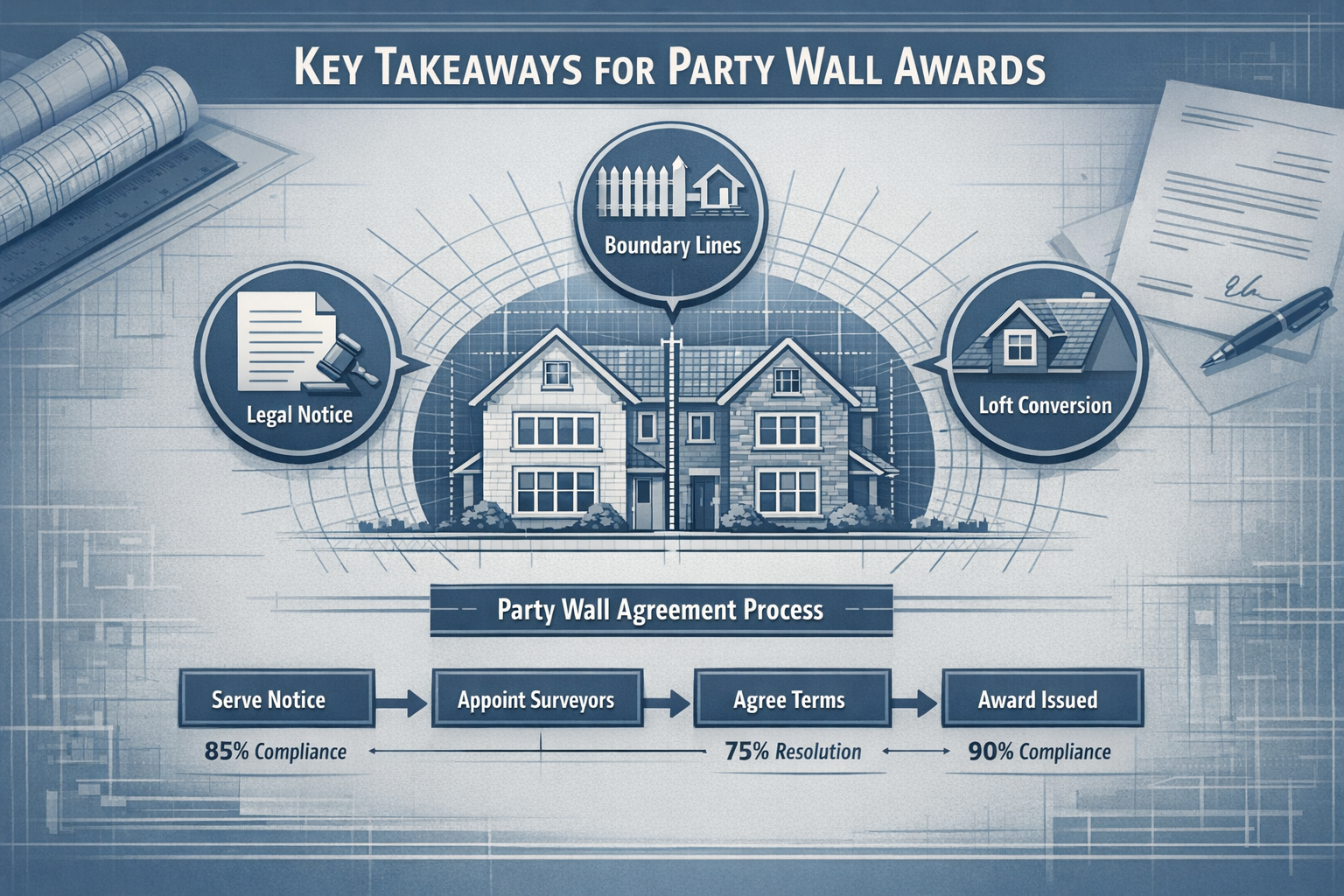
Key Takeaways
- Two-month notice period applies to most loft conversion works affecting party structures, with up to one year permitted to commence construction after serving notice
- Five validity requirements must be met for party wall notices: correct statutory route, accurate work descriptions, proper service to all adjoining owners, supporting documentation, and accurate property details
- Party Wall Awards must include specific safeguard clauses covering Schedule of Condition surveys, vibration monitoring protocols, access arrangements, and dispute resolution procedures
- Non-compliance risks include court injunctions halting construction, increased legal costs, and damaged neighbour relations
- Not all loft conversions require party wall procedures—minor works and conversions not affecting shared structures may proceed without formal agreements
Understanding Party Wall Act Triggers for Loft Conversions and Roof Works
Which Loft Conversion Works Trigger the Party Wall Act?
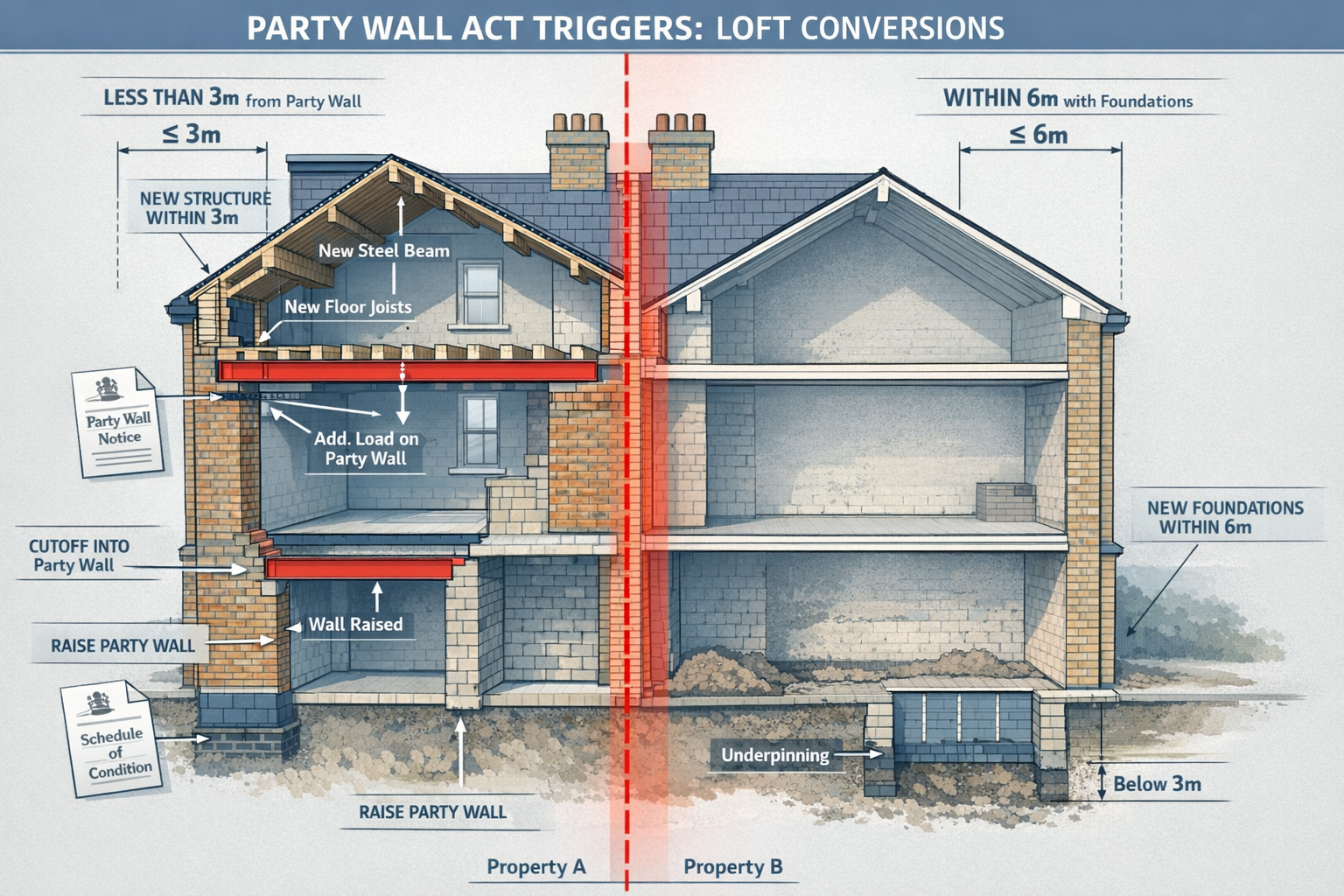
Loft conversions triggering the Party Wall etc. Act 1996 typically involve structural work affecting shared walls or boundaries. The most common triggers include:
🔨 Installing steel beams into party walls – Supporting new floor joists or roof structures often requires cutting into or bolting through the shared wall between properties[1].
📏 Raising party wall heights – Extending the party wall upward to accommodate increased ceiling height or new roof structures constitutes notifiable work under Section 2(2)(a) of the Act.
🏗️ Creating new openings or enlarging existing ones – Cutting through party walls for stairs, access points, or structural modifications requires formal notice.
🔩 Inserting damp-proof courses or wall plates – Any work involving cutting into the party structure, even for protective measures, falls under the Act’s scope.
⚡ Underpinning or foundation work – Excavation within three or six meters of neighbouring foundations (depending on depth) triggers Section 6 notice requirements.
It’s crucial to understand that not all loft conversions require party wall procedures. If the conversion involves no construction work on walls adjoining other properties—such as a straightforward internal reconfiguration without structural alterations to shared elements—the Act does not apply[2]. Minor works like plastering, electrical installations, or drilling internal walls for fixtures also fall outside the Act’s scope[2].
For detailed information about which works require formal procedures, consult our guide on types of party wall works.
The Three Statutory Notice Routes
The Party Wall etc. Act 1996 provides three distinct notice routes, and selecting the correct one is essential for validity[3]:
| Notice Type | Section | When Required | Notice Period |
|---|---|---|---|
| Party Structure Notice | Section 2 | Work directly to existing party walls or structures | 2 months |
| Line of Junction Notice | Section 1 | Building new walls at or astride the boundary line | 1 month |
| Adjacent Excavation Notice | Section 6 | Excavation within 3m (deeper than neighbour’s foundations) or 6m (within 45° angle) | 1 month |
Most loft conversions involving existing party walls require a Party Structure Notice under Section 2, which carries a two-month notice period before structural work can commence[2]. This extended timeframe allows neighbours adequate time to consider the proposals, appoint surveyors if needed, and ensure protective measures are established.
Understanding these statutory routes is fundamental to serving valid notices. Mixing up different notice types or applying the wrong statutory route is a primary cause of notice defectiveness[3]. For comprehensive guidance, see our article on party wall notices.
Urban 2026 Residential Trends Affecting Party Wall Requirements
The 2026 residential landscape in England’s urban centres presents unique challenges for party wall procedures:
🏙️ Increased density – Terraced housing and semi-detached properties dominate urban areas, meaning virtually every loft conversion affects neighbouring properties.
📈 Property value pressures – Rising property prices drive homeowners to maximize existing space through loft conversions rather than relocating, increasing party wall case volumes.
🌱 Sustainability focus – Modern loft conversions incorporate energy-efficient materials and insulation upgrades, sometimes requiring more extensive structural modifications to party walls.
⚖️ Heightened legal awareness – Neighbours in 2026 are more informed about their rights under the Party Wall Act, leading to increased scrutiny of notices and more frequent surveyor appointments.
🔧 Complex building techniques – Contemporary construction methods involving steel frames, engineered timber, and prefabricated elements require clearer technical descriptions in party wall notices.
These trends underscore the importance of thorough preparation, accurate documentation, and professional surveyor involvement when planning loft conversions in urban settings.
Notice Requirements for Party Wall Awards in Loft Conversions
The Five Validity Requirements for Party Wall Notices
Valid party wall notices must satisfy five critical requirements to be legally effective[3]:
1️⃣ Correct Statutory Route – The notice must cite the appropriate section of the Party Wall etc. Act 1996. Using the wrong notice type invalidates the entire procedure and requires re-serving with correct statutory references.
2️⃣ Accurate Work Descriptions – Vague or ambiguous descriptions are the primary cause of notice defectiveness[3]. The notice must clearly articulate:
- Specific structural interventions (e.g., “installation of 203x133mm universal steel beam at first-floor ceiling level, bearing 150mm into party wall”)
- Extent and depth of work
- Methods and materials to be used
- Duration and phasing of construction
3️⃣ Identification and Service to All Adjoining Owners – Every person with an interest in the adjoining property must receive notice, including:
- Freeholders
- Leaseholders with sufficient remaining term
- Mortgagees in possession
- Tenants with repairing obligations
Failing to identify and serve all relevant parties renders the notice invalid and can result in legal challenges.
4️⃣ Supporting Plans and Sections – Where the nature or depth of works is unclear from the written description alone, accompanying drawings are mandatory. These should include:
- Floor plans showing party wall locations and proposed beam positions
- Cross-sections illustrating depth of cutting or insertion
- Elevation drawings for raised party walls
- Foundation details for excavation work
5️⃣ Accurate Owner and Property Details – The notice must correctly identify:
- Building owner’s full name and address
- Property address where works will occur
- Adjoining owner’s name and property address
- Date of proposed commencement (must allow full notice period)
For practical guidance on preparing valid notices, review our resource on party wall act notices and how to respond.
Timeline: From Notice to Award to Commencement
Understanding the procedural timeline is essential for project planning:
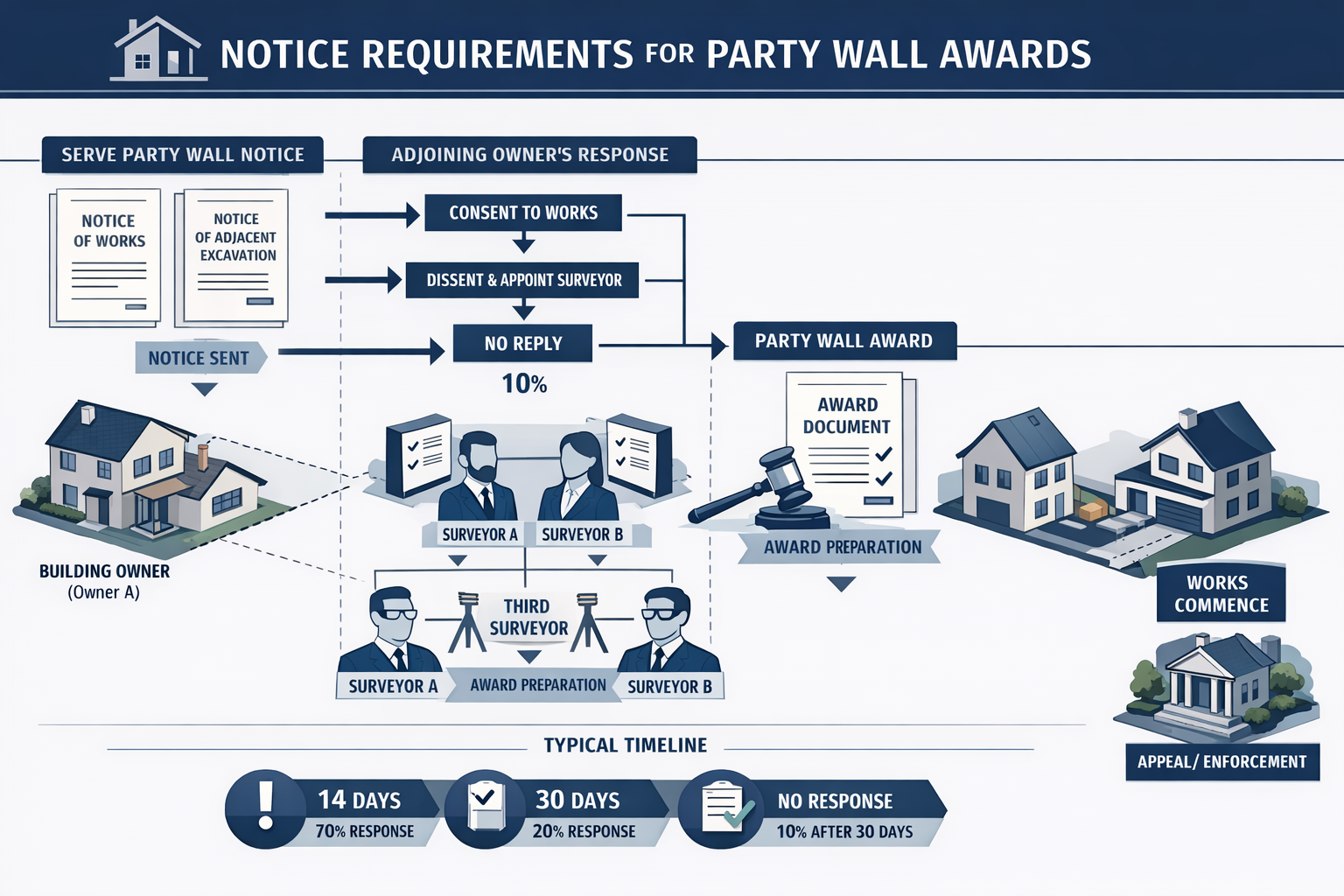
📅 Day 0: Notice Served – The two-month countdown begins when the Party Structure Notice is properly served to all adjoining owners. Service can be by hand delivery, recorded delivery post, or through letterbox delivery with proof.
📅 Days 1-14: Neighbour Response Period – Adjoining owners have 14 days to respond in writing. They can either:
- Consent to the works (ending the formal process)
- Dissent or fail to respond (triggering the surveyor appointment process)
- Request additional information (pausing the timeline)
📅 Days 15-24: Surveyor Appointments – If dissent occurs or no response is received, surveyors must be appointed. The building owner and adjoining owner can each appoint their own surveyor, or both parties can agree on a single “Agreed Surveyor.”
📅 Days 25-60: Award Preparation – Surveyors conduct site inspections, prepare Schedules of Condition, negotiate protective measures, and draft the Party Wall Award document. Complex loft conversions may require extended negotiation periods.
📅 Day 60+: Earliest Commencement Date – Works cannot legally commence until the two-month notice period expires AND either written consent is obtained or a Party Wall Award is finalized.
📅 Up to 12 Months: Flexibility Window – Once a valid notice is served, homeowners have up to one year before beginning construction, allowing flexibility in project scheduling and contractor availability[2].
⚠️ Critical Warning: Beginning work before the notice period expires or without proper consent/award in place exposes building owners to court injunctions, which can halt construction entirely and result in significant financial penalties[1].
Learn more about the complete process in our guide on party wall awards.
Essential Safeguard Clauses in Party Wall Awards for Roof Works
Schedule of Condition: The Foundation of Protection
A Schedule of Condition is the most critical protective element in any Party Wall Award for loft conversions. This detailed photographic and written record establishes the baseline condition of the adjoining owner’s property before works commence[4].
Why Schedules of Condition Are Mandatory:
✅ Establishes pre-existing conditions – Documents cracks, settlement, decorative condition, and structural elements before any vibration or movement occurs
✅ Provides dispute resolution evidence – Creates objective record for determining whether damage resulted from the notified works or existed previously
✅ Protects both parties – Building owners can demonstrate they didn’t cause pre-existing damage; adjoining owners have proof of their property’s original state
✅ Reduces post-construction claims – Clear baseline documentation minimizes disagreements about responsibility for repairs[4]
Best Practice Schedule of Condition Contents:
📸 Comprehensive photography – High-resolution images of:
- All rooms in the adjoining property
- Ceiling and wall surfaces adjacent to party structures
- External elevations and roof areas
- Existing cracks, staining, or defects (with measurements)
- Decorative finishes and fixtures
📝 Written descriptions – Detailed narrative accompanying photographs, noting:
- Room dimensions and layouts
- Construction materials and age
- Condition ratings (excellent, good, fair, poor)
- Specific defects with measurements and locations
- Date and time of inspection
🔍 Professional surveyor involvement – Qualified party wall surveyors should commission and review Schedules of Condition to ensure completeness and objectivity[4].
For more information about protective documentation, visit our page on schedule of condition.
Sample Vibration Monitoring Clauses for Loft Conversions
Modern Party Wall Awards for loft conversions increasingly include vibration monitoring provisions, particularly in urban 2026 contexts where properties are older and more susceptible to construction impacts.
Sample Clause 1: Basic Vibration Monitoring
“The Building Owner shall ensure that vibration monitoring equipment is installed at the adjoining property prior to commencement of works involving cutting, drilling, or insertion of structural elements into the party wall. Monitoring shall record peak particle velocity (PPV) and shall not exceed 10mm/s at any time. Records shall be provided to the Adjoining Owner’s surveyor weekly throughout the construction period.”
Sample Clause 2: Enhanced Monitoring with Thresholds
“Continuous vibration monitoring shall be implemented with the following thresholds:
- Alert Level: 5mm/s PPV – Building Owner to review working methods
- Action Level: 8mm/s PPV – Works to cease immediately; surveyors to inspect
- Maximum Limit: 10mm/s PPV – Not to be exceeded under any circumstances
Real-time monitoring data shall be accessible to both appointed surveyors via secure web portal. Any exceedance of Action Level requires 24-hour notification to all parties.”
Sample Clause 3: Specific Equipment and Methodology
“The Building Owner shall engage a specialist monitoring company approved by both surveyors to install tri-axial seismographs at the following locations:
- Ground floor party wall, 1.5m from floor level
- First floor party wall, adjoining proposed beam insertion point
- External facade, nearest point to construction activity
Monitoring shall commence 48 hours before works begin to establish baseline readings. Equipment shall remain in place until practical completion of all structural works affecting the party wall.”
These clauses reflect 2026 best practices for protecting historic and sensitive properties during intensive loft conversion work.
Access Rights and Arrangements
Party Wall Awards must clearly define access rights for surveyors and contractors to the adjoining property. Ambiguous access provisions are a common source of disputes.
Sample Clause 4: Surveyor Access for Inspections
“The Adjoining Owner shall permit the Building Owner’s surveyor and contractor reasonable access to the adjoining property for the following purposes:
- Initial Schedule of Condition survey (minimum 2 hours)
- Progress inspections during structural works (maximum 4 visits)
- Final completion inspection within 14 days of practical completion
Access requests shall be made with minimum 7 days’ written notice, specifying date, time, duration, and purpose. The Adjoining Owner may require access to occur during business hours (9:00-17:00, Monday-Friday) and may be present during all inspections.”
Sample Clause 5: Contractor Access for Specific Works
“Where insertion of structural elements requires access to the adjoining property, the Building Owner’s contractor shall be permitted access on the following terms:
- Maximum 2 operatives for maximum 4 hours per access occasion
- Minimum 14 days’ written notice with detailed method statement
- All floor areas to be protected with heavy-duty sheeting
- Contractor to provide £5 million public liability insurance evidence
- Adjoining Owner or representative entitled to be present
- Access limited to rooms directly adjacent to party wall work areas”
Sample Clause 6: Emergency Access Provisions
“In the event of emergency requiring immediate access to prevent damage to either property, the Building Owner or contractor may access the adjoining property with minimum 2 hours’ telephone notice. Emergency access is limited to:
- Water leaks or flooding affecting party structures
- Structural instability requiring immediate shoring
- Fire safety concerns
All emergency access occasions shall be documented with photographic evidence and written reports provided to both surveyors within 24 hours.”
Clear access provisions reduce friction between neighbours and ensure necessary inspections and works can proceed efficiently.
Dispute Resolution and Variation Procedures
Comprehensive Party Wall Awards include mechanisms for resolving disagreements and managing changes during construction.
Sample Clause 7: Variation Procedure
“Any material variation to the works described in this Award requires written agreement from both appointed surveyors. Material variations include:
- Changes to structural methodology or beam sizes
- Additional cutting or insertion into party structures
- Extended construction duration beyond 6 months
- Use of different materials than specified
Requests for variations shall be submitted with updated drawings and method statements. Surveyors shall respond within 14 days. Disputed variations shall be resolved through the dispute resolution procedure below.”
Sample Clause 8: Dispute Resolution Mechanism
“In the event of disagreement between the appointed surveyors regarding interpretation of this Award, protective measures, or damage assessment, the matter shall be referred to the Third Surveyor appointed herein. The Third Surveyor shall:
- Inspect both properties within 7 days of referral
- Receive written submissions from both party wall surveyors
- Issue a binding determination within 21 days
- Allocate costs of the determination between the parties
The Third Surveyor’s determination is final and binding, subject only to appeal to the County Court within 14 days under Section 10(17) of the Party Wall etc. Act 1996.”
These procedural safeguards ensure that construction can proceed even when disagreements arise, without resorting immediately to costly litigation.
For guidance on managing costs throughout the party wall process, see our article on how to keep party wall costs down.
Practical Considerations for Building Owners and Adjoining Owners
Building Owner Responsibilities and Best Practices
If you’re planning a loft conversion as a building owner, understanding your obligations under the Party Wall etc. Act 1996 is essential for smooth project execution.
✅ Early Planning – Integrate party wall procedures into project timelines from the outset. The two-month notice period plus Award preparation time can add 3-4 months to project schedules.
✅ Accurate Descriptions – Work with your architect and structural engineer to provide precise technical descriptions in notices. Vague descriptions lead to invalid notices and delays[3].
✅ Professional Surveyor Appointment – Engage a qualified party wall surveyor early in the process. Their expertise ensures compliance and reduces dispute risks. Browse our resources for building owners.
✅ Contractor Briefing – Ensure your contractor understands Party Wall Award conditions, particularly:
- Working hours restrictions
- Vibration limits and monitoring requirements
- Access protocols for adjoining properties
- Protective measures and insurance requirements
✅ Cost Responsibility – Building owners typically bear all reasonable party wall costs, including:
- Both surveyors’ fees (when separate surveyors are appointed)
- Schedule of Condition preparation
- Monitoring equipment installation and reporting
- Third Surveyor fees if disputes arise
For detailed cost information, visit our page on costs of party wall process.
✅ Maintaining Good Relations – While legal procedures are necessary, maintaining positive neighbour relationships smooths the process considerably. Consider:
- Personal conversation before serving formal notice
- Sharing detailed plans and visualizations
- Offering to address reasonable concerns proactively
- Providing direct contact information for questions
✅ Insurance Verification – Ensure your contractor maintains adequate public liability insurance (minimum £5-10 million) covering party wall works specifically.
Adjoining Owner Rights and Response Options
As an adjoining owner receiving party wall notice for a neighbour’s loft conversion, you have specific rights and response options.
📋 Your Rights Include:
🛡️ Protection from damage – The Party Wall Act requires building owners to make good any damage caused by notified works
🔍 Professional surveyor appointment – You can appoint your own surveyor (at the building owner’s expense) to protect your interests
📸 Schedule of Condition – Detailed record of your property’s condition before works commence
⚖️ Award conditions – Safeguard clauses covering working hours, access, vibration limits, and protective measures
💰 Cost recovery – Building owners pay reasonable surveyor fees and monitoring costs
📝 Response Options Within 14 Days:
Option 1: Consent – If you’re comfortable with the proposed works and trust your neighbour, you can provide written consent. This ends the formal process but provides minimal protection. Consider requesting a Schedule of Condition even when consenting.
Option 2: Dissent or Non-Response – Triggers the surveyor appointment process and Award preparation. This is the recommended approach for significant loft conversions, as it ensures professional oversight and protective measures.
Option 3: Appoint Your Own Surveyor – Provides maximum protection through independent professional representation. Your surveyor will negotiate Award conditions on your behalf.
Option 4: Agree to Shared “Agreed Surveyor” – Both parties use one surveyor, reducing costs while maintaining professional oversight. Requires mutual trust and agreement.
For comprehensive guidance on your rights, visit our page for adjoining owners.
⚠️ Common Mistakes to Avoid:
❌ Ignoring notices – Non-response triggers surveyor appointment anyway; engaging early provides more control
❌ Unreasonable objections – The Act doesn’t allow you to prevent reasonable works, only ensure they’re done safely with appropriate safeguards
❌ Delaying surveyor appointment – Delays extend the overall timeline and can create tension with neighbours
❌ Attempting DIY agreements – While possible for very minor works, loft conversions warrant professional surveyor involvement for adequate protection
When Professional Surveyor Involvement Is Essential
While the Party Wall etc. Act 1996 technically permits neighbours to reach agreements without surveyors, professional involvement is essential for loft conversions due to their structural complexity and potential for causing damage.
🎓 Situations Requiring Professional Surveyors:
🏗️ Structural beam installation – Cutting into or bolting through party walls requires technical assessment of load distribution and structural integrity
📐 Raised party walls – Increasing wall height affects structural loading and requires careful specification of materials, ties, and damp-proofing
🔨 Complex construction methods – Modern engineered solutions need professional evaluation to ensure neighbouring property protection
🏚️ Older or historic properties – Pre-1900 buildings with lime mortar, lath-and-plaster, or timber frames are particularly vulnerable to construction vibration
⚖️ High-value properties – Where potential damage claims could be substantial, professional documentation is essential
🤝 Strained neighbour relations – Independent surveyors provide objective mediation when trust is limited
Benefits of Professional Surveyor Involvement:
✅ Technical expertise in structural engineering and construction methods
✅ Legal knowledge of Party Wall Act procedures and case law
✅ Objective assessment free from emotional investment
✅ Professional indemnity insurance covering advice and Award preparation
✅ Dispute resolution experience to navigate disagreements efficiently
✅ Comprehensive documentation protecting both parties’ interests
For information on appointing surveyors, see our pages on building owners surveyor and adjoining owners surveyor.
Regional Considerations Across London
Party wall procedures are consistent across England and Wales under the Act, but practical considerations vary by London region due to housing stock characteristics and construction density.
🏙️ Central London – Predominantly Victorian and Georgian terraced properties with complex party wall arrangements. Higher property values increase scrutiny and surveyor involvement rates. Party wall surveyor Central London.
🌆 East London – Mix of Victorian terraces and post-war housing. Rapid gentrification drives high loft conversion volumes. Party wall surveyor East London.
🏘️ North London – Edwardian and Victorian semi-detached properties common. Strong community awareness of party wall rights. Party wall surveyor North London.
🌳 South London – Diverse housing stock from Victorian terraces to 1930s semi-detached. Growing loft conversion market. Party wall surveyor South London.
🏡 West London – High-value properties with sophisticated party wall procedures. Professional surveyor involvement nearly universal. Party wall surveyor West London.
Understanding regional housing characteristics helps anticipate party wall challenges specific to your location.
Conclusion
Party Wall Awards for Loft Conversions and Roof Works: Notice Requirements and Safeguard Clauses represent a critical legal framework protecting both building owners’ development rights and adjoining owners’ property interests. As urban residential density increases in 2026, understanding these procedures becomes essential for successful loft conversion projects.
The key principles to remember:
✅ Serve valid notices meeting all five validity requirements at least two months before commencing structural work
✅ Engage professional surveyors for loft conversions involving party structures—the technical complexity and potential damage risks warrant expert involvement
✅ Include comprehensive safeguard clauses in Party Wall Awards covering Schedules of Condition, vibration monitoring, access arrangements, and dispute resolution
✅ Maintain clear communication with neighbours throughout the process, even when formal procedures are required
✅ Plan adequate timelines incorporating 3-4 months for party wall procedures into overall project schedules
✅ Understand cost responsibilities—building owners bear reasonable party wall costs as the price of exercising development rights
Next Steps
For Building Owners Planning Loft Conversions:
- Consult your architect/structural engineer to identify which works trigger Party Wall Act requirements
- Engage a qualified party wall surveyor at the design stage to review plans and prepare valid notices
- Serve notices allowing the full two-month period plus Award preparation time
- Brief your contractor on Award conditions and protective measures before work begins
- Maintain documentation throughout construction for dispute resolution if needed
For Adjoining Owners Receiving Notices:
- Read the notice carefully and verify it describes the proposed works accurately
- Appoint your own surveyor within 14 days for significant loft conversions
- Request Schedule of Condition to document your property’s baseline condition
- Review the draft Award to ensure adequate safeguard clauses are included
- Maintain records of any concerns or issues during construction
For Both Parties:
Consider reviewing our comprehensive resources on party wall procedures and exploring whether having a party wall agreement without a surveyor is appropriate for your specific circumstances.
The Party Wall etc. Act 1996 provides a balanced framework enabling necessary property development while protecting neighbours from damage and disruption. By understanding notice requirements and incorporating robust safeguard clauses in Party Wall Awards, loft conversion projects can proceed smoothly with minimized dispute risks and preserved neighbour relationships.
References
[1] Party Wall Surveyor Loft Conversion – biggerlivinglofts.com
[2] Party Wall Agreement – hoa.org.uk
[3] What Makes A Party Wall Notice Valid – houricanassociates.com
[4] Schedules Of Condition In Party Wall Works Best Practices To Prevent Post Construction Claims In 2026 – https://nottinghillsurveyors.com/blog/schedules-of-condition-in-party-wall-works-best-practices-to-prevent-post-construction-claims-in-2026
Speak to a RICS chartered party wall surveyor
Free initial consultation. Notices, awards and schedules of condition across London and nationwide.