


Nearly one in three party wall disputes that reach formal surveyor involvement could have been avoided with a correctly drafted notice from the start. A defective notice does not just delay a project — it can reset the entire statutory clock, leaving building owners weeks or even months behind schedule before a single brick is moved.
Understanding what a party wall notice must include in 2026: a surveyor's checklist for faster responses and fewer disputes is therefore not a bureaucratic exercise. It is the single most effective risk-management step a building owner can take before notifiable works begin. This guide breaks down every required element from a working surveyor's perspective, flags the omissions that most commonly derail projects, and gives property owners and their agents a practical framework for getting it right the first time.
Key Takeaways 📋
- A party wall notice is only legally valid when it contains all the elements required by the Party Wall etc. Act 1996 — missing even one can make it void.
- The type of notice (Line of Junction, Party Structure, or Three Metre/Six Metre) determines which details must be included.
- Timing errors — serving too early or too late — are among the most common and most damaging mistakes.
- A clear, specific description of the proposed works dramatically reduces the likelihood of a neighbour dissenting or disputing.
- Professional surveyors can spot defects before service, saving significant time and cost downstream.
The Legal Foundation: What the Party Wall Act Actually Requires
The Party Wall etc. Act 1996 sets out three distinct notice types, each with its own content requirements. Knowing which notice applies to a specific project is the essential first step.
The Three Notice Types at a Glance
| Notice Type | When It Applies | Minimum Notice Period |
|---|---|---|
| Line of Junction Notice | Building a new wall on or at the boundary | 1 month |
| Party Structure Notice | Works to an existing party wall or structure | 2 months |
| Three Metre / Six Metre Notice | Excavations near a neighbour's foundations | 1 month |
💡 Pull Quote: "Serving the wrong type of notice is as problematic as serving no notice at all — the statutory protections simply do not apply."
Many building owners serve a Party Structure Notice when they should be serving a Line of Junction Notice, or vice versa. This is not a technicality — it changes the rights and obligations of both parties under the Act. For a deeper look at the Party Structure Notice specifically, the guide on what a Party Structure Notice is and how to serve it in London is an excellent starting point.
Core Elements Every Valid Notice Must Contain
Regardless of notice type, the Act specifies a set of mandatory elements. Think of these as the non-negotiable baseline — the floor, not the ceiling.
1. 📍 Full Names and Addresses of All Parties
The notice must clearly identify:
- The building owner (the person carrying out the works) — full legal name and current address
- The adjoining owner (the neighbour affected) — full legal name and the address of the property affected
Common omission: Using a trading name or abbreviated name rather than the legal owner's name. If the property is owned jointly, all owners must be named. Missing a joint owner can invalidate the notice entirely.
2. 🏠 Accurate Description of the Property
The notice must describe the property at which the works are to be carried out with enough precision that there is no ambiguity. This means:
- Full postal address, including postcode
- Description of the building type (e.g., mid-terrace, semi-detached, flat within a converted Victorian house)
For properties where the definition of a party wall or party fence wall is not immediately obvious — such as boundary walls in gardens — additional description of the relevant structure is advisable.
3. 🔨 Detailed Description of the Proposed Works
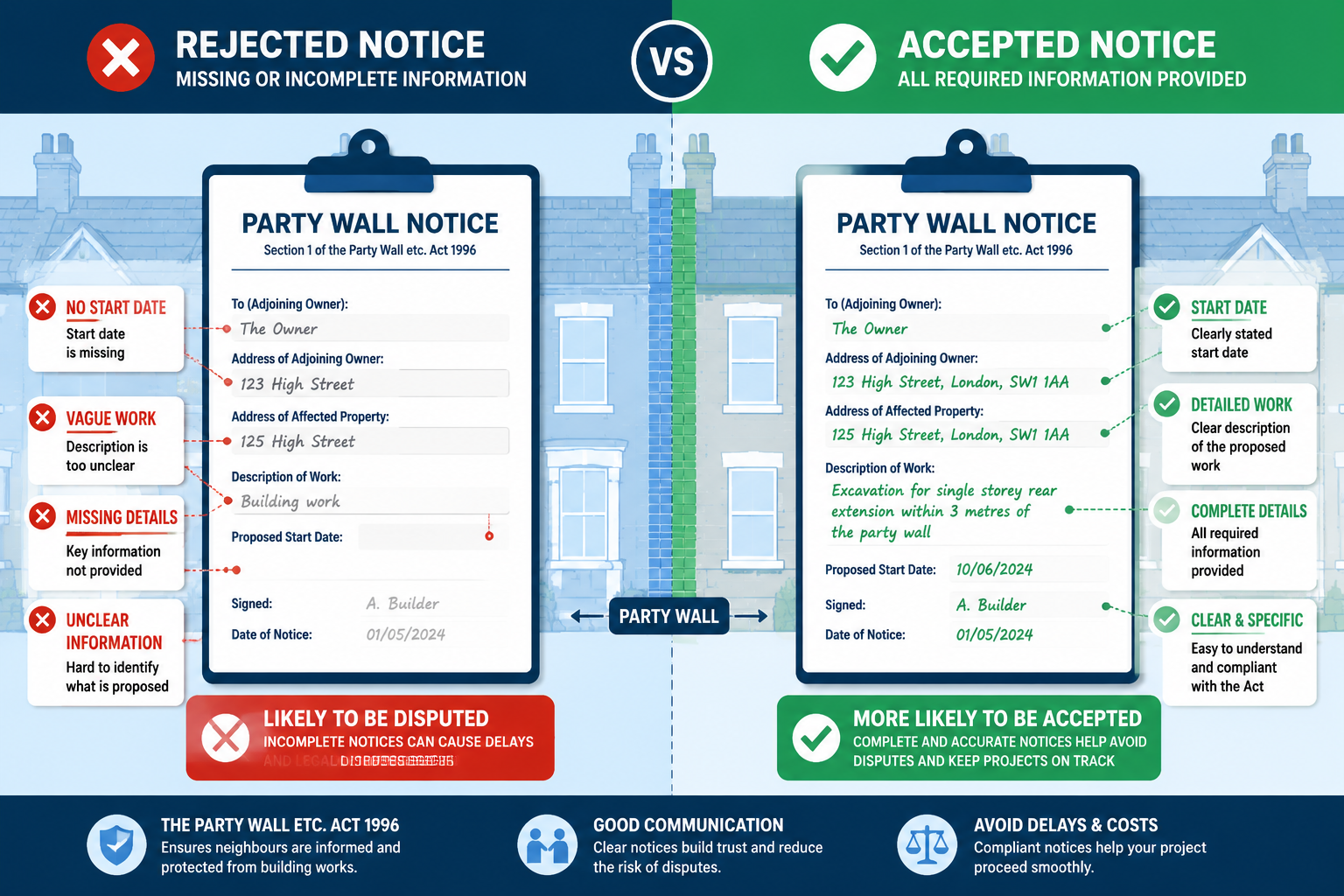
This is the element most frequently drafted too vaguely, and it is the single biggest driver of unnecessary disputes and dissents.
A valid and effective works description should include:
- Nature of the works — e.g., removal of chimney breast, insertion of RSJ, underpinning, loft conversion
- Location of the works — which wall, which floor, which part of the structure
- Method of working — where relevant, e.g., hand-digging vs. mechanical excavation
- Extent of the works — dimensions, depth of excavations, height of new walls
What to avoid: Vague phrases such as "general building works," "loft conversion works," or "basement works." These descriptions give the adjoining owner nothing concrete to assess, almost guaranteeing either a request for more information or an outright dissent.
⚠️ Surveyor's Note: A specific, well-drafted works description is the single most effective tool for achieving consent rather than dissent. Adjoining owners — and their surveyors — are far more likely to consent when they understand exactly what is being proposed.
4. 📅 The Proposed Start Date
The Act requires the notice to state the date on which the building owner proposes to start the works. This date must respect the statutory notice period:
- 2 months for Party Structure Notices
- 1 month for Line of Junction and excavation notices
Timing pitfalls to avoid:
- Stating a start date that is before the notice period has elapsed
- Serving a notice so far in advance that the proposed start date has passed by the time the adjoining owner responds
- Failing to state a start date at all (surprisingly common)
The notice period runs from the date of service, not the date the notice is written or signed. If the notice is posted, allow for postal delivery time.
5. ✍️ Signature and Date of Service
The notice must be signed by the building owner (or their authorised agent, such as a surveyor or solicitor) and dated. The date of signing should match — or precede — the date of service.
The Surveyor's Checklist: What a Party Wall Notice Must Include in 2026
The following checklist reflects current best practice for 2026, incorporating the practical lessons experienced surveyors have learned from notices that have been challenged, rejected, or that have generated unnecessary disputes.
✅ Pre-Service Checklist
Ownership verification
- Confirmed the building owner's full legal name via Land Registry
- Identified all adjoining owners (including leaseholders where applicable)
- Confirmed the adjoining owner's current address for service
Notice type selection
- Identified the correct notice type(s) for the works
- Confirmed whether multiple notices are required (e.g., both a Party Structure Notice and a Three Metre Notice)
Works description
- Works described in plain English with sufficient technical detail
- Location of works clearly identified
- Drawings or plans attached where the works are complex
Timing
- Proposed start date allows for the full statutory notice period
- Contingency built in for postal delivery or re-service if needed
Service method
- Notice will be served by hand, recorded post, or another legally valid method
- Proof of service will be retained
✅ Notice Content Checklist
| Element | Required? | Notes |
|---|---|---|
| Building owner's full name | ✅ Yes | Legal name, not trading name |
| Building owner's address | ✅ Yes | Current address |
| Adjoining owner's full name | ✅ Yes | All owners if jointly held |
| Adjoining owner's address | ✅ Yes | Address of affected property |
| Description of property | ✅ Yes | Full address and building type |
| Description of works | ✅ Yes | Specific, not generic |
| Proposed start date | ✅ Yes | Must respect notice period |
| Signature | ✅ Yes | Building owner or authorised agent |
| Date | ✅ Yes | Date of signing/service |
| Plans/drawings | ⚠️ Recommended | Required for complex works |
| Statement of rights | ⚠️ Best practice | Helps adjoining owner understand their options |
Common Omissions That Delay Projects ⏱️
Understanding what a party wall notice must include in 2026: a surveyor's checklist for faster responses and fewer disputes is only half the battle. Knowing what routinely goes wrong is equally valuable.
Omission 1: Missing Leaseholder Notification
Where a property is leasehold, the Act requires notice to be served on both the leaseholder and the freeholder if the works affect them. Serving only the freeholder — or only the leaseholder — is a common error that can invalidate the process.
Omission 2: Vague or Incomplete Works Descriptions
As noted above, this is the most frequent cause of dissent and delay. An adjoining owner who cannot understand what is being proposed will almost always dissent, triggering the formal surveyor appointment process. A clear description can mean the difference between a two-week consent and a two-month dispute process.
For building owners who want to understand the full range of types of party wall works and how they are described in notices, reviewing this resource before drafting is strongly recommended.
Omission 3: Incorrect Service Method
The Act specifies valid methods of service. Email alone is not a recognised method of service under the Act (unless the adjoining owner has explicitly agreed to receive notices electronically). Notices served by email only — without confirmation of acceptance — may be invalid.
Valid methods include:
- Personal delivery to the adjoining owner
- Leaving the notice at the adjoining owner's last known address
- Recorded post to the adjoining owner's last known address
- Posting through the letterbox of the affected property
Omission 4: No Acknowledgement of the Adjoining Owner's Rights
While not strictly a legal requirement for validity, a notice that fails to explain the adjoining owner's options — consent, dissent, or counter-notice — is far more likely to generate confusion and delay. Best practice in 2026 is to include a brief explanatory note or accompanying letter.
For adjoining owners who have received a notice and are unsure how to respond, the guide on party wall act notices and how to respond provides clear guidance.
Omission 5: Serving Notice Too Late
The statutory notice periods are minimum periods. Serving a notice just two months before a planned start date for Party Structure works leaves no room for dissent, counter-notice, or surveyor appointment. Experienced surveyors recommend building in an additional four to six weeks of contingency.
When Plans and Drawings Are Required
For straightforward works — such as minor repairs to a party wall — a written description may be sufficient. However, for more complex projects, attaching plans is not just good practice; it is often essential for the notice to be meaningful.
Works that almost always require accompanying drawings:
- Basement excavations or underpinning
- Loft conversions involving the party wall
- Extensions that involve cutting into or building off the party wall
- New walls built up to or astride the boundary
Plans should be drawn to a recognisable scale, clearly annotated, and cross-referenced in the notice text. Where a schedule of condition will be required, noting this in the notice can also help set expectations and reduce friction.

Serving the Notice: Practical Steps for 2026
Once the notice is correctly drafted, service must be executed carefully to preserve its validity.
Step-by-Step Service Process
- Date the notice on the day it will be served
- Make at least two copies — one for the adjoining owner, one for your records
- Serve by a valid method (see above)
- Retain proof of service — a signed receipt if hand-delivered, or a recorded delivery tracking reference if posted
- Diarise the response deadline — the adjoining owner has 14 days to respond in writing; if no response is received, they are deemed to have dissented
If the adjoining owner dissents or fails to respond, the formal dispute resolution process under the Act begins. At this point, both parties will need surveyors. Understanding the role of a building owner's surveyor and an adjoining owner's surveyor helps both sides navigate the process efficiently.
The Cost of Getting It Wrong
A defective notice does not simply delay a project — it can have real financial consequences:
- Wasted notice periods: If a notice is void, the clock resets. A two-month notice period lost to a drafting error can push a project start back by a full season.
- Injunctions: Adjoining owners can apply to court to stop works carried out without a valid notice. Court costs and project delays can run into thousands of pounds.
- Increased surveyor fees: Disputes generated by poorly drafted notices require more surveyor time to resolve, directly increasing costs. For guidance on managing these costs, see the resource on how to keep party wall costs down.
- Damaged neighbour relationships: Perhaps the most underestimated cost — a poorly handled notice process can create lasting tension between neighbours that outlasts the building works by years.
💡 Pull Quote: "The cost of a professionally drafted notice is almost always a fraction of the cost of the delays and disputes that a defective one creates."
Conclusion: Get the Notice Right, Get the Project Moving
The requirements for what a party wall notice must include in 2026: a surveyor's checklist for faster responses and fewer disputes have not changed dramatically from the original Act — but the practical lessons of nearly three decades of case law and surveyor experience have sharpened our understanding of what actually works.
Actionable Next Steps ✅
- Identify the correct notice type for your specific works before drafting anything.
- Use the checklist above to verify every required element is present before service.
- Write a specific, detailed works description — vagueness is the enemy of consent.
- Serve with adequate lead time — build contingency into your project programme.
- Retain proof of service — this is your protection if the process is later challenged.
- Consider professional help — a qualified party wall surveyor can draft, check, and serve notices correctly, reducing the risk of costly errors.
For building owners carrying out works in London, specialist support is available across all areas. Whether the project is in South London, North London, or anywhere else in the capital, local expertise makes a measurable difference in how smoothly the party wall process runs.
A correctly drafted and properly served notice is not just a legal formality — it is the foundation on which a smooth, dispute-free project is built. 🏗️