
Last updated: October 20, 2026
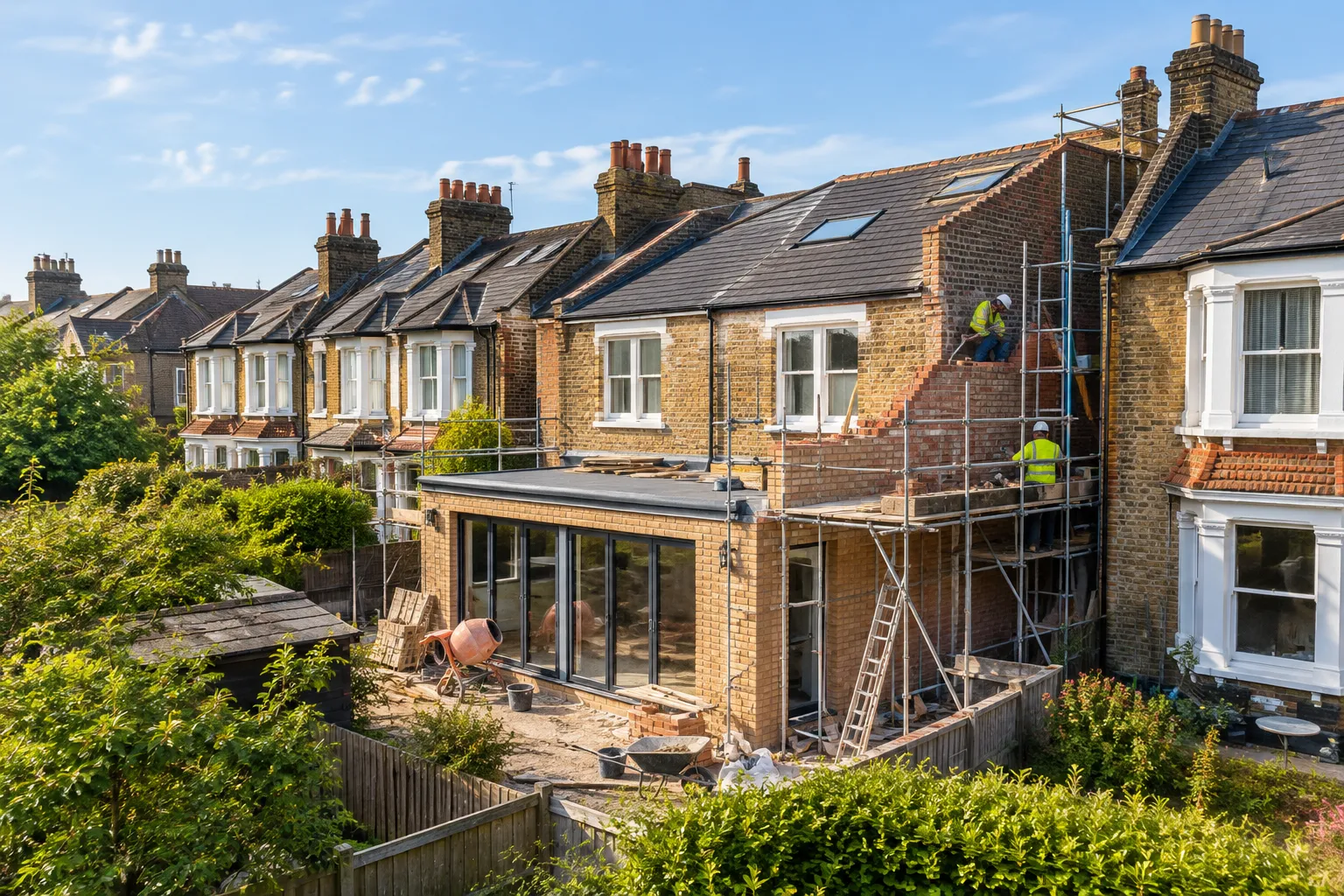
Eight percent fewer sales were agreed across Britain in the four weeks to mid-October 2026 than in the same period last year, according to Rightmove’s October House Price Index, published 19 October 2026. In London, where the average asking price now sits at £673,942, homes are taking 78 days to find a buyer. For many homeowners, that arithmetic is tipping the extend-or-move decision firmly towards staying put and building out.
Quick Answer
With London sales down 8%, buyer enquiries down 9%, and typical new mortgage costs up roughly £250 a month according to Rightmove’s October 2026 data, extending has become the more attractive option for many London homeowners this autumn. Anyone planning a loft conversion, rear extension or basement dig that touches a shared wall, boundary or nearby foundations needs to understand the Party Wall etc. Act 1996, because skipping notices can delay or derail a project even when the building work itself is straightforward.
Key Takeaways
- Agreed sales in Britain fell 8% and buyer enquiries fell 9% in October 2026 versus October 2025 (Rightmove).
- 38% of London listings have had a price reduction; reduced homes take 119 days to sell versus 39 days for correctly priced ones (Rightmove, October 2026).
- Rightmove’s average two-year fixed mortgage rate is 5.55%, up from 5.29% a month earlier and 4.25% in February 2026, adding about £250 a month to a typical new mortgage.
- Tembo reported average two-year and five-year fixed rates near 6% (5.97% and 5.99%) on 15 October 2026.
- The Autumn Budget lands on 28 October 2026 and the Bank of England’s next rate decision is 5 November 2026, with markets pricing in a possible rise.
- The Prime Minister has ruled out changing stamp duty in this Budget, removing one layer of uncertainty for movers.
- The Party Wall etc. Act 1996 applies to work on shared walls, boundary building, and excavation within 3 or 6 metres of a neighbour’s structure.
- Notice periods are two months for party structure works and one month for line of junction or adjacent excavation works.
- A dissenting neighbour triggers the surveyor appointment process and a formal party wall award before work can proceed.
Is it cheaper to extend your house or move in London 2026?
Moving has become materially more expensive and slower in London this autumn, which is pushing the balance towards extending for owners who already have reasonable space and equity. Rightmove’s October 2026 figures show London homes taking 78 days on average to find a buyer, with 38% of listings already reduced and those reduced homes taking 119 days to sell against 39 days for correctly priced stock.
Moving costs stack up quickly: estate agency fees, legal fees, removals, and a new mortgage priced at close to the 5.55% average two-year fix Rightmove reports (or nearer 6% on some products, per Tembo’s 15 October 2026 figures). That £250-a-month increase in typical new mortgage costs since February 2026 changes affordability calculations for anyone trading up.
Extending avoids stamp duty, estate agency fees and the uncertainty of a chain entirely. It also sidesteps the slower market: a seller currently needs 78 days just to find a buyer, then more time to complete.
Choose to extend if: you like your location, your current mortgage rate is lower than today’s market rate, and the extension cost is less than the stamp duty and moving costs of an equivalent upsize. Choose to move if: your current property cannot physically accommodate the space you need, or planning restrictions rule out extending.
What is a party wall and when do I actually need one?
A party wall is a wall shared between two properties, such as the dividing wall between two terraced or semi-detached houses, or a garden wall built astride a boundary. The Party Wall etc. Act 1996 governs any building work that affects that shared structure or nearby boundaries.
The Act applies in three main situations:
- Work directly on a party wall or party structure, cutting into it, raising it, underpinning it, or demolishing and rebuilding it.
- Building a new wall at or astride the boundary line (the “line of junction”) with a neighbouring property.
- Excavating within 3 metres of a neighbour’s building where the new foundations will go deeper than the neighbour’s existing foundations, or within 6 metres if the excavation is deep and at a certain angle to their foundations.
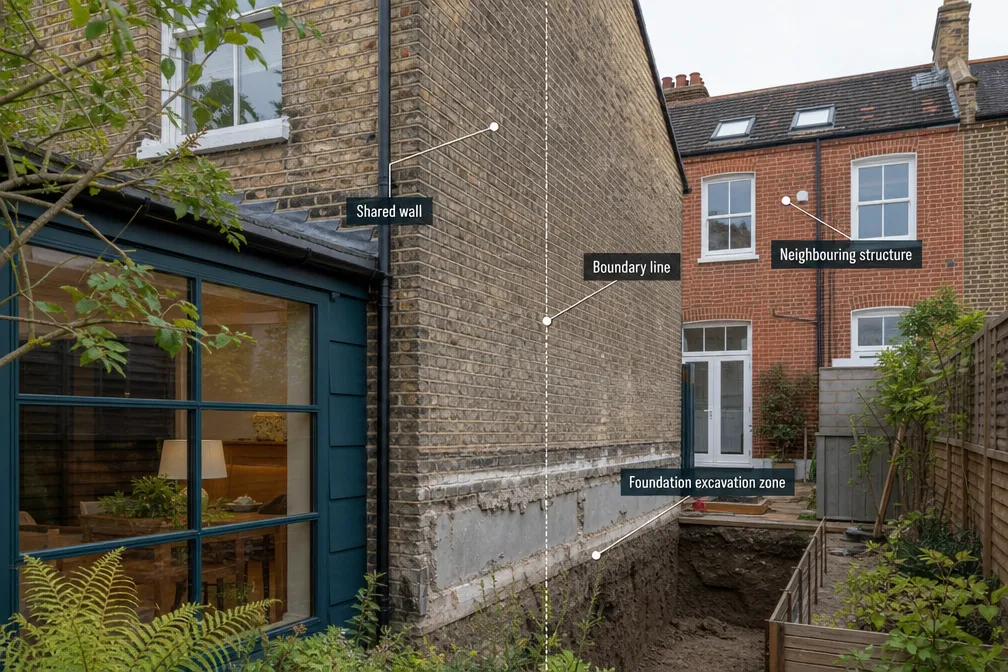
Most London terraced and semi-detached properties built in the Victorian and Edwardian eras have at least one shared wall, so the Act is relevant to the majority of loft conversions, side-return extensions, and basement projects in the capital.
Do you need a party wall for a loft conversion?
Yes, in most cases, because loft conversions typically involve inserting beams into, or raising, a party wall shared with a neighbouring property. Even a modest dormer loft conversion in a typical London terrace usually requires a party structure notice before work starts.
Exceptions exist: a loft conversion that stays entirely within the roof void without touching the party wall, and does not involve any new load-bearing work on the shared structure, may fall outside the Act. This is uncommon in practice, since most loft conversions need new steel beams that bear on the party wall for structural support.
Can you extend a house without dealing with party walls?
Yes, if the extension does not touch a shared wall, does not sit on or near the boundary, and does not involve excavation within the 3-metre or 6-metre thresholds described above. A free-standing rear extension set well away from both boundaries, with shallow foundations that don’t affect a neighbour’s foundations, might not trigger the Act.
In practice, this is rare in London, where plots are narrow and side-return and rear extensions almost always come close to a boundary or involve foundations near a neighbour’s wall. Always check the specific site layout with a surveyor before assuming the Act doesn’t apply.
When don’t you legally need a party wall agreement?
The Act does not apply where none of the three trigger conditions above are met, for example minor internal work that doesn’t touch a shared structure, loft insulation with no structural alteration, or an extension sited far enough from both boundaries and deep enough to avoid the excavation distance rules. Routine redecoration, replacing fixtures, or re-roofing within your own property line generally fall outside the Act entirely.
Do I need my neighbour’s permission for a party wall?
You don’t need permission in the sense of a yes/no approval, but you must serve formal written notice and allow your neighbour the chance to respond, consent, or dissent. Consent in writing means work can proceed without a surveyor being appointed; dissent, or no response within the statutory period, means the dispute resolution procedure in the Act kicks in automatically.
What happens if you build an extension without a party wall agreement?
Building without serving required notices leaves a homeowner exposed to an injunction stopping work, a claim for damages, or a neighbour disputing liability for any damage caused. Courts take the absence of proper notice seriously, and a neighbour who later discovers unauthorised work near their foundations or wall can demand remedial action at the homeowner’s expense.
How long does the party wall process take start to finish?
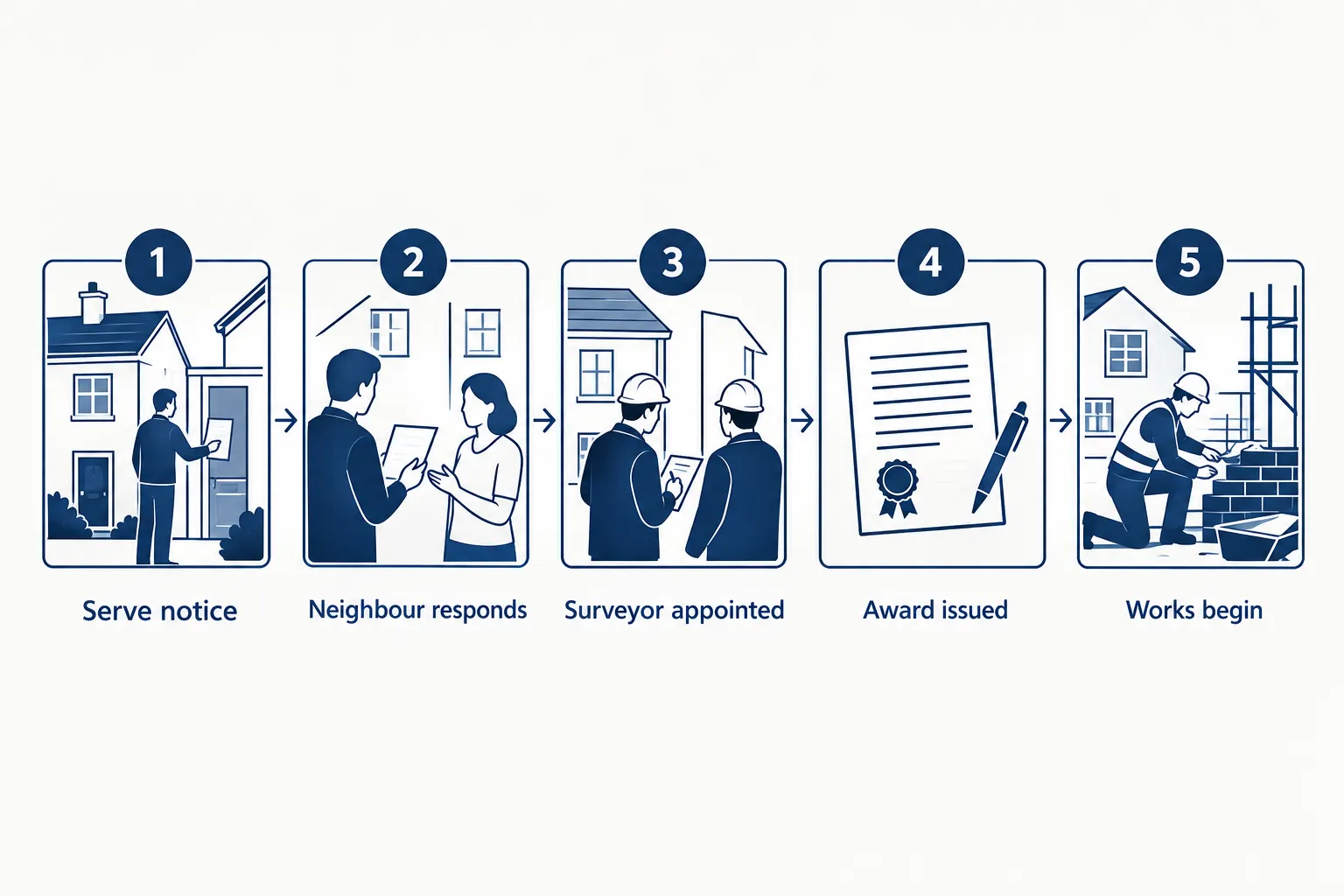
The statutory minimum is one to two months from serving notice before work can begin, but add time for response, negotiation, and any dispute resolution. For a straightforward project with a cooperative neighbour, expect six to ten weeks from notice to award or consent. Where a neighbour dissents, factor in several additional weeks for surveyor appointment and drafting of the award.
- Party structure notice: two months’ notice required before starting work.
- Line of junction notice (new wall at the boundary): one month’s notice.
- Adjacent excavation notice: one month’s notice.
- If a neighbour dissents or fails to respond within 14 days of a party structure notice, a dispute is deemed to exist and surveyors must be appointed.
What happens if a neighbour dissents, and what does an award cover?
If a neighbour dissents, each party appoints a surveyor (or they agree to use one “agreed surveyor”), and those surveyors produce a party wall award covering the work, timing, access arrangements, and a schedule of condition for the neighbouring property. The award is legally binding on both owners and sets out exactly what can be done and how disputes over damage will be resolved.
How much does a party wall surveyor cost in London, and what’s included in the fees?
Party wall surveyor fees vary by project complexity and the number of surveyors involved, but typically cover the notice drafting, site inspections, the schedule of condition, negotiation between parties, and preparation of the award itself. Where a neighbour appoints their own surveyor, the building owner usually pays both surveyors’ reasonable fees under the Act.
Budget considerations:
- Simple single-wall notices with a cooperative neighbour cost less than multi-surveyor disputes.
- Basement and excavation projects typically involve higher fees due to structural monitoring and more detailed schedules of condition.
- Fees are separate from, and additional to, any building contractor or architect costs.
Average cost of a house extension in London right now
Extension costs vary enormously by type and finish, and this article does not have a verified 2026 figure to cite for London-specific build costs. Homeowners should obtain quotes from builders and quantity surveyors for an accurate, current estimate rather than relying on generic national averages, since London labour and material costs typically run higher than the rest of the country.
Most common party wall mistakes people make
The most frequent mistake is starting building work before notices have been served or before the notice period has expired, which risks injunctions and disputes. Other recurring errors include:
- Assuming a verbal chat with a neighbour counts as formal notice (it does not; notice must be in writing).
- Underestimating how long dissent and surveyor appointment can add to a project timeline.
- Failing to commission a schedule of condition, which makes it harder to resolve later disagreements about damage.
- Serving notice too close to the planned start date, leaving no buffer for response or negotiation.
Are listed buildings and Victorian terraces treated differently for party walls?
The Party Wall etc. Act 1996 itself applies the same way regardless of a building’s age or listed status, but listed buildings carry additional planning and conservation consents that run alongside, not instead of, party wall requirements. Victorian and Edwardian terraces, common across London, are especially likely to trigger the Act because of their shared party walls and shallow historic foundations, which make adjacent excavation rules particularly relevant.
Is it worth extending if you’re planning to sell soon?
Extending shortly before selling is worth it only if the added space clearly lifts resale value by more than the build cost and the time lost to construction and notice periods. With homes taking 78 days to find a buyer in London and reduced-price homes taking 119 days according to Rightmove’s October 2026 data, a poorly planned extension that delays a sale into a softer market can cost more than it gains. Sellers under time pressure may do better pricing correctly from the outset rather than extending.
What this means for you
For London homeowners weighing extend or move in October 2026, party wall compliance should be factored into the decision alongside build costs and mortgage rates. With the Autumn Budget on 28 October 2026 and the Bank of England’s decision on 5 November 2026 adding further uncertainty to mortgage pricing, those planning to extend should start the notice process as early as possible to avoid delays stacking up during an already slower market. Anyone unsure whether their project triggers the Act should get a professional assessment before finalising design drawings, since retrofitting party wall compliance after planning permission is granted can cost valuable weeks.
FAQ
Does the Party Wall Act apply to flats as well as houses? Yes, where flats share a structural wall or floor with a neighbouring unit, the same notice and award principles apply.
Can I serve a party wall notice myself? Yes, homeowners can serve notice without a surveyor, but professional advice reduces the risk of invalid notices or missed timescales.
What if my neighbour simply ignores the notice? No response within 14 days of a party structure notice is treated as dissent, triggering the surveyor appointment process automatically.
Does a party wall award affect building regulations or planning permission? No, a party wall award is separate from planning permission and building regulations approval; all three may be needed for a single project.
How soon before building work should I serve notice? Serve a party structure notice at least two months, and a line of junction or excavation notice at least one month, before the planned start date, ideally with extra buffer for negotiation.
Will extending cost less than moving in London right now? It can, given Rightmove’s October 2026 data showing slower sales, more reductions, and mortgage rates up about £250 a month since February, but the answer depends on individual build costs versus moving costs.
Conclusion
London’s housing market in October 2026 is giving homeowners a clear signal: moving is slower and more expensive than it was a year ago, and extending is becoming the more practical route for many. But building out only works smoothly when party wall obligations are handled correctly from the start. Anyone planning a loft conversion, rear extension or basement project should identify whether the Party Wall etc. Act 1996 applies, serve the correct notices early, and budget for a surveyor’s involvement if a neighbour dissents. Getting this right protects the project timeline and the relationship with the people next door, both of which matter more than ever when the wider market is moving this slowly.
Speak to a RICS chartered party wall surveyor
Free initial consultation. Notices, awards and schedules of condition across London and nationwide.