

The data center construction boom sweeping across the United Kingdom in 2026 has created an unprecedented intersection of cutting-edge technology infrastructure and century-old property law. As developers race to meet the insatiable demand for artificial intelligence computing power and cloud services, many are discovering that their ambitious builds must navigate the complexities of Party Wall Agreements for Data Center Builds: Precision Surveying Challenges in 2026. These specialized facilities, with their unique requirements for vibration control, thermal management, and continuous power systems, present surveying obstacles that traditional residential or commercial projects rarely encounter.
The convergence of rapid construction timelines, massive structural loads, and sensitive neighboring properties has transformed party wall surveying from a routine administrative process into a critical risk management function. Data center developers in London and across the UK are finding that the Party Wall etc. Act 1996 applies with particular complexity to their projects, requiring specialized expertise that bridges structural engineering, property law, and advanced surveying techniques.
Key Takeaways
- 📊 Data center construction in 2026 is experiencing exponential growth, with projects increasingly located in urban areas where party wall agreements are essential for legal compliance and neighbor relations
- 🔧 Precision surveying challenges unique to data centers include vibration monitoring from heavy mechanical equipment, thermal transfer through shared walls, and managing electromagnetic interference near sensitive neighboring structures
- ⚖️ RICS-compliant party wall notices must address specialized considerations such as 24/7 operational noise, cooling system integration, and shared infrastructure awards that differ significantly from traditional construction projects
- 💡 Vibration monitoring protocols require continuous real-time data collection using advanced sensors, with tolerance levels measured in millimeters to protect both the data center's sensitive equipment and adjoining properties
- 🤝 Shared infrastructure agreements are becoming more common, allowing data centers to negotiate cooling, power, or fiber optic arrangements through party walls while maintaining clear legal boundaries and cost allocations
Understanding Party Wall Agreements in the Data Center Context
The Legal Framework for Data Center Construction
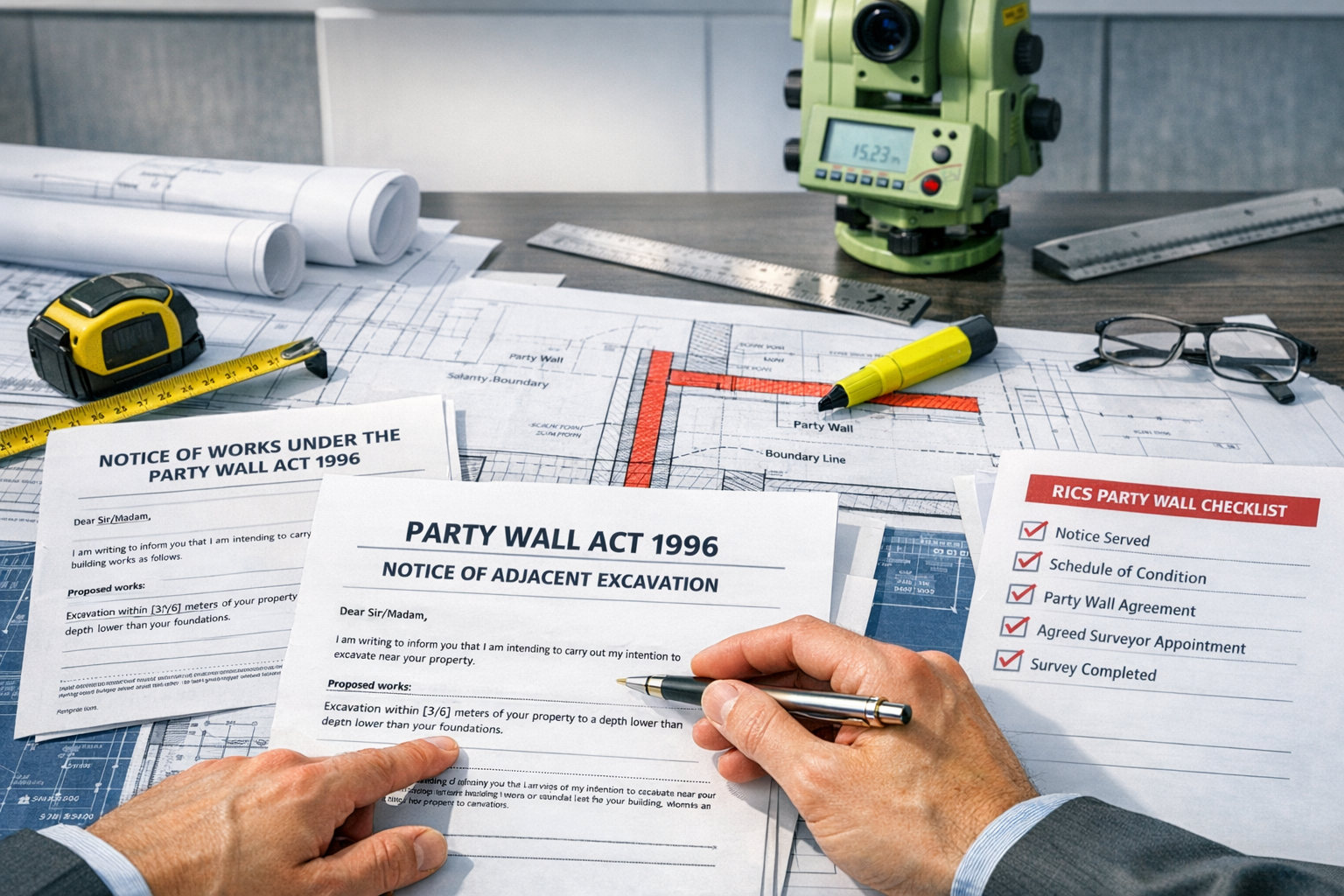
The foundation of Party Wall Agreements for Data Center Builds: Precision Surveying Challenges in 2026 rests on the Party Wall etc. Act 1996, a piece of legislation originally designed for residential and commercial developments that now must accommodate the unique demands of hyperscale computing facilities. This Act governs construction work on or near boundaries between properties, requiring building owners to serve formal notices to adjoining owners before commencing specific types of work.
For data center developers, understanding what party wall notices are and how to respond becomes particularly critical given the scale and technical complexity of these projects. The three primary notice types under the Act—Line of Junction Notice, Party Structure Notice, and Three Meter/Six Meter Notice—each carry different implications for data center construction.
Data centers typically trigger multiple notice requirements simultaneously. Excavations for deep foundations to support massive cooling equipment and backup generator systems often exceed six meters in depth, requiring notices to all properties within the statutory distances. The installation of shared walls for security perimeters or the modification of existing party structures to accommodate fiber optic penetrations necessitates Party Structure Notices with detailed technical specifications.
Why Data Centers Present Unique Party Wall Challenges
Unlike traditional commercial buildings, data centers operate as critical infrastructure with zero tolerance for downtime or structural movement. A residential apartment building might tolerate minor settlement or vibration during adjacent construction, but a data center housing millions of dollars in servers cannot accept even millimeter-level displacement without risking equipment failure [2].
The thermal characteristics of data centers create additional complications. These facilities generate enormous amounts of heat—a typical hyperscale data center can produce heat equivalent to a small power plant. When built adjacent to existing structures, the heat transfer through party walls becomes a surveying concern that standard party wall agreements rarely address. Temperature differentials can cause expansion, contraction, and moisture migration that affect both the data center's cooling efficiency and the adjoining property's structural integrity.
Electromagnetic interference (EMI) represents another dimension of party wall surveying unique to data center builds. The massive electrical systems, backup generators, and computing equipment create electromagnetic fields that can penetrate party walls and affect neighboring properties. While not traditionally within the scope of party wall agreements, forward-thinking surveyors in 2026 are incorporating EMI assessments into their schedules of condition to document baseline conditions and prevent future disputes.
The construction timeline pressures facing data center developers in 2026 add urgency to the party wall process. With demand for AI computing capacity driving unprecedented construction activity [7], developers cannot afford delays caused by party wall disputes. This creates pressure on surveyors to expedite processes while maintaining the rigorous standards necessary for these technically complex projects.
Precision Surveying Challenges Specific to Data Center Builds
Vibration Monitoring and Control Requirements
Vibration management stands as perhaps the most critical precision surveying challenge in Party Wall Agreements for Data Center Builds: Precision Surveying Challenges in 2026. Data centers house equipment with tolerances measured in micrometers—hard drives, solid-state storage arrays, and precision cooling systems can all suffer damage or performance degradation from vibration levels that would be imperceptible to human occupants.
Modern surveying protocols for data center party wall agreements require continuous vibration monitoring using triaxial accelerometers placed at strategic locations on party walls and within both the construction site and adjoining properties. These sensors capture vibration data in three dimensions, measuring peak particle velocity (PPV) in millimeters per second—the industry standard metric for assessing vibration impact.
| Vibration Source | Typical PPV Range | Monitoring Frequency | Mitigation Strategy |
|---|---|---|---|
| Pile Driving | 15-50 mm/s | Continuous real-time | Isolation trenches, alternative foundation methods |
| Excavation Equipment | 5-20 mm/s | Hourly during operation | Restricted equipment zones, dampening systems |
| Concrete Pouring | 2-8 mm/s | During pour events | Staged pouring, vibration-dampening forms |
| HVAC Installation | 1-5 mm/s | Daily monitoring | Isolated mounting systems, flexible connections |
| Generator Testing | 3-12 mm/s | During test events | Inertia bases, spring isolators |
The challenge for surveyors extends beyond mere measurement. Party wall awards for data center projects must specify actionable threshold levels that trigger construction modifications. A typical award might establish a baseline PPV limit of 5 mm/s for adjoining residential properties while setting a more stringent 2 mm/s limit for the data center's own sensitive equipment during fit-out phases.
Advanced surveying practices in 2026 incorporate predictive vibration modeling using finite element analysis software. Before construction begins, surveyors can simulate the vibration propagation through soil and party wall structures, identifying potential problem areas and recommending preventive measures. This proactive approach, while more expensive initially, significantly reduces the risk of costly construction stoppages and equipment damage.
Thermal Transfer and Cooling System Integration
The thermal dynamics of data center construction create surveying challenges that barely existed in traditional party wall practice. A single data center rack can generate 20-30 kilowatts of heat, and hyperscale facilities may house thousands of such racks. Managing this heat while preventing thermal transfer through party walls requires precision surveying techniques that document baseline conditions and monitor ongoing changes.
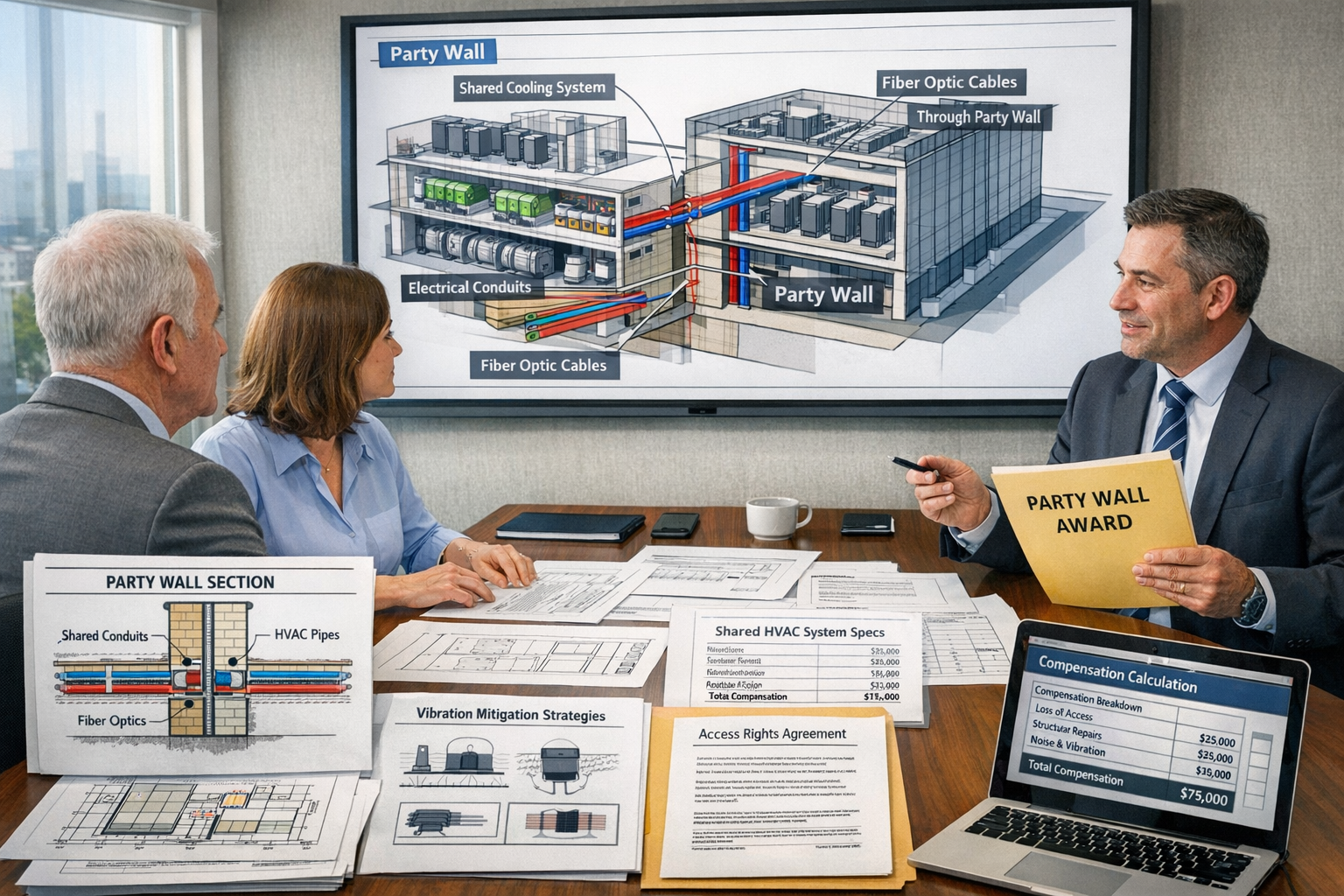
Thermal imaging surveys have become standard practice for Party Wall Agreements for Data Center Builds: Precision Surveying Challenges in 2026. Using infrared cameras capable of detecting temperature differences as small as 0.1°C, surveyors create detailed thermographic maps of party walls before construction begins. These baseline images prove invaluable when disputes arise about whether the data center's operations have affected adjoining properties through heat transfer.
Party wall agreements for data centers must address cooling system penetrations through shared structures. Modern data centers increasingly use liquid cooling systems that require piping to pass through walls to reach external cooling towers or heat exchangers. Each penetration point becomes a potential source of thermal bridging, moisture intrusion, and structural weakness that requires careful surveying documentation.
Some innovative party wall agreements in 2026 include shared cooling infrastructure provisions. When a data center is built adjacent to another commercial property, both parties might benefit from a shared cooling system that uses the party wall as a thermal boundary. These arrangements require exceptionally detailed surveying to establish baseline conditions, define maintenance responsibilities, and allocate costs—transforming the surveyor's role from mere documenter to infrastructure planning consultant.
The precision required for thermal surveying extends to moisture monitoring. Data centers maintain strict humidity controls, typically between 40-60% relative humidity. When these controlled environments exist adjacent to properties with different humidity levels, moisture can migrate through party walls, potentially causing condensation, mold growth, or material degradation. Advanced surveyors now incorporate hygroscopic sensors into their monitoring regimes, tracking moisture content in party wall materials throughout the construction and operational phases.
Foundation Load Distribution and Settlement Monitoring
Data center buildings impose extraordinary structural loads that dwarf those of conventional commercial construction. A typical office building might impose floor loads of 2.5-4 kN/m², while data center floors routinely handle 10-15 kN/m² or more to support dense server rack configurations, battery backup systems, and heavy mechanical equipment [3].
When these facilities are constructed adjacent to existing buildings with shared or nearby foundations, precision surveying becomes critical for preventing differential settlement that could damage both structures. The surveying challenges begin during the design phase, where boundary wall rules and differences between party fence walls and boundary walls must be carefully documented to establish legal and physical boundaries.
Geotechnical surveying for data center party wall agreements requires soil analysis at depths far exceeding standard practice. While residential projects might investigate soil conditions to 3-5 meters depth, data center foundations often extend 10-15 meters or more, requiring comprehensive soil boring and testing programs. The surveyor must document how these deep foundations interact with adjoining properties' foundation systems, assessing the potential for load transfer, settlement, or heave.
Modern surveying practice employs automated settlement monitoring systems using precise leveling instruments or GPS-based monitoring stations that can detect vertical movement as small as 0.5 millimeters. These systems provide continuous data feeds, allowing surveyors to identify problematic settlement trends before they cause visible damage. Party wall awards for data center projects increasingly specify these monitoring systems as mandatory, with data sharing requirements that keep all parties informed of structural behavior.
The excavation phase presents particular surveying challenges when data centers are built adjacent to existing structures. Deep excavations for basement-level mechanical equipment can extend below adjoining properties' foundations, requiring temporary shoring systems and underpinning work. Surveyors must establish precise three-dimensional control networks to monitor both horizontal and vertical movement of party walls during excavation, with measurement frequencies often increasing to multiple times daily during critical phases.
Electromagnetic Interference and Shielding Considerations
While not traditionally part of party wall surveying, electromagnetic compatibility (EMC) has emerged as a significant concern in Party Wall Agreements for Data Center Builds: Precision Surveying Challenges in 2026. Data centers generate substantial electromagnetic fields from their power distribution systems, backup generators, and computing equipment. When these facilities share walls with sensitive operations—medical facilities, research laboratories, or even other data centers—EMI becomes a surveying and legal consideration.
Progressive surveyors now conduct baseline electromagnetic surveys before data center construction begins, documenting the existing electromagnetic environment at the party wall and within adjoining properties. These surveys use spectrum analyzers and field strength meters to measure electromagnetic radiation across multiple frequency bands, creating a comprehensive baseline against which future measurements can be compared.
Party wall awards for data center projects may specify EMI shielding requirements within the party wall construction itself. This might include embedded metal mesh, specialized conductive coatings, or complete Faraday cage construction for portions of the shared structure. Surveying these installations requires specialized equipment to verify shielding effectiveness, measuring attenuation levels in decibels across relevant frequency ranges.
The challenge intensifies when data centers incorporate high-voltage electrical systems that penetrate or run parallel to party walls. Transformers, switchgear, and backup generator systems can create magnetic fields that extend several meters beyond their physical locations. Surveyors must map these field distributions and verify that they remain within acceptable limits at the party wall boundary—a task requiring both electrical engineering knowledge and precision measurement capabilities.
RICS-Compliant Party Wall Notices for Data Center Projects
Crafting Comprehensive Party Structure Notices
The Royal Institution of Chartered Surveyors (RICS) provides guidance on party wall matters, but data center projects often push beyond standard templates into bespoke territory. A RICS-compliant party structure notice for a data center build must address technical specifications that rarely appear in residential or conventional commercial notices.
Detailed technical descriptions form the foundation of effective party structure notices for data centers. Rather than generic descriptions like "installation of services," data center notices must specify the exact nature of penetrations through party walls: the diameter and number of fiber optic conduits, the size and routing of cooling system pipes, the specifications for electrical cable trays, and the methods for sealing penetrations to maintain fire resistance and acoustic separation.
The notice must address operational characteristics that affect the party wall's long-term performance. This includes:
- 🔊 Noise levels from cooling systems, backup generators, and mechanical equipment that may transmit through the party wall
- 🌡️ Thermal loads and temperature differentials that the party wall will experience
- ⚡ Vibration sources from rotating equipment, with specifications of operating frequencies and expected vibration levels
- 💧 Moisture management systems and how condensation from cooling equipment will be controlled
- 🔐 Security requirements that may affect access to the party wall for maintenance or inspection
RICS guidance emphasizes the importance of timing and sequence in serving notices. For data center projects with multiple notice requirements, surveyors must carefully coordinate the service of Line of Junction Notices, Party Structure Notices, and excavation notices to ensure compliance while maintaining construction schedule efficiency. Serving notices too early can result in consent periods expiring before construction begins; serving them too late creates legal exposure and potential injunctions.
Incorporating Advanced Monitoring Provisions
Modern party wall awards for data center construction incorporate technology-enabled monitoring provisions that would have been impractical or impossibly expensive just a decade ago. The 2026 surveying landscape benefits from affordable sensors, wireless data transmission, and cloud-based monitoring platforms that enable continuous oversight of party wall conditions.
A comprehensive party wall award for a data center project should specify:
Monitoring Equipment Requirements:
- Type and specification of vibration sensors (triaxial accelerometers with minimum sensitivity)
- Thermal imaging survey frequency and equipment specifications
- Settlement monitoring precision (typically ±0.5mm for data center projects)
- Crack width monitoring gauge installation locations and alert thresholds
- Electromagnetic field measurement protocols and acceptable limits
Data Management and Sharing:
- Real-time data access provisions for adjoining owners and their surveyors
- Alert threshold levels that trigger notifications to all parties
- Data retention periods (typically minimum 5 years post-construction)
- Third-party data verification requirements
- Dispute resolution protocols when monitoring data indicates potential issues
The award should establish clear action protocols triggered by monitoring data. For example, if vibration levels exceed 80% of the agreed threshold, the building owner might be required to notify the adjoining owner within 2 hours and implement mitigation measures within 24 hours. These provisions transform monitoring from passive observation into active risk management.
Addressing 24/7 Operational Considerations
Unlike construction projects that eventually complete and return to quiet occupancy, data centers operate continuously with high-intensity mechanical systems that affect party walls indefinitely. This operational reality requires party wall agreements to extend beyond construction phase considerations into long-term operational provisions.
The party wall award must address ongoing access rights for monitoring and maintenance. Data center security requirements often conflict with adjoining owners' rights to inspect party walls. The award should establish specific protocols: advance notice periods for inspections, security clearance procedures, escort requirements, and limitations on photography or recording within the data center—all while preserving the adjoining owner's fundamental rights under the Act.
Noise and vibration limits during operations require careful specification. While construction-phase limits might permit higher levels for limited durations, operational limits must be sustainable 24/7/365. The award should reference British Standards for noise in commercial environments (BS 8233) and vibration in buildings (BS 6472), adapting these standards to the specific party wall context.
Some forward-thinking awards include technology upgrade provisions that anticipate future changes to data center equipment. As computing technology evolves, data centers regularly replace servers, cooling systems, and power equipment with newer generations that may have different vibration, thermal, or electromagnetic characteristics. The award can establish a framework for notifying adjoining owners of significant equipment changes and reassessing party wall impacts without requiring entirely new party wall procedures.
Understanding how to keep party wall costs down becomes particularly important for data center projects, where the technical complexity can drive surveying and legal costs to substantial levels. Clear, comprehensive awards that anticipate operational issues prevent costly disputes and repeated surveyor appointments.
Shared Infrastructure Awards and Cost Allocation
Negotiating Shared Cooling and Power Systems
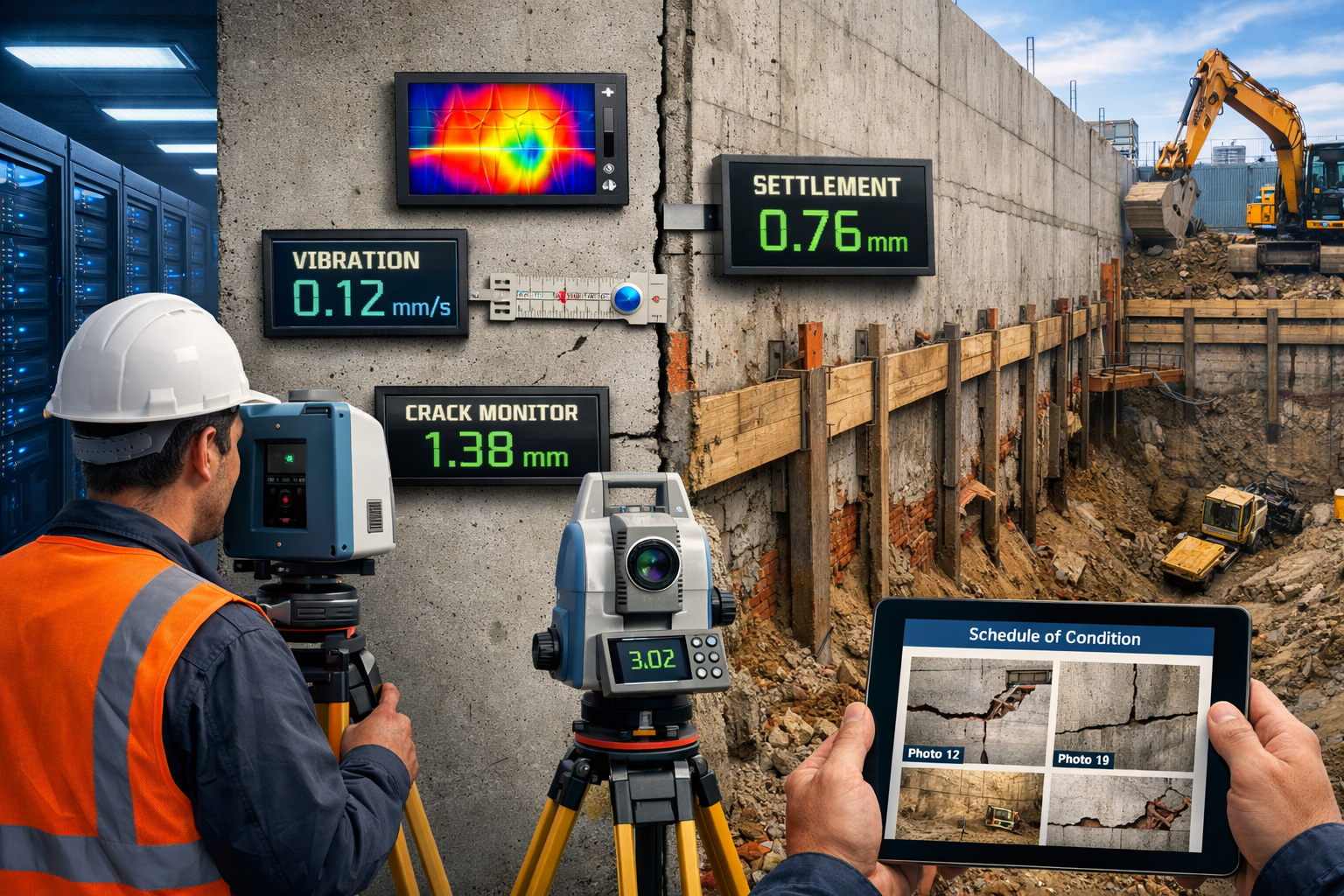
An emerging trend in Party Wall Agreements for Data Center Builds: Precision Surveying Challenges in 2026 involves shared infrastructure arrangements where adjoining properties benefit from data center systems. These arrangements transform the party wall from a mere boundary into a functional interface for shared utilities, creating both opportunities and complexities for surveyors.
Shared cooling systems present the most common infrastructure sharing scenario. A data center's cooling capacity often exceeds its own needs, particularly during cooler months or when using free cooling techniques. Adjoining commercial properties can potentially tap into this excess capacity, receiving chilled water for their HVAC systems through connections that pass through or near the party wall.
The surveyor's role in these arrangements extends far beyond traditional party wall practice into infrastructure planning and cost allocation. The party wall award must specify:
- 📐 Technical specifications for shared infrastructure penetrations through the party wall
- 💰 Capital cost allocation for installing shared systems
- 🔧 Maintenance responsibility and cost sharing for equipment serving both properties
- ⚡ Capacity allocation defining each property's share of available cooling or power
- 📊 Metering and billing systems to track actual usage and allocate operating costs
- 🚨 Service level agreements defining uptime expectations and remedies for failures
- 🔄 Exit provisions allowing either party to discontinue the arrangement under specified conditions
These complex arrangements require surveyors to work closely with mechanical engineers, cost consultants, and legal advisors. The party wall award becomes a hybrid document, incorporating elements of easement agreements, service contracts, and traditional party wall provisions.
Fiber Optic and Data Connectivity Sharing
Data centers are nodes in global communications networks, typically connecting to multiple fiber optic carriers for redundancy. These fiber optic cables must enter the facility from public rights-of-way, often crossing adjoining properties or passing through party walls. The surveying challenges involve both the physical installation and the long-term access and maintenance rights.
Party wall awards for fiber optic installations must address several unique considerations:
Physical Installation Requirements:
- Precise routing of fiber optic conduits through party walls to avoid structural elements
- Minimum bend radius specifications to prevent fiber damage (typically 20x cable diameter)
- Fire-stopping and acoustic sealing requirements for conduit penetrations
- Electromagnetic shielding if cables pass near high-voltage electrical systems
- Future capacity provisions allowing additional fiber installation without new party wall procedures
Access and Maintenance Provisions:
- Rights to access party wall areas for fiber repairs or upgrades
- Notice periods for planned maintenance (often shorter than standard party wall access notice periods due to network criticality)
- Emergency access rights for service-affecting failures
- Compensation provisions if fiber installation or maintenance damages the party wall
- Insurance requirements covering fiber optic infrastructure within party wall areas
Some innovative agreements establish communications infrastructure sharing where the adjoining owner gains rights to install their own fiber optic connections through the same conduits or party wall penetrations used by the data center. This arrangement benefits both parties: the data center developer gains goodwill and potentially easier consent to their works, while the adjoining owner obtains valuable connectivity infrastructure. The surveyor must carefully document these shared rights and ensure the party wall award clearly defines each party's allocated space within shared conduits.
Long-Term Maintenance and Modification Frameworks
Traditional party wall awards focus primarily on construction phase activities, with limited attention to long-term maintenance and future modifications. Data center projects require a more sophisticated approach that anticipates decades of ongoing operations and periodic technology upgrades.
A comprehensive maintenance framework within the party wall award should establish:
Regular Inspection Protocols:
- Annual joint inspections of party wall conditions by surveyors representing both parties
- Five-year comprehensive structural assessments including non-destructive testing
- Continuous monitoring data review meetings (quarterly or semi-annually)
- Documentation requirements for inspection findings and recommended actions
Modification Procedures:
- Streamlined notice procedures for minor modifications (e.g., adding fiber optic cables to existing conduits)
- Full party wall notice requirements for major modifications (e.g., structural alterations, new equipment installations)
- Technical review processes involving both parties' engineers for proposed changes
- Cost allocation principles for modifications that benefit both properties versus those serving only one party
Dispute Resolution Mechanisms:
- Graduated dispute resolution starting with direct negotiation between appointed surveyors
- Mediation provisions before resorting to Third Surveyor appointment
- Technical expert determination for specialized issues (vibration, thermal, electromagnetic)
- Arbitration or litigation as final resort, with cost allocation provisions
The framework should also address technology obsolescence scenarios. Data center equipment lifecycles range from 3-7 years for servers to 15-20 years for mechanical systems. The party wall award can establish principles for how equipment replacements affecting the party wall will be handled, potentially avoiding the need for entirely new party wall procedures for each technology refresh cycle.
Understanding the broader context of types of party wall works helps surveyors classify data center modifications appropriately and apply the correct procedural requirements.
Regional Variations and Jurisdictional Considerations
London-Specific Challenges for Data Center Party Walls
London's position as a global data center hub creates unique surveying challenges related to urban density, historic structures, and property values. Data centers in London frequently occupy sites in areas like Docklands, Slough (within the Greater London data center cluster), and increasingly in regeneration zones where they adjoin diverse property types.
Party wall surveyors in Central London face particular challenges when data centers are proposed adjacent to listed buildings or conservation areas. The party wall agreement must coordinate with heritage protection requirements, often requiring specialized surveying techniques that document historic fabric in extraordinary detail. Vibration limits for construction near listed structures may be significantly more stringent than standard practice, sometimes requiring PPV limits below 2 mm/s to protect delicate historic materials.
The property value implications of data center construction in London create heightened scrutiny of party wall agreements. When a data center is built adjacent to high-value residential or commercial properties, adjoining owners often engage specialist surveyors and legal counsel to ensure their interests are protected. This can transform what might be a straightforward party wall process elsewhere into a complex negotiation involving multiple expert advisors.
Different London boroughs have varying approaches to data center development, affecting the party wall process indirectly through planning conditions and building control requirements. Party wall surveyors in North London, South London, East London, and West London must understand local authority expectations regarding noise, vibration, and environmental impacts, ensuring party wall awards align with planning conditions.
Adapting to Regional Construction Standards
While the Party Wall etc. Act 1996 applies uniformly across England and Wales, regional construction practices and ground conditions create variations in how party wall agreements for data centers are implemented. Surveyors must adapt their approaches to local contexts while maintaining compliance with the Act and RICS guidance.
Geological variations significantly impact foundation design and party wall surveying requirements:
- London Clay areas require deep piled foundations for heavy data center loads, creating specific excavation and vibration challenges
- Chalk substrates in parts of Southeast England may require specialized foundation techniques and groundwater management
- Made ground in former industrial areas (common data center sites) necessitates extensive soil investigation and contamination assessment
- High water tables in low-lying areas require dewatering operations that can affect adjoining properties through settlement
Regional construction cost variations affect party wall negotiations and cost allocations. Data center construction costs in London can exceed £3,000 per square meter, compared to £2,000-2,500 per square meter in regional locations [4]. These cost differences influence how parties approach shared infrastructure opportunities and dispute resolution—higher stakes in expensive markets often lead to more detailed party wall awards and more frequent surveyor involvement.
Local surveying practice traditions also vary. Some regions have established networks of party wall surveyors with deep experience in commercial construction, while others may have limited expertise in complex projects like data centers. Building owners and adjoining owners benefit from engaging surveyors with specific data center experience, even if this requires looking beyond immediate local practitioners.
Cross-Border Considerations for Multi-Jurisdictional Projects
Some large data center campuses span multiple local authority boundaries or even cross the England-Wales border, creating jurisdictional complexities for party wall agreements. While the Party Wall etc. Act 1996 applies consistently across England and Wales, local building control, planning, and environmental health regulations vary, affecting how party wall provisions are implemented.
Surveyors must coordinate party wall agreements with:
- Building Regulations approval from potentially multiple local authorities
- Planning conditions that may impose specific requirements on construction methods, hours, or monitoring
- Environmental permits for cooling water discharge, generator emissions, or noise
- Highway authority requirements when construction affects public rights of way near party walls
Large data center developments may involve multiple building owners on a single campus, each with their own party wall obligations to external adjoining owners and potentially to each other. This creates complex networks of party wall relationships that require careful coordination to prevent conflicting obligations or monitoring requirements.
Best Practices for Surveyors and Stakeholders
Pre-Construction Planning and Risk Assessment
Successful navigation of Party Wall Agreements for Data Center Builds: Precision Surveying Challenges in 2026 begins long before formal party wall notices are served. Proactive surveyors engage in comprehensive pre-construction planning that identifies potential issues and develops mitigation strategies before they become disputes.
Early site assessment should include:
✅ Title and boundary verification using Land Registry documents, historical deeds, and measured surveys to establish precise property boundaries
✅ Adjoining owner identification extending beyond immediately adjacent properties to include those within potential notice distances (3 meters and 6 meters for excavations)
✅ Existing structure assessment documenting the condition of adjoining buildings through visual surveys, photographic records, and potentially structural investigations
✅ Geotechnical investigation with soil borings extending to depths below proposed data center foundations, assessing both bearing capacity and potential settlement impacts on adjoining properties
✅ Utility mapping identifying existing services that cross property boundaries or run near party walls, including telecommunications, water, gas, electricity, and drainage
✅ Stakeholder engagement initiating informal discussions with adjoining owners before formal notices, explaining the project and addressing concerns early
This planning phase allows surveyors to develop risk-informed party wall strategies that anticipate challenges rather than merely reacting to them. For example, if geotechnical investigation reveals poor soil conditions requiring deep piling near a party wall, the surveyor can proactively specify vibration monitoring and potentially recommend alternative foundation techniques before serving formal notices.
Understanding whether party wall agreements can proceed without a surveyor helps stakeholders appreciate when professional expertise is truly essential—and for data center projects, professional surveyor involvement is virtually always necessary given the technical complexity.
Technology Integration in Modern Party Wall Surveying
The surveying profession has embraced digital technologies that dramatically enhance the precision, efficiency, and transparency of party wall processes for data center projects. Modern surveyors leverage tools that would have been unavailable or prohibitively expensive just a few years ago.
Building Information Modeling (BIM) integration allows party wall surveyors to work with three-dimensional digital models of both the proposed data center and existing adjoining structures. These models enable:
- Precise visualization of party wall interfaces and proposed penetrations
- Clash detection identifying conflicts between proposed data center systems and existing structures
- Spatial coordination of monitoring equipment placement
- Simulation of construction sequences to identify high-risk phases
- Client and adjoining owner communication using visual representations rather than technical drawings
Laser scanning and photogrammetry create highly accurate three-dimensional records of existing conditions. A surveyor can capture millions of measurement points in hours, producing digital models accurate to ±2-3mm that serve as definitive baseline records. These scans prove invaluable when disputes arise about whether construction has caused damage—the pre-construction scan provides objective evidence of existing conditions.
Drone surveys enable efficient documentation of roof-level party walls and difficult-to-access areas. For multi-story data centers, drones can capture high-resolution imagery and measurements without requiring scaffolding or access equipment, reducing costs and safety risks while improving documentation quality.
Cloud-based collaboration platforms allow all parties to access monitoring data, survey reports, and party wall documentation in real-time. Rather than waiting for monthly reports, adjoining owners can log into secure portals to view current vibration levels, settlement data, and construction progress. This transparency builds trust and enables rapid response when issues arise.
Communication Strategies for Complex Technical Projects
Data center party wall agreements involve multiple stakeholders with varying levels of technical knowledge: building owners focused on construction schedules and costs, adjoining owners concerned about property impacts, technical specialists (structural engineers, mechanical engineers, IT infrastructure designers), and legal advisors ensuring compliance and risk management.
Effective surveyors develop layered communication strategies that convey appropriate information to each stakeholder group:
For Building Owners and Project Managers:
- Focus on schedule implications of party wall processes and how to minimize delays
- Highlight cost implications of different monitoring and mitigation options
- Provide clear decision points where owner input is required
- Explain how party wall compliance protects against injunctions and project stoppages
For Adjoining Owners:
- Use plain language explanations of technical concepts, avoiding jargon
- Provide visual aids (photos, diagrams, models) to illustrate proposed works
- Clearly explain rights under the Party Wall etc. Act and the role of surveyors
- Establish realistic expectations about construction impacts and duration
- Demonstrate how monitoring protects their interests
For Technical Specialists:
- Provide detailed specifications and performance criteria for party wall works
- Coordinate technical requirements across disciplines (structural, mechanical, electrical)
- Ensure party wall provisions align with building design and construction methodology
- Integrate party wall monitoring with broader construction quality control
For Legal Advisors:
- Ensure party wall awards provide legally enforceable provisions
- Address liability allocation and insurance requirements
- Coordinate party wall agreements with broader project legal documentation
- Provide evidence-based documentation supporting party wall positions
Regular stakeholder meetings throughout the party wall process keep all parties informed and aligned. For complex data center projects, monthly coordination meetings during the notice and award preparation phase, transitioning to weekly meetings during critical construction phases, help prevent misunderstandings and enable rapid issue resolution.
Providing access to resources like free downloadable party wall agreement templates helps adjoining owners understand the process, though data center projects invariably require bespoke agreements rather than template documents.
Case Studies: Lessons from Recent Data Center Party Wall Projects
Urban Infill Data Center with Historic Adjoining Structure
A 2025 project in East London illustrates the challenges of Party Wall Agreements for Data Center Builds: Precision Surveying Challenges in 2026 when modern infrastructure meets historic fabric. The developer proposed a 5,000 square meter data center on a former industrial site directly adjacent to a Grade II listed Victorian warehouse that had been converted to residential lofts.
Key Challenges:
- The listed building's brick party wall, over 150 years old, had no original structural calculations or known foundation depth
- Proposed data center foundations extended 12 meters below ground level, significantly deeper than the historic building's foundations
- Vibration limits for the listed structure were set at 2 mm/s PPV, well below typical construction levels
- The party wall required penetrations for fiber optic conduits serving both properties
Surveying Solutions Implemented:
- Non-destructive testing (ground-penetrating radar and ultrasonic testing) to map the historic wall's internal structure without damaging protected fabric
- Trial excavations to establish the depth and condition of the listed building's foundations
- Installation of 24 real-time vibration monitoring points on the party wall and within the residential units
- Modified foundation design using continuous flight auger (CFA) piling instead of impact-driven piles to minimize vibration
- Detailed photographic and laser scan documentation of every brick, crack, and architectural detail before construction
- Shared fiber optic infrastructure agreement allowing residential owners to access high-speed connectivity through data center conduits
Outcomes:
- Construction completed without exceeding vibration limits at any monitoring point
- No measurable settlement or structural movement in the listed building
- Party wall award included provisions for ongoing monitoring during data center operations
- Residential owners gained gigabit fiber connectivity as collateral benefit
- Project became a model for sensitive urban data center development
Shared Cooling Infrastructure Between Adjacent Data Centers
A unique 2024-2025 project in the Thames Valley involved two competing data center operators building adjacent facilities that shared a party wall. Rather than treating the party wall as merely a boundary, the operators negotiated a sophisticated shared infrastructure agreement that benefited both parties while presenting novel surveying challenges.
Project Structure:
- Two data centers, each approximately 10,000 square meters, sharing a 50-meter party wall
- Shared cooling infrastructure using the party wall as a thermal boundary
- Common fiber optic entry point serving both facilities
- Shared backup generator fuel storage beneath the party wall
Surveying Innovations:
- Dual-purpose party wall design engineered to support both facilities' structural loads while serving as thermal barrier
- Embedded sensors within the party wall structure monitoring temperature, moisture, structural stress, and vibration
- Detailed cost allocation methodology for shared infrastructure based on actual usage metering
- Governance framework requiring joint approval for modifications affecting shared systems
- Technical specifications ensuring each operator's systems remained independent despite physical proximity
Commercial Arrangements:
- Shared capital costs for party wall construction (60/40 split based on facility sizes)
- Operating cost allocation based on metered usage of shared cooling capacity
- Cross-access rights for emergency maintenance with strict security protocols
- Dispute resolution through technical expert determination before arbitration
Lessons Learned:
- Shared infrastructure can reduce overall project costs by 15-20% compared to fully independent systems
- Clear governance and decision-making frameworks are essential when competitors share infrastructure
- Technical monitoring systems must be independently verifiable to maintain trust between parties
- Party wall awards for shared infrastructure require ongoing amendment mechanisms as technology evolves
Vibration-Sensitive Research Facility Adjoining New Data Center
A 2025 project in Cambridge presented extreme vibration sensitivity challenges when a hyperscale data center was proposed adjacent to a university quantum computing research facility. The research facility housed equipment sensitive to vibrations at levels below 0.5 mm/s PPV—far more stringent than typical party wall vibration limits.
Technical Challenges:
- Research facility required vibration isolation to 0.3 mm/s PPV for quantum computing experiments
- Data center construction involved deep excavation, piling, and installation of heavy mechanical equipment
- Party wall separated facilities by only 5 meters
- Both facilities required 24/7 operations with zero tolerance for disruption
Surveying and Engineering Solutions:
- Comprehensive vibration modeling predicting construction and operational vibration propagation
- Modified construction methodology eliminating all impact-driven piling in favor of CFA and vibration-dampened techniques
- Installation of a vibration isolation trench between the facilities, extending to bedrock
- Continuous real-time vibration monitoring with automated construction shutdown if thresholds approached
- Phased construction schedule coordinating high-vibration activities with research facility's experimental calendar
- Post-construction operational vibration testing before data center equipment installation
Party Wall Award Provisions:
- Detailed construction methodology specifications mandating low-vibration techniques
- Real-time vibration data sharing with research facility's technical team
- Automatic work stoppage triggers if vibration levels exceeded 80% of agreed thresholds
- Compensation provisions if research experiments were disrupted despite precautions
- Long-term operational vibration limits for data center equipment (0.5 mm/s PPV maximum)
Results:
- Construction completed with maximum recorded vibration of 0.42 mm/s PPV—within acceptable limits
- No research disruption occurred during 18-month construction period
- Operational vibration levels measured below 0.2 mm/s PPV, well within limits
- Project demonstrated that even extreme vibration sensitivity can be managed with appropriate engineering and surveying protocols
These case studies demonstrate that while Party Wall Agreements for Data Center Builds: Precision Surveying Challenges in 2026 present significant technical and legal complexities, careful planning, innovative engineering, and professional surveying can achieve successful outcomes that protect all parties' interests.
Future Trends in Data Center Party Wall Agreements
Artificial Intelligence and Automated Monitoring
The intersection of AI-driven data centers and AI-enhanced surveying creates interesting possibilities for the future of party wall management. Machine learning algorithms can analyze continuous streams of monitoring data from vibration sensors, settlement gauges, and thermal cameras, identifying patterns that might indicate developing problems before they become visible.
Predictive maintenance applications could transform party wall monitoring from reactive to proactive. Rather than waiting for cracks to appear or settlement to exceed thresholds, AI systems could analyze subtle trends in monitoring data and predict potential issues weeks or months in advance. This early warning capability would allow building owners to implement preventive measures, potentially avoiding damage and disputes entirely.
Automated compliance verification using AI could streamline party wall administration. Systems could continuously verify that construction activities remain within agreed parameters, automatically generating compliance reports and alerting surveyors only when exceptions occur. This would reduce the administrative burden on surveyors while providing more comprehensive oversight than manual monitoring.
However, these technological advances also raise questions about liability and professional responsibility. If an AI system fails to detect a developing problem, who bears responsibility—the surveyor who specified the system, the software developer, or the building owner who relied on automated monitoring? Party wall awards in coming years will need to address these allocation-of-risk questions as automation becomes more prevalent.
Sustainability and Green Building Integration
The environmental impact of data centers has come under increasing scrutiny, with operators facing pressure to reduce energy consumption, water usage, and carbon emissions [8]. These sustainability initiatives create new party wall considerations as data centers implement innovative green technologies.
Waste heat recovery systems that capture data center thermal output and supply it to adjoining properties for space heating represent an emerging party wall opportunity. These systems require thermal connections through party walls, long-term operational agreements, and careful engineering to ensure reliable heat supply without creating dependencies that could constrain either party's future operations.
Renewable energy integration, particularly rooftop solar installations on data centers, may affect party wall considerations when solar panels create shading, glare, or electromagnetic effects impacting adjoining properties. Party wall awards may need to address these environmental impacts alongside traditional structural and construction concerns.
Water recycling systems that treat data center cooling water for reuse can reduce environmental impact but may require drainage connections or water supply sharing across party walls. These systems introduce water quality, pressure management, and contamination prevention considerations into party wall agreements.
Surveyors will increasingly need to understand green building standards (BREEAM, LEED, etc.) and how sustainability features interact with party wall obligations. A data center pursuing BREEAM Excellent certification might implement construction techniques or materials that affect party wall works, requiring surveyors to balance sustainability objectives with traditional party wall protections.
Modular and Rapid Deployment Construction Methods
The data center industry's demand for rapid deployment is driving adoption of modular construction techniques where significant portions of the facility are prefabricated off-site and assembled on location [2][7]. These methods present both opportunities and challenges for party wall agreements.
Prefabricated party wall sections could be manufactured to exact specifications in controlled factory environments, potentially achieving higher quality and precision than traditional site-built construction. However, this requires exceptionally accurate surveying to ensure prefabricated components align perfectly with existing structures and site conditions.
Accelerated construction schedules enabled by modular methods compress the timeline for party wall processes. Traditional party wall procedures with their statutory notice periods and consent timelines may not align well with construction programs that measure in weeks rather than months. This creates pressure for streamlined party wall processes—potentially through agreed surveyor appointments and advance framework agreements—that maintain legal compliance while supporting rapid deployment.
Reduced site disruption from modular construction could benefit adjoining owners through shorter periods of noise, vibration, and construction activity. Party wall awards might specify modular construction methods as a condition of consent, recognizing the reduced impact compared to traditional construction.
The challenge for surveyors lies in adapting traditional party wall documentation developed for conventional construction to these new methodologies. Awards must address the unique characteristics of modular construction: crane operations for module placement, connection methodologies for joining modules, and quality assurance processes for factory-manufactured components.
Conclusion: Navigating the Complex Landscape of Data Center Party Wall Agreements
The explosive growth of data center construction in 2026, driven by artificial intelligence, cloud computing, and digital transformation across industries, has created unprecedented challenges at the intersection of cutting-edge technology infrastructure and traditional property law. Party Wall Agreements for Data Center Builds: Precision Surveying Challenges in 2026 represent a specialized domain where surveyors must combine deep knowledge of the Party Wall etc. Act 1996 with technical expertise spanning structural engineering, vibration analysis, thermal dynamics, and electromagnetic compatibility.
The unique characteristics of data centers—massive structural loads, continuous high-intensity operations, extreme vibration sensitivity, substantial thermal output, and critical infrastructure status—transform routine party wall processes into complex technical and legal undertakings. Surveyors who successfully navigate these challenges employ precision measurement techniques, advanced monitoring technologies, and innovative agreement structures that go far beyond traditional party wall practice.
Key Success Factors
Successful party wall agreements for data center projects share several common elements:
🎯 Early engagement with adjoining owners and comprehensive pre-construction planning that identifies potential issues before they become disputes
📊 Technology-enabled monitoring using real-time sensors and data platforms that provide transparency and enable rapid response to developing problems
⚖️ Balanced agreements that protect adjoining owners' rights while enabling data center construction and operations to proceed efficiently
🤝 Collaborative approaches that seek mutual benefits through shared infrastructure where appropriate, transforming party walls from mere boundaries into functional interfaces
📋 Detailed documentation establishing baseline conditions, specifying performance criteria, and creating clear frameworks for ongoing maintenance and future modifications
Actionable Next Steps for Stakeholders
For Data Center Developers:
- Engage party wall surveyors during site selection and feasibility phases, not just after design is complete
- Budget adequately for comprehensive party wall processes—costs typically range from 0.5-2% of construction value for complex projects
- Consider shared infrastructure opportunities that can reduce costs while building positive relationships with adjoining owners
- Implement monitoring systems that exceed minimum requirements, demonstrating commitment to protecting neighboring properties
- Review the costs of party wall processes to understand financial implications
For Adjoining Owners:
- Engage your own surveyor when you receive party wall notices for data center projects—the technical complexity justifies professional representation
- Request comprehensive baseline documentation including laser scans, detailed photography, and structural assessments
- Ensure party wall awards specify ongoing monitoring during both construction and operations, not just construction phases
- Understand your rights under the Party Wall etc. Act 1996, including the right to reasonable compensation for inconvenience and loss
- Explore potential benefits from the development, such as shared infrastructure or improved connectivity
- Learn more about your rights as an adjoining owner
For Party Wall Surveyors:
- Develop specialized expertise in data center construction through continuing professional development and collaboration with technical specialists
- Invest in advanced surveying technologies (laser scanning, vibration monitoring equipment, thermal imaging) that enable precision documentation
- Build networks of expert consultants (structural engineers, geotechnical specialists, mechanical engineers) who can support complex data center projects
- Stay current with RICS guidance and emerging best practices for technology infrastructure projects
- Develop template frameworks for common data center party wall provisions while remaining flexible to project-specific requirements
- Consider whether you're carrying out works or responding to neighbor's works to understand your role
For Legal and Technical Advisors:
- Recognize that data center party wall agreements require multidisciplinary expertise—no single professional can address all aspects alone
- Coordinate party wall processes with broader project legal documentation, planning conditions, and building regulations
- Address liability allocation for monitoring systems, shared infrastructure, and long-term operational impacts
- Develop dispute resolution frameworks appropriate to the technical complexity and commercial stakes of data center projects
- Ensure insurance arrangements adequately cover party wall risks specific to data center construction and operations
The Path Forward
As data center construction continues its rapid expansion across the United Kingdom and globally, the surveying profession must evolve to meet the unique challenges these projects present. The traditional approaches that serve well for residential extensions or conventional commercial buildings require significant adaptation for data centers with their extreme technical requirements and operational characteristics.
The most successful outcomes emerge when all parties recognize their shared interest in successful project delivery that protects existing properties while enabling new infrastructure development. Party wall agreements, properly conceived and executed, provide the legal framework for achieving this balance—transforming potential conflicts into collaborative relationships.
The surveying challenges inherent in Party Wall Agreements for Data Center Builds: Precision Surveying Challenges in 2026 will only intensify as data centers become larger, more technologically sophisticated, and more deeply integrated into urban environments. Surveyors who embrace these challenges, invest in specialized expertise, and adopt innovative approaches will find themselves at the forefront of one of the construction industry's most dynamic sectors.
By combining respect for established party wall principles with openness to new technologies and agreement structures, the surveying profession can ensure that the data center boom proceeds in a manner that respects property rights, protects existing structures, and enables the digital infrastructure that increasingly underpins modern society.
References
[1] Report – https://www.datacenterwatch.org/report
[2] Data Center Construction Predictions For 2026 – https://www.databank.com/resources/blogs/data-center-construction-predictions-for-2026/
[3] Data Center Construction Trends – https://cmicglobal.com/resources/article/data-center-construction-trends
[4] Data Centres – https://www.brownejacobson.com/insights/2026-horizon-scanning-in-construction/data-centres
[5] Proposed Florida Legislation Creates New Regulatory Framework – https://www.hklaw.com/en/insights/publications/2026/02/proposed-florida-legislation-creates-new-regulatory-framework
[6] Navigating Contractual Considerations In The Ai Data Center Construction Boom – https://www.constructlaw.com/2025/10/20/navigating-contractual-considerations-in-the-ai-data-center-construction-boom/
[7] constructiondive – https://www.constructiondive.com/news/data-centers-construction-2026-trends/810016/
[8] Insights Realestate Cm From Data Centers To Offices – https://www.goodwinlaw.com/en/insights/publications/2026/02/insights-realestate-cm-from-data-centers-to-offices
[9] Data Centers – https://www.hklaw.com/en/services/practices/real-estate-hospitality-and-leisure/data-centers
[10] Data Centers Are The Winning Odds Less Certain In 2026 S101659690 – https://www.spglobal.com/ratings/en/regulatory/article/data-centers-are-the-winning-odds-less-certain-in-2026-s101659690