


The construction industry in 2026 faces unprecedented challenges. Labor costs are climbing between 4% and 10% annually due to persistent workforce constraints, supply chain disruptions continue to impact material availability, and inflation remains a concern for property owners undertaking building works. For those navigating the complexities of Contract Language for Party Wall Awards: Protecting Against Price Escalation and Labor Cost Volatility in 2026, understanding how to safeguard against unforeseen cost increases has never been more critical.
When adjacent property owners embark on construction projects that affect shared walls, foundations, or boundaries, the Party Wall etc. Act 1996 requires formal agreements known as party wall awards. These legally binding documents outline the scope of works, rights of access, and—crucially—the financial arrangements between parties. However, traditional party wall awards often lack robust provisions to address the volatile cost environment that characterizes today's construction landscape. Without proper contract language, building owners may face spiraling expenses, while adjoining owners worry about inadequate compensation for potential damage.
This comprehensive guide explores the essential contract language strategies that party wall surveyors and property owners should incorporate into awards to protect against price escalation and labor cost volatility. From escalation clauses and contingency provisions to time extension mechanisms and dispute resolution frameworks, we'll examine the tools available to create fair, enforceable agreements that withstand the economic pressures of 2026.
Key Takeaways
- Labor cost volatility in 2026 requires specific contract provisions including escalation clauses tied to recognized indices and regular cost review mechanisms to prevent disputes
- Fixed-price contracts without protection mechanisms expose building owners to contractor withdrawal risks, while cost-plus arrangements require careful caps and documentation requirements
- Time extension provisions must be clearly defined in party wall awards to address delays caused by material shortages, labor unavailability, or unforeseen site conditions without triggering penalty disputes
- Hybrid contract models combining fixed pricing for defined scopes with escalation provisions for materials and labor offer the most balanced protection for both building and adjoining owners
- Professional surveyor involvement remains essential for drafting enforceable cost protection language that complies with the Party Wall etc. Act 1996 while addressing 2026's economic realities
Understanding the Economic Context: Why Cost Protection Matters in 2026 Party Wall Awards
The Current State of Construction Costs
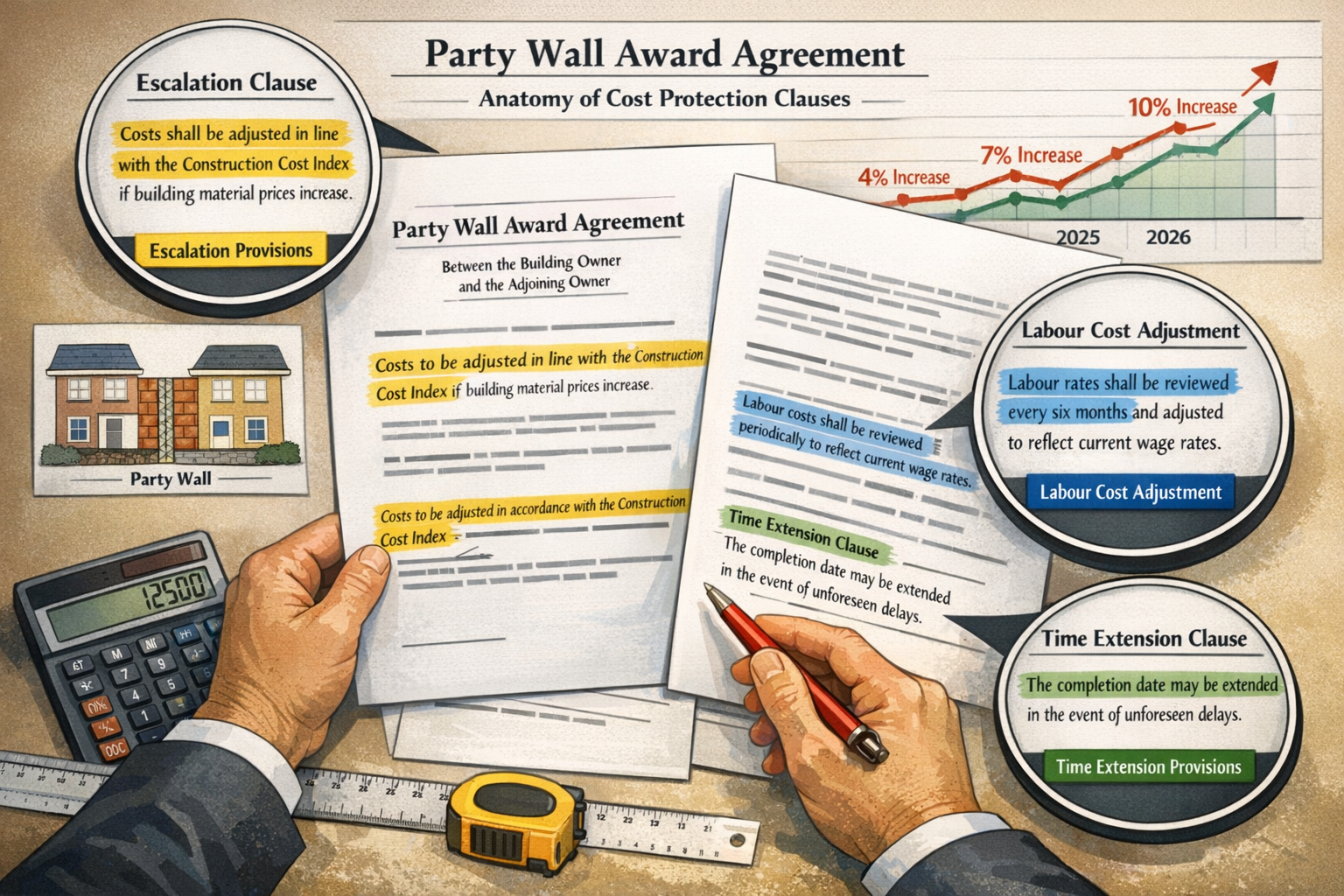
The construction sector in 2026 continues to grapple with economic headwinds that directly impact party wall projects. Labor shortages across skilled trades—including bricklayers, plasterers, and structural engineers—have created a competitive hiring environment where wages increase rapidly. According to industry analyses, labor costs have risen between 4% and 10% in many regions, with London and the South East experiencing the higher end of this range due to intense demand for construction workers.
Material costs present another challenge. While some commodity prices have stabilized compared to the volatile 2021-2023 period, supply chain fragility means that sudden price spikes remain possible. Steel, timber, and specialized building materials can experience significant price fluctuations within the typical 6-12 month timeframe of a party wall project. When these cost increases occur mid-project, the question arises: who bears the financial burden?
For property owners undertaking extensions, loft conversions, or basement excavations that trigger party wall procedures, these cost uncertainties create planning difficulties. Understanding party wall costs becomes more complex when the final price tag remains uncertain until project completion.
The Gap in Traditional Party Wall Awards
Historically, many party wall awards focused primarily on defining the scope of works, access rights, and basic compensation for damage. The financial provisions often consisted of simple statements about who would pay for what, without sophisticated mechanisms to address cost changes over time. This approach worked reasonably well during periods of economic stability when costs remained relatively predictable.
However, the economic volatility of recent years has exposed the limitations of these traditional approaches. Awards drafted without price escalation protections can lead to several problematic scenarios:
- Contractor withdrawal: When fixed-price contracts become unprofitable due to cost increases, contractors may seek to exit agreements, causing project delays
- Quality compromises: Contractors locked into unprofitable fixed prices may reduce quality or cut corners to maintain margins
- Dispute escalation: Disagreements about who should pay for cost overruns can damage neighbor relations and lead to costly legal proceedings
- Project abandonment: Building owners facing unexpected cost increases may halt projects mid-construction, leaving adjoining owners with incomplete works and potential property damage
Party wall awards must evolve to address these modern challenges while remaining compliant with statutory requirements.
The Role of Party Wall Surveyors in Cost Protection
Party wall surveyors occupy a unique position in protecting both building owners and adjoining owners from cost-related disputes. When drafting awards, surveyors must balance several competing interests:
- Building owner protection: Ensuring the project can proceed without prohibitive cost increases that might force abandonment
- Adjoining owner security: Guaranteeing adequate funds remain available for repairs, compensation, and restoration
- Contractor fairness: Creating terms that allow contractors to complete works profitably without excessive windfall gains
- Legal compliance: Maintaining adherence to the Party Wall etc. Act 1996 and relevant case law
Professional surveyors with experience in Contract Language for Party Wall Awards: Protecting Against Price Escalation and Labor Cost Volatility in 2026 understand that well-drafted cost protection provisions actually reduce disputes rather than create them. By establishing clear mechanisms for addressing cost changes before they occur, awards can prevent the conflicts that arise when parties face unexpected financial pressures.
Essential Contract Language Components for Price Escalation Protection
Escalation Clauses: Types and Implementation
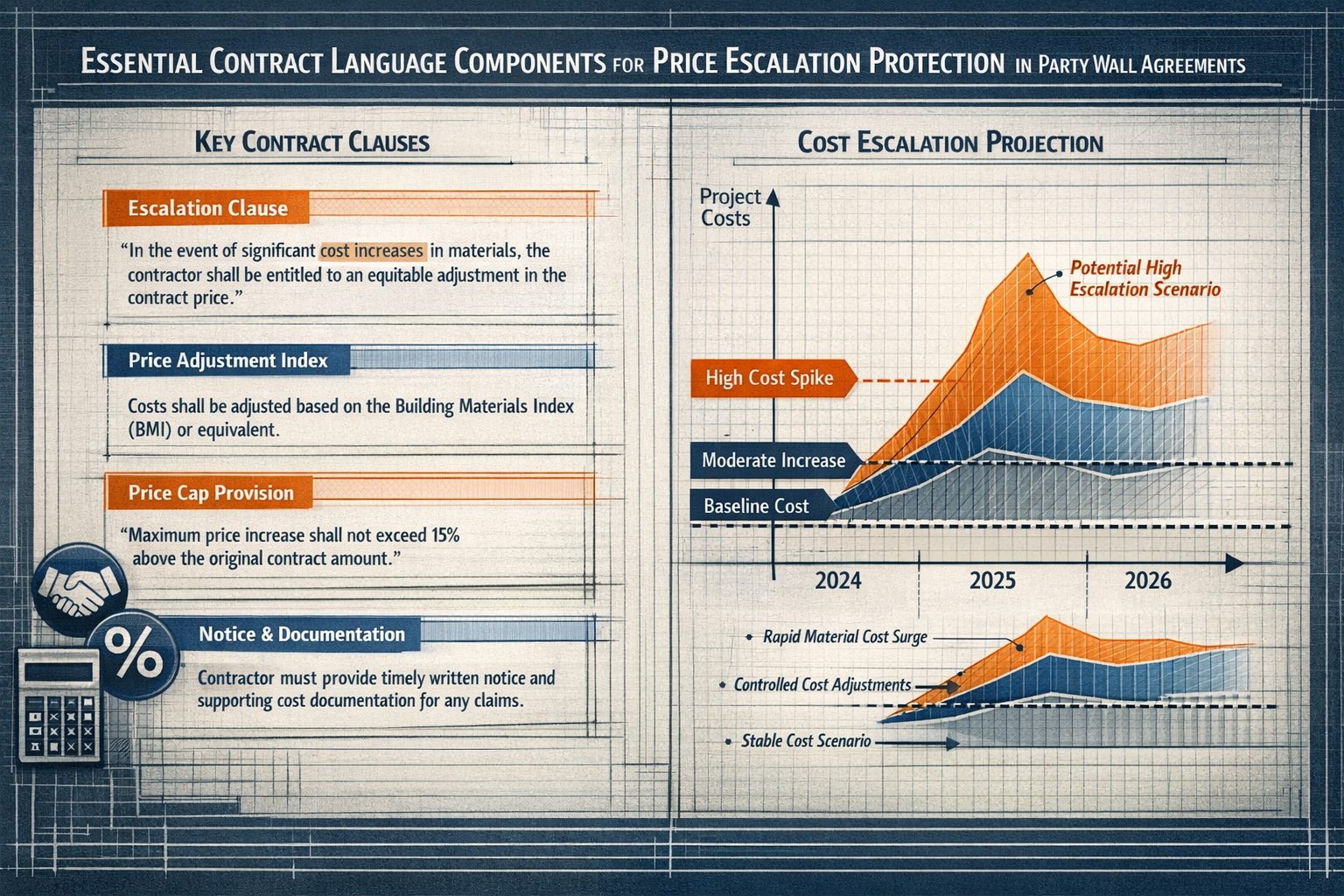
Escalation clauses form the cornerstone of cost protection in modern party wall awards. These provisions allow contract prices to adjust based on objective criteria, preventing the problems associated with rigid fixed-price agreements. Several types of escalation clauses can be incorporated into party wall contract language:
Index-Linked Escalation Clauses
Index-linked provisions tie cost adjustments to recognized industry indices that track construction costs. The most commonly used indices in the UK include:
- BCIS (Building Cost Information Service) indices: Published by RICS, these indices track various construction cost categories
- ONS Construction Output Price Indices: Government statistics measuring price changes in construction output
- Labor cost indices: Specific indices tracking wage rates in construction trades
An example of index-linked escalation language might read:
"The contract sum shall be subject to adjustment based on changes in the BCIS General Building Cost Index. The base index value shall be that published for [month/year of contract signing]. Adjustments shall be calculated quarterly based on the most recent published index values, with increases or decreases applied proportionally to the remaining contract value."
This approach provides objectivity and transparency, as both parties can independently verify index values. However, surveyors must ensure the chosen index appropriately reflects the actual cost components of the specific project.
Material-Specific Escalation Provisions
For projects heavily dependent on particular materials, material-specific escalation clauses offer targeted protection. These provisions identify key materials (such as steel, timber, or concrete) and establish mechanisms for price adjustments based on documented cost changes.
Example language:
"For materials constituting more than 10% of the contract value (specifically structural steel and ready-mix concrete), the contract price shall be adjusted to reflect documented changes in supplier costs. The Building Owner's contractor shall provide written quotations from at least two suppliers demonstrating price changes exceeding 5% from baseline costs established at contract signing. Such adjustments require approval from the Building Owner's surveyor before implementation."
This approach requires more administrative oversight but provides precise protection for high-impact cost items.
Labor Rate Adjustment Mechanisms
Given the 4-10% labor cost volatility in 2026, specific provisions addressing labor rates deserve particular attention in Contract Language for Party Wall Awards: Protecting Against Price Escalation and Labor Cost Volatility in 2026. These clauses can reference industry-standard wage agreements or regional labor rate surveys.
Example provision:
"Labor rates shall be reviewed at three-month intervals throughout the project duration. Adjustments shall be permitted when documented changes in prevailing wage rates for relevant trades (as published in [recognized industry source]) exceed 3% from the rates established in the original contract pricing. Any adjustments shall apply only to work performed after the adjustment date, not retroactively."
Contingency Provisions and Reserve Funds
Beyond escalation clauses, well-drafted party wall awards should include contingency provisions that establish financial reserves for unforeseen circumstances. These provisions protect both parties from the disruption of having to renegotiate terms when unexpected costs arise.
Percentage-Based Contingencies
A straightforward approach involves building a percentage contingency into the initial contract sum:
"The contract sum includes a contingency allowance of 10% (£[amount]) to address unforeseen conditions, necessary variations, or cost increases not covered by other escalation provisions. This contingency may be accessed only with written approval from both the Building Owner's surveyor and the Adjoining Owner's surveyor. Any unused contingency shall be returned to the Building Owner upon project completion."
The appropriate contingency percentage depends on project complexity, duration, and current market volatility. In 2026's uncertain environment, contingencies of 10-15% are becoming standard for substantial works.
Staged Release Mechanisms
For larger projects, staged contingency release provisions prevent premature depletion of reserves:
"The contingency fund shall be divided into three tranches corresponding to project phases: foundation works (40%), structural works (40%), and finishing works (20%). Each tranche becomes accessible only upon commencement of the relevant phase and requires documented justification for release."
This approach ensures funds remain available throughout the project lifecycle rather than being exhausted early in the works.
Time Extension Provisions
Cost escalation and time extensions are intimately connected. Delays caused by material shortages, labor unavailability, or unforeseen site conditions can trigger additional costs through extended site supervision, equipment rental, and general price inflation over the extended timeline.
Effective time extension language should address:
Qualifying events: Clearly define what circumstances justify time extensions (force majeure events, material unavailability, discovery of unforeseen conditions, regulatory delays, etc.)
Notification requirements: Establish procedures for contractors to notify surveyors of delay events promptly
Documentation standards: Specify what evidence must be provided to substantiate time extension requests
Cost implications: Clarify whether time extensions automatically trigger cost adjustments or require separate justification
Example comprehensive time extension provision:
"The Contractor shall be entitled to time extensions for delays caused by: (a) extreme weather preventing safe working for more than 3 consecutive days; (b) material unavailability despite reasonable procurement efforts; (c) unforeseen ground conditions requiring design modifications; (d) regulatory authority delays exceeding 4 weeks; or (e) force majeure events. The Contractor must provide written notice within 5 working days of becoming aware of the delay event, with supporting documentation. Time extensions do not automatically entitle the Contractor to additional payment beyond costs directly attributable to the delay and approved under escalation provisions."
For guidance on managing overall expenses, property owners should review strategies for keeping party wall costs down while maintaining appropriate protections.
Contract Models: Fixed-Price vs. Cost-Plus vs. Hybrid Approaches
Fixed-Price Contracts with Protection Mechanisms
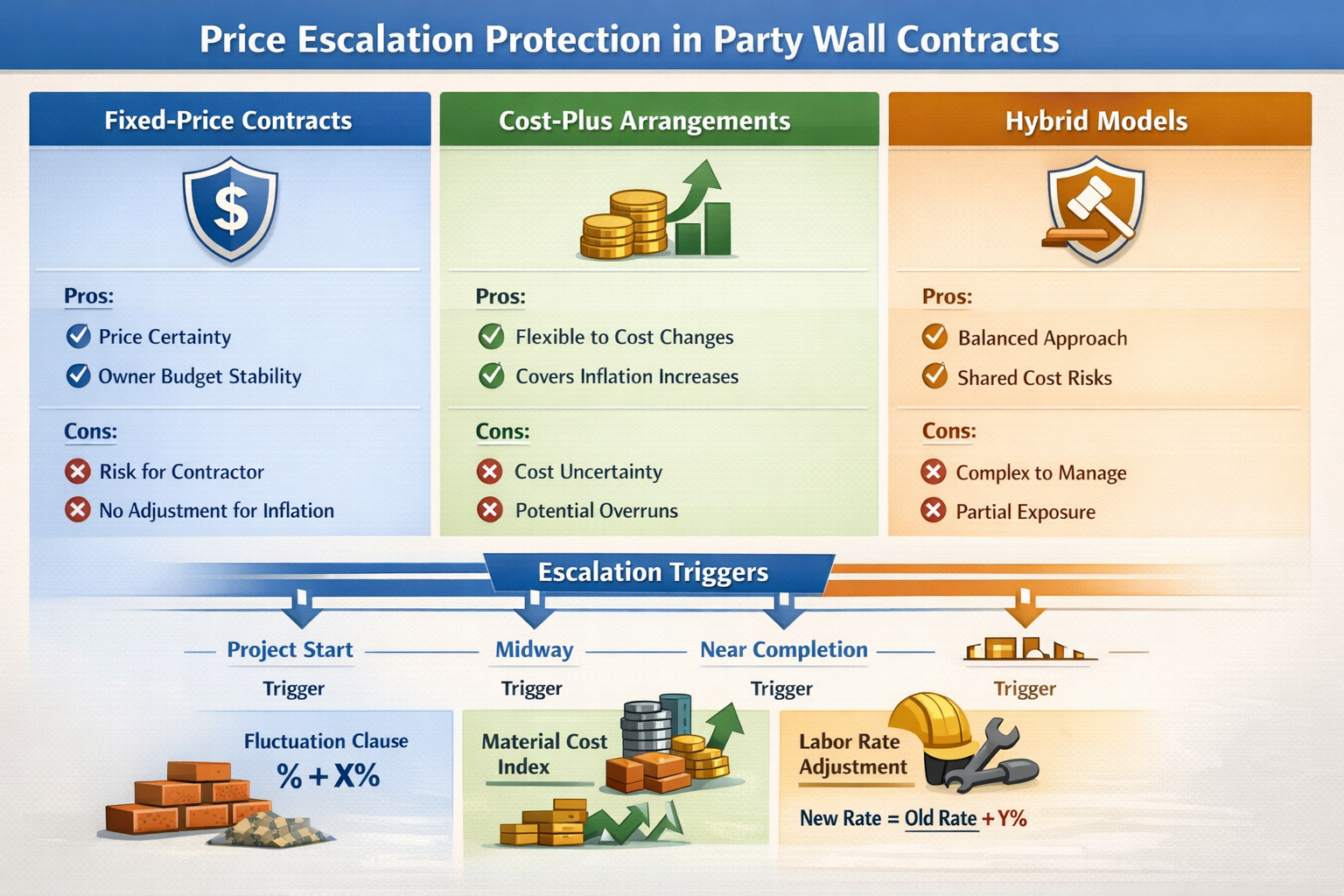
Fixed-price contracts offer certainty and simplicity, making them attractive to building owners who want predictable budgets. However, in 2026's volatile cost environment, pure fixed-price agreements without any protection mechanisms create significant risks.
Advantages of Fixed-Price Approaches
- Budget certainty: Building owners know the maximum cost commitment upfront
- Simplicity: Fewer administrative requirements for tracking and adjusting costs
- Risk transfer: Cost risk shifts primarily to the contractor, incentivizing efficient project management
- Reduced disputes: Less opportunity for disagreements about cost calculations
Disadvantages and Risk Mitigation
The primary disadvantage of fixed-price contracts in volatile markets is contractor risk aversion. Contractors may either refuse fixed-price terms entirely, build excessive contingencies into their pricing (making them uncompetitive), or accept terms they later regret, leading to quality compromises or contract disputes.
To make fixed-price contracts viable in 2026, surveyors should incorporate:
Price ceiling provisions: Rather than truly fixed prices, establish price ceilings with limited escalation allowances:
"The contract price is fixed at £[amount] subject to a maximum adjustment of 7.5% for documented material cost increases exceeding 10% for any material category, provided such increases are verified through independent supplier quotations."
Shortened contract periods: Fixed-price terms work better over shorter timeframes where cost prediction is more reliable. For longer projects, consider breaking the work into phases with separate fixed prices for each phase.
Robust scope definitions: The more precisely the scope is defined, the fewer opportunities for disputes about whether additional costs fall within the fixed price. Party wall contract templates should include detailed specifications and drawings.
Cost-Plus Contracts with Caps and Controls
Cost-plus contracts (also called cost-reimbursable contracts) take the opposite approach: the building owner pays the contractor's actual costs plus an agreed markup for profit and overhead. This model eliminates contractor pricing risk but shifts uncertainty to the building owner.
Implementing Cost-Plus Provisions
Effective cost-plus language in party wall awards requires careful controls:
"The Building Owner shall reimburse the Contractor for all reasonable and documented costs directly attributable to the Works, plus a management fee of 15% of costs. Reimbursable costs include: (a) labor at documented hourly rates not exceeding £[amount] per trade; (b) materials at invoice cost with supporting documentation; (c) equipment rental at competitive market rates; (d) subcontractor costs with prior approval; and (e) site supervision costs. The Contractor shall provide weekly cost reports with supporting invoices and receipts."
Maximum Price Guarantees
Pure cost-plus arrangements create unlimited exposure for building owners. To address this, surveyors should incorporate guaranteed maximum price (GMP) provisions:
"Notwithstanding the cost-plus reimbursement structure, the total contract sum shall not exceed £[amount] (the Guaranteed Maximum Price) except for variations approved in writing by the Building Owner. The Contractor assumes responsibility for cost overruns exceeding the GMP unless caused by Building Owner-directed changes, unforeseen conditions approved by the surveyors, or qualifying delay events."
This hybrid approach provides building owners with cost protection while allowing contractors flexibility to manage actual costs efficiently.
Hybrid Models: The Balanced Approach for 2026
For Contract Language for Party Wall Awards: Protecting Against Price Escalation and Labor Cost Volatility in 2026, hybrid contract models often provide the most practical solution. These approaches combine elements of fixed-price and cost-plus structures, allocating different risks to the parties best positioned to manage them.
Component-Based Pricing
One effective hybrid approach separates contract pricing into components with different pricing mechanisms:
| Contract Component | Pricing Mechanism | Rationale |
|---|---|---|
| Labor | Cost-plus with hourly rate caps | Addresses labor volatility while preventing excessive rates |
| Standard materials | Fixed price with 5% escalation allowance | Provides certainty for predictable items with limited protection |
| Volatile materials (steel, timber) | Cost-plus with documented invoicing | Protects against unpredictable price movements |
| Equipment rental | Fixed daily/weekly rates | Combines predictability with usage-based fairness |
| Profit & overhead | Fixed percentage (12-18%) | Provides contractor certainty on margin |
| Project management | Fixed fee | Encourages efficient project completion |
Example hybrid provision:
"The contract sum comprises: (1) Fixed-price components totaling £[amount] for standard materials, equipment, and project management as detailed in Schedule A; (2) Cost-reimbursable components for labor and volatile materials as defined in Schedule B, subject to the controls and caps specified therein; and (3) A fixed contractor's fee of £[amount] covering profit and overhead. The total contract value shall not exceed £[GMP amount] except for approved variations."
Risk-Sharing Mechanisms
Advanced hybrid models can include risk-sharing provisions where cost savings or overruns are split between building owner and contractor:
"If final project costs fall below the target cost of £[amount], the Building Owner and Contractor shall share the savings 50/50. If costs exceed the target cost but remain below the Guaranteed Maximum Price of £[amount], the overrun shall be shared 70% Contractor / 30% Building Owner. This provision incentivizes cost efficiency while providing fair risk allocation."
These sophisticated arrangements require experienced surveyors to draft and administer but can create aligned incentives that benefit all parties.
Specific Clauses for Labor Cost Volatility Management
Wage Rate Review Mechanisms
Given that labor costs represent 30-50% of most construction projects and are experiencing 4-10% annual increases in 2026, specific provisions addressing wage rate changes deserve detailed attention in party wall awards.
Baseline Establishment
Effective labor cost provisions begin with clear baseline establishment:
"The contract pricing is based on the following hourly labor rates, representing prevailing market rates as of [date]: Bricklayer £[amount], Carpenter £[amount], Plasterer £[amount], Laborer £[amount], Site Supervisor £[amount]. These baseline rates are documented in Schedule C and form the basis for any subsequent adjustments under this clause."
Adjustment Triggers and Frequency
Rather than continuous adjustments for minor fluctuations, practical provisions establish materiality thresholds and review periods:
"Labor rates shall be reviewed quarterly on [specific dates]. Adjustments shall be implemented only when documented changes in prevailing market rates (as evidenced by [recognized industry wage survey or union agreement]) exceed 3% from the current contract rates. Adjustments apply prospectively to work performed after the adjustment date."
This approach balances protection against volatility with administrative practicability.
Workforce Availability Provisions
Beyond wage rates, workforce availability itself presents challenges in 2026. Skilled trade shortages can delay projects or force contractors to pay premium rates for available workers. Forward-thinking party wall awards address these scenarios:
"If the Contractor demonstrates through reasonable efforts (minimum three documented recruitment attempts) that workers in a required trade are unavailable at the contract labor rates, the Contractor may engage workers at premium rates not exceeding 125% of contract rates, subject to Building Owner's surveyor approval. Such premium labor costs shall be reimbursed by the Building Owner as a variation to the contract sum."
This provision prevents project stoppages due to labor unavailability while capping the building owner's exposure to premium rates.
Subcontractor Management Clauses
Many party wall projects involve specialized subcontractors for structural engineering, underpinning, or other technical work. Subcontractor cost volatility requires specific attention:
"The Contractor shall obtain competitive quotations (minimum two quotes) for all subcontracted work exceeding £[amount]. Subcontractor agreements shall include price validity periods of not less than 90 days. If a subcontractor withdraws a quotation or increases pricing before work commencement, the Contractor shall obtain replacement quotations and the contract sum shall be adjusted to reflect the documented price difference, subject to Building Owner's surveyor approval."
These provisions ensure that subcontractor cost changes are managed transparently and fairly.
Documentation and Transparency Requirements
Cost Tracking and Reporting Obligations
Effective cost protection mechanisms require robust documentation. Party wall awards should establish clear reporting requirements that enable surveyors and building owners to monitor costs and verify escalation claims.
Regular Cost Reporting
"The Contractor shall provide cost reports on a bi-weekly basis, detailing: (a) costs incurred to date by category (labor, materials, equipment, subcontractors); (b) comparison to budget allocations; (c) forecast costs to completion; (d) any anticipated cost pressures or escalation triggers; and (e) supporting documentation including timesheets, invoices, and receipts. Reports shall be submitted to both the Building Owner's surveyor and Adjoining Owner's surveyor."
Regular reporting enables early identification of cost trends before they become disputes.
Invoice and Receipt Requirements
For cost-plus components and escalation claims, detailed documentation standards prevent disputes:
"All claims for cost reimbursement or escalation adjustments must be supported by: (1) original supplier invoices showing itemized costs; (2) proof of payment; (3) delivery receipts confirming materials were delivered to the project site; and (4) a written explanation of how the costs relate to the Works. The Building Owner's surveyor may reject claims lacking adequate documentation."
Audit Rights and Verification Procedures
Building owners and their surveyors need the ability to verify cost claims, particularly in cost-plus arrangements:
"The Building Owner and appointed surveyors reserve the right to audit all project cost records upon 5 working days' notice. The Contractor shall maintain organized records of all project costs for a period of 3 years following project completion. Audits may be conducted by the Building Owner's surveyor or an independent quantity surveyor appointed for this purpose. If an audit reveals overcharges exceeding 5% of audited costs, the Contractor shall bear the audit costs; otherwise, the Building Owner shall pay reasonable audit expenses."
This provision encourages accurate cost reporting while providing recourse if discrepancies arise.
Change Order Procedures
Many cost disputes arise from unclear procedures for approving variations and changes. Well-drafted awards establish formal change order processes:
"No variation to the Works or contract sum shall be valid unless documented through a written Change Order signed by the Building Owner's surveyor and the Contractor. Each Change Order shall specify: (a) description of the changed work; (b) cost impact (increase or decrease); (c) schedule impact; (d) justification for the change; and (e) any implications for adjoining owner interests. The Adjoining Owner's surveyor shall be copied on all Change Orders and may object within 5 working days if the change materially affects the Adjoining Owner's interests."
Formal change order procedures prevent the "scope creep" that often leads to cost overruns and disputes. For more information on the overall party wall process, property owners can review party wall notices and how to respond.
Dispute Resolution and Enforcement Mechanisms
Escalation Dispute Procedures
Even with well-drafted cost protection language, disagreements about whether escalation provisions apply or the magnitude of adjustments can arise. Awards should establish tiered dispute resolution procedures:
Level 1: Surveyor Negotiation
"In the event of disagreement regarding cost escalation claims or adjustments, the Building Owner's surveyor and Adjoining Owner's surveyor shall meet within 10 working days to review the claim and supporting documentation. The surveyors shall make good faith efforts to reach agreement on the appropriate adjustment, if any."
Most disputes can be resolved at this level when surveyors approach issues collaboratively.
Level 2: Third Surveyor Determination
If the appointed surveyors cannot agree, the Party Wall etc. Act 1996 provides for third surveyor involvement:
"If the appointed surveyors cannot reach agreement within 14 days, either surveyor may refer the matter to the Third Surveyor for determination. The Third Surveyor shall review submissions from both surveyors, examine supporting documentation, and issue a written determination within 21 days. The Third Surveyor's determination shall be binding on all parties unless successfully challenged through the dispute resolution procedures of the Party Wall etc. Act 1996."
The third surveyor mechanism provides an efficient resolution path without immediately resorting to litigation.
Security and Payment Guarantees
To ensure funds remain available for escalation adjustments and potential adjoining owner compensation, awards can include security provisions:
"The Building Owner shall maintain a project contingency fund of £[amount] in a designated account or provide a bond from a recognized financial institution guaranteeing availability of funds for approved escalation adjustments and potential adjoining owner claims. Evidence of such security shall be provided to the Adjoining Owner's surveyor before works commence."
These provisions protect adjoining owners from situations where building owners cannot pay for damage repairs or compensation due to cost overruns exhausting their resources.
Penalty and Incentive Provisions
Some awards incorporate penalties for unjustified cost claims or incentives for cost efficiency:
"If the Building Owner's surveyor determines that an escalation claim was submitted without reasonable basis or with inadequate documentation, the Contractor shall forfeit the right to escalation adjustments for the subsequent 30-day period. Conversely, if the project is completed below the target cost, the Contractor shall receive a bonus payment of 20% of the savings achieved."
These provisions must be carefully drafted to avoid being deemed "penalty clauses" that are unenforceable under English law, but when properly structured as genuine pre-estimates of damages or legitimate incentives, they can encourage good behavior.
Regional Considerations and London-Specific Factors
Geographic Cost Variations
Construction costs vary significantly across different regions of the UK, with London and the South East experiencing the highest costs and greatest volatility. Party wall awards should acknowledge these regional factors when establishing baselines and escalation mechanisms.
For projects in high-cost areas like North London, South London, West London, Central London, or East London, surveyors should:
- Use region-specific cost indices rather than national averages when establishing escalation benchmarks
- Account for London weighting in labor rates, which can be 20-30% higher than other UK regions
- Consider transport and logistics costs unique to urban construction (congestion charges, restricted access, limited material storage)
- Address planning and regulatory timelines specific to London boroughs, which may be longer than other areas
Example regional provision:
"Cost escalation adjustments shall be calculated using the BCIS London Index rather than the national index, recognizing the distinct cost environment of Central London construction. Labor rates shall reflect Inner London weighting factors as published in [recognized source]."
Regulatory and Planning Delay Provisions
London projects often face longer planning approval processes and more stringent building control requirements. These regulatory factors can trigger both time extensions and cost escalations:
"Delays caused by planning authority or building control processes exceeding the following timeframes shall constitute qualifying events for time extensions and associated cost adjustments: Planning decisions exceeding 12 weeks from submission; Building control approvals exceeding 6 weeks from submission; Statutory consultee responses exceeding 4 weeks. The Contractor must demonstrate reasonable efforts to expedite approvals and provide documented evidence of delay causes."
Practical Implementation: Drafting Effective Award Language
Working with Experienced Party Wall Surveyors
The complexity of Contract Language for Party Wall Awards: Protecting Against Price Escalation and Labor Cost Volatility in 2026 underscores the importance of engaging experienced professionals. Property owners should select surveyors with:
✅ Recent experience drafting awards in volatile cost environments
✅ Construction cost knowledge beyond basic party wall procedures
✅ Negotiation skills to balance competing interests fairly
✅ Technical expertise in the specific type of works planned
✅ Local market understanding of regional cost factors
When interviewing potential surveyors, property owners should ask:
- "How do you address cost escalation in awards you draft?"
- "What escalation provisions have you found most effective in recent projects?"
- "How do you balance building owner cost certainty with contractor fairness?"
- "What documentation do you require for escalation claims?"
Party wall surveyor services should include comprehensive award drafting that addresses modern cost protection needs, not just template documents.
Customization for Project-Specific Factors
While template language provides a starting point, effective cost protection requires customization based on:
Project duration: Longer projects need more robust escalation provisions due to greater cost uncertainty over time
Project complexity: Complex works involving specialized trades or materials require more detailed cost component breakdowns
Market conditions: Awards drafted during periods of high volatility should include more generous escalation allowances
Building owner risk tolerance: Some building owners prefer cost certainty even at the expense of higher initial pricing, while others are comfortable with cost-plus arrangements
Contractor relationships: Established relationships with trusted contractors may justify simpler provisions than first-time engagements
Balancing Protection with Practicality
While comprehensive cost protection is valuable, surveyors must avoid creating awards so complex that they become unworkable. The goal is practical protection, not perfect protection. Key principles include:
🎯 Focus on material risks: Provide detailed provisions for high-impact cost categories (labor, major materials) while using simpler approaches for minor items
🎯 Establish clear thresholds: Use materiality thresholds (e.g., "adjustments only for changes exceeding 5%") to avoid administrative burden of tracking minor fluctuations
🎯 Limit review frequency: Quarterly or monthly reviews provide adequate protection without constant renegotiation
🎯 Use recognized benchmarks: Reference published indices and industry standards rather than creating custom measurement systems
🎯 Maintain flexibility: Include provisions for unforeseen circumstances that don't fit neatly into defined categories
Case Studies: Lessons from Recent Party Wall Projects
Case Study 1: Basement Excavation with Material Cost Spike
Scenario: A building owner in West London undertook a basement excavation requiring substantial structural steel and concrete. The original party wall award included a fixed-price contract. Three months into the six-month project, steel prices increased by 18% due to supply chain disruptions.
Problem: The contractor demanded additional payment, threatening to halt works. The building owner refused, citing the fixed-price agreement. The project stalled for six weeks while the parties disputed the issue.
Resolution: The third surveyor determined that the fixed-price contract was valid but awarded the contractor a time extension for the dispute period, which ironically increased the building owner's total costs due to extended site supervision and equipment rental.
Lesson: A material-specific escalation clause with a threshold (e.g., "steel price increases exceeding 15% shall be shared 50/50 between building owner and contractor") would have prevented the dispute and likely resulted in lower total costs than the delay caused.
Case Study 2: Loft Conversion with Labor Shortage
Scenario: A North London loft conversion project included a hybrid contract with fixed pricing for materials and cost-plus provisions for labor, capped at specified hourly rates. Midway through the project, the contractor's carpenter left for another job, and replacement carpenters were unavailable at the contract rate.
Problem: The contractor found a carpenter willing to work at 140% of the contract rate but needed approval for the premium.
Resolution: Because the award included a workforce availability provision allowing premium rates up to 125% with surveyor approval, and up to 150% with building owner consent, the parties quickly agreed to the 140% rate. The project continued with minimal delay.
Lesson: Workforce availability provisions that anticipate labor shortages and establish pre-agreed frameworks for premium rates enable quick decision-making when issues arise.
Case Study 3: Extension Project with Effective Escalation Management
Scenario: A South London extension project used a comprehensive hybrid contract with index-linked escalation, material-specific provisions, and quarterly cost reviews. The 12-month project experienced moderate cost increases across multiple categories.
Problem: None—the escalation provisions functioned as designed.
Resolution: Quarterly reviews identified cost trends early. The building owner approved modest escalation adjustments totaling 6% of the original contract value. The contractor completed the work on schedule and to specification. Both parties considered the outcome fair.
Lesson: Well-drafted cost protection provisions prevent disputes rather than creating them. The administrative effort of quarterly reviews was minimal compared to the value of maintaining a cooperative working relationship.
Future-Proofing Party Wall Awards: Trends and Emerging Practices
Digital Documentation and Blockchain Verification
As construction embraces digital transformation, party wall awards are beginning to incorporate technology-enabled verification mechanisms. Some forward-thinking surveyors are exploring:
- Digital cost tracking platforms that provide real-time visibility into project costs for all parties
- Blockchain-based verification of material invoices and labor timesheets to prevent disputes about documentation authenticity
- Automated index tracking that calculates escalation adjustments automatically based on published index changes
- Digital change order systems that streamline approval processes and maintain comprehensive audit trails
While these technologies are not yet mainstream in 2026, they represent the direction of evolution for party wall documentation and cost management.
Sustainability and Green Building Considerations
The increasing focus on sustainable construction introduces new cost considerations for party wall projects. Sustainable materials and practices often carry premium costs but may qualify for incentives or grants. Modern party wall awards should address:
"If the Building Owner elects to use sustainable materials or construction methods that exceed minimum building regulation requirements, any additional costs shall be borne by the Building Owner unless such materials are required by planning conditions. However, if sustainable approaches result in cost savings (e.g., through grant funding or reduced material quantities), such savings shall be reflected in contract sum reductions."
Insurance-Backed Cost Protection
An emerging practice involves insurance products that protect against cost escalation, similar to how performance bonds protect against contractor default. Some awards now include provisions for:
"The Building Owner may elect to obtain cost escalation insurance covering material price increases exceeding [threshold]. Premiums for such insurance shall be included in the project costs. If escalation insurance is obtained, contractor escalation claims shall first be submitted to the insurer before being charged to the Building Owner."
These insurance mechanisms transfer risk to specialized risk-bearing entities, potentially at lower cost than building large contingencies into every contract.
Checklist: Essential Elements for Cost-Protected Party Wall Awards
When reviewing or drafting party wall awards in 2026, ensure the following elements are addressed:
✅ Cost Escalation Provisions
- Escalation mechanism clearly defined (index-linked, material-specific, or hybrid)
- Baseline costs and rates documented with effective date
- Materiality thresholds established (minimum change percentage to trigger adjustment)
- Review frequency specified (monthly, quarterly, etc.)
- Adjustment calculation methodology explained
- Documentation requirements for escalation claims detailed
✅ Labor Cost Management
- Baseline labor rates specified by trade category
- Labor rate adjustment triggers and frequency defined
- Workforce availability provisions included
- Premium rate caps established for shortage scenarios
- Subcontractor management procedures outlined
✅ Time Extension Framework
- Qualifying delay events enumerated
- Notification requirements specified
- Documentation standards established
- Relationship between time extensions and cost adjustments clarified
- Process for approving extensions defined
✅ Financial Controls
- Contract pricing model clearly stated (fixed-price, cost-plus, or hybrid)
- Guaranteed maximum price included (if applicable)
- Contingency provisions and access procedures defined
- Payment schedule aligned with project milestones
- Security or bond requirements specified
✅ Documentation and Transparency
- Cost reporting frequency and format specified
- Invoice and receipt requirements detailed
- Audit rights reserved
- Change order procedures established
- Record retention requirements stated
✅ Dispute Resolution
- Surveyor negotiation process outlined
- Third surveyor referral procedures specified
- Timeframes for dispute resolution established
- Enforcement mechanisms included
✅ Project-Specific Factors
- Regional cost factors addressed (if applicable)
- Specialized trade or material considerations included
- Regulatory delay provisions incorporated (if relevant)
- Sustainability cost implications addressed (if applicable)
For additional guidance on party wall documentation, property owners can access sample party wall agreement templates to understand standard provisions.
The Role of Professional Guidance in Complex Cost Environments
When to Seek Specialist Advice
While the Party Wall etc. Act 1996 allows property owners to act as their own surveyors, the complexity of Contract Language for Party Wall Awards: Protecting Against Price Escalation and Labor Cost Volatility in 2026 makes professional involvement increasingly valuable. Property owners should strongly consider professional surveyor appointment when:
🏗️ Project value exceeds £50,000: The cost protection provisions become proportionally more important for substantial projects
🏗️ Project duration exceeds 6 months: Longer timeframes increase cost volatility exposure
🏗️ Specialized works are involved: Underpinning, structural alterations, or complex excavations require specialized cost knowledge
🏗️ Contractor relationships are new: First-time engagements with contractors benefit from robust contractual protections
🏗️ Neighbor relations are strained: Professional surveyors can maintain objectivity when owner relationships are difficult
🏗️ Multiple adjoining owners are affected: Coordinating interests of several parties requires diplomatic expertise
Coordinating with Other Construction Professionals
Party wall surveyors should coordinate with other professionals involved in the project to ensure cost protection provisions align with overall project management:
- Architects and designers: Ensure specifications are sufficiently detailed to minimize scope ambiguity
- Quantity surveyors: Leverage QS expertise in cost estimation and escalation forecasting
- Project managers: Align cost tracking and reporting with project management systems
- Legal advisors: Ensure contract language is legally enforceable and complies with relevant construction law principles
- Insurance advisors: Coordinate cost protection provisions with available insurance products
This multidisciplinary approach creates comprehensive protection that addresses cost volatility from multiple angles.
Continuing Professional Development for Surveyors
The rapidly evolving cost environment requires party wall surveyors to maintain current knowledge through:
- Professional training on construction cost management and contract drafting
- Industry publications tracking cost trends and emerging protection mechanisms
- Professional body guidance from RICS and other surveying organizations
- Peer consultation and case study sharing within the surveying community
- Legal updates on relevant case law affecting party wall awards and construction contracts
Surveyors who invest in this continuing development provide greater value to their clients and contribute to raising professional standards across the industry.
Conclusion: Building Resilient Party Wall Agreements for Uncertain Times
The construction cost volatility characterizing 2026 presents significant challenges for property owners undertaking works that trigger party wall procedures. Labor costs rising 4-10% annually, material price fluctuations, workforce shortages, and supply chain fragility create an environment where traditional fixed-price party wall awards often prove inadequate or unworkable.
However, these challenges are not insurmountable. Through thoughtful Contract Language for Party Wall Awards: Protecting Against Price Escalation and Labor Cost Volatility in 2026, surveyors and property owners can create agreements that:
✨ Protect building owners from unlimited cost exposure while maintaining project viability
✨ Ensure adjoining owners receive adequate protection and compensation
✨ Enable contractors to complete works profitably without excessive risk
✨ Prevent disputes through clear, objective cost adjustment mechanisms
✨ Maintain compliance with the Party Wall etc. Act 1996 and relevant case law
The key principles for effective cost protection in party wall awards include:
- Recognize reality: Acknowledge that costs will change over project duration and build mechanisms to address changes fairly
- Use objective benchmarks: Tie escalation provisions to published indices and industry standards rather than subjective assessments
- Balance interests: Create provisions that distribute cost risks equitably among parties based on their ability to manage those risks
- Maintain transparency: Establish robust documentation and reporting requirements that enable verification and build trust
- Plan for disputes: Include clear dispute resolution procedures that provide efficient paths to resolution without litigation
- Customize appropriately: Tailor provisions to project-specific factors rather than relying solely on template language
- Seek expertise: Engage experienced party wall surveyors who understand both party wall law and construction cost management
Actionable Next Steps
For building owners planning works that will require party wall procedures:
- Engage a qualified party wall surveyor early in project planning to address cost protection in award drafting
- Discuss risk tolerance openly with your surveyor to ensure cost protection provisions match your preferences
- Budget appropriately for contingencies and potential escalation, recognizing that cost certainty comes at a price
- Review contractor proposals carefully to understand their pricing assumptions and escalation expectations
- Maintain open communication with adjoining owners about cost management approaches to prevent misunderstandings
For adjoining owners receiving notice of neighbor works:
- Appoint your own surveyor rather than consenting to the building owner's surveyor to ensure independent representation
- Review cost protection provisions in proposed awards to ensure adequate security for potential damage compensation
- Ask questions about how cost escalations might affect the project timeline or your property interests
- Understand your rights regarding changes to the works and associated cost implications
For party wall surveyors drafting awards:
- Stay current on construction cost trends and emerging protection mechanisms through continuing professional development
- Customize provisions based on specific project characteristics rather than relying on outdated template language
- Explain clearly to both building and adjoining owners how cost protection provisions function and why they're necessary
- Document thoroughly the rationale for chosen cost protection approaches in award schedules
- Monitor implementation during construction to ensure provisions function as intended and address issues promptly
For contractors bidding on party wall projects:
- Review award cost provisions carefully before finalizing pricing to understand your escalation rights and limitations
- Maintain detailed records of all costs to support any escalation claims under award provisions
- Communicate proactively with surveyors about emerging cost pressures before they become crises
- Honor the spirit of cost protection provisions rather than seeking to exploit them for windfall gains
The volatile cost environment of 2026 makes party wall work more challenging than in previous decades, but also more important. Well-drafted awards with robust cost protection provisions serve the interests of all parties by creating fair, workable frameworks that enable projects to proceed successfully despite economic uncertainty.
By incorporating the strategies, provisions, and principles outlined in this guide, property owners and their surveyors can create party wall awards that withstand the cost pressures of 2026 while maintaining the cooperative neighbor relationships that the Party Wall etc. Act 1996 was designed to preserve. The investment in thoughtful contract language pays dividends through smoother project execution, fewer disputes, and better outcomes for everyone involved.
As the construction industry continues to evolve and cost pressures persist, the importance of sophisticated Contract Language for Party Wall Awards: Protecting Against Price Escalation and Labor Cost Volatility in 2026 will only increase. Property owners and surveyors who embrace these modern approaches position themselves for success in an increasingly complex construction environment.
References
[1] Party Wall Agreements The Legalities Of Verbal Agreements – https://www.adamjoseph.co.uk/party-wall-agreements-the-legalities-of-verbal-agreements
[2] Buying Property Party Wall Award – https://osborneslaw.com/blog/buying-property-party-wall-award/
[3] Party Wall Agreement – https://hoa.org.uk/advice/guides-for-homeowners/i-am-improving/party-wall-agreement/
[4] Party Wall Agreement – https://www.lawdistrict.co.uk/party-wall-agreement/
[5] Do I Need A Party Wall Agreement A Complete Guide For Homeowners – https://nottinghillsurveyors.com/blog/do-i-need-a-party-wall-agreement-a-complete-guide-for-homeowners
[6] Party Wall Agreement A Homeowner S Guide – https://devisarchitecture.com/home-extensions/party-wall-agreement-a-homeowner-s-guide/
[7] Party Walls Frequently Asked Questions – https://www.lexisnexis.co.uk/legal/guidance/party-walls-frequently-asked-questions
[8] 021c0c5c7f5293d74ae83e46697b5ee4 – http://oreateai.com/blog/navigating-the-path-to-a-party-wall-agreement/021c0c5c7f5293d74ae83e46697b5ee4