


Mixed-use developments are transforming cityscapes across the United Kingdom, combining residential apartments with retail spaces, offices, and dining establishments in innovative architectural designs. As these complex projects reshape urban neighborhoods in 2026, property developers, surveyors, and adjoining owners face unprecedented challenges in navigating Party Wall Act Compliance and Mixed-Use Developments: Zoning Challenges and Neighbor Dispute Prevention in 2026. The intersection of evolving zoning regulations, multi-stakeholder ownership structures, and statutory party wall requirements creates a landscape where professional expertise and meticulous planning become essential to project success.
The surge in mixed-use construction activity brings with it heightened complexity in party wall matters. Expert witnesses are preparing for elevated dispute volumes in 2026, driven by multi-million pound development projects with intricate ownership arrangements.[2] Whether you're a developer planning a ground-floor retail space with residential units above, a building owner extending your property, or an adjoining owner receiving a party wall notice, understanding the compliance framework has never been more critical.
Key Takeaways
- 🏗️ Mixed-use developments require specialized party wall agreements that address complex ownership structures, shared utilities, and distinct zoning requirements for commercial and residential spaces
- 📋 New 2026 zoning legislation in various jurisdictions is reducing barriers to multifamily and mixed-use developments, creating new compliance pathways and neighbor notification requirements
- ⚖️ Dispute prevention depends on comprehensive documentation, including detailed schedules of condition, clear party wall agreements, and transparent communication with all stakeholders
- 💼 Professional surveyor expertise is essential for navigating the technical complexity of modern party wall matters, particularly in heritage buildings and multi-stakeholder developments
- 📊 Utility infrastructure agreements must use specific, clear language regarding shared water, sewer, and electrical systems to prevent costly future disputes and pass development inspections
Understanding the Party Wall Act Framework for Mixed-Use Developments

The Party Wall etc. Act 1996 establishes the statutory framework governing construction work on or near party walls, party structures, and boundary walls in England and Wales. While the Act has remained largely unchanged since its enactment, its application to mixed-use developments in 2026 presents unique challenges that require careful consideration.
What Constitutes a Party Wall in Mixed-Use Buildings
A party wall is a wall that stands on the boundary between two properties and forms part of a building. In mixed-use developments, these walls may separate:
- Residential units from commercial spaces
- Individual residential apartments
- Retail establishments on ground floors
- Office spaces from dining or entertainment venues
- Different ownership entities within the same structure
Understanding what is a party fence wall versus a party structure becomes particularly important when developments combine multiple building types. The distinction affects which notices must be served and what rights each owner possesses.
Core Statutory Requirements Under the Act
The Party Wall Act requires building owners to serve formal notices on adjoining owners before commencing certain types of work. For mixed-use developments, this typically includes:
- Building a new wall on the boundary line between properties
- Working directly on an existing party wall, such as cutting into it to insert beams or damp-proof courses
- Excavating within three or six meters of a neighboring building's foundation, depending on depth
The types of party wall works covered by the Act extend beyond simple residential extensions to encompass complex commercial renovations, basement excavations beneath mixed-use buildings, and structural alterations affecting multiple ownership interests.
The Notice and Response Process
When planning work that falls under the Act, building owners must serve appropriate party wall notices to all affected adjoining owners. The notice period varies:
- Party Structure Notice: Two months' notice for work on existing party walls
- Line of Junction Notice: One month's notice for new walls on boundary lines
- Notice of Adjacent Excavation: One month's notice for excavation work
Adjoining owners have 14 days to respond. They can either consent to the proposed work or dissent, triggering the appointment of party wall surveyors to prepare a party wall award that sets out the rights and responsibilities of both parties.
"Surveyors now handle significantly more complex proposals as extensions, basement projects, loft conversions, and mixed-use developments become increasingly common, requiring coordination with designers, engineers, and contractors."[5]
Party Wall Act Compliance and Mixed-Use Developments: Navigating 2026 Zoning Challenges
The regulatory landscape for mixed-use developments continues to evolve in 2026, with new legislation addressing housing shortages while creating additional compliance considerations for party wall matters.
New Multifamily and Mixed-Use Zoning Frameworks
Recent legislative changes, such as Maryland's House Bill 1137, exemplify the trend toward reducing zoning barriers for multifamily and mixed-use developments. The legislation requires certain counties to permit these developments as an allowed use on parcels served by water and sewer systems.[4]
Under this framework, a multifamily development is defined as a building with five or more dwelling units sharing common walls or ceilings, with no internal doorway access between units except through common hallways.[4] A mixed-use development combines residential use with recreational, office, dining, or retail uses, creating distinct compliance pathways.[4]
These zoning changes have significant implications for party wall compliance:
| Development Type | Zoning Consideration | Party Wall Impact |
|---|---|---|
| Pure Residential | Standard residential zoning | Traditional party wall agreements between homeowners |
| Mixed-Use (Residential + Retail) | Combined-use zoning approval | Complex agreements addressing commercial/residential boundaries |
| Multifamily (5+ units) | Density and parking requirements | Multiple adjoining owners requiring individual notices |
| Heritage Building Conversion | Conservation area restrictions | Specialized surveyor expertise for protected structures |
Coordination Between Zoning Approval and Party Wall Procedures
Developers must understand that zoning approval does not eliminate party wall obligations. Even when local authorities grant permission for a mixed-use development, the building owner must still:
- Serve appropriate party wall notices to all adjoining owners
- Allow reasonable time for responses and surveyor appointments
- Obtain a party wall award before commencing notifiable works
- Comply with conditions specified in the award
The boundary wall rules that govern how close development can occur to neighboring fences and walls interact with zoning setback requirements, creating a dual-compliance framework that developers must navigate carefully.
Heritage Buildings and Conservation Area Complications
Complex party wall issues in heritage or mixed-use buildings with multiple ownership structures are emerging as significant delay factors in multi-million pound developments.[2] These complications include:
- Structural sensitivity: Historic buildings may not tolerate standard construction techniques
- Multiple stakeholder coordination: Listed buildings often have numerous adjoining owners with protected interests
- Specialized surveyor requirements: Heritage expertise becomes essential for compliance
- Extended timelines: Conservation approvals add layers to the party wall process
When planning mixed-use developments in conservation areas, developers should engage party wall surveyors with specific heritage building experience early in the design process.
Utility Infrastructure and Zoning Compliance
Modern mixed-use developments must address shared utility infrastructure as both a zoning requirement and a party wall consideration. Party Wall Agreements must use specific and clear language regarding shared utilities—a critical requirement for passing inspections and preventing costly future disputes over water, sewer, and electrical infrastructure.[1]
Utility companies now require sign-off on shared utility language before granting development inspection clearance, making comprehensive party wall agreements essential to project completion.[1]
Preventing Neighbor Disputes in Mixed-Use Developments: Best Practices for 2026
Expert witnesses are preparing for elevated party wall dispute volumes in 2026, driven by expanded development activity and increased construction in mixed-use buildings with complex ownership structures.[2] Proactive dispute prevention strategies can save developers, building owners, and adjoining owners significant time, money, and stress.
Comprehensive Pre-Construction Communication
Transparent communication forms the foundation of effective dispute prevention. Building owners should:
- Meet with adjoining owners in person before serving formal notices
- Explain the proposed work in accessible language, avoiding technical jargon
- Address concerns proactively and demonstrate willingness to minimize disruption
- Provide visual aids such as architectural drawings and construction timelines
- Share contact information for the project manager and appointed surveyor
This early engagement builds trust and often leads to consent rather than dissent, streamlining the party wall process considerably.
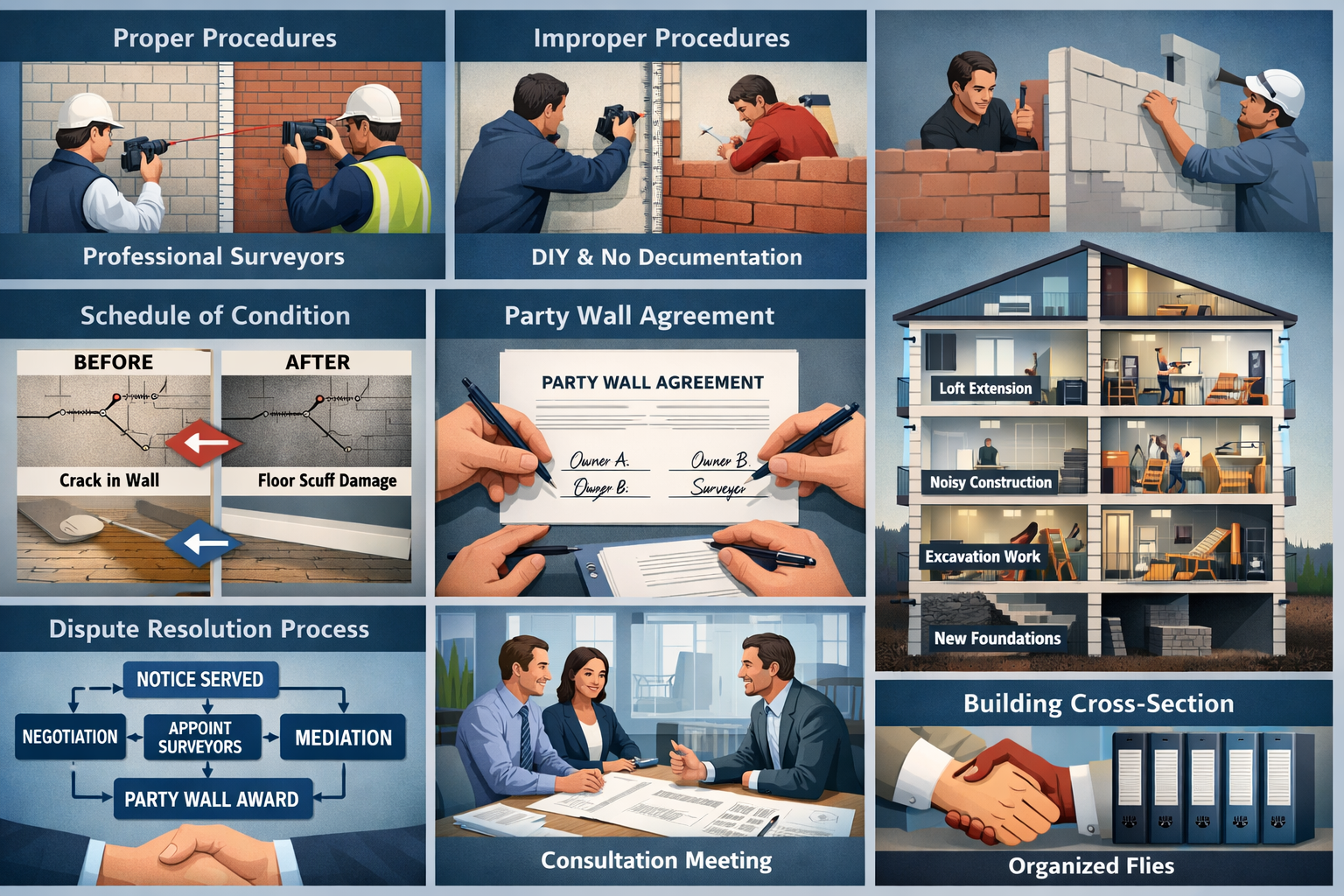
Detailed Schedules of Condition
A schedule of condition documents the existing state of adjoining properties before construction begins. For mixed-use developments, these schedules should be particularly thorough, including:
- Comprehensive photographic evidence of all rooms, facades, and shared structures
- Detailed written descriptions of existing defects, cracks, or damage
- Video walkthroughs for complex properties with multiple levels
- Structural measurements establishing baseline conditions
- Documentation of existing party wall arrangements and maintenance history
Property owners should maintain detailed logs of all repairs and maintenance work, including dates, photographs, contractor invoices, and neighbor communications, to prevent future disputes and demonstrate due diligence during potential legal claims.[3]
Appointing the Right Party Wall Surveyor
The choice of surveyor significantly impacts dispute prevention. When selecting a professional, consider:
- Experience with mixed-use developments and complex ownership structures
- Technical expertise in both residential and commercial construction
- Knowledge of local zoning regulations and how they interact with party wall law
- Professional accreditation and insurance coverage
- Communication skills and ability to mediate between parties
Understanding the costs of the party wall process helps building owners budget appropriately and avoid disputes over surveyor fees. While costs may increase in 2026 due to growing complexity,[5] investing in qualified professionals prevents far more expensive litigation.
Crafting Robust Party Wall Agreements
For townhome communities and mixed-use developments, developers must draft and record Party Wall Agreements and Townhome Declarations before receiving inspection approval.[1] These agreements should address:
Structural Responsibilities:
- Which party maintains which portions of shared walls
- How costs are allocated for repairs benefiting both sides
- Procedures for addressing emergency structural issues
Utility Management:
- Specific language regarding shared water, sewer, and electrical systems
- Maintenance schedules and cost-sharing arrangements
- Procedures for utility upgrades or replacements
Future Alterations:
- Process for requesting permission for modifications
- Standards for work quality and contractor qualifications
- Notification requirements and approval timelines
Dispute Resolution:
- Mediation procedures before resorting to litigation
- Designated surveyors or arbitrators
- Cost allocation for dispute resolution processes
The party wall contract template guide provides valuable insights into structuring comprehensive agreements that withstand legal scrutiny.
Addressing Maintenance Ambiguities
While the Party Wall Act 1996 governs alterations and construction work, general maintenance obligations lack direct statutory requirements. Responsibility typically falls on each owner for their side of the wall, with shared costs expected when both parties benefit.[3]
To prevent maintenance disputes in mixed-use developments:
- Establish clear maintenance protocols in the initial party wall agreement
- Create a maintenance reserve fund for anticipated shared expenses
- Schedule regular inspections by qualified professionals
- Document all maintenance activities with photographs and invoices
- Communicate proactively about emerging maintenance needs
Party Wall Agreements can be recorded against individual townhome properties and require periodic updates as properties change hands and shared amenities age.[1]
Special Considerations for Building Owners and Adjoining Owners
The dynamics between building owners initiating development and adjoining owners affected by construction create unique challenges in mixed-use environments.
For Building Owners: Strategic Planning and Compliance
Building owners planning mixed-use developments should approach party wall compliance strategically:
Early Planning Phase:
- Engage party wall surveyors during design development, not just before construction
- Identify all potential adjoining owners, including those with commercial interests
- Assess whether proposed work triggers party wall notice requirements
- Budget for surveyor fees, potential awards, and dispute resolution
Notice Service Phase:
- Serve notices with adequate lead time, accounting for potential dissent
- Provide comprehensive work descriptions and construction methodologies
- Include proposed start dates with reasonable buffers for the award process
- Maintain proof of service for all notices
Construction Phase:
- Comply strictly with conditions specified in the party wall award
- Provide regular updates to adjoining owners about progress
- Address concerns or complaints promptly and professionally
- Document compliance with photographic evidence
Resources for building owners provide additional guidance on navigating the process effectively.
For Adjoining Owners: Protecting Your Interests
Adjoining owners receiving party wall notices for mixed-use developments should:
Upon Receiving Notice:
- Read the notice carefully and understand what work is proposed
- Seek professional advice before responding, particularly for complex developments
- Consider appointing your own surveyor rather than agreeing to the building owner's surveyor
- Respond within the 14-day statutory period to preserve your rights
During the Award Process:
- Participate actively in schedule of condition preparation
- Raise concerns about construction methodology, access, or timing
- Ensure the award addresses your specific concerns about the mixed-use nature of the development
- Understand your rights regarding costs and surveyor fees
Throughout Construction:
- Monitor work to ensure compliance with the award
- Document any deviations or concerns with photographs and written records
- Communicate issues to your appointed surveyor immediately
- Maintain records of any damage or disruption
The guide on what to do if your neighbor is carrying out works offers practical advice for protecting your interests.
When Disputes Arise Despite Prevention Efforts
Even with comprehensive planning, disputes may arise. When they do:
- Review the party wall award to determine whether the issue is addressed
- Contact your appointed surveyor before taking independent action
- Document the dispute with detailed records, photographs, and correspondence
- Attempt informal resolution through direct communication or mediation
- Consider expert witness testimony if the dispute escalates to formal proceedings
The anticipated increase in 2026 party wall disputes has prompted increased professional preparation among expert witnesses, reflecting confidence in higher dispute volumes related to complex development projects and neighbor conflicts.[2]
Regional Variations and Local Expertise
Party wall compliance requirements remain consistent across England and Wales, but local development patterns, zoning regulations, and construction practices create regional variations that affect mixed-use projects.
London's Unique Mixed-Use Landscape
London's dense urban environment and active development market create particular challenges for party wall compliance. Different areas of the capital present distinct considerations:
- Central London: High-value properties, heritage buildings, and complex ownership structures
- North London: Diverse property types from Victorian terraces to modern developments
- East London: Rapid regeneration and new mixed-use construction
- South London: Suburban developments and townhome communities
- West London: High-end residential and commercial mixed-use projects
Engaging surveyors with specific regional expertise ensures familiarity with local building practices, common construction types, and established professional networks.
Zoning Variations Across Jurisdictions
While the Party Wall Act applies uniformly, local zoning regulations vary significantly:
- Urban cores: Higher density allowances and mixed-use encouragement
- Suburban areas: Transitional zoning creating residential-commercial boundaries
- Conservation areas: Additional restrictions on development and alterations
- Enterprise zones: Streamlined approval processes that still require party wall compliance
Understanding how local zoning interacts with party wall requirements prevents costly delays and ensures comprehensive compliance.
Financial Considerations and Cost Management
The financial aspects of party wall compliance in mixed-use developments extend beyond basic surveyor fees to encompass potential dispute costs, construction delays, and long-term maintenance obligations.
Budgeting for Party Wall Compliance
Building owners should budget for:
Professional Fees:
- Building owner's surveyor fees (typically £700-£1,500+ depending on complexity)
- Adjoining owner's surveyor fees (building owner's responsibility)
- Third surveyor fees if appointed
- Expert witness fees for dispute resolution
Construction-Related Costs:
- Temporary works required by the party wall award
- Enhanced construction methodologies to protect adjoining properties
- Monitoring and documentation requirements
- Schedule of condition preparation
Contingency Reserves:
- Potential dispute resolution costs
- Remediation of any damage to adjoining properties
- Delays to construction timelines
- Legal fees if disputes escalate
Resources on how to keep party wall costs down provide practical strategies for managing expenses without compromising compliance.
Will Party Wall Surveyor Fees Increase in 2026?
The growing technical complexity of party wall matters suggests upward pressure on surveyor fees in 2026. Surveyors now handle significantly more complex proposals requiring coordination with designers, engineers, and contractors.[5] Factors driving potential fee increases include:
- Increased technical complexity of mixed-use developments
- Higher professional insurance costs reflecting dispute risk
- Extended time requirements for multi-stakeholder coordination
- Specialized expertise demands for heritage and complex buildings
Despite potential increases, professional surveyor engagement remains a cost-effective investment compared to the expenses of unresolved disputes or construction delays.
Long-Term Financial Planning for Shared Maintenance
Mixed-use developments with shared party walls require long-term financial planning for maintenance obligations. Effective approaches include:
- Maintenance reserve funds: Establishing dedicated accounts for anticipated repairs
- Regular inspection schedules: Identifying issues before they become expensive emergencies
- Clear cost-allocation formulas: Preventing disputes over who pays for what
- Insurance considerations: Ensuring adequate coverage for shared structure risks
- Periodic agreement updates: Revising financial arrangements as circumstances change
Technology and Innovation in Party Wall Compliance
The party wall industry is embracing technological innovations that improve documentation, communication, and dispute prevention in 2026.
Digital Documentation and Record-Keeping
Modern party wall practice increasingly relies on digital tools:
- Photographic documentation apps with GPS tagging and timestamps
- Cloud-based document management for sharing agreements and notices
- Digital signatures for expedited agreement execution
- Video conferencing for remote inspections and consultations
- 3D scanning technology for detailed schedule of condition records
These technologies enhance accuracy, reduce costs, and provide superior evidence if disputes arise.
Building Information Modeling (BIM) Integration
Complex mixed-use developments increasingly use Building Information Modeling throughout design and construction. Party wall surveyors can leverage BIM data to:
- Visualize proposed work in relation to party walls and adjoining properties
- Identify potential conflicts before construction begins
- Communicate construction methodologies more effectively to adjoining owners
- Monitor compliance with party wall awards during construction
Online Resources and Self-Service Tools
Property owners increasingly access party wall information through online resources:
- Downloadable party wall agreement templates
- Guidance on party wall act notices and how to respond
- Information about having a party wall agreement without a surveyor
- FAQs addressing common concerns
While these resources provide valuable information, complex mixed-use developments typically require professional surveyor engagement for comprehensive compliance.
Case Studies: Lessons from Mixed-Use Party Wall Projects
Examining real-world examples illustrates the challenges and solutions in party wall compliance for mixed-use developments.
Case Study 1: Retail-to-Residential Conversion
A developer purchased a former department store in a town center, planning to convert the ground floor to retail units and upper floors to apartments. Party wall challenges included:
Challenges:
- Multiple adjoining commercial properties with different owners
- Existing party walls not designed for residential acoustic requirements
- Shared utility infrastructure requiring comprehensive agreements
- Heritage building constraints limiting construction methodologies
Solutions:
- Early engagement with all adjoining owners before formal notices
- Comprehensive acoustic testing and enhanced sound insulation
- Detailed utility-sharing agreements with maintenance protocols
- Specialized heritage surveyor with conservation expertise
Outcome:
Successful completion with no formal disputes, though extended timeline for stakeholder coordination.
Case Study 2: Townhome Development Party Wall Agreement
A developer built a townhome community requiring Party Wall Agreements before inspection approval. Key considerations included:
Challenges:
- Utility companies requiring sign-off on shared utility language[1]
- Multiple units requiring coordinated agreement execution
- Future resale considerations requiring clear documentation
- Maintenance responsibility ambiguities
Solutions:
- Standardized but comprehensive Party Wall Agreements for all units
- Specific language addressing water, sewer, and electrical sharing
- Recorded declarations establishing ongoing obligations
- Maintenance reserve fund and management structure
Outcome:
Inspection approval granted, clear framework for future owners, minimal post-construction disputes.
Case Study 3: Basement Excavation Beneath Mixed-Use Building
A building owner planned basement excavation beneath a mixed-use building with commercial ground floor and residential units above.
Challenges:
- Deep excavation requiring notices to multiple adjoining properties
- Structural concerns about existing party walls during excavation
- Coordination with ongoing commercial operations
- Heritage building sensitivity
Solutions:
- Comprehensive structural engineering analysis before notice service
- Detailed construction methodology in party wall award
- Phased excavation to minimize disruption
- Enhanced monitoring and temporary support systems
Outcome:
Successful project completion with minor settlement addressed through award provisions.
Future Trends: Party Wall Compliance Beyond 2026
Looking beyond 2026, several trends will likely shape party wall compliance for mixed-use developments.
Regulatory Evolution
Potential regulatory changes include:
- Standardized digital notice service replacing paper-based processes
- Enhanced protection for adjoining owners in complex developments
- Streamlined procedures for routine work while maintaining safeguards
- Integration with building control and planning approval systems
Sustainability and Green Building Considerations
Mixed-use developments increasingly incorporate sustainability features that create new party wall considerations:
- Shared renewable energy systems requiring utility-sharing agreements
- Green roofs and walls affecting party wall structures
- Enhanced insulation requirements impacting party wall construction
- Water recycling systems creating shared infrastructure obligations
Increased Professionalization
The party wall surveying profession continues to mature with:
- Enhanced training and certification requirements
- Specialized credentials for mixed-use and heritage buildings
- Professional standards for documentation and communication
- Technology adoption improving service delivery
Conclusion: Navigating Party Wall Act Compliance and Mixed-Use Developments in 2026
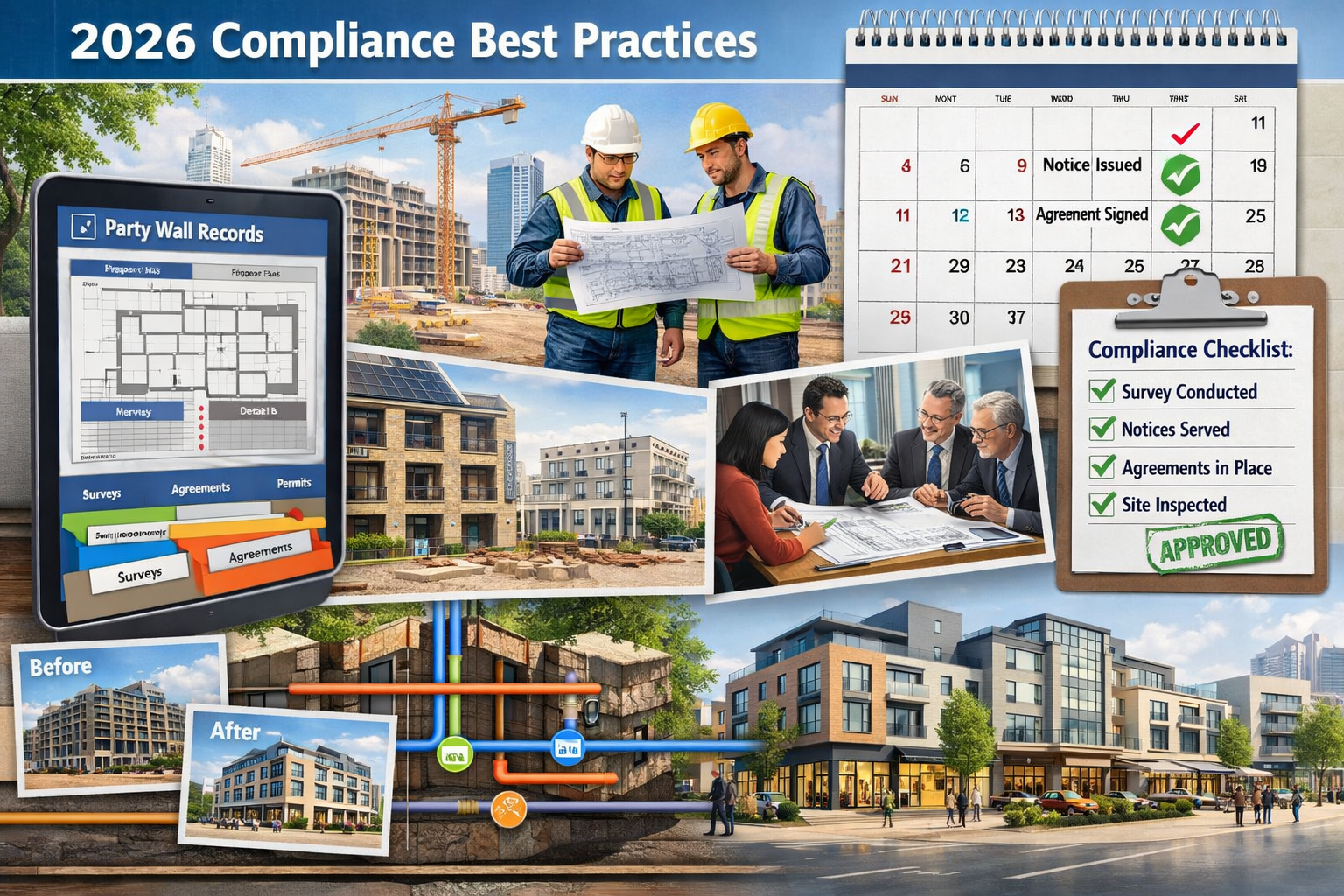
Party Wall Act Compliance and Mixed-Use Developments: Zoning Challenges and Neighbor Dispute Prevention in 2026 represents a complex but manageable challenge for developers, building owners, and adjoining owners. Success requires understanding the statutory framework, engaging qualified professionals early, maintaining transparent communication, and documenting every step of the process.
The key principles for effective compliance include:
✅ Early professional engagement: Involve party wall surveyors during design development, not just before construction
✅ Comprehensive documentation: Create detailed schedules of condition, agreements, and maintenance records
✅ Transparent communication: Build trust with adjoining owners through proactive, honest dialogue
✅ Robust agreements: Address structural responsibilities, utility sharing, future alterations, and dispute resolution
✅ Ongoing maintenance planning: Establish clear protocols and financial arrangements for long-term shared obligations
Actionable Next Steps
For Building Owners Planning Mixed-Use Developments:
- Engage a qualified party wall surveyor with mixed-use experience early in your planning process
- Identify all adjoining owners and assess which notices will be required
- Budget adequately for professional fees, awards, and potential contingencies
- Serve notices with sufficient lead time to accommodate the award process
- Maintain comprehensive documentation throughout construction
For Adjoining Owners Receiving Party Wall Notices:
- Read notices carefully and seek professional advice before responding
- Consider appointing your own surveyor to protect your interests
- Participate actively in schedule of condition preparation
- Ensure the award addresses your specific concerns about the development
- Monitor construction and document any concerns promptly
For Property Professionals and Surveyors:
- Develop specialized expertise in mixed-use developments and zoning regulations
- Invest in technology for improved documentation and communication
- Build networks of specialists for complex heritage and technical challenges
- Stay current with regulatory changes and professional standards
- Prepare for increased dispute volumes with enhanced expert witness capabilities
The intersection of party wall law, zoning regulations, and mixed-use development will continue to evolve. By combining statutory compliance with proactive dispute prevention strategies, stakeholders can successfully navigate this complex landscape, creating vibrant mixed-use communities while protecting the rights and interests of all parties involved.
References
[1] Party Wall Agreements And Townhome Declarations Key Issues To Watch Out For When Drafting – https://ngazette.com/party-wall-agreements-and-townhome-declarations-key-issues-to-watch-out-for-when-drafting/
[2] Expert Witness Preparation For 2026 Party Wall Disputes Managing Increased Development Activity And Neighbour Conflicts – https://nottinghillsurveyors.com/blog/expert-witness-preparation-for-2026-party-wall-disputes-managing-increased-development-activity-and-neighbour-conflicts
[3] Party Wall Maintenance Tips For Keeping Your Property In Compliance – https://www.adamjoseph.co.uk/party-wall-maintenance-tips-for-keeping-your-property-in-compliance
[4] Hb1137f – https://mgaleg.maryland.gov/2026RS/bills/hb/hb1137f.pdf
[5] Will Party Wall Surveyor Fees Go Up In 2026 – https://www.simplesurvey.co.uk/article/will-party-wall-surveyor-fees-go-up-in-2026/