

The construction industry in 2026 faces an unprecedented convergence of challenges that directly impacts how party wall notices are managed, executed, and enforced. As immigration enforcement intensifies across the United Kingdom and United States, construction crews are shrinking precisely when demand for skilled labor remains high. For party wall surveyors, building owners, and adjoining property holders, understanding how Party Wall Notices and Immigration Enforcement: Navigating Labor Shortages in 2026 Construction Projects intersect has become essential to avoiding costly delays, managing legal obligations, and maintaining neighborly relations during construction works.
The ripple effects of labor shortages extend far beyond simple project delays. When contractors cannot staff projects adequately, the carefully calibrated timelines outlined in party wall notices become unreliable. Cost escalations mount. Safety risks increase. And the legal framework that governs party wall agreements—designed for predictable construction schedules—must adapt to a new reality where workforce availability has become the critical constraint.
Key Takeaways
- 🏗️ The construction industry needs 349,000 net new workers in 2026, with shortages particularly acute in experienced roles like project managers, superintendents, and specialized electricians rather than entry-level positions
- 📋 Immigration enforcement has emerged as a major wildcard affecting construction labor supply, with undocumented worker flows declining precipitously in 2025 while voluntary deportations accelerated
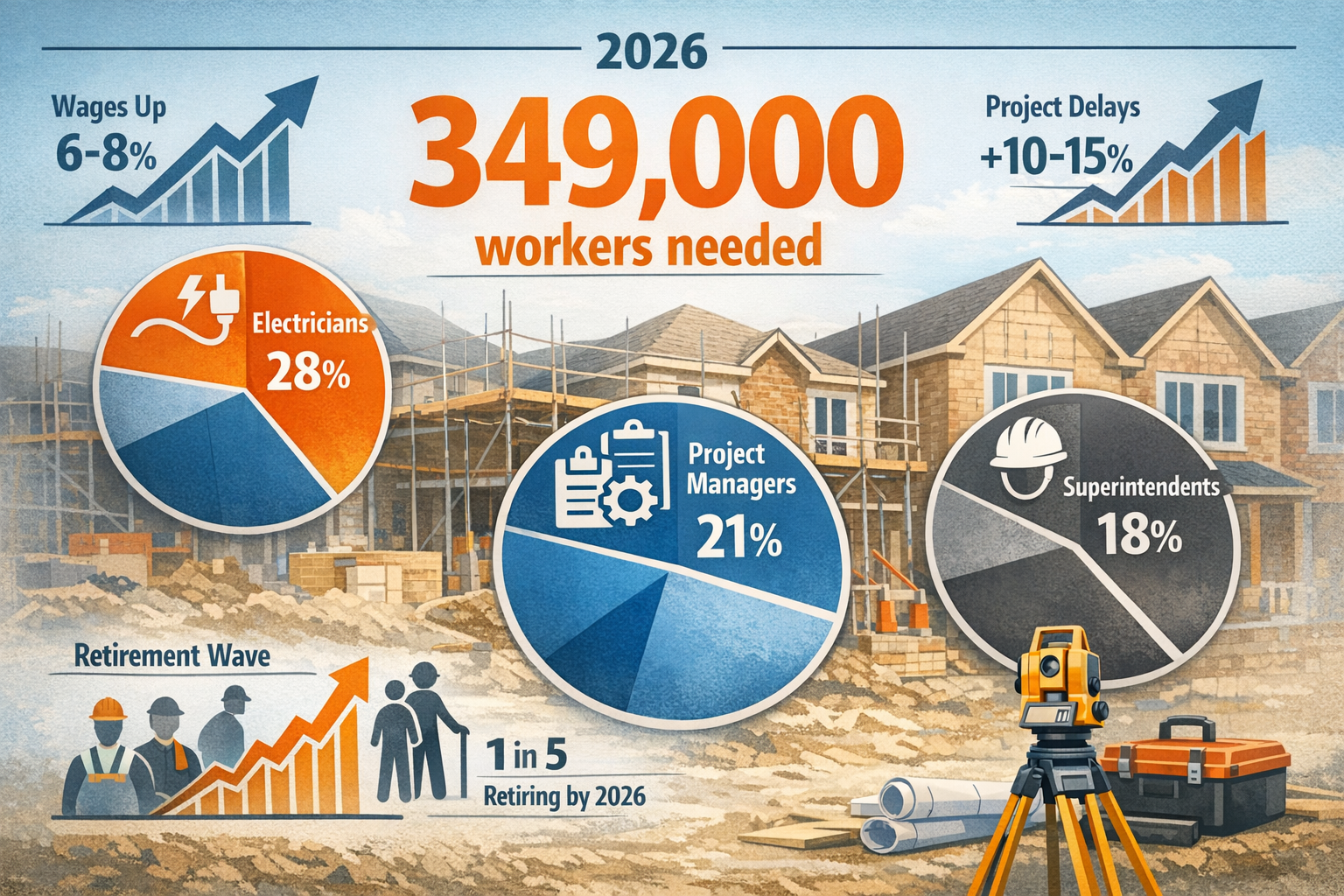
- ⏰ Party wall project timelines require 10-15% labor float in 2026 to account for workforce availability issues, directly impacting notice periods and construction schedules outlined in party wall agreements
- 💰 Labor costs are rising 6-8% annually, forcing revisions to party wall awards, cost estimates, and financial provisions for construction works affecting shared structures
- 🔧 Strategic responses include phased construction approaches, realistic scheduling based on actual labor availability, and enhanced communication between building owners, adjoining owners, and party wall surveyors to manage expectations
Understanding the 2026 Construction Labor Shortage
The Scale of Workforce Demand
The U.S. construction industry must attract an estimated 349,000 net new workers in 2026 to maintain labor supply-demand equilibrium, according to Associated Builders and Contractors (ABC), released January 15, 2026.[1][2] This figure represents a significant decline from 439,000 projected for 2025 and over 500,000 in prior years, but the shortage remains substantial.[3]
However, this temporary relief masks deeper structural challenges. The shortage is projected to increase to 456,000 additional workers in 2027, reflecting anticipated rebounds in construction spending tied to infrastructure programs and reshoring initiatives.[1][2] For those managing party wall works, this volatility in labor availability creates planning uncertainty that extends throughout the entire party wall process.
ABC's economic model converts anticipated increases in construction spending into worker demand at approximately 3,450 jobs per $1 billion in additional construction spending, integrating job openings data, unemployment rates, and retirement trends.[1] This methodology reveals that a majority of new worker demand in 2026 will be attributable to retirement rather than increased demand for construction services, despite the ongoing boom in artificial intelligence infrastructure buildout.[3]
Where the Shortages Hit Hardest
Contrary to popular assumption, the most acute shortage is not entry-level labor but experienced superintendents, project managers, and estimators who can lead complex projects. Contractors are delaying project starts or turning down work due to inability to staff leadership positions.[4]
Critical shortage areas in 2026:
| Role Category | Shortage Severity | Impact on Party Wall Projects |
|---|---|---|
| Project Managers | Severe | Delays in coordinating party wall works schedules |
| Superintendents | Severe | Reduced on-site oversight of party wall compliance |
| Estimators | High | Inaccurate cost projections for party wall awards |
| Electricians (specialized) | High | Delays in data center and complex electrical works |
| Entry-level laborers | Moderate | General construction timeline extensions |
Demand for electricians capable of precision wiring has surged due to rapid increases in data center construction, despite recent industry efforts to accelerate skilled worker development.[1] This specialized shortage affects party wall projects involving electrical system upgrades or installations near shared structures.
Interestingly, nonresidential specialty trade contractors have added 95,000 jobs since August 2024, indicating that certain sectors are hiring strongly despite broader shortages.[1][3] This uneven distribution of labor availability means that party wall surveyors must assess contractor capacity on a project-by-project basis rather than relying on historical norms.
Immigration Enforcement as a Labor Force Wildcard
The Immigration-Construction Nexus
Immigration policy has emerged as a "potential wildcard" for the industry's labor force dynamics, with data indicating that "the flow of undocumented workers into the country fell precipitously in 2025 while voluntary deportations accelerated."[3]
The actual extent to which unauthorized workers have departed the construction workforce remains unclear, but immigration enforcement is explicitly identified as one of the "macrodynamics at play in the industry" alongside tariffs, office vacancies, and an aging workforce.[1] For party wall surveyors and building owners planning construction works, this uncertainty compounds already complex scheduling challenges.
Key immigration enforcement impacts:
- 📉 Reduced workforce availability for contractors who historically relied on immigrant labor
- ⚠️ Increased compliance costs as contractors implement E-Verify and documentation requirements
- 🔄 Higher worker turnover as enforcement actions create workforce instability
- 💼 Contractor capacity constraints limiting ability to take on new party wall projects
- 📅 Schedule unpredictability when key workers are suddenly unavailable
Regional Variations in Impact
Immigration enforcement effects vary significantly by region and construction sector. In areas with historically high immigrant workforce participation—including major metropolitan areas where party wall issues are most common—the impact has been particularly pronounced.
Building owners in Central London, North London, and other dense urban environments must recognize that their contractors may face sudden workforce reductions that were not anticipated when party wall act notices were initially served.
The uncertainty surrounding immigration policy creates a planning dilemma: contractors cannot reliably predict workforce availability months in advance, yet party wall agreements typically require specific timelines and commitments. This mismatch between legal requirements and operational reality demands new approaches to party wall documentation and scheduling.
How Labor Shortages Impact Party Wall Notices and Agreements
Timeline Extensions and Notice Periods
The traditional party wall process assumes that once notices are served and agreements reached, construction will proceed on the stated timeline. Labor shortages fundamentally challenge this assumption.
Practical timeline impacts:
- Extended notice periods: Building owners may need to serve party structure notices earlier to accommodate contractor scheduling uncertainties
- Flexible commencement dates: Party wall awards increasingly include contingency language allowing delayed starts based on labor availability
- Phased construction approaches: Breaking projects into smaller phases that can be staffed incrementally rather than requiring full crews
- Extended completion timelines: Adding 10-15% labor float to projected completion dates in party wall documentation[7]
When serving party wall notices in 2026, building owners should communicate realistic timelines based on actual contractor capacity rather than ideal scenarios. This transparency helps adjoining owners plan accordingly and reduces the likelihood of disputes arising from unexpected delays.
Cost Escalations and Party Wall Awards
Labor shortages translate directly into higher costs that must be reflected in party wall awards and financial arrangements.
Cost impact factors:
- 💰 6-8% annual wage hikes as contractors compete for scarce skilled workers[7]
- ⏱️ Increased overtime costs when projects run longer than planned
- 🔧 Premium rates for specialized trades experiencing acute shortages
- 📊 Contingency increases to account for labor availability uncertainties
- 🏗️ Alternative construction methods that may cost more but require less specialized labor
Party wall surveyors preparing awards must incorporate these cost realities into their assessments. Historical cost data from 2023-2024 may significantly underestimate 2026 expenses. Building owners should budget accordingly, and adjoining owners reviewing awards should understand that higher costs often reflect market conditions rather than contractor inefficiency.
For guidance on managing these expenses, see our resource on how to keep party wall costs down while still accounting for current market realities.
Safety and Quality Concerns
Labor shortages create pressure to use less experienced workers or stretch existing crews beyond optimal capacity. These pressures have direct implications for party wall works, where precision and proper execution are essential to protecting both properties.
Safety and quality considerations:
- ⚠️ Increased accident risk when inexperienced workers perform complex tasks near party walls
- 🔍 Reduced supervision when project managers and superintendents are spread across multiple sites
- 📋 Schedule of condition accuracy may suffer if rushed due to workforce constraints
- 🏗️ Construction quality may decline when crews are overextended
- 🛡️ Damage prevention becomes more challenging with less experienced workers
Adjoining owners should insist on comprehensive schedules of condition before works commence, documenting property condition in detail. This documentation becomes even more critical when labor constraints may affect construction quality.
Party Wall Notices and Immigration Enforcement: Navigating Labor Shortages in 2026 Construction Projects – Strategic Responses
For Building Owners Planning Construction
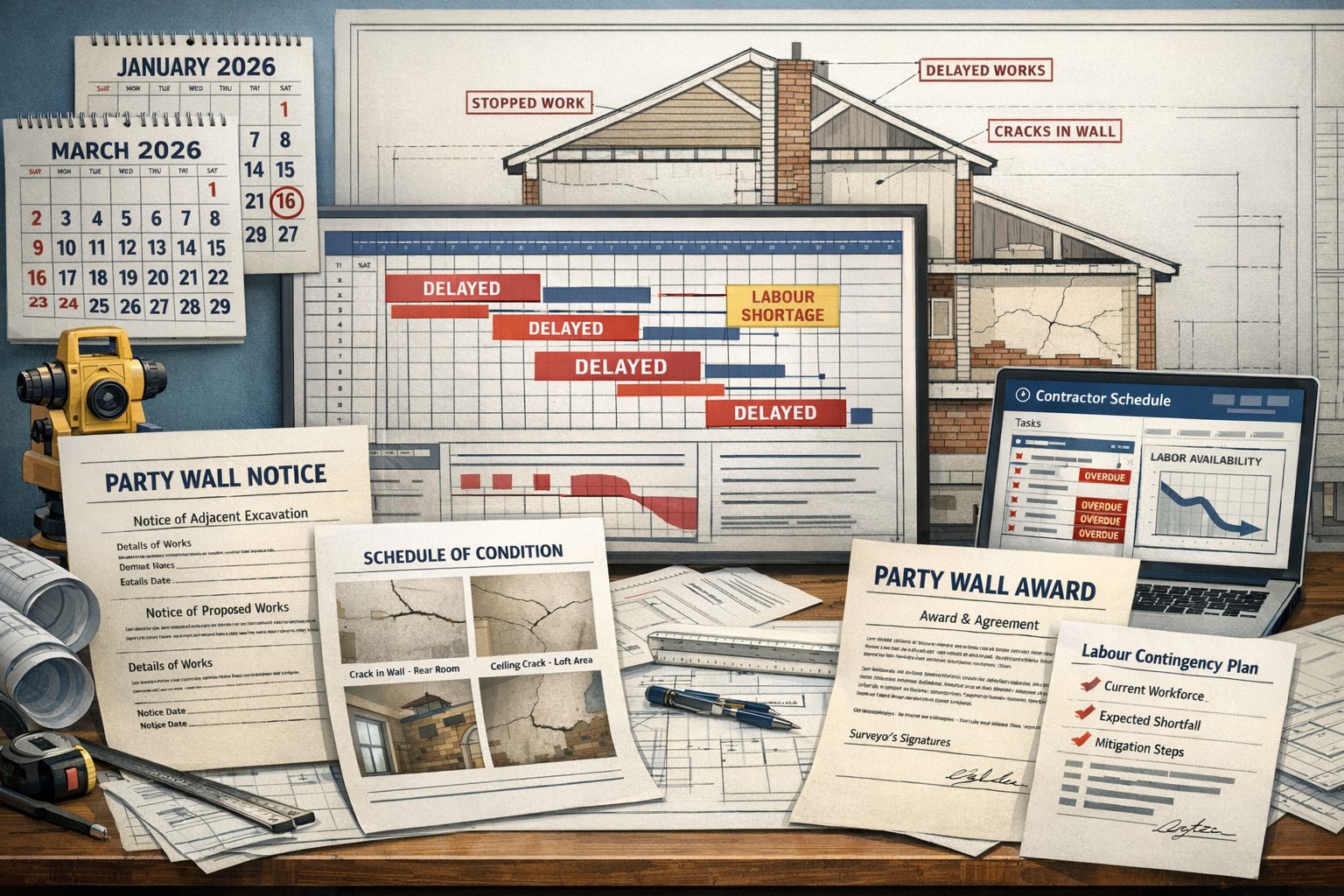
Building owners initiating construction works affecting party walls must adopt new planning approaches that account for labor market realities.
Strategic recommendations:
- Early contractor engagement: Begin discussions with contractors 3-6 months before planned works to assess labor availability
- Realistic scheduling: Build 10-15% buffer time into project timelines before serving party wall notices
- Flexible project phasing: Design projects that can be executed in discrete phases if full workforce unavailable
- Enhanced communication: Keep adjoining owners informed of labor-related delays before they occur
- Contingency planning: Identify backup contractors or alternative approaches if primary contractor cannot staff the project
When reviewing a party wall agreement template, building owners should ensure it includes provisions for labor-related delays that are beyond the contractor's reasonable control.
For Adjoining Owners Receiving Notices
Adjoining owners receiving party wall notices in 2026 should recognize that labor shortages may affect how and when works proceed, even after agreements are finalized.
Protective measures for adjoining owners:
- 📅 Request realistic timelines: Ask building owners for evidence that contractors can actually staff the project as proposed
- 💼 Verify contractor capacity: Ensure the proposed contractor has adequate workforce to complete works
- 📋 Insist on detailed schedules: Require specific work schedules with contingency provisions for labor delays
- 🔔 Establish communication protocols: Set expectations for notification if labor issues cause delays
- 🛡️ Enhanced condition documentation: Comprehensive pre-work documentation protects against quality issues arising from workforce constraints
Adjoining owners should not hesitate to appoint their own surveyor to review party wall notices and protect their interests, particularly when labor uncertainties add complexity to the process.
For Party Wall Surveyors
Party wall surveyors serve a critical role in bridging the gap between legal requirements and practical realities in 2026's constrained labor market.
Professional practice adaptations:
- Labor market assessment: Include contractor workforce capacity evaluation in party wall award preparation
- Flexible timeline provisions: Draft awards with realistic contingencies for labor availability issues
- Cost escalation clauses: Incorporate provisions for wage inflation and labor cost increases
- Phased work authorization: Structure awards to allow incremental work progression based on labor availability
- Enhanced monitoring: Increase site inspection frequency when less experienced crews are working
- Dispute prevention: Proactive communication with both parties about labor-related challenges
Surveyors should educate both building owners and adjoining owners about how labor shortages affect the party wall process, setting realistic expectations from the outset.
Contractual and Legal Considerations
Adapting Party Wall Agreements
The standard party wall agreement framework, established under the Party Wall etc. Act 1996, was not designed for the labor market volatility of 2026. While the legal requirements remain unchanged, the practical implementation must adapt.
Key contractual adaptations:
- Force majeure provisions: Including labor shortages as recognized causes for schedule adjustments
- Notice requirements: Specifying how and when building owners must notify adjoining owners of labor-related delays
- Cost revision mechanisms: Establishing processes for updating cost estimates when labor rates increase
- Completion date flexibility: Defining reasonable extensions based on documented labor availability issues
- Alternative dispute resolution: Streamlined processes for resolving disagreements arising from labor-related changes
For detailed guidance on party wall contract structures, review our party wall contract template guide.
Liability and Risk Allocation
Labor shortages create new liability questions: Who bears the risk when contractors cannot staff projects as promised? How are damages allocated when delays result from workforce unavailability rather than negligence?
Risk allocation principles:
- Reasonable foreseeability: 2026 labor shortages are now foreseeable, shifting some risk to building owners who should plan accordingly
- Contractor selection: Building owners may bear liability for choosing contractors without adequate workforce capacity
- Communication obligations: Failure to promptly notify adjoining owners of labor-related delays may create liability
- Mitigation duties: Both parties have obligations to minimize damages from labor-related delays
- Documentation requirements: Contractors must document labor availability challenges to justify schedule extensions
Party wall awards should clearly allocate these risks between parties, rather than leaving liability questions unresolved until disputes arise.
Regulatory Compliance Intersections
Immigration enforcement creates compliance obligations that intersect with party wall requirements in complex ways.
Compliance considerations:
- 🏛️ Contractor documentation: Building owners should verify that contractors maintain proper employment documentation
- ⚖️ Liability exposure: Using contractors who violate immigration laws may create legal exposure for building owners
- 📝 Due diligence requirements: Party wall surveyors may need to assess contractor compliance as part of award preparation
- 🔍 Inspection protocols: Enhanced scrutiny of workforce composition during party wall works
- 📋 Record keeping: Maintaining documentation of contractor compliance efforts
While party wall surveyors are not immigration enforcement officers, they have professional obligations to ensure that construction works proceed lawfully and that contractors can reliably execute agreed-upon works.
Regional Considerations Across London
Central and Inner London Challenges
Dense urban environments like Central London face unique labor shortage challenges that intensify party wall complications.
Urban-specific factors:
- 🚇 Transportation constraints: Workers commuting to central locations face longer travel times, reducing available labor pool
- 🏗️ Complex logistics: Urban construction requires specialized skills and experience, narrowing the available workforce
- 💰 Higher wage demands: Central London projects compete for workers by offering premium rates
- 📋 Regulatory complexity: Additional permitting and compliance requirements increase demand for experienced project managers
- 🏘️ Concentrated party wall activity: High density means more simultaneous projects competing for the same labor pool
Building owners in central areas should expect longer lead times for contractor availability and should serve party wall notices earlier to accommodate scheduling realities.
Outer London and Suburban Patterns
South London, East London, and West London suburban areas experience different labor dynamics.
Suburban considerations:
- 🚗 Broader contractor access: Larger geographic area provides access to more contractors
- 🏡 Residential specialization: Suburban projects often require different skill sets than commercial urban works
- 💼 Smaller contractor operations: Local builders may be more affected by loss of individual workers
- 📅 Seasonal variations: Suburban residential work experiences greater seasonal fluctuation
- 🤝 Community relationships: Long-term contractor-community relationships may provide more stability
Suburban party wall projects may have more flexibility in contractor selection but should still account for industry-wide labor constraints.
Practical Guidance for 2026 Party Wall Projects

Pre-Construction Planning Checklist
Before serving party wall notices in 2026, building owners should complete this comprehensive planning process:
✅ Planning checklist:
- Consult with contractors 3-6 months before planned start date
- Verify contractor workforce capacity and labor availability
- Obtain realistic timeline estimates incorporating current labor constraints
- Budget for 6-8% wage inflation above historical rates
- Add 10-15% time buffer to projected completion dates
- Identify alternative contractors or phasing options
- Review contractor immigration compliance and employment practices
- Prepare communication plan for adjoining owners
- Consult with party wall surveyor about labor market conditions
- Draft party wall notices with realistic, achievable timelines
Communication Strategies
Effective communication between all parties becomes even more critical when labor uncertainties add complexity to party wall projects.
Communication best practices:
- Transparency: Building owners should openly discuss labor availability challenges with adjoining owners
- Regular updates: Establish weekly or bi-weekly progress reports during active construction
- Early warning: Notify all parties immediately when labor issues threaten timelines
- Documentation: Maintain written records of all communications regarding labor-related changes
- Collaborative problem-solving: Engage adjoining owners in finding mutually acceptable solutions to labor-driven delays
Good communication cannot eliminate labor shortages, but it can prevent those shortages from destroying neighborly relationships and creating unnecessary disputes.
Dispute Prevention and Resolution
Labor shortages create new sources of potential disputes between building owners and adjoining owners. Proactive dispute prevention strategies are essential.
Dispute prevention approaches:
- 🤝 Realistic expectations: Set achievable timelines from the outset rather than promising unrealistic schedules
- 📋 Clear documentation: Ensure party wall awards explicitly address labor availability contingencies
- 💬 Open dialogue: Maintain communication channels throughout the construction process
- 🔧 Flexible solutions: Develop alternative approaches when labor constraints prevent original plans
- ⚖️ Professional mediation: Engage party wall surveyors to mediate disagreements before they escalate
When disputes do arise, both parties should recognize that labor shortages represent external market forces rather than bad faith by either building owner or contractor.
Looking Ahead: Long-Term Implications
The 2027 Labor Outlook
While 2026 presents significant labor challenges, the outlook for 2027 suggests conditions may worsen before improving. The projected need for 456,000 additional workers in 2027 indicates that party wall surveyors, building owners, and contractors must prepare for sustained labor constraints.[1][2]
Long-term planning considerations:
- 📈 Sustained wage inflation: Labor costs likely to continue rising 5-8% annually through 2027-2028
- ⏰ Extended project timelines: The "new normal" may involve 15-20% longer construction schedules
- 🔧 Technology adoption: Increased use of prefabrication and labor-saving construction methods
- 📚 Workforce development: Industry investment in training programs to develop skilled workers
- 🌍 Immigration policy evolution: Potential policy changes could significantly affect labor availability
Building owners planning multi-year renovation or development projects should incorporate these long-term trends into their party wall planning and financial projections.
Industry Adaptation Strategies
The construction industry is implementing various strategies to address labor shortages that will affect how party wall works are executed.
Emerging industry responses:
- Modular construction: Factory-built components requiring less on-site labor
- Technology integration: Drones, robotics, and automation reducing labor requirements
- Apprenticeship programs: Accelerated training to develop skilled workers more quickly
- Productivity improvements: Better project management and scheduling to maximize existing workforce
- Wage and benefit enhancements: Competitive compensation to attract and retain workers
Party wall surveyors should familiarize themselves with these industry trends, as they will increasingly affect how party wall works are planned and executed.
Policy and Regulatory Evolution
Both immigration policy and construction regulation may evolve in response to labor shortage pressures, with implications for party wall practice.
Potential policy developments:
- 🏛️ Immigration reform: Possible expansion of work visa programs for construction trades
- 📋 Regulatory streamlining: Efforts to reduce administrative burdens that consume skilled labor
- 💼 Workforce development funding: Government investment in construction training programs
- ⚖️ Liability framework updates: Legal adaptations to address labor shortage-related disputes
- 🔍 Enforcement priorities: Evolution of immigration enforcement approaches affecting construction
Party wall professionals should monitor these policy developments and adapt their practices accordingly.
Conclusion: Adapting Party Wall Practice for the New Reality
Party Wall Notices and Immigration Enforcement: Navigating Labor Shortages in 2026 Construction Projects represents more than a temporary challenge—it signals a fundamental shift in how construction works affecting shared structures must be planned, documented, and executed. The intersection of immigration enforcement, workforce constraints, and party wall legal requirements creates complexity that demands new approaches from all stakeholders.
For building owners, success in 2026 requires realistic planning, early contractor engagement, transparent communication with neighbors, and willingness to adapt timelines and budgets to labor market realities. The days of serving party wall notices with aggressive schedules and expecting contractors to deliver are over.
For adjoining owners, protecting property interests means understanding that legitimate labor constraints may affect even well-planned projects. Insisting on comprehensive documentation, realistic timelines, and clear communication protocols provides protection without creating unreasonable obstacles.
For party wall surveyors, professional practice must evolve to incorporate labor market assessment, flexible award structures, and enhanced dispute prevention strategies. Surveyors who help parties navigate these challenges add significant value beyond basic legal compliance.
Actionable Next Steps
If you are planning construction works:
- Consult with contractors now about labor availability for your planned timeline
- Review our comprehensive guide to party wall notices to understand your obligations
- Budget an additional 10-15% for both time and costs beyond historical norms
- Engage a qualified party wall surveyor early in the planning process
- Communicate proactively with adjoining owners about realistic timelines
If you have received a party wall notice:
- Verify that the proposed timeline is realistic given current labor constraints
- Consider appointing your own surveyor to protect your interests
- Request detailed information about contractor capacity and workforce availability
- Ensure comprehensive condition documentation before works commence
- Establish clear communication protocols with the building owner
For all parties:
The labor shortage challenge is not temporary. Successfully navigating party wall processes in 2026 and beyond requires acknowledging new realities, adapting established practices, and maintaining collaborative relationships despite increased complexity. Those who approach these challenges with flexibility, transparency, and professionalism will achieve successful outcomes even in a constrained labor environment.
The party wall legal framework remains sound, but its application must evolve to address workforce realities that were not contemplated when the Party Wall etc. Act 1996 was enacted. By incorporating labor availability considerations into every stage of the party wall process—from initial planning through final completion—building owners, adjoining owners, and surveyors can protect property rights, maintain neighborly relations, and complete necessary construction works despite the challenging labor market of 2026.
References
[1] Abc Construction Industry Must Attract 349000 Workers In 2026 Despite Macroeconomic Headwinds – https://www.abc.org/News-Media/News-Releases/abc-construction-industry-must-attract-349000-workers-in-2026-despite-macroeconomic-headwinds
[2] Construction Industry Labor Shortage Data Drivers And Strategic Responses – https://abccarolinas.org/construction-industry-labor-shortage-data-drivers-and-strategic-responses/
[3] constructiondive – https://www.constructiondive.com/news/labor-demand-gap-shrinks-abc-construction-staff/810681/
[4] Construction Labor Shortage 2026 The Roles Contractors Still Cant Fill – https://thebirmgroup.com/construction-labor-shortage-2026-the-roles-contractors-still-cant-fill/
[7] What The Labor Shortage Means For Construction Bidding In 2026 – https://www.constructconnect.com/blog/what-the-labor-shortage-means-for-construction-bidding-in-2026