


Northern England's property market is experiencing unprecedented growth in 2026, with first-time developers seizing opportunities in cities like Manchester, Leeds, and Newcastle. As terraced housing renovations and urban infill projects multiply, understanding the Party Wall Act 1996 has never been more critical. Yet for newcomers to development, the legislation can feel like navigating a legal maze—one wrong turn, and your entire project grinds to a halt.
This comprehensive guide demystifies the Party Wall Act Essentials for First-Time Developers: Navigating Notices and Agreements in Northern England's 2026 Surge, providing step-by-step instructions to serve notices correctly, secure neighbour agreements, and keep surveyor fees from spiraling out of control. Whether you're converting a Victorian terrace loft or building an extension on a semi-detached property, this article equips you with the knowledge to comply with the law while protecting your budget and timeline.
Key Takeaways
✅ The Party Wall Act 1996 applies exclusively to England and Wales—developers in Northern England must comply with specific notice requirements before starting construction work affecting shared walls or boundaries[1].
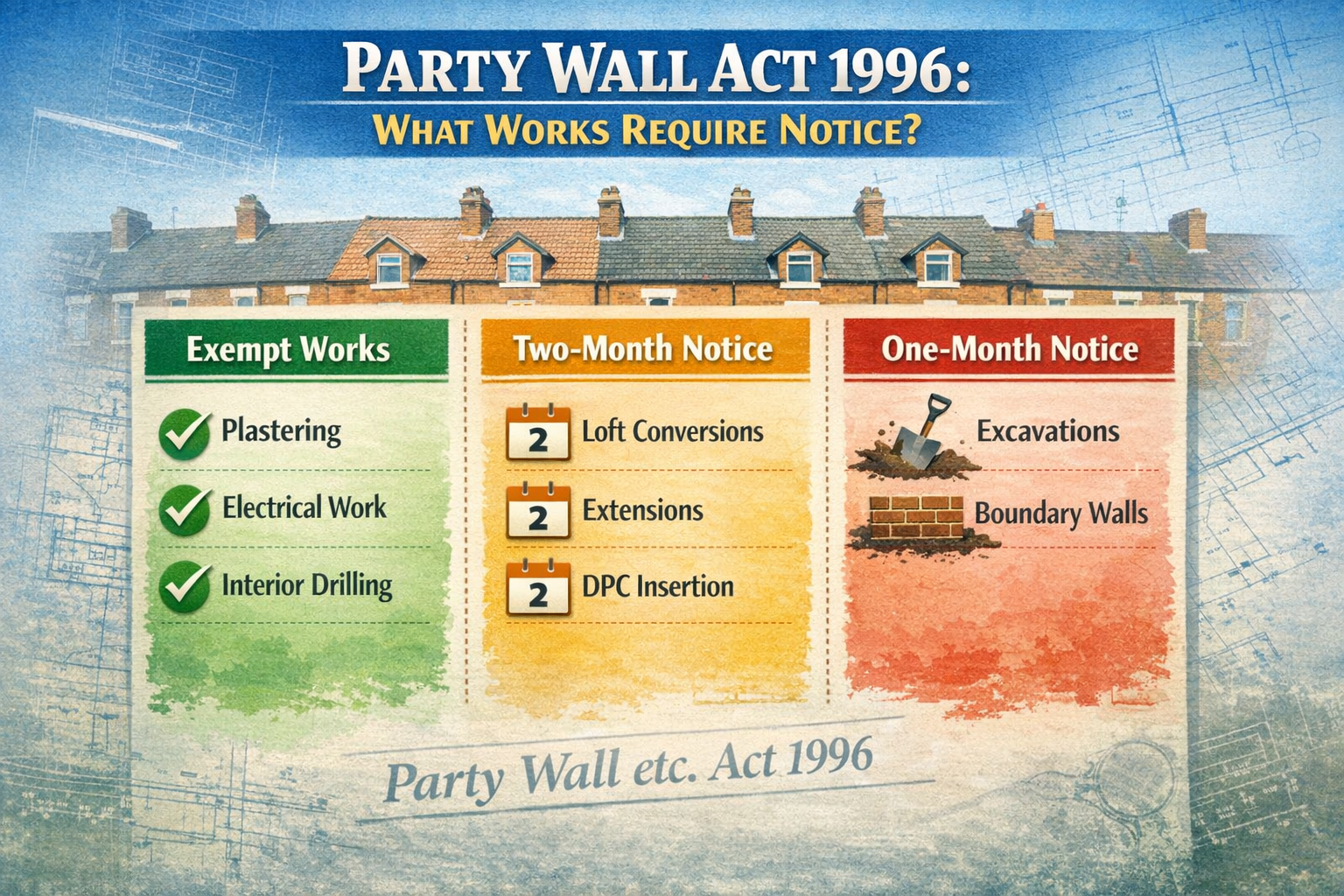
✅ Two distinct notice periods exist: two months for works affecting party walls or party structures, and one month for excavation or new boundary wall construction, with neighbours having 14 days to respond[1][3].
✅ Not all construction requires formal agreements—plastering, electrical work, and drilling interior walls for fixtures are exempt from Party Wall Act procedures[1].
✅ Failing to serve proper notice can halt your project—neighbours may obtain injunctions, and you'll face complications during property sales and weakened positions in future disputes[1][2].
✅ Cost-effective pathways exist—first-time developers can secure direct written consent from neighbours without appointing surveyors, dramatically reducing expenses in cooperative scenarios[1].
Understanding the Party Wall Act 1996: Jurisdiction and Application in Northern England
What Is the Party Wall Act and Where Does It Apply?
The Party Wall etc. Act 1996 is legislation governing construction work on shared walls, boundaries, and excavations near neighbouring properties. Critically, this Act applies exclusively to England and Wales—it does not extend to Scotland or Northern Ireland[1]. For developers working in Northern England's booming markets of Manchester, Leeds, Sheffield, or Newcastle, compliance with this Act is mandatory for qualifying construction projects.
The legislation exists to balance property owners' rights to improve their buildings with neighbours' rights to protect their properties from damage. It establishes formal procedures for notifying adjacent property owners, obtaining consent, and resolving disputes through appointed surveyors when agreement cannot be reached directly.
Why Northern England's 2026 Development Surge Demands Party Wall Expertise
Northern England is experiencing a construction renaissance in 2026, driven by affordability pressures pushing buyers and developers northward from overheated southern markets[9]. This surge brings thousands of first-time developers into the market—individuals purchasing Victorian terraces for conversion, semi-detached properties for extension, or infill plots for new construction.
The region's characteristic terraced housing stock means party walls are ubiquitous. Unlike detached properties common in newer suburbs, Northern England's urban fabric consists predominantly of properties sharing structural walls with neighbours. This architectural reality makes Party Wall Act compliance not an occasional concern but a standard requirement for most development projects.
Additionally, the Building Safety Levy scheduled to take effect October 1, 2026[5], may accelerate project timelines as developers rush to commence work before additional costs apply. This urgency makes understanding streamlined Party Wall procedures—particularly cost-effective direct neighbour agreements—essential for maintaining project viability.
Common Misconceptions About Party Wall Requirements
Myth 1: "I only need to worry about party walls if I'm doing major structural work."
Reality: Even seemingly minor works like inserting a damp proof course require formal Party Wall notices if they affect a shared wall[1]. Understanding which types of party wall works trigger the Act prevents costly compliance failures.
Myth 2: "The Act applies throughout the UK."
Reality: The Party Wall Act 1996 applies only to England and Wales[1]. Developers working across multiple UK regions must understand jurisdictional differences.
Myth 3: "I always need to hire an expensive surveyor."
Reality: If your neighbour consents in writing to your proposed works, you can proceed without appointing surveyors, saving thousands of pounds[1]. The surveyor pathway only becomes necessary when neighbours dissent or fail to respond within 14 days.
Party Wall Act Essentials: Which Works Require Notices and Agreements?
Works Requiring Two-Month Notice Period
The Act mandates two months' written notice for the following construction activities[1]:
🏗️ Loft Conversions
Converting attic space in terraced or semi-detached properties almost always involves party walls. Steel beam installation, floor joist work, and structural modifications to shared walls all trigger notice requirements. Given Northern England's abundance of Victorian and Edwardian terraces with conversion potential, this represents one of the most common scenarios for first-time developers.
🏗️ Building Extensions
Single-storey rear extensions, side returns, and two-storey additions frequently require work on or near party walls. Even if your extension doesn't directly modify the shared wall, excavating foundations within certain distances of your neighbour's structure triggers notice requirements (covered below).
🏗️ Damp Proof Course (DPC) Insertion
Retrofitting damp proof courses in older properties—a common necessity in Northern England's aging housing stock—requires cutting into walls. When performed on party walls, this necessitates formal notice[1].
🏗️ Structural Alterations
Removing chimney breasts (particularly when shared between properties), inserting steel beams, or underpinning party walls all require two-month notice periods. For detailed guidance on serving these notices, consult our resource on party wall notices.
Works Requiring One-Month Notice Period
🏗️ Excavation Within Three Meters
If you're excavating within three meters of your neighbour's structure and your excavation will go deeper than their foundations, you must serve one month's notice[1]. This commonly affects basement conversions and foundation work for extensions.
🏗️ Excavation Within Six Meters
For excavations within six meters of a neighbour's structure, notice is required if you're digging deeper than a line drawn at 45 degrees from the bottom of their foundations[1].
🏗️ New Boundary Walls
Constructing a new wall directly on the boundary line between properties requires one month's notice[3]. Understanding the distinction between party fence walls and boundary walls helps developers navigate these requirements correctly.
Works EXEMPT from Party Wall Requirements
Not every construction activity triggers Party Wall Act procedures. The following works do not require formal notices or agreements[1]:
✅ Plastering and decorating interior surfaces of party walls
✅ Electrical installations including socket outlets and lighting
✅ Drilling interior walls for kitchen units, shelving, or picture hanging
✅ Plumbing work that doesn't involve cutting into structural elements
✅ Cosmetic repairs to party wall surfaces
Understanding these exemptions prevents unnecessary delays and costs. First-time developers often over-comply, assuming every interaction with a party wall requires formal procedures. Focusing compliance efforts only where legally required streamlines projects and preserves neighbour relationships.
Special Considerations for Northern England's Housing Stock
Northern England's characteristic Victorian and Edwardian terraced housing presents unique Party Wall challenges:
Shared Chimney Stacks: Many terraces share chimney stacks between properties. Removing chimney breasts requires careful consideration of structural implications for both properties.
Cellar Conversions: Basement spaces in older terraces often extend beneath the party wall. Converting these spaces triggers both party wall and excavation notice requirements.
Rear Extensions on Terraces: The typical terraced layout means rear extensions almost always involve work near or on party walls separating properties.
Historic Construction Methods: Older properties may have party walls constructed with materials and techniques that require specialist assessment, particularly when planning structural alterations.
Navigating the Notice Process: Step-by-Step Guide for First-Time Developers
Step 1: Identify All Affected Neighbours
Before drafting notices, create a comprehensive list of all adjoining owners—anyone with a legal interest in properties sharing walls or boundaries with your development site. This includes:
- Direct neighbours sharing party walls
- Properties within three to six meters of planned excavations
- Leaseholders and freeholders (both must be notified)
- Tenants with specific property interests
Common mistake: First-time developers often notify only the immediate neighbour while overlooking other affected parties, invalidating the entire notice process.
Step 2: Prepare Compliant Party Wall Notices
Party Wall Notices must include specific information to be legally valid[4]:
📋 Essential Notice Components:
- Work description: Detailed explanation of proposed construction activities
- Party wall location: Precise identification of affected walls or boundaries
- Project timeline: Proposed start date (must be at least two months or one month ahead, depending on work type)
- Your contact information: Full name, address, and contact details
- Building owner declaration: Statement of your rights under the Act
The notice must be served in writing—verbal notifications have no legal standing[4]. For those seeking templates and guidance, our sample party wall agreement template provides a starting framework.
Step 3: Serve Notices Correctly and Document Delivery
Acceptable Service Methods:
- Hand delivery: Personally delivering the notice to your neighbour (obtain signed receipt)
- Registered post: Sending via Royal Mail Signed For or Special Delivery (retain proof of postage and delivery)
- Standard post: Legally acceptable but risky as you cannot prove delivery
- Email: Only if the neighbour explicitly agrees to electronic service
Best practice: Use registered post with proof of delivery, and follow up with a courtesy copy via email or hand delivery. Document everything—photograph the notice, retain postal receipts, and save email confirmations.
Timing calculation: The notice period begins the day after the neighbour receives the notice, not the day you send it[1].
Step 4: Understand Your Neighbour's Response Options
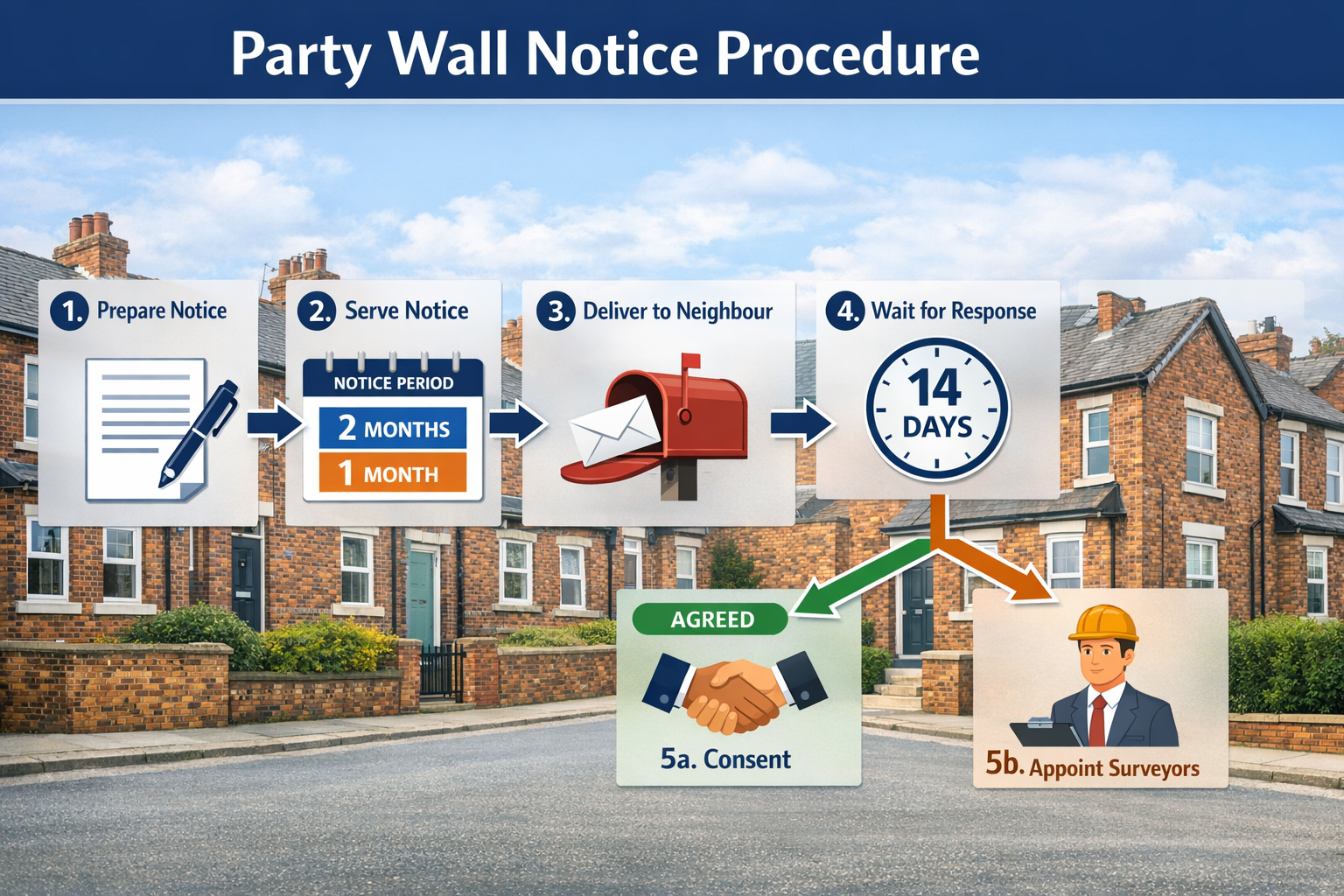
After receiving your notice, neighbours have 14 days to respond[3]. They have three options:
Option 1: Written Consent ✅
Your neighbour provides written agreement to the proposed works. This is the ideal outcome for first-time developers as it allows you to proceed without appointing surveyors, dramatically reducing costs. Ensure consent is documented in writing—verbal agreement is insufficient.
For guidance on proceeding without surveyors, see our article on having a party wall agreement without a surveyor.
Option 2: Written Dissent ❌
Your neighbour objects to the works or specific aspects of your proposal. This triggers the Party Wall Award process, requiring surveyor appointments (detailed below).
Option 3: No Response ⏰
If your neighbour fails to respond within 14 days, this is legally treated as dissent[3]. You must proceed with the surveyor appointment process—you cannot interpret silence as consent.
Step 5: Navigate the Party Wall Award Process (When Required)
When neighbours dissent or fail to respond, the Act provides a structured dispute resolution mechanism:
Surveyor Appointment Options:
- Agreed Surveyor: Both parties jointly appoint a single surveyor to act impartially (most cost-effective surveyor route)
- Two Surveyors: Each party appoints their own surveyor, who then appoint a third surveyor to resolve disagreements (more expensive)
- Building Owner's Surveyor: If the neighbour doesn't appoint a surveyor within 10 days, you can appoint one on their behalf[1]
The appointed surveyor(s) will:
- Inspect both properties
- Prepare a Schedule of Condition documenting pre-existing conditions
- Draft a Party Wall Award detailing permitted works, working methods, and timelines
- Determine cost allocation (typically the building owner pays all surveyor fees)
For comprehensive information on this process, review our guide on party wall awards.
Cost implications: Surveyor fees for straightforward residential projects typically range from £700 to £2,000+, depending on complexity and whether you use an agreed surveyor or two separate surveyors. Understanding how to keep party wall costs down becomes crucial for budget-conscious first-time developers.
Step 6: Create a Schedule of Condition
Whether working with surveyors or proceeding with neighbour consent, creating a Schedule of Condition is essential. This photographic and written record documents the condition of your neighbour's property before work commences, providing crucial evidence if damage disputes arise later.
What to document:
- Interior walls adjacent to party walls
- Ceilings and floors
- External walls and facades
- Existing cracks, stains, or defects
- Decorative finishes
Professional surveyors prepare comprehensive schedules, but even with direct neighbour agreements, first-time developers should create basic photographic records with timestamps. Learn more about this protective measure in our schedule of condition resource.
Step 7: Understand the Appeals Process
Both parties have 14 days to appeal a Party Wall Award to County Court after it's served[1]. Appeals are rare but can occur when:
- A party believes the award is unfair or unreasonable
- Procedural errors occurred during the surveyor process
- Significant factual disputes exist about property conditions
For first-time developers: The appeals process represents another reason to maintain cooperative neighbour relationships and work with experienced surveyors who produce defensible awards.
Cost Management Strategies: Keeping Party Wall Expenses Under Control in 2026
The True Cost of Party Wall Compliance
Understanding the full financial picture helps first-time developers budget accurately:
Scenario 1: Direct Neighbour Consent 💰
- Notice preparation: £0-£200 (DIY or solicitor assistance)
- Postal/delivery costs: £10-£20
- Optional basic Schedule of Condition: £0-£300 (DIY photography or professional)
- Total: £10-£520
Scenario 2: Agreed Surveyor Appointment 💰💰
- Notice preparation: £0-£200
- Agreed surveyor fees: £700-£1,200
- Schedule of Condition: Included in surveyor fees
- Total: £700-£1,400
Scenario 3: Two Surveyor Appointments 💰💰💰
- Notice preparation: £0-£200
- Your surveyor fees: £800-£1,500
- Neighbour's surveyor fees: £800-£1,500 (you pay both)
- Third surveyor fees (if required): £500-£1,000
- Total: £2,100-£4,200+
For detailed cost breakdowns, consult our comprehensive guide on costs of the party wall process.
Strategies to Minimize Party Wall Costs
Strategy 1: Prioritize Neighbour Communication 🤝
The single most effective cost-control measure is securing direct neighbour consent. First-time developers should:
- Communicate early: Discuss plans informally before serving formal notices
- Be transparent: Share architectural drawings and explain how you'll minimize disruption
- Address concerns proactively: If neighbours worry about noise, offer to limit working hours
- Put agreements in writing: Even friendly neighbours need formal written consent
Real-world example: A Manchester developer converting a terraced house loft saved £1,800 in surveyor fees by meeting neighbours for coffee, walking them through plans, and addressing concerns about structural safety before serving formal notices. Both neighbours provided written consent within a week.
Strategy 2: Choose the Right Surveyor Pathway
If surveyor appointment becomes necessary:
- Propose an agreed surveyor: This single-surveyor approach typically costs 30-40% less than two separate surveyors
- Research surveyors' fee structures: Some charge flat fees; others bill hourly
- Verify qualifications: Ensure surveyors are members of the Faculty of Party Wall Surveyors or Royal Institution of Chartered Surveyors
- Get written fee quotes: Avoid open-ended fee arrangements
Strategy 3: Prepare Thoroughly Before Serving Notices
Rushed or incomplete notices lead to disputes and delays:
- Finalize designs first: Don't serve notices until architectural plans are complete
- Identify all affected parties: Missing even one adjoining owner invalidates the process
- Use clear, jargon-free language: Neighbours who understand your plans are more likely to consent
- Include helpful visuals: Annotated drawings showing exactly what you're doing help neighbours visualize work
Strategy 4: Understand What You're Legally Required to Pay
Under the Party Wall Act:
- Building owners pay their own surveyor fees: This is standard
- Building owners typically pay neighbours' surveyor fees: This is also standard practice[1]
- Building owners pay for damage repairs: Any damage caused by your works is your financial responsibility
However, neighbours cannot use the Party Wall process to demand improvements to their property or extract unreasonable concessions. Surveyors must act impartially, and awards must be reasonable.
Northern England-Specific Cost Considerations in 2026
Regional factors affecting Party Wall costs in Northern England:
Lower surveyor fees: Northern England generally has lower professional fees than London and the Southeast, with typical agreed surveyor fees ranging £700-£1,200 versus £1,200-£2,000+ in London.
Higher construction activity: The 2026 construction boom[6] means surveyors are in high demand. Booking surveyors early prevents delays and may secure better rates.
Building Safety Levy impact: The October 1, 2026 implementation of the Building Safety Levy[5] may indirectly affect Party Wall timelines as developers accelerate projects, creating surveyor capacity constraints.
Terraced housing prevalence: The region's housing stock means party wall compliance is nearly universal for development projects, making local surveyors highly experienced with typical scenarios—potentially streamlining the process.
Consequences of Non-Compliance: What Happens When You Skip Party Wall Procedures
Legal Consequences: Injunctions and Work Stoppages
The most immediate risk of failing to serve proper Party Wall notices is a neighbour-obtained injunction halting your construction project[2]. Courts take Party Wall Act compliance seriously, and judges routinely grant injunctions when building owners proceed without following statutory procedures.
Real-world scenario: A Leeds developer began a loft conversion without serving Party Wall notices, assuming their friendly neighbour wouldn't object. Midway through the project, the neighbour discovered structural cracks in their property. Despite the developer's willingness to make repairs, the neighbour obtained a court injunction stopping all work until proper Party Wall procedures were completed retroactively. The project delay cost the developer:
- Three months of lost construction time
- £4,500 in emergency surveyor fees (higher than standard rates due to urgency)
- £2,800 in legal fees defending the injunction application
- £6,000 in contractor standby costs and remobilization
- Damage to the neighbour relationship, complicating future projects
Evidential Consequences: Inability to Prove Pre-Existing Conditions
Without a properly prepared Schedule of Condition, developers cannot definitively prove whether damage existed before their work commenced[1][2]. This creates several problems:
Dispute vulnerability: Neighbours can claim your work caused pre-existing damage, and you'll lack evidence to refute these claims.
Insurance complications: Professional indemnity and construction insurance may not cover damage claims when you've failed to follow statutory procedures.
Financial exposure: You may end up paying for repairs to damage you didn't cause, simply because you cannot prove the damage predated your work.
Example: A Newcastle developer extended a semi-detached property without serving Party Wall notices or creating a Schedule of Condition. After completion, the neighbour claimed the work caused ceiling cracks and demanded £3,200 in repairs. The developer believed the cracks existed previously but had no photographic evidence. Faced with potential litigation costs exceeding the repair costs, the developer settled and paid for repairs they likely didn't cause.
Property Transaction Consequences
Party Wall non-compliance creates complications when selling your developed property:
Solicitor inquiries: Buyers' solicitors routinely ask whether Party Wall procedures were followed for recent construction work[2].
Sale delays: Discovering non-compliance during conveyancing can delay or derail sales as you scramble to regularize the situation.
Price reductions: Buyers may demand price reductions to account for potential neighbour disputes or liability risks.
Indemnity insurance: You may need to purchase costly indemnity insurance to protect buyers against future claims—insurance that wouldn't be necessary with proper compliance.
Weakened Position in Future Disputes
Perhaps most insidiously, Party Wall non-compliance weakens your position in any future property disputes with neighbours[1][2]:
Credibility damage: Courts and surveyors view previous non-compliance unfavorably when assessing current disputes.
Reciprocal obligations: If your neighbour later serves Party Wall notices for their work, you'll have limited moral authority to raise concerns or request protective measures.
Relationship deterioration: Neighbours who discover you bypassed legal requirements lose trust, making cooperative resolution of future issues nearly impossible.
How to Remedy Non-Compliance
If you've already started work without proper Party Wall procedures:
- Stop work immediately: Continuing compounds the problem
- Consult a Party Wall surveyor urgently: Explain the situation and seek guidance on retroactive compliance
- Communicate with neighbours: Acknowledge the oversight and propose a path forward
- Serve notices retroactively: While not ideal, late compliance is better than continued non-compliance
- Document current conditions: Create a Schedule of Condition immediately to establish a baseline
- Consider legal advice: For complex situations, consult a property solicitor
The costs and complications of remedying non-compliance almost always exceed the costs of doing it right initially—making proper Party Wall procedures a wise investment for first-time developers.
Regional Insights: Party Wall Considerations Specific to Northern England's 2026 Market
Northern England's Property Development Landscape in 2026
Northern England is experiencing a development renaissance driven by multiple converging factors[9]:
Affordability Migration: Southern buyers and investors, priced out of London and Southeast markets, are driving demand northward. Cities like Manchester, Leeds, and Newcastle offer Victorian terraces at £200,000-£350,000—properties that would command £600,000+ in London—creating attractive development opportunities.
Urban Regeneration: Major infrastructure investments, including Northern Powerhouse Rail planning and city center regeneration schemes, are catalyzing development activity in previously overlooked areas.
First-Time Developer Entry: Lower property prices enable first-time developers to enter the market with smaller capital requirements, but many lack experience with Party Wall procedures.
Terraced Housing Dominance: Unlike newer suburban developments with detached properties, Northern England's urban cores consist predominantly of Victorian and Edwardian terraces—meaning Party Wall considerations affect nearly every development project.
Characteristic Party Wall Scenarios in Northern England
Scenario 1: Victorian Terrace Loft Conversions 🏠
The region's abundant Victorian terraces present classic Party Wall challenges. Typical issues include:
- Shared chimney stacks: Many terraces have chimney stacks straddling party walls
- Roof structure: Hip-to-gable conversions affect roof structures that may extend over party walls
- Floor joists: Original construction often has joists embedded in party walls
- Access: Narrow terraced plots mean scaffolding may need to overhang neighbours' properties
Developer tip: When planning loft conversions in terraces, engage structural engineers early to identify party wall implications before finalizing designs.
Scenario 2: Side Return Extensions 🏠
Popular in terraced properties with side access, these extensions typically involve:
- Boundary wall construction: New walls directly on property boundaries
- Excavation near neighbours: Foundation work within three meters of adjoining structures
- Roof tie-ins: Connecting new roofs to existing party walls
Developer tip: Side returns often require both party wall notices (for the new boundary wall) and excavation notices (for foundations), each with different notice periods. Plan timelines accordingly.
Scenario 3: Cellar and Basement Conversions 🏠
Converting existing cellars or creating new basements involves complex Party Wall considerations:
- Underpinning party walls: Deepening foundations beneath shared walls
- Excavation proximity: Working within three to six meters of neighbours' foundations
- Structural loading changes: Altering how loads transfer through party walls
Developer tip: Basement projects almost always require surveyor involvement due to technical complexity. Budget £1,500-£3,000 for Party Wall procedures on these projects.
Working with Northern England's Building Control Authorities
While Party Wall compliance is separate from Building Regulations approval, coordinating both processes streamlines development:
Timeline coordination: Serve Party Wall notices while preparing Building Control applications to avoid sequential delays.
Structural calculations: Engineers' calculations required for Building Control often inform Party Wall Awards, so commission these early.
Inspection scheduling: Coordinate Building Control inspections with Party Wall surveyors' site visits to minimize disruption.
Regional Surveyor Availability and Selection
Northern England's 2026 construction boom[6] means surveyor demand is high. First-time developers should:
Book early: Contact surveyors as soon as neighbours dissent or fail to respond—don't wait.
Verify local experience: Choose surveyors familiar with Northern England's characteristic housing stock and construction methods.
Check professional memberships: Verify membership in the Faculty of Party Wall Surveyors or RICS.
Request references: Ask for references from recent clients with similar project types.
Compare fee structures: Get written quotes from multiple surveyors before appointing.
Practical Tools and Templates for First-Time Developers
Essential Documents and Templates
Party Wall Notice Template 📄
While professional assistance is advisable for complex projects, straightforward scenarios may use template notices. Key sections include:
- Building owner details and property address
- Adjoining owner details and property address
- Detailed work description with reference to specific Act sections
- Proposed start date (respecting minimum notice periods)
- Invitation for neighbour to consent or appoint a surveyor
- Contact information for questions
Access our party wall structure notice guide for detailed serving instructions.
Neighbour Consent Form 📄
When neighbours agree to your works, document consent with:
- Clear identification of consenting neighbour
- Acknowledgment they've received and understood your notice
- Explicit consent to proceed with described works
- Date and signature
- Witness signature (recommended but not legally required)
Schedule of Condition Template 📄
Basic schedules should include:
- Date and time of inspection
- Room-by-room photographic documentation
- Written descriptions of existing conditions
- Notation of pre-existing cracks, stains, or defects
- Signatures of both parties (if neighbour cooperates)
Checklists for First-Time Developers
Pre-Notice Checklist ✅
- Finalize architectural and structural designs
- Identify all adjoining owners (including leaseholders and freeholders)
- Determine which type of notice is required (party wall or excavation)
- Calculate correct notice period (two months or one month)
- Prepare clear work descriptions and drawings
- Research surveyor options in case neighbours dissent
- Budget for potential surveyor costs
Notice Service Checklist ✅
- Draft compliant notice with all required information
- Prepare copies for all adjoining owners
- Choose service method (registered post recommended)
- Serve notices with appropriate lead time
- Document service with proof of delivery
- Diarize 14-day response deadline
- Prepare follow-up communication for non-responders
Post-Consent Checklist ✅
- Obtain written consent from all neighbours
- Create Schedule of Condition (even with consent)
- File all documentation securely
- Inform contractors they can proceed
- Maintain communication with neighbours during works
- Document completion and any issues
- Conduct post-work inspection with neighbours
Technology Tools for Party Wall Management
Digital Documentation 📱
Modern first-time developers can leverage technology:
- Timestamped photography apps: Apps like Timestamp Camera automatically embed date/time metadata in photos for Schedules of Condition
- Cloud storage: Store all Party Wall documentation in cloud services (Google Drive, Dropbox) for easy access and backup
- Email tracking: Use read receipt features to confirm neighbours received electronic communications
- Project management apps: Tools like Trello or Asana help track notice deadlines and surveyor appointments
Communication Platforms 📱
Maintain neighbour relationships with:
- WhatsApp groups: Create project update groups for transparent communication
- Email updates: Send weekly progress reports during construction
- Video calls: For neighbours who can't attend site meetings, offer video walkthroughs
Common Pitfalls and How to Avoid Them
Pitfall 1: Assuming Friendly Neighbours Don't Need Formal Notices
The mistake: First-time developers often believe good neighbour relationships eliminate the need for formal Party Wall procedures.
The reality: The Party Wall Act is statutory legislation—it applies regardless of relationship quality[1]. Even the friendliest neighbour cannot waive your legal obligation to serve proper notices.
The solution: Serve formal notices to all neighbours, but accompany them with friendly, informal communication explaining the process and your plans. Frame compliance as protecting both parties' interests.
Pitfall 2: Serving Notices Too Late
The mistake: Developers finalize contractor schedules, then realize they need two months' notice before work can legally commence.
The reality: Notice periods are minimum requirements—you cannot shorten them regardless of urgency[1].
The solution: Incorporate Party Wall timelines into project planning from day one. Serve notices as soon as designs are finalized, even if construction is months away. For guidance on timing, review our resource on party wall act notices and how to respond.
Pitfall 3: Inadequate Work Descriptions
The mistake: Vague notices stating "extension works" or "loft conversion" without technical details.
The reality: Neighbours and surveyors need specific information to assess implications and provide informed consent or awards.
The solution: Include detailed descriptions referencing architectural drawings, structural calculations, and specific Party Wall Act sections. Specify:
- Exact wall locations and dimensions
- Structural modifications (beam insertions, joist work, etc.)
- Excavation depths and distances
- Proposed working methods and timelines
Pitfall 4: Ignoring Non-Responding Neighbours
The mistake: Assuming neighbour silence equals consent and proceeding with work after 14 days.
The reality: Non-response is legally treated as dissent, requiring surveyor appointment[3].
The solution: If neighbours don't respond within 14 days, immediately initiate surveyor appointment procedures. Send a follow-up letter explaining that non-response triggers the surveyor process and inviting them to appoint their own surveyor or agree to a single agreed surveyor.
Pitfall 5: Skipping Schedules of Condition
The mistake: Proceeding without photographic documentation of neighbours' properties before work commences.
The reality: Without baseline documentation, you're vulnerable to damage claims for pre-existing conditions[1][2].
The solution: Always create a Schedule of Condition, even when neighbours provide written consent and surveyors aren't appointed. The modest cost (or time investment for DIY schedules) provides invaluable protection.
Pitfall 6: Choosing Surveyors Based Solely on Price
The mistake: Appointing the cheapest surveyor to minimize costs.
The reality: Inexperienced or unqualified surveyors may produce deficient awards that fail to protect your interests or lead to disputes.
The solution: Evaluate surveyors based on:
- Professional qualifications and memberships
- Experience with similar project types
- References from recent clients
- Understanding of local building practices
- Communication skills and responsiveness
- Then consider price among qualified candidates
Pitfall 7: Poor Communication During Construction
The mistake: Serving proper notices, then failing to keep neighbours informed during actual construction.
The reality: Even with formal compliance, poor communication during works damages relationships and can lead to complaints or disputes.
The solution: Maintain proactive communication:
- Provide advance notice of particularly noisy or disruptive work
- Share updated timelines when delays occur
- Respond promptly to neighbour concerns
- Invite neighbours to inspect work at key milestones
- Address minor issues before they escalate
Future-Proofing Your Development: Beyond Initial Compliance

Maintaining Records for Property Sales
First-time developers planning to sell completed projects must maintain comprehensive Party Wall documentation:
Essential records to preserve:
- Original Party Wall notices and proof of service
- Neighbour consent letters or Party Wall Awards
- Schedules of Condition (before and after)
- Surveyor correspondence and reports
- Photographic documentation of work progress
- Completion certificates and final inspections
Storage recommendations: Create both physical and digital archives. Buyers' solicitors will request these documents during conveyancing, and inability to produce them can derail sales.
Building Long-Term Neighbour Relationships
For developers planning multiple projects or buy-to-let portfolios, neighbour relationships are valuable assets:
Best practices:
- Exceed minimum requirements: Offer more protective measures than legally required
- Maintain properties well: Demonstrate you're a responsible owner
- Be responsive: Address concerns promptly, even after projects complete
- Share expertise: Help neighbours navigate their own Party Wall procedures when they undertake work
Long-term benefits: Developers with strong neighbour relationships secure consent more easily on future projects, receive fewer complaints, and build reputations that facilitate additional opportunities.
Understanding Evolving Legislation
While the Party Wall Act 1996 itself remains stable, related legislation evolves:
Building Safety Act 2022: Introduced enhanced building safety requirements that may interact with Party Wall procedures for certain projects.
Building Safety Levy (October 1, 2026): This new levy applies to residential buildings in England requiring Building Control approval[5]. While not directly part of Party Wall legislation, it affects project economics and timelines.
Local authority variations: Some councils have additional requirements or guidance supplementing the Party Wall Act.
Best practice: First-time developers should consult the Party Wall etc. Act 1996 periodically and work with professionals who stay current on legislative changes.
Conclusion: Empowering First-Time Developers in Northern England's 2026 Market
The Party Wall Act Essentials for First-Time Developers: Navigating Notices and Agreements in Northern England's 2026 Surge need not be intimidating. While the legislation imposes specific requirements, understanding these procedures transforms compliance from a barrier into a manageable project component—one that protects both your investment and your neighbour relationships.
Northern England's 2026 development boom presents extraordinary opportunities for first-time developers willing to navigate the region's characteristic terraced housing stock and party wall complexities. The strategies outlined in this guide—prioritizing neighbour communication, serving compliant notices with appropriate lead times, choosing cost-effective surveyor pathways when necessary, and maintaining comprehensive documentation—enable developers to comply with the law while controlling costs.
Remember the key principles:
🎯 Serve proper notices for all qualifying works—the two-month or one-month lead time is non-negotiable[1]
🎯 Pursue direct neighbour consent whenever possible—this dramatically reduces costs compared to surveyor appointments
🎯 Always create a Schedule of Condition—this modest investment provides invaluable protection against damage disputes[1][2]
🎯 Choose qualified surveyors when needed—professional expertise prevents costly mistakes
🎯 Maintain excellent documentation—comprehensive records protect you during construction and property sales
Actionable Next Steps for Your Development Project
If you're planning a development project in Northern England:
- Review your plans against Party Wall Act requirements using the work categories outlined in this guide
- Identify all adjoining owners who must receive notices
- Calculate notice periods and incorporate them into your project timeline
- Draft compliant notices or engage professional assistance for complex projects
- Initiate neighbour communication before serving formal notices to build cooperative relationships
- Serve notices via registered post and document delivery meticulously
- Prepare for both consent and dissent scenarios by researching local surveyors
- Create Schedules of Condition before work commences, regardless of the consent pathway
- Maintain communication with neighbours throughout construction
- Archive all documentation for future property transactions
For additional support:
- Consult our comprehensive resources on party wall procedures
- Review specific guidance for building owners and adjoining owners
- Access our general FAQs for answers to common questions
- Contact us for project-specific advice
The Party Wall Act exists to balance competing interests—your right to improve your property and your neighbours' right to protection from damage. By embracing these procedures rather than viewing them as obstacles, first-time developers in Northern England's surging 2026 market can execute successful projects that enhance properties, preserve relationships, and comply fully with the law.
Your development journey begins with knowledge, proceeds with proper procedure, and succeeds through diligent execution. Armed with the Party Wall Act essentials outlined in this guide, you're equipped to navigate notices and agreements confidently, keeping your Northern England development project on schedule and on budget.
References
[1] Party Wall Agreement – https://hoa.org.uk/advice/guides-for-homeowners/i-am-improving/party-wall-agreement/
[2] What Happens If I Forget To Follow The Party Wall Procedure – https://www.adamjoseph.co.uk/what-happens-if-i-forget-to-follow-the-party-wall-procedure
[3] How Close Can My Neighbour Build To My Fence Learn The Party Fence Wall Rules – https://www.surveymerchant.com/blog/how-close-can-my-neighbour-build-to-my-fence-learn-the-party-fence-wall-rules
[4] Party Wall Agreement – https://www.moveiq.co.uk/blog/managing-your-home/party-wall-agreement/
[5] Construction Look Ahead 2026 What You Need To Know Key Legislations And Updates – https://www.herrington-carmichael.com/construction-look-ahead-2026-what-you-need-to-know-key-legislations-and-updates/
[6] Party Wall Surveys Amid 2026 Construction Boom Handling Disputes In High Demand Uk Housing Markets – https://nottinghillsurveyors.com/blog/party-wall-surveys-amid-2026-construction-boom-handling-disputes-in-high-demand-uk-housing-markets
[7] Commercial Real Estate Disputes In 2026 Whats Coming Into View – https://www.ashurst.com/en/insights/commercial-real-estate-disputes-in-2026-whats-coming-into-view/
[8] Legal Tips For Kent Property Owners On Party Walls – https://fpws-kent.co.uk/legal-tips-for-kent-property-owners-on-party-walls/
[9] Valuing Northern England Properties In 2026 Surveyor Tactics For Outpacing Southern Affordability Pressures – https://nottinghillsurveyors.com/blog/valuing-northern-england-properties-in-2026-surveyor-tactics-for-outpacing-southern-affordability-pressures