
The United Kingdom's ambitious journey toward net-zero carbon emissions has triggered an unprecedented surge in residential retrofit projects throughout 2026. As homeowners rush to meet increasingly stringent Energy Performance Certificate (EPC) requirements and capitalize on government incentives, party wall disputes have emerged as one of the most significant obstacles to timely project completion. Understanding how to navigate Handling Party Wall Disputes in 2026 Retrofit Projects: RICS Standards and Award Essentials Post-Quality Summit has become essential for property owners, surveyors, and construction professionals alike.
The landscape of party wall matters has evolved considerably following recent industry developments, particularly the Quality Summit initiatives that have reshaped professional standards and dispute resolution protocols. With retrofit works involving external wall insulation, cavity wall treatments, and structural modifications to improve thermal performance, the potential for neighbor conflicts has multiplied exponentially. This comprehensive guide examines the critical intersection of energy efficiency upgrades and party wall legislation, providing actionable strategies for minimizing disputes while maintaining compliance with current RICS standards.
Key Takeaways
- EPC-driven retrofits in 2026 have increased party wall notice requirements by an estimated 40%, making proper notification and surveyor engagement more critical than ever for avoiding costly delays
- RICS standards post-Quality Summit emphasize enhanced documentation, transparent communication, and standardized award templates specifically adapted for energy efficiency works
- Early engagement strategies including pre-notice consultations and comprehensive Schedules of Condition can reduce dispute escalation by up to 60% in retrofit projects
- Party Wall Awards for retrofit works must address unique considerations such as thermal bridging, condensation risk, and reversibility of energy efficiency installations
- Professional surveyor selection following updated RICS guidance ensures disputes are resolved efficiently while protecting both building and adjoining owners' interests
Understanding the 2026 Retrofit Boom and Party Wall Implications
The year 2026 has witnessed an extraordinary acceleration in residential energy efficiency upgrades across the UK. Government mandates requiring rental properties to achieve minimum EPC ratings, combined with enhanced grant programs and rising energy costs, have created what industry experts call the "Great Retrofit Wave." This phenomenon has profound implications for party wall matters, as many of the most effective energy improvements directly impact shared structures.
The EPC Requirement Catalyst
Recent legislative changes have established EPC Band C as the minimum standard for rental properties by 2028, with owner-occupied homes facing similar requirements by 2030. This regulatory pressure has compressed what might have been a decade-long transition into just a few years, creating intense demand for retrofit solutions. The most common improvements—external wall insulation (EWI), cavity wall insulation, and loft conversions for additional insulation—frequently trigger party wall notice requirements under the Party Wall etc. Act 1996.
According to recent industry analysis, approximately 65% of retrofit projects in terraced and semi-detached properties now involve works that fall under party wall legislation [6]. This represents a dramatic increase from pre-2026 levels and has placed unprecedented strain on surveying resources and dispute resolution mechanisms.
Common Retrofit Works Triggering Party Wall Procedures
Understanding which energy efficiency improvements require party wall notices is fundamental to avoiding legal complications. The following types of party wall works are particularly prevalent in 2026 retrofit projects:
External Wall Insulation (EWI)
- Attachment of insulation boards to external walls that form part of a party wall structure
- Installation of render systems that may affect the party wall's weather resistance
- Scaffolding and access requirements that impact adjoining property
Cavity Wall Insulation
- Drilling into party walls to inject insulation materials
- Potential impact on wall structure and moisture management
- Risk of material migration to adjoining property's cavity
Structural Modifications
- Cutting into party walls to install ventilation systems
- Beam insertions for thermal bridging solutions
- Floor and ceiling works affecting party structures
Loft Conversions and Roof Insulation
- Works to party walls extending into roof space
- Modifications to shared roof structures
- Installation of roof ventilation affecting both properties
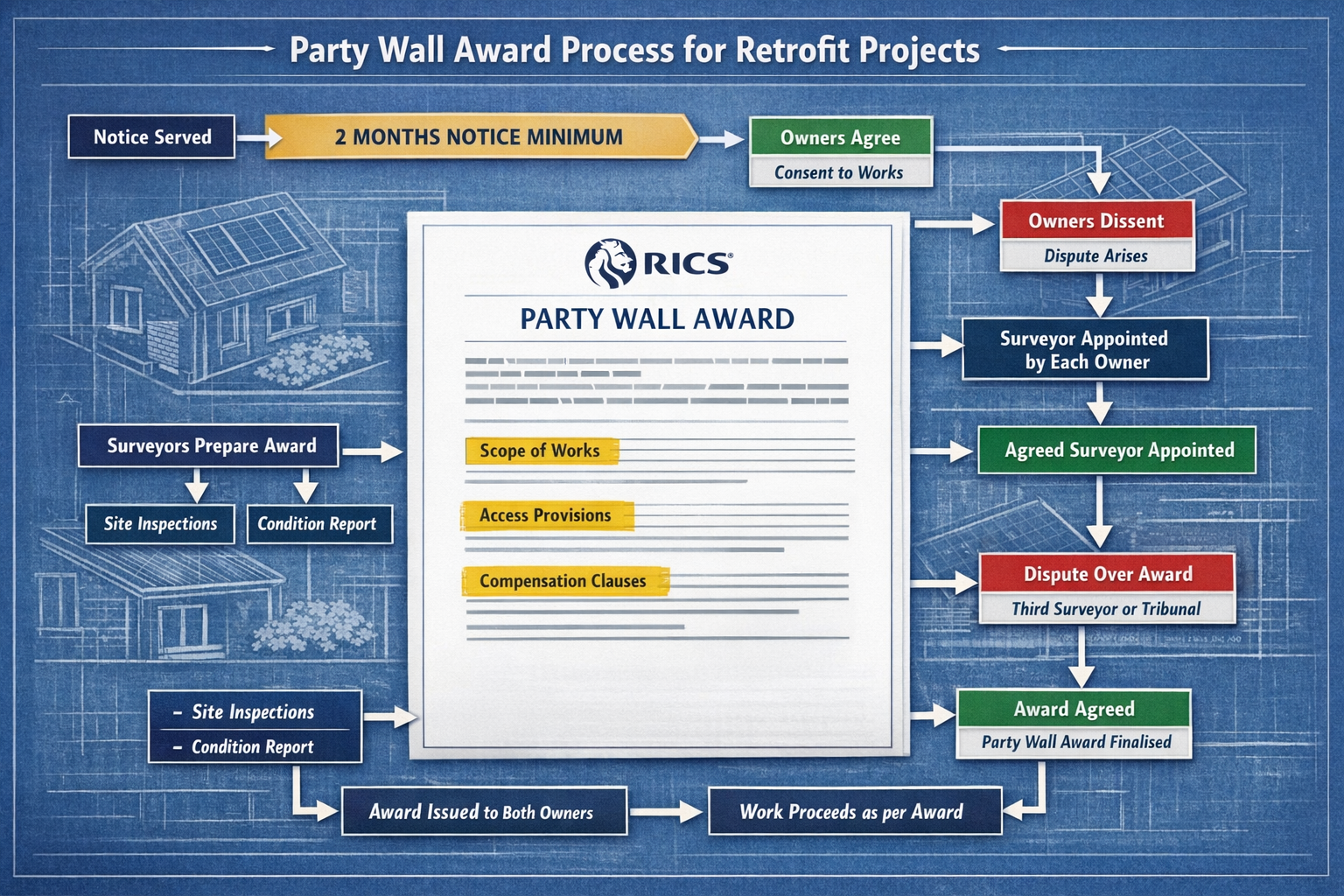
Each of these interventions requires careful consideration of notice requirements, with party wall notices typically needing to be served at least two months before work commences for most structural works.
Why Retrofit Projects Generate More Disputes
The surge in party wall disputes related to retrofit works stems from several unique factors that distinguish energy efficiency projects from traditional building work:
🔧 Technical Complexity: Retrofit solutions often involve unfamiliar technologies and materials that adjoining owners may not understand, leading to heightened anxiety and opposition.
⏰ Time Pressures: Grant deadlines and EPC compliance timelines create urgency that can lead building owners to rush or skip proper party wall procedures.
💰 Cost Concerns: Adjoining owners worry about potential damage or future maintenance costs associated with retrofit installations, particularly with external insulation systems.
🏠 Aesthetic Impact: External wall insulation significantly alters a building's appearance, which can be contentious in conservation areas or where architectural consistency matters to neighbors.
📋 Information Gaps: Many homeowners undertaking their first retrofit project are unfamiliar with party wall legislation, leading to procedural errors and unnecessary conflicts.
The Quality Summit initiatives of late 2025 and early 2026 specifically addressed these challenges, resulting in updated guidance that emphasizes proactive communication, comprehensive documentation, and specialized expertise for retrofit-related party wall matters [3].
RICS Standards for Handling Party Wall Disputes in 2026 Retrofit Projects: RICS Standards and Award Essentials Post-Quality Summit
The Royal Institution of Chartered Surveyors (RICS) has long provided the professional framework for party wall practice in the UK. Following the Quality Summit—a series of industry consultations held throughout 2025—RICS updated its guidance to address the specific challenges posed by the retrofit boom. Understanding these current standards is essential for anyone involved in Handling Party Wall Disputes in 2026 Retrofit Projects: RICS Standards and Award Essentials Post-Quality Summit.
Updated RICS Guidance on Party Wall Legislation and Procedure
The RICS professional standard "Party Wall Legislation and Procedure" serves as the authoritative reference for surveyors operating under the Party Wall etc. Act 1996 [3]. The most recent updates, implemented in early 2026, include specific provisions for energy efficiency works:
Enhanced Pre-Notice Consultation Requirements
The updated guidance strongly recommends that building owners engage in informal consultation with adjoining owners before serving formal notices for retrofit works. This pre-notice phase should include:
- Clear explanations of the proposed energy efficiency improvements
- Visual representations (drawings, photographs of similar installations)
- Expected timelines and access requirements
- Anticipated noise, dust, and disruption levels
- Contact information for the project team
This approach aligns with RICS's emphasis on dispute avoidance rather than dispute resolution [1]. Early dialogue helps address concerns before they escalate into formal dissent.
Specialized Surveyor Competency
The 2026 guidance introduces the concept of retrofit-competent surveyors—professionals who possess both traditional party wall expertise and understanding of building physics, thermal performance, and energy efficiency technologies. When appointing surveyors for retrofit-related party wall matters, both building and adjoining owners are encouraged to verify:
- Current RICS membership and professional indemnity insurance
- Demonstrated experience with energy efficiency projects
- Understanding of thermal bridging, condensation risk, and moisture management
- Familiarity with relevant building regulations and EPC requirements
Documentation Standards
RICS has elevated documentation requirements for retrofit projects, recognizing that energy efficiency installations may have long-term implications for building performance. Surveyors must now ensure that party wall awards include:
- Detailed specifications of insulation materials and installation methods
- Thermal performance calculations demonstrating compliance
- Moisture management strategies
- Long-term maintenance responsibilities
- Provisions for future access if remedial work becomes necessary
The Quality Summit Impact on Professional Practice
The Quality Summit represented a collaborative effort among RICS, the Faculty of Party Wall Surveyors, and other professional bodies to address emerging challenges in party wall practice. Key outcomes relevant to retrofit projects include:
Standardized Award Templates for Energy Works
The Summit resulted in development of specialized party wall award templates specifically designed for common retrofit scenarios. These templates address:
- External wall insulation installations
- Cavity wall treatment works
- Roof and loft insulation projects
- Ventilation system installations
These standardized documents reduce ambiguity and provide clearer guidance for all parties involved, potentially reducing disputes by ensuring consistent treatment of common scenarios.
Enhanced Dispute Resolution Protocols
The Quality Summit established clearer pathways for resolving disagreements that arise during retrofit projects. The updated protocols emphasize:
- Mediation before escalation: Encouraging informal resolution through surveyor-facilitated discussions
- Technical expert involvement: Bringing in building physics specialists when disputes involve thermal performance questions
- Time-bound resolution processes: Establishing maximum timeframes for surveyor responses to prevent project delays
- Cost transparency: Clearer guidelines on fee allocation and expense recovery
Professional Conduct Standards
New ethical guidelines specifically address the unique pressures of the 2026 retrofit environment, including:
- Prohibition against surveyors creating unnecessary delays when EPC deadlines are at stake
- Requirements for timely communication (48-hour response standards for urgent matters)
- Transparency regarding potential conflicts of interest in energy efficiency projects
- Continuing professional development requirements for retrofit-related competencies
Applying RICS Standards to Common Retrofit Scenarios
To illustrate how current RICS standards apply in practice, consider these typical 2026 retrofit situations:
| Retrofit Work Type | Notice Required | Key RICS Considerations | Typical Award Provisions |
|---|---|---|---|
| External Wall Insulation | Line of Junction Notice (Section 1) | Attachment method, weather protection, appearance impact | Material specifications, installation supervision, warranty terms, future maintenance access |
| Cavity Wall Insulation | Notice of Adjacent Excavation (Section 6) if drilling near foundations | Drilling depth, material containment, moisture barrier integrity | Drilling methodology, inspection protocols, remediation if material migration occurs |
| Party Wall Beam Installation | Party Structure Notice (Section 2) | Structural calculations, thermal bridging mitigation, load distribution | Engineering approval, installation monitoring, thermal break details |
| Loft Conversion with Party Wall Works | Party Structure Notice (Section 2) | Sound insulation, fire resistance, structural adequacy | Building control coordination, acoustic testing, fire barrier specifications |
Each scenario requires careful application of RICS guidance to ensure both legal compliance and practical project success [5].
Essential Elements of Party Wall Awards for 2026 Retrofit Projects
A party wall award serves as the legally binding document that governs how notifiable works will proceed, what protections exist for the adjoining owner, and how disputes will be resolved. For retrofit projects in 2026, awards must address both traditional party wall concerns and the unique technical requirements of energy efficiency installations.
Core Components of a Retrofit-Specific Party Wall Award
Understanding the essential elements of a properly drafted award is crucial for anyone involved in Handling Party Wall Disputes in 2026 Retrofit Projects: RICS Standards and Award Essentials Post-Quality Summit. The following components should appear in every retrofit-related award:
1. Comprehensive Scope of Works
The award must precisely describe the proposed energy efficiency improvements, including:
- Detailed specifications of all materials (insulation type, thickness, thermal conductivity values)
- Installation methodology (mechanical fixings, adhesive systems, render application)
- Extent of works (which elevations, height parameters, interface with existing structures)
- Associated works (scaffolding, temporary weather protection, making good)
Vague descriptions like "installation of external insulation" are insufficient. The award should reference detailed drawings and specifications that leave no ambiguity about what is permitted [4].
2. Schedule of Condition
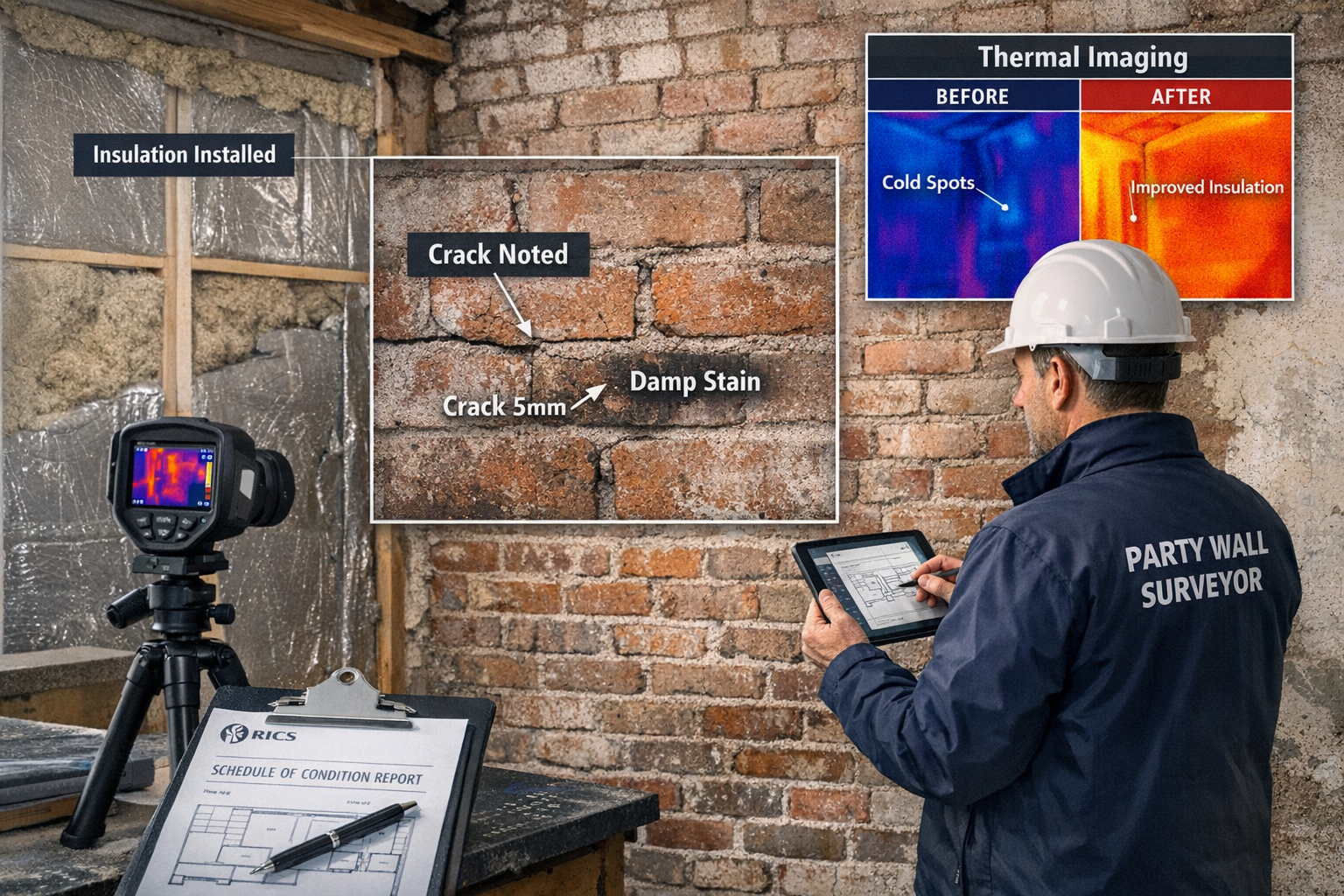
A thorough Schedule of Condition documenting the pre-works state of both the party wall and the adjoining owner's property is absolutely essential for retrofit projects. This photographic and written record should capture:
- Current condition of all party wall structures
- Existing cracks, defects, or areas of concern
- Internal finishes in rooms adjacent to party walls
- External conditions where insulation will be installed
- Baseline moisture readings and thermal imaging results
The Schedule of Condition provides the benchmark against which any damage claims will be assessed. For retrofit works, it's particularly important to document existing thermal performance issues to avoid later disputes about whether condensation or moisture problems were caused by the new installation.
3. Access Provisions
Retrofit works frequently require access to the adjoining owner's property for:
- Installation of scaffolding or access equipment
- Inspection of internal wall conditions
- Verification that works haven't caused damage
- Future maintenance or remedial work
The award must specify:
- When and how access will be requested (reasonable notice periods)
- Duration and frequency of access requirements
- Protections for the adjoining owner's property during access
- Compensation for significant inconvenience or loss of use
RICS guidance emphasizes that access provisions should be proportionate and clearly justified by the technical requirements of the work [1].
4. Damage and Making Good Provisions
The award should establish clear protocols for addressing any damage that occurs during retrofit works:
- Immediate notification requirements when damage is discovered
- Documentation procedures (photographs, written descriptions)
- Repair standards (matching existing materials and finishes)
- Timeframes for completion of making good
- Dispute resolution if parties disagree about damage or repair adequacy
For retrofit projects, it's particularly important to address latent damage that may only become apparent after works are completed, such as moisture ingress or thermal bridging effects.
5. Cost Allocation and Fee Payment
The award must clearly state:
- Who pays surveyor fees (typically the building owner pays all reasonable fees)
- How costs are apportioned if works benefit both properties
- Payment terms and schedules
- Dispute resolution for fee disagreements
The updated RICS guidance encourages transparency about likely costs early in the process to avoid disputes later [3]. For more information on managing expenses, see our guide on how to keep party wall costs down.
Retrofit-Specific Award Clauses
Beyond the standard elements, awards for 2026 retrofit projects should include specialized provisions addressing energy efficiency concerns:
Thermal Performance Guarantees
The award should specify:
- Minimum thermal performance standards (U-values) to be achieved
- Testing and verification procedures
- Remediation protocols if performance targets aren't met
- Long-term performance monitoring (where appropriate)
Condensation and Moisture Management
Given the risks associated with adding insulation to existing structures, awards should address:
- Pre-installation moisture surveys
- Vapor barrier and breathability requirements
- Ventilation provisions to prevent interstitial condensation
- Post-installation monitoring periods
- Responsibility for addressing moisture issues that arise
Reversibility and Future Modifications
Energy efficiency technologies evolve rapidly. Awards should consider:
- Provisions for future upgrades or replacements
- Notice requirements for modifications to installed systems
- Access rights for future maintenance
- Responsibilities if systems need to be removed or altered
Building Regulations and EPC Compliance
The award should confirm:
- That works will comply with current Building Regulations Part L (Conservation of Fuel and Power)
- EPC improvement targets being pursued
- Building Control notification and inspection protocols
- Responsibility for obtaining necessary approvals
Common Award Deficiencies in Retrofit Projects
Based on 2026 dispute analysis, the following award deficiencies frequently lead to problems:
❌ Insufficient material specifications: Awards that don't specify exact insulation products, allowing substitution of inferior materials
❌ Vague timelines: Failure to establish clear start and completion dates, leading to prolonged disruption
❌ Inadequate damage protocols: No clear process for documenting and resolving damage claims
❌ Missing maintenance provisions: No consideration of long-term access needs for system maintenance
❌ Unclear cost allocation: Ambiguity about who pays for various aspects of the work and associated surveyor involvement
Avoiding these deficiencies requires careful drafting by experienced surveyors familiar with both party wall law and retrofit technology.
Strategies for Minimizing Disputes in Retrofit Party Wall Matters
While the Party Wall etc. Act 1996 provides a framework for managing disagreements, the best outcome for all parties is avoiding disputes altogether. The following strategies, aligned with current RICS best practices for Handling Party Wall Disputes in 2026 Retrofit Projects: RICS Standards and Award Essentials Post-Quality Summit, can significantly reduce conflict potential.
Pre-Notice Engagement and Neighbor Relations
The foundation of dispute avoidance is proactive communication before formal notices are served. Building owners should:
1. Conduct Informal Preliminary Discussions
Before serving official party wall notices, arrange a friendly conversation with adjoining owners to:
- Explain the energy efficiency goals and benefits
- Show examples of similar completed projects
- Discuss potential concerns and how they'll be addressed
- Provide preliminary timelines
- Offer contact information for questions
This informal approach often prevents the defensive reaction that formal legal notices can trigger. Many adjoining owners are more cooperative when they feel informed and respected rather than legally compelled.
2. Provide Comprehensive Information Packages
When serving formal notices, supplement the legal minimum with:
- Visual materials: Photographs, drawings, or renderings showing the proposed changes
- Technical summaries: Plain-language explanations of the retrofit technology
- Benefit statements: How the works might benefit the adjoining property (improved weather protection, potential property value increase)
- Disruption mitigation plans: Specific measures to minimize noise, dust, and inconvenience
- Contact details: Direct access to the project manager or building owner for questions
3. Demonstrate Professional Project Management
Adjoining owners are more likely to consent when they have confidence in the building owner's professionalism:
- Engage reputable contractors with retrofit expertise
- Obtain necessary planning permissions and building control approvals before serving notices
- Provide evidence of adequate insurance coverage
- Establish clear communication channels and response commitments
Selecting the Right Surveyors
If the adjoining owner dissents or doesn't respond to the notice, surveyors must be appointed. The choice of surveyor can significantly influence whether disputes escalate or resolve smoothly.
Building Owner's Surveyor Selection
When selecting a surveyor to represent the building owner's interests, prioritize:
- Retrofit experience: Demonstrated familiarity with energy efficiency projects and associated technical challenges
- Local knowledge: Understanding of local building practices and common construction types in the area
- Communication skills: Ability to explain technical matters clearly to non-experts
- Efficiency: Track record of timely award production and project progression
- RICS membership: Current professional standing and continuing education
For London-based projects, consider specialists such as party wall surveyors in West London, Central London, or other regional specialists who understand local building characteristics.
Adjoining Owner's Surveyor Considerations
Adjoining owners have three options when a party wall notice is served:
- Consent to the works (no surveyor needed)
- Appoint their own surveyor to negotiate terms
- Agree to the building owner's surveyor acting for both parties
While option 3 can reduce costs, adjoining owners should carefully consider whether independent representation better protects their interests, particularly for complex retrofit projects [2]. When appointing their own surveyor, adjoining owners should seek:
- Independence from the building owner and their contractors
- Technical expertise relevant to the proposed works
- Clear fee structures and cost estimates
- Responsiveness and accessibility
The Third Surveyor Safety Net
If the building owner's and adjoining owner's surveyors cannot reach agreement, they may appoint a third surveyor to resolve the dispute. This mechanism provides an important safety valve, but adds time and cost. Selecting surveyors who work collaboratively and professionally reduces the likelihood of third surveyor involvement.
Effective Communication Throughout the Project
Once the award is in place and work commences, ongoing communication remains essential:
Regular Progress Updates
Building owners or their surveyors should provide:
- Weekly updates during active work periods
- Advance notice of particularly disruptive activities
- Prompt notification of any issues or delays
- Photographic progress records shared with the adjoining owner
Responsive Issue Resolution
When concerns arise during construction:
- Acknowledge immediately: Respond to adjoining owner concerns within 24-48 hours
- Investigate thoroughly: Don't dismiss complaints without proper assessment
- Propose solutions: Offer concrete remediation plans, not just explanations
- Document everything: Maintain written records of all issues and resolutions
Post-Completion Follow-Up
After retrofit works are finished:
- Conduct a joint final inspection with the adjoining owner
- Address any outstanding making good items promptly
- Provide warranty information and maintenance guidance for new installations
- Confirm that all award conditions have been satisfied
Leveraging Technology for Dispute Prevention
Modern technology offers new tools for managing party wall matters more transparently:
Digital Documentation
- Cloud-based photo sharing: Real-time access to condition surveys and progress photographs
- Digital award distribution: Ensuring all parties have immediate access to the agreed terms
- Electronic communication trails: Clear records of all correspondence and agreements
Building Performance Monitoring
- Thermal imaging: Demonstrating that retrofit works are performing as intended
- Moisture monitoring: Early detection of any condensation or dampness issues
- Energy consumption tracking: Proving the effectiveness of efficiency improvements
Project Management Platforms
- Shared timelines: Transparent scheduling that keeps all parties informed
- Issue tracking systems: Formal logging and resolution of concerns
- Document repositories: Centralized access to all project documentation
Case Studies: Successful Dispute Resolution in 2026 Retrofit Projects
Examining real-world examples of how party wall disputes have been successfully managed in 2026 retrofit contexts provides valuable practical insights. The following case studies (details anonymized) illustrate effective application of RICS standards and dispute resolution strategies.
Case Study 1: External Wall Insulation in Victorian Terrace
Situation: A homeowner in a Victorian terrace in North London planned to install external wall insulation to achieve EPC Band C for rental compliance. The property shared party walls with neighbors on both sides, one of whom immediately dissented to the party wall notice.
Challenges:
- Adjoining owner concerned about aesthetic impact on the terrace's period character
- Worry about potential moisture problems from "sealing" the walls
- Previous negative experience with building works causing damage
Resolution Strategy:
The building owner's surveyor, working with a party wall surveyor in North London experienced in retrofit projects, implemented several key strategies:
-
Technical education session: Arranged a meeting with both the building owner and adjoining owner where a building physics consultant explained modern breathable insulation systems and moisture management
-
Enhanced Schedule of Condition: Conducted an exceptionally detailed pre-works survey including thermal imaging and moisture readings, giving the adjoining owner confidence that any future issues could be objectively assessed
-
Aesthetic protections: Included award provisions requiring that the insulation system match the existing render finish and that all architectural details be replicated
-
Performance guarantees: Specified that if any moisture issues arose within two years, the building owner would fund investigation and remediation
-
Regular communication protocol: Established weekly email updates with photographs during the eight-week installation period
Outcome: The award was agreed within three weeks, works proceeded without incident, and the adjoining owner later reported satisfaction with both the process and the finished appearance. The building owner achieved the target EPC rating, and the property was successfully re-let.
Key Lesson: Investing time in education and relationship-building early in the process prevented what could have escalated into a protracted dispute requiring third surveyor involvement.
Case Study 2: Cavity Wall Insulation Dispute
Situation: A semi-detached property owner in South London arranged for cavity wall insulation as part of a government-funded retrofit program. The work was completed before party wall notices were served, and the adjoining owner discovered insulation material had migrated into their cavity, causing damp patches on internal walls.
Challenges:
- Works completed without proper party wall procedure
- Actual damage had occurred to the adjoining property
- Grant funding timeline pressure to complete works quickly
- Adjoining owner considering legal action beyond the Party Wall Act
Resolution Strategy:
Recognizing the serious procedural failure, the building owner engaged a party wall surveyor in South London to manage remediation:
-
Immediate acknowledgment: Building owner formally apologized and accepted responsibility for the procedural failure
-
Retrospective award: Surveyors prepared an award documenting the works that had been completed and establishing remediation obligations
-
Expert investigation: Engaged a building pathologist to assess the extent of insulation migration and moisture damage
-
Comprehensive remediation: Building owner funded complete removal of contaminated insulation from the adjoining property's cavity, treatment of affected walls, and re-plastering of damaged internal surfaces
-
Compensation payment: Award included financial compensation for the adjoining owner's inconvenience and distress
-
Procedural improvements: Building owner committed to proper party wall procedures for future planned loft insulation works
Outcome: The adjoining owner agreed not to pursue legal action beyond the Party Wall Act framework. Remediation was completed to the adjoining owner's satisfaction within six weeks. The building owner incurred approximately £8,500 in additional costs that could have been avoided with proper initial procedures.
Key Lesson: Attempting to bypass party wall procedures to meet grant deadlines or save costs almost always results in greater expense and delay. Proper process from the outset protects all parties and facilitates smoother project delivery.
Case Study 3: Loft Conversion with Party Wall Extension
Situation: An East London property owner planned a loft conversion that required raising the party wall by 1.2 meters and installing steel beams within the party wall structure. The project aimed to create additional living space while also installing high-performance insulation to achieve EPC Band B.
Challenges:
- Significant structural intervention in party wall
- Extended construction period (estimated 14 weeks)
- Adjoining owner initially refused to appoint a surveyor, causing procedural delay
- Complex coordination between party wall requirements and Building Regulations
Resolution Strategy:
Working with an experienced party wall surveyor in East London, the building owner implemented a comprehensive approach:
-
Statutory notice compliance: When the adjoining owner didn't respond to the party structure notice within the 14-day period, the building owner's surveyor properly invoked the deemed appointment provisions of the Act
-
Collaborative surveyor approach: Despite representing different parties, both surveyors worked cooperatively to produce a comprehensive award within four weeks
-
Detailed structural specifications: Award included full structural engineer's calculations, steel beam specifications, and installation methodology
-
Phased access provisions: Established clear schedule for when adjoining owner access would be needed for inspections, minimizing disruption
-
Enhanced protections: Given the significant structural work, the award required:
- Professional indemnity insurance confirmation
- Structural engineer supervision during critical phases
- Immediate notification of any unexpected conditions
- Post-completion structural verification
-
Thermal performance documentation: Award specified insulation U-values and required Building Control sign-off before works were considered complete
Outcome: Works proceeded according to schedule with only minor issues (temporary scaffolding adjustment) that were quickly resolved. The loft conversion achieved the planned EPC improvement and added significant value to the property. The adjoining owner reported that the process, while lengthy, was professionally managed with minimal disruption.
Key Lesson: Proper use of the Act's deemed appointment provisions ensures that projects can proceed even when adjoining owners are unresponsive, while still protecting their interests through independent surveyor representation. For more information on this scenario, see our guide for adjoining owners.
The Future of Party Wall Practice in the Retrofit Era
As 2026 progresses and the retrofit boom continues, party wall practice is evolving to meet new challenges. Understanding emerging trends helps property owners and professionals prepare for the changing landscape of Handling Party Wall Disputes in 2026 Retrofit Projects: RICS Standards and Award Essentials Post-Quality Summit.
Anticipated Regulatory Developments
Several regulatory changes are on the horizon that will further impact party wall matters in retrofit contexts:
Enhanced EPC Requirements
Government consultations suggest that minimum EPC standards may be progressively raised through the late 2020s, with Band B potentially becoming the rental standard by 2030. This will drive even more extensive retrofit works, including:
- Whole-house retrofit approaches requiring multiple party wall interventions
- More complex insulation systems (internal wall insulation where EWI isn't possible)
- Heat pump installations potentially affecting party wall structures
- Solar panel and renewable energy installations on shared roof structures
Building Safety Act Implications
The Building Safety Act's emphasis on competence and accountability is beginning to influence party wall practice, with expectations that:
- Surveyors will need to demonstrate continuing professional development specifically in retrofit technologies
- Documentation standards will increase, with digital record-keeping becoming standard
- Competence frameworks may be formalized for surveyors working on energy efficiency projects
Permitted Development Changes
Ongoing reviews of permitted development rights for energy efficiency works may affect when party wall procedures are required, potentially:
- Exempting certain minor retrofit works from planning requirements while still requiring party wall compliance
- Creating fast-track approval processes for standard retrofit installations
- Establishing pre-approved specifications that simplify party wall award drafting
Technology and Innovation in Party Wall Practice
Technological advancement is transforming how party wall matters are managed:
Digital Awards and Electronic Service
The profession is moving toward:
- Fully digital award production using standardized templates and automated clause libraries
- Electronic service of notices with proof of delivery
- Blockchain-based record-keeping for permanent, tamper-proof documentation
- AI-assisted drafting that suggests appropriate provisions based on work descriptions
Remote Surveying Capabilities
Post-pandemic innovations continue to develop:
- Virtual inspections using high-resolution video and photographs
- Drone surveys for external condition assessment
- 3D scanning to create detailed pre-works records
- Remote collaboration platforms allowing surveyors to work together across distances
Predictive Analytics
Emerging data analysis tools may soon enable:
- Dispute risk assessment based on project characteristics and historical patterns
- Cost prediction models for more accurate fee estimates
- Timeline optimization identifying likely bottlenecks before they occur
Professional Development and Specialization
The complexity of retrofit party wall work is driving increasing specialization:
Retrofit-Specialist Surveyors
A new category of party wall surveyors is emerging with dual expertise in:
- Traditional party wall law and procedure
- Building physics and energy efficiency technology
- Moisture management and thermal performance
- Renewable energy systems and their structural implications
Interdisciplinary Collaboration
Effective retrofit party wall practice increasingly requires collaboration among:
- Party wall surveyors
- Building physics consultants
- Structural engineers
- Energy assessors
- Building control officers
Awards and project management approaches that facilitate this interdisciplinary cooperation produce better outcomes for all parties [8].
Industry Initiatives and Best Practice Development
Following the Quality Summit, ongoing initiatives continue to refine best practices:
Standardized Retrofit Award Templates
Industry bodies are developing comprehensive template libraries for common retrofit scenarios, including:
- External wall insulation (various fixing methods)
- Cavity wall insulation (injection and extraction methods)
- Internal wall insulation systems
- Roof and loft insulation with party wall implications
- Heat pump installations affecting party structures
Dispute Resolution Innovation
New approaches to resolving disagreements include:
- Early neutral evaluation: Independent technical experts providing non-binding assessments early in disputes
- Mediation protocols: Structured facilitation before formal third surveyor appointment
- Online dispute resolution: Digital platforms for managing disagreement resolution efficiently
Consumer Education Programs
Recognizing that many property owners are unfamiliar with party wall requirements, industry initiatives focus on:
- Plain-language guidance materials
- Online decision tools helping owners determine if notices are required
- Template letters for initial neighbor consultations
- Video resources explaining the party wall process
These educational efforts aim to reduce accidental non-compliance and improve the overall quality of party wall practice in the retrofit context.
Practical Checklist for Retrofit Project Party Wall Compliance
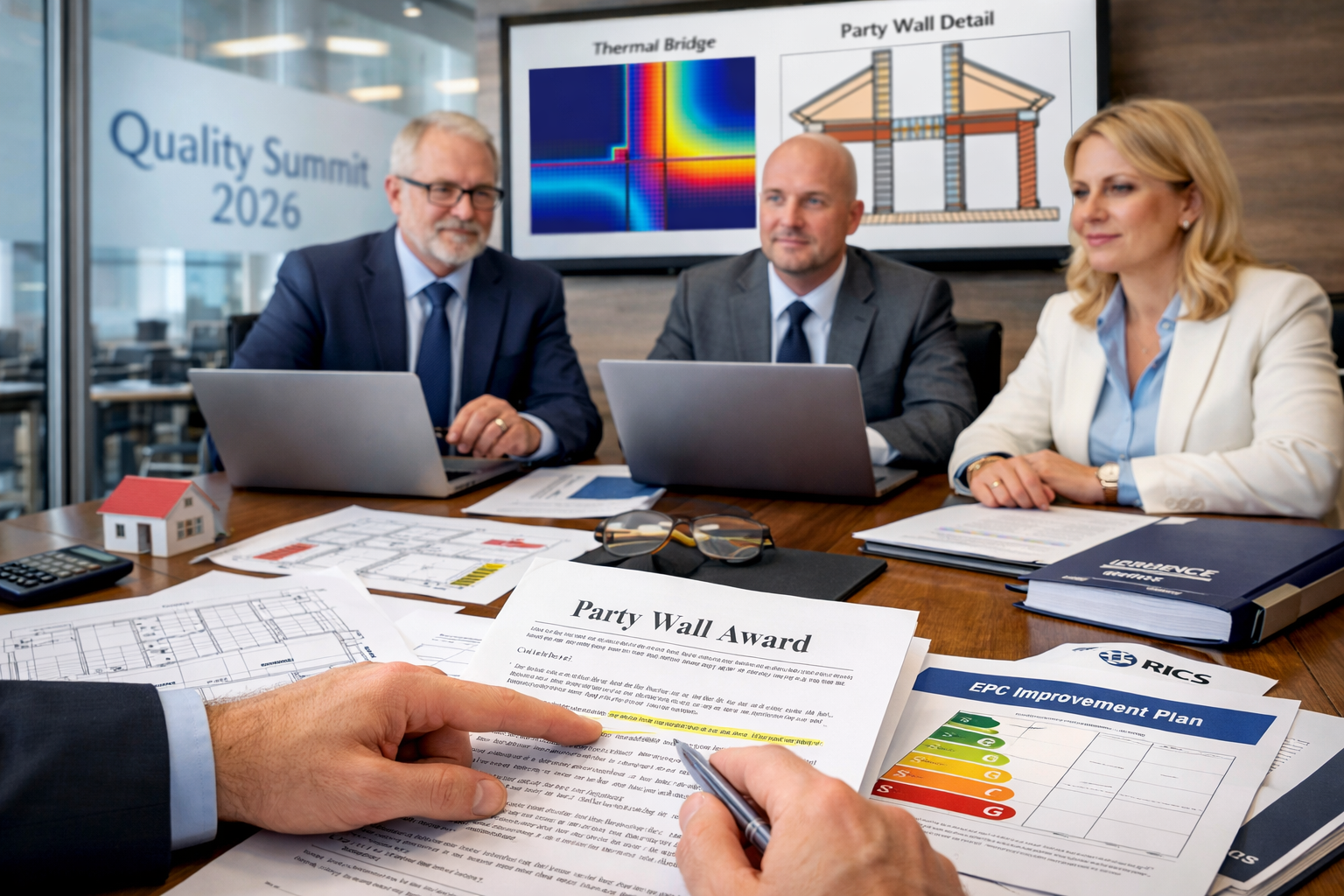
To ensure proper handling of party wall matters in 2026 retrofit projects, use this comprehensive checklist:
Pre-Project Planning Phase
✅ Identify all potentially notifiable works in the retrofit plan
- External wall insulation affecting party walls
- Cavity wall treatment
- Structural modifications for thermal performance
- Roof works affecting party structures
- Foundation works for ground source heat pumps
✅ Determine notice requirements for each element
- Section 1 (Line of Junction) notices
- Section 2 (Party Structure) notices
- Section 6 (Adjacent Excavation) notices
✅ Prepare comprehensive project documentation
- Detailed drawings and specifications
- Thermal performance calculations
- Structural engineer's reports (if applicable)
- Building Regulations compliance strategy
- Project timeline with key milestones
✅ Identify all adjoining owners
- Immediate neighbors sharing party walls
- Properties potentially affected by excavation
- Leaseholders vs. freeholders (serve notices on both)
Neighbor Engagement Phase
✅ Conduct preliminary informal consultation
- Explain retrofit goals and benefits
- Show visual representations of proposed works
- Discuss potential concerns
- Provide contact information
✅ Prepare and serve formal notices
- Use correct notice forms for work types
- Include all required information
- Serve on all relevant parties
- Maintain proof of service
✅ Allow statutory response periods
- 14 days for consent/dissent or surveyor appointment
- Don't commence works prematurely
Surveyor Appointment and Award Phase
✅ Appoint qualified surveyor(s)
- Verify RICS membership and retrofit experience
- Confirm professional indemnity insurance
- Agree fee structures in advance
- Establish communication protocols
✅ Cooperate with Schedule of Condition preparation
- Provide access for pre-works inspection
- Review and approve photographic records
- Ensure thermal imaging and moisture readings are included
- Keep copies of all documentation
✅ Review draft award carefully
- Verify work descriptions match actual plans
- Confirm timelines are realistic
- Understand access provisions
- Clarify any ambiguous terms
- Ensure retrofit-specific provisions are included
✅ Obtain all necessary approvals before commencing
- Party wall award signed by all surveyors
- Building Regulations approval
- Planning permission (if required)
- Contractor appointments and insurance confirmation
Construction Phase
✅ Comply with award terms
- Adhere to specified timelines
- Provide required access
- Use specified materials and methods
- Maintain required insurances
✅ Maintain communication
- Provide regular progress updates
- Give advance notice of disruptive activities
- Respond promptly to concerns
- Document all interactions
✅ Monitor for issues
- Conduct regular inspections
- Address any damage immediately
- Keep photographic records
- Notify surveyors of unexpected conditions
Completion Phase
✅ Conduct final inspections
- Joint inspection with adjoining owner
- Surveyor verification of award compliance
- Building Control final inspection
- EPC assessment
✅ Complete making good
- Address all damage or defects
- Match existing finishes
- Obtain adjoining owner approval
- Document completion
✅ Finalize documentation
- Obtain final surveyor sign-off
- Settle all fees
- Provide warranty information
- Archive all records for future reference
Following this systematic approach significantly reduces the risk of disputes and ensures compliance with current standards for Handling Party Wall Disputes in 2026 Retrofit Projects: RICS Standards and Award Essentials Post-Quality Summit.
Conclusion: Navigating Party Wall Matters in the Retrofit Era
The intersection of the UK's ambitious energy efficiency goals and the practical realities of party wall legislation creates both challenges and opportunities for property owners in 2026. As retrofit projects continue to surge in response to EPC requirements and climate commitments, understanding how to properly navigate party wall procedures has become an essential competency for homeowners, developers, and construction professionals.
The key to successful Handling Party Wall Disputes in 2026 Retrofit Projects: RICS Standards and Award Essentials Post-Quality Summit lies in proactive engagement, professional expertise, and transparent communication. The updated RICS guidance and Quality Summit outcomes provide a robust framework for managing these complex matters, but success ultimately depends on how these standards are applied in practice.
Essential Principles for Success
Early Engagement: Begin party wall considerations during project planning, not as an afterthought when contractors are ready to start. Informal neighbor consultations before formal notices can prevent many disputes from arising.
Professional Expertise: Engage RICS-qualified surveyors with demonstrated retrofit experience. The modest investment in professional fees is insignificant compared to the costs of disputes, delays, or non-compliance.
Comprehensive Documentation: Detailed Schedules of Condition, precise work specifications, and thorough awards protect all parties and provide clear reference points if disagreements arise.
Transparent Communication: Regular updates, prompt responses to concerns, and honest acknowledgment of issues build trust and facilitate cooperative problem-solving.
Regulatory Compliance: Party wall procedures complement, rather than replace, Building Regulations, planning requirements, and other legal obligations. Ensure all aspects of compliance are addressed.
Actionable Next Steps
For property owners planning retrofit projects in 2026 and beyond:
-
Assess your retrofit plans against party wall requirements using the checklist provided in this guide or consult our resources on types of party wall works
-
Engage with neighbors early before serving formal notices, using the communication strategies outlined above
-
Appoint qualified professionals including RICS surveyors with retrofit expertise and contractors familiar with party wall requirements
-
Budget appropriately for party wall costs, including surveyor fees, Schedule of Condition preparation, and potential making good expenses (see our guide on costs of party wall procedures)
-
Allow adequate time in project schedules for the party wall process, including notice periods, award preparation, and potential dispute resolution
-
Maintain comprehensive records of all communications, inspections, and agreements throughout the project
-
Stay informed about evolving RICS guidance and industry best practices as the retrofit sector continues to develop
The 2026 retrofit boom represents a critical moment in the UK's journey toward sustainable building stock and net-zero emissions. By properly managing party wall matters according to current RICS standards and the enhanced guidance emerging from the Quality Summit, property owners can achieve their energy efficiency goals while maintaining positive neighbor relations and legal compliance.
The Party Wall etc. Act 1996 provides a balanced framework that protects both building owners' rights to improve their properties and adjoining owners' interests in preventing damage and maintaining their property's integrity. When applied thoughtfully and professionally, particularly in the context of energy efficiency upgrades, this framework facilitates progress while ensuring fairness.
As retrofit technologies continue to evolve and regulatory requirements become more stringent, party wall practice will undoubtedly continue to adapt. Property owners who invest in understanding these procedures, engage professional expertise, and approach neighbor relations with transparency and respect will find that party wall requirements, rather than being obstacles, provide a structured pathway to successful project delivery.
The future of UK housing depends on successful delivery of millions of retrofit projects over the coming years. Proper party wall practice is an essential component of this transformation, ensuring that the drive for energy efficiency proceeds in a manner that respects property rights, maintains building integrity, and preserves community relationships. By following the principles and practices outlined in this guide, property owners can contribute to this vital national effort while protecting their own interests and those of their neighbors.
References
[1] Party Walls – https://www.rics.org/consumer-guides/party-walls
[2] Party Wall Agreement – https://hoa.org.uk/advice/guides-for-homeowners/i-am-improving/party-wall-agreement/
[3] Party Wall Legislation And Procedure – https://www.rics.org/profession-standards/rics-standards-and-guidance/sector-standards/building-surveying-standards/party-wall-legislation-and-procedure
[4] Party Wall – https://www.allcottassociates.co.uk/advice/party-wall/
[5] Mastering Party Wall Agreements A Comprehensive Breakdown For Homeowners – https://kandasurveyors.co.uk/about-surveys/mastering-party-wall-agreements-a-comprehensive-breakdown-for-homeowners/
[6] Party Wall Surveys Amid 2026 Construction Boom Handling Disputes In High Demand Uk Housing Markets – https://nottinghillsurveyors.com/blog/party-wall-surveys-amid-2026-construction-boom-handling-disputes-in-high-demand-uk-housing-markets
[7] Rics Consumer Guide Party Walls – https://www.ricsfirms.com/residential/legal-issues/party-walls/rics-consumer-guide-party-walls/
[8] Building Surveying Standards – https://www.rics.org/profession-standards/rics-standards-and-guidance/sector-standards/building-surveying-standards