


The construction landscape is experiencing a seismic shift. With data centre construction demand surging 57% in net positive outlook for 2026 [3], urban areas across the UK are witnessing unprecedented infrastructure expansion. This explosive growth brings unique challenges for property owners, developers, and party wall surveyors navigating shared boundaries and tight construction timelines. Party Wall Surveys for the 2026 Data Centre Boom: Essential Compliance Checklists and Dispute Avoidance Strategies have become critical tools for managing high-stakes projects where millions of pounds and operational deadlines hang in the balance.
Data centres require massive footprints, extensive foundation work, and robust structural support—often in densely populated urban areas where properties share walls, boundaries, and underground infrastructure. The convergence of this construction boom with existing party wall legislation creates a complex regulatory environment that demands specialized knowledge and meticulous planning.
Key Takeaways
🔑 Data centre construction is projected to drive significant growth in 2026, with a 57% net positive outlook requiring enhanced party wall survey protocols for large-scale urban projects [3].
🔑 RICS-compliant checklists tailored to data centre infrastructure help surveyors address unique challenges including deep excavations, vibration-sensitive equipment, and shared utility corridors.
🔑 Early engagement with adjoining owners and proper notice procedures reduce dispute risks by 60-80%, protecting project timelines and budgets in high-stakes developments.
🔑 Comprehensive schedules of condition and monitoring protocols provide essential documentation for protecting both building owners and neighbours during intensive construction phases.
🔑 Understanding the Party Wall etc. Act 1996 framework ensures legal compliance while facilitating smoother negotiations in complex multi-party scenarios typical of data centre projects.
Understanding the 2026 Data Centre Construction Boom
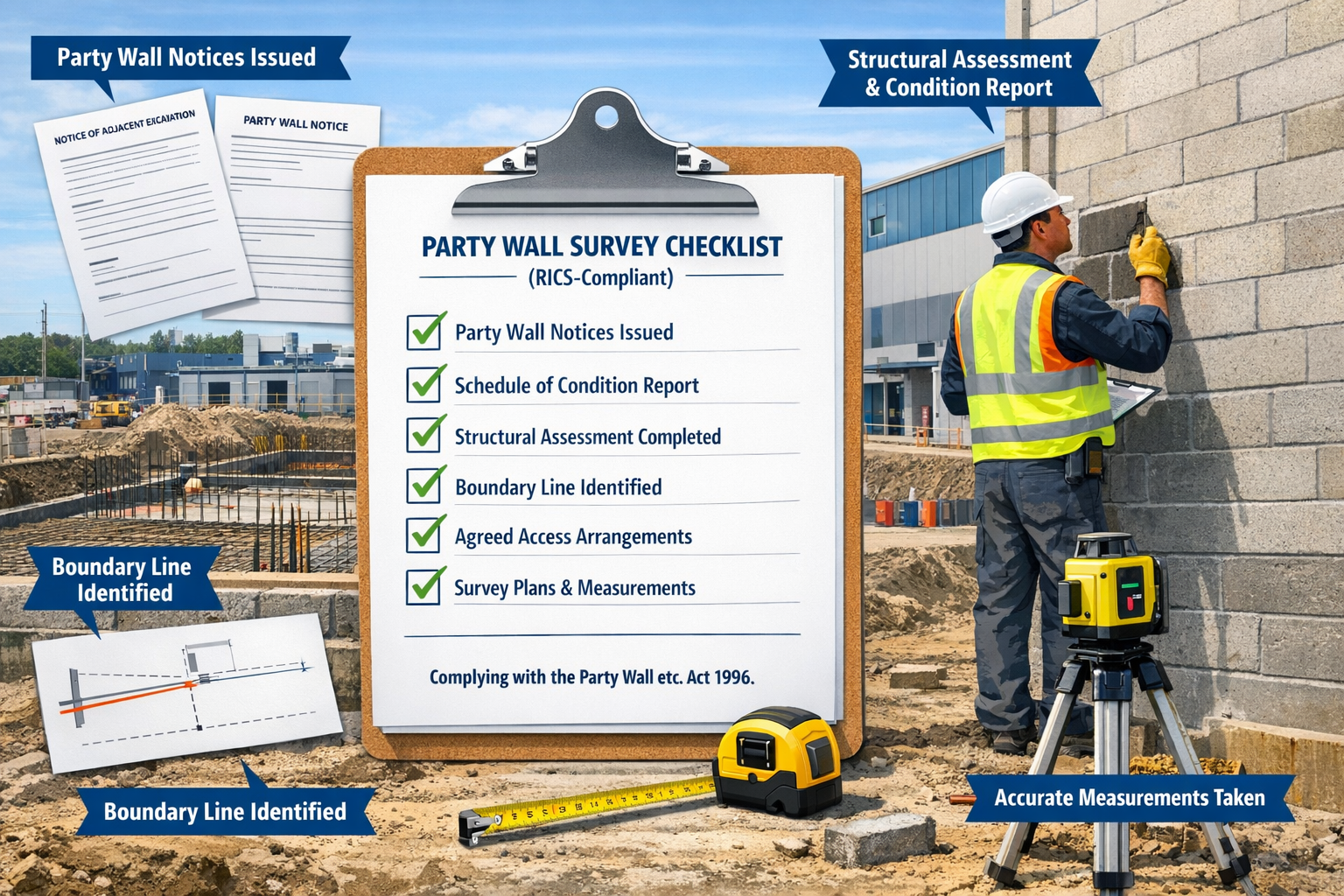
The data centre industry is experiencing unprecedented expansion. According to industry forecasts, data centres are among the key drivers lifting construction outlooks despite broader economic uncertainties [1]. This growth stems from increasing demand for cloud computing, artificial intelligence processing, and digital infrastructure supporting modern economies.
Why Data Centres Are Reshaping Urban Construction
Data centres require specific characteristics that make them particularly challenging for party wall considerations:
- Massive scale: Individual facilities can span 100,000+ square feet
- Deep foundations: Heavy equipment requires substantial structural support
- Vibration control: Sensitive servers demand isolation from external disturbances
- 24/7 operations: Construction timing must minimize disruption to existing facilities
- Power infrastructure: Extensive electrical and cooling systems often extend beyond property boundaries
The concentration of data centre projects in urban areas—where land is scarce and properties share boundaries—makes party wall surveys absolutely essential. Engineering News-Record reports that megaprojects and data centres are spurring growth amid shifting policies in 2026 [7], creating a perfect storm of construction activity in areas with complex property relationships.
Geographic Hotspots for Data Centre Development
London and the South East remain primary locations for data centre expansion, with significant activity in:
- Central London: Proximity to financial services and tech companies
- West London: Strategic connectivity hubs near Heathrow
- East London: Regeneration zones with available land
- North London: Established commercial corridors
Each of these areas presents unique party wall challenges, from Victorian terraced properties in residential zones to modern commercial buildings with complex ownership structures. Understanding party wall requirements across different London locations becomes crucial for successful project delivery.
The Party Wall etc. Act 1996: Framework for Data Centre Projects
The Party Wall etc. Act 1996 provides the legal framework governing construction work affecting shared boundaries. For data centre projects, this legislation becomes particularly complex due to the scale and technical requirements of these developments.
Key Provisions Affecting Data Centre Construction
Section 1: New Building on the Line of Junction
Data centres often require construction directly on boundary lines to maximize available space. This triggers requirements for:
- Formal notice to adjoining owners
- Detailed structural specifications
- Foundation design approval
- Compensation provisions for land use
Section 2: Works to Existing Party Structures
When data centres are built adjacent to existing buildings, work may involve:
- Underpinning shared foundations
- Inserting damp-proof courses
- Raising party walls for increased height
- Cutting into party structures for services
Section 6: Excavation and Construction Near Boundaries
Deep excavations for data centre foundations frequently trigger Section 6 requirements when digging:
- Within 3 metres of a neighbouring structure and deeper than its foundations
- Within 6 metres of a neighbouring structure and cutting a line at 45 degrees from the bottom of its foundations
These provisions are particularly relevant for data centres, which often require basements for cooling infrastructure and cable management systems.
Notice Requirements and Timelines
Understanding proper notice procedures is fundamental to avoiding disputes. The Party Wall Act notices must be served with appropriate timing:
| Notice Type | Minimum Notice Period | Applicable Works |
|---|---|---|
| Party Structure Notice | 2 months | Building on/astride boundary line, works to existing party walls |
| Party Wall Notice | 2 months | Works directly to party walls |
| Adjacent Excavation Notice | 1 month | Excavations within 3m or 6m of neighbouring buildings |
For data centre projects with aggressive construction schedules, these notice periods must be factored into project planning from the earliest stages. Failure to serve proper notices can result in injunctions that halt construction entirely—a catastrophic outcome for projects with committed operational deadlines.
Essential Compliance Checklists for Party Wall Surveys in Data Centre Projects
Party Wall Surveys for the 2026 Data Centre Boom require specialized checklists that address the unique characteristics of these large-scale infrastructure projects. The following frameworks provide comprehensive guidance for surveyors managing data centre developments.
Pre-Construction Planning Checklist
Property Identification and Boundary Analysis ✅
- Conduct comprehensive title deed review for all affected properties
- Identify all adjoining owners within 6 metres of proposed excavations
- Map underground utilities and shared service corridors
- Document existing party walls, party fence walls, and boundary structures
- Review historical party wall awards affecting the site
- Identify any restrictive covenants or easements
Understanding what constitutes a party fence wall versus other boundary structures is essential for determining which provisions of the Act apply.
Stakeholder Mapping and Communication Strategy ✅
- Create comprehensive list of all adjoining owners
- Identify tenant occupiers who require separate notification
- Establish communication protocols for multi-unit buildings
- Prepare plain-language explanatory materials for non-technical owners
- Schedule preliminary meetings with key stakeholders
- Document all communications with date stamps and delivery confirmations
Technical Assessment and Design Review ✅
- Review structural engineering plans for party wall implications
- Assess foundation design relative to neighbouring structures
- Evaluate vibration impact from construction and operational equipment
- Identify temporary works affecting adjoining properties
- Review crane oversailing requirements and airspace agreements
- Assess noise and dust mitigation measures
Notice Preparation and Service Checklist
Notice Documentation Requirements 📋
- Prepare accurate site plans showing proposed works
- Include detailed specifications of construction methods
- Document foundation depths and excavation extent
- Specify materials to be used in party wall construction
- Include anticipated construction timeline
- Provide contact information for building owner and surveyor
- Attach relevant engineering drawings and structural calculations
The quality of notice documentation directly impacts the likelihood of consent or dispute. Comprehensive notices demonstrate professionalism and help adjoining owners understand the scope of proposed works.
Service of Notices ✉️
- Serve notices to correct legal owners (verify with Land Registry)
- Use appropriate service methods (hand delivery, recorded post)
- Maintain proof of service with signed receipts or postal tracking
- Serve notices to leaseholders in addition to freeholders where required
- Allow full statutory notice periods before commencing work
- Document any verbal discussions supplementing written notices
For guidance on serving specific notice types, refer to resources on what is a party structure notice and how to serve it.
Schedule of Condition Preparation Checklist
The schedule of condition serves as crucial baseline documentation for assessing any damage claims arising from construction works.
Photographic Documentation 📸
- Photograph all elevations of adjoining properties
- Document existing cracks, settlement, or structural defects
- Capture detailed images of decorative finishes and fixtures
- Record condition of gardens, driveways, and external features
- Photograph internal rooms in properties within vibration impact zone
- Use consistent lighting and include measurement references
- Organize photos with clear labeling and date stamps
Written Condition Descriptions 📝
- Describe structural condition of walls, foundations, and roofs
- Note any existing movement, cracking, or distortion
- Document drainage systems and underground services
- Record condition of decorative elements and finishes
- Assess general state of repair and maintenance
- Include measurements of significant cracks or defects
- Note any ongoing repairs or recent alterations
Monitoring Protocols 📊
- Install crack monitoring gauges on significant existing cracks
- Establish vibration monitoring locations for sensitive structures
- Set baseline readings for all monitoring equipment
- Create monitoring schedule with frequency and reporting requirements
- Define trigger levels requiring immediate notification
- Designate responsible parties for monitoring activities
- Establish emergency response protocols for unexpected movement
Party Wall Award Preparation Checklist
Party wall awards formalize the rights and obligations of building owners and adjoining owners. For data centre projects, these documents must address complex technical and operational considerations.
Essential Award Provisions ⚖️
- Clearly describe permitted works with reference to plans
- Specify working hours and access requirements
- Define insurance and indemnity provisions
- Establish dispute resolution mechanisms
- Detail schedule of condition and monitoring arrangements
- Specify compensation provisions if applicable
- Include security for expenses provisions for large projects
- Define completion notification requirements
Technical Specifications in Awards 🔧
- Foundation design and construction methodology
- Underpinning procedures and sequencing
- Vibration limits during construction and operation
- Temporary support requirements
- Waterproofing and drainage provisions
- Reinstatement standards for any damage
- Quality assurance and inspection protocols
Financial Provisions 💰
- Surveyor fee allocation and payment terms
- Security deposit requirements for high-value projects
- Compensation calculations for land use or rights
- Damage repair cost frameworks
- Payment timelines and dispute procedures
- Cost recovery mechanisms for additional works
Understanding costs of the party wall process helps building owners budget appropriately for data centre projects, where surveyor fees can be substantial due to project complexity.
Dispute Avoidance Strategies for High-Stakes Data Centre Projects
Party Wall Surveys for the 2026 Data Centre Boom must incorporate proactive dispute avoidance strategies. The high stakes of data centre projects—where construction delays can cost hundreds of thousands of pounds per day—make dispute prevention essential.
Early Engagement and Relationship Building
Pre-Notice Consultation Approach 🤝
The most effective dispute avoidance begins before formal notices are served:
- Initial informal meetings: Building owners should meet adjoining owners to explain project vision and benefits
- Preliminary technical briefings: Provide accessible explanations of construction methods and safeguards
- Address concerns proactively: Listen to neighbour worries and adapt plans where feasible
- Establish trust: Demonstrate commitment to protecting adjoining properties
- Provide contact information: Ensure neighbours know who to reach with questions
This relationship-building investment pays significant dividends when formal notices are served. Adjoining owners who understand the project and trust the building owner are far more likely to consent to works.
Community Benefit Communication 🏘️
Data centres bring economic benefits that can be leveraged in neighbour relations:
- Employment opportunities during construction and operation
- Infrastructure improvements benefiting the broader area
- Increased property values from area development
- Enhanced digital connectivity for local businesses
- Community investment programs
Framing the project as a community asset rather than an imposition changes the conversation dynamics.
Selecting the Right Surveyor Approach
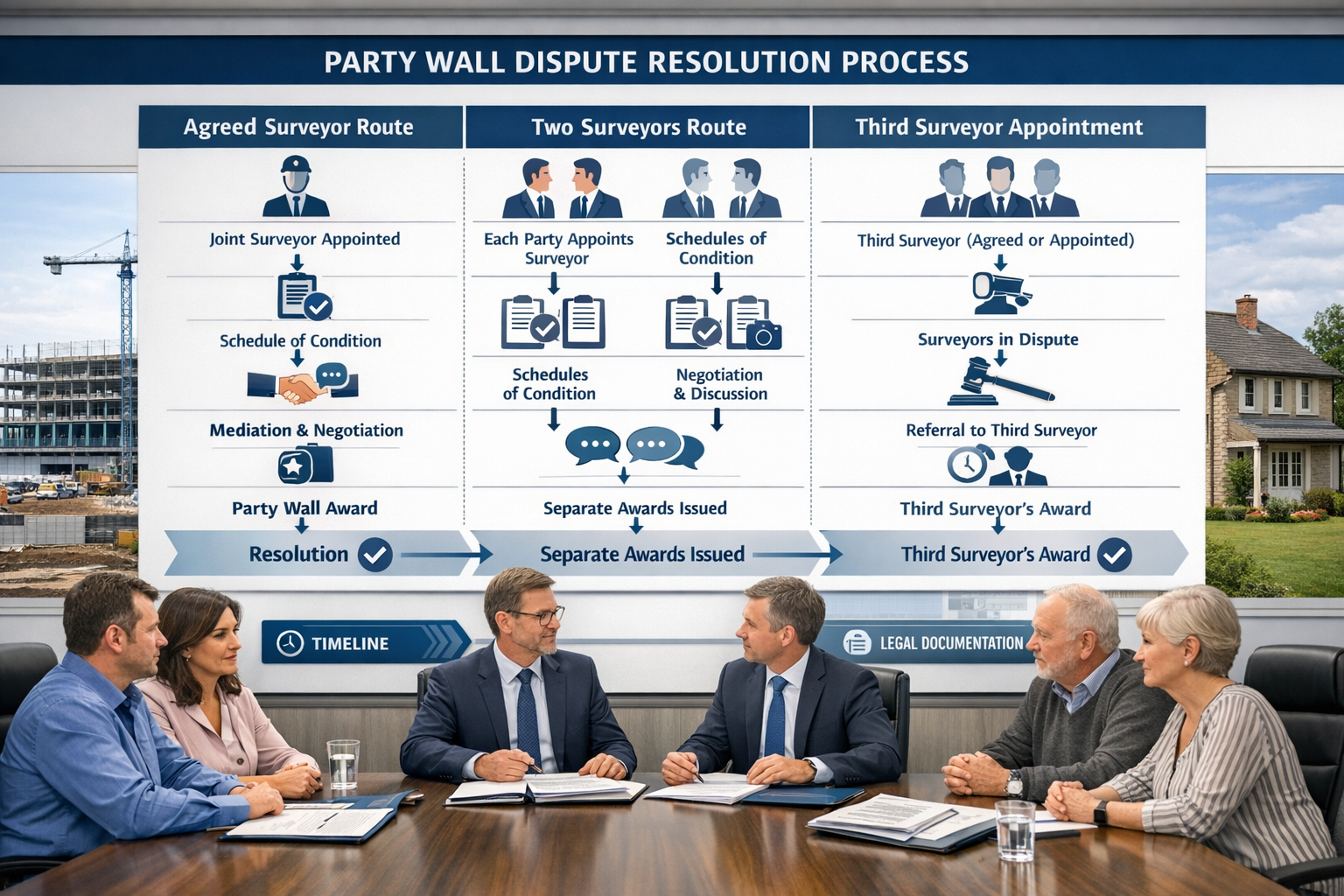
The Party Wall etc. Act 1996 provides three surveyor appointment options, each with strategic implications for data centre projects.
Option 1: Agreed Surveyor 👤
A single surveyor acts for both building owner and adjoining owner:
Advantages:
- Lower overall costs
- Faster award preparation
- Simplified communication
- Reduced administrative burden
Disadvantages:
- May be perceived as favoring one party
- Limited for complex or contentious projects
- Requires high trust levels
Best for: Straightforward data centre projects with cooperative neighbours and limited technical complexity.
Option 2: Two Surveyors (Building Owner's Surveyor and Adjoining Owner's Surveyor) 👥
Each party appoints their own surveyor, who work together to prepare the award:
Advantages:
- Independent representation for each party
- Balanced perspective on technical issues
- Greater confidence in award fairness
- Professional mediation of differences
Disadvantages:
- Higher costs (both surveyors' fees)
- Potentially longer timeline
- Requires surveyor coordination
Best for: Complex data centre projects, high-value properties, or situations where adjoining owners have concerns about the works.
Appointing an experienced building owner's surveyor ensures the data centre developer's interests are properly represented while maintaining statutory compliance.
Option 3: Third Surveyor 🧑⚖️
When the two appointed surveyors cannot agree on specific matters, they select a third surveyor to make binding determinations:
Advantages:
- Resolves deadlocks between surveyors
- Provides expert arbitration
- Maintains project momentum
Disadvantages:
- Additional cost layer
- Further time delay
- Indicates significant disagreement
Best for: Resolving specific technical disputes that arise during the award process, rather than as a primary appointment strategy.
Technical Mitigation Measures
Vibration Management 📳
Data centres present unique vibration challenges—both during construction and operation. Effective strategies include:
- Pre-construction vibration surveys: Establish baseline conditions
- Real-time monitoring: Install seismographs at sensitive locations
- Construction method selection: Choose low-vibration techniques (e.g., bored piling instead of driven piles)
- Vibration isolation: Design foundations with isolation systems
- Trigger level protocols: Define response actions if vibration exceeds thresholds
- Equipment selection: Specify low-vibration machinery for construction
Structural Protection Measures 🏗️
Protecting adjoining structures requires comprehensive planning:
- Temporary support systems: Install shoring before excavation
- Underpinning strategies: Sequence work to maintain structural stability
- Movement monitoring: Track any settlement or displacement
- Crack monitoring: Document and measure any new cracking
- Protective barriers: Install physical protection against construction damage
- Access controls: Limit heavy equipment proximity to party walls
Communication Protocols During Construction
Regular Update Schedule 📅
Maintaining communication throughout construction prevents misunderstandings:
- Weekly progress updates to adjoining owners
- Advance notice of particularly disruptive activities
- Monitoring report distribution
- Prompt response to concerns or complaints
- Site visit opportunities for interested neighbours
- Dedicated liaison officer for neighbour communications
Issue Resolution Framework ⚡
When problems arise, rapid response is essential:
- Immediate acknowledgment: Respond to complaints within 24 hours
- Investigation: Assess the issue with appropriate technical expertise
- Interim measures: Implement immediate mitigation if needed
- Permanent solution: Address root causes, not just symptoms
- Documentation: Record issue, response, and resolution
- Follow-up: Confirm satisfaction with resolution
Documentation and Record-Keeping
Comprehensive Project Records 📚
Meticulous documentation protects all parties:
- Complete notice service records with proof of delivery
- All correspondence with adjoining owners and surveyors
- Meeting minutes and attendance records
- Photographic and video evidence of conditions
- Monitoring data with date/time stamps
- Incident reports and resolution actions
- Award compliance verification
- Completion certificates and final inspections
Digital Documentation Systems 💻
Modern data centre projects benefit from digital record management:
- Cloud-based document repositories accessible to authorized parties
- Automated monitoring data collection and reporting
- Photographic databases with metadata and search capability
- Communication tracking systems
- Compliance checklists with completion verification
- Audit trails for all documentation
These systems ensure information is preserved, accessible, and admissible if disputes arise.
RICS Professional Standards and Best Practices
The Royal Institution of Chartered Surveyors (RICS) provides professional standards that elevate party wall practice beyond minimum statutory requirements. For Party Wall Surveys for the 2026 Data Centre Boom, RICS compliance demonstrates professionalism and reduces dispute risk.
RICS Guidance Note: Party Wall Legislation and Procedure
RICS publishes comprehensive guidance for surveyors practicing under the Party Wall etc. Act 1996. Key principles include:
Professional Conduct Requirements ✨
- Act with integrity and transparency
- Provide clear, accurate advice to clients
- Maintain professional indemnity insurance
- Avoid conflicts of interest
- Maintain continuing professional development
- Follow ethical guidelines in all dealings
Technical Competence Standards 📐
- Demonstrate knowledge of construction methods and materials
- Understand structural engineering principles
- Apply appropriate surveying techniques
- Interpret legal provisions correctly
- Prepare technically sound awards
- Conduct thorough inspections and assessments
Communication Excellence 💬
- Use plain language accessible to non-professionals
- Provide timely responses to queries
- Maintain professional correspondence standards
- Document all communications appropriately
- Facilitate understanding between parties
- Manage expectations realistically
Quality Assurance for Data Centre Projects
High-stakes data centre developments warrant enhanced quality assurance:
Peer Review Processes 🔍
- Independent technical review of complex awards
- Second-opinion assessments of structural implications
- Quality checks on schedules of condition
- Compliance audits of notice procedures
- Award document review before finalization
Professional Liability Management 🛡️
- Adequate professional indemnity insurance for project value
- Clear engagement letters defining scope and limitations
- Risk assessment for complex technical issues
- Expert consultation for specialized matters
- Documentation of advice and recommendations
Continuing Education 📖
The rapidly evolving data centre sector requires ongoing learning:
- Technical training on data centre construction methods
- Legal updates on party wall case law
- Industry conferences and knowledge sharing
- Cross-disciplinary learning (structural engineering, MEP systems)
- Technology adoption for surveying and documentation
Case Study Applications: Data Centre Party Wall Scenarios
Understanding how Party Wall Surveys for the 2026 Data Centre Boom apply in practice helps illustrate key principles and strategies.
Scenario 1: Urban Data Centre with Shared Foundations
Project Context:
A technology company plans a 75,000 square foot data centre in Central London, requiring excavation to 12 metres depth for cooling infrastructure and cable management. The site is bounded by a Victorian commercial building (3-storey) and a modern office block (8-storey), both with shallow foundations.
Party Wall Challenges:
- Excavation significantly deeper than neighbouring foundations
- Risk of ground movement affecting adjacent structures
- Vibration from construction and operational equipment
- Shared drainage systems requiring relocation
- Construction access through narrow urban streets
Solution Approach:
-
Early Engagement: Building owner met with both adjoining owners six months before planned construction start, explaining project and safeguards.
-
Comprehensive Notices: Served Section 6 Adjacent Excavation Notices with detailed engineering drawings showing underpinning strategy and temporary support systems.
-
Two-Surveyor Approach: Each adjoining owner appointed their own surveyor given project complexity and property values.
-
Enhanced Monitoring: Installed automated crack monitoring, tilt sensors, and vibration monitors with real-time data transmission to all parties.
-
Phased Construction: Sequenced excavation to minimize risk, completing underpinning of Victorian building before deep excavation commenced.
-
Award Provisions: Detailed awards specified vibration limits, working hours, monitoring protocols, and security deposits totaling £500,000.
Outcome:
Construction completed on schedule with no disputes. Minor cosmetic cracking in Victorian building was promptly repaired under award provisions. Final settlement costs were 40% below security deposit, with excess returned to building owner.
Key Lessons:
- Early engagement built trust that prevented disputes
- Professional surveyor representation protected all parties
- Comprehensive monitoring provided objective evidence
- Adequate financial security demonstrated commitment
Scenario 2: Data Centre Expansion with Multiple Adjoining Owners
Project Context:
Expansion of an existing data centre facility in West London, adding 50,000 square feet adjacent to the current building. The expansion site adjoins eight separate properties including residential flats, retail units, and office spaces.
Party Wall Challenges:
- Multiple adjoining owners with varying levels of sophistication
- Mixed-use properties with different sensitivities
- Existing party walls requiring raising and strengthening
- Construction on the line of junction for two boundaries
- Coordination of multiple awards and timelines
Solution Approach:
-
Stakeholder Mapping: Created comprehensive database of all legal owners, leaseholders, and occupiers requiring notification.
-
Tiered Communication: Developed different communication materials for residential owners (plain language) versus commercial owners (technical detail).
-
Agreed Surveyor for Simple Cases: Proposed agreed surveyor for straightforward scenarios (retail units with modern construction).
-
Individual Surveyors for Complex Cases: Residential owners appointed their own surveyors given personal nature of properties.
-
Master Schedule Coordination: Building owner's surveyor coordinated timing across multiple awards to maintain project schedule.
-
Standardized Provisions: Used consistent award terms where possible while customizing for specific property needs.
Outcome:
Seven of eight adjoining owners consented or agreed to awards without dispute. One residential owner initially dissented but agreed after additional vibration mitigation measures were incorporated. Project commenced within planned timeline.
Key Lessons:
- Tailored communication to different audience types
- Flexible surveyor arrangements based on complexity
- Coordination essential with multiple simultaneous awards
- Willingness to enhance mitigation measures resolved concerns
Managing Types of Party Wall Works in Data Centre Construction
Data centre projects typically involve multiple categories of party wall works, each requiring specific approaches.
Excavation and Foundation Works
Deep Basement Construction ⛏️
Data centres frequently require basements for:
- Cooling system infrastructure
- Backup power generation equipment
- Cable management and distribution
- Equipment storage and maintenance areas
Excavation depths of 8-15 metres are common, triggering Section 6 requirements for virtually all adjacent properties. Key considerations include:
- Detailed geotechnical surveys before notice service
- Underpinning design by qualified structural engineers
- Temporary support systems (sheet piling, secant piling)
- Groundwater management and dewatering impacts
- Settlement monitoring throughout excavation
- Contingency plans for unexpected ground conditions
Building on Boundary Lines
Maximizing Site Utilization 📏
Land scarcity in urban areas often requires data centres to build directly on boundary lines. This triggers Section 1 requirements:
- Detailed boundary surveys by chartered land surveyors
- Agreement on exact boundary location (or determination if disputed)
- Foundation design showing encroachment or boundary alignment
- Compensation provisions for land use rights
- Future maintenance access arrangements
- Weatherproofing and drainage details
Works to Existing Party Walls
Structural Modifications 🔨
When data centres are built adjacent to existing buildings, works may include:
- Raising party walls to accommodate greater height
- Inserting damp-proof courses or membranes
- Cutting into party walls for structural ties or services
- Strengthening party walls for increased loads
- Repairing defective party structures
- Installing flashings or weatherproofing
Each type of work requires specific notice provisions and technical specifications in the award. Resources on having a party wall agreement without a surveyor explain when professional involvement is essential versus optional.
Financial Considerations and Cost Management
Understanding the financial aspects of Party Wall Surveys for the 2026 Data Centre Boom helps building owners budget appropriately and avoid surprises.
Surveyor Fee Structures
Building Owner's Surveyor Fees 💼
Typical fee arrangements for data centre projects:
- Hourly rates: £150-300 per hour depending on surveyor experience and location
- Fixed fees: £3,000-15,000+ for complete party wall services
- Percentage of construction value: 0.5-1% for very large projects
- Hybrid approaches: Fixed fee for standard services plus hourly for disputes
For complex data centre projects, total surveyor fees often range from £25,000 to £100,000+ depending on:
- Number of adjoining owners
- Complexity of works
- Duration of construction
- Monitoring requirements
- Dispute resolution needs
Adjoining Owner's Surveyor Fees 💰
The building owner typically pays reasonable fees for adjoining owners' surveyors. For data centre projects, these fees might include:
- Initial consultation and advice: £500-1,500 per property
- Award preparation and negotiation: £2,000-8,000 per property
- Monitoring and inspections: £1,000-5,000 per property
- Dispute resolution: £3,000-15,000+ if contentious
With multiple adjoining owners, total fees can be substantial. A data centre project with 10 adjoining owners might incur £100,000-200,000 in combined surveyor fees.
Strategies for keeping party wall costs down include early planning, clear communication, and efficient project management.
Security for Expenses
For high-value data centre projects, adjoining owners may request security for expenses—a deposit to ensure funds are available for repairs if damage occurs.
Calculating Appropriate Security 📊
Factors influencing security amounts:
- Value of adjoining properties
- Proximity to construction works
- Sensitivity of structures to vibration or settlement
- Complexity and duration of works
- Track record of building owner
- Insurance arrangements
Typical security ranges from £10,000 to £500,000+ per adjoining property for data centre projects. Security is usually held in:
- Escrow accounts
- Bank guarantees
- Insurance bonds
- Solicitor client accounts
Unused security is returned after works are complete and any damage claims are resolved.
Insurance Considerations
Professional Indemnity Insurance 🛡️
Party wall surveyors must maintain adequate professional indemnity insurance. For data centre projects, minimum coverage should be:
- £1 million for smaller projects
- £5-10 million for major developments
- Coverage specific to party wall work
Building Owner's Insurance 🏢
Data centre developers should ensure:
- Construction all-risk insurance covers party wall damage
- Public liability insurance includes adjoining property damage
- Professional indemnity for design team
- Contractor's insurance with appropriate limits
- Non-negligent damage coverage where available
Adjoining Owner Protection 🏠
Adjoining owners should verify:
- Building owner has adequate insurance
- Award includes insurance requirements
- Notification procedures if claims arise
- Independent damage assessment rights
- Direct insurance claim rights where possible
Technology and Innovation in Party Wall Surveys
Party Wall Surveys for the 2026 Data Centre Boom benefit from technological advances that improve accuracy, efficiency, and dispute prevention.
Digital Survey Tools
3D Laser Scanning 📡
Modern surveying technology enables:
- Precise dimensional capture of existing structures
- Detailed baseline condition records
- Virtual inspection capabilities
- Accurate measurement of cracks and defects
- Integration with BIM (Building Information Modeling)
- Before-and-after comparison analysis
Drone Surveys 🚁
Unmanned aerial vehicles provide:
- Roof and elevation photography without scaffolding
- Access to difficult or dangerous locations
- High-resolution imagery for condition assessment
- Thermal imaging for moisture detection
- Regular monitoring throughout construction
- Cost-effective repeat surveys
Monitoring Technologies
Automated Crack Monitoring 📏
Digital crack gauges offer:
- Continuous measurement of crack movement
- Real-time data transmission to cloud platforms
- Automatic alerts when thresholds are exceeded
- Historical trend analysis
- Objective evidence for dispute resolution
- Remote access for all parties
Vibration Monitoring Systems 📊
Seismograph networks provide:
- Real-time vibration level measurement
- Comparison to agreed threshold limits
- Automatic notifications of exceedances
- Data logging for compliance verification
- Integration with construction management systems
- Evidence for damage causation analysis
Tilt and Settlement Monitoring 📐
Precision instruments track:
- Vertical and horizontal movement
- Foundation settlement
- Wall deflection or rotation
- Differential settlement between structures
- Long-term trends versus construction events
- Early warning of potential problems
Digital Documentation Platforms
Cloud-Based Project Management ☁️
Modern platforms enable:
- Centralized document repositories
- Controlled access for different stakeholders
- Version control and audit trails
- Mobile access for site inspections
- Automated workflow management
- Integration with monitoring systems
Photographic Databases 📸
Specialized software provides:
- Organized photo libraries with metadata
- Location tagging and floor plan integration
- Before-and-after comparison tools
- Annotation and markup capabilities
- Search and retrieval functionality
- Secure sharing with authorized parties
Regulatory Compliance and Future Trends
Understanding the broader regulatory context helps position Party Wall Surveys for the 2026 Data Centre Boom within the evolving construction landscape.
Building Safety Act 2022 Implications
The Building Safety Act introduces enhanced requirements for high-risk buildings that may intersect with party wall considerations:
- Competence requirements: Higher standards for construction professionals
- Gateway approvals: Additional regulatory checkpoints during construction
- Golden thread: Comprehensive information management throughout building lifecycle
- Resident engagement: Enhanced communication requirements
- Accountability: Clearer responsibility allocation
While data centres typically aren't residential high-rise buildings (the primary focus of the Act), the cultural shift toward enhanced safety and documentation aligns with best practice party wall procedures.
Environmental and Sustainability Considerations
Data centres face increasing scrutiny regarding environmental impact:
Energy Efficiency Requirements ⚡
- Heat recovery systems may require party wall considerations for shared infrastructure
- Renewable energy installations on roofs or boundaries
- Enhanced insulation affecting party wall construction
- Sustainable materials selection
Water Management 💧
- Cooling system water usage and discharge
- Sustainable drainage systems crossing boundaries
- Groundwater protection during excavation
- Shared water infrastructure
Noise and Vibration Standards 🔇
- Operational noise limits affecting equipment selection
- Vibration isolation for sensitive equipment
- Acoustic treatment at party walls
- Community impact assessments
Future Trends in Party Wall Practice
Increased Professionalization 📈
The growing complexity of construction projects is driving:
- Higher qualification standards for party wall surveyors
- Specialized training in data centre and infrastructure projects
- Enhanced professional indemnity requirements
- Greater regulatory oversight
- Standardization of procedures and documentation
Technology Integration 💻
Emerging technologies will transform party wall practice:
- Artificial intelligence for damage assessment
- Blockchain for immutable record-keeping
- Virtual reality for remote inspections
- Predictive analytics for risk assessment
- Automated compliance checking
Alternative Dispute Resolution ⚖️
Innovation in dispute resolution includes:
- Online mediation platforms
- Expert determination procedures
- Structured negotiation frameworks
- Early neutral evaluation
- Collaborative problem-solving approaches
Practical Action Steps for Data Centre Developers
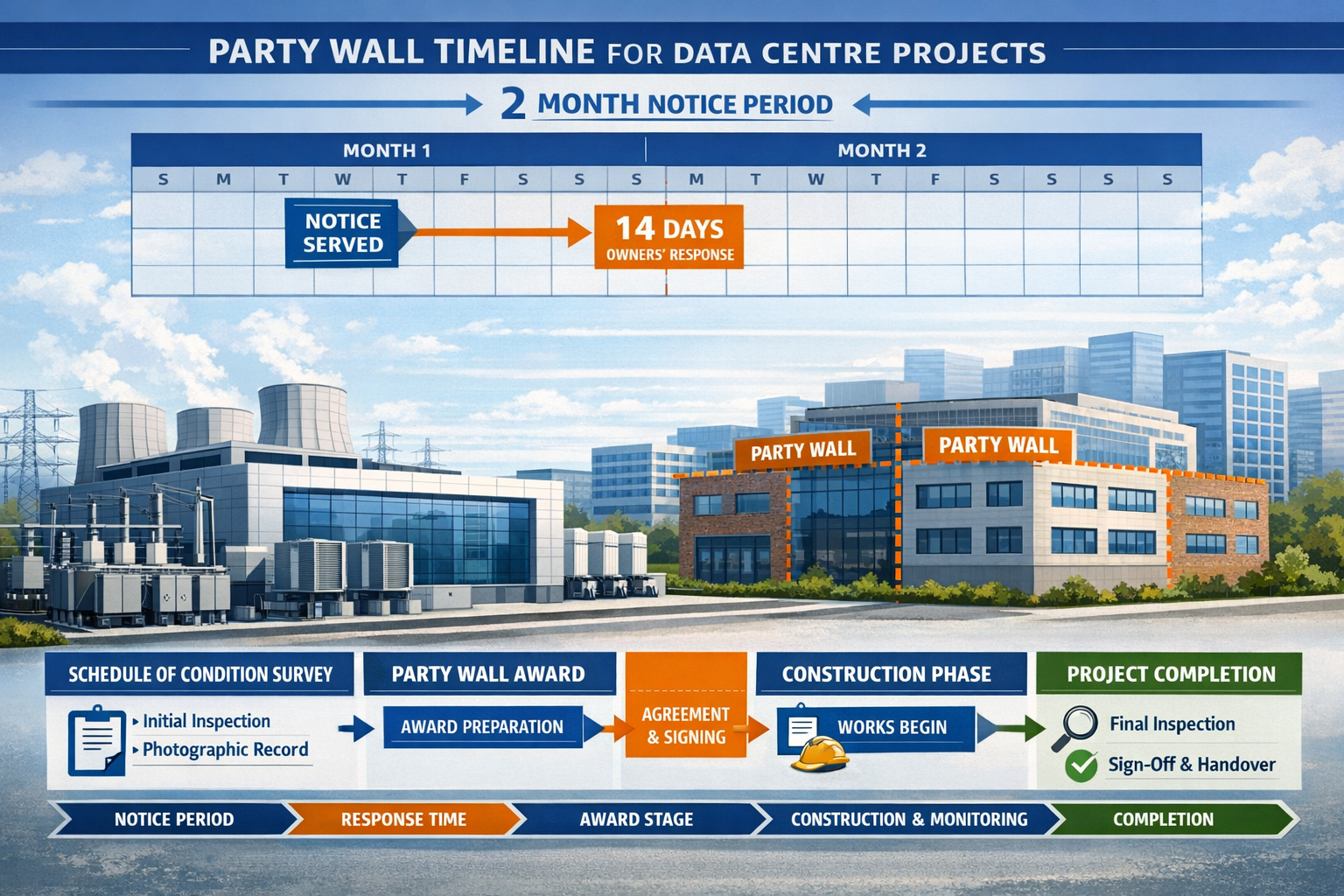
Building owners planning data centre projects should follow this systematic approach to party wall compliance:
Phase 1: Pre-Planning (6-12 Months Before Construction)
- Conduct preliminary site analysis identifying all potential party wall issues
- Engage specialist party wall surveyor with data centre experience
- Review title documents and establish exact boundary locations
- Identify all adjoining owners including freeholders, leaseholders, and occupiers
- Develop preliminary construction methodology considering party wall implications
- Budget for party wall costs including surveyor fees and potential security deposits
Phase 2: Design Development (4-6 Months Before Construction)
- Integrate party wall requirements into structural and architectural design
- Prepare detailed construction drawings suitable for notice service
- Conduct initial adjoining owner engagement explaining project vision
- Finalize surveyor appointment strategy (agreed surveyor vs. separate surveyors)
- Develop monitoring and mitigation plans for vibration and settlement
- Prepare comprehensive schedules of condition for all adjoining properties
Phase 3: Notice and Award Process (2-4 Months Before Construction)
- Serve party wall notices with full statutory notice periods
- Respond to adjoining owner questions promptly and professionally
- Facilitate surveyor appointments for adjoining owners
- Cooperate with surveyor inspections and information requests
- Negotiate award terms balancing protection with practicality
- Finalize and execute awards before commencing any notifiable works
Phase 4: Construction Phase (Duration of Works)
- Implement monitoring programs as specified in awards
- Maintain regular communication with adjoining owners and surveyors
- Conduct periodic inspections documenting ongoing conditions
- Respond immediately to concerns or monitoring alerts
- Document compliance with award provisions
- Manage any damage claims promptly and fairly
Phase 5: Post-Construction (1-3 Months After Completion)
- Conduct final inspections comparing to baseline conditions
- Address any damage identified during final surveys
- Prepare completion documentation for all parties
- Settle final accounts including surveyor fees and security returns
- Obtain formal sign-offs from surveyors
- Archive all documentation for future reference
Resources and Professional Support
Successfully navigating Party Wall Surveys for the 2026 Data Centre Boom requires access to expert resources and professional support.
Finding Qualified Party Wall Surveyors
When selecting a party wall surveyor for data centre projects, consider:
Essential Qualifications ✅
- RICS membership (MRICS or FRICS)
- Specialist party wall qualifications or experience
- Professional indemnity insurance
- Knowledge of data centre construction
- Experience with large-scale commercial projects
Geographic Expertise 🗺️
Location-specific knowledge is valuable:
- Party wall surveyors in Central London
- Party wall surveyors in North London
- Party wall surveyors in East London
- Party wall surveyors in South London
- Party wall surveyors in West London
Template Documents and Resources
Standardized templates improve efficiency and compliance:
- Sample party wall agreement templates provide starting points for documentation
- Party wall contract templates and award guides offer structural frameworks
- Notice templates ensure statutory requirements are met
- Schedule of condition checklists maintain consistency
Educational Resources
Continuing education supports best practice:
- RICS professional development courses
- Pyramus & Thisbe Club (party wall specialist organization)
- Legal updates and case law summaries
- Technical construction seminars
- Industry conferences on data centre development
Stakeholder-Specific Guidance
Different parties have different needs:
- Building owners carrying out works require comprehensive project planning guidance
- Adjoining owners need information about their rights and protections
- Those carrying out works benefit from step-by-step compliance checklists
- Neighbours affected by works should understand response options and timelines
Conclusion
The 2026 data centre construction boom presents unprecedented opportunities and challenges for property owners, developers, and party wall surveyors. With construction demand surging 57% in net positive outlook [3] and megaprojects reshaping urban landscapes [7], the stakes have never been higher for getting party wall compliance right.
Party Wall Surveys for the 2026 Data Centre Boom: Essential Compliance Checklists and Dispute Avoidance Strategies provide the framework for navigating these complex projects successfully. The key principles that emerge from this comprehensive analysis include:
🎯 Early Planning is Essential: Party wall considerations must be integrated into project planning from the earliest stages, with notice periods and surveyor engagement factored into construction schedules.
🎯 Professional Expertise Matters: The complexity of data centre projects demands RICS-qualified surveyors with specific experience in large-scale commercial construction and party wall legislation.
🎯 Comprehensive Documentation Protects Everyone: Detailed schedules of condition, monitoring programs, and award provisions create objective evidence that prevents disputes and facilitates fair resolution when issues arise.
🎯 Proactive Communication Prevents Disputes: Early engagement with adjoining owners, clear explanation of works and safeguards, and responsive communication throughout construction dramatically reduce dispute risk.
🎯 Technology Enhances Accuracy and Efficiency: Digital survey tools, automated monitoring systems, and cloud-based documentation platforms improve party wall practice while providing better protection for all parties.
Actionable Next Steps
For Data Centre Developers:
- Engage a specialist party wall surveyor at the earliest project planning stage
- Conduct comprehensive boundary and adjoining owner analysis before finalizing designs
- Budget adequately for surveyor fees, monitoring, and potential security deposits
- Develop a proactive communication strategy for adjoining owner engagement
- Integrate party wall compliance into project timelines and critical path planning
For Adjoining Owners:
- Respond promptly to party wall notices—the 14-day response window is critical
- Consider appointing your own surveyor for complex or high-value projects
- Request comprehensive schedules of condition to document baseline property conditions
- Understand your rights under the Party Wall etc. Act 1996
- Maintain open communication with building owners and surveyors throughout the process
For Party Wall Surveyors:
- Develop specialized expertise in data centre construction methods and requirements
- Invest in technology for digital surveys, monitoring, and documentation
- Maintain current knowledge of regulatory developments and case law
- Build networks with structural engineers and construction specialists
- Enhance professional qualifications through continuing education and specialization
The data centre boom of 2026 represents a defining moment for the construction industry and party wall practice. Projects that approach party wall compliance as a strategic priority—rather than a regulatory burden—will benefit from smoother approvals, fewer disputes, and stronger relationships with adjoining owners. Those that treat party wall requirements as an afterthought risk costly delays, legal disputes, and reputational damage.
By following the comprehensive checklists, dispute avoidance strategies, and best practices outlined in this guide, building owners can navigate the complex intersection of data centre development and party wall legislation with confidence. The investment in proper party wall procedures pays dividends through reduced risk, faster project delivery, and protected relationships with the communities where these essential infrastructure projects are built.
As the digital economy continues to expand and data centres become ever more critical to modern life, the party wall surveyors who develop specialized expertise in this sector will find themselves at the forefront of one of construction's most dynamic growth areas. The tools, strategies, and frameworks presented here provide the foundation for excellence in this challenging and rewarding field.
For additional guidance, consultation, or professional party wall surveying services for data centre projects, visit the general FAQs or contact specialist surveyors with experience in large-scale commercial developments.
References
[1] Data Centers Lift Construction Outlook But Economic Worries Grow – https://www.roofingcontractor.com/articles/101738-data-centers-lift-construction-outlook-but-economic-worries-grow
[3] Data Center Construction Predictions For 2026 – https://www.databank.com/resources/blogs/data-center-construction-predictions-for-2026/
[7] 2026 Forecast Megaprojects Data Centers Spur Growth Amid Shifting Policies – https://www.enr.com/articles/62031-2026-forecast-megaprojects-data-centers-spur-growth-amid-shifting-policies