


The construction industry in 2026 faces an unprecedented challenge: heightened immigration enforcement is creating significant workforce disruptions that are delaying building projects and complicating party wall agreements across London and beyond. Property owners planning extensions, loft conversions, or structural work now face a perfect storm of labor shortages, extended timelines, and escalating disputes with neighbors—all stemming from immigration policy changes that have fundamentally altered the construction workforce landscape.
Navigating party wall agreements amid 2026 immigration enforcement and workforce disruptions requires property owners, surveyors, and contractors to adopt new strategies that account for unpredictable delays, contractor availability issues, and the increased likelihood of disputes arising from project postponements. With the Trump administration's expanded ICE operations and the 287(g) deputization program creating widespread uncertainty in the construction sector, understanding how to protect your interests while maintaining good neighbor relations has never been more critical. 🏗️
Key Takeaways
- Immigration enforcement in 2026 has significantly reduced construction workforce availability, causing project delays that directly impact party wall agreement timelines and neighbor relations
- Early party wall notice serving and proactive communication are essential strategies to mitigate risks associated with unpredictable construction schedules
- Surveyor involvement and properly documented party wall awards provide legal protection when workforce disruptions cause project delays or disputes
- Contractor vetting and contingency planning help property owners navigate labor shortages while maintaining compliance with party wall legislation
- Understanding your rights under the Party Wall etc. Act 1996 becomes crucial when immigration-related delays threaten to derail construction projects and strain neighbor relationships
Understanding the 2026 Immigration Enforcement Landscape
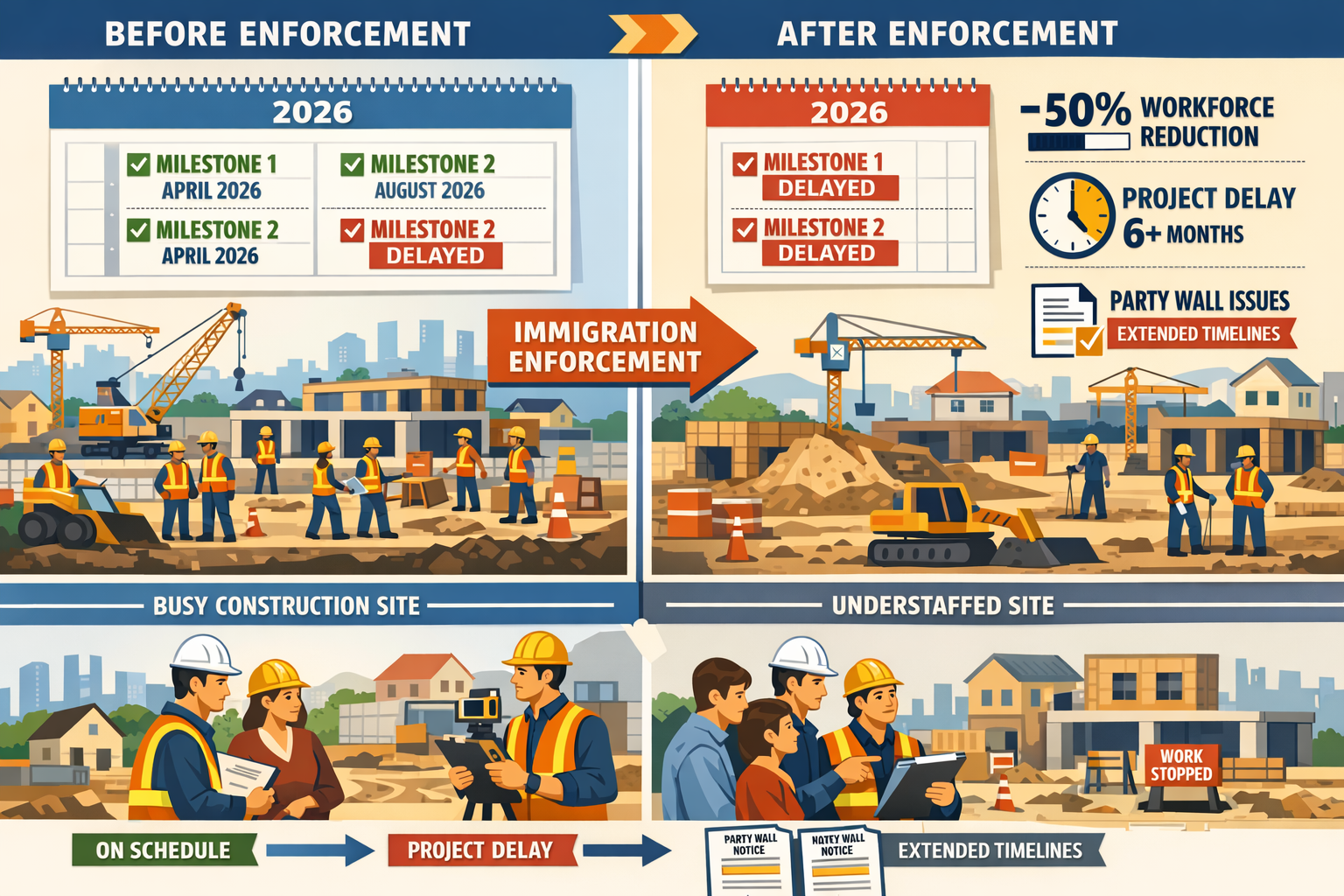
The construction industry has historically relied heavily on immigrant labor, with estimates suggesting that foreign-born workers comprise a substantial portion of the workforce in trades essential to building projects. In 2026, however, the landscape has shifted dramatically due to expanded federal immigration enforcement efforts.
Federal Enforcement Expansion
The Trump administration has significantly increased ICE operations and expanded the 287(g) program, which allows local law enforcement to act as immigration officers [2]. This expansion has created a climate of uncertainty that affects construction sites across the country, particularly in major metropolitan areas like London where building activity remains robust despite economic headwinds.
Federal funding allocations have prioritized immigration enforcement, with resources directed toward workplace raids and verification programs that specifically target industries known to employ immigrant workers—construction being among the most affected sectors [2].
State and Local Resistance
The enforcement landscape is further complicated by state-level resistance to federal immigration policies. Democratic-led states and municipalities have implemented sanctuary policies and refused to cooperate with ICE operations [1][3]. This patchwork of cooperation and resistance creates regional variations in how immigration enforcement affects construction workforce availability.
Some jurisdictions have passed resolutions specifically limiting cooperation with ICE and CBP in noncriminal activities [5], while others have actively partnered with federal authorities. For property owners planning construction work, understanding the local enforcement climate is essential for realistic project planning.
Workforce Impact Statistics
The construction sector has experienced measurable workforce disruptions in 2026:
- Reduced labor pool: Immigration enforcement has removed workers from job sites through deportations and voluntary departures
- Increased labor costs: Remaining workers command higher wages due to scarcity
- Project delays: Average construction timelines have extended by 20-40% in affected markets
- Contractor bankruptcies: Smaller firms unable to staff projects have closed operations
These disruptions create a ripple effect that directly impacts party wall agreements, as delayed projects strain neighbor relations and complicate the legal frameworks designed to protect both building owners and adjoining owners.
How Immigration Enforcement Disrupts Party Wall Agreements
The connection between immigration enforcement and party wall agreements may not be immediately obvious, but the workforce disruptions create multiple pressure points in the party wall process.
Timeline Complications and Notice Requirements
Under the Party Wall etc. Act 1996, building owners must serve proper notice to adjoining owners before commencing work on shared walls or structures. The standard notice periods are:
| Type of Work | Notice Period Required |
|---|---|
| Line of Junction Notice | 1 month |
| Party Structure Notice | 2 months |
| Adjacent Excavation Notice | 1 month |
These timelines assume that work will commence shortly after the notice period expires. However, workforce shortages in 2026 mean that contractors may not be available when planned, forcing building owners to either:
- Delay serving notices (creating uncertainty for neighbors)
- Serve notices and then postpone work (potentially requiring new notices)
- Rush into agreements with unreliable contractors (risking poor workmanship)
For guidance on proper notice serving, review our comprehensive guide on party wall act notices and how to respond.
Contractor Reliability and Workforce Verification
Property owners now face difficult questions when hiring contractors:
- Will the contractor's workforce remain available throughout the project?
- Are workers properly documented to avoid mid-project enforcement actions?
- Does the contractor have contingency plans for workforce disruptions?
A contractor who loses key workers to immigration enforcement mid-project creates immediate problems for party wall agreements. Work may stop abruptly, leaving shared structures in vulnerable states and potentially causing damage to adjoining properties—precisely what party wall legislation aims to prevent.
Escalating Neighbor Disputes
Project delays caused by workforce shortages frequently trigger disputes between building owners and adjoining owners:
Common dispute scenarios in 2026:
- 🔨 Extended construction periods: What was planned as a 3-month loft conversion stretches to 6-9 months, causing prolonged disruption
- 📅 Multiple postponements: Contractors repeatedly reschedule, creating uncertainty and frustration
- 💰 Cost escalations: Building owners face unexpected expenses and may cut corners, raising safety concerns
- 🏗️ Incomplete work: Projects abandoned mid-construction when contractors fail, leaving properties vulnerable
These situations often require surveyor intervention and formal party wall awards to resolve, adding costs and complexity to already troubled projects.
Impact on Party Wall Surveyors
Professional surveyors navigating party wall agreements amid 2026 immigration enforcement and workforce disruptions face new challenges:
- Scheduling condition surveys becomes difficult when project timelines are uncertain
- Drafting party wall awards requires accounting for potential workforce-related delays
- Mediating disputes increasingly involves immigration-related workforce issues
- Ensuring compliance with agreed-upon work schedules becomes more complex
Surveyors must now incorporate workforce stability assessments into their advice to both building owners and adjoining owners. Understanding the costs of party wall processes helps property owners budget appropriately for these extended timelines.
Strategies for Successfully Navigating Party Wall Agreements in 2026
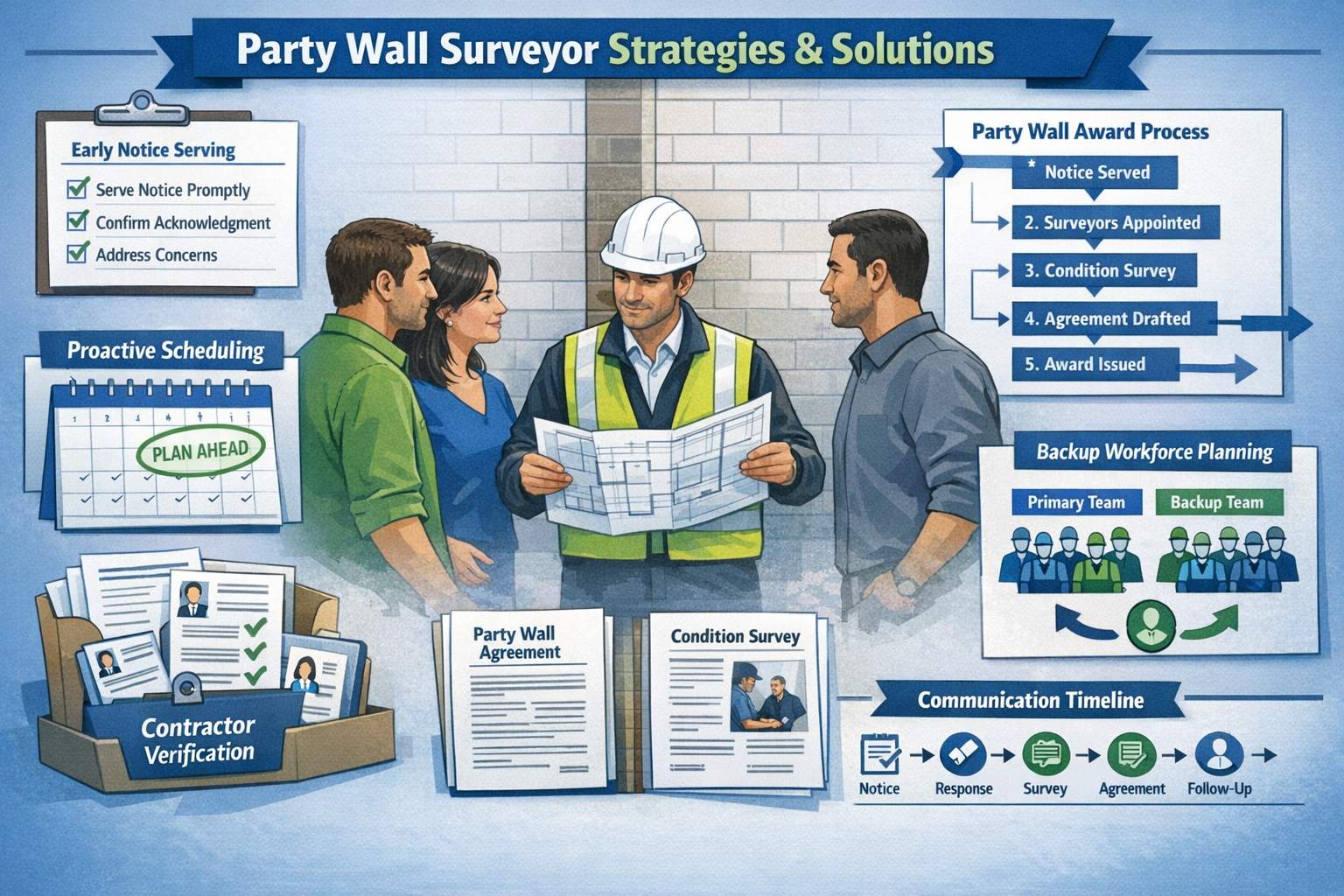
Despite the challenges, property owners can successfully navigate party wall agreements amid 2026 immigration enforcement and workforce disruptions by adopting proactive strategies and working with experienced professionals.
Early Planning and Notice Serving
The single most important strategy is early action. Property owners should:
- Begin planning 6-12 months before intended construction start dates
- Serve party wall notices early to establish legal protections even if timelines shift
- Communicate transparently with neighbors about potential delays and workforce challenges
- Engage surveyors early to document existing conditions and establish baseline agreements
Early notice serving provides flexibility when workforce issues cause delays. Rather than scrambling to serve notices when contractors become available, building owners who plan ahead maintain legal compliance and neighbor goodwill.
For those considering whether professional help is necessary, our article on having a party wall agreement without a surveyor explores the options and risks.
Contractor Vetting and Contingency Planning
Thorough contractor evaluation is essential in 2026:
✅ Request workforce stability documentation
- How many workers are employed?
- What contingency plans exist for workforce disruptions?
- Can the contractor demonstrate workforce stability over the past 12 months?
✅ Verify contractor credentials and insurance
- Are all necessary licenses current?
- Does insurance cover workforce-related project delays?
- What is the contractor's track record for completing projects on time?
✅ Build contingency timelines into agreements
- Add 30-50% buffer time to estimated completion dates
- Include specific provisions for workforce-related delays in contracts
- Establish clear communication protocols for delay notifications
✅ Identify backup contractors
- Have alternative contractors vetted and ready
- Understand costs of switching contractors mid-project
- Ensure party wall awards accommodate potential contractor changes
Leveraging Professional Surveyor Expertise
Working with experienced party wall surveyors provides critical advantages when navigating party wall agreements amid 2026 immigration enforcement and workforce disruptions:
Surveyors can:
- Draft comprehensive party wall awards that account for potential delays and workforce issues
- Mediate disputes before they escalate to formal legal proceedings
- Document conditions thoroughly to protect both parties if projects are delayed or abandoned
- Provide expert testimony if disputes require legal resolution
- Navigate complex scenarios involving multiple adjoining owners or complicated structural work
Regional expertise matters significantly. Property owners in different areas of London may benefit from working with surveyors who understand local enforcement patterns and construction market conditions. Consider connecting with specialists such as a party wall surveyor in North London, Central London, South London, West London, or East London depending on your property location.
Transparent Communication with Adjoining Owners
Maintaining positive neighbor relations requires honesty and transparency:
- Explain workforce challenges proactively rather than waiting for neighbors to complain about delays
- Provide realistic timelines that account for potential disruptions
- Offer regular updates on project status and any changes to schedules
- Address concerns promptly when neighbors raise issues about noise, access, or safety
- Document all communications to create a record of good-faith efforts
"In 2026, the most successful party wall agreements are those where building owners treat their neighbors as partners in navigating unprecedented workforce challenges, rather than adversaries to be managed."
This collaborative approach reduces the likelihood of formal disputes and creates goodwill that proves invaluable when unexpected delays occur.
Understanding Your Legal Rights and Obligations
Property owners must understand their rights and responsibilities under the Party Wall etc. Act 1996, particularly regarding:
Building Owner Obligations:
- Serve proper notice within required timeframes
- Pay for party wall awards and agreed-upon surveyors
- Complete work in accordance with agreed schedules and methods
- Compensate adjoining owners for any damage caused
- Maintain insurance coverage throughout construction
Adjoining Owner Rights:
- Receive proper notice before work commences
- Appoint their own surveyor (at building owner's expense)
- Have existing conditions documented before work begins
- Receive compensation for any damage to their property
- Enforce agreed-upon work schedules and methods
For specific guidance on different types of construction work, review our resource on types of party wall works.
Cost Management Strategies
Workforce disruptions inevitably increase costs, but strategic planning can minimize financial impact:
Budget considerations for 2026:
- Add 25-40% contingency to initial cost estimates
- Obtain fixed-price quotes that include workforce stability guarantees
- Understand party wall cost structures and plan accordingly
- Consider phased construction to reduce exposure to workforce disruptions
- Explore insurance options that cover workforce-related delays
Our guide on how to keep party wall costs down provides additional strategies for managing expenses without compromising quality or legal compliance.
Regional Variations and State-Level Protections
The impact of immigration enforcement on construction workforces varies significantly by region, creating different challenges for property owners in different jurisdictions.
Sanctuary Jurisdictions and Workforce Stability
Areas with sanctuary policies that limit cooperation with ICE generally experience greater workforce stability [1][3]. Property owners in these jurisdictions may find:
- More contractors willing to commit to firm timelines
- Greater workforce availability for specialized trades
- Lower risk of mid-project enforcement actions disrupting work
- More competitive pricing due to larger labor pools
However, even in sanctuary jurisdictions, the broader climate of immigration enforcement creates anxiety that affects workforce participation and availability.
High-Enforcement Areas and Planning Challenges
Regions where state and local authorities actively cooperate with ICE face more severe workforce disruptions [2]. Property owners in these areas should:
- Extend planning timelines significantly beyond traditional estimates
- Prioritize contractors with documented, stable workforces
- Build extensive contingencies into party wall agreements
- Consider delaying non-essential construction until workforce stability improves
State-Level Immigrant Protections
Some states have implemented protections for immigrant workers that may help stabilize construction workforces [4]. These protections include:
- Workplace raid notification requirements
- Limits on employer cooperation with immigration enforcement
- Legal assistance programs for workers facing deportation
- Labor rights enforcement regardless of immigration status
Property owners should research their state's policies to understand how local protections may affect workforce availability and project stability.
Future Outlook and Long-Term Considerations
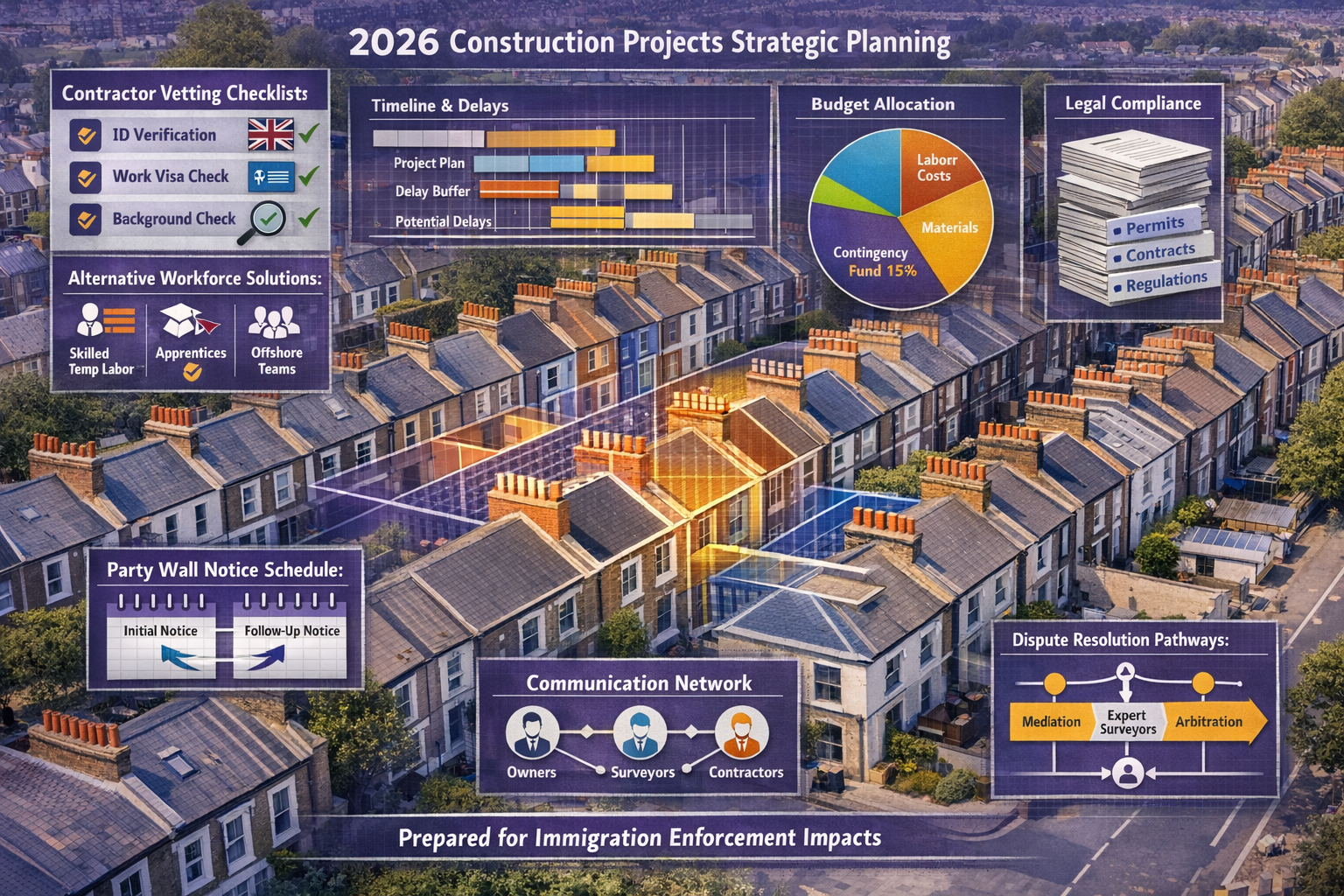
As 2026 progresses, several trends are likely to shape the intersection of immigration enforcement and party wall agreements:
Workforce Adaptation
The construction industry is adapting to the new enforcement environment through:
- Increased automation in certain construction processes
- Training programs to develop domestic workforce capacity
- Wage increases to attract workers from other industries
- Alternative construction methods that require less labor
These adaptations may gradually stabilize the workforce, but the transition period creates ongoing uncertainty for property owners planning construction projects.
Legal and Policy Evolution
Both immigration enforcement policies and party wall practices are evolving:
- Court challenges to enforcement programs may alter the landscape [3]
- Legislative changes at state and federal levels could increase or decrease enforcement
- Industry standards for party wall agreements may adapt to account for workforce volatility
- Insurance products may emerge to cover immigration-related project delays
Property owners should stay informed about these developments and adjust their planning accordingly.
Market Impacts
The construction market itself is transforming in response to workforce challenges:
- Project costs have increased substantially in many markets
- Timelines for even simple projects have extended significantly
- Contractor consolidation as smaller firms exit the market
- Specialization with contractors focusing on niches where they can maintain stable workforces
These market changes affect party wall agreements by altering the baseline assumptions about project costs, timelines, and contractor availability.
Conclusion: Proactive Planning for Success
Navigating party wall agreements amid 2026 immigration enforcement and workforce disruptions requires property owners to adopt a fundamentally different approach to construction planning. The days of assuming contractor availability and predictable timelines are gone, replaced by a landscape of uncertainty that demands proactive planning, transparent communication, and professional expertise.
The most successful property owners in 2026 are those who:
✅ Plan early and serve party wall notices well in advance of intended construction dates
✅ Vet contractors thoroughly for workforce stability and contingency planning
✅ Engage professional surveyors to document conditions and draft comprehensive awards
✅ Communicate transparently with neighbors about potential challenges and delays
✅ Build substantial contingencies into budgets and timelines
✅ Stay informed about regional enforcement patterns and policy changes
Actionable Next Steps
If you're planning construction work that requires a party wall agreement:
-
Download a sample party wall agreement template to understand the documentation requirements
-
Consult with a qualified party wall surveyor to assess your specific situation and develop a strategy that accounts for current workforce challenges
-
Begin contractor vetting immediately, focusing on workforce stability and contingency planning capabilities
-
Serve party wall notices early, even if your exact construction timeline remains uncertain
-
Establish open communication with your neighbors to build goodwill before challenges arise
-
Review your insurance coverage to ensure adequate protection against workforce-related delays
-
Monitor local enforcement patterns and adjust your planning as conditions change
The challenges of 2026 are significant, but they are not insurmountable. With careful planning, professional guidance, and realistic expectations, property owners can successfully complete construction projects while maintaining positive neighbor relations and full legal compliance. The key is recognizing that navigating party wall agreements amid 2026 immigration enforcement and workforce disruptions requires a new playbook—one that prioritizes flexibility, transparency, and proactive risk management above all else. 🏡
References
[1] States Resist As Trump Asks Local Officers To Aid Immigration Effort – https://www.latimes.com/world-nation/story/2026-02-17/states-resist-as-trump-asks-local-officers-to-aid-immigration-effort
[2] Ice And Deportations How Trump Reshaping Immigration Enforcement – https://www.cfr.org/articles/ice-and-deportations-how-trump-reshaping-immigration-enforcement
[3] Ice Wars Us State Federal Immigration – https://mixedmigration.org/publications/mmr/2025/ice-wars-us-state-federal-immigration/
[4] Protecting Immigrants How States Can Lead In 2026 – https://www.americanimmigrationcouncil.org/blog/protecting-immigrants-how-states-can-lead-in-2026/
[5] Resolution To Not Aid Ice Cbp Noncriminal Activity Passes In Mccandless – https://triblive.com/local/resolution-to-not-aid-ice-cbp-noncriminal-activity-passes-in-mccandless/
