

When a neighbor refuses to consent to party wall works, the project doesn't stop—it simply shifts into a more formal process. Handling Neighbor Refusals on Party Wall Notices: Surveyor Tactics for 2026 Projects has become increasingly critical as construction activity rebounds and property owners navigate complex legal frameworks. In 2026, professional surveyors are employing refined strategies to ensure projects progress smoothly even when adjoining owners dissent, combining rigorous documentation protocols with expert negotiation techniques.
The refusal of a party wall notice, whether justified or not, triggers specific legal mechanisms under the Party Wall etc. Act 1996. Understanding these protocols and implementing proven surveyor tactics can mean the difference between costly delays and timely project completion.
Key Takeaways
- Neighbor refusals automatically trigger the surveyor appointment process, creating a formal dispute resolution framework that protects both parties' interests
- Schedule of condition records are essential evidence that must be completed before works commence to establish baseline property conditions
- The 14-day response window is critical—understanding timeline requirements prevents procedural errors that could invalidate the entire process
- Professional surveyors act as neutral arbiters even when appointed by one party, ensuring awards are fair and legally enforceable
- Award enforcement mechanisms in 2026 provide clear pathways for compelling compliance when neighbors refuse to engage constructively
Understanding Neighbor Refusals: Why They Happen and What They Mean
The Legal Framework of Dissent
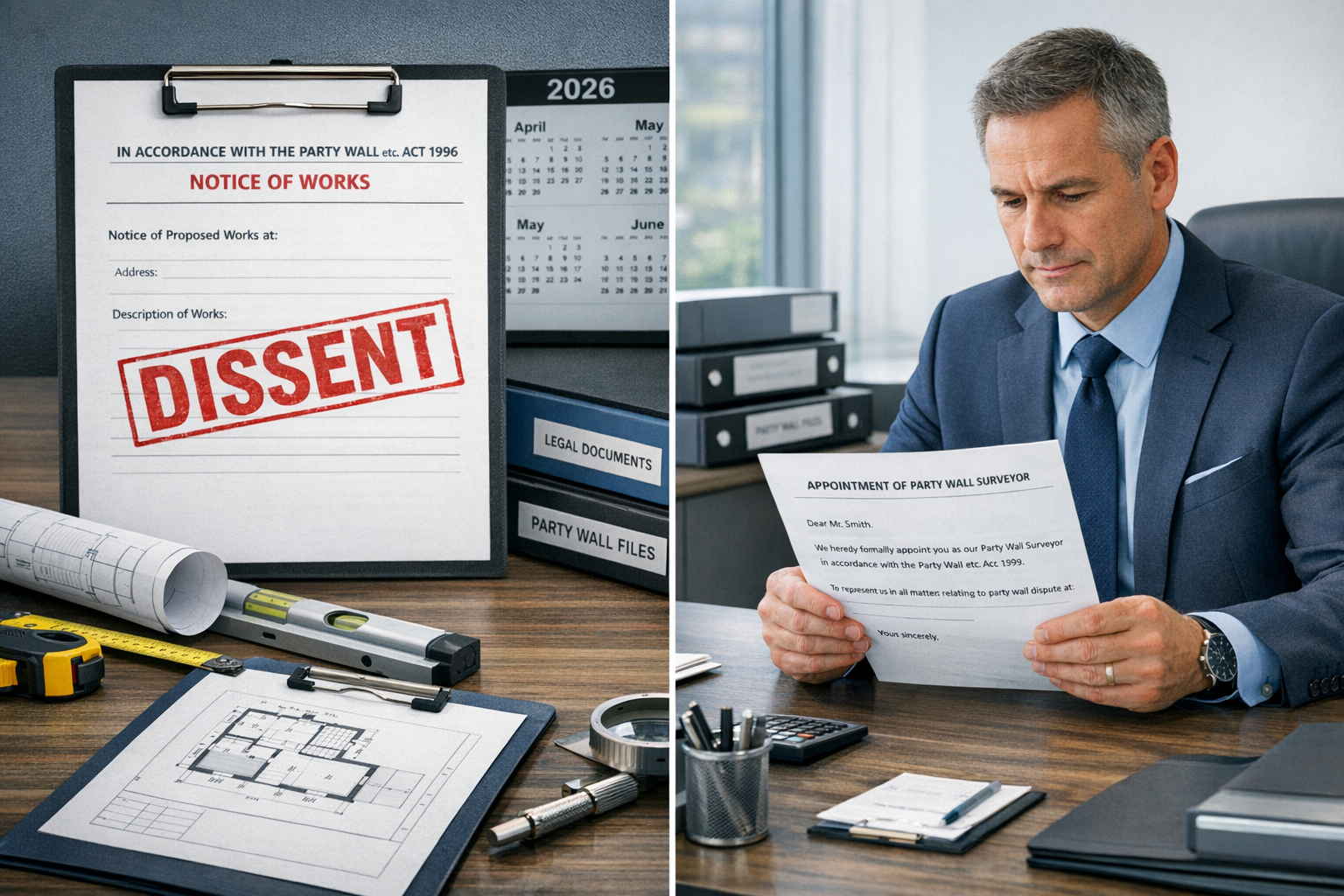
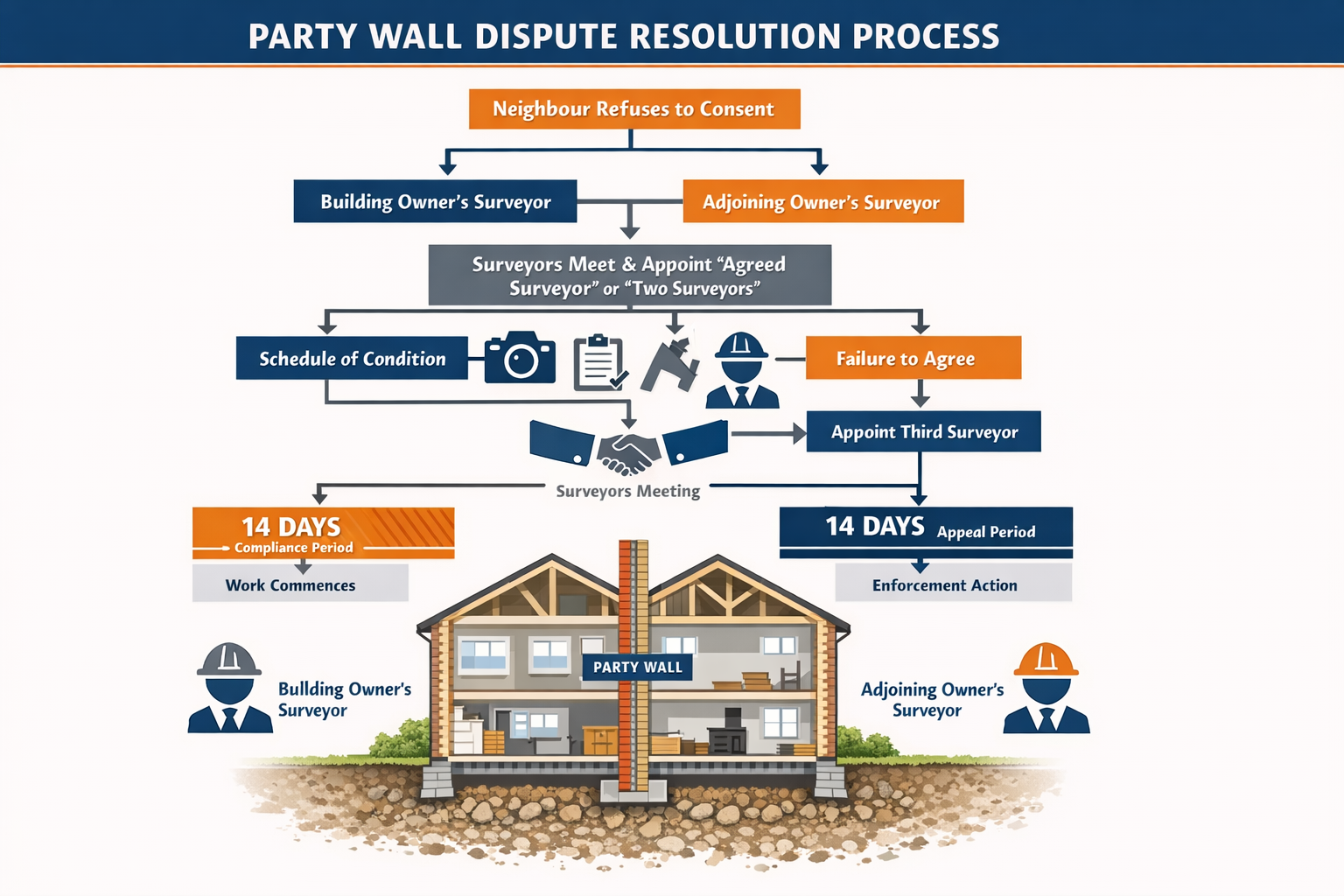
When property owners serve party wall notices under the Party Wall etc. Act 1996, adjoining owners have 14 days to respond. A refusal—or more accurately, a "dissent"—can take several forms:
- Explicit written refusal stating disagreement with the proposed works
- No response whatsoever after the 14-day period expires
- Conditional consent that attempts to impose unreasonable requirements
- Partial consent agreeing to some works but not others
Each scenario triggers the same legal consequence: a dispute is deemed to exist, and the surveyor appointment process must begin. This isn't necessarily adversarial—many refusals stem from lack of understanding rather than genuine opposition.
Common Reasons for Neighbor Refusals in 2026
Recent case studies from 2026 projects reveal several recurring patterns:
🏗️ Fear of Property Damage
Neighbors worry about structural integrity, cracking, or subsidence resulting from excavation or structural alterations.
💰 Cost Concerns
Adjoining owners may fear being liable for surveyor fees or repair costs, even when the Party Wall etc. Act 1996 places these on the building owner.
⏰ Disruption Anxiety
Concerns about noise, dust, access requirements, and general inconvenience during construction periods.
📋 Lack of Information
Many refusals occur simply because neighbors don't understand what's being proposed or their rights under the Act.
🤝 Relationship Breakdown
Pre-existing disputes between neighbors can manifest as blanket refusals regardless of the works' legitimacy.
"In approximately 60% of refusal cases we handled in 2026, the adjoining owner's concerns were resolved through clear communication and detailed explanations before any formal award was necessary." — Senior Party Wall Surveyor, Central London
Surveyor Tactics for Handling Neighbor Refusals on Party Wall Notices: The Response Protocol
Immediate Steps Following Refusal
When a refusal is received—or when the 14-day period expires without response—building owners must act decisively but professionally. The Handling Neighbor Refusals on Party Wall Notices: Surveyor Tactics for 2026 Projects framework emphasizes these critical first steps:
Step 1: Document Everything 📝
Create a comprehensive file containing:
- Original notice as served with proof of delivery
- Dated refusal letter or evidence of non-response
- All correspondence between parties
- Photographic evidence of current property conditions
- Proposed works specifications and drawings
Step 2: Initiate Surveyor Appointment Process
Under Section 10 of the Act, the building owner must write to the adjoining owner proposing either:
- Agreed Surveyor: A single surveyor acceptable to both parties
- Two Surveyors: Each party appoints their own surveyor, who may appoint a third surveyor if needed
The letter must clearly state the 10-day deadline for the adjoining owner to make their selection. If they fail to respond, the building owner can make the appointment on their behalf—a powerful mechanism that prevents indefinite delays.
Step 3: Strategic Surveyor Selection
Choosing the right building owner's surveyor is crucial. In 2026, successful appointments prioritize:
| Selection Criteria | Why It Matters |
|---|---|
| Local Experience | Familiarity with regional construction practices and council requirements |
| RICS Accreditation | Professional standards and insurance coverage |
| Communication Skills | Ability to de-escalate tensions and explain technical matters clearly |
| Availability | Capacity to complete awards within reasonable timeframes |
| Track Record | Demonstrated success in similar refusal scenarios |
Professional surveyors operating in areas like Central London, South London, and North London bring invaluable local knowledge to these appointments.
The Surveyor's Negotiation Playbook
Once appointed, surveyors employ specific tactics refined through 2026 case precedents:
Tactic 1: The Initial Engagement Meeting 🤝
Successful surveyors arrange face-to-face meetings (or video calls) with the adjoining owner within 48 hours of appointment. This serves multiple purposes:
- Humanizes the process beyond formal legal documents
- Identifies genuine concerns that can be addressed through award conditions
- Educates about rights, responsibilities, and protections
- Builds trust in the surveyor's impartiality
Tactic 2: Comprehensive Schedule of Condition
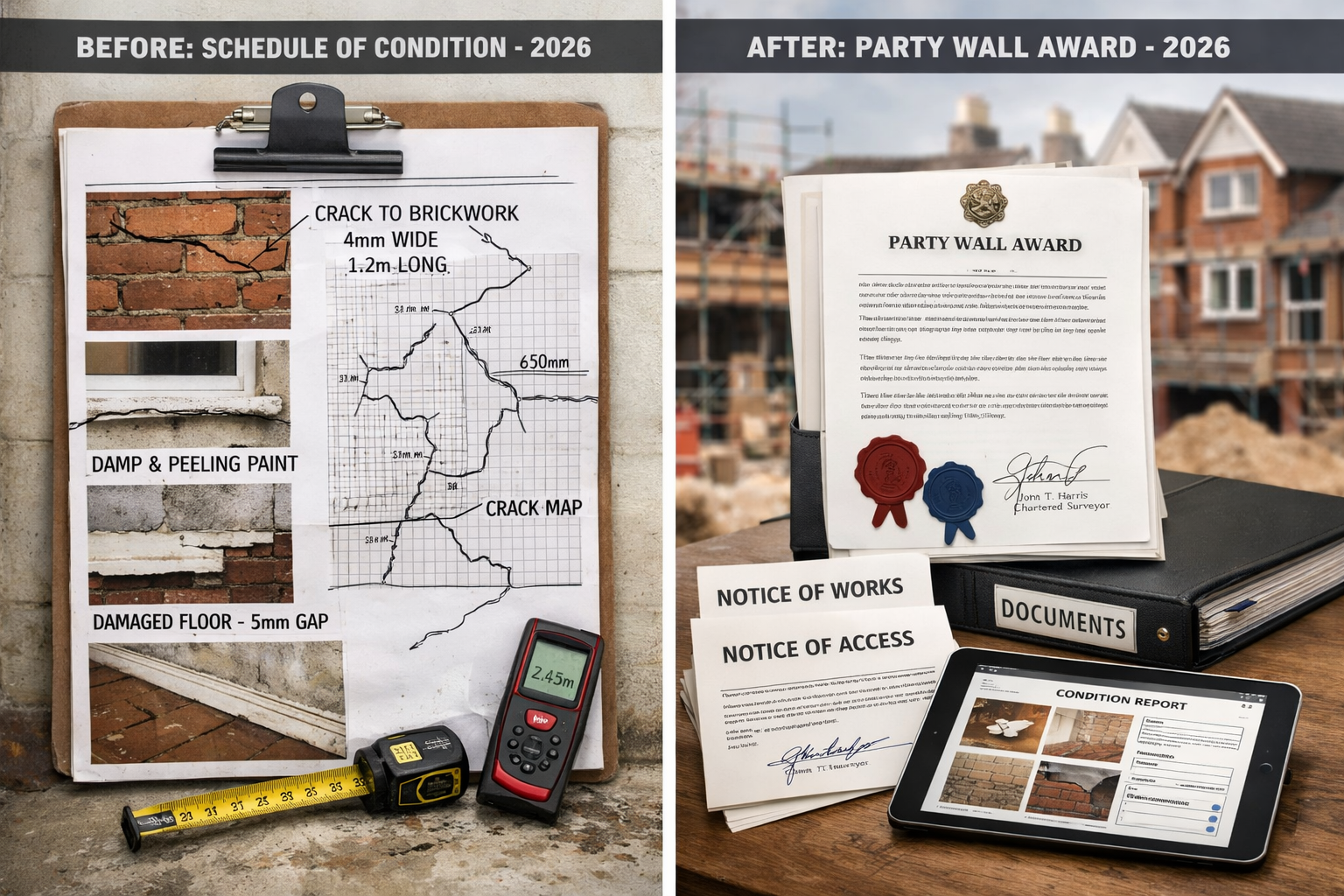
The schedule of condition is the surveyor's most powerful protective tool. In 2026, best practices include:
- High-resolution photography with timestamp and GPS metadata
- Detailed written descriptions of every room, external elevation, and relevant feature
- Crack mapping using digital measurement tools
- Video walkthroughs providing contextual understanding
- Structural observations noting pre-existing defects or concerns
This documentation creates an irrefutable baseline. If the neighbor later claims damage, the schedule proves what conditions existed before works commenced.
Tactic 3: Protective Award Conditions
Rather than minimal awards, experienced surveyors in 2026 include comprehensive protective conditions:
✅ Specific working hours to minimize disruption
✅ Dust suppression measures and protective sheeting requirements
✅ Access protocols with advance notice periods
✅ Monitoring provisions for vibration or movement
✅ Insurance requirements with adequate coverage limits
✅ Completion timelines preventing indefinite disturbance
These conditions transform the award from a simple permission document into a comprehensive protection framework that addresses the neighbor's legitimate concerns.
Tactic 4: The "Reasonable Neighbor" Standard
When neighbors make unreasonable demands or refuse to engage constructively, surveyors apply the legal standard of what a "reasonable person" would accept. This includes:
- Rejecting excessive conditions that would make works impractical
- Proceeding with awards even when the adjoining owner refuses to cooperate
- Appointing the adjoining owner's surveyor when they fail to do so themselves
- Setting fair but firm timelines for response and compliance
"The Act is designed to balance rights—the building owner's right to develop their property and the adjoining owner's right to protection. Neither party can hold the other hostage through unreasonable positions." — RICS Party Wall Guidance, 2026 Edition
Advanced Surveyor Tactics for Handling Neighbor Refusals on Party Wall Notices in Complex Situations
Dealing with the "Ghost Neighbor" Scenario
One of the most challenging situations in 2026 involves adjoining owners who simply disappear—not responding to notices, surveyor appointments, or any communication attempts. The Handling Neighbor Refusals on Party Wall Notices: Surveyor Tactics for 2026 Projects approach addresses this through:
The Dual Appointment Strategy
When an adjoining owner fails to appoint a surveyor within 10 days, the building owner can make the appointment on their behalf. Experienced practitioners recommend:
- Select a highly reputable surveyor with impeccable credentials
- Document the appointment with registered mail and statutory declarations
- Ensure the appointed surveyor acts with complete impartiality
- Maintain detailed records of all attempts to contact the adjoining owner
This approach has withstood legal challenges in 2026 cases, provided proper procedures are followed meticulously.
Managing Multiple Adjoining Owners
Projects affecting several neighbors—common in terraced housing developments—require coordinated tactics:
Staggered Notice Serving 📅
Serve notices sequentially rather than simultaneously, allowing time to address concerns before they spread among neighbors.
Collective Information Sessions 👥
Host group meetings where all affected neighbors can ask questions and understand the process together.
Consistent Award Terms 📋
Ensure similar protective conditions across all awards to prevent perceptions of unfair treatment.
Single Agreed Surveyor 🎯
When possible, propose one agreed surveyor for all parties, reducing costs and improving coordination.
The Vexatious Refusal Response
Some neighbors refuse party wall notices as part of broader disputes or personality conflicts. In 2026, surveyors employ specific tactics for these situations:
| Vexatious Behavior | Surveyor Response |
|---|---|
| Repeated unreasonable demands | Document each request and formal rejection with legal reasoning |
| Threats of legal action | Proceed professionally; the Act provides legal framework |
| Personal attacks or harassment | Maintain professional boundaries; involve solicitors if necessary |
| Deliberate obstruction | Exercise statutory powers to proceed without cooperation |
| False damage claims | Rely on comprehensive schedule of condition evidence |
The key principle: never escalate emotionally, but also never allow unreasonable behavior to derail legitimate projects.
Award Enforcement: When Neighbors Won't Comply
Even after a party wall award is issued, some neighbors may refuse access or attempt to prevent works. The 2026 enforcement toolkit includes:
Legal Enforcement Mechanisms
County Court Injunctions ⚖️
Awards are legally binding documents. Failure to comply can result in court orders compelling access and compliance.
Damages Claims 💷
Building owners can claim financial losses resulting from delays caused by non-compliance.
Police Assistance 👮
In extreme cases of physical obstruction, police can facilitate lawful access under the award terms.
Preventive Enforcement Tactics
Smart surveyors build enforcement provisions directly into awards:
- Explicit access rights with specific dates and times
- Penalty clauses for unreasonable denial of access
- Alternative access routes when primary access is blocked
- Photographic evidence requirements proving compliance attempts
Technology-Enhanced Tactics for 2026
Modern surveyors leverage technology to strengthen their position when handling refusals:
Digital Service Platforms 📱
Blockchain-verified delivery of notices and appointments, creating tamper-proof evidence trails.
3D Condition Surveys 🏗️
Laser scanning creates millimeter-accurate baseline records, eliminating disputes about pre-existing conditions.
AI-Assisted Award Drafting 🤖
Machine learning systems analyze thousands of precedent awards to suggest optimal protective conditions for specific scenarios.
Real-Time Monitoring Systems 📊
Vibration sensors and tilt meters provide objective data about construction impacts, addressing neighbor concerns with facts rather than fears.
Virtual Dispute Resolution 💻
Video conferencing platforms enable efficient surveyor meetings without the delays of coordinating schedules for in-person gatherings.
Case Studies: Real 2026 Refusal Scenarios and Surveyor Solutions
Case Study 1: The Basement Extension Refusal
Situation: Homeowner in East London served notice for basement excavation. Neighbor refused, citing fears of subsidence affecting their Victorian terrace.
Surveyor Tactics Applied:
- Commissioned structural engineer's report demonstrating safe excavation methodology
- Created comprehensive schedule of condition with professional crack monitoring
- Included continuous vibration monitoring in award conditions
- Arranged weekly progress updates to the adjoining owner
- Specified underpinning methodology and insurance requirements
Outcome: Works proceeded on schedule. Post-completion survey showed zero new cracking or movement. Neighbor relationship actually improved through transparent communication.
Case Study 2: The Silent Neighbor
Situation: West London loft conversion notice received no response. Adjoining owner had moved abroad and was unreachable.
Surveyor Tactics Applied:
- Exhaustive paper trail of contact attempts via multiple channels
- Appointed highly credentialed surveyor on behalf of absent neighbor
- Appointed surveyor conducted independent assessment and recommended protective conditions
- Created detailed photographic schedule despite lack of interior access
- Included provisions for post-completion verification
Outcome: Award issued after proper statutory periods. Works completed without incident. Documentation withstood subsequent scrutiny when owner returned.
Case Study 3: The Vexatious Objector
Situation: Commercial development affecting residential neighbor who had history of objecting to all nearby projects.
Surveyor Tactics Applied:
- Maintained strictly professional communication despite provocations
- Documented every unreasonable demand with reasoned rejections
- Proceeded with award despite non-cooperation
- Included robust access provisions anticipating resistance
- Prepared injunction application in advance (though ultimately unnecessary)
Outcome: Award enforced through formal legal channels. Project completed with minimal delays. Costs awarded against the vexatious neighbor for unreasonable behavior.
Cost Implications and Fee Management
Understanding the financial aspects of handling refusals is crucial for building owners in 2026. The costs of the party wall process typically increase when neighbors refuse:
Typical Cost Breakdown
Agreed Surveyor Scenario (Consent Given):
- Single surveyor fee: £800-£1,500
- Schedule of condition: £300-£600
- Total: £1,100-£2,100
Dispute Scenario (Refusal):
- Building owner's surveyor: £1,200-£2,500
- Adjoining owner's surveyor: £1,200-£2,500
- Third surveyor (if needed): £1,500-£3,000
- Enhanced schedule of condition: £500-£1,200
- Total: £2,900-£9,200
While the building owner typically bears these costs, strategic surveyor selection and efficient process management can minimize expenses. For guidance on keeping party wall costs down, consider these tactics:
✅ Choose experienced surveyors who work efficiently
✅ Provide comprehensive information upfront
✅ Respond promptly to surveyor requests
✅ Consider an agreed surveyor if the neighbor is willing
✅ Avoid unnecessary complications or changes mid-process
Preventing Refusals: Proactive Communication Strategies
The best tactic for Handling Neighbor Refusals on Party Wall Notices: Surveyor Tactics for 2026 Projects is preventing refusals in the first place. Forward-thinking building owners employ these pre-notice strategies:
The Courtesy Visit Approach
Before serving formal notices, visit neighbors personally to:
- Explain the proposed works in plain language
- Show plans and answer questions informally
- Address concerns before they become formal objections
- Build goodwill that carries through the process
- Provide contact information for follow-up questions
The Information Package
Accompany notices with supplementary materials:
- Plain English summary of the legal notice
- Visual representations of proposed works
- FAQ sheet addressing common concerns
- Timeline showing expected duration and milestones
- Contact details for questions or concerns
- Information about party wall act notices and how to respond
The Professional Introduction
Include a letter from your proposed surveyor explaining:
- Their role as impartial professional
- The protective nature of the process
- The neighbor's rights and options
- How concerns will be addressed in the award
- Assurance of fair treatment regardless of who appoints them
These proactive measures dramatically reduce refusal rates while establishing a collaborative foundation for the entire project.
Conclusion: Mastering the Art of Handling Neighbor Refusals
Handling Neighbor Refusals on Party Wall Notices: Surveyor Tactics for 2026 Projects requires a sophisticated blend of legal knowledge, negotiation skill, technical expertise, and emotional intelligence. The refusal of a party wall notice is not a project-ending obstacle—it's simply a procedural step that, when managed properly, ensures both parties' interests are protected.
The most successful outcomes in 2026 share common characteristics:
🎯 Professional surveyor selection based on experience and communication skills
📸 Comprehensive documentation establishing baseline conditions
🤝 Proactive communication addressing concerns before they escalate
⚖️ Balanced awards protecting neighbors while enabling legitimate works
📋 Meticulous procedure following statutory requirements precisely
Actionable Next Steps
If you're facing a neighbor refusal on your party wall notice:
- Don't panic—refusals are common and manageable through proper procedures
- Document everything from the moment of refusal or non-response
- Appoint a qualified surveyor immediately to prevent delays
- Maintain professional communication regardless of the neighbor's approach
- Ensure comprehensive schedule of condition before works commence
- Follow your surveyor's guidance on timing, access, and protective measures
For building owners planning works that will require party wall notices, invest time in pre-notice relationship building and clear communication. The goodwill established before formal procedures begin often determines whether you'll receive consent or face refusal.
The Party Wall etc. Act 1996 provides a robust framework that balances property development rights with neighbor protection. When surveyors apply proven tactics with professionalism and precision, even the most challenging refusal scenarios can be resolved efficiently, allowing projects to proceed while preserving—or even improving—neighbor relationships.
Understanding these surveyor tactics empowers building owners to approach party wall procedures with confidence, knowing that refusals are manageable procedural steps rather than insurmountable barriers to their development plans.