


{"cover":"Professional landscape format (1536×1024) hero image featuring bold text overlay 'The Role of Agreed Surveyors in 2026 Party Wall Disputes: Cost-Saving Strategies and Outcomes' in extra large 70pt white sans-serif font with dark shadow effect, centered in upper third. Background shows two professional surveyors in hard hats examining shared wall between London terraced houses, one holding clipboard with party wall award document, architectural drawings visible, measuring equipment, handshake symbolizing agreement. Split composition showing cost comparison graphics: left side shows single agreed surveyor icon with £1,500-£2,800 label, right side shows two separate surveyors with higher cost indicators. Color scheme: deep navy blue, gold accents, white text, professional editorial quality, modern business aesthetic with subtle London skyline elements.","content":["Landscape format (1536×1024) detailed infographic showing agreed surveyor cost comparison chart for 2026 London party wall disputes. Central visual: large cost savings calculator display with £1,500-£2,800 range highlighted in green for single agreed surveyor versus £3,000-£7,200+ in red for two separate appointed surveyors. Left side shows professional surveyor in business attire with hard hat holding party wall award document. Right side displays percentage savings badge showing 30-50% reduction. Background includes subtle architectural blueprints, London terraced houses, measuring tools, and timeline icons showing 2-6 weeks award preparation period. Clean financial aesthetic with bar graphs, currency symbols, checkmarks for cost-effective approach, professional color palette of navy, green, gold.","Landscape format (1536×1024) conceptual illustration depicting party wall dispute resolution pathways in 2026. Central flowchart design showing decision tree: top path labeled 'Good Relations' leads to single agreed surveyor icon with handshake symbol and fast-track timeline; bottom path labeled 'Adversarial Relations' branches to two separate surveyor icons, then potential third surveyor icon with £1,500-£4,000 cost indicator, and County Court appeal option showing £3,000-£12,000+ costs. Visual includes professional surveyors reviewing documents at shared wall boundary, access arrangement diagrams, schedule of condition photography equipment, calendar icons showing 3-4 month standard timeline. Modern infographic style with clear pathway arrows, cost badges, time indicators, professional business aesthetic with blue, orange, and gray color scheme.","Landscape format (1536×1024) professional scene showing successful party wall agreement outcome in 2026 London residential setting. Main visual: two neighboring property owners shaking hands in front of terraced houses with shared party wall, single agreed surveyor in center holding completed party wall award document on clipboard. Foreground shows cost savings summary sheet with itemized fees, hourly rate breakdown (£150-£200/hour), total project cost approximately £1,000 highlighted. Background displays construction work proceeding smoothly on loft conversion, workers following award conditions, access arrangements being respected. Visual elements include checkmarks for compliance, timeline showing efficient 2-6 week resolution, independence verification badge, neutral third-party certification symbol. Professional editorial quality with warm, positive color palette: greens for savings, blues for trust, gold accents for success, clean modern composition."]
When planning building work that affects a shared wall with your neighbour in 2026, one decision can save you thousands of pounds while accelerating your project timeline: appointing a single agreed surveyor instead of two separate professionals. The Role of Agreed Surveyors in 2026 Party Wall Disputes: Cost-Saving Strategies and Outcomes represents a strategic approach that can reduce total costs by 30-50% compared to the traditional two-surveyor model—but only when certain conditions align. 🏠
Understanding when and how to leverage this cost-saving mechanism under the Party Wall etc. Act 1996 requires navigating the delicate balance between neighbourly cooperation, legal compliance, and financial prudence. While many London property owners default to appointing separate surveyors, the agreed surveyor pathway offers substantial benefits for those willing to invest in collaborative relationships.
Key Takeaways
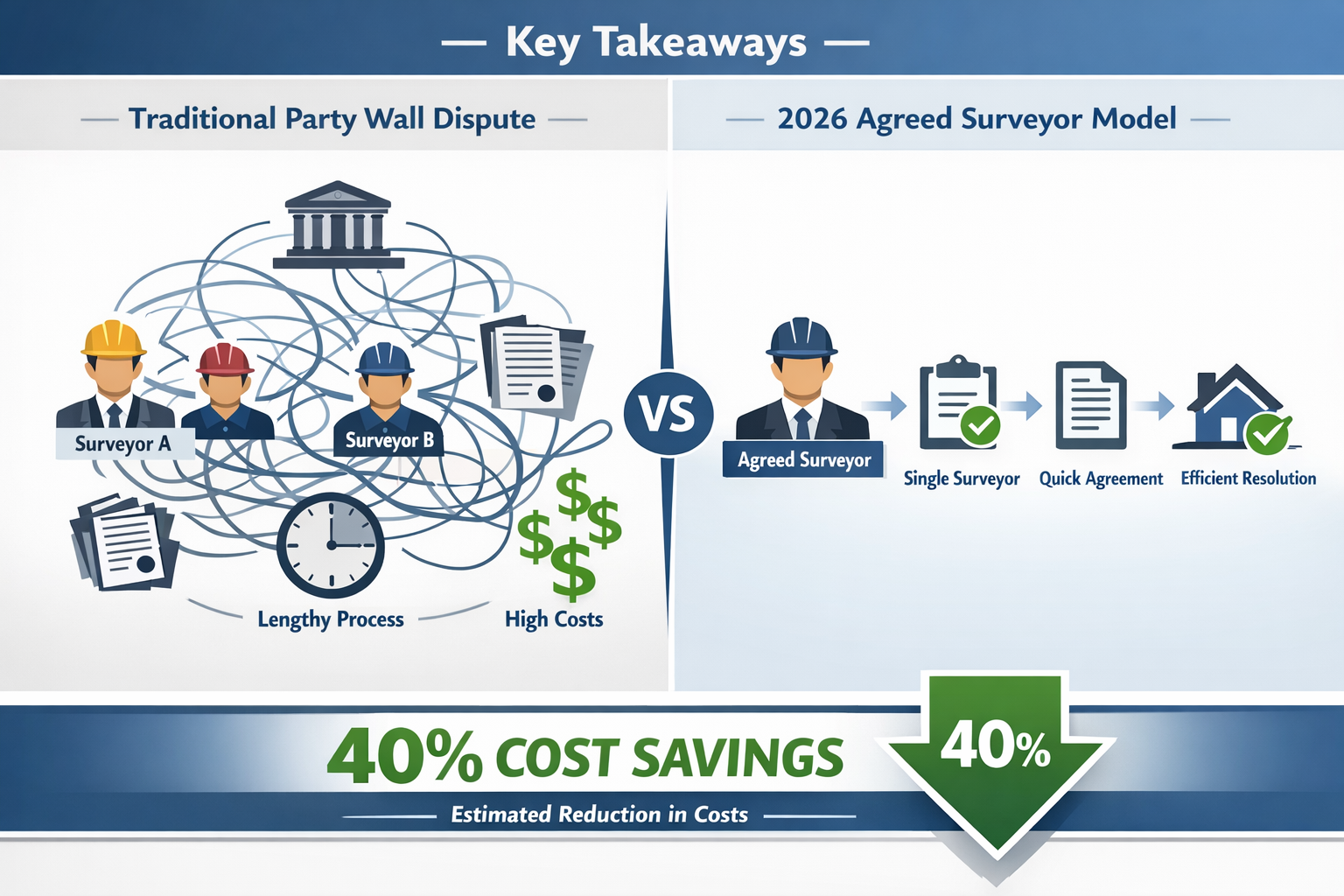
- Significant Cost Savings: Using a single agreed surveyor typically costs £1,500–£2,800 compared to £3,000–£7,200+ for two separate appointed surveyors, potentially reducing expenses by 30-50%[1]
- Speed Advantage: The agreed surveyor approach can accelerate dispute resolution and award preparation, though success depends on neighbourly consensus and cooperation
- Critical Requirement: Both parties must agree on the surveyor's appointment, making this strategy impractical for adversarial relationships or contentious projects
- Independence is Essential: The agreed surveyor must be genuinely independent and cannot be the same professional retained by the building owner for their own works[2]
- Best for Simple Projects: This approach works optimally for straightforward building works between neighbours with good pre-existing relations, while complex or contentious projects typically require separate surveyors
Understanding the Agreed Surveyor Model in 2026
The agreed surveyor represents one of three possible surveyor appointment scenarios under the Party Wall etc. Act 1996. When a neighbour receives proper party wall notices for proposed building work, they have 14 days to respond. If they consent, no surveyor appointment is necessary. If they dissent—or simply fail to respond—the Party Wall Act requires surveyor involvement.
Three Surveyor Appointment Pathways
| Scenario | Structure | Typical Cost Range (2026) | Timeline |
|---|---|---|---|
| Agreed Surveyor | Single surveyor serves both parties | £1,500–£2,800 total[1] | 2–4 weeks for award |
| Two Appointed Surveyors | Each party appoints their own | £1,500–£3,600+ per party[1] | 2–6 weeks for award |
| Third Surveyor Required | Resolves disagreement between two surveyors | Additional £1,500–£4,000[1] | 4–8 weeks additional |
The agreed surveyor model consolidates the entire party wall process under one professional who acts impartially for both the building owner and the adjoining owner. This single point of accountability can streamline communication, reduce administrative overhead, and eliminate the coordination challenges that arise when two separate surveyors must negotiate award terms.
How Agreed Surveyors Differ from Appointed Surveyors
When parties appoint separate surveyors, each professional advocates for their client's interests while working toward a mutually acceptable party wall award. The building owner's surveyor focuses on enabling the proposed works with minimal restrictions, while the adjoining owner's surveyor prioritizes protecting their client's property from damage and ensuring adequate safeguards.
In contrast, an agreed surveyor must balance both perspectives simultaneously. They cannot favor either party and must prepare an award that fairly addresses the building owner's construction needs while protecting the adjoining owner's legitimate interests. This neutrality requirement is why independence is absolutely critical—a surveyor already retained by the building owner for design work or project management cannot credibly serve as an agreed surveyor[2].
"The agreed surveyor must be independent and explicitly cannot be the same surveyor retained by the building owner for their own works, otherwise the neighbour is unlikely to view them as neutral."[2]
The Role of Agreed Surveyors in 2026 Party Wall Disputes: Cost-Saving Analysis
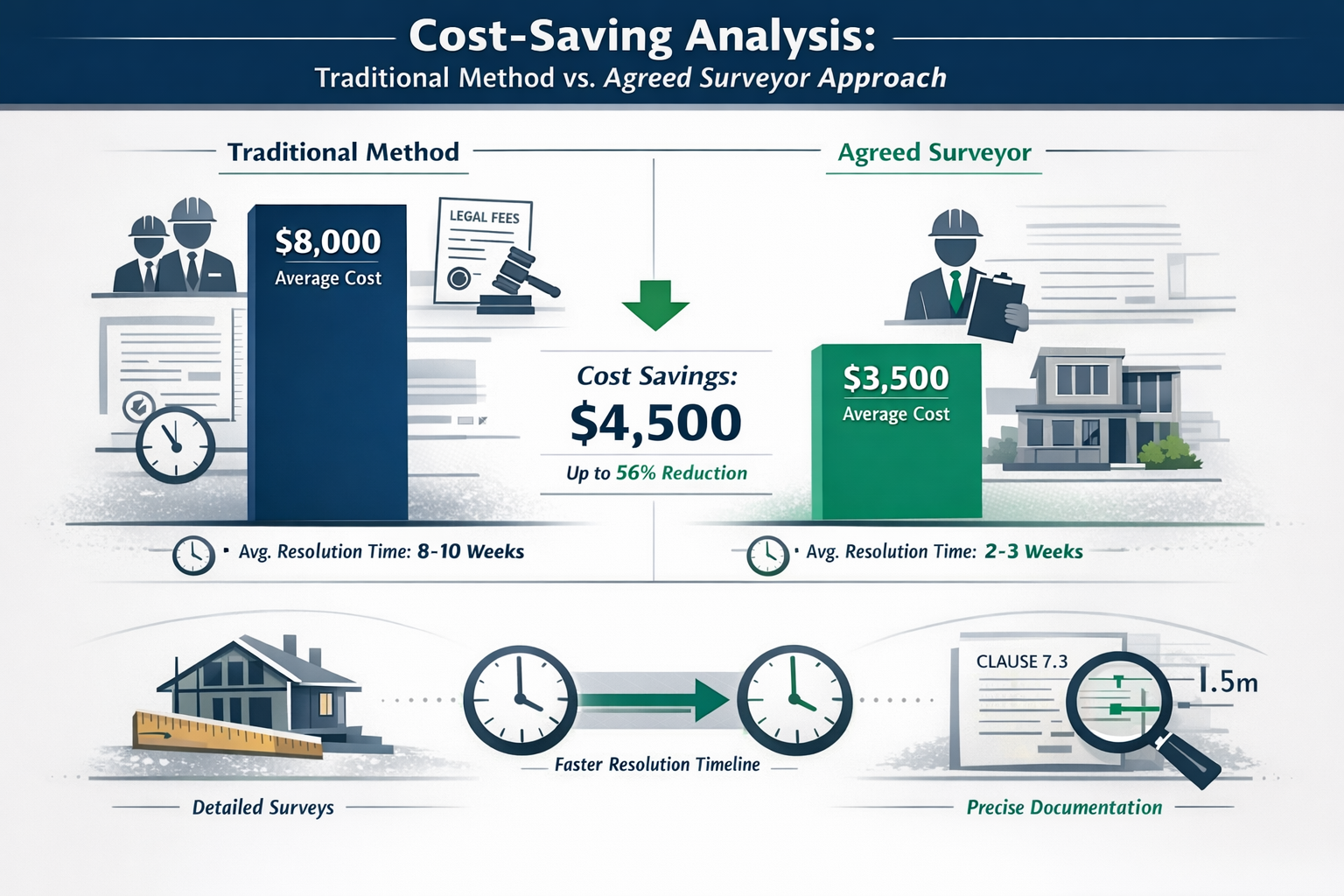
The financial advantages of appointing an agreed surveyor become immediately apparent when comparing total project costs. Since the building owner pays all party wall surveyor fees under the Act—including both their own surveyor and the neighbour's surveyor—consolidating these roles delivers direct savings.

Detailed Cost Breakdown for 2026 London Projects
Agreed Surveyor Scenario:
- Initial consultation and site inspection: £300–£500
- Award preparation and documentation: £800–£1,500
- Schedule of condition (if required): £400–£800
- Total estimated cost: £1,500–£2,800[1]
Two Appointed Surveyors Scenario:
- Building owner's surveyor fees: £1,500–£3,600
- Adjoining owner's surveyor fees: £1,500–£3,600
- Coordination and negotiation overhead: Additional time charges
- Total estimated cost: £3,000–£7,200+[1]
Hourly Rate Considerations
Party wall surveyors in London typically charge between £150–£200 per hour in 2026[2]. The agreed surveyor model reduces billable hours by eliminating duplicate site visits, redundant documentation preparation, and inter-surveyor negotiation time. For straightforward projects, a complete party wall award costs approximately £1,000 when handled efficiently[2].
However, building owners should understand that cost savings depend heavily on project complexity and relationship dynamics. If an agreed surveyor encounters resistance from either party or faces complicated technical issues, their billable hours may increase substantially. The costs of party wall processes vary significantly based on specific circumstances.
When Cost Savings Materialize vs. When They Don't
Optimal Cost-Saving Scenarios:
- ✅ Simple loft conversions affecting party walls
- ✅ Straightforward rear extensions with minimal structural impact
- ✅ Routine maintenance and repair works
- ✅ Properties with good existing neighbour relations
- ✅ Projects where both parties prioritize efficiency
Scenarios Where Savings May Not Materialize:
- ❌ Complex structural alterations requiring extensive technical analysis
- ❌ Projects involving multiple adjoining properties
- ❌ Situations with pre-existing neighbour disputes or mistrust
- ❌ Works requiring extensive protective measures or monitoring
- ❌ Cases where one party has unreasonable expectations
For those wondering about keeping party wall costs down, the agreed surveyor approach represents the single most effective strategy—when it's viable.
Strategic Implementation: Making the Agreed Surveyor Approach Work
Successfully implementing the agreed surveyor model requires careful planning, transparent communication, and realistic assessment of whether this approach suits your specific circumstances.
Pre-Requisites for Success
1. Establish Neighbourly Consensus Early
The primary barrier to adopting an agreed surveyor is achieving mutual agreement. This requirement is described as "rare in London"[1], where property owners often default to adversarial positions. Building owners should initiate conversations with neighbours well before serving formal notices, explaining the potential cost and time benefits of the agreed surveyor approach.
2. Select a Genuinely Independent Professional
Independence cannot be overstated. The agreed surveyor must have no prior relationship with either party that could create perceived bias. Building owners should avoid suggesting their own project architect, structural engineer, or any consultant already involved in the works. Instead, jointly research and interview candidates with both parties participating in the selection process.
3. Verify Qualifications and Experience
Look for surveyors who are members of the Faculty of Party Wall Surveyors (FPWS) or have demonstrable experience with agreed surveyor appointments. Request references from previous cases where they served in this dual capacity. Whether you're working with a party wall surveyor in South London, West London, or Central London, professional credentials matter significantly.
Step-by-Step Implementation Process
Step 1: Informal Neighbour Discussion (Week 1)
Before serving formal notices, discuss your planned works with adjoining owners. Explain the party wall process and introduce the agreed surveyor concept. Gauge their receptiveness to collaborative resolution.
Step 2: Serve Proper Party Wall Notices (Week 2)
Serve the appropriate party wall notices according to the types of party wall works you're undertaking. Include a covering letter suggesting the agreed surveyor approach and offering to jointly select a professional.
Step 3: Joint Surveyor Selection (Weeks 3-4)
If the neighbour agrees in principle, schedule a joint meeting to interview potential agreed surveyors. Prepare questions about their approach to balancing both parties' interests, fee structures, and timeline expectations.
Step 4: Formal Appointment (Week 4)
Both parties must formally appoint the same surveyor in writing. The agreed surveyor should provide a clear fee estimate and scope of services before beginning work.
Step 5: Award Preparation (Weeks 5-8)
The agreed surveyor conducts site inspections, prepares the schedule of condition, and drafts the party wall award. This typically takes 2-6 weeks depending on project complexity[1].
Step 6: Award Service and Commencement (Week 8+)
Once the award is finalized and served on both parties, works can commence in accordance with its terms. The standard case timeline from appointing your surveyor to starting on site is 3-4 months[1], though the agreed surveyor approach can accelerate this.
Case Study: Successful Agreed Surveyor Appointment in 2026
Project: Loft conversion in a Victorian terrace in North London
Background: Building owner planned to raise the party wall by 1.2 meters for a loft conversion. Good relationship existed with both adjoining neighbours.
Approach: Building owner discussed plans informally with neighbours three months before construction. Suggested agreed surveyor approach, emphasizing cost savings for all parties (building owner pays all fees). Neighbours agreed, appreciating the transparency.
Outcome:
- Single agreed surveyor appointed at £2,200 total cost
- Award prepared in 3 weeks
- No disputes or challenges
- Works commenced on schedule
- Estimated savings: £3,000-£5,000 compared to two-surveyor scenario
Key Success Factors:
- Early communication and relationship investment
- Transparent discussion of cost implications
- Joint participation in surveyor selection
- Simple, straightforward project scope
Escalation Scenarios: When to Involve Third Surveyors and Beyond
Even with the best intentions, some party wall situations require escalation beyond the agreed surveyor model. Understanding these escalation pathways helps building owners make informed decisions about when to persist with the collaborative approach and when to pivot to more formal dispute resolution.
The Third Surveyor Mechanism
When two appointed surveyors cannot agree on award terms—a situation that cannot arise with an agreed surveyor—they must appoint a Third Surveyor to resolve the dispute. This additional layer costs typically £1,500–£4,000[1], with costs split or assigned at the Third Surveyor's discretion.
The Third Surveyor scenario illustrates why the agreed surveyor approach is so valuable when viable: it eliminates this entire escalation pathway. However, if an agreed surveyor appointment fails to materialize or breaks down mid-process, parties revert to appointing separate surveyors, potentially triggering Third Surveyor involvement if disagreements arise.
Fee Challenge Mechanisms
Under the Party Wall Act, all surveyor charges must be "reasonable." If a neighbour's surveyor charges excessive fees, the building owner's surveyor can formally challenge those fees[1]. This protection applies regardless of whether you use an agreed surveyor or separate appointed surveyors.
For agreed surveyors, fee reasonableness becomes even more critical since both parties must accept the single professional's charges. Building owners should request detailed fee estimates upfront and establish clear parameters for additional charges if project scope changes.
County Court Appeals: The Nuclear Option
Either party can appeal a party wall award to County Court within 14 days of service. Estimated costs range from £3,000–£12,000+ with a 3-6 month timeline[1], making this option impractical except as a genuine last resort.
The appeal mechanism exists regardless of surveyor appointment structure, but agreed surveyor awards may face fewer appeals precisely because both parties participated in selecting the professional and had input throughout the process. When parties feel heard and fairly represented, they're less likely to escalate to litigation.
When to Abandon the Agreed Surveyor Approach
Red Flags Indicating Separate Surveyors Are Necessary:
🚩 Neighbour Explicitly Refuses Agreement
If your neighbour insists on appointing their own surveyor despite your suggestion of an agreed surveyor, respect this decision immediately. Pressuring them will damage relations and potentially delay your project.
🚩 Significant Power Imbalance or Knowledge Gap
If one party has substantially more construction knowledge or resources, the less-informed party may need independent representation to ensure fair treatment.
🚩 Complex Technical Issues Requiring Specialized Advocacy
Projects involving underpinning, significant structural alterations, or works affecting multiple properties often benefit from specialized surveyor representation for each party.
🚩 Pre-Existing Disputes or Mistrust
If relations are already strained due to previous issues, attempting the agreed surveyor approach may exacerbate tensions rather than resolve them.
🚩 One Party Has Unreasonable Expectations
If either the building owner or adjoining owner demonstrates unrealistic demands or inflexible positions, separate surveyors provide necessary buffer and negotiation structure.
Access Arrangements and Award Compliance in 2026
Regardless of whether you use an agreed surveyor or separate appointed surveyors, the resulting party wall award will specify critical terms including access arrangements, working hours, protective measures, and monitoring protocols. Understanding these elements helps building owners appreciate what surveyors negotiate and why their expertise matters.
Standard Award Components
1. Scope of Works Description
Detailed specification of exactly what building work is permitted, including any limitations or restrictions to protect adjoining property.
2. Access Rights and Arrangements
Specification of when and how building owner's contractors can access adjoining property for necessary works, inspections, or protective measures. Access rights are limited to what's reasonably necessary and must be exercised with minimum inconvenience.
3. Working Hours and Noise Restrictions
Typical London awards restrict noisy works to weekdays between 8:00 AM and 6:00 PM, with limited Saturday hours and no Sunday/bank holiday work.
4. Protective Measures and Monitoring
Requirements for protective boarding, dust suppression, vibration monitoring, or other safeguards to prevent damage to adjoining property.
5. Schedule of Condition
Photographic and written record of adjoining property's condition before works commence, establishing baseline for assessing any damage claims. This documentation is crucial for both parties' protection.
6. Dispute Resolution Procedures
Process for addressing issues that arise during construction, typically requiring the surveyor(s) to inspect and determine appropriate remedial action.
How Agreed Surveyors Handle Access Disputes
When access disputes arise during construction, agreed surveyors must balance both parties' interests without the advocacy dynamic of separate surveyors. This can be advantageous—the agreed surveyor has no incentive to favor either party and can make pragmatic decisions focused on project completion and property protection.
However, if one party feels the agreed surveyor is making unfair decisions, they have limited recourse beyond the formal appeal process. With separate surveyors, each party has an advocate who can negotiate on their behalf before disputes escalate to formal appeals.
For those considering whether to proceed without a surveyor, understanding these award components demonstrates why professional involvement typically benefits all parties, even when costs are a concern.
Practical Recommendations for Building Owners in 2026
Based on current market conditions, legal requirements, and practical experience with party wall processes across London, building owners should consider these strategic recommendations when deciding whether to pursue the agreed surveyor approach.
Decision Matrix: Agreed Surveyor vs. Separate Surveyors
Choose Agreed Surveyor When:
- ✅ You have genuinely good relations with neighbours
- ✅ Your project involves straightforward, simple works
- ✅ Both parties prioritize cost efficiency and speed
- ✅ The neighbour expresses willingness to collaborate
- ✅ No significant technical complexity or risk exists
- ✅ Only one or two adjoining properties are affected
Choose Separate Surveyors When:
- ✅ Relations with neighbours are neutral, strained, or adversarial
- ✅ Your project involves complex structural work or underpinning
- ✅ Multiple adjoining properties are affected
- ✅ The neighbour prefers independent representation
- ✅ Significant property value or damage risk is involved
- ✅ You want specialized advocacy for your interests
Cost-Benefit Analysis Framework
Building owners should calculate the total potential cost difference and weigh it against relationship risk:
Potential Savings: £1,500–£4,400 (difference between agreed surveyor and two-surveyor scenarios)
Risk Factors:
- Relationship damage if agreed surveyor approach fails: High
- Project delay if you must restart with separate surveyors: Medium-High
- Additional costs if escalation to Third Surveyor becomes necessary: £1,500–£4,000
Break-Even Analysis:
If there's more than 30% chance the agreed surveyor approach will fail or create relationship problems, the risk-adjusted expected value favors starting with separate surveyors from the outset.
Regional Considerations Across London
Party wall practices and neighbour attitudes vary across London boroughs. Properties in East London areas undergoing rapid development may face different dynamics than established neighborhoods in other regions. Local surveyors understand these nuances and can advise on whether agreed surveyor appointments are common in your specific area.
Timeline Optimization Strategies
To maximize the speed advantages of the agreed surveyor approach:
1. Begin Neighbour Conversations 3-4 Months Before Planned Construction
Early engagement allows time to build consensus without rushing decisions.
2. Provide Detailed Project Information Upfront
Share architectural drawings, structural calculations, and construction methodology with neighbours before formal notices. Transparency builds trust.
3. Offer to Share Surveyor Selection Process
Invite neighbours to jointly interview candidates rather than presenting a fait accompli.
4. Set Clear Timeline Expectations
Explain that the agreed surveyor approach can reduce the standard 3-4 month timeline[1] by several weeks if everyone cooperates.
5. Maintain Regular Communication
Keep neighbours informed throughout the award preparation process, even when the agreed surveyor is handling formal communications.
Conclusion: Strategic Deployment of Agreed Surveyors in 2026
The Role of Agreed Surveyors in 2026 Party Wall Disputes: Cost-Saving Strategies and Outcomes represents a powerful tool for building owners who can successfully navigate the prerequisites of neighbourly consensus and genuine independence. With potential savings of 30-50% compared to the two-surveyor model—translating to £1,500–£4,400 in real terms—this approach delivers meaningful financial benefits while potentially accelerating project timelines.
However, the agreed surveyor model is not universally applicable. Its success depends fundamentally on relationship quality, project simplicity, and both parties' willingness to prioritize collaboration over adversarial positioning. In London's competitive property market, where such consensus is described as "rare," building owners must realistically assess whether their specific circumstances support this approach.
Key Strategic Takeaways
For Building Owners Planning Works:
- Invest in neighbour relations well before serving party wall notices
- Present the agreed surveyor option transparently, emphasizing mutual benefits
- Be prepared to pivot to separate surveyors if consensus doesn't materialize
- Never compromise on surveyor independence to achieve agreement
- Factor realistic timelines and costs into project planning regardless of surveyor structure
For Adjoining Owners Receiving Notices:
- Understand that agreeing to a single surveyor can reduce costs the building owner pays
- Ensure any agreed surveyor is genuinely independent and has no prior relationship with the building owner
- Don't feel pressured to accept this approach if you prefer independent representation
- Remember that separate surveyors provide advocacy and specialized protection of your interests
For All Parties:
- The Party Wall Act exists to balance building owners' rights to develop with adjoining owners' rights to protection
- Professional surveyor involvement—whether agreed or separate—typically produces better outcomes than informal arrangements
- Cost considerations matter, but relationship preservation and fair treatment matter more
- Early communication, transparency, and mutual respect enable efficient resolution regardless of surveyor structure
Next Steps for Implementation
If You're a Building Owner:
- Assess Your Situation: Honestly evaluate your relationship with neighbours and project complexity using the decision matrix provided above
- Initiate Early Conversations: Contact neighbours 3-4 months before planned construction to discuss your project and gauge receptiveness
- Research Qualified Surveyors: Identify several independent professionals with agreed surveyor experience in your area
- Prepare Documentation: Gather architectural drawings, structural calculations, and project specifications to share with neighbours and surveyors
- Serve Proper Notices: Follow legal requirements precisely, regardless of which surveyor approach you ultimately pursue
- Remain Flexible: Be prepared to adapt your approach based on neighbour response and professional advice
If You're an Adjoining Owner:
- Understand Your Rights: Review the Party Wall etc. Act 1996 to understand your protections and options
- Evaluate the Proposal: If offered an agreed surveyor arrangement, assess whether you trust this approach given your specific circumstances
- Ask Questions: Request detailed information about the proposed surveyor's qualifications, independence, and fee structure
- Seek Independent Advice: Consider consulting your own surveyor for preliminary advice before deciding whether to accept an agreed surveyor
- Make an Informed Decision: Choose the approach that provides you with appropriate protection and peace of mind
The agreed surveyor model represents best-case scenario party wall resolution: cost-efficient, time-effective, and relationship-preserving. When circumstances align to make this approach viable, both building owners and adjoining owners benefit substantially. When circumstances don't align, the traditional two-surveyor model provides essential structure, advocacy, and protection that justify its additional cost.
In 2026's complex property development landscape, understanding these options and deploying them strategically separates successful projects from costly disputes. Whether you ultimately choose an agreed surveyor or separate appointed surveyors, professional guidance under the Party Wall Act protects all parties' interests while enabling necessary development to proceed legally and fairly.
References
[1] Party Wall Agreement London 2026 – https://www.mayfairstudio.co.uk/blog/party-wall-agreement-london-2026
[2] Party Wall Agreement – https://hoa.org.uk/advice/guides-for-homeowners/i-am-improving/party-wall-agreement/