


Planning a kitchen extension in 2026? The dream of a light-filled space with bifold doors opening onto the garden can quickly become complicated when you share a wall—or even a boundary—with your neighbour. While most homeowners understand they might need planning permission, far fewer realise that the Party Wall etc. Act 1996 applies independently and can add thousands of pounds and several months to even straightforward projects. This comprehensive guide to Kitchen Extensions and the Party Wall Act: A Homeowner's Playbook for 2026 Projects walks through exactly when the Act is triggered, how to serve notices correctly, what to expect from surveyors, and how to budget for awards and potential delays.

Key Takeaways
✅ The Party Wall Act 1996 applies to approximately 95% of London extension projects, including permitted development extensions if they involve a boundary, party wall, or excavation near a neighbour's foundation[2]
✅ Party wall surveyor fees range from £1,500-£3,600 per affected neighbour in 2026, with the process taking 2-4 months minimum before work can legally commence[2]
✅ You must serve notice at least 2 months before starting work—if your neighbour dissents or doesn't respond within 14 days, surveyors must be appointed, adding £1,200-£2,500 in fees and 4-8 weeks delay[1]
✅ Excavation within 3 metres of a neighbour's building (if going deeper than their foundations) or within 6 metres (if going deeper than a 45° line from their foundation bottom) triggers Party Wall Act requirements[1]
✅ Building Regulations approval is always mandatory for kitchen extensions regardless of planning permission status, covering structural integrity, fire safety, drainage, and energy efficiency[1]
Understanding Kitchen Extensions and the Party Wall Act in 2026
The Party Wall etc. Act 1996 governs work on shared walls, boundary structures, and excavations near neighbouring properties throughout England and Wales (it does not apply in Scotland or Northern Ireland)[3]. For kitchen extensions, this legislation becomes relevant far more often than most homeowners anticipate.
What Makes Kitchen Extensions Different?
Kitchen extensions typically involve rear or side additions to properties, frequently in semi-detached or terraced houses where party walls are common. Unlike loft conversions that work within existing structures, kitchen extensions often require:
- Foundation excavation near boundary lines
- Building up to or along party walls
- Side return infills that attach directly to shared structures
- Wrap-around extensions combining rear and side elements
Each of these scenarios can trigger different sections of the Party Wall Act, making it essential to understand which types of party wall works apply to your specific project.
The Three Main Party Wall Act Triggers for Kitchen Extensions
The Act contains three distinct notice types, each covering different work scenarios:
1. Line of Junction Notice (Section 1)
This applies when building a new wall directly on the boundary line between properties. For kitchen extensions, this is relevant when constructing a side extension wall exactly on the property boundary[4].
2. Party Structure Notice (Section 2)
Required for work directly to an existing party wall, including:
- Cutting into the party wall for new steel beams
- Raising the height of a party wall
- Underpinning a party wall
- Inserting a damp-proof course
3. Excavation Notice (Section 6)
Triggered when digging foundations within specific distances from a neighbour's building:
- Within 3 metres if excavating deeper than the neighbour's foundations
- Within 6 metres if excavating deeper than a line drawn at 45° from the bottom of the neighbour's foundations[1]
For a typical rear kitchen extension on a semi-detached or terraced property, the excavation notice is almost always required, even for permitted development projects.
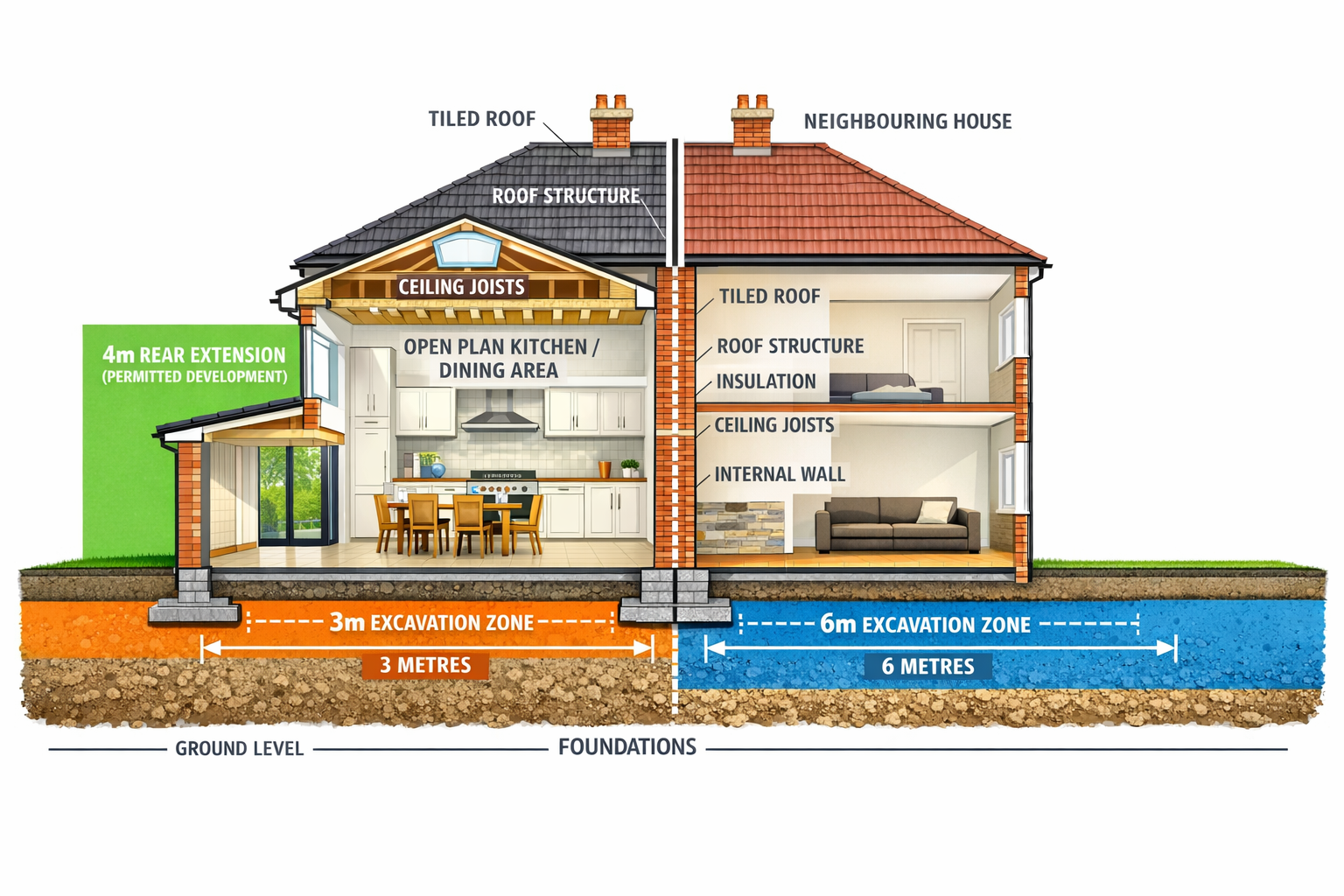
The Kitchen Extension Case Study: When the Party Wall Act Applies
Let's examine a typical scenario that illustrates Kitchen Extensions and the Party Wall Act: A Homeowner's Playbook for 2026 Projects in practice.
The Scenario: 4-Metre Rear Extension on a Semi-Detached Property
Property Details:
- Semi-detached house in North London
- Proposed single-storey rear extension: 4 metres deep × 5 metres wide
- Flat roof construction with large bifold doors
- Total floor area: 20m²
- Estimated cost: £45,000 (excluding party wall fees)
Permitted Development Assessment
Under 2026 regulations, this extension qualifies for permitted development rights because:
✓ Single-storey rear extension
✓ Maximum depth of 3 metres for semi-detached (this project is 4m, so planning permission required)
✓ Maximum height of 4 metres
✓ Not extending beyond the side of the house facing a road
✓ Total garden coverage not exceeding 50%[1]
Important: Even though permitted development might apply to smaller versions (3m depth), Building Regulations approval is always mandatory regardless of planning status[1].
Party Wall Act Requirements for This Extension
Despite potentially qualifying for permitted development (if reduced to 3m), this project triggers multiple Party Wall Act requirements:
1. Excavation Notice (Section 6) ✅ Required
The new extension requires foundations approximately 1 metre deep. The neighbouring semi-detached property sits within 3 metres of the proposed excavation, and the new foundations will be deeper than the existing house foundations. This automatically triggers Section 6 excavation notice requirements[1].
2. Party Structure Notice (Section 2) ⚠️ Possibly Required
If the extension ties into or affects the existing party wall between the semi-detached properties—for example, if removing an internal wall that provides lateral support to the party wall—a Party Structure Notice may also be necessary[4].
3. Line of Junction Notice (Section 1) ❌ Not Required
Since the extension doesn't build a new wall directly on the boundary line, this notice type doesn't apply to this scenario.
What Work Doesn't Require Party Wall Notices
It's important to understand that minor internal works do not trigger the Act. For this kitchen extension, the following activities proceed without party wall notices:
- Plastering internal walls
- Installing kitchen units and shelving
- Electrical work and plumbing
- Drilling internal walls for fixings
- Painting and decorating[3]
The Party Wall Act concerns structural work that could affect neighbouring properties, not finishing trades.
Serving Party Wall Notices: The Step-by-Step Process for 2026 Kitchen Extensions
Understanding how to properly serve party wall notices is crucial for keeping your kitchen extension project on schedule.
Timeline Requirements
Minimum 2 months' notice must be given before starting work[1]. This is a legal requirement, not a suggestion. Starting work before the notice period expires—or before receiving consent or an award—constitutes a breach of the Act and can result in injunctions stopping your work.
How to Serve Notice
You can serve notice yourself or appoint a surveyor to do so. The notice must include:
📋 Essential Information:
- Your name and address (the "Building Owner")
- Description of the proposed works
- Drawings showing the work location
- Expected start date (at least 2 months away)
- Statement of the relevant section of the Act
The notice must be delivered to all affected "Adjoining Owners"—anyone who shares the party wall or whose property falls within the excavation zones.
Three Possible Neighbour Responses
Once you serve notice, your neighbour has 14 days to respond in one of three ways:
Response 1: Consent ✅
Your neighbour agrees to the works in writing. This is the simplest outcome—you can proceed after the 2-month notice period without appointing surveyors. However, you should still prepare a schedule of condition documenting the neighbour's property before work begins.
Cost Impact: Minimal (£200-400 for professional photography)
Timeline Impact: None beyond the mandatory 2-month notice period
Response 2: Dissent ❌
Your neighbour formally objects to the works or requests modifications. This triggers the dispute resolution process requiring surveyor appointments.
Cost Impact: £1,500-£3,600 per neighbour[2]
Timeline Impact: Additional 4-8 weeks for award preparation[1]
Response 3: No Response 🔇
If your neighbour doesn't respond within 14 days, the Act treats this as a deemed dissent—exactly the same as a formal objection.
Cost Impact: £1,500-£3,600 per neighbour[2]
Timeline Impact: Additional 4-8 weeks for award preparation[1]

Party Wall Surveyors and Awards: What to Expect in 2026
When consent isn't given (or no response is received), the Act requires appointing surveyors to prepare a party wall award—a legal document setting out how the work will proceed and protecting both parties' interests.
Surveyor Appointment Options
You have two choices:
Option 1: Agreed Surveyor
Both parties agree to appoint a single surveyor who acts impartially. This is typically faster and cheaper.
Option 2: Two Surveyors
You appoint a Building Owner's surveyor, and your neighbour appoints an Adjoining Owner's surveyor. These two surveyors then select a third surveyor who would resolve any disputes (though this third surveyor rarely needs to act).
2026 Party Wall Surveyor Fees
Based on current London rates, expect to pay:
| Service | Cost Range (2026) |
|---|---|
| Building Owner's surveyor | £750-£1,200 per neighbour |
| Adjoining Owner's surveyor | £750-£1,200 per neighbour |
| Third surveyor (if required) | £500-£800 |
| Schedule of condition | £300-£600 |
| Total per neighbour | £1,500-£3,600 |
Critical Point: As the Building Owner initiating the works, you pay all reasonable surveyor fees—both your own surveyor and your neighbour's surveyor[2]. This is a legal requirement under the Act.
For detailed guidance on managing these expenses, review strategies on how to keep party wall costs down.
What Goes Into a Party Wall Award
The award is a comprehensive legal document typically including:
✓ Detailed description of the proposed works
✓ Schedule of condition documenting the neighbour's property before work
✓ Working hours and access arrangements
✓ Protection measures for the neighbour's property
✓ Insurance requirements
✓ Dispute resolution procedures
✓ Rights of inspection during construction
The award becomes binding on both parties once served. Understanding what is included in party wall awards helps set realistic expectations.
Timeline for Award Preparation
From initial dissent to final award typically takes:
- Weeks 1-2: Surveyor appointments and initial site visit
- Weeks 3-4: Schedule of condition preparation
- Weeks 5-6: Award drafting and review
- Weeks 7-8: Final award service and 14-day appeal period
Total: 6-10 weeks from dissent to being able to commence work[2]
Budgeting for Kitchen Extensions and the Party Wall Act: Complete 2026 Cost Breakdown
Understanding the full financial picture helps avoid nasty surprises mid-project.
Comprehensive Budget Example: 4m × 5m Kitchen Extension
| Cost Category | Amount (2026) | Notes |
|---|---|---|
| Construction costs | £40,000-£50,000 | Groundwork, structure, roof, glazing, finishes |
| Building Regulations | £800-£1,200 | Mandatory regardless of planning status |
| Planning application | £206 (if required) | Government fee for householder application |
| Architect/design | £1,500-£3,000 | Drawings for Building Regs and planning |
| Party Wall (1 neighbour, consent) | £200-£400 | Schedule of condition only |
| Party Wall (1 neighbour, dissent) | £1,500-£3,600 | Both surveyors plus award |
| Party Wall (2 neighbours, dissent) | £3,000-£7,200 | Multiplied by number of neighbours |
| Contingency (10%) | £4,000-£5,000 | Unexpected issues |
| TOTAL (consent scenario) | £47,000-£60,000 | Best-case timeline |
| TOTAL (1 dissent scenario) | £48,500-£63,000 | Add 2-3 months |
| TOTAL (2 dissent scenario) | £50,500-£67,000 | Add 2-3 months |
These figures align with industry data showing kitchen extension costs ranging from £25,000-£60,000+ depending on size and specifications[1].
Hidden Costs to Consider
Beyond the obvious construction and party wall fees, budget for:
🔧 Temporary kitchen facilities during the 8-12 week construction period
🏠 Increased buildings insurance during construction
📸 Professional photography for condition surveys
⚖️ Legal fees if disputes escalate (rare but possible)
🌳 Garden reinstatement after construction access
Common Mistakes and How to Avoid Them
Mistake 1: Assuming Permitted Development Means No Party Wall Requirements ❌
Reality: The Party Wall Act operates completely independently from planning permission. A permitted development extension still requires party wall notices if it involves excavation near boundaries or work to party structures[2].
Solution: Always assess party wall requirements separately from planning considerations.
Mistake 2: Starting Work Before the Notice Period Expires ❌
Reality: The 2-month notice period is a legal minimum. Starting early can result in injunctions, forced work stoppage, and legal costs.
Solution: Build the 2-month minimum (plus potential additional surveyor time) into your project timeline from day one.
Mistake 3: Failing to Budget for Neighbour's Surveyor Fees ❌
Reality: Many homeowners budget only for their own surveyor, not realising they must pay both sides' reasonable fees[2].
Solution: Budget £1,500-£3,600 per affected neighbour for the full surveyor process, not just your own surveyor's fees.
Mistake 4: Poor Communication with Neighbours ❌
Reality: Neighbours who feel blindsided are more likely to dissent, even if they don't object to the work itself.
Solution: Discuss your plans informally before serving formal notices. Good neighbour relations can save thousands in surveyor fees.
Mistake 5: Using Generic Notice Templates Without Professional Review ❌
Reality: Incorrectly worded or incomplete notices can be invalid, requiring re-service and extending timelines.
Solution: For complex projects, have a party wall surveyor review or serve notices on your behalf. The modest upfront cost prevents expensive delays.
Regional Considerations: Party Wall Act Application Across England and Wales
While the Party Wall Act 1996 applies uniformly across England and Wales, practical implementation varies by region:
London and Urban Areas
London sees the highest volume of party wall work, with approximately 95% of extension projects triggering Act requirements[2]. Surveyors in Central London, West London, East London, and South London are highly experienced with kitchen extension scenarios.
Urban characteristics:
- Higher density = more party walls and close boundaries
- More experienced surveyors available
- Neighbours more familiar with the process
- Slightly higher surveyor fees due to demand
Conservation Areas and Listed Buildings
Properties in conservation areas or listed buildings face additional restrictions beyond the Party Wall Act:
⚠️ Permitted development rights are often restricted or removed by Article 4 directions
⚠️ Full planning applications required even for minor extensions
⚠️ Heritage considerations may limit design options
⚠️ Longer approval timelines (12-16 weeks vs. 8 weeks standard)
Historic town centres including Canterbury, Rochester, and Tunbridge Wells have Article 4 restrictions covering thousands of properties[1].
Scotland and Northern Ireland
Critical: The Party Wall etc. Act 1996 does not apply in Scotland or Northern Ireland[3]. These jurisdictions have different legal frameworks:
- Scotland: Common law principles and the Title Conditions (Scotland) Act 2003
- Northern Ireland: Common law and party wall provisions in property deeds
If your property is near the England-Wales border with Scotland, verify which jurisdiction applies.
Building Regulations Compliance for 2026 Kitchen Extensions
While separate from the Party Wall Act, Building Regulations approval is mandatory and intersects with party wall considerations.
Key Building Regulations for Kitchen Extensions
Part A (Structure): Foundation design, structural calculations, beam specifications
Part B (Fire Safety): Means of escape, fire resistance of party walls
Part C (Site Preparation): Damp-proofing, drainage
Part L (Conservation of Fuel and Power): Thermal performance, glazing limits
Part M (Access): Level thresholds, door widths
Part L 2025 Updates: Glazing Restrictions
The 2025 version of Part L limits glazing to 25% of total floor area unless you demonstrate better-than-minimum performance elsewhere[1].
For a 20m² kitchen extension:
- Maximum glazing: 5m²
- Example: 3m wide bifold doors at 2.1m height (6.3m²) exceeds limit
- Solution: Reduce glazing or improve thermal performance elsewhere
Thermal Performance Requirements
Flat roofs using warm deck construction (insulation above the structural deck) are particularly effective for meeting Part L requirements[1]. Typical specification:
- Structural deck (timber or concrete)
- Vapour control layer
- 150-200mm PIR insulation boards
- Waterproof membrane
- Internal finish: plasterboard on battens (minimum 12.5mm tapered-edge boards)
Practical Timeline: Kitchen Extension with Party Wall Act Compliance
Here's a realistic timeline for Kitchen Extensions and the Party Wall Act: A Homeowner's Playbook for 2026 Projects:
Months 1-2: Planning and Design
- Architect consultation and design development
- Planning application submission (if required)
- Party wall assessment and neighbour discussions
Month 3: Formal Notices
- Serve party wall notices (2 months before intended start)
- Await neighbour responses (14-day deadline)
Months 4-5: Surveyor Process (if dissent)
- Surveyor appointments
- Schedule of condition preparation
- Award drafting and service
- 14-day appeal period
Month 6: Pre-Construction
- Building Regulations submission
- Contractor procurement
- Materials ordering
Months 7-9: Construction Phase
- Groundwork and foundations (2-3 weeks)
- Structural work and roof (3-4 weeks)
- First fix (plumbing, electrics) (1-2 weeks)
- Plastering and finishing (2-3 weeks)
- Final fit-out (1-2 weeks)
Month 10: Completion
- Building Control final inspection
- Snagging and remedial work
- Completion certificate
Total Timeline: 9-10 months from initial design to completion, including full party wall surveyor process.
Without party wall complications: 6-7 months
When to Seek Professional Help
You Should Appoint a Party Wall Surveyor If:
✓ Your neighbour has dissented or not responded
✓ The project involves complex structural work
✓ Multiple neighbours are affected
✓ You're unfamiliar with the Act's requirements
✓ Your neighbour has already appointed a surveyor
✓ The project value exceeds £40,000
DIY Notice Service May Work If:
✓ Simple, straightforward extension
✓ Good relationship with neighbour
✓ Only one neighbour affected
✓ You're comfortable with legal documentation
✓ Neighbour is likely to consent
For complex scenarios or if you're carrying out works affecting multiple properties, professional surveyor involvement from the outset saves time and money.
If you're on the receiving end, understanding your rights as someone whose neighbour is carrying out works is equally important.
Conclusion
Kitchen Extensions and the Party Wall Act: A Homeowner's Playbook for 2026 Projects requires understanding that the Party Wall etc. Act 1996 operates independently from planning permission and Building Regulations—yet all three must align for a successful project. The Act applies to approximately 95% of London extension projects, with excavation notices being the most common trigger for typical rear kitchen extensions.
Key actions for homeowners planning kitchen extensions in 2026:
- Assess party wall requirements early during the design phase, not after planning approval
- Budget realistically for £1,500-£3,600 per affected neighbour if surveyors are needed
- Serve notices at least 2 months before your intended start date—earlier if possible
- Communicate with neighbours before formal notices to build goodwill
- Appoint experienced surveyors if your neighbour dissents or doesn't respond
- Prepare schedules of condition even if neighbours consent
- Factor party wall timelines into your overall project schedule (add 2-4 months minimum)
The Party Wall Act exists to protect both building owners and neighbours, providing a clear framework for managing construction that affects shared structures or boundaries. While it adds cost and time, proper compliance prevents disputes, protects relationships, and ensures your dream kitchen extension proceeds legally and smoothly.
For more detailed information about the Party Wall etc. Act 1996 and how it applies to your specific circumstances, consult with a qualified party wall surveyor before serving notices or commencing work.
References
[1] Kitchen Extension Ideas – https://kentplastickers.co.uk/kitchen-extension-ideas/
[2] Party Wall Agreement London 2026 – https://www.mayfairstudio.co.uk/blog/party-wall-agreement-london-2026
[3] Party Wall Agreement – https://hoa.org.uk/advice/guides-for-homeowners/i-am-improving/party-wall-agreement/
[4] Rear Extensions And The Party Wall Act – https://www.peterbarry.co.uk/blog/rear-extensions-and-the-party-wall-act/
[5] Party Wall Agreements What You Need To Know – https://www.fmb.org.uk/find-a-builder/ultimate-guides-to-home-renovation/party-wall-agreements-what-you-need-to-know.html