


Starting a home extension or renovation project in 2026 can feel overwhelming, especially when navigating the maze of legal requirements. Should you serve a party wall notice or submit your planning application first? Understanding the correct sequence for party wall notice or planning permission first can mean the difference between a smooth build and months of expensive delays, strained neighbour relations, and mounting costs.
Many homeowners assume planning permission is the only hurdle, only to discover—often too late—that party wall notices operate on an entirely separate legal timeline that cannot be rushed or bypassed. This comprehensive guide walks through the optimal order for planning applications, building control, and party wall notices, complete with timelines, real-world scenarios, and strategic approaches to keep your project on track.
Key Takeaways
- Planning permission and party wall notices operate independently—planning approval does not exempt you from party wall requirements, and vice versa
- Party wall notice periods are legally mandated at 1-2 months and cannot be shortened, requiring strategic early action
- Optimal sequencing involves serving party wall notices early (even before planning submission) to run processes concurrently and avoid delays
- Timeline varies dramatically from 2.5 months (best case) to 9+ months (disputed cases), making early planning essential
- Building owners pay all surveyor costs, including neighbours' fees, with typical costs ranging £750-£1,800 per neighbour in London
Understanding the Two Separate Legal Frameworks 🏛️
Before determining whether party wall notice or planning permission first makes sense for your project, it's crucial to understand that these are completely independent legal requirements governed by different legislation.
Planning Permission: Local Authority Control
Planning permission falls under the Town and Country Planning Act and is administered by your local planning authority. It determines whether your proposed development is acceptable in terms of:
- Size and scale of the extension
- Impact on neighbouring properties (light, privacy, outlook)
- Design and materials
- Local planning policies and conservation areas
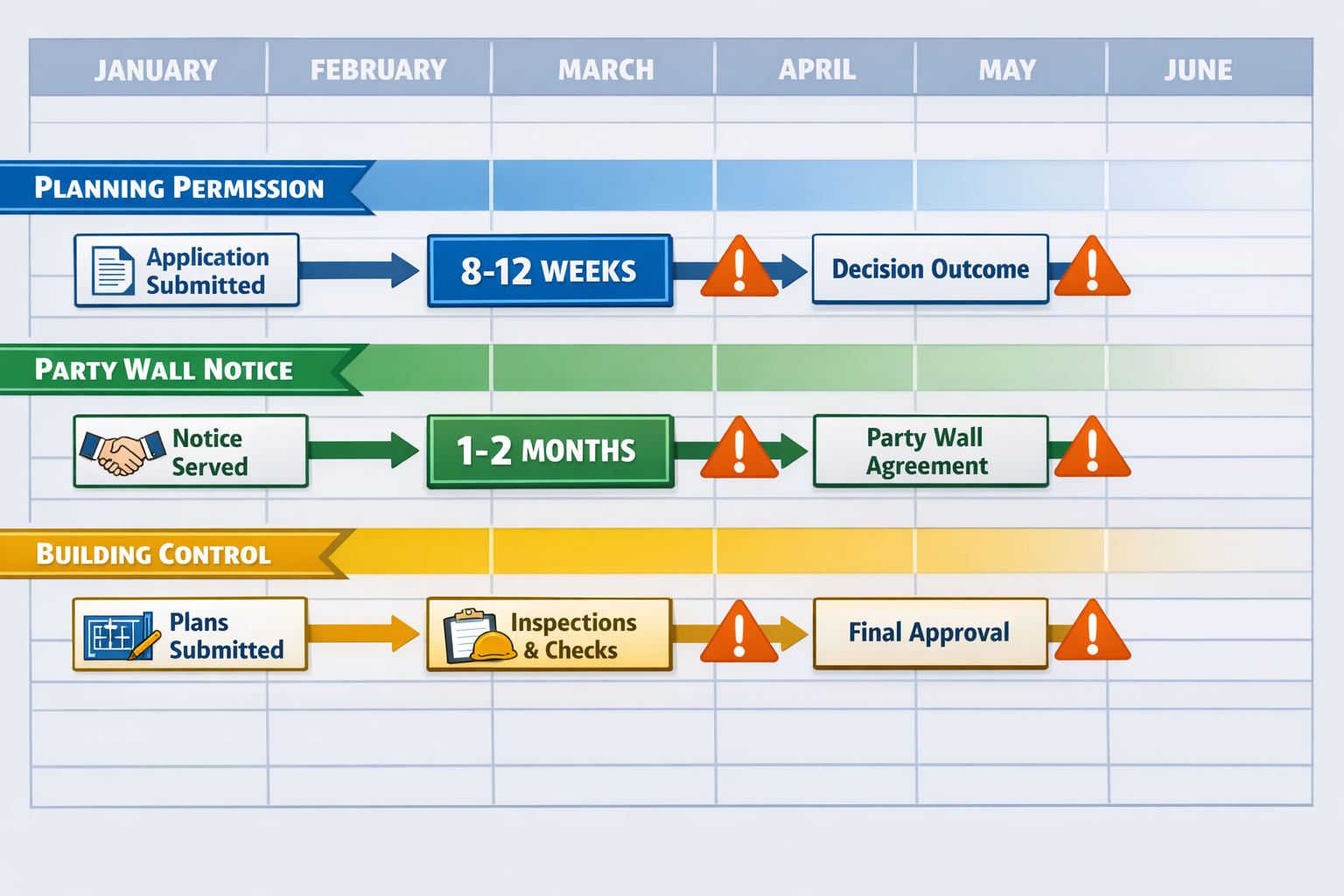
Standard planning applications typically take 8-12 weeks for a decision, though this can extend significantly for complex applications or if amendments are required.
Party Wall Act: Neighbour Protection
The Party Wall etc. Act 1996 is entirely separate legislation designed to protect both building owners and adjoining owners when construction work affects shared structures or boundaries. Critically, planning permission and the Party Wall Act operate independently—even if your extension qualifies as Permitted Development and requires no planning application, you must still follow the Party Wall Act if building on a boundary, cutting into a party wall, or excavating near a neighbour's foundation.[1]
You cannot use planning approval as a substitute for party wall compliance.[2]
When Party Wall Notices Are Required
Understanding what triggers party wall requirements is essential for proper sequencing:
Building on or at the boundary (Line of Junction Notice):
- New walls built directly on the boundary line
- Extensions that reach the side boundary
- Side return extensions (which always touch the boundary)[1]
Work to existing party walls (Party Structure Notice):
- Cutting into a party wall for beams or joists
- Raising, thickening, or underpinning a party wall
- Demolishing and rebuilding a party wall
Excavation work (Notice of Adjacent Excavation):
- Digging within 3 metres of a neighbour's foundations (if going deeper than their foundations)
- Excavating within 6 metres of a neighbour's foundations within a 45-degree angle from their foundation level
- Basement construction in London almost always triggers these notices[1]
Minor works exempt from party wall notices include plastering, electrical work, or drilling internal walls to fit kitchen units or shelving.[2]
The Critical Timing Question: Party Wall Notice or Planning Permission First?
The question of party wall notice or planning permission first doesn't have a one-size-fits-all answer, but understanding the mandatory timelines for each process reveals the optimal strategy.
Party Wall Notice Periods Are Non-Negotiable ⏰
Party wall notice periods are legally mandated and cannot be shortened. You must serve notice between 2 months and 1 year before works start. The specific period depends on work type[2][3]:
- 2 months' notice for building on/at the boundary (Line of Junction)
- 1 month's notice for excavation work or modifications to existing party walls (Party Structure Notice)
After you serve the notice, neighbours have 14 days to respond. If they don't respond within this period, non-response is deemed dissent, triggering the surveyor appointment process.[1]
Realistic Party Wall Timelines
According to 2026 industry data, the actual time from starting the party wall process to beginning construction varies significantly[1]:
Best-case scenario (neighbour consents promptly):
- 2.5-3 months from appointing a surveyor to starting on-site work
Standard case (neighbour dissents, Award needed):
- 3-4 months for the full party wall process
Difficult case (access denied, disputes, Third Surveyor involvement):
- 5-9 months or longer, particularly when surveyors disagree and third-party arbitration is needed
Planning Permission Timeline
Standard planning applications take 8-12 weeks from submission to decision, though this can extend if:
- The application requires amendments
- Neighbour objections are raised
- The proposal goes to committee
- Additional information is requested
The Strategic Answer: Start Party Wall Early 🎯
Given these timelines, the optimal strategy for most projects is to:
- Serve party wall notices as early as possible—even before submitting your planning application
- Submit planning application concurrently or shortly after serving party wall notices
- Run both processes in parallel to avoid sequential delays
This approach works because after serving notice, you have up to one year to start work,[2] providing flexibility in project scheduling despite the advance notice requirement.
Practical Sequencing Strategies for Different Project Types
The ideal sequence for party wall notice or planning permission first depends on your specific project circumstances.
Strategy 1: Concurrent Processing (Recommended for Most Projects)
Best for: Standard rear extensions, loft conversions, side returns
Sequence:
- Finalise architectural plans
- Serve party wall notices immediately (Month 0)
- Submit planning application (Month 0-1)
- Neighbour response period (14 days)
- Party wall surveyor appointment and Award process (Months 1-3)
- Planning decision received (Months 2-3)
- Commence construction (Month 3-4)
Advantages:
- Minimises overall project timeline
- Both approvals ready simultaneously
- Demonstrates professionalism to neighbours
- Reduces risk of last-minute delays
Strategy 2: Party Wall First (Conservative Approach)
Best for: Projects with uncertain planning outcomes, conservation areas, contentious designs
Sequence:
- Initial architectural concepts
- Serve party wall notices (Month 0)
- Begin party wall process
- Wait for neighbour response before finalising expensive architectural drawings
- Submit planning application (Month 1-2)
- Complete party wall Award (Months 2-3)
- Receive planning decision (Months 3-4)
- Commence construction (Month 4)
Advantages:
- Gauges neighbour sentiment early
- Avoids wasting money on detailed plans if neighbours object strongly
- Allows time to address neighbour concerns before planning submission
Strategy 3: Planning First (Risky but Sometimes Necessary)
Best for: Permitted Development projects, projects where planning is uncertain
Sequence:
- Submit planning application (Month 0)
- Receive planning decision (Months 2-3)
- Serve party wall notices (Month 3)
- Party wall process (Months 3-6)
- Commence construction (Month 6-7)
Disadvantages:
- Adds 2-4 months to overall timeline
- Planning approval may expire if party wall process is protracted
- Neighbours may feel blindsided
- Contractor availability may change during delays
⚠️ Warning: This approach often leads to the most delays and should generally be avoided unless you have specific reasons to prioritise planning approval.
Strategy 4: Permitted Development with Party Wall
Best for: Projects that don't require planning permission but do require party wall notices
Sequence:
- Confirm Permitted Development status with planning authority (Certificate of Lawfulness optional)
- Finalise construction drawings
- Serve party wall notices (Month 0)
- Complete party wall process (Months 1-3)
- Commence construction (Month 3)
Key point: Many homeowners mistakenly believe Permitted Development means no legal requirements. Understanding party wall requirements remains essential even when planning permission isn't needed.
Real-World Scenarios: How Sequencing Impacts Project Success

Case Study 1: The Delayed Rear Extension ❌
Project: Single-storey rear extension in South London
Mistake: Homeowner obtained planning permission first, then discovered party wall requirements when contractor was ready to start.
Timeline:
- Planning application submitted and approved: 10 weeks
- Party wall notice served (after planning): Week 11
- Neighbour dissented: Week 13
- Surveyor appointment and Award process: Weeks 13-26
- Total delay from planning approval to construction start: 16 weeks
Cost impact:
- Contractor rescheduling fees: £1,200
- Extended surveyor fees due to disputes: £2,400
- Increased material costs due to delay: £800
- Total additional cost: £4,400
Case Study 2: The Strategic Side Return ✅
Project: Side return extension in West London
Success: Homeowner consulted a party wall surveyor in West London before starting any formal processes.
Timeline:
- Party wall notice served: Week 0
- Planning application submitted: Week 1
- Neighbour consented to party wall: Week 2
- Party wall Award completed: Week 8
- Planning permission granted: Week 10
- Construction commenced: Week 11
Benefits:
- Minimal delays between approvals
- Neighbour felt respected and informed
- Contractor started on scheduled date
- Total timeline reduced by 12+ weeks compared to sequential approach
Case Study 3: The Basement Excavation Challenge ⚠️
Project: Basement conversion in Central London
Complexity: Required both planning permission and multiple party wall notices (both neighbours affected by excavation)
Approach:
- Engaged party wall surveyor in Central London for pre-application advice
- Served party wall notices to both neighbours: Week 0
- Submitted planning application: Week 2
- One neighbour consented, one dissented: Week 3
- Planning approved with conditions: Week 14
- Party wall Award completed (required Third Surveyor): Week 22
- Construction commenced: Week 23
Key lessons:
- Early professional advice saved months
- Concurrent processing prevented even longer delays
- Complex projects benefit most from expert sequencing guidance
Cost Implications of Poor Sequencing 💷
Understanding the financial impact of party wall notice or planning permission first sequencing helps justify the investment in proper planning.
Direct Party Wall Costs
Surveyor fees in London for 2026 typically range from £750-£1,800 per neighbour[1], with the building owner paying all surveyor costs, including the cost of the neighbour's surveyor if the neighbour dissents and a surveyor must be appointed on their behalf.[2][4]
For a typical project affecting two neighbours:
- Best case (both consent): £1,500-£2,000
- Standard case (one dissents): £2,500-£4,000
- Complex case (both dissent, disputes): £4,000-£7,000+
Learn more about how to keep party wall costs down.
Indirect Delay Costs
Poor sequencing creates additional expenses:
Contractor costs:
- Rescheduling fees: £500-£2,000
- Daily standing charges during delays: £150-£300/day
- Price increases if rebooked months later: 5-15%
Professional fees:
- Extended architect involvement: £500-£1,500
- Additional surveyor time for disputes: £1,000-£3,000
Opportunity costs:
- Extended temporary accommodation: £1,000-£3,000/month
- Lost rental income if investment property: £1,500-£4,000/month
- Stress and inconvenience: Immeasurable
The ROI of Proper Sequencing
Investing £500-£1,000 in professional advice upfront to optimise your sequencing can save £5,000-£15,000 in delay-related costs—a return of 500-1500%.
Step-by-Step Action Plan: Sequencing Your Project to Avoid Delays

Follow this practical roadmap to ensure party wall notice or planning permission first sequencing works for your project:
Phase 1: Pre-Planning (Weeks 1-2)
Week 1:
- ✅ Consult with an architect to develop initial design concepts
- ✅ Identify whether your project requires planning permission or qualifies as Permitted Development
- ✅ Determine which types of party wall works your project involves
- ✅ Engage a party wall surveyor for preliminary advice
Week 2:
- ✅ Finalise design sufficient for party wall notice (doesn't need to be as detailed as planning drawings)
- ✅ Prepare party wall notice documents
- ✅ Inform neighbours informally about your plans (builds goodwill)
- ✅ Commission detailed architectural drawings for planning application
Phase 2: Formal Notices (Weeks 3-4)
Week 3:
- ✅ Serve party wall notices to all affected neighbours
- ✅ Keep proof of service (recorded delivery or hand delivery with signature)
- ✅ Provide neighbours with explanatory letter and contact details for questions
Week 4:
- ✅ Submit planning application (if required)
- ✅ Monitor for neighbour responses to party wall notice (14-day window)
- ✅ Prepare for either consent or dissent scenarios
Phase 3: Concurrent Processing (Weeks 5-12)
Weeks 5-8:
- ✅ If neighbour consents: Proceed with documenting agreement
- ✅ If neighbour dissents: Appoint party wall surveyor (or agree on Agreed Surveyor)
- ✅ Surveyors conduct inspections and prepare Schedule of Condition
- ✅ Respond to any planning application queries
Weeks 9-12:
- ✅ Surveyors negotiate and draft Party Wall Award
- ✅ Receive planning decision
- ✅ Review and accept Party Wall Award
- ✅ Discharge any planning conditions
Phase 4: Pre-Construction (Weeks 13-14)
- ✅ Ensure all party wall documentation is complete
- ✅ Confirm planning permission is granted (if required)
- ✅ Notify Building Control
- ✅ Schedule contractor start date
- ✅ Provide neighbours with construction schedule and site manager contact
Phase 5: Construction Commencement (Week 15+)
- ✅ Begin construction in compliance with Party Wall Award conditions
- ✅ Maintain communication with neighbours
- ✅ Conduct any required ongoing inspections per Award
- ✅ Keep records of compliance with Award terms
Common Mistakes to Avoid When Sequencing Your Project
Mistake 1: Assuming Planning Permission Covers Everything
The problem: Many homeowners believe planning approval means they can start building immediately.
The reality: Planning permission and party wall compliance are separate legal requirements. Even with planning approval, starting work without serving required party wall notices is illegal and can result in injunctions, forced work stoppage, and legal costs.
Mistake 2: Leaving Party Wall Notices Until the Last Minute
The problem: Serving notices just before your planned construction start date.
The reality: The minimum notice periods (1-2 months) are just the beginning. If your neighbour dissents, the full process takes 3-4 months minimum, potentially 5-9 months for complex cases.[1]
Mistake 3: Not Budgeting for Party Wall Costs
The problem: Failing to include party wall surveyor fees in project budgets.
The reality: As the building owner, you pay all surveyor costs, including your neighbour's surveyor if they appoint one. Budget £1,500-£7,000+ depending on complexity.
Mistake 4: Poor Neighbour Communication
The problem: Serving formal notices without any prior informal discussion.
The reality: While not legally required, informing neighbours about your plans before formal notices builds goodwill and often leads to consent rather than dissent, saving months and thousands of pounds.
Mistake 5: Using Generic Templates Without Professional Review
The problem: Downloading free party wall agreement templates and serving them without professional input.
The reality: Incorrectly served notices may be invalid, requiring you to start the process again. Professional surveyors ensure notices are properly served and compliant.
When to Seek Professional Help
While understanding party wall notice or planning permission first sequencing is valuable, certain situations demand professional expertise:
Engage a Party Wall Surveyor When:
- Your project involves complex excavation work
- You're building in a high-value area where disputes are common
- Your neighbour has already indicated objections
- The project affects multiple neighbours
- You're unfamiliar with the Party Wall etc. Act 1996
- Time is critical and you need efficient processing
Engage a Planning Consultant When:
- Your project is in a conservation area
- Previous applications have been refused
- Local planning policies are complex
- Neighbour objections are anticipated
- The design is innovative or unusual
The Value of Integrated Advice
The most successful projects involve coordinated professional teams where architects, party wall surveyors, and planning consultants work together from the outset to optimise sequencing and minimise delays.
Frequently Asked Questions About Sequencing
Q: Can I submit my planning application and party wall notice on the same day?
A: Yes, absolutely. This is often the optimal approach, allowing both processes to run concurrently and minimising overall project timeline.
Q: What if my neighbour objects to both the planning application and the party wall notice?
A: These are separate processes. Neighbour objections to planning are considered by the planning authority but don't affect the party wall process. For party walls, objections (dissent) simply trigger the surveyor appointment process—they don't stop your project.
Q: Do I need party wall notices for Permitted Development projects?
A: Yes, if your Permitted Development project involves building on a boundary, working on a party wall, or excavating near a neighbour's foundations. Planning status and party wall requirements are completely independent.[1][2]
Q: How long do I have to start work after receiving approvals?
A: Planning permission typically lasts 3 years. For party walls, you must start within 12 months of serving the notice (or the date specified in the notice).[2]
Q: Can I speed up the party wall process by offering to pay my neighbour's surveyor fees upfront?
A: You're legally required to pay these fees anyway, so offering upfront doesn't accelerate the process. The timeline is determined by the surveyor inspection, negotiation, and Award preparation process, not payment.
Conclusion
Successfully navigating the question of party wall notice or planning permission first requires understanding that these are separate legal frameworks operating on different timelines. The optimal strategy for most projects involves serving party wall notices early—ideally before or concurrent with planning applications—to run both processes in parallel and avoid costly sequential delays.
The stakes are significant: poor sequencing can add 3-9 months to your project timeline and cost £5,000-£15,000+ in delays, rescheduling fees, and extended professional costs. Conversely, strategic sequencing with early party wall notice service can ensure approvals align perfectly with your construction schedule.
Your Next Steps:
- Assess your project requirements using the guidance in this article to determine which party wall notices you need
- Engage professionals early—consult with a party wall surveyor before finalising your timeline
- Develop a concurrent processing strategy that serves party wall notices while preparing your planning application
- Communicate proactively with neighbours before serving formal notices
- Budget appropriately for both party wall and planning costs
- Start the party wall process immediately rather than waiting for planning approval
Remember: the party wall notice periods are non-negotiable by law. Every week you delay serving notices is a week added to your overall project timeline. By understanding the proper sequence and acting strategically, you can avoid the costly delays that plague poorly planned projects and ensure your construction starts on schedule.
For expert guidance on your specific project, contact a qualified party wall surveyor who can review your plans and develop an optimised sequencing strategy tailored to your circumstances.
References
[1] Party Wall Agreement London 2026 – https://www.mayfairstudio.co.uk/blog/party-wall-agreement-london-2026
[2] Party Wall Agreement – https://hoa.org.uk/advice/guides-for-homeowners/i-am-improving/party-wall-agreement/
[3] When How Tell Them – https://www.gov.uk/party-walls-building-works/when-how-tell-them
[4] Top 8 Essential Steps For A Successful Uk House Extension – https://tacman.uk/top-8-essential-steps-for-a-successful-uk-house-extension/