


Picture this: you're planning a stunning basement extension beneath your London home, dreaming of extra living space and increased property value. Then your surveyor drops the bombshell—your Victorian neighbor's shallow foundations mean Deeper Foundations and Adjacent Excavations: When Section 6 of the Party Wall Act Really Bites applies to your project. Suddenly, you're navigating complex geometric tests, mandatory notices, and potential surveyor fees that could add thousands to your budget.
In 2026, as property owners increasingly dig deeper to maximize space in crowded urban areas, Section 6 of the Party Wall etc. Act 1996 has become more relevant than ever. This often-misunderstood provision governs excavations near neighboring buildings, and it catches many property developers off guard. The contrast between Victorian-era shallow foundations and modern deep basements creates a perfect storm where Section 6 requirements become unavoidable.
Understanding when and how Deeper Foundations and Adjacent Excavations: When Section 6 of the Party Wall Act Really Bites can save you from costly delays, legal disputes, and damaged neighbor relations. This comprehensive guide explores the critical rules, timelines, and practical steps you need to navigate adjacent excavation requirements successfully.
Key Takeaways
- The 3-metre and 6-metre rules determine when Section 6 applies based on excavation proximity and depth relative to your neighbor's foundations—understanding these geometric tests is essential for compliance
- Mandatory one-month notice period must be served before excavation begins, and neighbor silence for 14 days automatically triggers a dispute requiring surveyor involvement
- Victorian properties with shallow foundations frequently trigger Section 6 when adjacent to modern deep excavations, making trial pits and foundation surveys critical planning steps
- Surveyor fees range from £750–£1,800 per neighbor in London as of 2026, with the entire process typically taking 2–4 months from notice to award
- Failure to comply with Section 6 can result in injunctions halting your works, compensation claims, and significant project delays
Understanding Section 6: The Rules That Govern Deeper Foundations and Adjacent Excavations
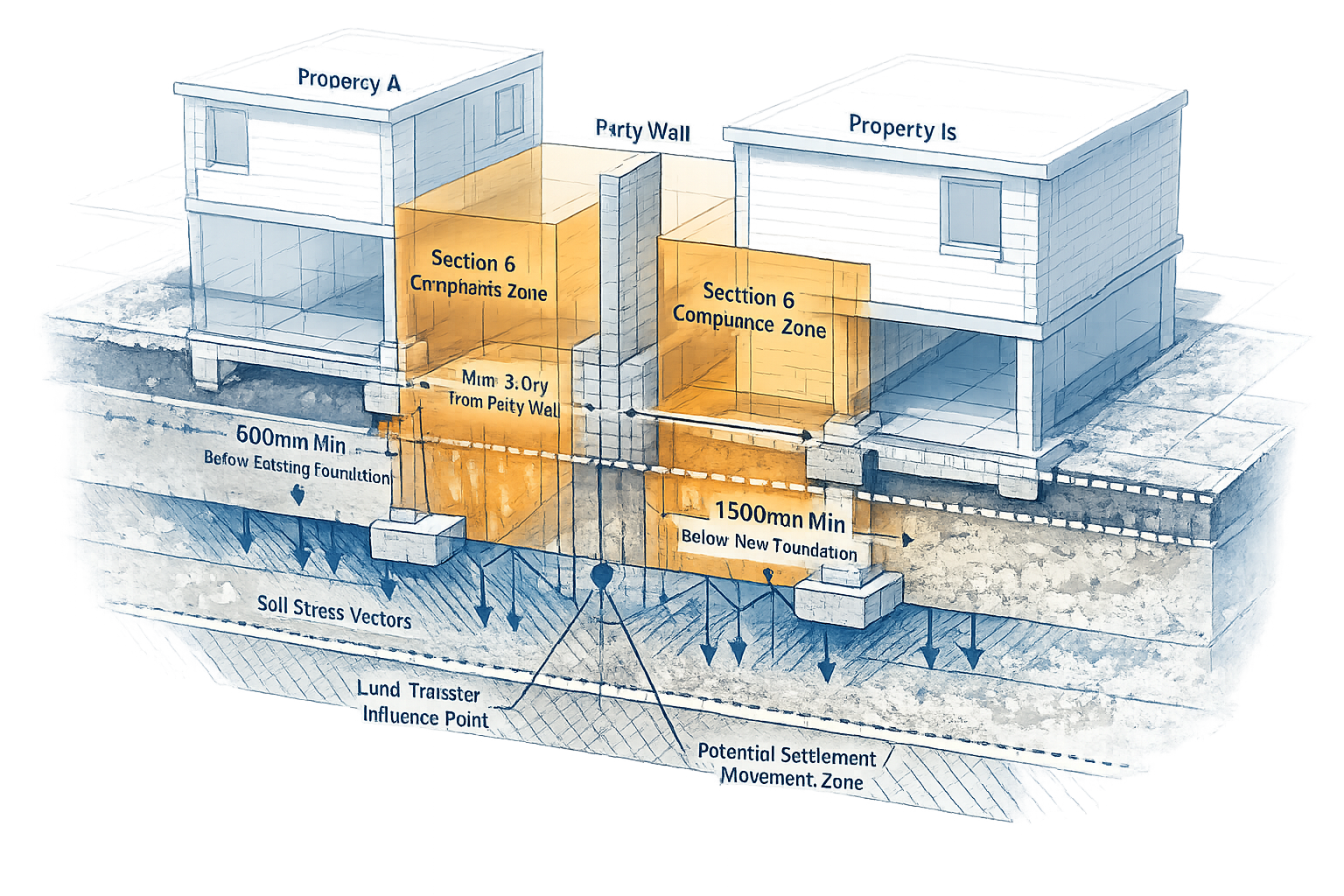
Section 6 of the Party Wall etc. Act 1996 exists to protect neighboring properties when excavation work occurs close to their foundations. Unlike Sections 1 and 2, which deal with work directly on shared walls, Section 6 addresses the risk of ground movement and foundation undermining when you dig near—but not necessarily touching—your neighbor's property.[1]
The 3-Metre Rule: When Proximity Triggers Protection
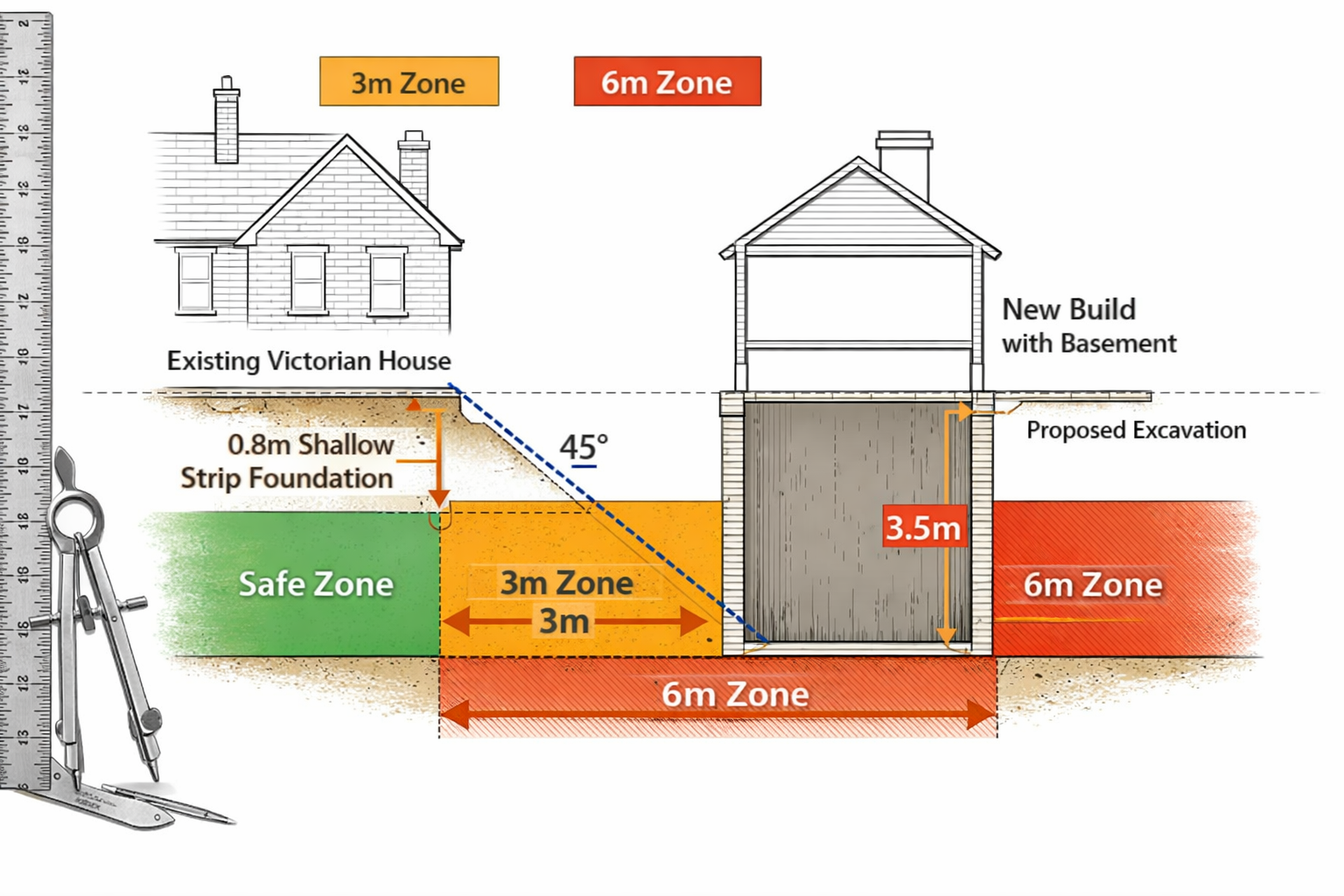
The first critical threshold involves excavations within three metres of a neighboring building. Section 6 applies when you excavate within this distance AND your excavation goes deeper than the bottom of your neighbor's foundations.[1][2]
This rule is straightforward in concept but requires accurate knowledge of your neighbor's foundation depth. Many Victorian and Edwardian properties in London have surprisingly shallow foundations—sometimes as little as 600-900mm below ground level. If you're planning a basement extension that goes 2.5 metres deep, you'll almost certainly trigger the 3-metre rule for adjacent period properties.
Key requirements under the 3-metre rule:
- Excavation must be within 3 metres of the neighboring building (measured horizontally)
- Your excavation must go below the neighbor's foundation base
- Both conditions must be met simultaneously
- The rule applies regardless of property type or construction method[1]
The 6-Metre Rule: The 45-Degree Geometry Test
The second threshold extends protection to excavations between 3 and 6 metres from a neighboring building. This rule uses a more complex geometric test: Section 6 applies when any part of your excavation meets an imaginary plane drawn downwards at 45 degrees from the bottom of your neighbor's foundations.[2]
Imagine drawing a line from the base of your neighbor's foundation, angling down at 45 degrees toward your property. If your proposed excavation cuts through this angled plane, Section 6 applies—even if you're not digging as deep as the neighbor's foundation level.
This geometric test catches many property owners by surprise. A basement extension 5 metres from your neighbor might seem safely distant, but if their foundations are shallow and your excavation is deep, the 45-degree plane test could still trigger Section 6 requirements.
What Types of Work Fall Under Section 6?
Section 6 applies to all excavation types that meet the distance and depth criteria, including:[1][3]
- 🏗️ New building foundations for extensions or standalone structures
- 🏚️ Basement excavations for conversions or new underground spaces
- 🔨 Underpinning works to strengthen existing foundations
- 🚧 Ground stabilization projects involving deep excavation
- 🏭 Utility installations requiring significant depth
The Act doesn't distinguish between residential and commercial projects—Section 6 applies equally to all building types. Even temporary excavations for drainage or service installations can trigger the requirements if they meet the depth and distance tests.
Victorian vs. Modern Properties: Why Foundation Depth Matters
The contrast between Victorian-era construction and modern building standards creates the most common Section 6 scenarios in 2026. Victorian terraced houses typically have:
- Shallow brick strip foundations (600-1200mm deep)
- Minimal ground investigation before construction
- Foundations designed for lighter loads than modern buildings
- No concrete reinforcement in many cases
Modern developments, by contrast, often feature:
- Deep concrete foundations (2-4 metres or more)
- Engineered pile foundations for heavy loads
- Basement levels requiring substantial excavation
- Comprehensive ground surveys and soil analysis
When these two building types sit adjacent to each other, Deeper Foundations and Adjacent Excavations: When Section 6 of the Party Wall Act Really Bites becomes almost inevitable. The modern property owner planning deep excavation must navigate Section 6 to protect the Victorian neighbor's shallow foundations.
For guidance on related boundary considerations, see our article on boundary wall rules and the difference between party fence walls and boundary walls.
The Section 6 Notice Process: Timelines, Requirements, and What Happens When Deeper Foundations and Adjacent Excavations Trigger Compliance
Once you've determined that Section 6 applies to your excavation project, you must follow a strict statutory process that begins with serving proper notice to your neighbors. Understanding these procedural requirements is essential to avoid delays and legal complications.
Serving the Section 6 Notice: One-Month Minimum
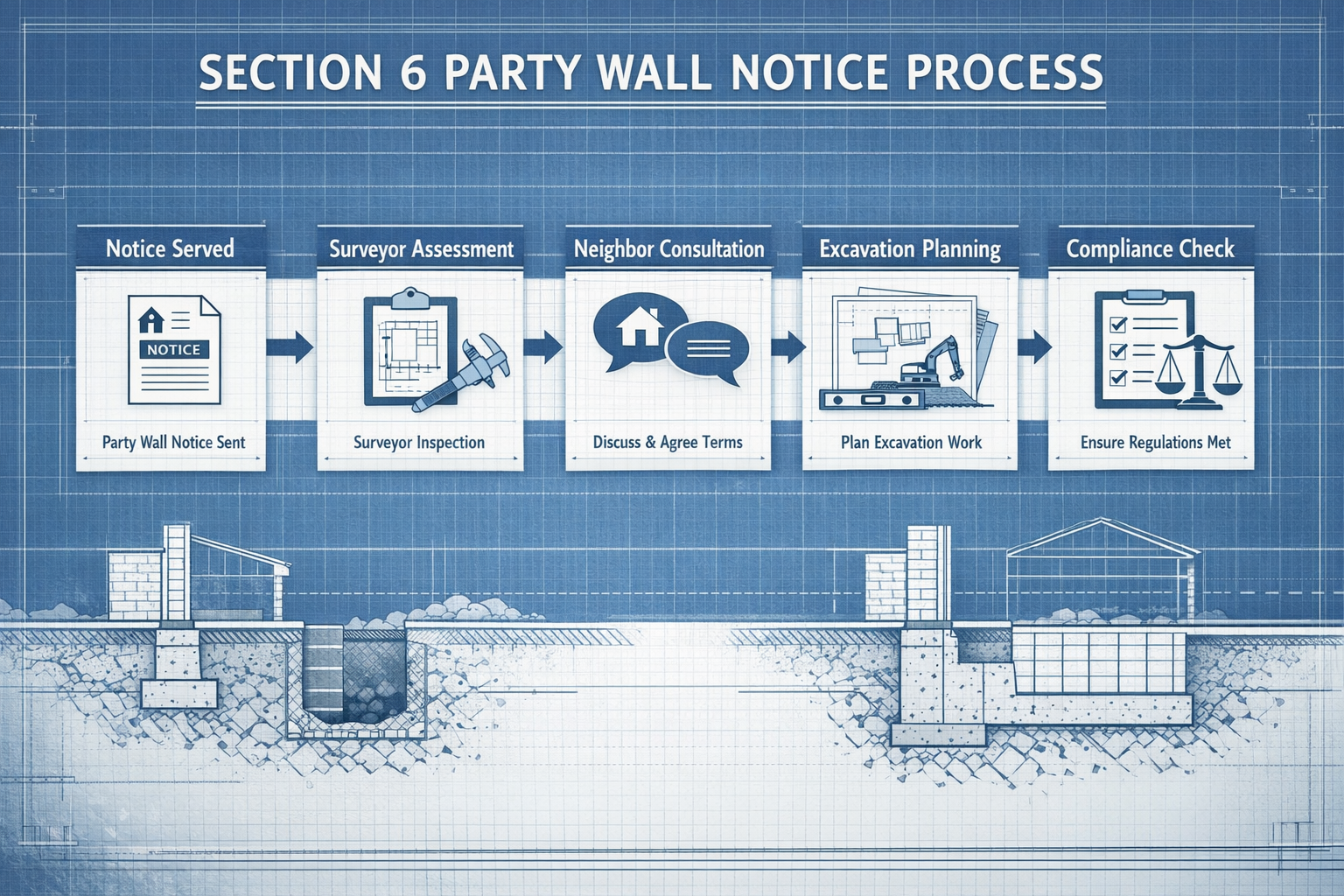
Before any excavation work begins, you must serve a Section 6 notice to all affected adjoining owners at least one month before your planned start date.[1][2] This notice period is mandatory—you cannot begin excavation earlier, even with neighbor consent.
The notice must include specific technical information:[1][2]
- Planned starting date for excavation works
- Detailed drawings showing the extent and depth of excavation
- Cross-sections illustrating the relationship to neighboring foundations
- Description of excavation methods and temporary support measures
- Proposed underpinning or strengthening works (if applicable)
Unlike informal neighbor discussions, the Section 6 notice is a legal document with formal requirements. Many property owners benefit from professional assistance when preparing notices to ensure compliance. Learn more about serving party wall notices effectively.
The 14-Day Consent Window: Silence Means Dispute
After receiving your Section 6 notice, your neighbor has 14 days to respond in writing with either consent or dissent.[2][4] This timeline is critical because of a unique provision in the Party Wall Act: if your neighbor doesn't respond within 14 days, their silence is automatically treated as dissent.[2][4]
This "deemed dissent" rule surprises many property owners who assume silence means acceptance. In reality, the opposite is true—failure to respond triggers the same dispute resolution process as active disagreement.
Three possible outcomes:
- Written consent within 14 days → Works can proceed after the one-month notice period expires
- Written dissent within 14 days → Dispute resolution process begins immediately
- No response within 14 days → Deemed dissent triggers dispute resolution automatically[2][4]
When Dispute Arises: Surveyor Appointment Requirements
When dissent occurs (either express or deemed), both parties must appoint surveyors to resolve the dispute through a Party Wall Award.[3] You have two options:
Option 1: Agreed Surveyor
Both parties jointly appoint a single surveyor to act impartially for both sides. This approach is typically faster and more cost-effective, with one set of fees shared between parties.
Option 2: Two Surveyors
Each party appoints their own surveyor, and these two professionals then select a third surveyor to act as arbitrator if they cannot agree. This approach provides independent representation but increases costs and complexity.
The surveyor(s) will:
- Inspect both properties and assess foundation conditions
- Review excavation plans and construction methods
- Determine necessary protective measures
- Prepare a Party Wall Award documenting agreed procedures
- Specify monitoring requirements and condition surveys[3]
For detailed information on the award process, visit our guide on party wall awards.
The 12-Month Validity Period: Use It or Lose It
Section 6 notices have a 12-month validity period from the date of service.[2][4] If you haven't started the excavation works within this timeframe, or if you begin but don't pursue the works "with due diligence," the notice expires and you must serve a fresh notice to proceed.
This provision prevents indefinite uncertainty for adjoining owners. However, it can create complications if your project faces unexpected delays from planning permissions, financing, or other contractors. Many property owners serve Section 6 notices only when they have firm construction schedules to avoid expiration issues.
Trial Pits and Foundation Surveys: Essential Preliminary Work
Before you can accurately complete a Section 6 notice or determine whether the 3-metre or 6-metre rules apply, you need to know your neighbor's actual foundation depth. This information rarely exists in historical building records for Victorian properties.
Trial pits offer the most reliable solution. These small exploratory excavations, dug near the boundary, allow surveyors to:
- Measure precise foundation depth
- Assess foundation type and condition
- Identify soil conditions and stability
- Determine appropriate protection measures
While trial pits require neighbor cooperation and access, they're often essential for accurate Section 6 compliance. The cost of a trial pit investigation (typically £300-£800) is minimal compared to the risk of proceeding with inaccurate assumptions about foundation depths.
Cost Implications: What to Budget in 2026
The financial impact of Section 6 compliance extends beyond surveyor fees. Property owners should budget for:
| Cost Element | Typical Range (2026) |
|---|---|
| Trial pit investigation | £300-£800 per location |
| Party wall surveyor fees | £750-£1,800 per neighbor[5] |
| Condition survey and photography | £400-£900 |
| Award preparation | Included in surveyor fees |
| Monitoring equipment | £500-£2,000 |
| Additional underpinning (if required) | £1,500-£3,000 per metre |
The building owner typically bears all reasonable costs associated with the Section 6 process, including the adjoining owner's surveyor fees. For strategies to manage expenses, see our article on how to keep party wall costs down.
Understanding the costs of the party wall process helps you budget accurately for your project.
Practical Protection Measures: What the Award Requires When Deeper Foundations and Adjacent Excavations Proceed
Once surveyors have assessed the situation and prepared a Party Wall Award, the document will specify detailed protective measures you must implement during excavation. These requirements ensure your neighbor's property remains safe and any damage is properly documented and compensated.
Condition Surveys: Establishing the Baseline
Before any excavation begins, the award typically mandates a comprehensive Schedule of Condition for the adjoining property.[2] This detailed survey documents:
- Existing cracks, settlement, or structural issues
- Photographic evidence of all rooms and external elevations
- Measurements of significant defects
- Overall structural condition assessment
The Schedule of Condition serves as crucial evidence if disputes arise later about whether your works caused damage. Without this baseline documentation, distinguishing pre-existing conditions from new damage becomes nearly impossible. Learn more about the importance of a schedule of condition.
Method Statements and Temporary Works
The Party Wall Award will specify approved excavation methods and temporary support requirements:[2]
- Shoring systems to support excavation sides
- Temporary propping for adjacent structures if needed
- Excavation sequence to minimize ground movement
- Dewatering controls if groundwater is present
- Vibration limits for machinery operation
These specifications aren't suggestions—they're legally binding requirements. Your contractor must follow the approved methods or risk breach of the award, which could result in work stoppages and legal action.
Underpinning Rights and Obligations
Section 6 grants you both the right and, where necessary, the duty to underpin or otherwise strengthen your neighbor's foundations to prevent damage.[2] If surveyors determine that your excavation would undermine the adjacent property without additional support, the award will specify:
- Underpinning extent and methodology
- Concrete mix specifications and curing times
- Sequence of underpinning sections
- Monitoring requirements during underpinning
- Quality control and inspection procedures
Underpinning represents a significant additional cost (typically £1,500-£3,000 per linear metre in 2026), but it's often unavoidable when Victorian shallow foundations sit adjacent to modern deep excavations. The building owner bears this cost as part of the project.
Monitoring During Excavation
To detect any movement or damage early, awards typically require continuous monitoring throughout the excavation period:[2]
- Crack monitoring gauges installed on existing cracks
- Tilt sensors on walls near the excavation
- Leveling surveys to detect settlement
- Vibration monitoring during excavation and piling
- Regular inspections by the appointed surveyor(s)
Monitoring data must be recorded and shared with all parties. If readings exceed agreed thresholds, work must stop immediately while surveyors assess the situation and determine appropriate remedial measures.
Compensation and Making Good
The Party Wall Act imposes clear obligations on building owners:[2]
"The building owner must not cause unnecessary inconvenience and must compensate any adjoining owner and occupier for loss or damage resulting from the works."
This compensation duty covers:
- Physical damage to the property requiring repair
- Loss of amenity during works (noise, dust, access restrictions)
- Diminution in value if permanent damage occurs
- Professional fees for surveyors and legal advice
- Alternative accommodation if the property becomes uninhabitable
Awards often include provisions for security for expenses, where the building owner deposits funds or provides a bond to guarantee compensation payment if damage occurs. This protects adjoining owners from the risk that the building owner might be unable to pay for damage they cause.
Special Foundations and Neighbor's Land
The Act contains an important restriction: you cannot place special foundations (such as reinforced concrete piles or raft foundations) on your neighbor's land without their prior written consent.[2] This limitation applies even if the award otherwise authorizes your works.
If your structural engineer determines that the most effective foundation solution requires elements extending onto neighboring land, you must negotiate separate permission beyond the Party Wall Act framework. This often involves:
- Formal license agreements
- Payment for land use rights
- Indemnity provisions
- Restoration obligations
Hoarding, Access, and Site Management
When excavation requires opening or accessing your neighbor's land, the award will specify requirements for:[2]
- Protective hoarding to secure the site
- Access arrangements and timing restrictions
- Site cleanliness and debris management
- Noise and dust control measures
- Emergency contact procedures
These practical provisions help minimize disruption to adjoining owners while ensuring safe working conditions. Violation of these requirements can constitute breach of the award and may result in legal enforcement action.
Regional Considerations Across London
Section 6 requirements apply throughout England and Wales, but practical implementation varies by location. Property owners in different London areas may benefit from local expertise:
- Party wall surveyors in Central London handle complex multi-story developments
- Party wall surveyors in West London frequently work with Victorian terraces
- Party wall surveyors in South London navigate varied property types
- Party wall surveyors in North London address hillside excavation challenges
- Party wall surveyors in East London manage new development areas
Finding a surveyor with experience in your specific area can streamline the process and ensure local building characteristics are properly addressed.
Common Pitfalls and How to Avoid Them
Even with professional guidance, property owners frequently encounter preventable problems when Deeper Foundations and Adjacent Excavations: When Section 6 of the Party Wall Act Really Bites. Awareness of these common pitfalls helps you navigate the process more smoothly.
❌ Assuming Section 6 Doesn't Apply
Many property owners mistakenly believe Section 6 only applies to large commercial developments or extreme excavations. In reality, even modest basement conversions frequently trigger the 3-metre or 6-metre rules when adjacent to Victorian properties with shallow foundations.
Solution: Conduct early foundation investigations and consult with a party wall surveyor during project planning, not after construction contracts are signed.
❌ Delaying Notice Service
Waiting until the last minute to serve Section 6 notices creates unnecessary time pressure. Remember that the one-month notice period is a minimum, and if dissent occurs, the surveyor appointment and award process typically adds 2-4 months to your timeline.[5]
Solution: Serve notices at least 3-4 months before your planned excavation start date to accommodate potential surveyor involvement without delaying construction.
❌ Inadequate Neighbor Communication
While formal notices are legally required, informal communication with neighbors beforehand often prevents disputes. Many neighbors consent to works when they understand the project, timeline, and protective measures—but react negatively to unexpected formal notices without context.
Solution: Discuss your plans with neighbors before serving formal notices. Explain the works, timeline, and protections you'll implement. Good relationships often lead to consent rather than dissent.
❌ Ignoring the 14-Day Deemed Dissent Rule
Property owners sometimes assume neighbor silence means approval and proceed with works, only to face legal action later. Remember: no response within 14 days automatically triggers the dispute process.[2][4]
Solution: Follow up with neighbors after serving notices to ensure they received the documents and understand the 14-day response requirement. Consider using tracked delivery methods to prove service.
❌ Proceeding Without an Award When Required
Some property owners attempt to bypass the surveyor process to save costs, proceeding with excavation after serving notice but before obtaining an award. This constitutes a breach of the Act and can result in:
- Injunctions halting your works immediately
- Compensation claims for any damage
- Legal costs for enforcement proceedings
- Significant project delays while compliance is achieved
Solution: Never begin excavation until either written consent is received or a Party Wall Award is in place. The cost of compliance is always less than the cost of legal disputes.
❌ Choosing Surveyors Based Solely on Cost
While managing expenses is important, selecting the cheapest surveyor can prove costly if they lack experience with Section 6 complexities. Inexperienced surveyors may:
- Fail to identify necessary protective measures
- Prepare inadequate awards that don't protect either party
- Miss critical foundation issues during inspections
- Create disputes through poor communication
Solution: Select surveyors based on relevant experience, professional qualifications, and recommendations. The difference between a £900 and £1,200 surveyor fee is minimal compared to the cost of problems caused by inadequate professional service.
Conclusion: Navigating Section 6 Successfully in 2026
Deeper Foundations and Adjacent Excavations: When Section 6 of the Party Wall Act Really Bites represents a critical compliance area for property owners planning excavation work near neighboring buildings. The contrast between Victorian-era shallow foundations and modern deep construction creates frequent Section 6 scenarios across London and other urban areas in 2026.
Success requires understanding the 3-metre and 6-metre geometric tests, serving proper notices with adequate lead time, and engaging qualified surveyors when disputes arise. While the process adds time and cost to excavation projects, it provides essential protection for both building owners and their neighbors.
Key Success Factors
✅ Investigate early – Determine neighbor foundation depths through trial pits before finalizing excavation plans
✅ Serve notices promptly – Allow 3-4 months before planned excavation to accommodate the notice period and potential surveyor involvement
✅ Communicate proactively – Discuss plans with neighbors informally before serving formal notices
✅ Engage qualified professionals – Select experienced party wall surveyors with relevant Section 6 expertise
✅ Document thoroughly – Ensure comprehensive condition surveys before works begin
✅ Monitor continuously – Implement required monitoring systems and respond immediately to concerning readings
✅ Budget realistically – Include surveyor fees, monitoring costs, and potential underpinning in project budgets
Next Steps for Your Project
If you're planning excavation work that may trigger Section 6 requirements:
- Assess applicability – Determine whether the 3-metre or 6-metre rules apply to your project
- Conduct foundation surveys – Arrange trial pits or investigations to establish neighbor foundation depths
- Consult professionals – Engage a qualified party wall surveyor for guidance on notice requirements
- Prepare comprehensive notices – Include all required technical information and drawings
- Serve notices timely – Allow adequate time for the statutory process before your construction schedule
- Maintain good neighbor relations – Communicate openly throughout the process
For professional assistance with Section 6 excavation notices and awards, explore our comprehensive party wall services or contact experienced surveyors who can guide you through the process.
Understanding when and how Deeper Foundations and Adjacent Excavations: When Section 6 of the Party Wall Act Really Bites transforms a potential legal minefield into a manageable compliance process. With proper planning, professional guidance, and proactive communication, you can protect both your project and your neighbor's property while achieving your construction goals in 2026 and beyond.
References
[1] Knowledge Article Section 6 Party Wall Act – https://www.aylingassociates.com/knowledge-article-section-6-party-wall-act.html
[2] Party Wall Section 6 Explained The 3m 6m Excavation Rules – https://www.ansteyhorne.co.uk/news/party-wall-section-6-explained-the-3m-6m-excavation-rules
[3] Section%206%20party%20wall%20act – https://www.designingbuildings.co.uk/wiki/Section%206%20Party%20Wall%20Act
[4] Section – https://www.legislation.gov.uk/ukpga/1996/40/section/6
[5] Party Wall Agreement London 2026 – https://www.mayfairstudio.co.uk/blog/party-wall-agreement-london-2026