

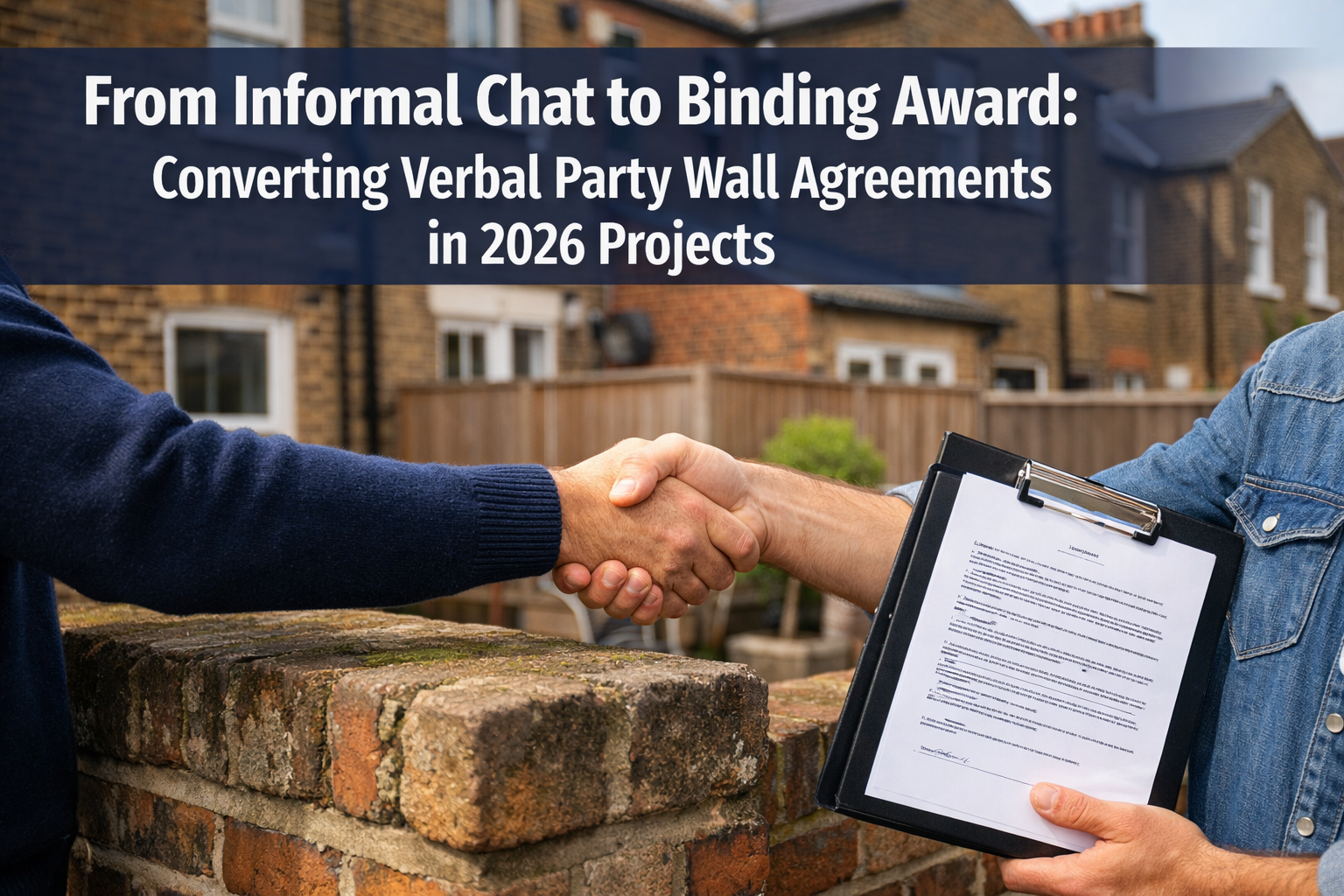
A friendly conversation over the garden fence might seem like enough to start your home renovation—but when it comes to party wall matters, a handshake won't protect you. With renovation activity surging across London and the UK in 2026, understanding how to transform informal neighbour consent into legally binding documentation has never been more critical. The process of from informal chat to binding award: converting verbal party wall agreements in 2026 projects can mean the difference between a smooth construction experience and costly legal disputes.
Despite good intentions, thousands of homeowners each year discover that their verbal agreements hold no legal weight under the Party Wall etc. Act 1996. This comprehensive guide details the step-by-step process to formalize neighbour consent into a legal party wall award, helping you avoid common pitfalls that plague terraced home renovations.
Key Takeaways
- ✅ Verbal agreements are not legally valid under the Party Wall etc. Act 1996—all party wall matters require written documentation
- 📋 Formal Party Wall Awards provide legal protection for both building owners and adjoining owners throughout construction projects
- 🏘️ Terraced homes face unique challenges with multiple shared walls requiring careful documentation and surveyor involvement
- ⚡ Converting informal consent to binding awards follows a specific seven-step process that must be completed before works begin
- 💰 Proper documentation prevents disputes that can cost thousands in legal fees and construction delays
Understanding Why Verbal Agreements Fail Under the Party Wall Act
The Party Wall etc. Act 1996 establishes clear requirements for any work affecting shared walls, boundaries, or excavations near neighbouring properties. Written consent is mandatory—there are no exceptions for friendly neighbours or simple projects.
The Legal Framework in 2026
The Act requires building owners to serve formal party wall notices on adjoining owners at least two months before starting work (one month for excavation work). Adjoining owners must respond in writing within 14 days. Without written consent, a Party Wall Award becomes necessary.
Why verbal agreements create problems:
- 🚫 No legal enforceability in court
- 🚫 No protection if damage occurs during construction
- 🚫 No clear record of agreed working hours or methods
- 🚫 No mechanism for dispute resolution
- 🚫 Potential for neighbour to change mind mid-project
"The single biggest mistake homeowners make is assuming a friendly chat replaces formal party wall procedures. We see dozens of cases each month where verbal agreements collapse when construction actually begins." — Senior Party Wall Surveyor, London
Common Scenarios Where Informal Agreements Break Down
Terraced home renovations present particular challenges. Consider these typical situations:
| Scenario | Why Verbal Agreement Fails | Proper Solution |
|---|---|---|
| Loft conversion affecting party wall | No record of agreed structural changes | Formal award with structural engineer specifications |
| Kitchen extension at boundary | Neighbour disputes foundation depth | Award with detailed excavation schedule |
| Removing chimney breast | Disagreement about support beam installation | Award specifying structural support requirements |
| Basement excavation | Concerns about underpinning emerge | Award with condition survey and monitoring protocol |
In 2026, with property values at record highs, neighbours are increasingly protective of their investments. What begins as a cordial conversation can quickly deteriorate when construction noise, dust, or concerns about property damage arise.
The Step-by-Step Process: From Informal Chat to Binding Award in 2026 Projects
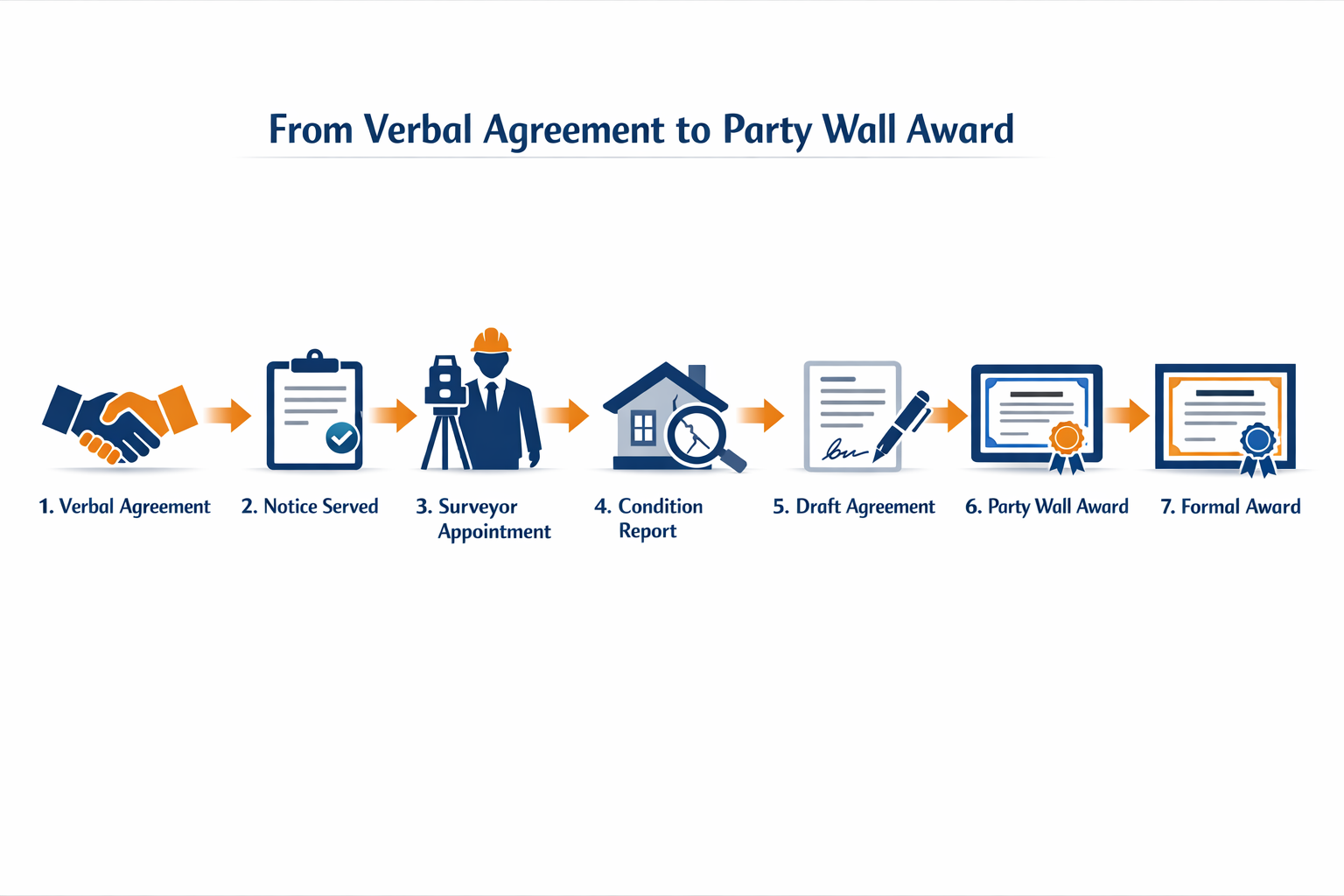
Converting informal neighbour consent into a legally binding Party Wall Award requires following a structured process. Here's the complete roadmap for 2026 projects.
Step 1: Document the Informal Agreement (Immediately) ✍️
Even though verbal agreements aren't legally binding, documenting initial conversations provides a foundation:
- Write a follow-up email summarizing the discussion
- Include specific details about proposed works
- Note any concerns the neighbour raised
- Request written confirmation of their understanding
- Keep all correspondence in a dedicated project folder
This documentation proves you acted in good faith and can smooth the formal process.
Step 2: Prepare Detailed Plans and Specifications 📐
Before serving formal notices, prepare comprehensive documentation:
Essential documents include:
- Architectural drawings showing party wall locations
- Structural engineer calculations (if required)
- Detailed work schedule with timings
- Method statements for sensitive operations
- Access requirements and logistics plans
Professional plans demonstrate seriousness and help neighbours understand exactly what you're proposing. This transparency builds trust during the formal process.
Step 3: Serve Formal Party Wall Notice ⚖️
This is where informal becomes formal. You must serve the correct type of notice based on your works:
Notice types:
- Party Structure Notice — for work directly to the party wall
- Line of Junction Notice — for new walls at the boundary
- 3-Metre/6-Metre Notice — for excavations near neighbouring foundations
The notice must include specific information required by the Act. Using a party wall agreement template ensures compliance, but professional surveyor preparation is recommended for complex projects.
Critical timing requirements:
- Serve at least two months before starting party structure work
- Serve at least one month before excavation work
- Allow 14 days for neighbour response
Step 4: Await Neighbour's Written Response 📨
Your adjoining owner has three options after receiving formal notice:
- Consent in writing — works can proceed with written agreement
- Dissent or not respond — Party Wall Award becomes necessary
- Consent with conditions — negotiate specific requirements
Approximately 70% of neighbours either dissent or don't respond within 14 days in 2026, making the Award process standard rather than exceptional.
Step 5: Appoint Party Wall Surveyors 👷
When consent isn't given, surveyors must be appointed:
Two appointment options:
- Agreed Surveyor — single surveyor acting impartially for both parties (most cost-effective)
- Two Surveyors — each party appoints their own surveyor, who may appoint a Third Surveyor if needed
The building owner typically pays all reasonable surveyor fees. Understanding how to keep party wall costs down helps manage expenses during this phase.
Surveyor responsibilities include:
- Inspecting the party wall and adjoining property
- Preparing a Schedule of Condition
- Determining fair working methods
- Setting reasonable working hours
- Establishing dispute resolution procedures
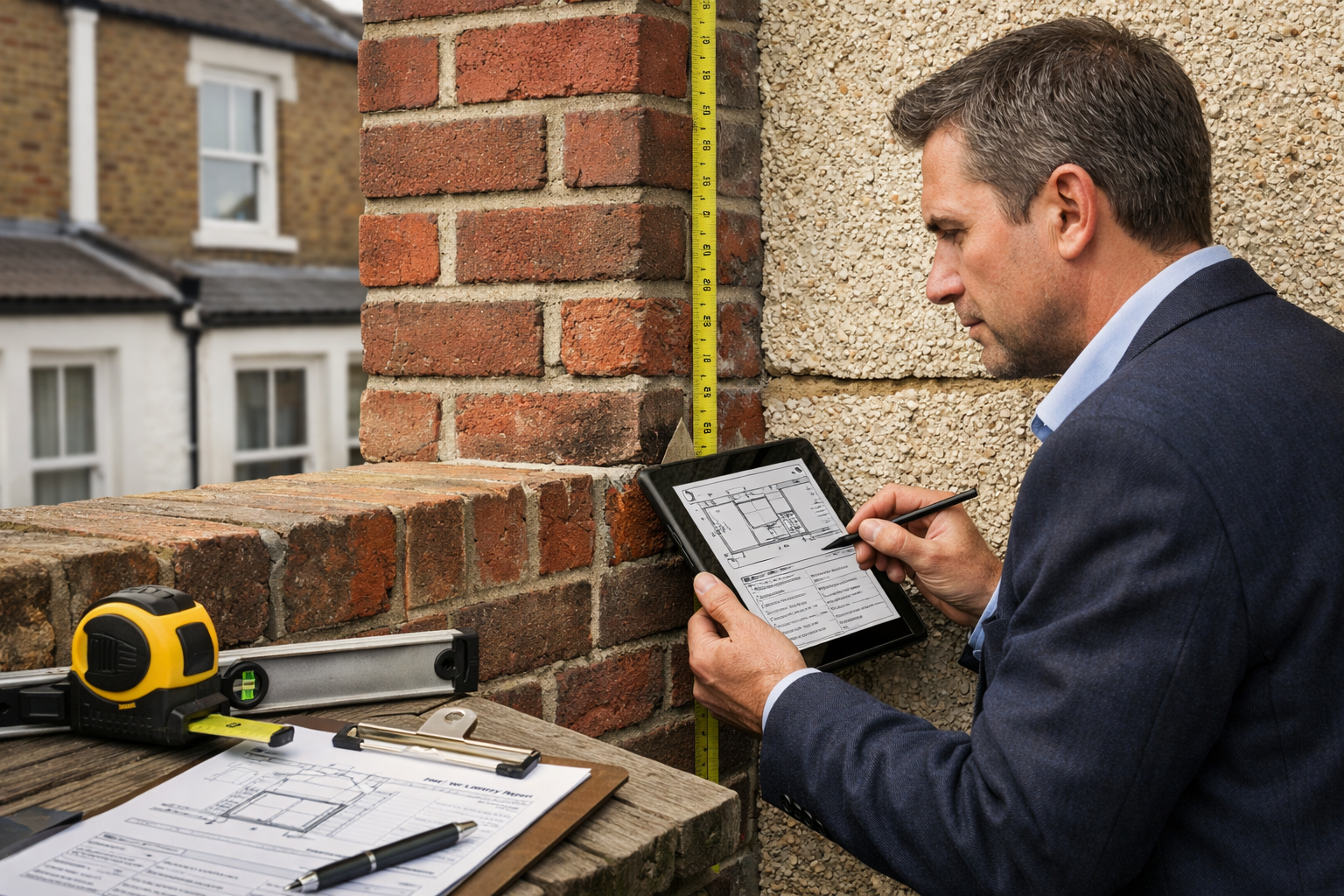
Step 6: Schedule of Condition Survey 📸
Before any work begins, surveyors conduct a detailed condition survey of the adjoining owner's property:
The survey documents:
- Existing cracks, settlement, or defects
- Photographic evidence of current condition
- Detailed written descriptions
- Measurements and locations of all defects
This creates a baseline that protects both parties. If damage occurs during construction, the Schedule proves what existed beforehand versus what resulted from the works.
For terraced homes, this survey is particularly crucial because pre-existing settlement and historic movement are common. Without clear documentation, disputes about responsibility for cracks or damage become inevitable.
Step 7: Issue the Party Wall Award 📜
The surveyors prepare and serve the formal Party Wall Award, which includes:
Standard Award contents:
- ✅ Description of proposed works
- ✅ Working hours and days
- ✅ Access arrangements
- ✅ Noise and dust mitigation measures
- ✅ Security and safety requirements
- ✅ Insurance requirements
- ✅ Dispute resolution procedures
- ✅ Compensation provisions (if applicable)
The Award is legally binding on both parties and provides the framework for the entire project. It transforms informal understanding into enforceable obligations.
Both parties have 14 days to appeal the Award to the County Court. If no appeal is made, the Award becomes final and works can proceed according to its terms.
Critical Pitfalls to Avoid When Converting Verbal Agreements
Even with the best intentions, homeowners frequently encounter problems when formalizing party wall arrangements. Recognizing these pitfalls helps you navigate from informal chat to binding award: converting verbal party wall agreements in 2026 projects successfully.
Pitfall 1: Delaying the Formal Process ⏰
The mistake: Relying on verbal agreement and only starting formal procedures when the builder is ready to start work.
The consequence: The minimum two-month notice period delays your entire project. Builders may charge waiting fees or move to other jobs.
The solution: Begin the formal party wall process immediately after receiving planning permission, even while finalizing other arrangements. The timeline runs concurrently with other preparations.
Pitfall 2: Incomplete or Vague Work Descriptions 📝
The mistake: Serving notices with general descriptions like "loft conversion" without specific structural details.
The consequence: Neighbours become suspicious and are more likely to dissent. Surveyors cannot prepare adequate Awards without complete information.
The solution: Include comprehensive specifications, drawings, and method statements with your initial notice. Detail exactly what structural work will affect the party wall.
Pitfall 3: Assuming Good Relations Eliminate Legal Requirements 🤝
The mistake: Thinking "we get along well, so we don't need formal documentation."
The consequence: When construction disruption begins, even the best neighbour relationships can deteriorate. Without legal protection, disputes have no resolution framework.
The solution: Explain to neighbours that formal procedures protect both parties. A proper Party Wall Award ensures fair treatment and provides recourse if problems arise.
Pitfall 4: Choosing the Wrong Surveyor 🔍
The mistake: Appointing a surveyor based solely on lowest cost or builder recommendation without checking qualifications.
The consequence: Inadequate Awards that miss critical protections, leading to disputes during construction.
The solution: Select surveyors who are:
- Members of the Faculty of Party Wall Surveyors (FPWS)
- Experienced with your specific type of work
- Knowledgeable about local building practices
- Independent from your builder
For London projects, consider specialists in your area such as party wall surveyors in North London, East London, South London, or West London who understand regional construction patterns.
Pitfall 5: Neglecting the Schedule of Condition 📋
The mistake: Rushing through or skipping the condition survey to save time or money.
The consequence: No evidence of pre-existing conditions means you may be blamed (and financially liable) for damage you didn't cause.
The solution: Insist on a thorough, photographic Schedule of Condition. For terraced homes, request surveys of properties on both sides, as vibration and settlement can affect multiple neighbours.
Pitfall 6: Failing to Follow Award Terms 🚧
The mistake: Treating the Award as a formality and not ensuring builders comply with its specific requirements.
The consequence: Neighbours can halt work, claim breach of the Award, and seek injunctions or damages.
The solution:
- Provide builders with complete copies of the Award
- Include Award compliance in construction contracts
- Conduct regular compliance checks
- Document adherence to working hours and methods
Surveyor Checklists for Terraced Home Projects in 2026
Terraced homes present unique challenges for party wall procedures. Professional surveyors use specialized checklists to ensure nothing is overlooked.
Pre-Notice Checklist for Building Owners 🏠
Before serving notice on terraced home neighbours:
- Identify all party walls (often 2-3 in terraced properties)
- Determine if works affect party walls, boundaries, or require excavation
- Obtain architectural and structural drawings showing party wall locations
- Verify property boundaries with Land Registry documents
- Identify all adjoining owners (including leaseholders if applicable)
- Prepare detailed work specifications and timelines
- Budget for surveyor fees (typically £700-£1,500 per neighbour)
- Schedule allows for 2-month notice period minimum
- Consider whether works qualify under types of party wall works
Surveyor's Award Preparation Checklist 📋
Professional surveyors ensure Awards for terraced homes include:
Structural considerations:
- Load-bearing capacity of existing party walls
- Foundation depths and underpinning requirements
- Chimney breast removal support specifications
- Joist bearing and insertion details
- Steel beam installation methods
- Temporary support requirements
Practical arrangements:
- Specific working hours (typically 8am-6pm weekdays)
- Weekend and bank holiday restrictions
- Access routes through property
- Scaffolding and equipment placement
- Waste removal and storage locations
- Parking arrangements for contractors
Protection measures:
- Dust suppression methods
- Noise limitation requirements
- Vibration monitoring for sensitive works
- Floor and wall protection during access
- Security arrangements for access points
- Insurance certificate requirements
Documentation requirements:
- Photographic Schedule of Condition (minimum 50 photos for typical terraced home)
- Video walkthroughs for high-value properties
- Detailed written descriptions of all rooms
- Measurements of existing cracks and defects
- External elevation condition records
- Drainage and services locations
Post-Award Compliance Checklist ✅
Once the Award is issued, building owners should:
- Provide Award copies to all contractors
- Confirm builders understand working hour restrictions
- Schedule pre-commencement meeting with surveyors
- Establish communication protocol with neighbours
- Arrange progress inspections at key stages
- Document compliance with photographic evidence
- Address neighbour concerns promptly
- Maintain access for surveyor inspections
- Keep detailed records of all party wall-related communications
Understanding Costs: From Verbal Agreement to Binding Award
Converting informal agreements to formal Awards involves costs that many homeowners underestimate in 2026.
Typical Cost Breakdown 💰
Agreed Surveyor approach (most economical):
- Surveyor fees: £700-£1,200 per adjoining owner
- Schedule of Condition: £300-£500 per property
- Award preparation: £400-£600
- Total per neighbour: £1,400-£2,300
For a mid-terrace property with two adjoining owners: £2,800-£4,600 total
Two Surveyor approach:
- Building Owner's surveyor: £1,000-£1,800
- Adjoining Owner's surveyor: £800-£1,500 (paid by Building Owner)
- Third Surveyor (if required): £1,200-£2,000
- Schedules of Condition: £300-£500 per property
- Total per neighbour: £2,100-£3,800
For a mid-terrace property: £4,200-£7,600 total
These costs are in addition to construction expenses and represent the price of legal protection. Attempting to avoid them through verbal agreements often results in far greater costs when disputes arise.
Hidden Costs of Skipping Formal Procedures ⚠️
Homeowners who rely on verbal agreements and skip formal party wall procedures risk:
- Construction delays: Injunctions halting work (£5,000-£15,000 in lost time and legal fees)
- Damage claims: Without Schedule of Condition, defending against claims becomes nearly impossible (£3,000-£20,000+)
- Legal disputes: Court proceedings to resolve party wall matters (£10,000-£50,000+)
- Relationship breakdown: Permanent damage to neighbour relations (priceless)
The formal Award process is insurance against these far more expensive outcomes.
When Professional Help Becomes Essential
While some straightforward party wall matters can be handled without a surveyor, most 2026 renovation projects benefit from professional involvement.
Projects Requiring Professional Surveyors 👨💼
Mandatory professional involvement:
- Structural alterations to party walls
- Loft conversions affecting party walls
- Basement excavations
- Removing chimney breasts
- Installing steel beams through party walls
- Underpinning near boundaries
- New buildings at the boundary line
Recommended professional involvement:
- High-value properties (£500,000+)
- Listed buildings or conservation areas
- Properties with existing structural issues
- Difficult neighbour relationships
- Complex multi-party situations
- Commercial property conversions
Selecting the Right Party Wall Surveyor 🎯
Key qualifications to verify:
- Membership in Faculty of Party Wall Surveyors (FPWS)
- Professional indemnity insurance (minimum £1 million)
- Local experience with similar property types
- Understanding of Party Wall etc. Act 1996 requirements
- Clear fee structure and timeline estimates
Questions to ask potential surveyors:
- How many Awards have you prepared for terraced homes?
- What is your typical timeline from appointment to Award?
- Do you recommend Agreed Surveyor or separate surveyors for my situation?
- What are your fees, and what do they include?
- How do you handle disputes during construction?
- Can you provide references from recent similar projects?
The 2026 Landscape: Rising Renovation Activity and Party Wall Implications
The UK property market in 2026 sees unprecedented renovation activity, driven by several factors:
- Property prices making moving prohibitively expensive
- Remote work creating demand for home office conversions
- Energy efficiency requirements driving structural upgrades
- Planning reforms making extensions easier to approve
This surge in renovation work means more party wall situations than ever before. Neighbours who previously had no party wall experience now find themselves navigating the process, often with unrealistic expectations based on informal conversations.
Modern Communication Challenges 📱
Digital communication has created new complications for party wall procedures:
WhatsApp and text messages feel binding but aren't legally valid. Homeowners exchange dozens of messages with neighbours, believing they've secured agreement, only to discover these don't satisfy the Act's written consent requirements.
Email communications can form part of the evidence trail but don't replace formal notices and Awards. Proper service of party wall notices requires specific formats and delivery methods.
Social media misunderstandings where neighbours post about planned works can create expectations that don't align with legal requirements.
The solution: Treat all digital communications as preliminary discussions only. Always follow up with formal written notices and procedures as required by the Act.
Conclusion: Protecting Your 2026 Project with Proper Documentation
The journey from informal chat to binding award: converting verbal party wall agreements in 2026 projects requires diligence, patience, and proper legal procedures. While friendly neighbour conversations provide a helpful foundation, they cannot replace the formal protections that written Party Wall Awards deliver.
Essential Actions for Building Owners 🎯
Before starting any party wall work:
- Serve formal notices at least two months before planned start date
- Appoint qualified surveyors if neighbours dissent or don't respond
- Insist on thorough Schedules of Condition documenting existing property state
- Obtain a comprehensive Party Wall Award covering all aspects of the work
- Ensure builders understand and comply with Award requirements
- Maintain open communication with neighbours throughout the project
- Document everything with photos, emails, and written records
Protecting Your Investment 💼
For terraced home owners in London and across the UK, party wall procedures represent essential protection for what is likely your largest financial asset. The costs of formal procedures—typically £3,000-£5,000 for a standard terraced property renovation—pale in comparison to the potential costs of disputes, delays, and damage claims.
Next Steps for Your 2026 Project 🚀
If you're planning renovation work:
- Review your plans to identify all party wall implications
- Consult a qualified party wall surveyor for preliminary advice
- Budget appropriately for party wall costs and timelines
- Begin formal procedures early to avoid project delays
- Maintain positive neighbour relations while following legal requirements
If you've already had informal conversations:
- Don't assume verbal agreement is sufficient — begin formal procedures immediately
- Document previous discussions in writing for the record
- Explain to neighbours why formal procedures benefit everyone
- Engage professional surveyors to guide the conversion process
The Party Wall etc. Act 1996 exists to protect both building owners and adjoining owners. By converting informal agreements into binding Awards, you ensure your 2026 renovation project proceeds smoothly, legally, and with full protection for all parties involved.
Remember: a friendly chat over the fence is a wonderful starting point, but only a formal Party Wall Award provides the legal foundation for successful construction work. Invest the time and resources to do it properly, and you'll avoid the stress, expense, and relationship damage that informal approaches inevitably create.