


The construction industry in 2026 faces unprecedented challenges as global tariffs and supply chain disruptions drive material costs to record highs. For property owners planning building works in London, these economic pressures extend beyond bricks and mortar—they're reshaping the landscape of party wall surveyor fees and awards. Understanding Tariffs and Rising Material Costs: Impact on Party Wall Surveyor Fees and Awards in 2026 has become essential for anyone navigating the Party Wall etc. Act 1996.
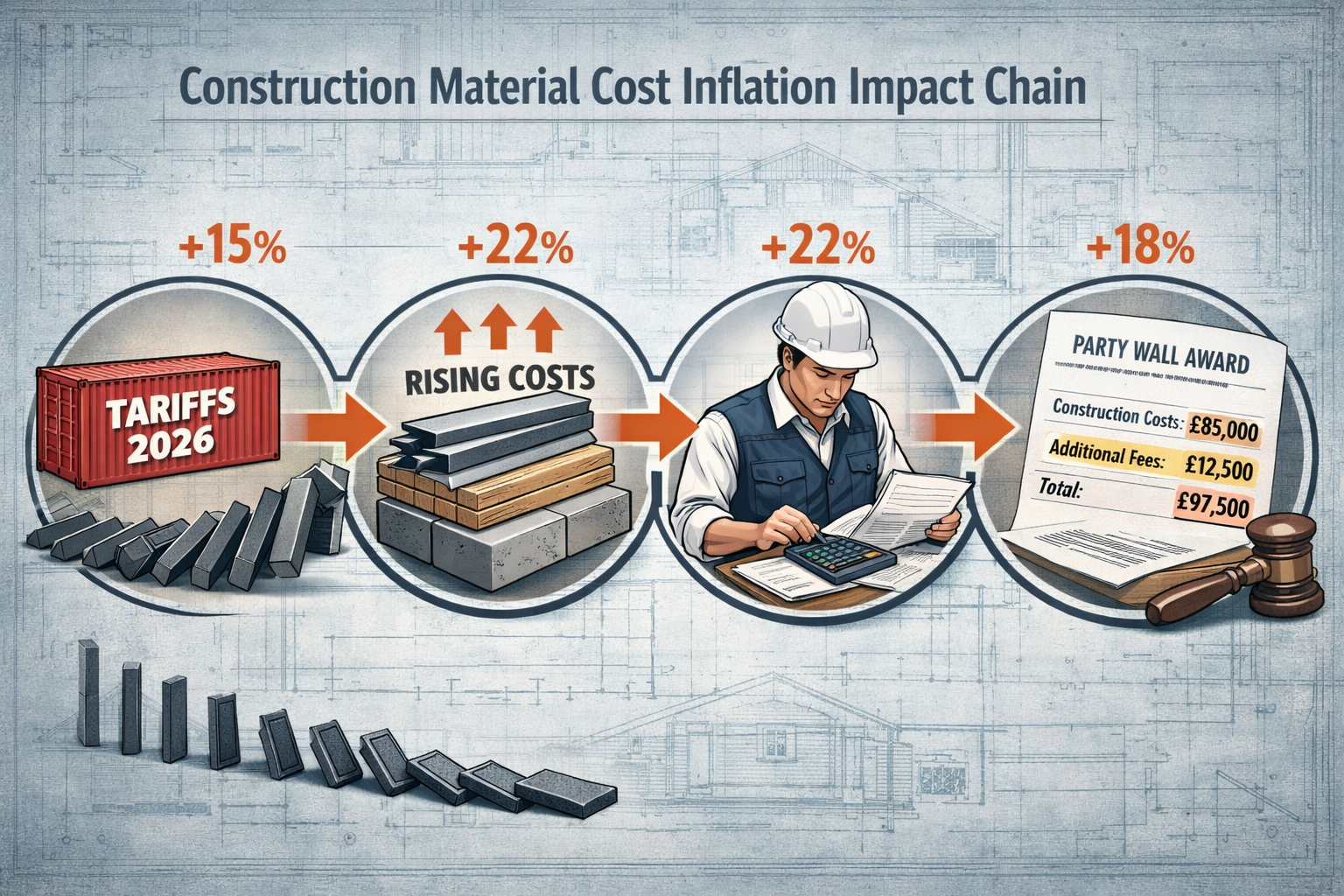
As steel prices surge by 22% and timber costs climb 18% compared to 2024 levels, the ripple effects touch every aspect of construction projects. Party wall surveyors must now account for these escalating expenses when preparing awards, while building owners face mounting pressure to budget accurately for both construction and compliance costs. The question isn't whether fees will increase—it's how to prepare strategically for these changes.
Key Takeaways
- Party wall surveyor fees in London range from £750–£1,800 per surveyor per affected neighbour in 2026, with total costs typically £1,500–£3,600, representing modest increases driven by inflation and project complexity[1]
- Tariffs and material cost inflation directly impact party wall awards by increasing repair cost estimates, security deposits, and the overall scope of surveyor assessments required for construction projects
- Building owners bear full responsibility for all party wall surveyor fees under the Party Wall Act 1996, making accurate budgeting critical as costs rise[1]
- Using a single agreed surveyor can save £100–£800 per neighbour compared to appointing separate surveyors, offering a strategic cost-mitigation approach[1]
- Complex basement projects with multiple neighbours can exceed £12,000 in total party wall costs as of 2026, requiring careful financial planning[1]
Understanding Party Wall Surveyor Fees in 2026
Current Fee Structures and Ranges
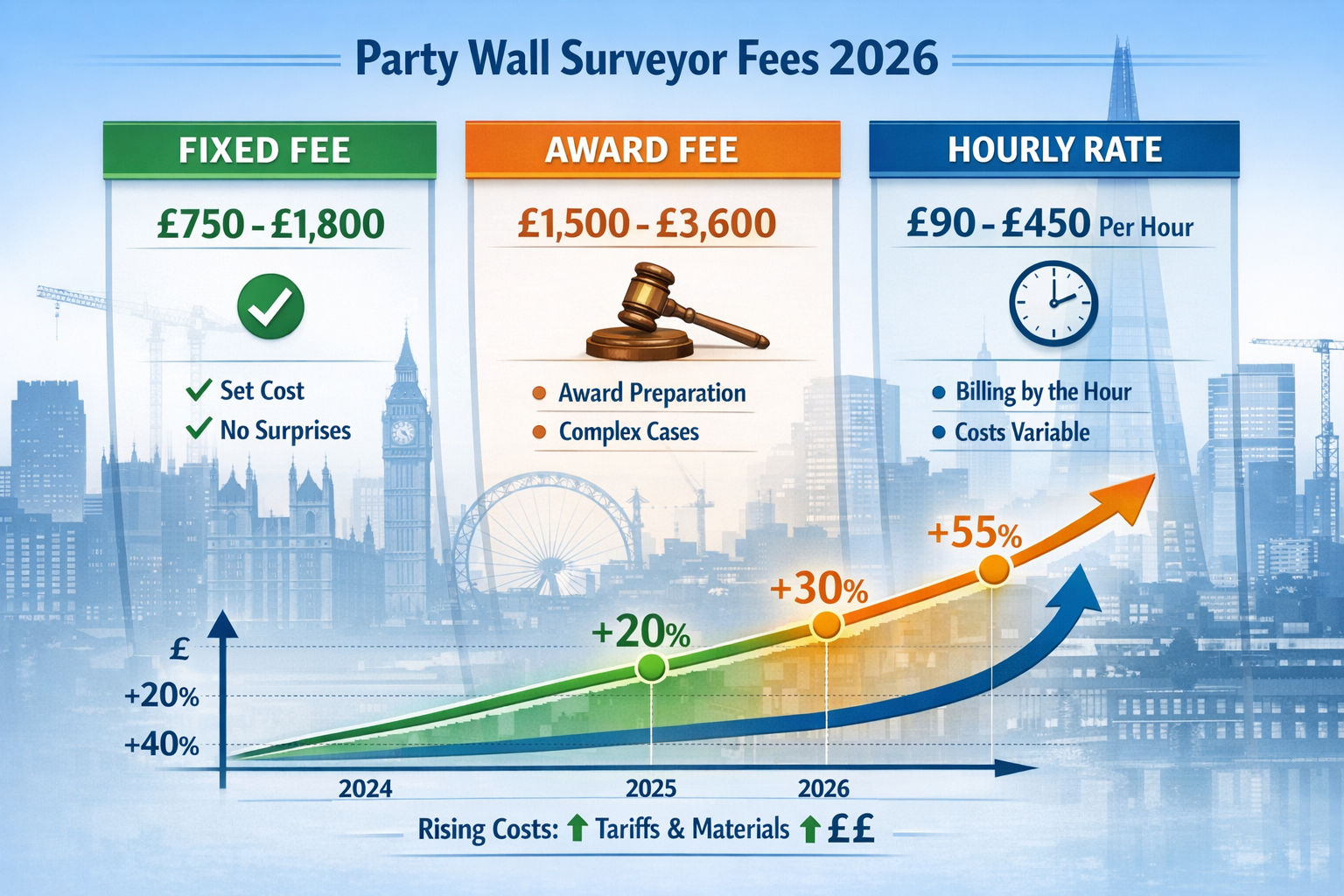
Party wall surveyor fees are not regulated by law—the Party Wall etc. Act 1996 does not mandate fixed pricing, allowing surveyors to charge reasonable fees based on time invested and work complexity[2]. In 2026, three primary fee structures dominate the market:
Fixed Fees provide certainty for straightforward projects, typically covering specific services like schedule of condition reports or single-wall assessments. These range from £750–£1,800 per surveyor depending on property type and work scope[1].
Award Fees represent comprehensive party wall services including notices, schedules, awards, and dispute resolution. For 2026, expect total costs of £1,500–£3,600 per affected neighbour when using separate surveyors[1].
Hourly Rates apply to ongoing monitoring, complex disputes, or bespoke services, typically charging £90–£450 per hour based on surveyor experience and project demands[2].
Factors Driving Fee Increases in 2026
Multiple economic forces converge to push surveyor fees upward in 2026:
- Inflation pressures affecting professional service costs across all sectors
- Increased project complexity requiring more detailed assessments and documentation
- Enhanced digital tools and software subscriptions improving accuracy but adding operational costs
- Professional indemnity insurance premiums rising in response to construction industry volatility
- Extended timelines for projects delayed by material shortages, requiring additional surveyor involvement[2]
Understanding the costs of party wall processes helps property owners budget realistically for 2026 projects.
Tariffs and Rising Material Costs: Impact on Party Wall Surveyor Fees and Awards in 2026
How Material Cost Inflation Affects Party Wall Awards
The connection between construction material costs and party wall awards runs deeper than many property owners realize. When preparing a party wall award, surveyors must estimate potential repair costs, specify protective measures, and determine appropriate security deposits—all calculations directly influenced by current material prices.
Steel and structural materials: With tariffs adding 15–25% to imported steel costs in 2026, surveyors must increase estimated repair provisions for structural work affecting party walls. A basement excavation requiring temporary support now carries significantly higher contingency allowances.
Timber and joinery: Rising timber costs impact awards involving floor joist work, roof alterations, or timber-frame party walls. Surveyors adjust specifications and cost estimates accordingly, protecting adjoining owners from inadequate repair provisions.
Concrete and masonry: Foundation underpinning and wall repairs face inflated material costs, requiring surveyors to recalculate traditional cost benchmarks when drafting awards.
Tariff-Driven Delays and Extended Surveyor Involvement
Material shortages caused by tariff disruptions create a cascading effect on party wall procedures:
- Extended project timelines mean surveyors remain engaged longer, increasing hourly rate charges
- Multiple site visits become necessary as work phases stretch across months rather than weeks
- Revised awards may be required when material substitutions alter original specifications
- Dispute resolution intensifies when delays cause neighbour frustration, demanding additional surveyor mediation
For property owners working with a party wall surveyor in Central London or West London, these extended engagements translate directly to higher total fees.
Security Deposits and Financial Provisions
Party wall awards often require building owners to provide security deposits protecting adjoining owners against potential damage. In 2026's inflated cost environment, these deposits have increased substantially:
| Work Type | Typical 2024 Security | 2026 Estimate | Increase |
|---|---|---|---|
| Single-storey extension | £2,000–£4,000 | £2,500–£5,000 | +25% |
| Basement excavation | £8,000–£15,000 | £10,000–£19,000 | +25–27% |
| Loft conversion | £1,500–£3,000 | £2,000–£4,000 | +33% |
| Foundation underpinning | £5,000–£10,000 | £6,500–£13,000 | +30% |
Surveyors base these provisions on realistic repair cost estimates, meaning material inflation directly impacts the financial burden on building owners.
Strategic Cost-Mitigation Approaches for 2026

Choosing Between Separate and Agreed Surveyors
One of the most impactful decisions affecting total party wall costs is the surveyor appointment strategy. The Party Wall Act allows two approaches:
Separate Surveyors: Each party appoints their own surveyor, who then jointly appoint a third surveyor for dispute resolution. Total cost: £1,500–£3,600+ per affected neighbour[1].
Agreed Surveyor: Both parties consent to a single impartial surveyor. Total cost: £1,500–£2,800 for the entire process[1].
The agreed surveyor option can save £100–£800 per neighbour, making it particularly valuable for projects affecting multiple properties. However, this requires neighbour cooperation and trust in the surveyor's impartiality.
"Using an agreed surveyor represents one of the most effective strategies for controlling party wall costs in 2026's challenging economic environment, potentially saving thousands on multi-neighbour projects."
Proactive Notice and Early Engagement
Timing significantly impacts total party wall costs. Consider these strategies to keep party wall costs down:
✅ Serve notices early: Provide the statutory two-month notice period (or one month for certain works) to avoid rushed assessments and premium fees
✅ Engage surveyors during planning: Early consultation helps identify potential issues before formal notices, reducing dispute likelihood
✅ Communicate transparently: Clear dialogue with neighbours about work scope and timelines minimizes misunderstandings that escalate costs
✅ Bundle assessments: If planning multiple projects, coordinate party wall procedures to reduce duplicate surveyor visits
✅ Request fixed-fee quotes: Lock in costs before inflation continues upward, particularly for straightforward projects
Understanding Fee Responsibility and Negotiation
Under the Party Wall Act 1996, the building owner pays all surveyor fees—both their own surveyor and the adjoining owner's surveyor[1]. This legal requirement means building owners cannot shift costs to neighbours, making budget planning essential.
However, fees remain negotiable within reason:
- Request detailed fee breakdowns showing hourly rates, expected time investment, and disbursements
- Compare quotes from multiple surveyors, though the cheapest option rarely proves the best value
- Negotiate payment structures such as staged payments aligned with project milestones
- Question excessive charges if fees seem disproportionate to work complexity
For guidance on the formal process, review information about party wall notices and types of party wall works that trigger surveyor involvement.
Leveraging Technology and Documentation
Modern party wall surveyors increasingly use digital tools that can both increase and decrease costs:
Cost-increasing technologies:
- Professional 3D scanning equipment for precise condition records
- Specialized structural analysis software
- Digital monitoring systems for subsidence or movement tracking
Cost-reducing efficiencies:
- Virtual consultations reducing travel time charges
- Digital document sharing accelerating approval processes
- Automated report generation lowering administrative time
- Electronic signatures expediting award finalization
Property owners should inquire whether surveyors utilize technology that genuinely improves value rather than simply justifying higher fees.
Regional Variations and Complex Project Considerations
London-Specific Cost Pressures
Party wall surveyor fees vary significantly by location, with London commanding premium rates due to:
- Higher property values requiring more detailed assessments and larger security provisions
- Dense urban development creating complex multi-party scenarios
- Stricter planning requirements demanding more comprehensive surveyor reports
- Professional service cost premiums reflecting London's elevated business expenses
Whether working with a party wall surveyor in North London, South London, or East London, expect fees at the higher end of national ranges.
Basement and Complex Excavation Projects
Basement conversions represent the most expensive party wall scenarios in 2026. A mid-terrace property with 2–3 affected neighbours can easily exceed £12,000 in total party wall costs[1], driven by:
- Multiple surveyor appointments (potentially 6+ professionals involved)
- Extensive schedule of condition reports for multiple properties
- Complex structural calculations for underpinning and temporary support
- Ongoing monitoring throughout extended construction periods
- Higher security deposits reflecting significant damage risk
For such projects, understanding party wall contract templates and awards becomes crucial for managing expectations and budgets.
Multi-Party Scenarios and Terrace Properties
Terrace properties present unique challenges:
- Each affected neighbour requires separate surveyor appointments (unless agreed surveyors are used)
- Cumulative fees multiply rapidly: three neighbours at £3,000 each = £9,000 minimum
- Coordination complexity increases surveyor time investment as more parties participate
- Dispute probability rises with more stakeholders, potentially requiring third surveyor involvement
Building owners should factor these multipliers into initial project budgets rather than facing unpleasant surprises mid-construction.
Practical Budgeting Framework for 2026 Projects
Calculating Total Party Wall Costs
Use this framework to estimate complete party wall expenses:
Step 1: Identify affected neighbours
- Count properties sharing walls, foundations, or within excavation influence zones
- Consider both immediately adjacent and diagonal properties for basement work
Step 2: Determine surveyor approach
- Agreed surveyor: £1,500–£2,800 total
- Separate surveyors: £1,500–£3,600 per neighbour[1]
Step 3: Add project complexity factors
- Simple extension: base fees
- Basement excavation: +50–100% above base
- Structural alterations: +30–60% above base
Step 4: Include contingencies
- Security deposits: £2,000–£19,000 depending on work type
- Potential dispute resolution: +£1,000–£3,000
- Extended monitoring: +£500–£2,000
Step 5: Apply 2026 inflation buffer
- Add 10–15% contingency for material cost volatility
- Consider tariff-driven delay impacts
When to Seek Professional Advice
Certain scenarios demand early professional consultation:
🔍 Complex structural work involving foundations, load-bearing walls, or extensive excavation
🔍 Multiple affected properties where coordination and cost management become critical
🔍 Neighbour disputes already present before formal notices are served
🔍 High-value properties where potential damage claims justify premium surveyor expertise
🔍 Commercial properties with different risk profiles and legal considerations
For building owners, engaging a qualified building owner's surveyor early prevents costly mistakes. Neighbouring property owners benefit from understanding their rights through an adjoining owner's surveyor.
Alternative Approaches and DIY Considerations
Some property owners explore having a party wall agreement without a surveyor to reduce costs. While legally possible if neighbours consent, this approach carries significant risks in 2026's complex environment:
Risks of DIY party wall agreements:
- Inadequate damage protection provisions given inflated repair costs
- Missing technical details that cause disputes during construction
- Invalid notices or awards that fail legal scrutiny
- Underestimated security deposits leaving adjoining owners vulnerable
- No professional mediation when disagreements arise
When DIY might work:
- Very minor works with cooperative neighbours
- Simple single-storey extensions on detached properties
- Non-structural cosmetic alterations
- Situations where both parties have construction expertise
For most 2026 projects involving significant structural work, professional surveyor engagement remains the prudent choice despite the fees involved.
Navigating the Party Wall Act in 2026's Economic Climate
Understanding Your Legal Obligations
The Party Wall etc. Act 1996 establishes clear requirements regardless of economic conditions:
- Serve appropriate notices at least two months before work begins (one month for certain works)
- Obtain consent or appoint surveyors if neighbours dissent or don't respond
- Pay all surveyor fees as the building owner, including neighbours' surveyor costs[1]
- Follow award conditions precisely to maintain legal protection
- Provide security deposits if specified in the award
Understanding what party structure notices are and how to serve them prevents procedural errors that add costs.
Rights and Protections for Adjoining Owners
Neighbouring property owners facing construction next door should understand their protections:
✔️ Right to appoint a surveyor at the building owner's expense
✔️ Right to comprehensive condition surveys documenting pre-work property state
✔️ Right to adequate security deposits protecting against damage
✔️ Right to dispute resolution through the third surveyor mechanism
✔️ Right to compensation for proven damage caused by notifiable works
Resources for those asking "my neighbour is carrying out works" provide essential guidance on protecting interests without inflaming disputes.
Responding to Party Wall Notices
When receiving a party wall notice, adjoining owners have three options:
- Consent in writing (ending the formal process but potentially reducing protection)
- Dissent or remain silent (triggering surveyor appointments)
- Request modifications to the proposed works (potentially requiring negotiation)
Given 2026's elevated repair costs, appointing a surveyor even for apparently minor works provides valuable protection through proper condition records and security provisions.
Conclusion
Tariffs and Rising Material Costs: Impact on Party Wall Surveyor Fees and Awards in 2026 represents a significant challenge for property owners and construction professionals across London. With surveyor fees ranging from £750–£1,800 per surveyor per affected neighbour, and total costs potentially exceeding £12,000 for complex projects[1], strategic planning has never been more critical.
The economic pressures of 2026—including material cost inflation of 15–25% for key construction inputs and tariff-driven supply chain disruptions—directly impact party wall awards through increased repair cost estimates, higher security deposits, and extended surveyor engagement periods. Building owners must budget not only for escalating construction costs but also for the professional fees necessary to comply with the Party Wall etc. Act 1996.
Actionable Next Steps
For Building Owners Planning Works:
- Budget comprehensively: Allocate £1,500–£3,600 per affected neighbour for party wall costs, plus 10–15% contingency for 2026 volatility
- Serve notices early: Maximize time for negotiation and avoid premium rush fees
- Consider agreed surveyors: Save £100–£800 per neighbour where neighbour relationships permit
- Request detailed quotes: Compare multiple surveyors using fixed-fee structures where possible
- Engage professionals early: Consult surveyors during planning stages to identify cost-saving opportunities
For Adjoining Owners Receiving Notices:
- Appoint a surveyor: Protect your interests through professional representation at the building owner's expense
- Insist on comprehensive condition surveys: Document property state thoroughly given elevated repair costs
- Verify security provisions: Ensure deposits reflect 2026's inflated material and labour costs
- Understand your rights: The building owner pays all fees—exercise your protections fully
- Maintain communication: Professional dialogue reduces disputes that escalate costs for everyone
For Property Professionals and Surveyors:
- Update fee structures: Reflect genuine 2026 cost pressures including insurance, technology, and time investment
- Communicate value clearly: Help clients understand how professional services protect against far larger losses
- Leverage technology: Invest in tools that improve efficiency and accuracy, sharing savings with clients
- Provide transparent estimates: Detailed breakdowns build trust and justify reasonable fees
- Educate clients proactively: Help building owners budget realistically before project commitment
The intersection of tariffs, material cost inflation, and party wall compliance creates complexity, but informed property owners who plan strategically can navigate these challenges successfully. By understanding fee structures, leveraging cost-mitigation approaches like agreed surveyors, and engaging professionals early, building owners can control expenses while maintaining full legal compliance and neighbour relationships.
As 2026 progresses, those who treat party wall procedures as an essential project component—rather than an unwelcome expense—will find themselves better positioned to complete construction works smoothly, legally, and with minimized financial surprises.