


Modern construction in 2026 is reaching new depths—literally. As climate risks intensify and building regulations evolve, homeowners across England and Wales are excavating deeper than ever before for extensions, basements, and structural reinforcements. This shift toward deeper foundations is triggering a surge in Section 6 Party Wall notices, catching many property owners off guard. Understanding how to navigate Section 6 Party Wall notices for modern extensions has become essential for anyone planning significant building work near neighboring properties.
The Party Wall Act 1996 exists to protect both building owners and their neighbors when construction work affects shared boundaries or nearby structures. While many homeowners are familiar with Section 1 (new walls on boundaries) and Section 2 (work to existing party walls), Section 6 notices remain the most misunderstood—yet increasingly critical—component of the legislation. This comprehensive guide explores how evolving construction practices are intersecting with Party Wall requirements and provides practical checklists to ensure compliance in 2026.
Key Takeaways
- Section 6 notices are mandatory when excavating within 3 meters of a neighbor's foundation and going deeper, or within 6 meters at a specific angle—requirements triggered by modern deeper foundation designs
- Neighbors have just 14 days to respond to excavation notices; no response automatically counts as dissent, requiring surveyor involvement
- The Party Wall process is independent from planning permission—even Permitted Development projects require proper notices if excavation thresholds are met
- Early notice service is strategic—homeowners have up to 12 months to start work after serving notice, making advance planning essential
- Professional surveyor fees in London range from £750–£1,800 per neighbor in 2026, with the complete process typically taking 2–4 months
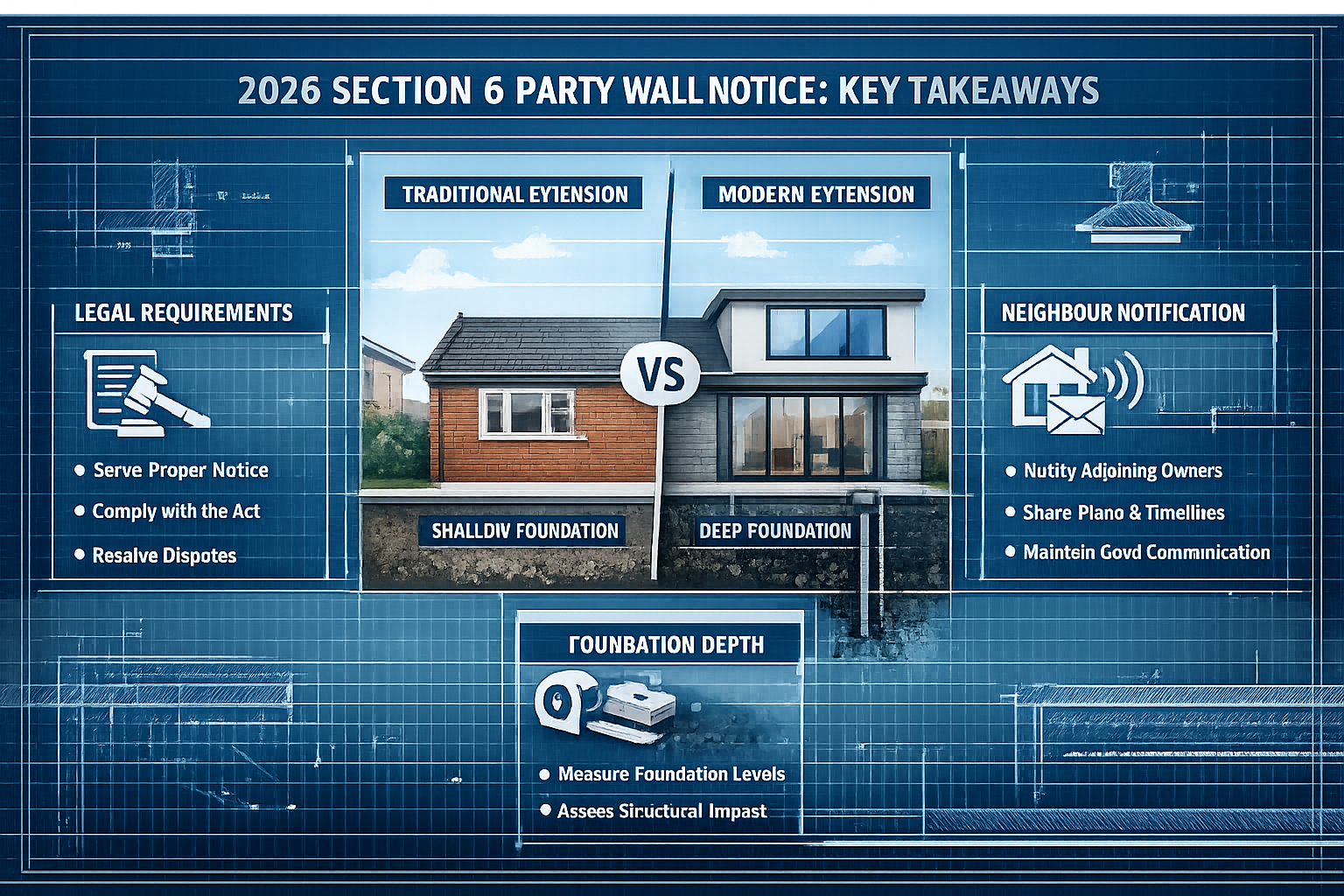
Understanding Section 6 of the Party Wall Act in 2026
What Makes Section 6 Different from Other Party Wall Provisions
Section 6 of the Party Wall Act specifically addresses excavation near neighboring buildings. Unlike Sections 1 and 2, which deal with walls on or astride boundaries, Section 6 focuses on the depth and proximity of foundation work to adjacent properties. This distinction becomes crucial as modern construction techniques demand deeper, more robust foundations to support heavier loads and mitigate climate-related ground movement.
The legislation recognizes that excavation work—even when entirely on your own property—can destabilize neighboring structures if it undermines their existing foundations. Section 6 provides a legal framework to ensure such work is properly notified, assessed, and executed with appropriate safeguards.
The Two Critical Distance Thresholds 📏
Section 6 establishes two specific scenarios that trigger mandatory notice requirements:
Threshold 1: The 3-Meter Rule
You must serve formal notice at least one month before starting work if you plan to excavate within 3 meters of a neighboring building's foundation and your excavation will go deeper than their foundation level.[1]
Threshold 2: The 6-Meter Rule
Notice is also required when excavating within 6 meters of a neighbor's structure if your excavation extends below a line drawn at a 45-degree angle downward from the bottom of their foundation.[1]
These geometric requirements might seem technical, but they're designed to protect the "cone of influence" around existing foundations—the zone where excavation could potentially cause settlement or structural movement.
Why Deeper Foundations Are Becoming Standard in 2026
Several converging factors are driving the trend toward deeper foundations:
🌍 Climate adaptation: Increased ground movement from extreme weather cycles requires more stable foundation systems
🏗️ Heavier construction: Modern building materials and multi-story extensions demand greater load-bearing capacity
🏡 Basement conversions: The popularity of basement extensions in urban areas naturally requires significant excavation
⚡ Building regulation updates: Enhanced energy efficiency requirements often necessitate more substantial structural elements
📊 Property value maximization: Homeowners are investing in deeper, more permanent improvements to maximize returns
This evolution in construction practice means that work which might not have triggered Section 6 requirements a decade ago now routinely crosses the distance and depth thresholds.
Deeper Foundations in 2026: When Section 6 Notices Are Required
Practical Excavation Risk Assessment Checklist ✅
Before beginning any foundation work, homeowners should systematically assess whether Section 6 applies:
Step 1: Measure Horizontal Distance
- Determine the distance from your proposed excavation to the nearest point of your neighbor's building
- Measure to the foundation, not just the visible wall above ground
- Use professional survey equipment or hire a surveyor for accuracy
Step 2: Determine Foundation Depths
- Establish the depth of your neighbor's existing foundation (trial pits or building records may be necessary)
- Calculate your planned excavation depth
- Compare the two measurements
Step 3: Apply the Geometric Tests
- If within 3 meters: Will you dig deeper than their foundation? → Notice required
- If within 6 meters: Will you breach the 45-degree line? → Notice required
- Beyond 6 meters: Section 6 typically doesn't apply (though other considerations may exist)
Step 4: Document Everything
- Take photographs of existing conditions
- Obtain copies of neighboring property's building plans if available
- Create detailed drawings showing measurements and proposed work
Types of Modern Work Covered Under Section 6
Section 6 applies to various excavation scenarios common in 2026 construction projects:[1]
| Work Type | Section 6 Relevance | Common Trigger Points |
|---|---|---|
| Basement extensions | High | Almost always triggers 3m rule in terraced properties |
| New building foundations | High | Frequently exceeds depth thresholds |
| Underpinning existing structures | High | Specifically designed to go deeper than current foundations |
| Deep drainage installations | Medium | May trigger if excavation exceeds neighbor's foundation depth |
| Swimming pool excavations | Medium | Depends on depth and proximity to boundaries |
| Retaining wall foundations | Medium | Particularly relevant on sloped sites |
| Ground source heat pump installations | Low-Medium | Vertical boreholes may trigger in specific circumstances |
Understanding which types of party wall works apply to your project helps ensure comprehensive compliance.
The Independence of Party Wall Requirements from Planning Permission
A critical misconception in 2026 is that obtaining planning permission automatically addresses Party Wall obligations. This is categorically false.[2]
The Party Wall Act operates entirely independently from the planning system:
- ✅ Permitted Development projects still require Section 6 notices if excavation thresholds are met
- ✅ Planning approval does not grant permission to affect neighboring properties
- ✅ Building regulations approval is separate from Party Wall compliance
- ✅ Conservation area consent doesn't override Party Wall requirements
Even small-scale projects that don't require planning permission may trigger Party Wall obligations. Conversely, major projects with full planning approval can still face Party Wall disputes if proper notices aren't served. For comprehensive guidance, review our resource on Party Wall Act notices and how to respond.

The Section 6 Notice Process: Step-by-Step Guide for 2026
Preparing and Serving Your Notice
Required Information in Your Section 6 Notice 📋
Your excavation notice must include specific details to be legally valid:[4]
- Your contact information: Full name, address, and contact details of the building owner
- Comprehensive work description: Exact nature of excavation, depths, dimensions, and purpose
- Proposed start date: When you intend to commence work (at least one month from notice service)
- Access requirements: Any need to access the neighbor's property for materials, equipment, or construction
- Technical drawings: Plans and sections showing excavation relative to the neighboring property
- Professional details: Information about your builder, engineer, or project manager
Special Considerations for Leasehold Properties
If your neighbor's property is leasehold, you must serve notice to both the leaseholder (tenant) and the freeholder (building owner).[4] This dual-service requirement often surprises homeowners but is essential for legal compliance.
Understanding the 14-Day Response Window ⏰
Once you serve your Section 6 notice, your neighbor has exactly 14 days to respond in one of three ways:[1]
Response 1: Written Consent ✅
- The neighbor agrees to the proposed work in writing
- No surveyor appointment necessary
- Work can proceed after the one-month notice period expires
- Best practice: Take dated photographs and create a written record of existing conditions, even with consent[3]
Response 2: Written Dissent ⚠️
- The neighbor formally objects or has concerns
- Triggers the surveyor appointment process
- Does not mean work cannot proceed—only that formal assessment is required
- Most common response when significant excavation is proposed
Response 3: No Response 🔕
- Silence is automatically treated as dissent after 14 days[1]
- Same outcome as formal dissent—surveyor process begins
- Cannot be interpreted as consent under any circumstances
- Often occurs when neighbors don't understand the notice or are away
The Surveyor Appointment Process
When dissent occurs (or is deemed to occur), the Party Wall Act requires surveyor involvement to protect both parties' interests.
Three Surveyor Appointment Options:
1️⃣ Agreed Surveyor: Both parties jointly appoint a single surveyor to act impartially
- Most cost-effective option
- Faster resolution
- Requires mutual trust and agreement
2️⃣ Two Surveyors: Each party appoints their own surveyor, who then work together
- Building owner appoints their surveyor
- Adjoining owner appoints their surveyor
- The two surveyors collaborate to produce a Party Wall Award
- Most common arrangement for significant projects
3️⃣ Third Surveyor: Appointed by the two party-appointed surveyors to resolve disputes
- Only involved if the two surveyors cannot agree
- Acts as final arbiter
- Rarely needed in straightforward excavation cases
Understanding costs of the Party Wall process helps budget appropriately for these professional fees.
Timeline and Cost Expectations for 2026
Realistic Timeline for Section 6 Compliance:
- Notice preparation: 1-2 weeks (with professional assistance)
- Notice period: Minimum 1 month (statutory requirement)
- Neighbor response window: 14 days
- Surveyor appointment: 1-2 weeks
- Site inspection and assessment: 2-4 weeks
- Award preparation: 2-4 weeks
- Total typical duration: 2-4 months[2]
Financial Investment:
Professional surveyor fees in London for 2026 typically range from £750 to £1,800 per neighboring property.[2] Factors affecting cost include:
- Complexity of the excavation work
- Number of adjoining owners
- Property type and condition
- Geographic location within London
- Surveyor experience and reputation
For projects in specific areas, consider consulting specialists such as a party wall surveyor in South London or party wall surveyor in North London depending on your location.
Building owner responsibilities typically include:
- Their own surveyor's fees
- The adjoining owner's surveyor's fees
- Third surveyor fees (if required)
- Cost of any protective measures specified in the Award
Learn strategies for keeping party wall costs down while maintaining compliance.

Strategic Timing: Maximizing the 12-Month Work Authorization Window
When to Serve Notice for Optimal Project Flow
One of the most valuable yet underutilized aspects of Section 6 is the 12-month work authorization window. Once you serve a valid Party Wall notice, you have up to one year to commence the work described.[3]
This extended timeframe enables strategic planning:
Optimal Timing Strategy:
- Serve notice immediately after planning approval is granted (if applicable)
- Allow the Party Wall process to run concurrently with detailed design development
- Finalize builder contracts and material procurement during the surveyor assessment period
- Commence work when the Party Wall Award is issued and all other approvals are in place
Common Timing Mistakes to Avoid: ❌
- Waiting until you want to break ground before serving notice
- Assuming the surveyor appointment is the start of the notice period (it's not—the notice service date controls)[2]
- Failing to account for holiday periods when neighbors may not respond promptly
- Underestimating the total process duration
Coordinating Multiple Notice Types
Complex modern extensions often trigger multiple sections of the Party Wall Act simultaneously:
- Section 1: Building a new wall on the boundary line
- Section 2: Cutting into or working on an existing party wall
- Section 6: Excavating near the neighbor's foundation
Best Practice: Serve all applicable notices together with a comprehensive package of information. This coordinated approach:
- Reduces overall timeline by running processes concurrently
- Minimizes confusion for neighbors
- Demonstrates professional project management
- Often results in a single comprehensive Award covering all work types
For detailed guidance, consult resources on what is a Party Structure Notice and how to serve it.
Legal Consequences and Protective Measures
What Happens If You Don't Serve a Required Notice? ⚖️
Non-compliance with Section 6 requirements carries serious consequences:
Immediate Legal Remedies Available to Neighbors:
- Party Wall injunction: Court order stopping all work until proper notice is served[3]
- Mandatory compliance order: Legal requirement to follow the Act retroactively
- Damages claim: Financial compensation for any harm caused
- Cost recovery: Neighbor's legal fees charged to the building owner
Long-Term Complications:
- Difficulty proving which damage was caused by your work versus pre-existing conditions[3]
- Potential impact on property insurance claims
- Complications when selling the property (solicitors will investigate Party Wall compliance)
- Strained neighbor relations that can affect quality of life for years
The Protection Mechanism: How Section 6 Safeguards Both Parties
The Party Wall Act is fundamentally protective legislation, not restrictive:[2]
For Building Owners:
- ✅ Legal right to proceed with necessary excavation work
- ✅ Clear framework for managing neighbor concerns
- ✅ Professional assessment reducing liability risks
- ✅ Documented evidence of proper procedure
For Adjoining Owners:
- ✅ Formal notification of potentially disruptive work
- ✅ Independent professional assessment of risks
- ✅ Legal recourse if damage occurs
- ✅ Documented baseline condition through Schedule of Condition
The Schedule of Condition is particularly valuable—this photographic and written record of the neighbor's property before work commences provides objective evidence if disputes arise about damage causation.
Creating Effective Documentation
Essential Documentation Checklist: 📸
Before work begins:
- Comprehensive photographic survey of neighbor's property (interior and exterior)
- Written description of existing cracks, settlement, or defects
- Video walkthrough with date stamp
- Copies provided to both parties
- Professional Schedule of Condition (if surveyors are involved)
During construction:
- Regular monitoring reports (often specified in the Award)
- Photographic updates at key stages
- Incident logs for any concerns raised
- Communication records with neighbors
After completion:
- Final inspection photographs
- Comparison with pre-work conditions
- Sign-off documentation
- Retention of all records for minimum 6 years
Practical Scenarios: Deeper Foundations in 2026 Case Studies
Scenario 1: Terraced House Rear Extension with Basement
Project Details:
- Victorian terraced house in East London
- Two-story rear extension with basement level
- Excavation depth: 2.8 meters
- Distance to neighbor's foundation: 2.5 meters
- Neighbor's foundation depth: 1.2 meters
Section 6 Analysis:
✅ Within 3 meters of neighbor's building
✅ Excavation goes deeper than neighbor's foundation (2.8m vs 1.2m)
Result: Section 6 notice mandatory
Process Outcome:
- Notice served 3 months before planned construction start
- Neighbor initially concerned but appointed surveyor
- Award specified underpinning of party wall and monitoring regime
- Work completed successfully with no damage
- Total Party Wall cost: £2,400 (two surveyors)
Homeowners in this area can benefit from consulting a party wall surveyor in East London familiar with Victorian terraced properties.
Scenario 2: Detached House with Swimming Pool Installation
Project Details:
- Modern detached house in West London
- Outdoor swimming pool installation
- Excavation depth: 2.2 meters
- Distance to neighbor's boundary: 4.5 meters
- Neighbor's foundation depth: 0.9 meters
Section 6 Analysis:
✅ Within 6 meters of neighbor's building
✅ Excavation breaches 45-degree line from neighbor's foundation
Result: Section 6 notice required
Process Outcome:
- Neighbor gave written consent after reviewing detailed plans
- No surveyor appointment necessary
- Photographic record created by mutual agreement
- Work completed with regular updates to neighbor
- Total Party Wall cost: £0 (consent route)
For properties in this region, a party wall surveyor in West London can provide location-specific advice.
Scenario 3: Central London Townhouse Underpinning
Project Details:
- Georgian townhouse requiring structural underpinning
- Excavation depth: 3.5 meters
- Shared party walls on both sides
- Distance to foundations: 0 meters (party wall scenario)
- Multiple adjoining owners (6 properties affected)
Section 6 Analysis:
✅ Work directly affects party wall foundations
✅ Significant depth increase
Result: Section 6 notices required for all adjoining owners, plus Section 2 notices for party wall work
Process Outcome:
- Comprehensive notice package served to all 6 neighbors
- Agreed surveyor appointed to act for all parties
- Detailed Award with phased work schedule and extensive monitoring
- One neighbor initially dissented but agreed after surveyor consultation
- Total Party Wall cost: £8,400 (multiple properties)
Complex projects in the capital often benefit from experienced professionals like those offering services as a party wall surveyor in Central London.
Expert Tips for Smooth Section 6 Compliance in 2026
Building Owner Best Practices 🏗️
1. Early Engagement
Discuss your plans informally with neighbors before serving formal notices. While not legally required, this courtesy often prevents disputes and builds goodwill.
2. Professional Representation
Engage a qualified party wall surveyor early in the design process. They can:
- Assess whether Section 6 applies to your specific project
- Prepare technically accurate notices
- Advise on excavation methods that minimize risk
- Represent your interests if the process becomes contentious
3. Clear Communication
Provide neighbors with:
- Plain-language explanations alongside formal notices
- Visual representations of the proposed work
- Your contact information and availability for questions
- Realistic timelines for construction phases
4. Budget Appropriately
Include Party Wall costs in your initial project budget:
- Surveyor fees for all potentially affected neighbors
- Contingency for protective measures that may be required
- Time buffer in your construction schedule
5. Document Everything
Maintain comprehensive records:
- Proof of notice service (recorded delivery receipts)
- All written communications with neighbors
- Photographs and condition reports
- Surveyor correspondence and reports
For building owners managing the process, resources for building owners provide additional guidance.
Adjoining Owner Considerations 🏘️
1. Respond Promptly
Don't ignore Party Wall notices. Even if you intend to consent, provide written confirmation within the 14-day window to avoid automatic dissent.
2. Seek Independent Advice
You have the right to appoint your own surveyor at the building owner's expense. This professional will:
- Assess potential risks to your property
- Ensure adequate protective measures are specified
- Monitor the work on your behalf
- Provide expert evidence if damage occurs
3. Understand Your Rights
The Party Wall Act gives you:
- Right to access the Award and all associated documents
- Right to have your property's condition recorded
- Right to compensation for any damage caused
- Right to reasonable monitoring of the work
4. Don't Unreasonably Withhold Consent
While you can dissent to trigger the surveyor process, you cannot prevent lawful work from proceeding. The Act balances rights and provides a dispute resolution mechanism.
Resources for adjoining owners explain your rights and options in detail.
Surveyor Selection Criteria
Qualifications to Look For:
- ✅ Membership in Royal Institution of Chartered Surveyors (RICS)
- ✅ Specialist Party Wall expertise (not just general surveying)
- ✅ Professional indemnity insurance
- ✅ Local knowledge of construction practices in your area
- ✅ Experience with similar project types
- ✅ Clear fee structure and terms of engagement
Red Flags to Avoid:
- ❌ Unwillingness to provide references
- ❌ Lack of specific Party Wall Act experience
- ❌ Vague or unclear fee arrangements
- ❌ Pressure to make immediate decisions
- ❌ Conflicts of interest (e.g., also representing your builder)
Conclusion: Mastering Section 6 for Successful Modern Extensions
As construction practices evolve in 2026, deeper foundations have become the norm rather than the exception. Climate adaptation, building regulation changes, and homeowner ambitions for substantial improvements all drive excavation work that increasingly triggers Section 6 Party Wall notice requirements. Understanding and properly navigating these obligations is no longer optional—it's an essential component of responsible property development.
The key to successful compliance lies in early assessment, strategic timing, and professional guidance. By systematically evaluating whether your excavation work crosses the 3-meter or 6-meter thresholds, serving comprehensive notices well in advance of construction, and engaging qualified surveyors when necessary, homeowners can protect both their project timeline and their relationships with neighbors.
Actionable Next Steps 🎯
If you're planning excavation work in 2026:
- Assess your project now: Use the checklists in this guide to determine if Section 6 applies
- Measure carefully: Obtain accurate measurements of distances and depths before making assumptions
- Engage professionals early: Consult a party wall surveyor during the design phase, not when you're ready to dig
- Serve notices strategically: Take advantage of the 12-month work window by serving notices as soon as planning is secured
- Budget comprehensively: Include £750-£1,800 per affected neighbor for surveyor fees in your project budget
- Document everything: Create photographic and written records before, during, and after construction
- Communicate proactively: Keep neighbors informed beyond the minimum legal requirements
If you've received a Section 6 notice:
- Respond within 14 days: Don't let the deadline pass—silence equals dissent
- Seek independent advice: Consider appointing your own surveyor to protect your interests
- Request clarification: Ask questions if the notice is unclear or you have concerns
- Understand your rights: You cannot prevent lawful work, but you can ensure it's done safely
- Insist on condition records: Ensure a comprehensive Schedule of Condition is prepared before work begins
The Party Wall Act exists to facilitate necessary construction while protecting property rights. Section 6 specifically addresses the unique risks of excavation near neighboring structures—risks that have only increased as modern extensions demand deeper, more substantial foundations. By approaching these requirements with knowledge, preparation, and professionalism, homeowners can successfully navigate deeper foundations in 2026 while maintaining positive relationships and legal compliance.
For comprehensive support throughout your Party Wall journey, explore our resources on party wall notices and connect with qualified professionals who can guide your specific project to successful completion.
References
[1] Section%206 Party Wall Act – https://www.designingbuildings.co.uk/wiki/Section%206%20Party%20Wall%20Act
[2] Party Wall Agreement London 2026 – https://www.mayfairstudio.co.uk/blog/party-wall-agreement-london-2026
[3] Party Wall Agreement – https://hoa.org.uk/advice/guides-for-homeowners/i-am-improving/party-wall-agreement/
[4] Party Wall Agreements What You Need To Know – https://www.fmb.org.uk/find-a-builder/ultimate-guides-to-home-renovation/party-wall-agreements-what-you-need-to-know.html