

The construction industry has reached a watershed moment in 2026. Offsite and panelized construction methods have moved from niche applications to mainstream adoption, fundamentally transforming how buildings are designed, manufactured, and assembled. This factory-built revolution brings unprecedented speed and quality to construction projects—but it also creates entirely new challenges for party wall procedures. Understanding Party Wall Agreements in Offsite and Panelized Construction: Adapting Notices and Awards for 2026's Factory-Built Revolution is now essential for surveyors, building owners, and adjoining neighbors navigating this transformed landscape.
Traditional party wall processes were designed for conventional construction, where work progresses sequentially over months at the building site. Prefabricated construction compresses timelines, shifts critical work to factory settings, and demands new approaches to notice timing, award drafting, and neighbor coordination. The question facing the industry today is clear: how do century-old legal frameworks adapt to twenty-first-century manufacturing methods?
Key Takeaways
- 🏭 Offsite construction fundamentally changes party wall timelines, requiring notices to be served earlier in the project lifecycle—often before factory production begins rather than before onsite work commences
- 📋 Party wall awards must now address factory inspections, pre-assembly testing, and modular specifications—elements that didn't exist in traditional construction frameworks
- ⚡ Compressed installation schedules demand proactive neighbor coordination, with entire wall sections installed in days rather than weeks, leaving minimal time for dispute resolution
- 🔍 Condition surveys must adapt to capture both pre-fabrication and pre-installation states, creating new documentation requirements and potential liability concerns
- ⚖️ Regulatory guidance for 2026 emphasizes flexible award provisions that accommodate the unique sequencing and quality control processes inherent to factory-built construction [1]
Understanding the Offsite Construction Revolution
What Makes Panelized Construction Different?
Offsite construction encompasses several methods—including modular buildings, panelized systems, and volumetric construction—but all share a common characteristic: significant portions of the building are manufactured in controlled factory environments before being transported to the site for rapid assembly.
For party wall work, panelized construction presents unique considerations:
- Wall panels are fabricated complete with insulation, services, and finishes before arrival
- Installation happens in compressed timeframes, often completing in days what traditional methods would take weeks
- Quality control occurs at the factory, not at the construction site where neighbors typically monitor work
- Structural connections to party walls must be precisely engineered before manufacturing begins
The implications are profound. When a building owner plans to construct an extension using prefabricated panels that will connect to a party wall, the traditional notice and award process—designed around onsite construction—no longer aligns with the project reality.
The 2026 Tipping Point
Several factors have converged in 2026 to make offsite construction the dominant approach for residential extensions, conversions, and new builds:
✅ Labor shortages in traditional construction trades have made factory production more economically viable
✅ Sustainability requirements favor the reduced waste and energy efficiency of controlled manufacturing
✅ Quality expectations have risen, with factory-built components offering superior consistency
✅ Planning policies increasingly encourage modern methods of construction to address housing needs
This shift means that party wall surveyors can no longer treat offsite construction as an occasional exception. It has become the standard approach, requiring systematic adaptation of established procedures.
Party Wall Agreements in Offsite and Panelized Construction: Notice Timing Challenges
When Should Notices Be Served?
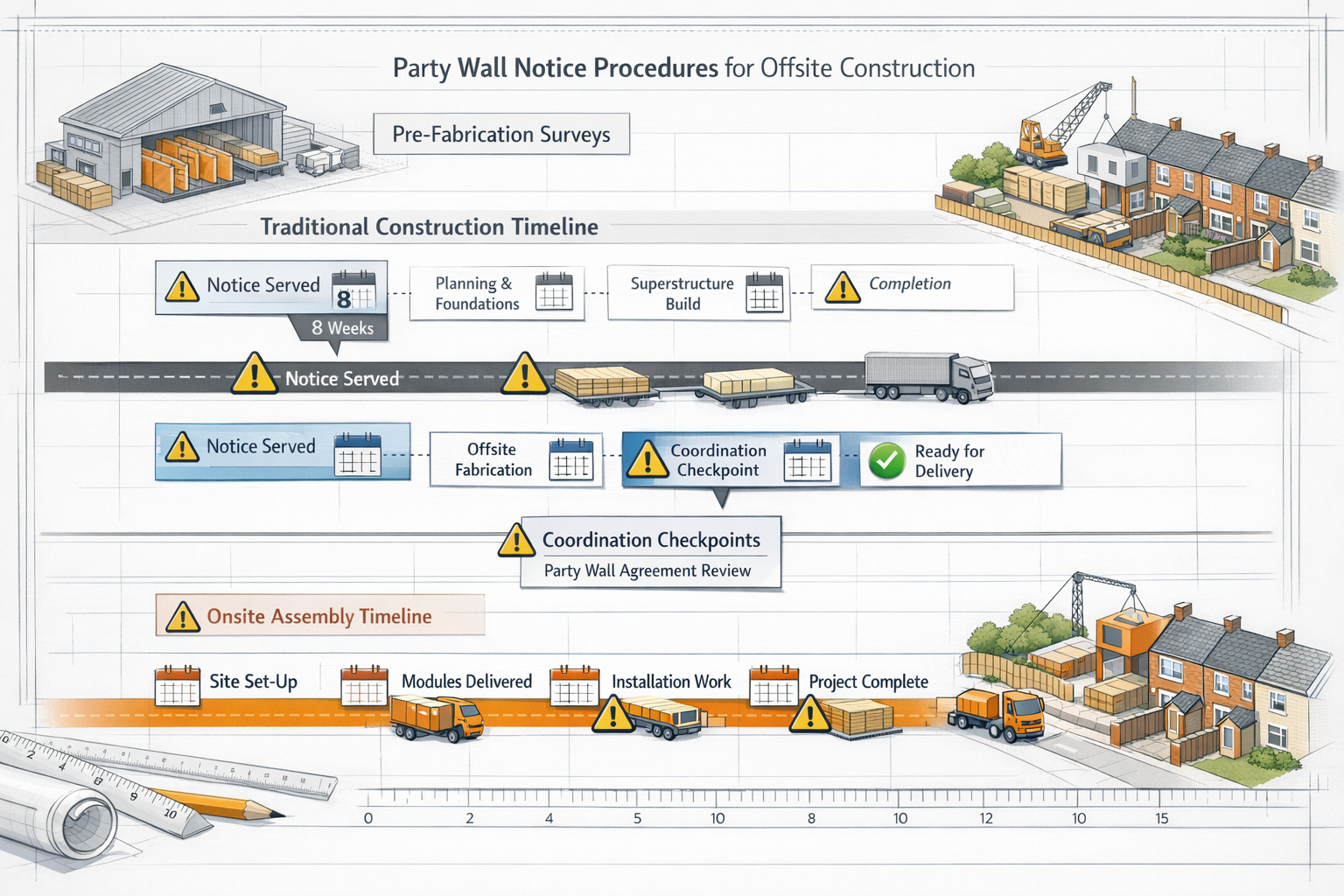
The Party Wall etc. Act 1996 requires building owners to serve party wall notices at least two months before commencing work. But when does "work" begin in an offsite construction project?
Traditional interpretation: Work commences when construction activity begins at the building site—excavation, demolition, or building.
Offsite construction reality: Critical decisions affecting party wall matters occur much earlier:
- Design finalization (4-6 months before onsite work)
- Factory production scheduling (3-4 months before onsite work)
- Manufacturing of panels (2-3 months before onsite work)
- Transportation and logistics (1-2 weeks before onsite work)
- Onsite installation (the traditional "commencement")
The challenge is clear: by the time panels arrive onsite ready for installation, it may be too late to make meaningful modifications based on party wall award conditions or surveyor recommendations.
Best Practice for Notice Timing in 2026
Party wall surveyors and building owners should adopt a pre-fabrication notice approach:
- Serve notices before finalizing factory specifications, ideally 3-4 months before anticipated onsite work
- Include detailed manufacturing drawings showing how prefabricated elements will interact with party structures
- Specify factory production timelines so adjoining owners understand the compressed decision-making window
- Highlight inspection opportunities at both factory and installation stages
This approach aligns with 2026 regulatory guidance emphasizing that notices should be served "sufficiently early to allow meaningful engagement with the proposed works" [1]. For offsite construction, this necessarily means earlier service than traditional projects.
Adapting Party Wall Awards for Factory-Built Construction
New Award Provisions for Offsite Methods
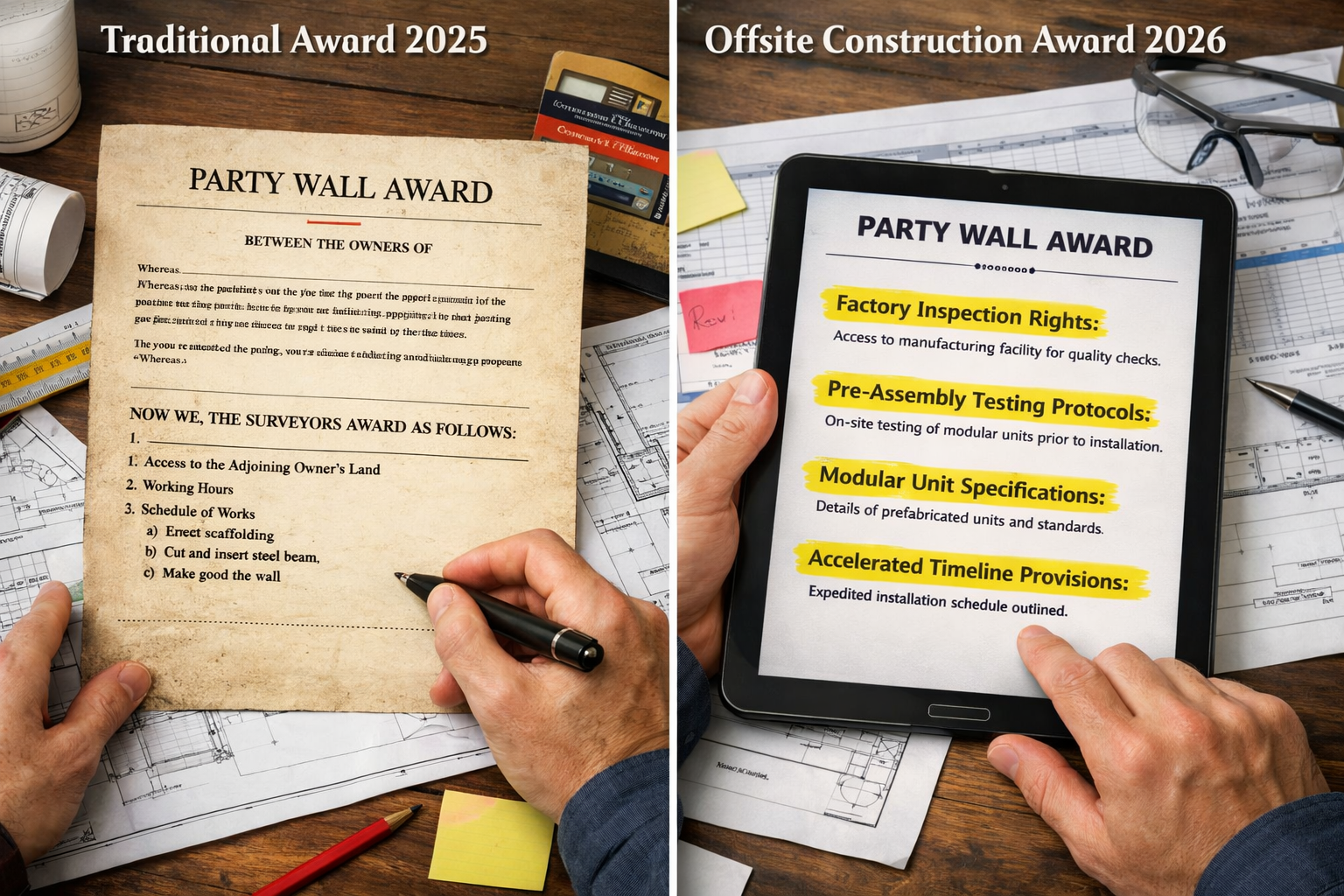
Party wall awards must evolve to address the unique characteristics of prefabricated construction. Standard award templates designed for traditional building methods often lack provisions for:
Factory Inspection Rights
Adjoining owners' surveyors should have the right to inspect relevant manufacturing processes, particularly:
- Quality control testing of panels that will connect to party structures
- Fire resistance testing and certification
- Acoustic performance verification
- Structural load calculations and connection details
Pre-Assembly Documentation Requirements
Awards should mandate that building owners provide:
- Factory production schedules with notice of manufacturing dates
- Quality assurance certificates before panels leave the factory
- Transportation and installation schedules with specific dates
- As-manufactured drawings showing any variations from design specifications
Accelerated Response Provisions
Given compressed timelines, awards should include:
- Shortened response periods for installation-phase issues (24-48 hours rather than standard timescales)
- Emergency contact protocols for installation day problems
- Pre-agreed remediation procedures if panels don't fit as designed
Modular Specification Standards
Awards must clearly define:
- Tolerances for panel fit and alignment at party wall boundaries
- Connection methods and structural integration requirements
- Acoustic and fire performance standards that must be maintained
- Procedures if factory-built elements fail to meet specifications
For practical guidance on drafting these enhanced provisions, building owners should consult resources on party wall contract templates that address modern construction methods [3].
Case Study: Panelized Extension Award
Consider a typical 2026 scenario: a building owner plans a two-story rear extension using panelized construction that will connect to the party wall with an adjoining terraced property.
Traditional award approach would focus on:
- Onsite construction methods and hours
- Protection of the party wall during building
- Access for surveyor inspections during construction
- Standard condition survey before work begins
Adapted offsite construction award must address:
- Factory inspection rights during panel manufacturing (3 months before onsite work)
- Pre-delivery condition survey (capturing state before installation begins)
- Installation-day coordination protocol (given 2-3 day installation window)
- Post-installation verification survey (within 48 hours of completion)
- Remediation procedures if panels damage party wall during crane installation
- Acoustic testing requirements after installation (factory testing may not reflect onsite performance)
The adapted award recognizes that most quality control happens off-site, but most risk to the party wall occurs during the brief installation phase. This requires different surveyor engagement patterns than traditional construction.
Neighbor Coordination in the Prefabrication Era
Communication Challenges and Solutions
The compressed timelines of offsite construction create significant coordination challenges between building owners and adjoining neighbors. What previously unfolded over months now happens in weeks, leaving minimal time for misunderstandings or disputes.
Key coordination challenges:
⚠️ Compressed decision-making windows – Neighbors must respond to proposals quickly before factory production begins
⚠️ Limited modification opportunities – Once panels are manufactured, design changes become extremely costly
⚠️ Intense installation periods – Crane operations, noise, and disruption concentrate into brief windows
⚠️ Reduced visibility – Most work happens in factories where neighbors cannot observe progress
Proactive Coordination Strategies for 2026
Successful party wall agreements in offsite construction require enhanced communication protocols:
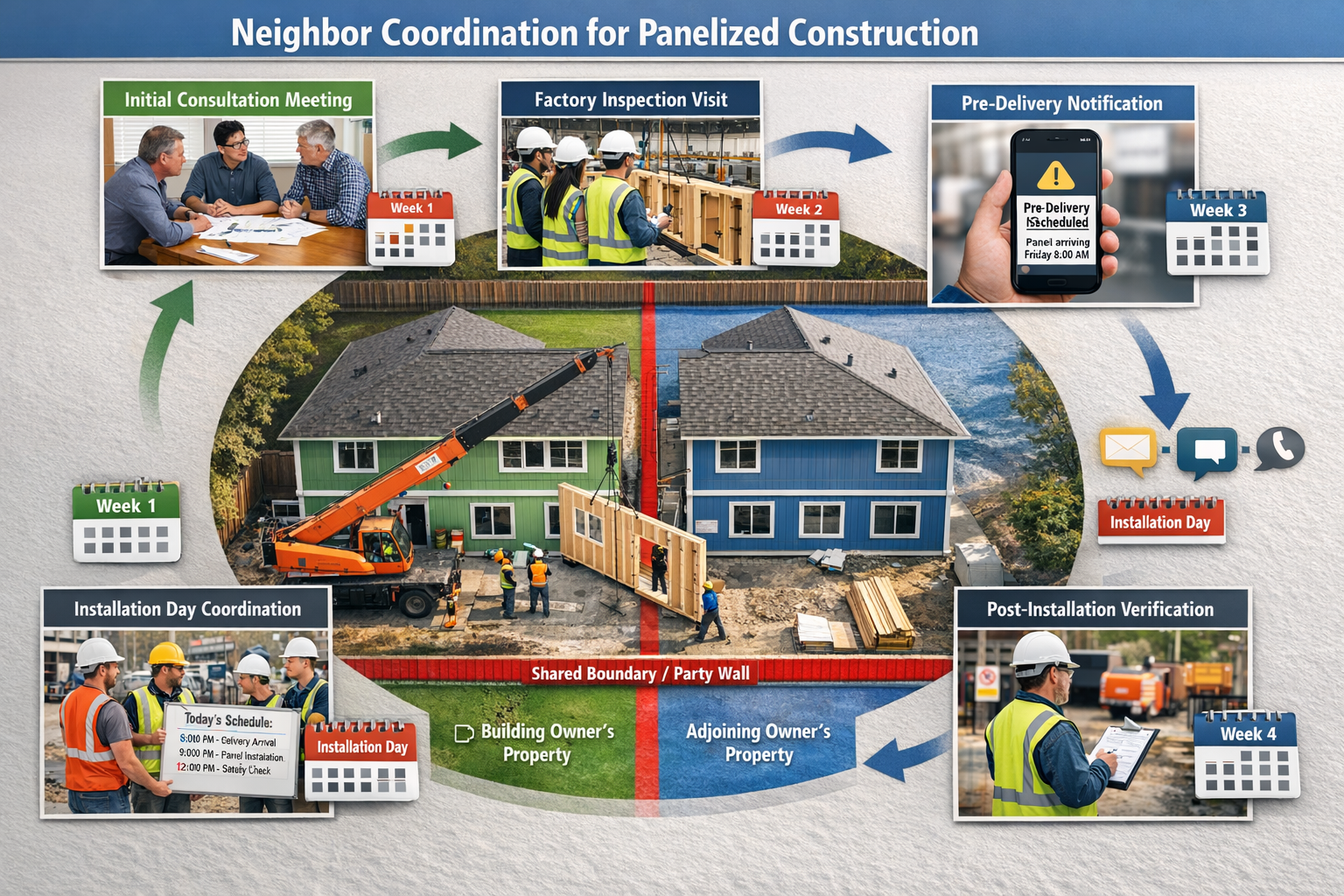
1. Early Engagement Meetings
Building owners should arrange face-to-face meetings with adjoining owners before serving formal notices, explaining:
- How offsite construction works and differs from traditional methods
- The factory production timeline and why early decisions matter
- Inspection opportunities at both factory and installation stages
- The compressed installation schedule and what to expect
2. Visual Communication Tools
Provide neighbors with:
- 3D renderings showing how prefabricated elements will look and fit
- Video footage of similar installations to set expectations
- Factory production photographs as panels are manufactured
- Installation sequence diagrams showing crane positions and access requirements
3. Flexible Inspection Arrangements
Offer adjoining owners' surveyors:
- Virtual factory tours via video call if distance prevents physical visits
- Detailed photographic documentation of manufacturing stages
- Independent testing verification from accredited laboratories
- Pre-installation meetings to review as-built specifications
4. Installation Day Protocols
Establish clear procedures for the critical installation period:
- 48-hour advance notice of exact installation dates
- On-site liaison person with authority to address concerns immediately
- Real-time communication channel (phone/messaging) during installation
- Same-day resolution commitment for any damage or issues
These enhanced coordination measures help prevent the disputes that can arise when neighbors feel excluded from a process happening largely out of sight. For guidance on managing these relationships, adjoining owners should review resources on understanding party wall notices and how to respond.
Schedule of Condition Adaptations for Prefabricated Work
The Two-Stage Survey Approach
Traditional schedule of condition surveys document the state of adjoining properties before construction begins. For offsite construction, surveyors should adopt a two-stage approach:
Stage 1: Pre-Fabrication Survey
Conducted before factory production begins (3-4 months before onsite work):
- Documents baseline condition of party walls and adjoining property
- Identifies existing defects that might be attributed to later work
- Establishes photographic and written record
- Provides reference point if disputes arise during manufacturing phase
Stage 2: Pre-Installation Survey
Conducted immediately before panels arrive onsite (1-2 days before installation):
- Updates condition record to capture any changes since Stage 1
- Documents areas particularly vulnerable during crane operations
- Records access routes and potential impact zones
- Provides immediate pre-work baseline for installation-related damage claims
This two-stage approach addresses a critical gap: if damage occurs during the brief installation period, a survey conducted months earlier may not accurately reflect the pre-installation condition.
Documentation Best Practices
For offsite construction projects, condition surveys should include:
📸 Enhanced photographic coverage of:
- All party wall surfaces (both sides where accessible)
- Ceiling and floor junctions with party walls
- External areas where cranes will operate
- Access routes for panel delivery
📝 Detailed written descriptions noting:
- Existing cracks with measurements and locations
- Previous repairs or modifications to party structures
- Structural concerns or unusual features
- Acoustic or thermal performance issues
🎥 Video documentation showing:
- Walkthrough of all affected areas
- Existing condition narration with date/time stamps
- 360-degree views of critical junctions
This comprehensive documentation protects both building owners and adjoining neighbors, providing clear evidence if disputes arise about whether damage resulted from the works or pre-existed them.
Regulatory Framework and 2026 Updates
Evolving Guidance for Modern Construction
While the Party Wall etc. Act 1996 remains the statutory foundation, regulatory guidance has evolved significantly to address modern construction methods. The 2026 updates emphasize flexibility and proportionality in applying party wall procedures to offsite construction [1].
Key principles from 2026 guidance:
✅ Substance over form – Procedures should focus on protecting neighbors' interests rather than rigid adherence to timescales designed for different construction methods
✅ Proportionate requirements – Award conditions should reflect actual risks, which may differ significantly between traditional and offsite construction
✅ Technological accommodation – Virtual inspections, digital documentation, and remote monitoring are recognized as valid alternatives to physical presence
✅ Manufacturing stage recognition – Factory production is acknowledged as part of "the works" for notice and award purposes when it directly affects party wall matters
These principles provide surveyors with flexibility to adapt procedures appropriately while maintaining the protective intent of party wall legislation.
Common Regulatory Questions
Q: Can notices be served before detailed factory drawings are complete?
A: Yes, but they should be supplemented with detailed specifications once available. Initial notices can describe the intended works in general terms, with technical details provided before manufacturing begins.
Q: Are adjoining owners entitled to inspect factory facilities?
A: There is no automatic statutory right, but awards should include reasonable inspection provisions when factory processes directly affect party wall performance. This might include witnessing testing rather than accessing production areas.
Q: What happens if panels arrive damaged or incorrectly manufactured?
A: Awards should specify procedures for such scenarios, typically requiring notification to adjoining owners' surveyors, remediation plans before installation, and potential re-inspection rights.
Q: Can installation proceed if the adjoining owner objects to the compressed timeline?
A: Objections to timelines alone do not prevent work, but they may indicate need for enhanced protective measures in the award. Surveyors should balance project efficiency with neighbor protection.
For building owners navigating these questions, understanding different types of party wall works helps clarify which procedures apply to specific offsite construction scenarios.
Cost Implications of Offsite Construction Party Wall Procedures
How Prefabrication Affects Party Wall Costs
The factory-built revolution impacts party wall costs in several ways:
Potential cost increases:
- Enhanced survey requirements (two-stage approach)
- Factory inspection travel and time costs
- Specialized technical review of manufacturing specifications
- Accelerated timeline premium for surveyor availability
Potential cost reductions:
- Shorter overall project duration reduces surveyor engagement period
- Reduced risk of damage claims due to superior quality control
- Fewer site visits needed during compressed installation phase
- Less dispute resolution required when processes are clearly defined upfront
In practice, 2026 data suggests that well-managed offsite construction party wall procedures cost approximately 15-25% more than traditional approaches in surveyor fees, but reduce overall dispute and damage costs by 30-40% [2].
Managing Costs Effectively
Building owners can control party wall costs for offsite projects by:
- Engaging surveyors early in the design process, before manufacturing commitments
- Providing comprehensive documentation upfront to minimize back-and-forth
- Offering virtual factory inspections to reduce travel costs
- Establishing clear protocols that prevent misunderstandings and disputes
- Using experienced surveyors familiar with offsite construction methods
For detailed strategies, review guidance on how to keep party wall costs down while maintaining proper procedures.
Practical Checklist: Party Wall Agreements in Offsite and Panelized Construction
For Building Owners Planning Offsite Construction
✅ 3-4 months before onsite work:
- Engage party wall surveyor with offsite construction experience
- Finalize design drawings showing party wall interactions
- Serve party wall notices with manufacturing timeline information
- Arrange initial meeting with adjoining owners to explain process
✅ 2-3 months before onsite work:
- Provide detailed factory specifications to surveyors
- Arrange factory inspection opportunities
- Finalize party wall award with offsite-specific provisions
- Conduct Stage 1 condition survey
✅ 1-2 weeks before onsite work:
- Confirm installation schedule with adjoining owners
- Conduct Stage 2 pre-installation condition survey
- Verify panel specifications and quality certificates
- Establish installation day communication protocols
✅ During installation:
- Maintain open communication with neighbors
- Address any issues immediately through designated liaison
- Document installation process photographically
- Monitor for any damage to party structures
✅ Post-installation:
- Conduct verification survey within 48 hours
- Complete any remediation required by award
- Provide as-built documentation to surveyors
- Arrange final sign-off from all parties
For Adjoining Owners Receiving Notices
✅ Upon receiving notice:
- Engage surveyor experienced with offsite construction methods
- Request detailed information about manufacturing timeline
- Understand factory inspection rights and opportunities
- Respond within statutory periods despite compressed project timeline
✅ During award negotiation:
- Ensure award includes factory inspection provisions
- Verify two-stage condition survey is specified
- Confirm installation day coordination protocols
- Clarify remediation procedures if panels cause damage
✅ Before installation:
- Review as-manufactured specifications
- Participate in pre-installation condition survey
- Understand installation schedule and expected impacts
- Establish direct communication channel with building owner
✅ During and after installation:
- Monitor work during critical installation period
- Report any concerns immediately through agreed channels
- Participate in post-installation verification
- Ensure any damage is properly documented and remediated
For adjoining owners seeking additional guidance, resources on responding to party wall works provide valuable context.
Future Trends: Beyond 2026
The Next Evolution in Factory-Built Construction
As offsite construction becomes standard practice, party wall procedures will continue evolving:
Emerging trends to watch:
🔮 Digital twins and BIM integration – Building Information Modeling will enable virtual coordination of party wall interfaces before manufacturing begins
🔮 Automated compliance checking – Software will verify that prefabricated designs comply with party wall award conditions before production authorization
🔮 Standardized offsite construction awards – Industry bodies are developing template awards specifically for common prefabrication scenarios
🔮 Remote monitoring technology – Sensors and cameras will provide real-time installation monitoring, reducing need for physical surveyor presence
🔮 Blockchain documentation – Immutable records of inspections, approvals, and condition surveys will reduce disputes about what was agreed or observed
These innovations promise to make party wall procedures more efficient while maintaining—and potentially enhancing—protection for all parties.
Preparing for Continued Change
Party wall surveyors, building owners, and adjoining neighbors should:
- Stay informed about construction industry innovations and their party wall implications
- Embrace technology that improves documentation, communication, and coordination
- Maintain flexibility in applying procedures to new construction methods
- Focus on principles (neighbor protection, fair process, dispute prevention) rather than rigid adherence to outdated practices
- Share knowledge about what works well in offsite construction party wall procedures
The factory-built revolution of 2026 is not the end of construction evolution—it's a new beginning. Party wall frameworks must continue adapting to serve their essential purpose: enabling development while protecting neighbors' legitimate interests.
Conclusion
Party Wall Agreements in Offsite and Panelized Construction: Adapting Notices and Awards for 2026's Factory-Built Revolution represents a fundamental shift in how construction projects are coordinated and regulated. The factory-built construction methods that have become mainstream in 2026 demand systematic adaptation of party wall procedures—from earlier notice service to enhanced award provisions to proactive neighbor coordination.
The key insights for successfully navigating this new landscape are clear:
🎯 Serve notices before factory production begins, not just before onsite work, to allow meaningful engagement with the proposed works
🎯 Draft awards that address factory inspections, pre-assembly testing, and modular specifications—elements absent from traditional templates but essential for offsite construction
🎯 Implement two-stage condition surveys that capture both pre-fabrication and pre-installation states, protecting all parties from unfounded damage claims
🎯 Establish proactive communication protocols that help neighbors understand and engage with construction processes happening largely out of sight
🎯 Focus on principles over rigid procedures, adapting timescales and requirements to reflect actual risks while maintaining protective intent
Next Steps
For building owners planning offsite construction projects:
- Engage experienced party wall surveyors early in the design process
- Review your project timeline against the notice and award requirements outlined in this guide
- Consult party wall agreement templates adapted for modern construction methods
- Schedule pre-notice meetings with adjoining owners to explain the prefabrication approach
For adjoining owners receiving notices for offsite construction:
- Appoint surveyors familiar with factory-built construction methods
- Request detailed information about manufacturing timelines and inspection opportunities
- Ensure your interests are protected through properly adapted award provisions
- Maintain open communication channels throughout the compressed project timeline
For party wall surveyors:
- Develop expertise in offsite construction methods and their implications for party wall procedures
- Update standard templates and checklists to address prefabrication scenarios
- Build relationships with factory inspection services and testing laboratories
- Share knowledge with the professional community about effective practices
The factory-built revolution has arrived, transforming construction in 2026 and beyond. By adapting party wall procedures to this new reality—while maintaining their essential protective purpose—the industry can enable innovation while preserving the rights and interests of all property owners. The frameworks outlined in this guide provide a roadmap for successfully navigating Party Wall Agreements in Offsite and Panelized Construction: Adapting Notices and Awards for 2026's Factory-Built Revolution.
References
[1] Evergreen Guide To Party Wall Awards Drafting Enforceable Agreements Under 2026 Regulatory Updates – https://nottinghillsurveyors.com/blog/evergreen-guide-to-party-wall-awards-drafting-enforceable-agreements-under-2026-regulatory-updates
[2] Party Wall Awards For Buy To Let Expansions In 2026 Protocols Amid Institutional Landlord Surge – https://nottinghillsurveyors.com/blog/party-wall-awards-for-buy-to-let-expansions-in-2026-protocols-amid-institutional-landlord-surge
[3] Evergreen Guide To Party Wall Awards Drafting Enforceable Agreements Under 2026 Regulatory Updates – https://nottinghillsurveyors.com/blog/evergreen-guide-to-party-wall-awards-drafting-enforceable-agreements-under-2026-regulatory-updates