


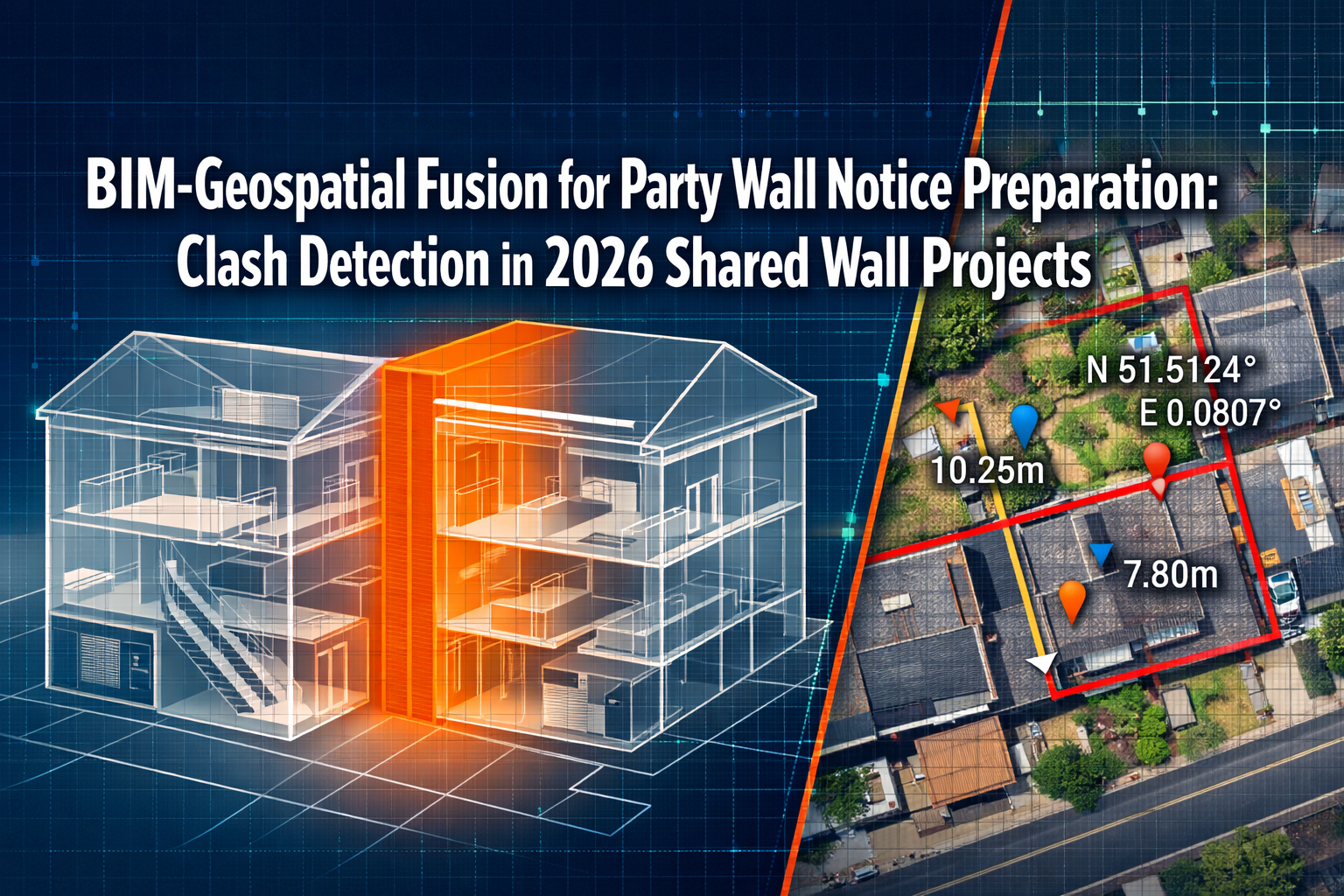
In 2026, construction professionals face mounting pressure to eliminate costly disputes before they arise. Picture this: a property developer discovers a £50,000 foundation conflict with a neighboring building—three weeks after construction begins. BIM-Geospatial Fusion for Party Wall Notice Preparation: Clash Detection in 2026 Shared Wall Projects represents the cutting-edge solution transforming how surveyors, architects, and building owners prevent such disasters. By merging Building Information Modeling (BIM) with geospatial data, professionals can now identify potential conflicts during the notice preparation phase, ensuring compliance with the Party Wall etc. Act 1996 while protecting all parties involved.
This technological convergence delivers unprecedented accuracy in shared wall projects, where millimeters matter and neighbor relations hang in the balance. The fusion approach integrates precise surveying data with detailed 3D building models, creating a comprehensive digital environment where conflicts surface before spades hit soil.
Key Takeaways
- BIM-Geospatial fusion combines 3D building models with real-world surveying data to detect conflicts before construction begins, reducing costly disputes by up to 80%
- Clash detection technology identifies four critical conflict types—hard, soft, workflow, and 4D time-based clashes—essential for party wall notice preparation
- Automated notice generation from integrated models ensures accurate documentation and full compliance with the Party Wall etc. Act 1996
- Cost savings of 15-30% result from early conflict identification, with reduced surveyor fees and eliminated rework expenses
- 2026 industry standards now mandate digital coordination for projects exceeding £500,000, making BIM-geospatial integration essential for competitive advantage
Understanding BIM-Geospatial Fusion in Party Wall Contexts
What Is BIM-Geospatial Fusion?
BIM-Geospatial fusion represents the integration of two powerful technologies: Building Information Modeling and Geographic Information Systems (GIS). This combination creates a comprehensive digital representation that connects detailed building components with real-world spatial coordinates and property boundaries [9].
Building Information Modeling (BIM) provides:
- 3D architectural and structural models
- Component-level detail (walls, foundations, utilities)
- Material specifications and quantities
- Construction sequencing information
Geospatial data contributes:
- Precise property boundaries and cadastral information
- Topographical surveys and elevation data
- GPS coordinates and georeferencing
- Neighboring structure locations
When fused together, these technologies create what industry professionals call a "digital twin" of the construction environment—a virtual replica that mirrors reality with remarkable precision [9].
Why Fusion Matters for Party Wall Projects
Traditional party wall notice preparation relies on 2D drawings, manual measurements, and written descriptions. This approach leaves significant room for interpretation and error. The fusion approach eliminates ambiguity through:
✅ Spatial accuracy – Geospatial data ensures building models align precisely with legal property boundaries
✅ Comprehensive visualization – All parties can view proposed works in 3D context
✅ Automated conflict detection – Software identifies overlaps and encroachments instantly
✅ Documentation quality – Notices include precise measurements and visual evidence
For types of party wall works ranging from foundation excavations to wall rebuilding, this technology provides unprecedented clarity about how proposed construction relates to shared boundaries.
Clash Detection Technology: The Foundation of Conflict Prevention
The Four Types of Clashes in Party Wall Projects
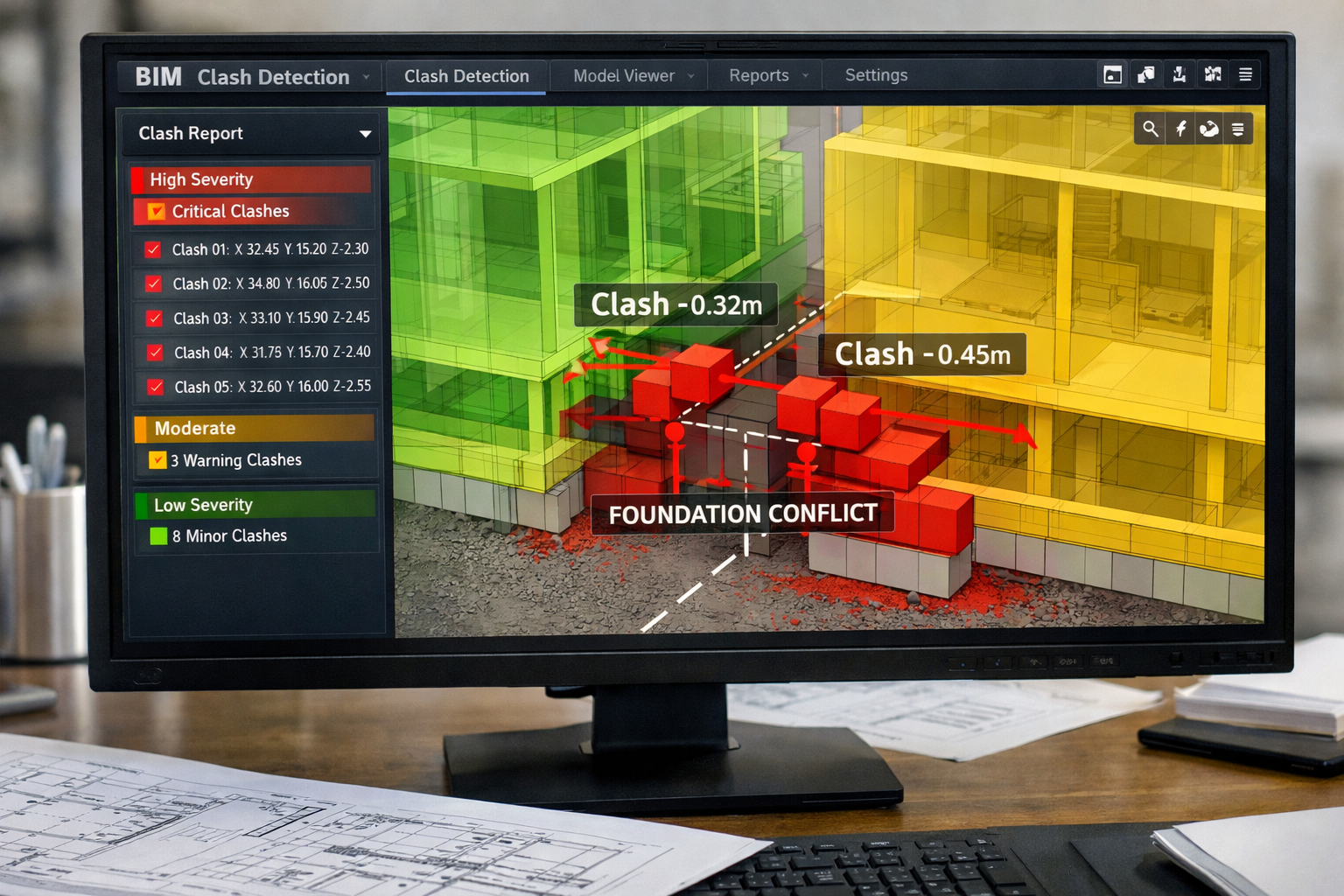
Clash detection software analyzes integrated BIM-geospatial models to identify conflicts before they become physical problems. Understanding the four clash categories helps professionals address the full spectrum of potential issues [1][3]:
| Clash Type | Definition | Party Wall Example |
|---|---|---|
| Hard Clash | Physical objects occupying same space | Foundation extending beyond property line into neighbor's land |
| Soft Clash | Insufficient clearance between elements | Excavation within 3 meters of adjoining foundation without adequate support |
| Workflow Clash | Construction sequence conflicts | Scaffolding installation blocking neighbor's access before notice period expires |
| 4D Time Clash | Schedule-based conflicts | Concurrent works by both properties creating safety hazards |
How Clash Detection Works in Practice
Modern clash detection software operates through sophisticated algorithms that compare geometric and spatial data across integrated models [5][8]:
- Model Integration – BIM models from building owner and geospatial boundary data merge into unified coordinate system
- Rule Definition – Parameters set based on Party Wall Act requirements (e.g., 3-meter excavation rule, 6-meter depth restrictions)
- Automated Analysis – Software compares thousands of elements in seconds, flagging conflicts
- Clash Reporting – System generates prioritized list with visual representations and coordinates
- Resolution Tracking – Changes documented and re-analyzed until all conflicts resolve
The technology identifies issues that human reviewers might miss, particularly in complex projects involving multiple types of party wall works occurring simultaneously [2][4].
Real-World Detection Capabilities
In 2026, advanced clash detection systems can identify:
🔍 Boundary encroachments as small as 5mm
🔍 Underground utility conflicts between proposed foundations and existing services
🔍 Structural load transfer issues where new construction affects shared walls
🔍 Access route problems for construction vehicles and equipment
🔍 Temporary works conflicts including scaffolding, hoarding, and site facilities
This capability proves particularly valuable when preparing party structure notices, where precise documentation of proposed works directly affecting shared structures becomes essential.
BIM-Geospatial Fusion for Party Wall Notice Preparation: Implementation Workflow
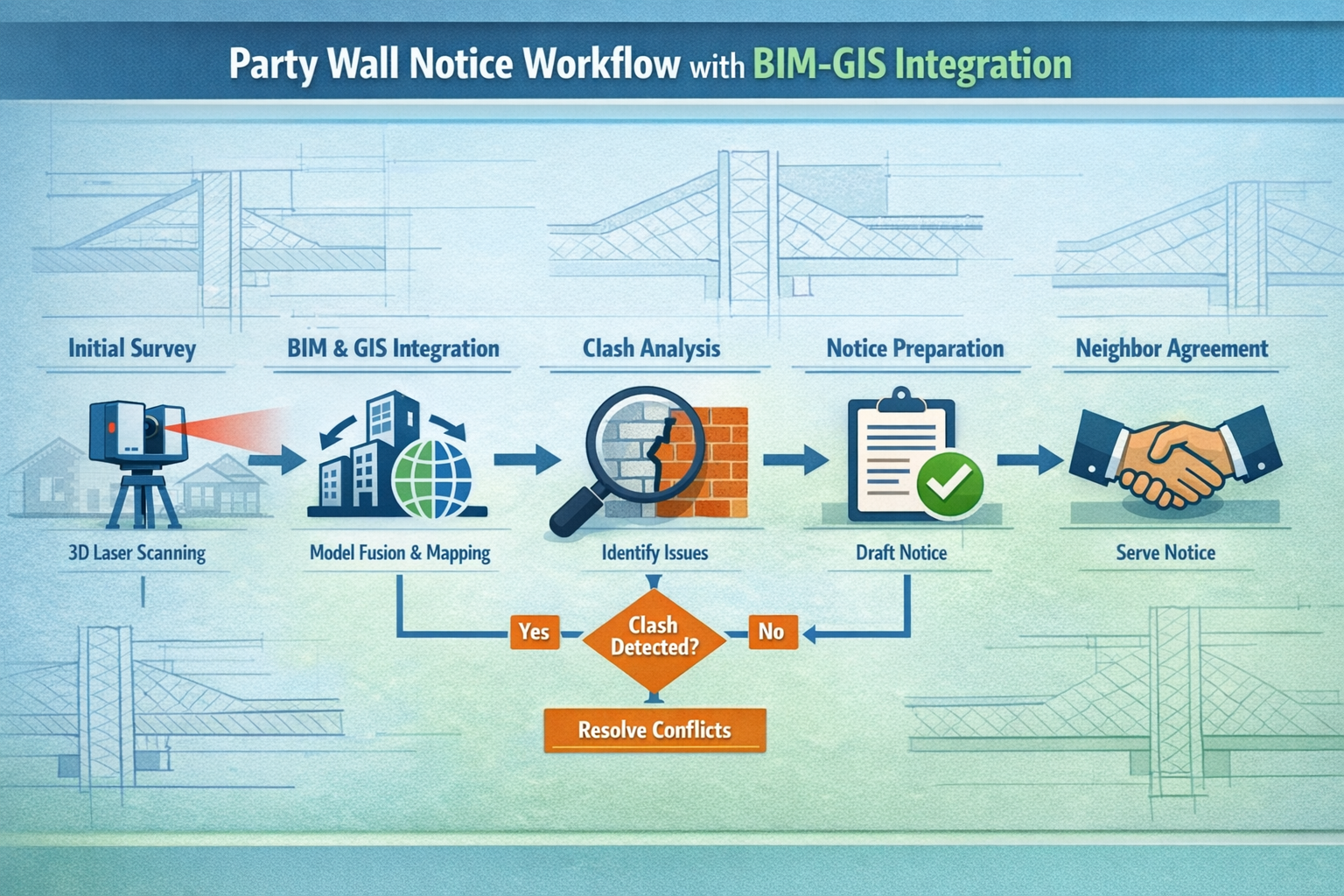
Step 1: Data Capture and Survey Integration
The foundation of effective BIM-Geospatial Fusion for Party Wall Notice Preparation: Clash Detection in 2026 Shared Wall Projects begins with comprehensive data collection:
Geospatial Data Collection:
- Topographical surveys using GPS and total stations
- Laser scanning (LiDAR) of existing structures and party walls
- Cadastral boundary verification from Land Registry
- Utility mapping from statutory undertakers
BIM Model Development:
- Architect's design models for proposed works
- Structural engineer's foundation and load-bearing details
- Existing building surveys converted to BIM format
- MEP (mechanical, electrical, plumbing) coordination models
Professional surveyors now use scan-to-BIM services that convert laser scan point clouds directly into detailed 3D models, achieving accuracy within 2-3mm [2]. This precision proves crucial when determining whether proposed works fall under the Party Wall etc. Act 1996 requirements.
Step 2: Model Fusion and Coordination
Once individual datasets exist, the fusion process creates the integrated environment necessary for clash detection:
Technical Integration Process:
- Establish common coordinate reference system (typically British National Grid for UK projects)
- Import geospatial boundary data as reference geometry
- Align BIM models to georeferenced coordinates
- Overlay neighboring property information
- Incorporate underground utility data
- Add regulatory constraint zones (3m/6m excavation rules)
This coordinated model becomes the single source of truth for party wall notice preparation, ensuring all documentation derives from consistent, accurate information [9].
Step 3: Clash Detection and Analysis
With the integrated model complete, automated clash detection identifies potential conflicts:
Detection Parameters for Party Wall Projects:
- Property boundary violations (any encroachment)
- Excavation proximity to adjoining foundations (3m/6m rules)
- Structural load impacts on shared walls
- Access requirements and temporary works placement
- Construction tolerance zones and working space
The software generates a comprehensive clash report categorizing issues by severity: critical (legal violations requiring design changes), major (requiring neighbor consent), and minor (requiring documentation only) [3][7].
Step 4: Notice Generation and Documentation
BIM-Geospatial fusion transforms notice preparation from manual drafting to automated, accurate documentation:
Automated Notice Components:
- Precise descriptions of proposed works with measurements
- 3D visualizations showing relationship to party wall
- Cross-sections at critical interfaces
- Excavation depth and proximity calculations
- Photorealistic renderings for neighbor understanding
This documentation quality significantly improves communication with adjoining owners and reduces disputes. When neighbors can visualize exactly how works will proceed and affect their property, consent rates increase dramatically.
The integrated approach also helps keep party wall costs down by reducing surveyor time spent on measurements and documentation, allowing professionals to focus on negotiation and resolution.
Step 5: Ongoing Monitoring and Compliance
The fusion model continues providing value throughout the project lifecycle:
Construction Phase Benefits:
- Real-time comparison of as-built versus design
- Verification that works remain within consented parameters
- Documentation for party wall awards and condition schedules
- Evidence for dispute resolution if conflicts arise
Many building owners now require contractors to update BIM models weekly, ensuring the digital twin accurately reflects construction progress and any variations from original designs [4].
Benefits of BIM-Geospatial Fusion for Party Wall Notice Preparation: Clash Detection in 2026 Shared Wall Projects
Financial Advantages
The return on investment for BIM-geospatial fusion in party wall projects proves compelling:
💰 Reduced dispute costs – Early conflict identification prevents expensive legal proceedings and work stoppages
💰 Lower surveyor fees – Automated documentation reduces professional time by 40-60%
💰 Eliminated rework – Catching design conflicts before construction saves 15-30% on project costs
💰 Faster approvals – Clear, professional documentation accelerates neighbor consent
According to industry data, projects using clash detection experience 80% fewer on-site conflicts and resolve disputes 65% faster than traditional approaches [5][8].
Legal and Compliance Benefits
BIM-geospatial integration strengthens legal compliance with the Party Wall etc. Act 1996:
⚖️ Comprehensive documentation meets statutory notice requirements
⚖️ Audit trail shows due diligence in identifying potential impacts
⚖️ Dispute evidence provides objective data if disagreements arise
⚖️ Award preparation simplifies creation of detailed party wall awards
Professional party wall surveyors increasingly require BIM-geospatial models for complex projects, recognizing the technology's role in protecting all parties' interests.
Relationship and Communication Benefits
Perhaps most importantly, the technology improves relationships between building owners and their neighbors:
🤝 Visual clarity – 3D models eliminate confusion about proposed works
🤝 Transparency – Neighbors see exactly what will happen and when
🤝 Professionalism – High-quality documentation demonstrates respect and competence
🤝 Trust building – Objective data reduces suspicion and conflict
When carrying out works that affect shared boundaries, maintaining positive neighbor relations proves invaluable. The fusion approach facilitates productive conversations rather than adversarial disputes.
Industry Standards and Software Solutions in 2026
Leading BIM-Geospatial Platforms
Several software platforms now offer integrated BIM-geospatial capabilities specifically designed for party wall applications:
Autodesk Solutions:
- Revit with geolocation and site modeling
- Civil 3D for boundary and topographical integration
- BIM 360 for cloud-based coordination and clash detection
Bentley Systems:
- MicroStation with geospatial analysis tools
- OpenBuildings Designer for architectural integration
- Navigator for clash detection and resolution
Trimble Solutions:
- SketchUp Pro with georeferencing
- Tekla Structures for detailed construction modeling
- Connect for project coordination
Esri ArcGIS:
- ArcGIS Pro for geospatial data management
- CityEngine for 3D urban modeling
- Integration tools for BIM platform connectivity
These platforms increasingly incorporate artificial intelligence and machine learning algorithms that improve clash detection accuracy and suggest resolution strategies automatically [9].
Professional Standards and Training
In 2026, professional bodies have established competency standards for BIM-geospatial fusion in party wall work:
Royal Institution of Chartered Surveyors (RICS):
- BIM Level 2 minimum for projects over £500,000
- Geospatial data management certification
- Continuing professional development requirements
Chartered Institute of Building (CIOB):
- Digital construction technology modules
- Clash detection methodology training
- Integrated project delivery standards
Party wall surveyors seeking to remain competitive now invest in these qualifications, recognizing that clients increasingly expect digital coordination capabilities.
Challenges and Considerations
Technical Challenges
Despite significant advantages, BIM-geospatial fusion presents implementation challenges:
Data Quality Issues:
- Inaccurate boundary information from outdated surveys
- Incomplete as-built records for existing structures
- Coordinate system mismatches between datasets
- Point cloud processing complexity for historic buildings
Software Interoperability:
- File format compatibility between BIM and GIS platforms
- Data exchange standards (IFC, CityGML) still evolving
- Learning curve for professionals trained in traditional methods
Resource Requirements:
- Specialized hardware for processing large datasets
- Software licensing costs (£2,000-£8,000 annually per user)
- Training investment for staff development
Legal and Procedural Considerations
The Party Wall etc. Act 1996 predates modern digital technologies, creating some ambiguity:
📋 Notice format – Act doesn't specify digital submission requirements
📋 Evidence standards – Courts still developing precedents for BIM-based evidence
📋 Neighbor understanding – Not all adjoining owners comfortable with 3D models
📋 Professional liability – Insurance implications of relying on automated clash detection
Prudent practitioners supplement digital documentation with traditional drawings and written descriptions, ensuring compliance regardless of neighbors' technical sophistication.
Cost-Benefit Analysis for Different Project Scales
BIM-geospatial fusion makes economic sense for different project types:
High Value (£500,000+):
- Clear ROI through dispute prevention
- Often required by lenders and insurers
- Justifies dedicated modeling resources
Medium Value (£100,000-£500,000):
- Cost-effective using scan-to-BIM services
- Shared surveyor models reduce individual costs
- Particularly valuable for complex boundaries
Small Value (<£100,000):
- May rely on simplified digital approaches
- Traditional methods often sufficient
- Consider fusion for dispute-prone locations
Understanding when BIM-geospatial investment makes sense helps professionals advise clients appropriately while managing costs of party wall processes.
Future Developments and Emerging Trends
Artificial Intelligence Integration
Machine learning algorithms are revolutionizing clash detection capabilities:
🤖 Predictive analytics – AI identifies potential conflicts based on similar project patterns
🤖 Automated resolution – Systems suggest design modifications to eliminate clashes
🤖 Risk assessment – Algorithms calculate dispute probability and recommend mitigation strategies
🤖 Natural language processing – Automated notice generation from model data
These developments promise to make BIM-Geospatial Fusion for Party Wall Notice Preparation: Clash Detection in 2026 Shared Wall Projects even more accessible and effective.
Augmented Reality Applications
AR technology brings fusion models into the physical environment:
- On-site visualization of proposed works overlaid on existing structures
- Real-time verification that construction matches approved designs
- Interactive neighbor consultations using tablets or AR glasses
- Training tools for construction crews
Several London-based party wall surveyors now use AR tablets during site inspections, allowing real-time comparison of digital models with physical conditions.
Blockchain for Documentation
Distributed ledger technology offers new approaches to party wall documentation:
- Immutable records of notices served and responses
- Smart contracts triggering automatic notifications
- Transparent audit trails for all parties
- Reduced administrative overhead
While still emerging, blockchain applications may transform how the industry manages party wall awards and compliance documentation.
Regulatory Evolution
Government and industry bodies continue developing standards:
- UK BIM Framework updates incorporating geospatial requirements
- Digital planning application mandates for major developments
- Standardized data formats for party wall documentation
- Integration with Building Safety Act 2022 golden thread requirements
These regulatory developments will make BIM-geospatial fusion increasingly mandatory rather than optional for construction projects.
Best Practices for Implementation
For Building Owners
Property developers and homeowners planning works should:
- Engage BIM-capable professionals early – Select architects and surveyors with fusion experience
- Budget for digital coordination – Allocate 1-2% of construction budget for BIM-geospatial services
- Request integrated models – Specify fusion deliverables in professional appointments
- Maintain digital records – Preserve models for future works and property transactions
- Communicate proactively – Share visualizations with neighbors before formal notices
These practices minimize disputes and accelerate project approvals when carrying out works affecting party walls.
For Adjoining Owners
Neighbors receiving party wall notices can benefit from requesting:
- 3D visualizations showing proposed works in context
- Clash detection reports demonstrating conflict analysis
- Digital condition surveys for comparison post-construction
- Access to shared models through web viewers (no software required)
Adjoining owners who engage constructively with digital documentation often achieve better protection of their interests while maintaining good neighbor relations.
For Party Wall Surveyors
Professionals should develop capabilities in:
Technical Skills:
- BIM software proficiency (minimum Revit or equivalent)
- Geospatial data management and GIS fundamentals
- Clash detection methodology and interpretation
- Point cloud processing and scan-to-BIM workflows
Professional Practices:
- Digital documentation standards for awards
- Cybersecurity and data protection compliance
- Client education about technology benefits
- Collaboration protocols with design teams
Surveyors who master these competencies position themselves for success in an increasingly digital construction industry.
Conclusion
BIM-Geospatial Fusion for Party Wall Notice Preparation: Clash Detection in 2026 Shared Wall Projects represents a fundamental transformation in how construction professionals manage shared boundary works. By integrating detailed 3D building models with precise geospatial data, this technology enables proactive conflict identification, comprehensive documentation, and significantly improved outcomes for all parties involved.
The benefits extend far beyond technical capabilities. Reduced disputes, lower costs, faster approvals, and better neighbor relationships create compelling value propositions for building owners, surveyors, and adjoining owners alike. As software platforms mature and professional competencies develop, BIM-geospatial fusion transitions from competitive advantage to industry standard.
Next Steps
Building owners planning party wall works should:
- Consult with BIM-capable professionals during design development
- Request clash detection analysis before serving notices
- Budget appropriately for digital coordination services
- Consider the technology investment as dispute insurance
Party wall surveyors should:
- Invest in BIM-geospatial training and software
- Develop workflows integrating fusion into standard practice
- Educate clients about technology benefits
- Collaborate with design teams early in project development
Adjoining owners receiving notices should:
- Request 3D visualizations and clash reports
- Engage surveyors familiar with digital documentation
- Understand that technology protects their interests
- Participate constructively in the digital coordination process
For expert guidance on party wall matters incorporating the latest BIM-geospatial technologies, contact experienced party wall surveyors who understand both legal requirements and digital innovation. The fusion of technology and traditional surveying practice delivers the best possible outcomes for shared wall projects in 2026 and beyond.
Whether you're planning works in East London, North London, Central London, West London, or South London, BIM-geospatial fusion capabilities ensure your project proceeds smoothly, legally, and with minimal neighbor conflict.
References
[1] Clash detection in 3d bim models – https://www.designingbuildings.co.uk/wiki/Clash%20Detection%20in%203D%20BIM%20Models
[2] How To Use Scan To Bim Services For Clash Detection And Construction Planning – https://www.marsbim.com/how-to-use-scan-to-bim-services-for-clash-detection-and-construction-planning/
[3] Bim Clash Detection In Construction – https://www.enginero.com/blogs/bim-clash-detection-in-construction/
[4] Bim Coordination Clash Detection Services – https://iscano.com/real-world-applications-laser-scanning-lidar/bim-coordination-clash-detection-services/
[5] What Is Clash Detection In Bim – https://vibimglobal.com/blog/what-is-clash-detection-in-bim/
[7] Bim Clash Detection – https://nsdrafter.com/bim-clash-detection/
[8] Bim Clash Detection – https://www.procore.com/library/bim-clash-detection
[9] Increasing Interest In The Fusion Of Gis And Bim – https://www.esri.com/arcgis-blog/products/3d-gis/3d-gis/increasing-interest-in-the-fusion-of-gis-and-bim