


Thermal bridges account for between 20% and 70% of a building envelope's total heat loss in poorly detailed structures — a range so wide it exposes just how inconsistently the construction industry has treated junction design [1]. For party wall surveyors working on electrified extensions and loft conversions in 2026, that statistic is no longer an abstract engineering concern. Updated energy codes on both sides of the Atlantic now demand airtightness targets as tight as 3 ACH50 and mandatory continuous insulation, and shared walls sit squarely in the critical path to compliance. Thermal Bridging Controls in Party Wall Agreements: Meeting 2026 Code Updates for Energy Efficiency is therefore not a niche specialism — it is a core competency for every professional serving building owners and adjoining owners today.
Key Takeaways
- Thermal bridges at party wall junctions can reduce envelope thermal performance by 20–70%, making detailed junction design essential for 2026 code compliance.
- Updated regulations in the UK (Part L), the US (IECC 2021/2024), and multiple state codes now explicitly require thermal bridging analysis and continuous insulation at shared wall interfaces.
- Party wall awards drafted in 2026 should include specific clauses covering psi-value targets, continuous insulation specifications, airtightness membranes, and post-construction thermal verification.
- Building owners carrying out electrified extensions face compounded risk: heat pump efficiency is directly undermined by thermal bridges that inflate space-heating demand.
- Engaging a qualified party wall surveyor early ensures that thermal performance obligations are embedded in the award before construction begins, reducing disputes and compliance failures.
Why Thermal Bridging at Shared Walls Demands Attention in 2026
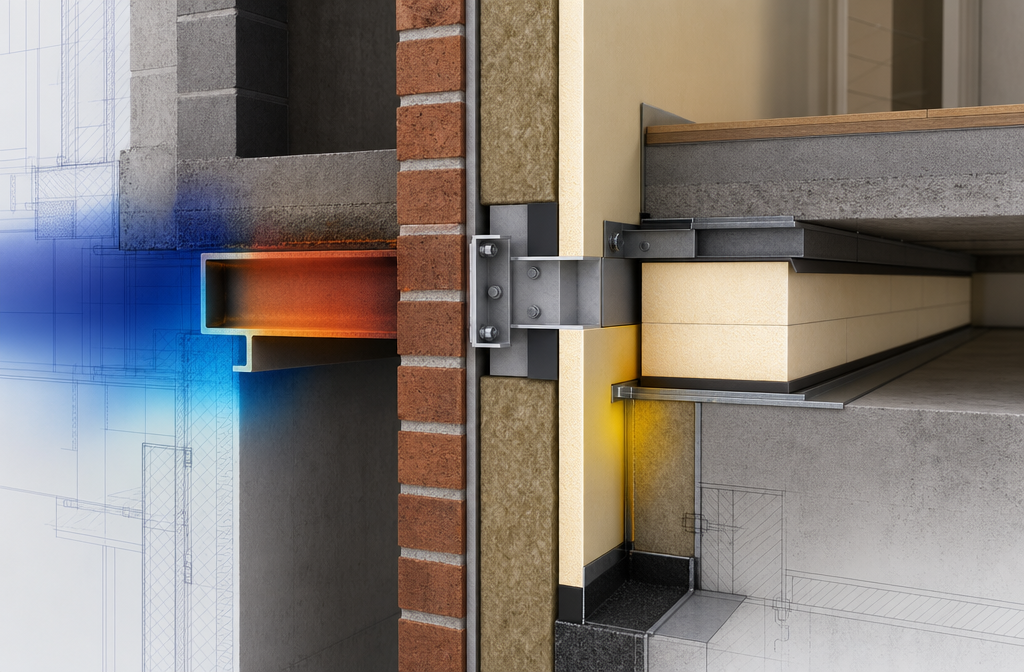
A party wall is, by its nature, a structural and thermal junction between two independently owned properties. Every steel joist hanger, every concrete padstone, every masonry tie that penetrates the insulation layer creates a pathway for heat to bypass the intended thermal envelope. These pathways are thermal bridges, and in the context of Thermal Bridging Controls in Party Wall Agreements: Meeting 2026 Code Updates for Energy Efficiency, they represent the single most technically complex challenge surveyors face when drafting awards for modern extensions.
What the 2026 Code Landscape Actually Requires
The regulatory environment shifted materially at the start of 2026. In the UK, updated Part L Building Regulations introduced stricter U-value and psi-value requirements for new build and material change of use, with explicit guidance on accredited construction details at party wall junctions [9]. Builders and designers can no longer rely on notional building calculations that ignore repeating and non-repeating thermal bridges.
In the United States, California's updated Energy Code — effective 1 January 2026 — raised the bar for exterior wall thermal performance and introduced tighter requirements for window-to-wall junctions and continuous insulation [2]. Massachusetts already embedded detailed thermal bridging analysis into its Stretch Energy Code 10th Edition, requiring designers to "derate" assembly R-values to account for framing and structural penetrations [3]. Utah followed with a new energy code effective 1 July 2026, establishing minimum thermal-performance requirements for building envelopes that directly address bridging at structural connections [8].
Internationally, the 2026 code cycle — encompassing IECC 2021 and 2024 adoptions across US jurisdictions — places greater emphasis on air barrier continuity and thermal bridging, particularly at metal framing and structural steel elements [4]. The Rocky Mountain Institute's updated Energy Code Safe Harbor Toolkit, revised in 2026, provides simplified compliance pathways that include thermal bridge mitigation as a standard provision [5]. Looking ahead, the 2027 IECC development process — with a final publication target of December 2026 — includes dedicated thermal bridging provisions that will set the benchmark for the next code cycle [7].
"The 2026 code cycle brings more stringent energy codes impacting architectural and envelope design, with a clear focus on reducing thermal bridging at structural junctions." [6]
The Party Wall Act Framework and Its Energy Blind Spot
The Party Wall etc. Act 1996 was drafted to protect structural and proprietary rights at shared boundaries. It was not written with thermal performance in mind. This creates a practical gap: the Act gives surveyors authority to set out the manner of executing works in a party wall award, but it does not automatically require thermal compliance clauses. In 2026, filling that gap is both a professional responsibility and a legal risk-management imperative.
When a building owner constructs an electrified extension — one heated by a heat pump rather than a gas boiler — the thermal quality of the party wall interface becomes financially critical. A heat pump's coefficient of performance (COP) drops as space-heating demand rises. Every unmitigated thermal bridge at the shared wall junction inflates that demand, increasing running costs for both the building owner and, potentially, the adjoining owner through conducted heat loss or gain.
Understanding the types of party wall works that trigger these obligations is the starting point. Extensions built up to or astride the boundary line, loft conversions that cut into shared chimney breasts, and basement excavations that expose party wall foundations all create new thermal bridge risks that a well-drafted award must address.
Embedding Thermal Performance Clauses in Party Wall Awards

The party wall award is the primary legal instrument through which surveyors can impose thermal performance obligations on a building owner. A party wall award that is silent on insulation continuity, junction detailing, and airtightness verification is inadequate for 2026 conditions.
Specific Clauses Surveyors Should Include
The following table summarises the key thermal performance provisions that should be considered for inclusion in awards where works affect a shared wall:
| Clause Type | What It Should Specify | Why It Matters |
|---|---|---|
| Continuous insulation requirement | Minimum R-value or U-value for insulation layer, with no breaks at structural elements | Prevents repeating thermal bridges at joist ends and hangers |
| Psi-value (linear thermal transmittance) targets | Maximum psi-value for party wall junctions, typically 0.10 W/mK or lower | Quantifies and limits heat loss at linear junctions |
| Airtightness membrane specification | Membrane type, lapping requirements, and tape specification at all penetrations | Supports ACH50 targets and prevents interstitial condensation |
| Thermally broken fixings | Requirement to use proprietary thermally broken brackets and wall ties | Eliminates point thermal bridges at structural connections |
| Post-construction verification | Thermographic survey or blower door test within 28 days of completion | Confirms compliance before final sign-off |
| Remediation obligation | Building owner's duty to rectify any identified thermal bridge before practical completion | Provides enforceable remedy without litigation |
Psi-Values, U-Values, and Why Both Matter
Many surveyors are comfortable specifying U-values for wall elements but less familiar with psi-values (pronounced "sigh-values"). A U-value measures the thermal transmittance of a homogeneous element — a wall, a floor, a roof. A psi-value measures the additional heat loss per metre length at a linear junction, such as where a party wall meets a floor slab or where a steel beam penetrates an insulation layer.
In a party wall context, the junctions between the shared wall and the new extension's floor, ceiling, and external walls are all potential psi-value hotspots. Updated UK Part L guidance and the IECC framework both require that these linear thermal transmittances be calculated using recognised software (such as THERM or equivalent) and that the results be included in the overall energy compliance calculation [9] [4].
For surveyors drafting awards, the practical implication is straightforward: the award should require the building owner to submit junction calculations prepared by a competent thermal modeller before works commence, and to confirm that the specified details have been installed correctly upon completion.
Airtightness and the 3 ACH50 Target
Airtightness and thermal bridging are closely linked. A continuous insulation layer that is punctured by unsealed penetrations — pipe runs, electrical conduits, structural fixings — creates both thermal bridges and air leakage paths. The 2026 code environment, particularly under IECC 2021/2024 adoptions and California's updated Energy Code, targets whole-building airtightness of 3 ACH50 or better [2] [4].
At a party wall, achieving this target requires:
- Continuous airtightness membrane on the warm side of the insulation, lapped and taped at all junctions
- Pre-compressed foam tape at the interface between the new extension frame and the existing party wall masonry
- Service penetration seals using proprietary grommets or intumescent collars where pipes and cables pass through the party wall plane
- Robust detailing at the wall head, where the extension roof meets the party wall, to prevent air bypass above the insulation layer
The party wall notice served on the adjoining owner should reference the intended airtightness strategy, and the award should make the building owner's compliance with that strategy a condition of the works.
Practical Guidance for Surveyors and Building Owners in 2026
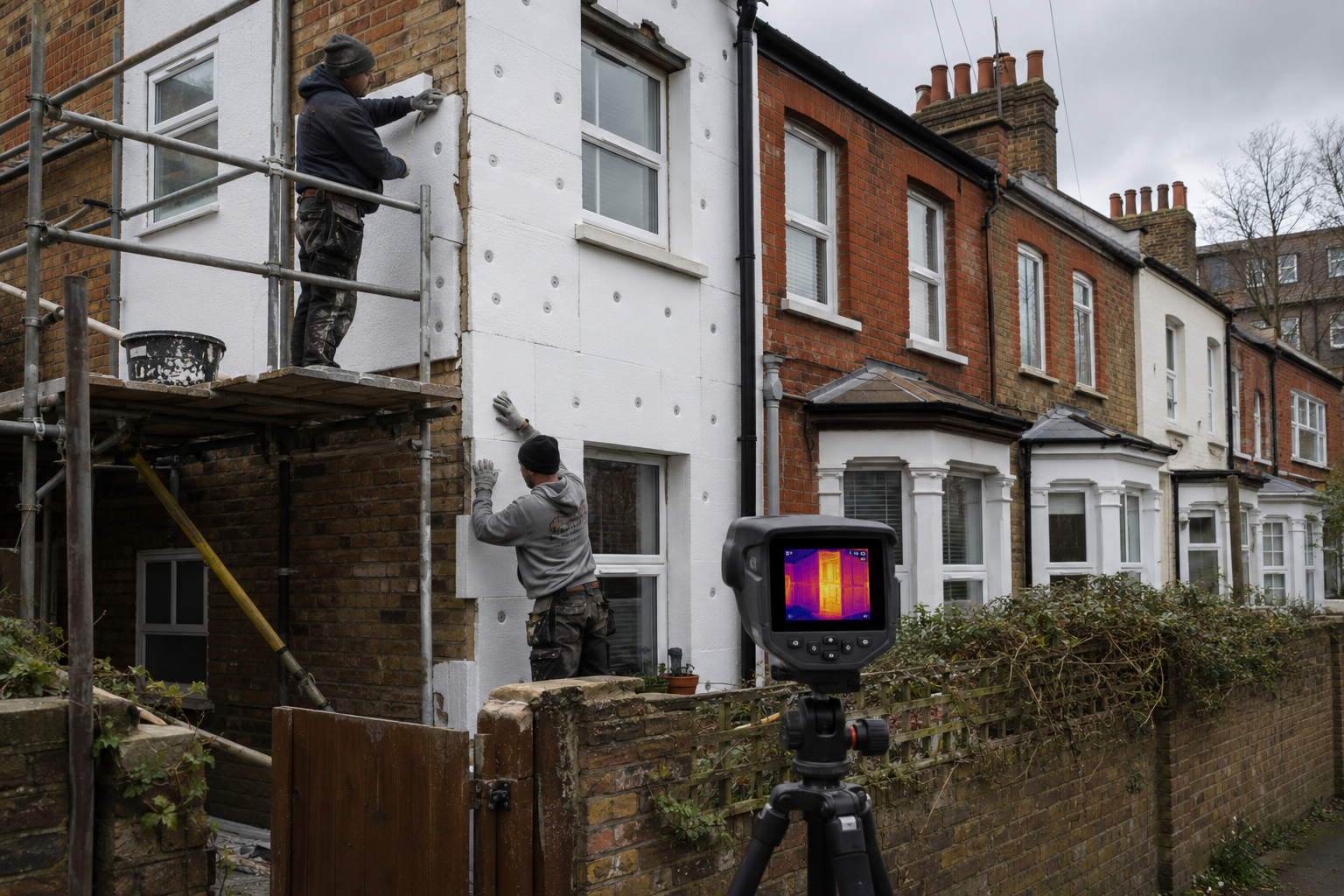
Meeting the requirements for Thermal Bridging Controls in Party Wall Agreements: Meeting 2026 Code Updates for Energy Efficiency demands coordinated action from the building owner, their designer, and the appointed surveyor. The following guidance addresses the most common practical challenges.
Coordinating with the Designer Early
The party wall process and the building regulations process run in parallel but are legally distinct. A building owner may obtain planning permission and building regulations approval for an extension without those approvals containing any party wall-specific thermal obligations. The surveyor's role is to ensure that the thermal performance strategy embedded in the building regulations submission is reflected — and where necessary strengthened — in the party wall award.
This requires the surveyor to request and review:
- The building's SAP or PHPP energy calculation, showing how party wall junctions are treated
- Junction details prepared to Accredited Construction Detail (ACD) standard or equivalent
- The specification for insulation products, including thermal conductivity (lambda) values
- The airtightness strategy document, including membrane layout drawings
Builders are adapting to these demands in 2026, with many now supplying pre-engineered thermal break systems and pre-formed airtightness membrane kits specifically designed for party wall interfaces [10]. Surveyors who understand these products can specify them by performance standard rather than by proprietary name, keeping the award technically robust and commercially neutral.
Managing the Adjoining Owner's Interests
The adjoining owner has a legitimate interest in thermal performance at the shared wall. An inadequately insulated party wall junction can cause:
- Cold bridging on the adjoining side, leading to surface condensation and mould growth
- Increased heat loss from the adjoining property if the building owner's works remove or damage existing insulation
- Noise transmission changes if insulation products with different acoustic properties are substituted
The adjoining owner should be advised to request that the award includes a schedule of condition recording the thermal and acoustic condition of the shared wall before works begin. This provides an evidential baseline if disputes arise about post-construction condensation or heat loss.
Common Thermal Bridge Risks by Work Type
Loft conversions — Steel beams inserted into party walls to carry new floor loads create significant point and linear thermal bridges. The award should require thermally broken beam end details and specify the minimum insulation thickness around beam pockets.
Side-return extensions — The junction between the new extension's flat or pitched roof and the party wall is a classic cold bridge location. Continuous insulation over the wall head, with no gaps at rafter feet, is essential.
Basement excavations — Underpinning sequences that expose the party wall foundation create thermal bridge risks at the wall-to-slab junction. The award should specify the insulation treatment for the new floor slab perimeter.
Electrified extensions with underfloor heating — Where underfloor heating is installed in a new extension, the edge insulation at the party wall perimeter is critical. Without it, heat from the slab conducts directly into the party wall foundation, inflating energy consumption and potentially causing discomfort in the adjoining property.
Cost Implications and How to Keep Them Proportionate
Thermal bridging mitigation adds cost, but the quantum is manageable when specified correctly. Proprietary thermally broken brackets typically add 5–15% to the cost of structural fixings. Continuous external insulation on an extension wall adds material cost but may reduce the required wall thickness, partially offsetting the expense. Airtightness membranes and tapes are low-cost relative to the whole-works budget.
For guidance on managing the overall financial picture, the resource on how to keep party wall costs down provides practical strategies that complement the technical requirements discussed here. Early engagement with a surveyor — before design is fixed — is consistently the most effective cost-control measure, because retrofitting thermal bridge solutions into a completed design is always more expensive than designing them in from the outset.
Verification and Enforcement
An award clause that cannot be verified is an award clause that cannot be enforced. Surveyors should specify:
- Pre-completion thermographic survey: Conducted with a calibrated thermal imaging camera under a minimum 10°C temperature differential between inside and outside, this identifies cold spots at junctions before finishes are applied.
- Blower door test: A whole-building pressurisation test to 50 Pa, confirming that the airtightness target has been achieved. Results should be submitted to the surveyor within a specified timeframe after practical completion.
- Photographic record: The building owner's contractor should provide timestamped photographs of all insulation and membrane installations at the party wall interface before they are covered up.
These verification requirements align with the approach taken in the Rocky Mountain Institute's updated Energy Code Safe Harbor Toolkit, which emphasises measurable, enforceable compliance pathways rather than design-stage calculations alone [5].
Conclusion
Thermal bridging at party wall junctions is no longer a detail that can be left to the building regulations process alone. The 2026 code environment — from UK Part L updates to IECC adoptions and state-level energy codes across the US — makes explicit what good practice has long implied: shared walls must be treated as critical thermal junctions, not just structural boundaries.
For surveyors, the actionable steps are clear:
- Request thermal junction calculations from the building owner's designer before finalising the award, and verify that party wall junctions are explicitly addressed.
- Include specific, measurable thermal performance clauses in every award where works affect a shared wall — covering psi-values, continuous insulation, airtightness membranes, and thermally broken fixings.
- Specify post-construction verification — thermographic survey and blower door test — as conditions of the award, not optional extras.
- Advise adjoining owners to request a schedule of condition that records the existing thermal state of the shared wall before works begin.
- Stay current with code updates: the 2027 IECC is in development now, with publication targeted for December 2026, and its thermal bridging provisions will shape the next generation of compliance requirements [7].
Building owners planning electrified extensions in 2026 should engage a qualified party wall surveyor at the earliest design stage. The intersection of party wall law and energy code compliance is complex, but with the right expertise embedded in the award from the outset, both structural protection and thermal performance can be achieved without conflict or delay.
References
[1] journals.sagepub – https://journals.sagepub.com/doi/10.1177/01436244261453333?utm_source=openai
[2] Californias Energy Code Update Guides Construction Cleaner Healthier Buildings – https://www.energy.ca.gov/news/2026-01/californias-energy-code-update-guides-construction-cleaner-healthier-buildings?utm_source=openai
[3] Derating Thermal Bridging Ma 10th Edition – https://copelandbec.com/2023/12/14/derating-thermal-bridging-ma-10th-edition/?utm_source=openai
[4] Iecc 2021 2024 Updates Air Barriers And Thermal Bridging In Metal Buildings – https://therm-all.com/iecc-2021-2024-updates-air-barriers-and-thermal-bridging-in-metal-buildings/?utm_source=openai
[5] The Energy Code Safe Harbor – https://rmi.org/insight/the-energy-code-safe-harbor/?utm_source=openai
[6] 2026 Code Cycle Changes Guide – https://www.withpulley.com/resources/2026-code-cycle-changes-guide?utm_source=openai
[7] 2026 Energy Codes Outlook – https://www.cityenergyproject.org/news/2026-energy-codes-outlook/?utm_source=openai
[8] New Energy Code – https://www.hbautah.com/new-energy-code?utm_source=openai
[9] Part L Building Regulations 2026 – https://www.arcbuildingsupplies.com/blog/part-l-building-regulations-2026?utm_source=openai
[10] Energy Codes Are Changing Everything What Builders Need To Know In 2026 – https://www.snaptightproducts.com/energy-codes-are-changing-everything-what-builders-need-to-know-in-2026/?utm_source=openai