Imagine predicting exactly how your basement excavation will affect your neighbor's Victorian terrace—before you even break ground. In 2026, Real-Time 3D Digital Twins for Party Wall Act Excavations: Simulating Section 6 Risks in 2026 are transforming how surveyors, contractors, and property owners approach complex urban construction projects. By creating live-updating virtual replicas of buildings and subsurface conditions, these advanced digital models allow professionals to simulate excavation impacts on neighboring foundations with unprecedented accuracy—all before party wall notices are even served. 🏗️
For property owners planning basement conversions, extensions, or deep foundation work in densely built areas, this technology represents a paradigm shift. Traditional approaches to Party Wall Act compliance often rely on historical data, manual calculations, and reactive monitoring. Digital twin technology changes the game by providing predictive insights that help prevent disputes, reduce costs, and protect neighboring properties from damage.
Key Takeaways
- Digital twins create virtual replicas of construction sites that update in real-time, allowing surveyors to simulate excavation impacts before work begins
- Section 6 of the Party Wall Act governs excavation near neighboring buildings, and digital twins help quantify risks with precision previously impossible
- Live sensor integration feeds actual ground movement data into digital models, enabling immediate adjustments to construction methods
- Cost savings and dispute prevention result from identifying potential issues during the planning phase rather than after damage occurs
- 2026 technology advances have made digital twin implementation more accessible for standard residential projects, not just large commercial developments
Understanding the Party Wall Act and Section 6 Excavation Risks
The Party Wall etc. Act 1996 provides a framework for preventing and resolving disputes between property owners undertaking building works. Section 6 of the Party Wall Act specifically addresses excavation work within three or six meters of a neighboring building, depending on the depth of the proposed excavation relative to the neighbor's foundations.
What Section 6 Covers
Section 6 requires building owners to serve notice when planning to:
- Excavate within 3 meters of a neighboring structure if going deeper than its foundations
- Excavate within 6 meters of a neighboring structure if going deeper than a line drawn at 45 degrees from the bottom of the neighbor's foundations
These requirements exist because excavation can cause:
- Ground settlement and subsidence
- Foundation movement and cracking
- Structural instability in adjacent buildings
- Water table changes affecting neighboring properties
Traditional approaches to assessing these risks involve soil reports, structural calculations, and experienced judgment. However, these methods often cannot predict the complex interactions between soil conditions, existing structures, and excavation activities with complete accuracy.
The Limitations of Traditional Risk Assessment
Conventional Party Wall Act compliance typically follows this pattern:
- Building owner commissions soil investigation
- Structural engineer performs calculations
- Party wall surveyor prepares notices and schedules of condition
- Work proceeds with periodic monitoring
- Disputes arise if unexpected damage occurs
This reactive approach can lead to costly disputes, project delays, and damaged neighbor relationships. The fundamental problem is that traditional methods provide snapshots rather than continuous, predictive insights.
How Real-Time 3D Digital Twins Transform Party Wall Act Compliance
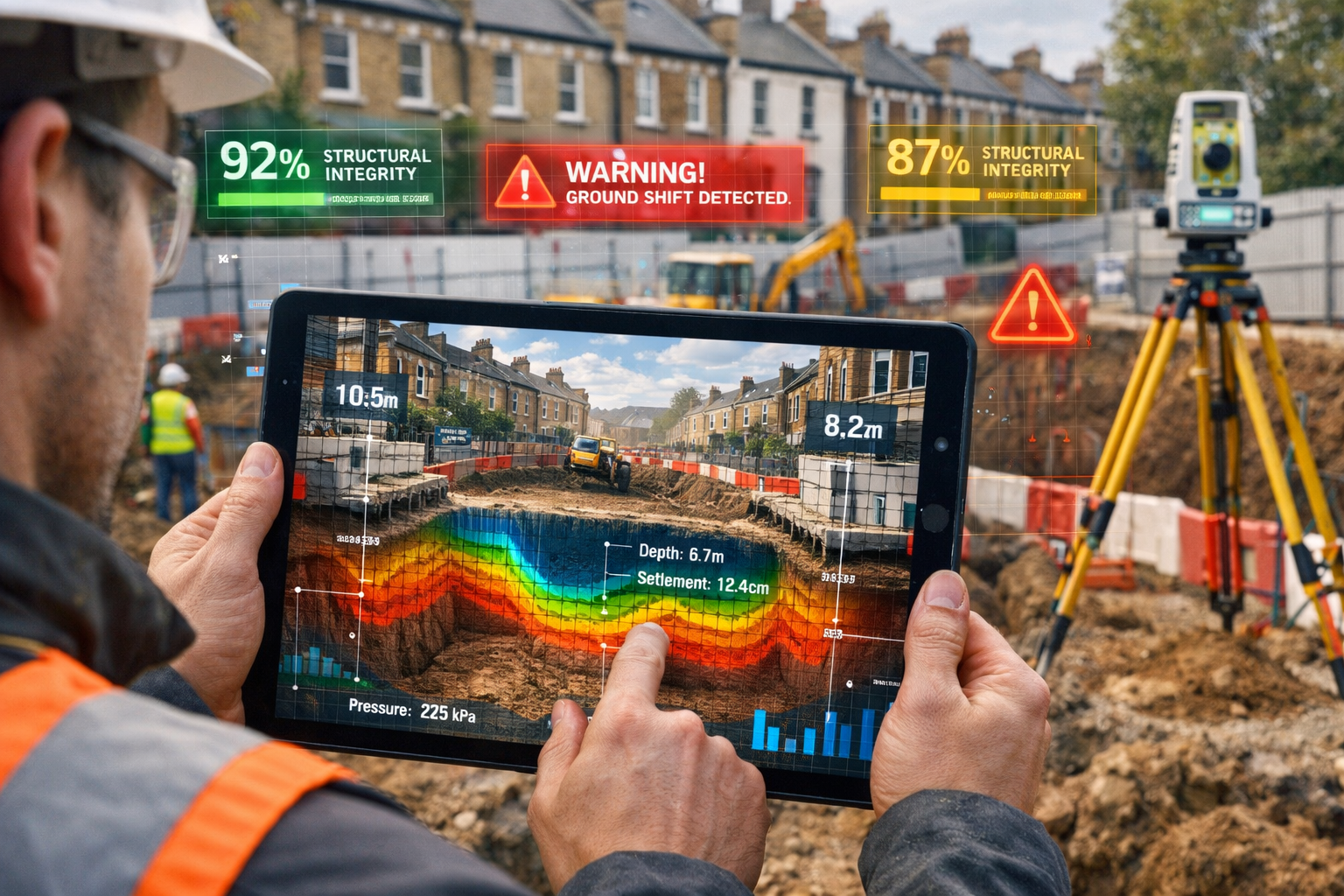
Real-Time 3D Digital Twins for Party Wall Act Excavations: Simulating Section 6 Risks in 2026 represent a fundamental shift from reactive monitoring to proactive risk management. A digital twin is a virtual replica of a physical asset that updates continuously based on real-world data [1].
What Makes Digital Twins "Real-Time"
The "real-time" aspect distinguishes modern digital twins from simple 3D models or Building Information Modeling (BIM). Real-time digital twins incorporate:
- Live sensor feeds from ground movement monitors, inclinometers, and strain gauges
- Continuous data processing that updates the model as conditions change
- Predictive algorithms that forecast future conditions based on current trends
- Automated alerts when parameters exceed safe thresholds
According to industry research, digital twins in construction enable stakeholders to "visualize, simulate, and optimize building performance throughout its lifecycle" [1]. For Party Wall Act excavations, this means surveyors can model how soil will behave as excavation progresses, predict settlement patterns, and adjust construction methods before damage occurs.
Key Components of Digital Twin Technology for Excavations
Implementing Real-Time 3D Digital Twins for Party Wall Act Excavations: Simulating Section 6 Risks in 2026 requires several integrated technologies:
| Component | Function | Party Wall Act Application |
|---|---|---|
| 3D Laser Scanning | Creates precise digital models of existing structures | Documents pre-construction condition of neighboring buildings |
| Ground Penetrating Radar | Maps subsurface conditions and utilities | Identifies foundation depths and soil composition |
| IoT Sensors | Monitors ground movement, vibration, and structural stress | Provides real-time data on excavation impacts |
| AI/Machine Learning | Analyzes patterns and predicts future conditions | Forecasts settlement and identifies emerging risks |
| Cloud Computing | Processes and stores massive datasets | Enables remote access for all parties to party wall awards |
| Visualization Software | Presents complex data in understandable formats | Helps building and adjoining owners understand risks |
The Digital Twin Workflow for Section 6 Excavations
The practical implementation of digital twins for Party Wall Act compliance follows a structured workflow:
Phase 1: Pre-Notice Assessment 🔍
- Conduct 3D laser scanning of building owner's property and neighboring structures
- Perform ground penetrating radar surveys to map foundations and soil conditions
- Create initial digital twin model incorporating all structural and geological data
- Run preliminary simulations of proposed excavation methods
Phase 2: Risk Simulation and Notice Preparation
- Model various excavation scenarios (depth, method, timeline)
- Simulate settlement patterns and foundation movements
- Identify high-risk areas requiring special precautions
- Use simulation results to prepare detailed party wall notices with evidence-based risk assessments
Phase 3: Real-Time Monitoring During Construction
- Install IoT sensors around excavation and on neighboring structures
- Feed live data into digital twin for continuous model updates
- Compare actual conditions against predictions
- Receive automated alerts when movements exceed safe parameters
- Adjust construction methods in response to real-world conditions
Phase 4: Post-Construction Verification
- Document final conditions using the digital twin
- Compare pre- and post-construction states
- Provide evidence for schedule of condition compliance
- Archive data for future reference and dispute resolution
"Digital twins are revolutionizing construction by enabling real-time monitoring and predictive maintenance, reducing costs and improving project outcomes throughout the building lifecycle." [1]
Simulating Section 6 Risks: Practical Applications in 2026
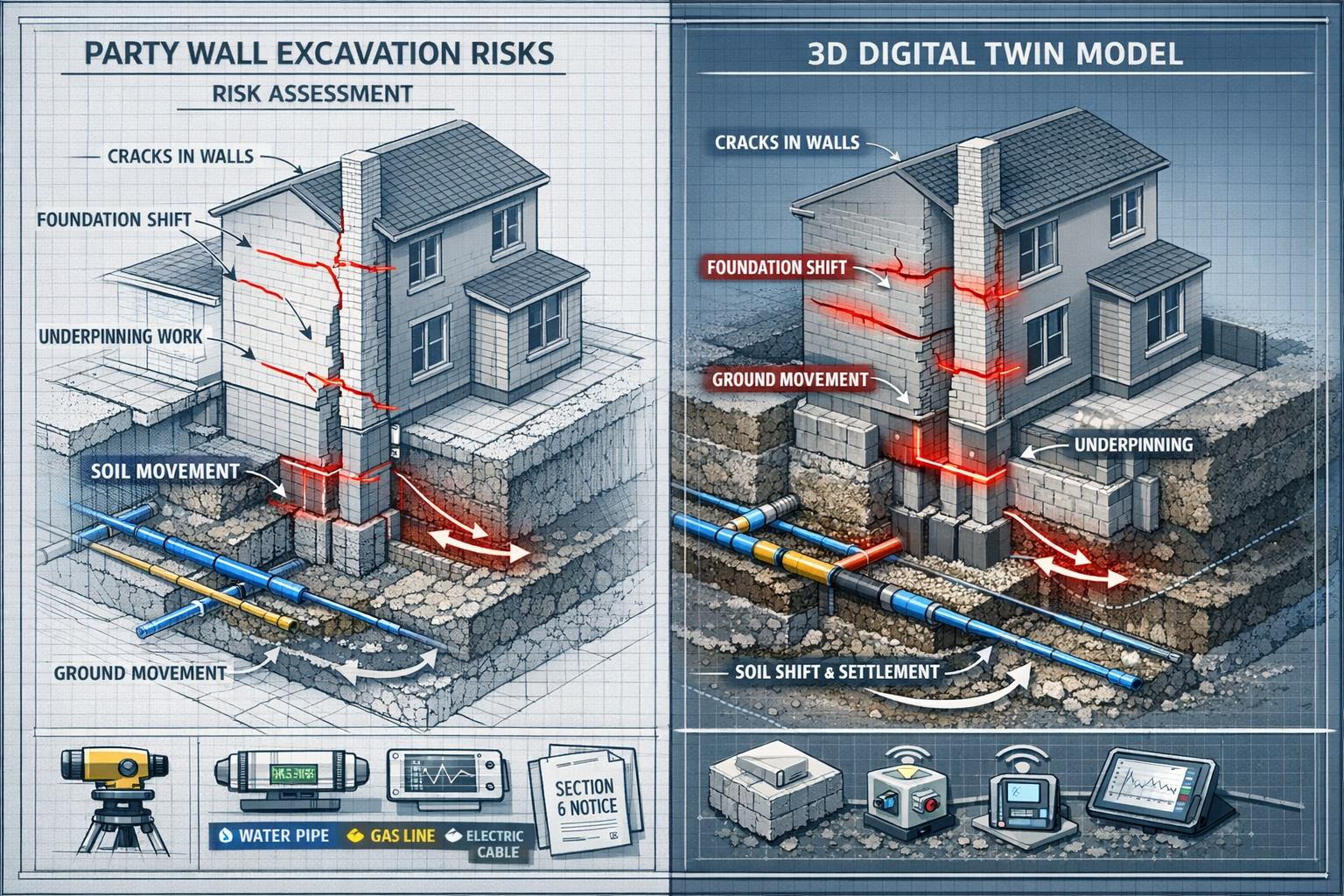
The true value of Real-Time 3D Digital Twins for Party Wall Act Excavations: Simulating Section 6 Risks in 2026 becomes apparent when examining specific applications in urban construction scenarios common across London and other UK cities.
Case Study: Basement Excavation in Victorian Terrace
Consider a typical scenario: a property owner in East London wants to excavate a 2.5-meter-deep basement beneath their Victorian terrace. The neighboring properties have shallow strip foundations approximately 1 meter deep, triggering Section 6 requirements.
Traditional Approach Challenges:
- Soil reports provide limited data points
- Calculations assume uniform soil conditions
- Monitoring detects problems only after they occur
- Disputes arise over whether damage was construction-related
Digital Twin Solution:
- 3D scanning captures precise geometry of all three properties
- Ground penetrating radar maps foundation depths and soil stratification
- Digital model simulates excavation in 10cm increments
- Simulation reveals a clay lens that could cause differential settlement
- Construction plan modified to include localized underpinning before excavation begins
Result: The digital twin identified a high-risk condition that traditional methods would have missed. By addressing it proactively, the project avoided an estimated £45,000 in remedial costs and a six-month delay.
Quantifying Risk with Digital Precision
One of the most significant advantages of digital twins is their ability to quantify risks with unprecedented precision. Instead of qualitative assessments like "low," "medium," or "high" risk, digital twins provide:
- Settlement predictions in millimeters at specific locations
- Probability distributions for various damage scenarios
- Time-based forecasts showing when risks will peak during construction
- Cost estimates for different mitigation strategies
This quantification transforms how parties approach types of party wall works. Building owners can make informed decisions about construction methods based on actual risk-cost trade-offs. Adjoining owners receive transparent, evidence-based information rather than vague assurances.
Integration with Automated Monitoring Systems
By 2026, digital twin technology has become increasingly integrated with automated monitoring systems. As noted in recent industry analysis, "robots and autonomous systems are closing the loop for digital twins" by providing continuous, accurate data collection [3].
For Party Wall Act excavations, this means:
Automated Ground Movement Monitoring 📊
- Robotic total stations track reference points on neighboring buildings
- Measurements taken every 15 minutes during active excavation
- Data automatically feeds into digital twin model
- Deviations from predicted movements trigger immediate alerts
Vibration and Structural Stress Monitoring
- Accelerometers detect vibration from excavation equipment
- Strain gauges measure stress on party walls and foundations
- AI algorithms distinguish construction-related movements from environmental factors (temperature, traffic)
- Real-time dashboards accessible to all parties via secure cloud platforms
Predictive Maintenance and Risk Mitigation
- Machine learning algorithms identify patterns indicating emerging problems
- System recommends specific interventions (slower excavation, additional shoring, etc.)
- Contractors receive actionable guidance before problems escalate
- Documentation automatically generated for party wall awards compliance
Addressing Complex Urban Scenarios
Real-Time 3D Digital Twins for Party Wall Act Excavations: Simulating Section 6 Risks in 2026 excel in complex urban scenarios where multiple factors interact:
Multi-Party Excavations 🏘️
When excavation affects multiple adjoining properties (common in Central London terraces), digital twins can:
- Model cumulative effects on each property
- Identify which neighbors face highest risks
- Optimize excavation sequencing to minimize overall impact
- Provide each adjoining owner with customized risk assessments
Proximity to Heritage Structures
For excavations near listed buildings or conservation areas:
- Ultra-high-resolution scanning captures architectural details
- Simulations account for unique structural characteristics of historic construction
- Monitoring detects sub-millimeter movements that could damage heritage features
- Documentation meets stringent heritage protection requirements
Challenging Soil Conditions
In areas with variable geology, water tables, or contaminated ground:
- Digital twins incorporate geotechnical data from multiple sources
- Simulations model soil-structure interaction under various scenarios
- Real-time updates account for unexpected conditions encountered during excavation
- Contingency plans activated automatically when conditions deviate from assumptions
Benefits and Practical Considerations for Implementation
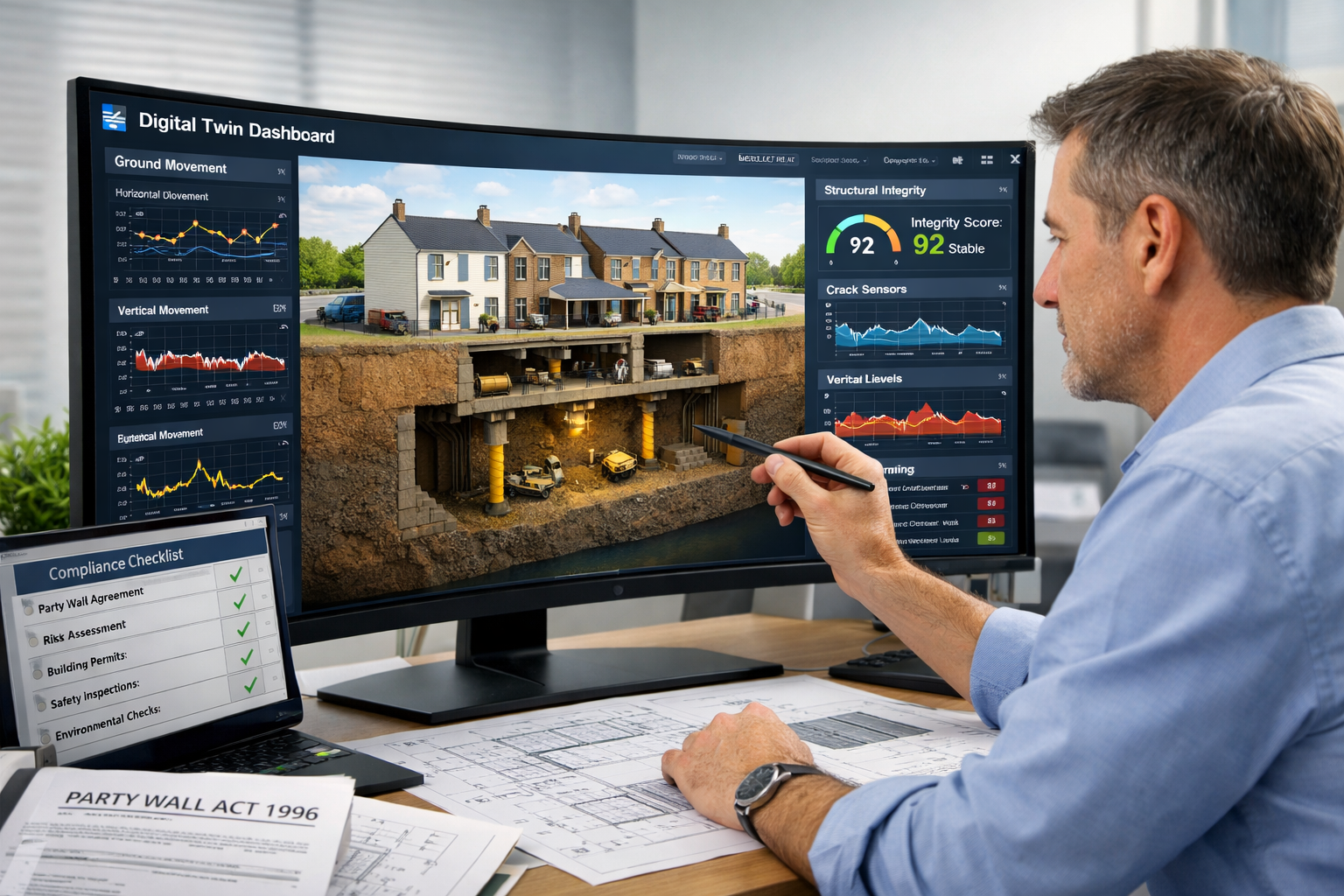
As Real-Time 3D Digital Twins for Party Wall Act Excavations: Simulating Section 6 Risks in 2026 become more mainstream, understanding their benefits and implementation considerations is essential for property owners, surveyors, and contractors.
Key Benefits for Stakeholders
For Building Owners:
- Reduced dispute risk: Evidence-based risk assessments prevent misunderstandings
- Cost certainty: Identify potential problems before they become expensive
- Faster approvals: Comprehensive risk data facilitates neighbor consent
- Insurance advantages: Some insurers offer premium reductions for projects using digital twins
- Project confidence: Real-time monitoring provides peace of mind during construction
For Adjoining Owners:
- Transparency: Access to real-time data about excavation impacts
- Objective evidence: Digital records document actual vs. predicted conditions
- Early warning: Automated alerts enable rapid response to emerging issues
- Property protection: Proactive risk management minimizes damage potential
- Reduced anxiety: Continuous monitoring provides reassurance
For Party Wall Surveyors:
- Enhanced accuracy: Precise measurements replace estimates and assumptions
- Efficient monitoring: Automated systems reduce site visit requirements
- Better documentation: Comprehensive digital records support party wall awards
- Dispute resolution: Objective data resolves disagreements about causation
- Professional differentiation: Offering digital twin services distinguishes surveyors in competitive markets
For Contractors:
- Risk mitigation: Early identification of problems prevents costly remedial work
- Optimized methods: Simulations identify most efficient excavation approaches
- Quality assurance: Real-time feedback ensures work stays within safe parameters
- Reduced liability: Documentation demonstrates due diligence and compliance
- Competitive advantage: Technology adoption attracts sophisticated clients
Cost Considerations and ROI
The investment required for Real-Time 3D Digital Twins for Party Wall Act Excavations: Simulating Section 6 Risks in 2026 varies based on project complexity:
Typical Cost Breakdown:
- Initial 3D scanning and modeling: £3,000-£8,000
- Sensor installation and monitoring: £2,000-£5,000
- Software licenses and cloud services: £1,000-£3,000
- Data analysis and reporting: £2,000-£4,000
- Total: £8,000-£20,000 for a standard residential excavation project
While these costs may seem significant, they typically represent 2-4% of total excavation costs and deliver substantial ROI:
- Dispute avoidance: A single party wall dispute can cost £15,000-£50,000 in legal fees and delays
- Damage prevention: Remedial work for foundation damage often exceeds £30,000
- Time savings: Projects proceed faster with fewer interruptions
- Insurance benefits: Reduced premiums and excess fees
According to industry projections for 2026, digital twin technology is becoming more accessible as "visualization tools evolve into comprehensive operational platforms" [2]. This trend is making digital twins viable for standard residential projects, not just large commercial developments.
Selecting the Right Technology and Partners
Implementing digital twins successfully requires choosing appropriate technology and experienced partners:
Technology Selection Criteria:
- Integration capability: Systems should work with existing BIM and project management tools
- User-friendliness: Interfaces must be accessible to non-technical stakeholders
- Scalability: Technology should handle projects of varying complexity
- Support and training: Vendors should provide comprehensive onboarding
- Compliance: Systems must meet UK data protection and construction standards
Partner Selection:
Working with professionals experienced in both Party Wall Act compliance and digital technology is crucial. When selecting a party wall surveyor, ask about:
- Experience with digital twin projects
- Technology partnerships and platforms used
- Training and certifications in advanced surveying technology
- Case studies demonstrating successful implementations
- Approach to explaining technical information to clients
Overcoming Implementation Challenges
While the benefits are substantial, implementing Real-Time 3D Digital Twins for Party Wall Act Excavations: Simulating Section 6 Risks in 2026 presents some challenges:
Technical Complexity ⚙️
- Challenge: Digital twins require specialized expertise
- Solution: Partner with surveyors who have technology partnerships and training
- Tip: Start with simpler projects to build experience before tackling complex scenarios
Stakeholder Buy-In
- Challenge: Neighbors may be skeptical of new technology
- Solution: Provide clear explanations and demonstrations of benefits
- Tip: Emphasize transparency and protection aspects rather than technical details
Data Management
- Challenge: Digital twins generate massive amounts of data
- Solution: Use cloud-based platforms with automated processing
- Tip: Establish clear protocols for data access, storage, and retention
Cost Justification
- Challenge: Initial investment may seem high for smaller projects
- Solution: Present comprehensive cost-benefit analysis including risk reduction
- Tip: Consider cost-sharing arrangements with adjoining owners who benefit from monitoring
Regulatory Adaptation
- Challenge: Party Wall Act procedures were designed for pre-digital era
- Solution: Work with surveyors experienced in integrating technology with traditional procedures
- Tip: Maintain traditional documentation alongside digital records for compliance
Future Developments: What's Next for 2026 and Beyond
The field of digital twins continues to evolve rapidly. Key trends shaping Real-Time 3D Digital Twins for Party Wall Act Excavations: Simulating Section 6 Risks in 2026 include:
AI-Enhanced Predictive Capabilities 🤖
Machine learning algorithms are becoming more sophisticated at predicting excavation outcomes. By analyzing thousands of historical projects, AI can identify patterns invisible to human observers and provide increasingly accurate forecasts.
Augmented Reality Integration
AR headsets allow surveyors and contractors to visualize digital twin data overlaid on the physical construction site. This technology helps workers understand subsurface conditions and see real-time risk zones during excavation.
Blockchain for Dispute Resolution
Immutable blockchain records of digital twin data provide tamper-proof evidence for resolving disputes. This technology may transform how party wall awards handle contested damage claims.
Standardization and Regulation
As digital twins become mainstream, industry bodies are developing standards for their use in Party Wall Act compliance. This standardization will make implementation more straightforward and cost-effective.
Integration with Smart Building Systems
Digital twins created for construction increasingly serve as foundations for ongoing building management, creating lifecycle value that extends far beyond the excavation phase [2].
Legal and Regulatory Framework for Digital Twin Evidence
Understanding how Real-Time 3D Digital Twins for Party Wall Act Excavations: Simulating Section 6 Risks in 2026 fit within the legal framework of the Party Wall Act is essential for proper implementation.
Admissibility of Digital Evidence
Digital twin data is increasingly accepted as evidence in party wall disputes, provided it meets certain standards:
Documentation Requirements:
- Calibration records for all sensors and scanning equipment
- Methodology statements explaining data collection and analysis
- Chain of custody documentation for data integrity
- Expert witness reports interpreting technical findings
- Compliance with British Standards for surveying and monitoring
When properly documented, digital twin evidence often proves more persuasive than traditional methods because it provides:
- Continuous rather than periodic measurements
- Objective data rather than subjective observations
- Predictive insights rather than reactive responses
- Comprehensive records rather than selective documentation
Integration with Traditional Party Wall Procedures
Digital twins complement rather than replace traditional Party Wall Act procedures. The technology integrates at several key stages:
Notice Stage:
Digital twin simulations can accompany party wall notices, providing adjoining owners with clear visualizations of proposed work and predicted impacts. This transparency often facilitates consent and reduces disputes.
Schedule of Condition:
3D laser scanning creates exceptionally detailed pre-construction records, far surpassing traditional photographic schedules. These digital records document:
- Precise measurements of existing cracks and defects
- Three-dimensional structural geometry
- Surface conditions and finishes
- Subsurface conditions (via ground penetrating radar)
Award Preparation:
Digital twin data informs award conditions by identifying specific risks and appropriate precautions. Awards may include provisions for:
- Continuous monitoring with defined alert thresholds
- Data sharing protocols between parties
- Response procedures when alerts are triggered
- Post-construction verification requirements
Dispute Resolution:
When disputes arise, digital twin records provide objective evidence about:
- Whether damage was caused by construction work
- Whether proper precautions were taken
- Whether movements exceeded predicted ranges
- Timeline of events and causation
Data Protection and Privacy Considerations
Implementing digital twins requires attention to UK data protection regulations:
GDPR Compliance:
- Digital twin data may include personal information about property owners
- Proper consent and data processing agreements are required
- Data retention policies must comply with privacy regulations
- Security measures must protect sensitive information
Access and Sharing:
Clear protocols should define:
- Who has access to real-time monitoring data
- How data is shared between building and adjoining owners
- What information is included in party wall awards
- How long data is retained after project completion
Practical Tips for Property Owners Considering Digital Twins
For property owners planning excavation work under Section 6, here are practical steps to leverage Real-Time 3D Digital Twins for Party Wall Act Excavations: Simulating Section 6 Risks in 2026:
Early Planning Recommendations
Start the Conversation Early 💬
Discuss digital twin options with your surveyor during initial project planning, not after party wall notices are served. Early implementation allows maximum benefit from predictive simulations.
Educate Your Neighbors
Proactively explain digital twin technology to adjoining owners, emphasizing how it protects their property. Offer to share monitoring access to build trust and transparency.
Budget Appropriately
Include digital twin costs in your initial project budget. The investment typically pays for itself through risk reduction and dispute avoidance.
Choose Experienced Professionals
Select party wall surveyors and contractors with demonstrated digital twin experience. Ask for case studies and references from similar projects.
Questions to Ask Your Surveyor
When evaluating whether to implement digital twins, ask your surveyor:
- What specific risks does digital twin technology address for my project?
- What is the total cost, and how does it compare to potential dispute costs?
- What technology platforms and partners do you work with?
- How will monitoring data be shared with adjoining owners?
- What happens if the digital twin predicts problems during excavation?
- How does this technology integrate with traditional party wall awards?
- Can you provide references from similar projects?
- What training or support is provided for understanding the technology?
Red Flags to Avoid
Be cautious of:
- Surveyors who oversell technology as a complete replacement for traditional expertise
- Unrealistic promises about eliminating all risks
- Proprietary systems that lock you into single vendors
- Lack of transparency about costs or methodologies
- Insufficient experience with actual Party Wall Act compliance
The most effective approach combines digital innovation with traditional surveying expertise and thorough understanding of the Party Wall Act framework.
Conclusion: Embracing the Future of Party Wall Act Compliance
Real-Time 3D Digital Twins for Party Wall Act Excavations: Simulating Section 6 Risks in 2026 represent a transformative advancement in construction risk management. By creating live-updating virtual replicas of construction sites, this technology enables surveyors, property owners, and contractors to predict and prevent problems rather than merely react to them.
The benefits are substantial and measurable:
- Reduced disputes through transparent, evidence-based risk communication
- Lower costs by identifying problems during planning rather than construction
- Better outcomes for both building and adjoining owners
- Enhanced professional practice for surveyors and contractors
- Stronger compliance with Party Wall Act requirements
As digital twin technology becomes more accessible and affordable in 2026, it is transitioning from a luxury for large commercial projects to a standard practice for residential excavations. Property owners planning basement conversions, extensions, or other excavation work should seriously consider incorporating digital twins into their Party Wall Act compliance strategy.
Next Steps for Property Owners
If you're planning excavation work that triggers Section 6 requirements:
- Consult early with a party wall surveyor experienced in digital twin technology
- Request a cost-benefit analysis comparing traditional and digital twin approaches
- Discuss options with adjoining owners to build support for advanced monitoring
- Budget appropriately for technology implementation in your project plan
- Stay informed about evolving standards and best practices
The Path Forward
The construction industry is experiencing a digital transformation, and Party Wall Act compliance is no exception. While traditional surveying skills and legal knowledge remain essential, augmenting them with Real-Time 3D Digital Twins for Party Wall Act Excavations: Simulating Section 6 Risks in 2026 creates a more robust, transparent, and effective approach to protecting all parties' interests.
For property owners, the message is clear: technology that was once science fiction is now practical reality. By embracing digital twins, you can approach your excavation project with confidence, knowing that you have the most advanced tools available to predict risks, prevent problems, and protect your neighbors' properties.
The future of Party Wall Act compliance is here—and it's digital, predictive, and remarkably effective. Whether you're planning work in North London, South London, or anywhere else in the UK, digital twin technology offers unprecedented capabilities for managing excavation risks under Section 6.
Take the first step today by discussing digital twin options with qualified professionals who understand both the technology and the timeless principles of good neighbor relations that underpin the Party Wall Act.
References
[1] Digital Twin In Construction – https://www.skyebrowse.com/news/posts/digital-twin-in-construction
[2] What Do Digital Twins Hold For 2026 From Visualisation To Smart Building Operations – https://www.twinview.com/insights/what-do-digital-twins-hold-for-2026-from-visualisation-to-smart-building-operations
[3] 62104 Filling The Gaps Robots Close The Loop For Digital Twins – https://www.enr.com/articles/62104-filling-the-gaps-robots-close-the-loop-for-digital-twins