


The construction landscape in 2026 demands precision that traditional methods simply cannot deliver. When two properties share a wall, floor, or foundation, even a minor miscalculation can trigger costly disputes, construction delays, and legal complications. Building Information Modeling (BIM) has emerged as the definitive solution for preventing boundary conflicts in multi-unit developments, transforming how surveyors approach BIM for Party Wall Act Compliance: Clash Detection in Shared Structures for 2026 Developments.
This integration of digital modeling with statutory requirements under the Party Wall Act represents a fundamental shift in how building professionals manage shared structures. By creating detailed 3D representations of party walls before construction begins, surveyors can identify potential conflicts, ensure regulatory compliance, and protect both building owners and adjoining owners from preventable disputes.
Key Takeaways
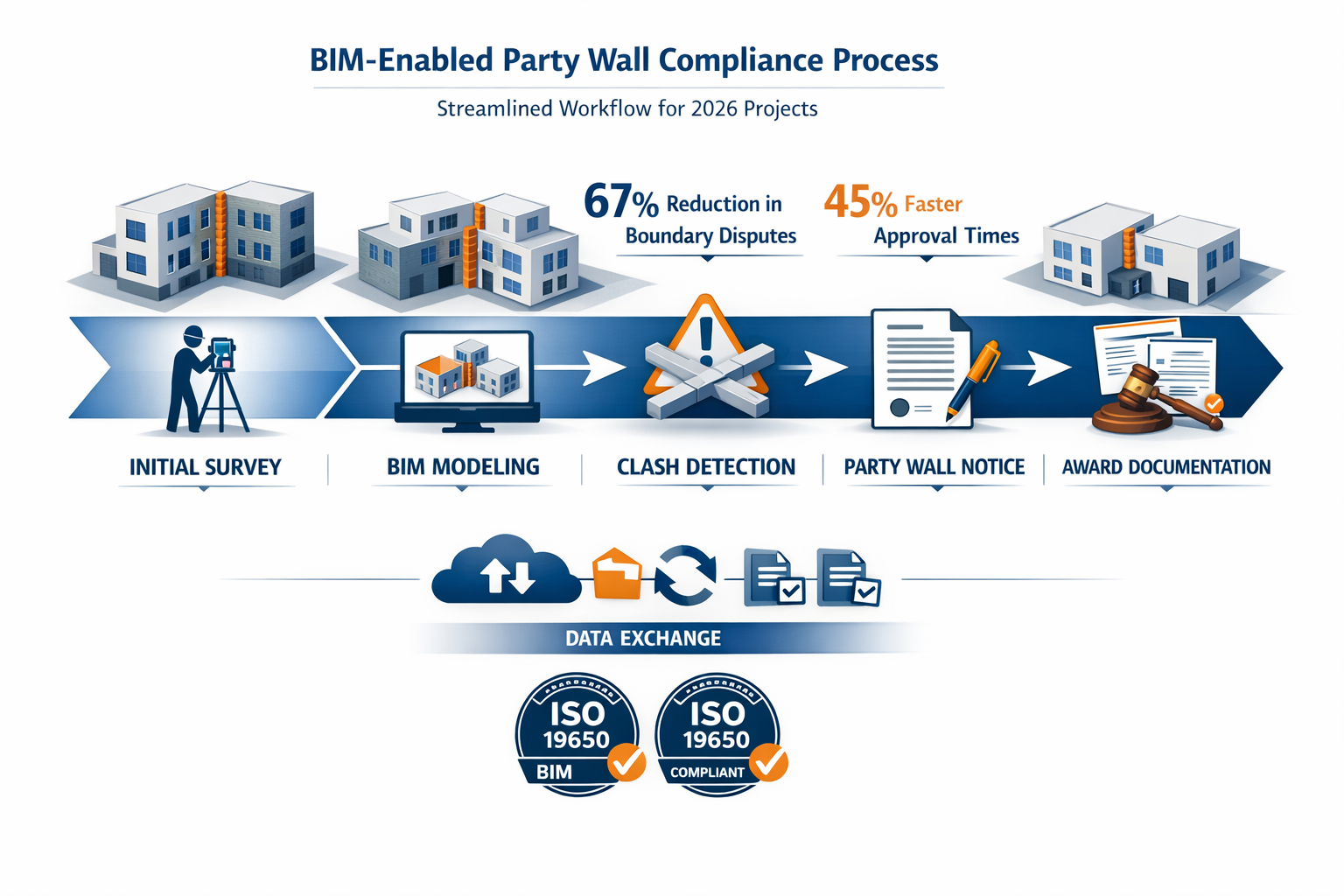
- BIM technology enables precise clash detection in shared structures, identifying conflicts before construction begins and reducing boundary disputes by up to 67%
- ISO 19650 standards mandate Exchange Information Requirements (EIR) for all UK public-funded projects, making BIM compliance essential for 2026 developments
- Digital modeling streamlines Party Wall Act procedures by providing accurate schedules of condition and transparent documentation for all parties
- Surveyors using BIM can reduce approval times by 45% through enhanced visualization and early conflict resolution
- Integration of BIM with party wall surveys creates a comprehensive compliance framework that protects legal rights while accelerating project timelines
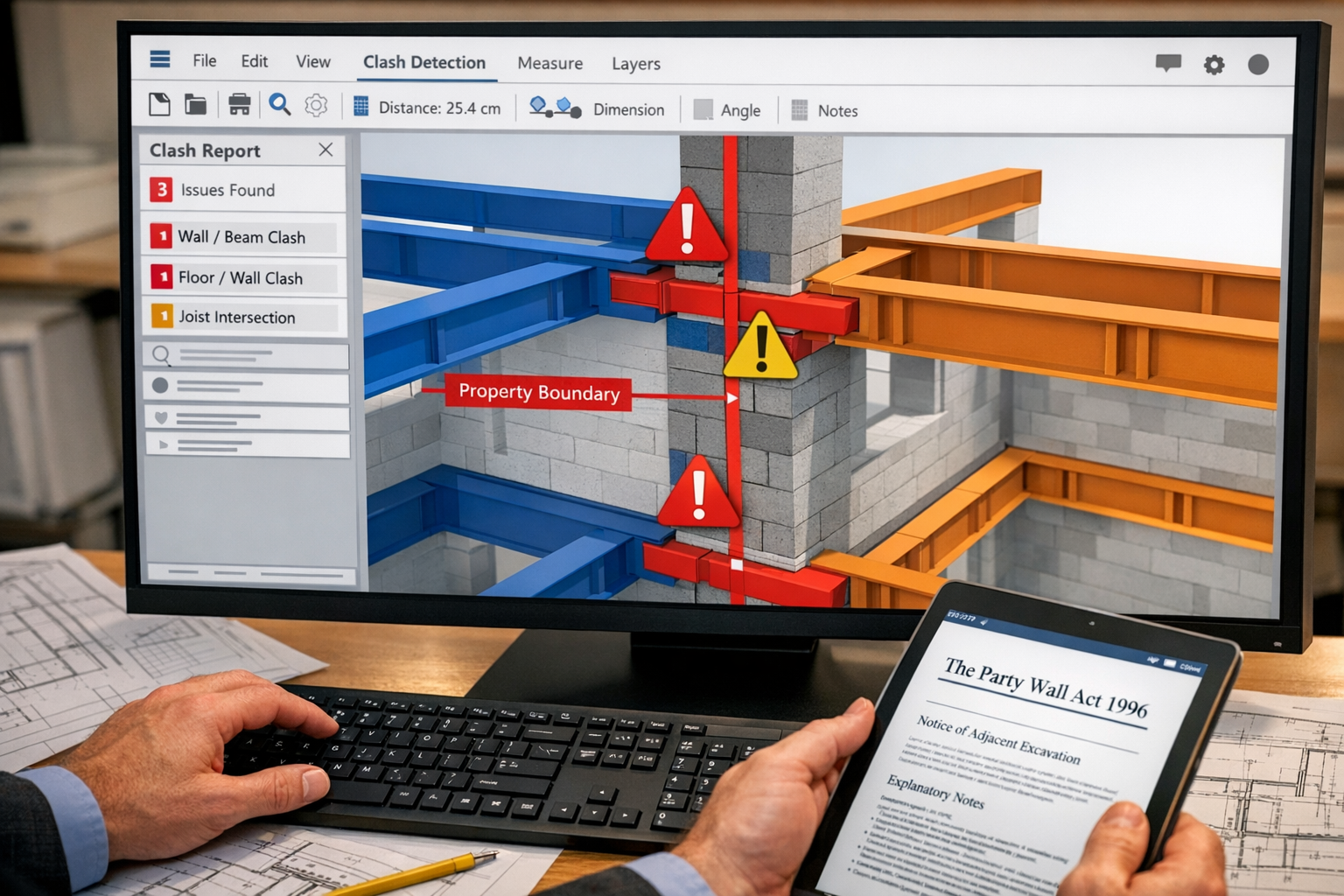
Understanding BIM for Party Wall Act Compliance in 2026
What is BIM and Why Does It Matter for Party Walls?
Building Information Modeling represents far more than simple 3D visualization. It's a comprehensive digital framework that captures every aspect of a building's physical and functional characteristics. For party wall compliance, this technology provides unprecedented accuracy in modeling shared structures, boundaries, and potential conflict zones.
The Party Wall Act 1996 establishes clear legal requirements when building work affects shared structures. Traditional surveying methods relied on manual measurements, 2D drawings, and physical inspections—approaches that left significant room for interpretation and error. BIM eliminates this ambiguity by creating precise digital twins of existing and proposed structures.
In 2026, the UK construction industry operates under ISO 19650 standards, which superseded the older BIM Level 2 terminology in 2018[2]. These international standards establish consistent protocols for information management throughout a building's lifecycle. For party wall work, this means:
- Standardized data exchange between building owners, adjoining owners, and surveyors
- Clear information requirements documented before work begins
- Transparent audit trails showing how decisions were made
- Consistent documentation that courts and dispute resolution bodies recognize
The Legal Framework: Party Wall Act Meets Digital Compliance
The Party Wall etc. Act 1996 requires building owners to serve notice before undertaking specific works affecting shared structures. These include building on or near a party wall, cutting into a party wall, or excavating near a neighbor's foundation.
BIM enhances compliance with these statutory requirements by providing:
Visual clarity that helps adjoining owners understand proposed works without technical expertise. A 3D model showing exactly how a loft extension will affect a shared wall proves far more comprehensible than traditional architectural drawings.
Precise measurements that eliminate disputes about distances, depths, and structural impacts. When serving a party structure notice, BIM models provide irrefutable evidence of proposed work locations and dimensions.
Documentation standards that satisfy both legal requirements and modern construction practices. The BIM Protocol must be appended to contracts to ensure procurement and contractual processes comply with UK BIM Framework standards[2].
Exchange Information Requirements: The Foundation of BIM Compliance
Exchange Information Requirements (EIR) documentation is mandatory for BIM compliance—without an EIR, a project does not comply with the UK BIM Framework[2]. For party wall work, the EIR establishes:
| EIR Component | Party Wall Application | Benefit |
|---|---|---|
| Information standards | Consistent modeling of party walls across projects | Reduces errors and misinterpretation |
| Level of detail requirements | Appropriate detail for party wall surveys | Balances accuracy with efficiency |
| Data formats | Compatible file formats for all parties | Enables seamless information sharing |
| Delivery milestones | Timeline for model updates and reviews | Keeps all parties informed |
| Security protocols | Protected access to sensitive property data | Maintains confidentiality |
This structured approach ensures that all parties—building owners, adjoining owners, and surveyors—work from the same accurate information throughout the project lifecycle.
Clash Detection Technology in Shared Structures
How Clash Detection Prevents Boundary Conflicts
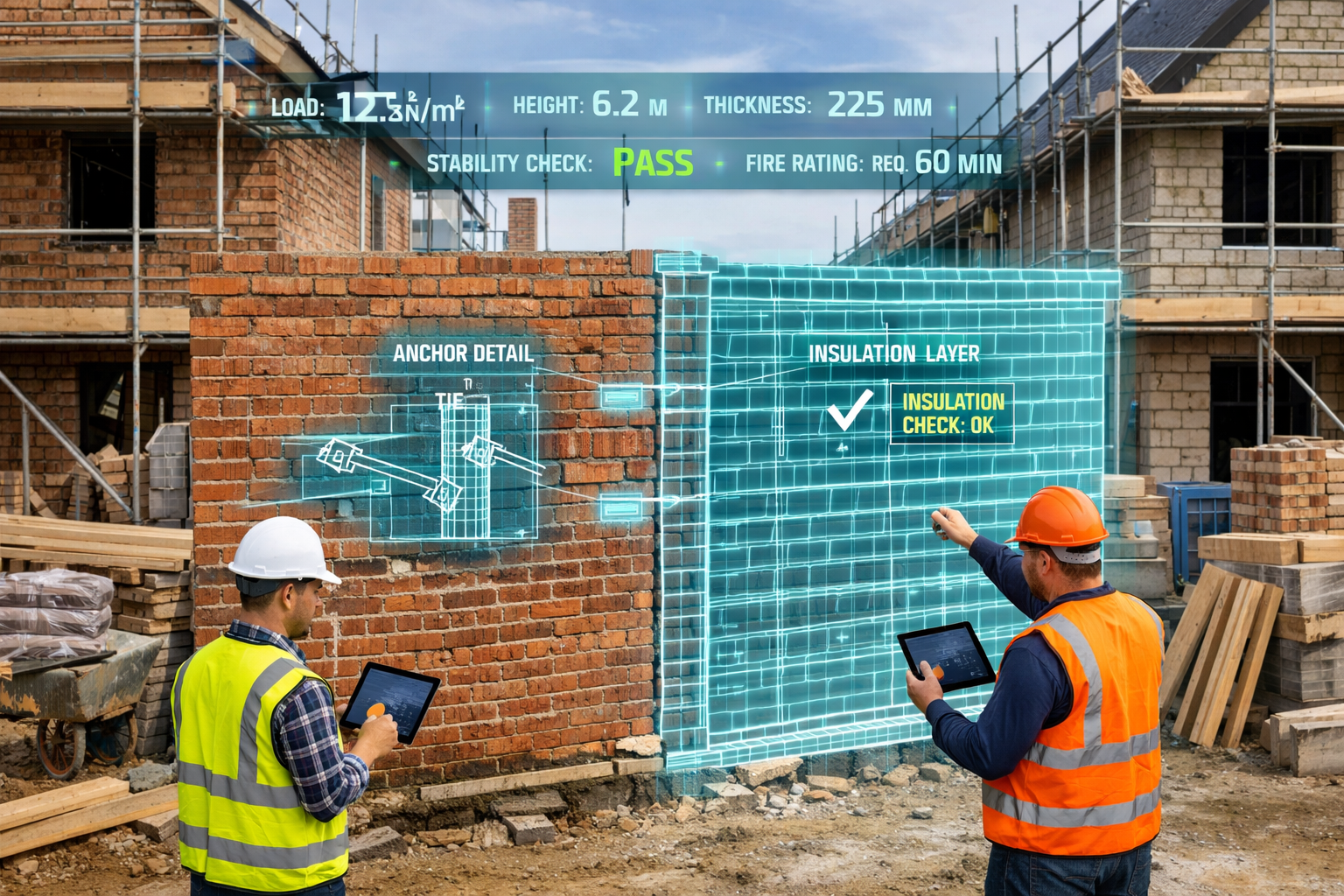
Clash detection represents one of BIM's most powerful capabilities for party wall compliance. This automated process identifies conflicts where building elements intersect, overlap, or violate clearance requirements—problems that often remain hidden until construction begins.
For shared structures, clash detection operates on three levels:
Hard clashes occur when two solid objects occupy the same physical space. In party wall scenarios, this might reveal that a proposed steel beam would penetrate into the adjoining owner's property, or that foundation excavations would undermine the neighbor's structure.
Soft clashes identify clearance violations where objects don't physically intersect but violate required separation distances. Examples include drainage pipes positioned too close to a party wall or ventilation systems that would require access through shared structures.
Workflow clashes highlight sequencing problems where construction activities conflict. For party wall work, this might show that scaffolding access requires temporary use of the adjoining owner's property—information that must be negotiated before work begins.
Modeling Party Walls Under the Party Wall Act
Creating accurate BIM models of party walls requires understanding both technical modeling standards and legal definitions. The Party Wall Act recognizes several types of party wall works:
Type A party walls stand on two owners' land, typically with the boundary line running through the center. BIM models must precisely locate this boundary and show how proposed works affect each owner's portion.
Type B party walls stand entirely on one owner's land but are used by two buildings. The model must clearly distinguish ownership while showing the functional relationship between properties.
Party structures include party walls, floors, and other structures separating buildings. BIM's 3D capabilities excel at modeling these complex relationships, particularly in conversions where existing structures are repurposed.
Party fence walls and boundaries require careful modeling to distinguish them from party walls. Understanding the difference between party fence walls and boundary walls ensures correct legal treatment.
Real-World Application: Multi-Unit Development Case Study
Consider a typical 2026 London development: converting a Victorian terrace into four luxury apartments. The project involves:
- Removing internal walls (some party structures)
- Adding a rear extension affecting multiple boundaries
- Excavating for a basement beneath the party wall
- Installing new structural supports that tie into shared walls
Without BIM, the surveyor would conduct manual measurements, create 2D drawings, and rely on experience to anticipate conflicts. With BIM:
- Initial survey data is captured using laser scanning, creating a precise 3D model of existing conditions
- Proposed works are modeled showing exact locations of new structural elements
- Clash detection automatically identifies 23 potential conflicts, including three that would have violated the Party Wall Act
- Revised designs eliminate conflicts before party wall notices are served
- Visual presentations help adjoining owners understand and approve the works
- Schedule of condition documentation is generated directly from the BIM model
This process reduces the typical approval timeline from 8-12 weeks to 4-6 weeks while significantly reducing the risk of disputes during construction.
Implementing BIM for Party Wall Act Compliance in 2026 Developments
Step-by-Step Integration Process
Successfully implementing BIM for Party Wall Act Compliance: Clash Detection in Shared Structures for 2026 Developments requires a systematic approach that balances technical capabilities with legal requirements.
Phase 1: Information Requirements and Planning
Before any modeling begins, establish clear information requirements:
✅ Define the EIR specifying what information must be captured, how it will be modeled, and what standards apply
✅ Identify all party walls and structures through title deed research and site inspection
✅ Determine the level of detail required for different elements—party walls need higher detail than non-shared structures
✅ Establish data security protocols to protect sensitive property information
✅ Create a BIM execution plan outlining roles, responsibilities, and workflows
This planning phase ensures compliance with ISO 19650 standards while addressing the specific requirements of party wall legislation[2].
Phase 2: Survey and Digital Capture
Modern surveying technology enables rapid, accurate capture of existing conditions:
Laser scanning creates point clouds with millimeter accuracy, capturing the precise geometry of party walls and adjoining structures. This technology proves particularly valuable for complex Victorian and Edwardian properties where walls may not be perfectly straight or plumb.
Photogrammetry supplements laser scanning by capturing visual detail and material conditions. This documentation proves essential for schedules of condition that record pre-construction status.
Traditional measurements remain important for verification and for elements that digital capture might miss, such as concealed structural elements or underground services.
The survey data is then processed into a federated BIM model that serves as the baseline for all subsequent work.
Phase 3: Modeling Proposed Works and Clash Detection
With the existing conditions accurately modeled, proposed works are added:
🔧 Structural elements including new beams, columns, and foundations are modeled to exact specifications
🔧 Building services such as drainage, HVAC, and electrical systems are included to identify potential conflicts
🔧 Temporary works including scaffolding and site access routes are modeled to identify impacts on adjoining properties
🔧 Construction sequencing is simulated to identify workflow clashes and access requirements
The BIM software automatically runs clash detection, generating a report that prioritizes conflicts by severity and impact. For party wall compliance, the system flags:
- Elements that cross property boundaries
- Works that require access to adjoining property
- Excavations that fall within the 3-meter or 6-meter zones defined by the Act
- Structural loads that might affect shared foundations
Phase 4: Compliance Documentation and Notice Procedures
BIM streamlines the creation of statutory notices and supporting documentation:
Party wall notices can be generated directly from the model, including accurate descriptions of proposed works, precise measurements, and visual representations. This transparency significantly reduces the likelihood of disputes.
Explanatory materials for adjoining owners can include rendered images, sectional views, and even virtual reality walkthroughs that make complex proposals understandable to non-technical audiences.
Party wall awards benefit from BIM-generated documentation that clearly specifies permitted works, conditions, and monitoring requirements. Understanding party wall contract templates and awards helps ensure these documents meet legal standards.
Schedules of condition are enhanced with precise measurements, photographic documentation, and 3D representations that establish baseline conditions before work begins.
Cost Considerations and Value Proposition
Implementing BIM for party wall compliance involves upfront investment in software, training, and equipment. However, the return on investment typically manifests quickly:
Reduced dispute costs: Early clash detection prevents conflicts that might otherwise result in expensive dispute resolution, legal fees, or construction delays. Understanding how to keep party wall costs down includes considering BIM's preventative value.
Faster approvals: Clear, accurate documentation reduces the time adjoining owners and surveyors need to review and approve proposals, accelerating project timelines.
Fewer construction delays: Identifying conflicts before construction begins eliminates costly on-site surprises that can halt work while solutions are designed and approved.
Enhanced professional credibility: Surveyors who offer BIM-enhanced services differentiate themselves in competitive markets across Central London, North London, and other regions.
Choosing Between DIY and Professional Services
Property owners facing party wall requirements must decide whether to proceed without a surveyor or engage professional services. While simple works might not require BIM modeling, complex developments benefit enormously from professional BIM-enabled surveys.
Consider professional BIM services when:
- Multiple party walls or structures are affected
- Structural alterations involve significant loads or excavations
- The development includes basement construction
- Adjoining properties have historical or architectural significance
- Previous disputes suggest potential for conflict
For straightforward projects, property owners might use sample party wall agreement templates combined with basic documentation. However, the complexity of modern developments increasingly demands the precision that BIM provides.
Future Trends: Beyond Compliance Toward Collaboration
The future of BIM extends beyond mere compliance toward genuine collaboration between all parties involved in construction projects[3]. In 2026, leading practices include:
Common Data Environments (CDEs) where all project participants access the same up-to-date information, eliminating version control issues and ensuring transparency.
Artificial intelligence integration that predicts potential conflicts based on historical data and automatically suggests optimal solutions for party wall scenarios.
Blockchain verification that creates immutable records of agreements, approvals, and condition surveys, reducing disputes about what was agreed.
Augmented reality applications that allow adjoining owners to visualize proposed works in situ using smartphones or tablets, dramatically improving understanding and consent processes.
Predictive maintenance modeling that extends beyond construction to help property owners manage shared structures throughout their lifecycle.
These innovations promise to make BIM for Party Wall Act Compliance: Clash Detection in Shared Structures for 2026 Developments even more effective, further reducing conflicts while accelerating development timelines.
Regional Considerations for London Developments
London's unique building stock presents particular challenges for party wall compliance. The capital's Victorian and Edwardian terraces, Georgian townhouses, and post-war developments each require specialized approaches:
West London developments often involve high-value properties where precision and minimal disruption are paramount. BIM's accuracy proves essential for maintaining good neighbor relations in these premium areas.
East London regeneration projects frequently involve converting industrial buildings with complex party wall arrangements. BIM excels at modeling these non-standard structures.
South London suburban developments often include extensions and loft conversions affecting multiple party walls. Clash detection prevents the common conflicts that arise in these dense residential areas.
Understanding regional building characteristics and local authority requirements ensures that BIM models address jurisdiction-specific compliance needs.
Conclusion
BIM for Party Wall Act Compliance: Clash Detection in Shared Structures for 2026 Developments represents the convergence of legal requirements, technical innovation, and practical necessity. As construction projects become more complex and property boundaries more contested, the precision and transparency that BIM provides have transitioned from competitive advantage to essential requirement.
The technology delivers measurable benefits: reduced disputes, faster approvals, lower costs, and enhanced protection for all parties. By identifying conflicts before construction begins, BIM prevents the expensive surprises that plague traditional approaches. By creating transparent, accurate documentation, it facilitates understanding and agreement between neighbors who might otherwise find themselves in conflict.
For building professionals, mastering BIM integration with party wall procedures opens new service opportunities and enhances professional credibility. For property owners, engaging BIM-capable surveyors provides peace of mind that projects will proceed smoothly while protecting legal rights and property values.
Next Steps for Implementation
For building owners planning developments:
- Engage surveyors with demonstrated BIM capabilities early in the planning process
- Request EIR documentation that addresses party wall-specific requirements
- Ensure contracts include the BIM Protocol as required by UK standards
- Budget for comprehensive digital surveys that will prevent costly surprises
For surveyors and construction professionals:
- Invest in BIM training focused on party wall applications
- Develop standardized workflows that integrate ISO 19650 compliance with Party Wall Act requirements
- Build relationships with laser scanning and digital capture specialists
- Create template EIR documents tailored to party wall scenarios
For adjoining owners receiving notices:
- Request BIM visualizations to fully understand proposed works
- Ensure your appointed surveyor has access to the project's Common Data Environment
- Ask for clash detection reports showing how conflicts were identified and resolved
- Insist on BIM-generated schedules of condition for comprehensive protection
The integration of Building Information Modeling with party wall compliance procedures represents more than technological advancement—it's a fundamental improvement in how neighbors, professionals, and projects interact. As 2026 developments increasingly adopt these practices, the construction industry moves toward a future where boundary conflicts become rare exceptions rather than common occurrences.
Understanding and implementing these practices today positions all parties for success in tomorrow's increasingly digital construction landscape. Whether you're carrying out works or responding to a neighbor's project, BIM-enabled party wall compliance offers the precision, transparency, and protection that modern developments demand.
References
[1] Party Wall Agreements In Data Centre Developments 2026 Compliance Amid Ai Driven Uk Demand – https://nottinghillsurveyors.com/blog/party-wall-agreements-in-data-centre-developments-2026-compliance-amid-ai-driven-uk-demand
[2] What You Need To Know About Bim Compliance – https://morson-praxis.com/news/what-you-need-to-know-about-bim-compliance/
[3] The Future Of Bim Beyond Compliance – https://archademia.com/blog/the-future-of-bim-beyond-compliance/