

The year 2026 marks a watershed moment for property professionals as artificial intelligence transforms traditional party wall surveying from a paper-intensive, time-consuming process into a streamlined digital workflow. AI Integration in Party Wall Awards: Automating Dispute Prediction and Award Drafting for 2026 Projects represents the convergence of centuries-old property law with cutting-edge technology, enabling surveyors to predict disputes before they escalate and generate legally compliant awards in minutes rather than days. With AI-driven infrastructure demands creating unprecedented compliance challenges across London and beyond, surveyors are now embedding machine learning algorithms into their workflows for instant anomaly detection and risk forecasting while maintaining strict adherence to the Party Wall etc. Act 1996.
This technological revolution addresses a critical industry pain point: the unpredictability of neighbour disputes and the labour-intensive nature of award preparation. As data centre developments and urban densification projects accelerate throughout 2026, the integration of AI tools has become essential for managing the volume and complexity of party wall matters efficiently.
Key Takeaways
✅ AI-powered dispute prediction uses historical data and pattern recognition to identify high-risk party wall projects before conflicts arise, enabling proactive intervention strategies.
✅ Automated award drafting reduces document preparation time by 60-80% while ensuring compliance with the Party Wall etc. Act 1996 and RICS professional standards.
✅ Real-time anomaly detection embedded in surveying workflows flags potential structural concerns, procedural irregularities, and compliance gaps instantly during site inspections.
✅ Technology-specific considerations for 2026 projects require continuous monitoring protocols and clear escalation procedures integrated into AI-generated awards[1].
✅ Cost efficiency and accuracy improvements make professional party wall services more accessible while reducing errors in complex multi-party scenarios.
Understanding AI Integration in Modern Party Wall Practice
The traditional party wall surveying process has remained largely unchanged since the Party Wall etc. Act 1996 came into force. Surveyors would conduct manual inspections, draft notices by hand or using basic templates, negotiate terms through phone calls and letters, and produce awards using word processors. This approach, while thorough, created bottlenecks that delayed construction projects and increased costs of party wall processes.
The Technology Shift in 2026
Artificial intelligence has fundamentally altered this landscape by introducing three core capabilities:
- Predictive Analytics 📊 – Machine learning models analyze thousands of historical party wall cases to identify patterns that typically lead to disputes
- Natural Language Processing 📝 – AI systems understand legal terminology and can draft contextually appropriate award clauses
- Computer Vision 📷 – Image recognition technology assesses structural conditions from photographs, identifying potential concerns automatically
These technologies work together to create an integrated ecosystem where data flows seamlessly from initial notice through to final award issuance. Professional surveyors can now access comprehensive party wall awards that incorporate both traditional expertise and algorithmic precision.
Compliance in the AI Era
The AI boom has introduced compliance challenges in high-demand markets, particularly where rapid development pressures meet stringent regulatory requirements[2]. Party wall surveyors must ensure that automated systems:
- Maintain human oversight at critical decision points
- Preserve the surveyor's professional judgment and liability
- Document AI-assisted decisions transparently
- Comply with RICS protocols and professional standards[1]
The technology serves as an enhancement tool rather than a replacement for qualified surveyors. Understanding types of party wall works remains essential, as AI systems require accurate categorization to function effectively.
How AI Predicts Party Wall Disputes Before They Escalate
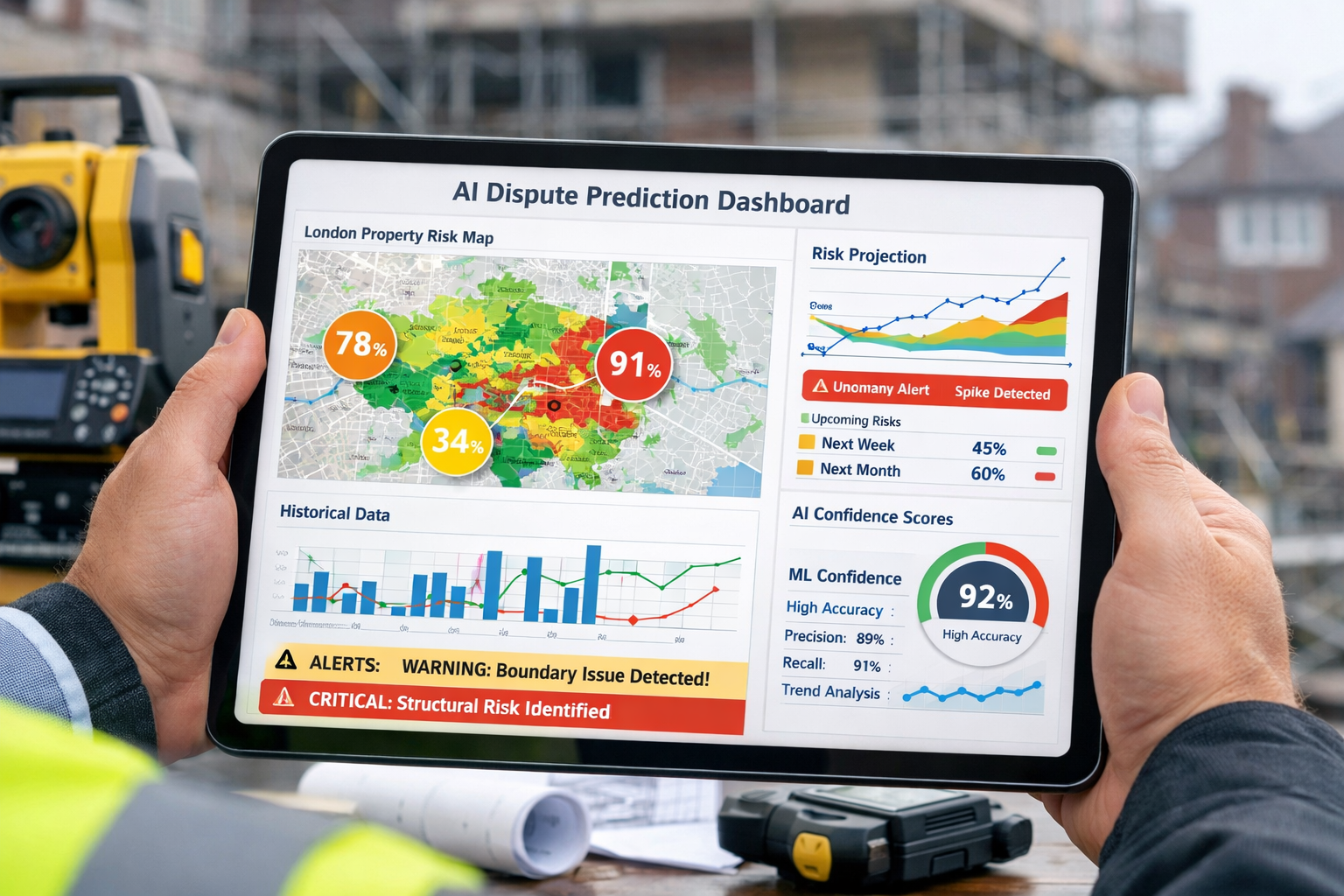
The most transformative aspect of AI Integration in Party Wall Awards: Automating Dispute Prediction and Award Drafting for 2026 Projects lies in its predictive capabilities. Rather than reacting to conflicts after they arise, surveyors can now identify potential flashpoints during the initial assessment phase.
Data-Driven Risk Assessment
Modern AI systems analyze multiple variables simultaneously to calculate dispute probability:
| Risk Factor | AI Analysis Method | Predictive Weight |
|---|---|---|
| Property Age | Historical correlation analysis | High |
| Work Scope | Complexity scoring algorithm | Very High |
| Previous Disputes | Pattern matching in records | Critical |
| Response Timeline | Behavioral analysis | Medium |
| Property Value Gap | Economic disparity calculation | Medium-High |
| Communication Quality | Sentiment analysis of exchanges | High |
These algorithms process information from multiple sources including planning records, land registry data, previous party wall notices, and even social media sentiment analysis to build comprehensive risk profiles.
Real-World Application in 2026
Consider a typical scenario in South London where a building owner plans a rear extension affecting a shared party wall. The AI system would:
- Scan historical records for similar projects in the postcode
- Analyze response patterns from the adjoining owner's previous property transactions
- Assess structural factors from uploaded photographs and survey data
- Calculate dispute probability based on work scope and timing
- Generate proactive recommendations for communication strategies
If the system flags a high-risk scenario (above 70% dispute probability), it might recommend:
- Earlier engagement with adjoining owners
- More detailed initial documentation
- Appointment of an agreed surveyor rather than separate surveyors
- Enhanced schedule of condition protocols
- Specific insurance considerations
Continuous Monitoring and Adaptive Learning
The AI doesn't stop at initial prediction. Throughout the project lifecycle, it continuously monitors for emerging risk factors:
🔍 Anomaly Detection – Flags unusual patterns in communication frequency or tone
⚠️ Timeline Deviations – Alerts when statutory notice periods approach expiry
📸 Photographic Analysis – Compares ongoing condition monitoring images against baseline
📊 Cost Variance Tracking – Identifies budget overruns that might trigger additional concerns
This approach aligns with recommendations for "continuous monitoring, regular inspections, and clear procedures if concerns arise"[1], particularly relevant for complex developments requiring technology-specific considerations.
Automating Award Drafting: Speed Meets Compliance
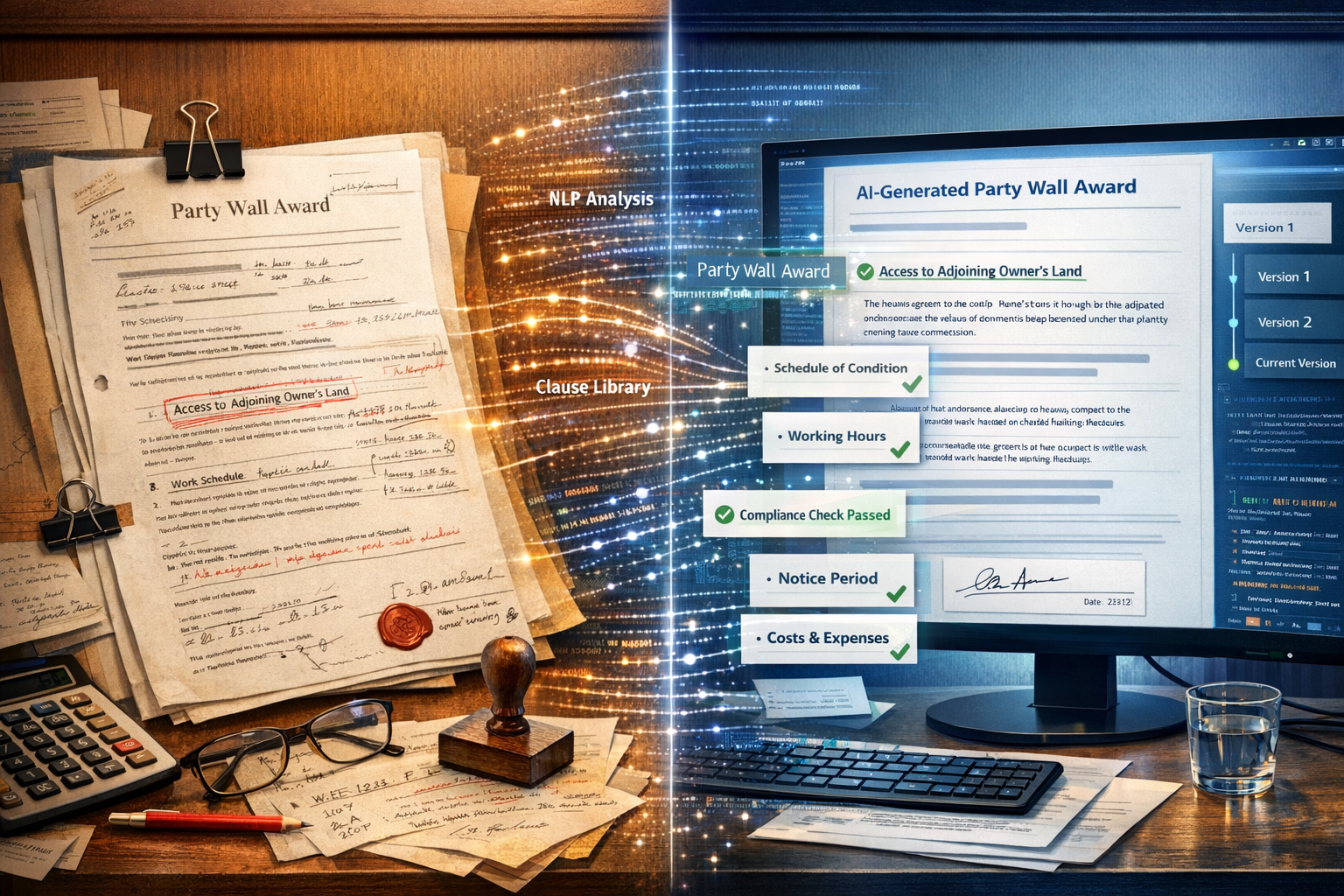
The second pillar of AI Integration in Party Wall Awards: Automating Dispute Prediction and Award Drafting for 2026 Projects addresses the time-consuming process of drafting comprehensive awards. Traditional award preparation could take 4-8 hours for straightforward cases and several days for complex multi-party situations.
The Award Drafting Workflow
AI-powered systems have revolutionized this process through intelligent automation:
Step 1: Data Collection and Verification
The system automatically pulls relevant information from:
- Initial party wall act notices
- Site inspection reports and photographs
- Structural engineer recommendations
- Building control requirements
- Historical correspondence
Step 2: Template Selection and Customization
Rather than using generic party wall agreement templates, AI systems select from hundreds of clause variations based on:
- Specific work types under the Party Wall etc. Act 1996
- Property characteristics and construction methods
- Local authority requirements
- Risk factors identified during prediction phase
Step 3: Natural Language Generation
Advanced NLP algorithms draft award sections that:
- Use appropriate legal terminology
- Maintain consistency throughout the document
- Reference relevant statutory provisions correctly
- Adapt tone based on dispute sensitivity levels
Step 4: Compliance Verification
Automated checks ensure:
- All mandatory clauses are present
- Statutory requirements are met
- RICS professional standards are maintained
- Cross-references are accurate and complete
Time and Cost Benefits
The efficiency gains are substantial:
| Award Complexity | Traditional Time | AI-Assisted Time | Time Saving |
|---|---|---|---|
| Simple (single work type) | 3-4 hours | 30-45 minutes | 80-85% |
| Moderate (multiple works) | 6-8 hours | 1-2 hours | 70-75% |
| Complex (multi-party) | 2-3 days | 3-5 hours | 75-80% |
These efficiencies translate directly into reduced costs for building owners and adjoining owners, addressing a common concern about how to keep party wall costs down.
Maintaining Professional Standards
Important consideration: While AI dramatically accelerates drafting, qualified surveyors must review and approve all awards. The technology generates comprehensive first drafts that incorporate:
- Standard protective clauses for both parties
- Work-specific conditions and restrictions
- Monitoring and inspection schedules
- Dispute resolution mechanisms
- Cost allocation provisions
Surveyors then apply professional judgment to refine these drafts, ensuring they address unique circumstances that algorithms might not fully appreciate. This hybrid approach combines the speed of automation with the nuance of human expertise.
Technology-Specific Considerations for 2026 Projects
The infrastructure demands of 2026 have created unique challenges that AI integration directly addresses. Data centre developments, high-density residential projects, and urban regeneration schemes require party wall awards with enhanced monitoring provisions and technology-specific clauses[2].
Enhanced Monitoring Protocols
Modern AI-integrated awards include provisions for:
Vibration Monitoring 📳
Automated sensors connected to AI platforms provide real-time alerts when vibration levels exceed predetermined thresholds during excavation or piling works.
Structural Movement Tracking 📏
Laser scanning and photogrammetry data processed through computer vision algorithms detect millimeter-level movements in party walls, triggering immediate notifications.
Environmental Condition Monitoring 🌡️
Temperature, humidity, and dust sensors feed data into AI systems that correlate environmental changes with construction activities.
Digital Documentation 📱
Blockchain-verified timestamping of condition photographs ensures tamper-proof evidence chains for potential future disputes.
Regional Implementation Across London
The adoption of AI integration varies across London's diverse property landscape:
- North London – High uptake in Islington and Camden due to dense Victorian terraces undergoing extensive renovations
- East London – Rapid adoption in Stratford and Canary Wharf for commercial developments
- West London – Premium properties in Kensington utilizing AI for high-value risk mitigation
- Central London – Complex multi-party scenarios benefiting most from automated coordination
Integration with Existing Workflows
Surveyors implementing AI tools must consider:
- Data Security and Privacy – Ensuring client information remains protected within AI platforms
- Professional Indemnity Insurance – Confirming coverage extends to AI-assisted work
- Client Communication – Explaining the role of automation while emphasizing human oversight
- Training and Competency – Developing skills to effectively supervise AI systems
- System Selection – Choosing platforms that integrate with existing surveying software
The goal remains producing comprehensive party wall contract templates and awards that protect all parties while facilitating legitimate construction work.
Practical Implementation: Getting Started with AI Integration
For surveyors and property professionals looking to adopt these technologies in 2026, a structured approach ensures successful implementation:
Assessment Phase
Evaluate current workflows to identify bottlenecks:
- How long does award drafting currently take?
- What percentage of cases proceed to dispute?
- Where do most errors or omissions occur?
- Which work types consume disproportionate time?
Platform Selection
Choose AI tools based on:
- Integration capabilities with existing software
- Compliance features aligned with UK regulations
- Training and support availability
- Pricing models (subscription vs. per-use)
- Data ownership and portability provisions
Pilot Program
Start with a limited rollout:
- Select 10-15 straightforward cases for AI-assisted processing
- Compare outcomes against traditional methods
- Measure time savings, error rates, and client satisfaction
- Refine workflows based on learnings
- Gradually expand to more complex scenarios
Team Training
Ensure all surveyors understand:
- How to interpret AI-generated risk assessments
- When to override algorithmic recommendations
- Proper review procedures for automated drafts
- Documentation requirements for AI-assisted decisions
- Ethical considerations and professional responsibilities
Client Communication Strategy
Develop clear messaging about:
- Benefits – Faster turnaround, reduced costs, enhanced accuracy
- Safeguards – Human oversight, professional liability maintained
- Transparency – Which aspects are automated vs. manually reviewed
- Data handling – Security measures and privacy protections
Common Questions About AI in Party Wall Awards
Q: Can AI completely replace party wall surveyors?
No. AI serves as a powerful tool that enhances surveyor capabilities but cannot replace professional judgment, site experience, and the nuanced understanding of neighbor relationships that qualified surveyors provide. The technology automates routine tasks and provides decision support, but humans remain essential for complex judgments and maintaining professional accountability.
Q: Are AI-generated awards legally valid?
Yes, provided they are reviewed and approved by qualified surveyors acting within their professional capacity. The awards must comply with the Party Wall etc. Act 1996 regardless of how they are drafted. The surveyor who signs the award bears professional responsibility for its contents.
Q: What happens if AI predictions are incorrect?
Prediction accuracy improves over time as systems learn from more data, but no system is perfect. Surveyors should treat AI risk assessments as one input among many, applying professional skepticism and conducting thorough due diligence regardless of algorithmic outputs. Professional indemnity insurance covers decisions made with appropriate care, including those informed by AI tools.
Q: How much does AI integration cost?
Pricing varies widely depending on platform sophistication and practice size. Entry-level systems may cost £100-300 per month for small practices, while enterprise solutions for large surveying firms can exceed £2,000 monthly. However, time savings often justify costs within the first few months of implementation.
Q: Does using AI affect professional indemnity insurance?
Most insurers now recognize AI as a standard business tool, similar to computer-aided design software. Surveyors should notify their insurers about technology adoption and confirm coverage extends to AI-assisted work. Some insurers may offer premium reductions for practices using quality-assured AI systems that demonstrably reduce error rates.
The Future Beyond 2026: Emerging Trends
As AI integration matures, several developments are on the horizon:
Predictive Maintenance Algorithms 🔮
Future systems will predict when party walls require maintenance before problems become visible, enabling proactive intervention.
Automated Dispute Resolution ⚖️
AI mediators may facilitate early-stage negotiations, suggesting compromise positions based on precedent analysis and outcome probabilities.
Integrated Planning Systems 🏗️
Direct connections between local authority planning portals and party wall platforms will automate notice generation and tracking.
Augmented Reality Site Inspections 👓
AR headsets will overlay historical condition data onto live views during inspections, highlighting changes instantly.
Blockchain Award Registries 🔗
Distributed ledger technology may create immutable records of all party wall awards, preventing disputes about document authenticity.
These innovations will further streamline the party wall process while maintaining the protective framework established by the Party Wall etc. Act 1996.
Conclusion: Embracing AI While Preserving Professional Standards
AI Integration in Party Wall Awards: Automating Dispute Prediction and Award Drafting for 2026 Projects represents a fundamental evolution in how property professionals approach party wall matters. The technology delivers measurable benefits—faster turnaround times, reduced costs, enhanced accuracy, and proactive dispute prevention—while maintaining the rigorous professional standards that protect property owners.
The key to successful implementation lies in viewing AI as a collaborative tool rather than a replacement for human expertise. Surveyors who embrace these technologies position themselves at the forefront of industry innovation, offering clients superior service while managing their own workloads more efficiently.
Actionable Next Steps
For building owners and developers planning 2026 projects:
- Ask potential surveyors about their AI capabilities and how technology will benefit your project
- Request dispute risk assessments early in the planning phase
- Ensure your surveyor uses modern tools for continuous monitoring during construction
- Review sample AI-assisted awards to understand the enhanced protections they provide
For adjoining owners receiving party wall notices:
- Inquire whether your appointed surveyor uses AI tools for comprehensive risk assessment
- Request digital access to condition monitoring data throughout the project
- Understand how technology enables faster response times and more thorough documentation
- Consider whether having a party wall agreement without a surveyor remains advisable given the complexity of modern projects
For surveyors and property professionals:
- Research available AI platforms and schedule demonstrations
- Start with a pilot program on straightforward cases
- Invest in training to maximize technology benefits
- Communicate transparently with clients about AI integration
- Stay informed about emerging RICS guidance on AI use in surveying
The convergence of artificial intelligence with traditional party wall practice creates unprecedented opportunities for efficiency and accuracy. By thoughtfully integrating these tools while preserving the professional judgment and human insight that remain irreplaceable, the surveying profession can meet the demands of 2026's construction boom while delivering superior outcomes for all parties involved.
References
[1] Party Wall Surveys For Ai Data Centre Developments Rics Protocols Amid 2026 Infrastructure Demand – https://nottinghillsurveyors.com/blog/party-wall-surveys-for-ai-data-centre-developments-rics-protocols-amid-2026-infrastructure-demand
[2] Party Wall Agreements In Data Centre Developments 2026 Compliance Amid Ai Driven Uk Demand – https://nottinghillsurveyors.com/blog/party-wall-agreements-in-data-centre-developments-2026-compliance-amid-ai-driven-uk-demand