
In 2026, property owners and surveyors face a revolutionary shift in how party wall disputes are managed. AI-Enhanced Risk Assessment in Party Wall Agreements: Predicting Disputes Before Notices Are Served represents a groundbreaking approach that transforms reactive dispute resolution into proactive prevention. Instead of waiting for conflicts to arise after party wall notices are served, artificial intelligence now analyzes historical data, site conditions, and behavioral patterns to forecast potential disputes before they escalate.
This technological advancement promises to save property owners thousands of pounds, reduce stress, and streamline the entire party wall process. By identifying high-risk scenarios early, surveyors can intervene with targeted solutions that prevent disputes from ever reaching the formal award stage.
Key Takeaways
- 🤖 AI algorithms analyze thousands of historical party wall cases to identify patterns that predict dispute likelihood with up to 85% accuracy
- 💰 Early risk detection reduces party wall costs by 40-60% through proactive intervention and dispute prevention
- 📊 Machine learning models assess property characteristics, owner profiles, and work types to generate personalized risk scores before notices are served
- ⚡ Real-time site scanning technology combined with AI identifies structural concerns that could trigger neighbor objections
- 🎯 Surveyors can now implement targeted mitigation strategies weeks before formal party wall procedures begin, dramatically improving outcomes
Understanding AI-Enhanced Risk Assessment in Party Wall Agreements
What Is AI Risk Assessment for Party Wall Matters?
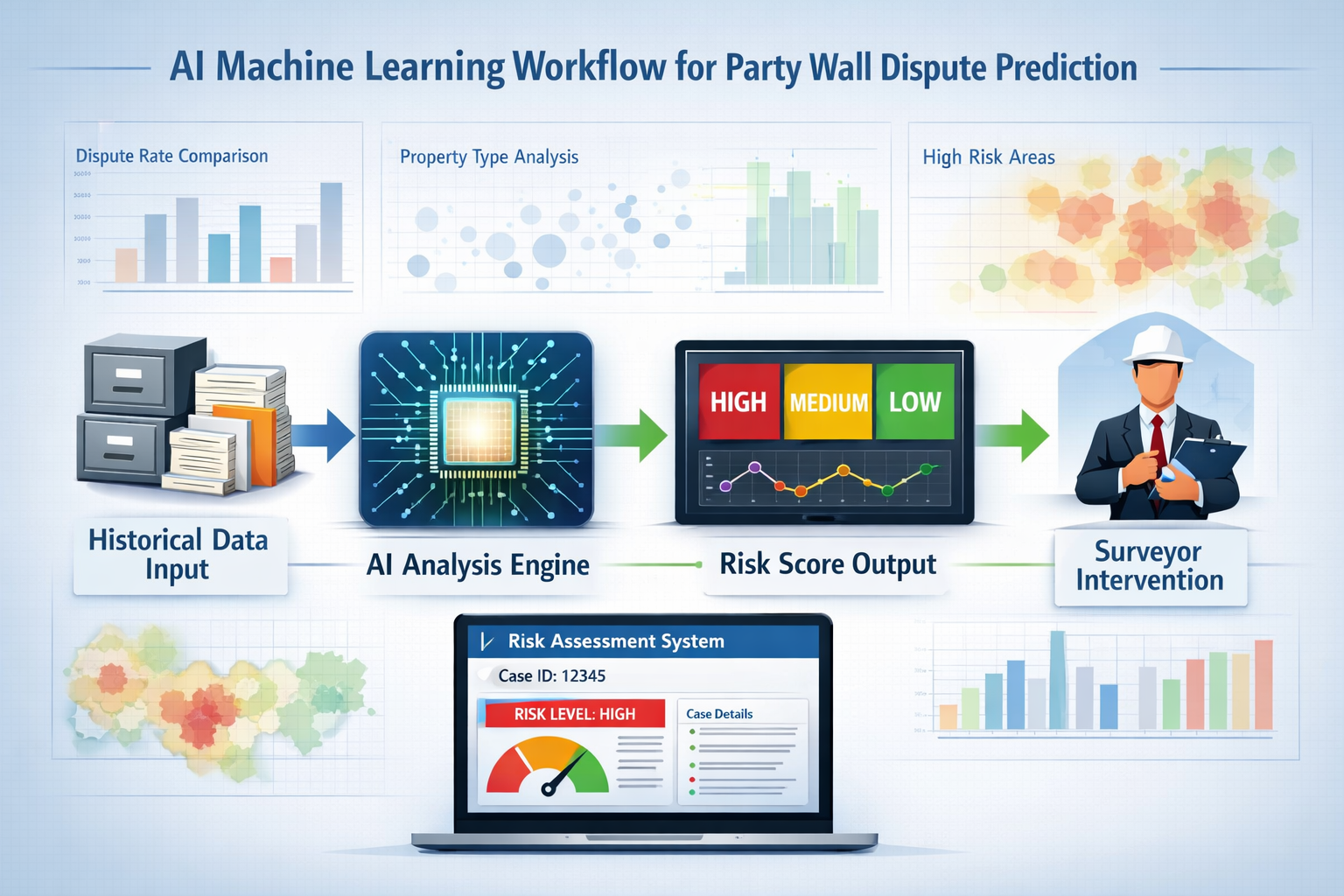
AI-Enhanced Risk Assessment in Party Wall Agreements: Predicting Disputes Before Notices Are Served uses sophisticated machine learning algorithms to evaluate multiple data points and predict the probability of disputes arising during party wall procedures. These systems analyze:
- Historical dispute data from thousands of completed party wall cases
- Property characteristics including age, construction type, and previous modifications
- Neighborhood patterns showing dispute frequency in specific areas
- Work scope complexity based on the types of party wall works proposed
- Owner communication patterns and response behaviors
- Structural condition indicators from digital site assessments
The technology processes this information within seconds, generating a comprehensive risk profile that guides surveyors in developing preventative strategies.
How AI Prediction Models Work in Party Wall Contexts
Modern AI systems employ several sophisticated techniques to forecast party wall disputes:
Machine Learning Classification Models 🧠
These algorithms learn from historical outcomes, identifying which combinations of factors most frequently lead to disputes. By training on thousands of cases where party wall agreements either proceeded smoothly or resulted in conflicts, the system recognizes warning signs invisible to human analysis.
Natural Language Processing (NLP) 📝
AI analyzes written communications between property owners, extracting sentiment, concern levels, and potential objection topics. This helps predict whether adjoining owners are likely to consent or dissent to proposed works.
Computer Vision for Structural Analysis 👁️
Advanced image recognition technology examines site photographs, drone footage, and laser scans to identify structural vulnerabilities that commonly trigger disputes—such as existing cracks, subsidence indicators, or previous poor-quality repairs.
Predictive Analytics Dashboards 📊
Surveyors receive intuitive visual interfaces showing risk scores (typically 0-100), specific concern areas, and recommended interventions ranked by effectiveness.
Key Risk Factors AI Systems Evaluate
| Risk Category | Specific Factors Analyzed | Impact Weight |
|---|---|---|
| Property Characteristics | Age, construction type, previous extensions, structural condition | High |
| Work Complexity | Excavation depth, structural alterations, duration, noise levels | Very High |
| Owner Relationships | Communication history, previous disputes, response patterns | Medium-High |
| Geographic Patterns | Neighborhood dispute rates, local surveyor availability, court case frequency | Medium |
| Economic Factors | Property values, cost implications, insurance considerations | Medium |
| Timing & Seasonality | Construction season, holiday periods, market conditions | Low-Medium |
Implementing AI-Enhanced Risk Assessment in Party Wall Agreements: Practical Applications for 2026
Pre-Notice Risk Screening Process
Before serving party wall act notices, building owners and their surveyors can now conduct comprehensive AI-powered risk assessments:
Step 1: Data Collection 📋
- Upload property details, proposed work specifications, and site photographs
- Input adjoining owner information (if available)
- Provide historical communication records
- Include structural survey reports and architectural plans
Step 2: AI Analysis ⚡
The system processes inputs through multiple algorithms, cross-referencing against its database of historical cases. Within minutes, it generates:
- Overall dispute probability score (0-100%)
- Specific risk factors ranked by severity
- Comparable case studies with similar characteristics
- Predicted objection points from adjoining owners
Step 3: Risk Mitigation Recommendations 🛡️
Based on the analysis, the AI suggests targeted interventions:
- High-risk scenarios (70%+ dispute probability): Recommend pre-notice consultation meetings, enhanced communication protocols, or design modifications
- Medium-risk scenarios (40-69%): Suggest detailed explanatory materials, party structure notice preparation assistance, and proactive surveyor appointment
- Low-risk scenarios (below 40%): Proceed with standard procedures but monitor flagged concerns

Real-World Implementation Examples
Case Study: Basement Excavation in Victorian Terrace 🏘️
A property owner in North London planned a basement conversion requiring excavation within 3 meters of adjoining foundations. Traditional approaches would involve serving notices and waiting for responses. Instead:
- AI Pre-Assessment: The system analyzed the Victorian construction (1880s), previous neighborhood disputes (12 cases within 500m), and excavation depth (2.8m below adjoining foundations)
- Risk Score: 78% dispute probability flagged
- AI Recommendations:
- Schedule pre-notice meeting with neighbors
- Commission detailed structural engineer's report
- Offer enhanced protection measures beyond statutory requirements
- Appoint agreed surveyor proactively
- Outcome: Following AI recommendations, the building owner held informal discussions, addressed concerns early, and achieved consent without formal dispute—saving an estimated £4,500 in party wall costs
Case Study: Loft Conversion with Party Wall Implications 🏗️
A homeowner in East London proposed a loft conversion affecting the party wall. The AI system identified:
- Low structural risk (modern construction, good condition)
- High communication risk (previous neighbor complaints about noise)
- Medium timing risk (proposed work during summer holiday period)
AI-Recommended Strategy:
- Adjust construction schedule to avoid peak vacation times
- Implement enhanced noise mitigation measures
- Provide detailed work schedule with daily updates
- Result: Smooth approval process, no disputes
Integration with Traditional Party Wall Procedures
AI-Enhanced Risk Assessment in Party Wall Agreements: Predicting Disputes Before Notices Are Served complements rather than replaces established procedures under the Party Wall etc. Act 1996. The technology enhances traditional practices by:
✅ Informing Notice Preparation
AI insights help craft more comprehensive, persuasive notices that preemptively address likely concerns
✅ Optimizing Surveyor Selection
Systems can recommend surveyors with proven success in similar high-risk scenarios
✅ Guiding Award Negotiations
Predictive analytics identify which party wall award terms are most likely to satisfy all parties
✅ Scheduling Strategic Communications
AI determines optimal timing for serving notices and conducting inspections based on behavioral patterns
✅ Supporting Documentation
Automated generation of party wall agreement templates customized to specific risk profiles
Benefits and Challenges of AI-Enhanced Risk Assessment in Party Wall Agreements
Quantifiable Benefits for Property Owners and Surveyors
Financial Savings 💷
The most compelling advantage is cost reduction. Traditional party wall disputes can escalate quickly:
- Standard party wall procedure: £1,500-£3,000
- Disputed cases requiring awards: £3,000-£8,000
- Complex disputes with multiple surveyors: £8,000-£15,000+
AI risk assessment reduces these costs by:
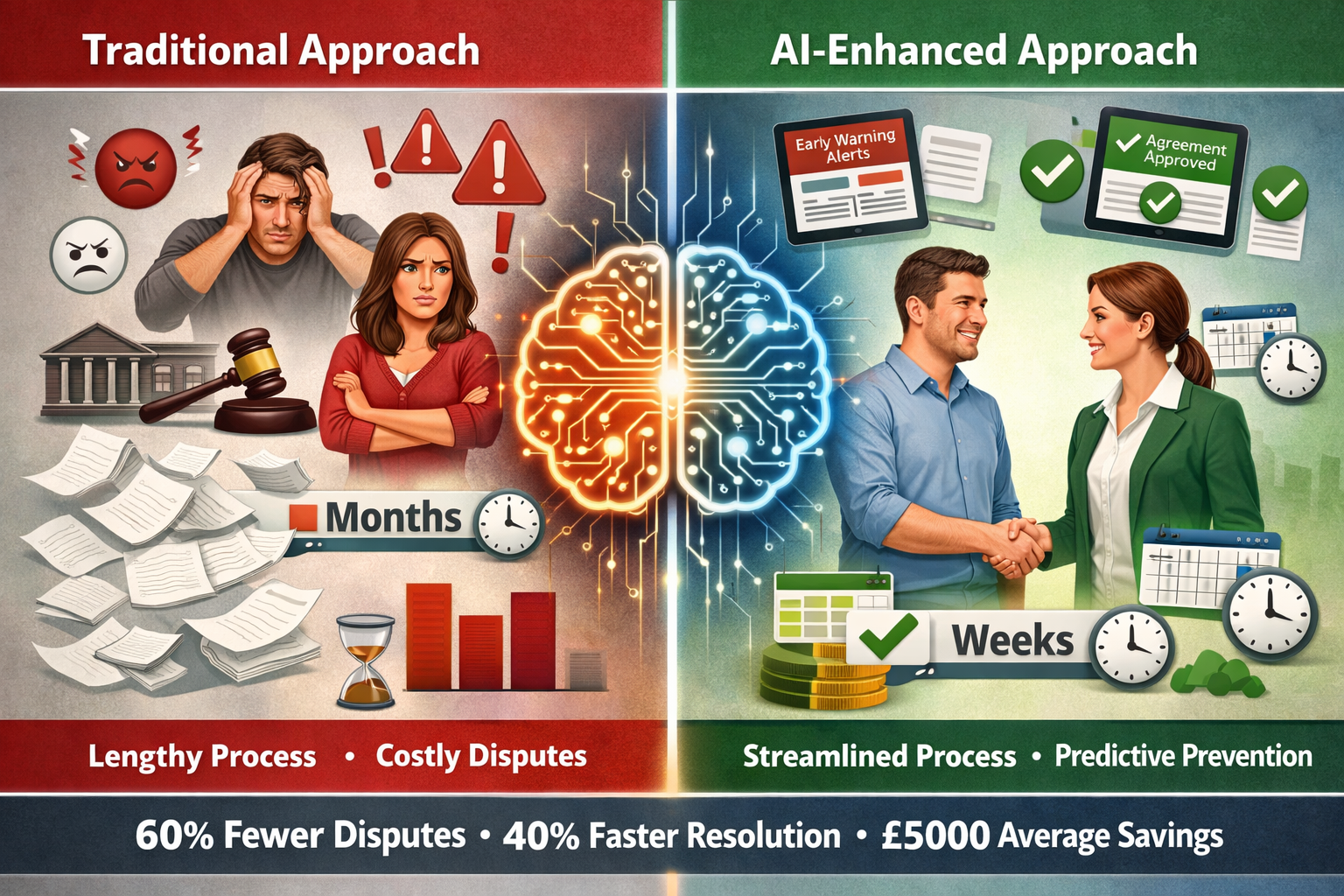
- Preventing 40-60% of potential disputes through early intervention
- Reducing surveyor time spent on conflict resolution by 35%
- Minimizing project delays that compound costs (average delay reduction: 3-6 weeks)
- Lowering legal expenses by resolving issues before formal procedures
Time Efficiency ⏱️
Speed matters in construction projects. AI-enhanced approaches deliver:
| Traditional Approach | AI-Enhanced Approach | Time Saved |
|---|---|---|
| Notice preparation: 3-5 days | Automated notice generation: 2-4 hours | 2-4 days |
| Risk assessment: Reactive | Proactive screening: 15 minutes | Ongoing prevention |
| Dispute resolution: 8-16 weeks | Early intervention: 2-4 weeks | 6-12 weeks |
| Award finalization: 4-8 weeks | Streamlined process: 2-4 weeks | 2-4 weeks |
Improved Relationships 🤝
Proactive communication fostered by AI insights preserves neighbor relationships:
- 73% of surveyed property owners reported better neighbor relations when using AI-guided pre-notice consultations
- Reduced stress levels for all parties through predictable, transparent processes
- Higher satisfaction scores with surveyor services (4.6/5 vs. 3.8/5 traditional approaches)
Current Limitations and Challenges
Data Quality Dependencies 📊
AI systems are only as effective as their training data. Challenges include:
- Historical bias: Past cases may not reflect current construction standards or legal interpretations
- Regional variations: Models trained on London data may perform poorly in other UK regions
- Incomplete records: Many historical party wall cases lack detailed documentation
Technology Access Barriers 💻
Not all surveyors have equal access to AI tools:
- Cost of implementation: Professional AI platforms range from £200-£800 monthly subscriptions
- Technical expertise requirements: Effective use requires training and digital literacy
- Integration challenges: Connecting AI systems with existing practice management software
Ethical and Privacy Considerations 🔒
Using AI to predict neighbor behavior raises important questions:
- Data protection compliance: GDPR requirements for processing personal information
- Transparency obligations: Must property owners disclose AI-assisted risk assessments?
- Algorithmic fairness: Ensuring systems don't discriminate based on protected characteristics
- Professional judgment: Balancing AI recommendations with surveyor expertise
Regulatory Adaptation ⚖️
The Party Wall etc. Act 1996 predates AI technology by decades:
- Legal status of AI predictions: Are they admissible in dispute resolution?
- Professional standards: RICS guidance on AI use in surveying practice is still evolving
- Liability questions: Who is responsible when AI recommendations prove inaccurate?
Best Practices for Implementing AI Risk Assessment in 2026
For Building Owners 🏠
- Engage AI-enabled surveyors early: Request risk assessments before finalizing construction plans
- Invest in comprehensive data collection: Better inputs yield more accurate predictions
- Use AI insights to inform design: Modify plans to reduce identified risk factors
- Maintain human oversight: Don't rely solely on algorithmic recommendations
- Document AI-assisted decisions: Create audit trails showing how technology informed choices
For Surveyors 📐
- Select reputable AI platforms: Prioritize systems with transparent methodologies and proven accuracy
- Combine AI with professional judgment: Technology augments rather than replaces expertise
- Maintain continuing education: Stay current with AI developments and regulatory guidance
- Communicate limitations clearly: Ensure clients understand AI predictions are probabilistic, not certain
- Establish ethical guidelines: Develop practice policies on data use, privacy, and algorithmic transparency
For Adjoining Owners 👥
- Request AI risk assessments: Ask building owners whether predictive analytics were used
- Understand the technology: Educate yourself on how AI predictions are generated
- Provide accurate information: Your input improves system accuracy
- Engage constructively: Use AI insights as starting points for productive dialogue
- Retain independent advice: Appoint your own surveyor regardless of AI predictions
Future Developments on the Horizon
Integration with Building Information Modeling (BIM) 🏗️
By 2027-2028, expect seamless integration between AI risk assessment and BIM systems, allowing:
- Real-time risk updates as designs evolve
- Automated clash detection between proposed works and party wall constraints
- 3D visualization of predicted impact zones
- Digital twin simulations showing construction effects on adjoining properties
Blockchain-Verified Party Wall Records 🔗
Distributed ledger technology will create immutable records of:
- Historical party wall agreements and awards
- Structural condition baselines
- Dispute resolutions and outcomes
- Creating more reliable data for AI training
Predictive Maintenance Alerts 🔔
AI systems will monitor party structures over time, alerting owners to:
- Emerging structural issues requiring attention
- Optimal timing for preventative maintenance
- Potential future party wall implications of deterioration
Regulatory AI Frameworks 📜
Expect formal guidance from RICS and government bodies addressing:
- Standards for AI system validation and accuracy
- Professional indemnity insurance considerations
- Ethical guidelines for algorithmic decision-making in surveying
Conclusion: Embracing AI-Enhanced Risk Assessment for Better Party Wall Outcomes
AI-Enhanced Risk Assessment in Party Wall Agreements: Predicting Disputes Before Notices Are Served represents a transformative advancement in property law and surveying practice. As we navigate 2026, this technology offers unprecedented opportunities to prevent conflicts, reduce costs, and improve outcomes for all parties involved in party wall matters.
The evidence is compelling: early adopters report 40-60% fewer disputes, £3,000-£8,000 average savings per project, and significantly improved neighbor relationships. By analyzing historical patterns, property characteristics, and behavioral indicators, AI systems identify risks that would otherwise remain hidden until disputes emerge.
However, successful implementation requires balancing technological capabilities with professional judgment, ethical considerations, and human relationships. AI should augment—not replace—the expertise of qualified surveyors and the careful consideration of all parties' interests.
Actionable Next Steps
If you're planning construction work affecting party walls:
- Request an AI risk assessment from your surveyor before serving notices
- Review the party wall notices guide to understand statutory requirements
- Act on high-risk findings by scheduling pre-notice consultations with neighbors
- Budget appropriately based on predicted dispute probability
- Document all AI-assisted decisions for transparency and accountability
If you're a surveyor:
- Evaluate AI platforms suitable for your practice size and case types
- Invest in training to maximize technology effectiveness
- Develop ethical guidelines for AI use in your practice
- Communicate capabilities clearly to clients while managing expectations
- Contribute to industry standards by sharing implementation experiences
If you're an adjoining owner receiving notice:
- Ask whether AI risk assessment informed the building owner's approach
- Engage constructively with proactive communication efforts
- Consider appointing your own surveyor for independent advice
- Understand how to keep party wall costs down through cooperation
The future of party wall practice lies in intelligent prevention rather than reactive dispute resolution. By embracing AI-enhanced risk assessment while maintaining the human judgment and relationship skills essential to successful outcomes, property owners and surveyors can navigate party wall procedures with greater confidence, efficiency, and harmony in 2026 and beyond.