


More than 60% of homeowners planning garden improvements underestimate their legal obligations under the Party Wall Act, leading to costly disputes and project delays. Understanding the Party Wall Act Thresholds for Garden Walls and Outbuildings: When Notices Are Required can save thousands of pounds in legal fees and preserve neighborly relations during construction projects.
Garden walls, boundary structures, and outbuildings occupy a complex legal space where property rights intersect. The Party Wall etc. Act 1996 establishes clear thresholds that determine when formal notification becomes mandatory, yet confusion persists about which structures require notices and which excavation depths trigger legal requirements. This guide clarifies the specific thresholds, notice periods, and exemptions that apply to garden structures in 2026.
Key Takeaways
- Solid masonry garden walls on or near boundaries require formal Party Wall notices, while wooden fences and hedges are exempt from the Act
- Two distinct notice periods apply: two months for alterations to existing structures and one month for new boundary walls or excavation work
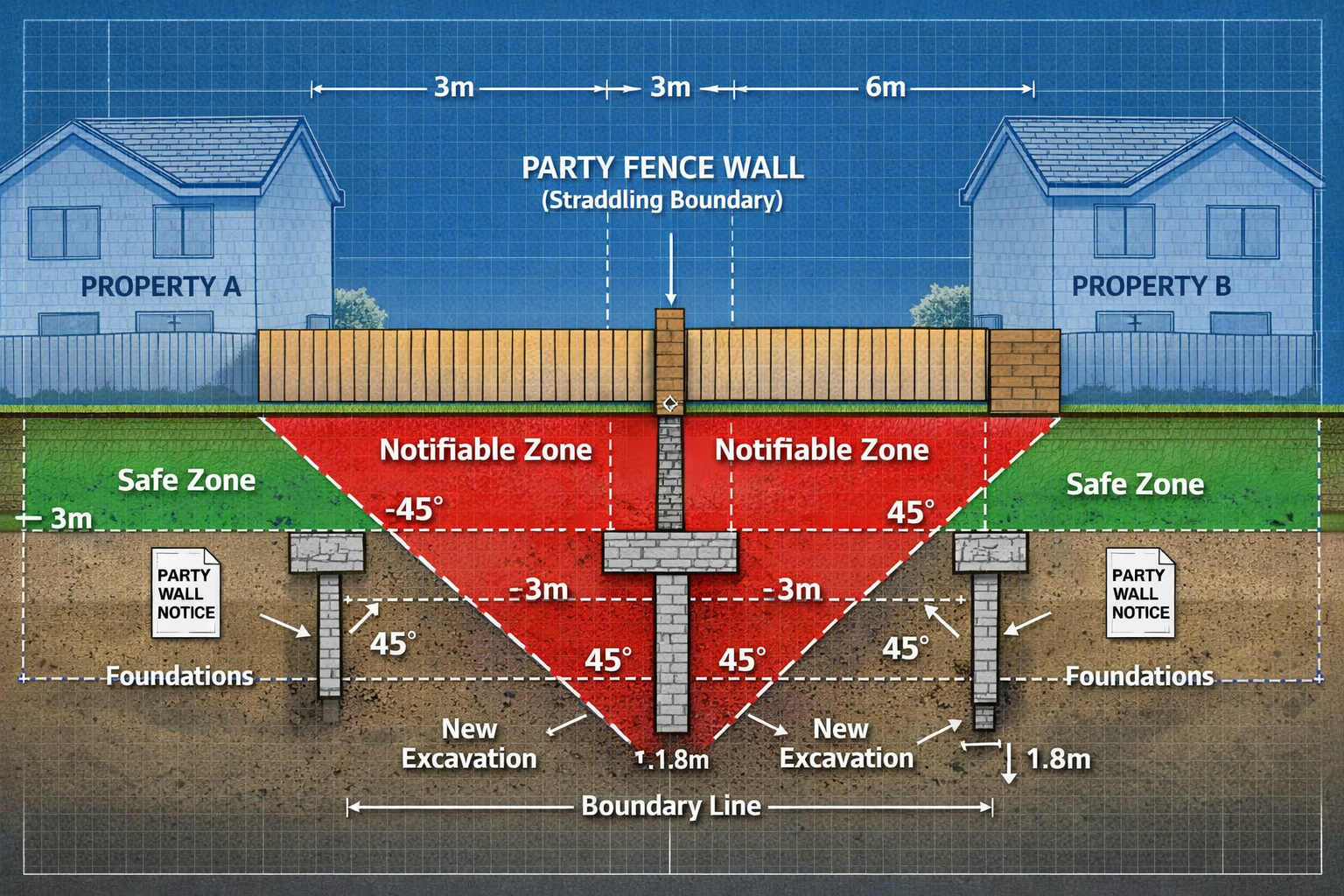
- Excavation thresholds mandate notices when digging within 3 meters of a neighbor's foundation or within 6 meters at specific depths
- Three notice types govern different scenarios: Line of Junction Notices, Party Structure Notices, and Excavation Notices under Section 6
- Professional surveyors play a critical role in assessing threshold compliance and facilitating agreements when neighbors dissent
Understanding Which Garden Structures Fall Under the Party Wall Act
The Party Wall Act applies specifically to solid masonry structures that form party walls or sit on property boundaries. Not all garden features trigger legal requirements, making it essential to distinguish between notifiable and exempt structures.
Structures Covered by the Act
Brick and stone garden walls constitute the primary structures requiring Party Wall compliance when they meet specific criteria. The Act covers walls constructed from concrete blocks, bricks, stone, or other masonry materials that either straddle the boundary line or sit entirely on one property but serve as a boundary marker [1].
Garden walls incorporated into permanent structures such as garages, extensions, or brick-built sheds fall under the Act's jurisdiction when work involves demolition, alteration, or rebuilding. These hybrid structures require careful assessment because they combine boundary elements with habitable or storage spaces [1].
Party fence walls—solid masonry walls standing astride the boundary line between properties—represent the most clear-cut scenario requiring notification. These walls belong jointly to both property owners and any modifications demand formal procedures [4].
Structures Explicitly Excluded
The Act explicitly excludes several common garden features from its requirements:
- 🚫 Wooden fences of any height or construction method
- 🚫 Metal railings and chain-link fencing
- 🚫 Hedges and living boundaries
- 🚫 Retaining walls that don't form property boundaries
- 🚫 Decorative garden features like planters or low ornamental walls
These exclusions exist because the Act focuses on structural elements that could affect building stability or property rights, not aesthetic boundaries [1][5].
The Critical Distinction: Location Matters
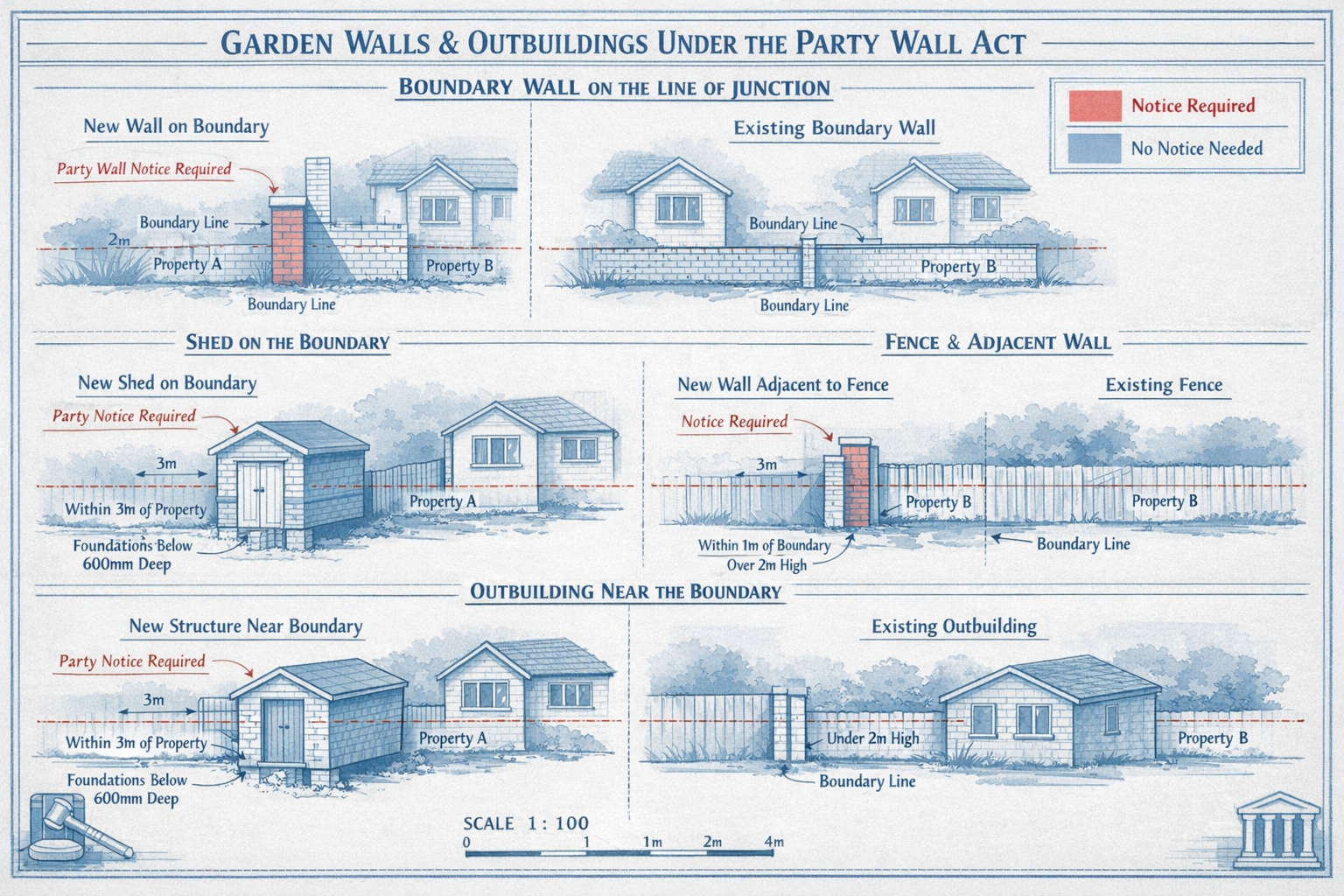
A garden wall's position relative to the boundary line determines whether notices become necessary. Three scenarios exist:
| Wall Position | Notice Required? | Notice Type |
|---|---|---|
| Straddling the boundary (party fence wall) | Yes | Line of Junction or Party Structure Notice |
| Entirely on your land, away from boundary | No | None (unless excavation thresholds apply) |
| On your land, built up to boundary | Depends | Only if raising height or excavating nearby |
Understanding these distinctions helps homeowners identify when their garden projects trigger legal obligations. For detailed guidance on party fence wall definitions, consult specialized resources.
Party Wall Act Thresholds: Specific Distance and Depth Requirements
The Party Wall Act establishes precise thresholds based on distance from neighboring structures and excavation depth. These measurements determine when formal notices become mandatory, regardless of the garden wall's ownership status.
The 3-Meter Excavation Threshold
Any excavation within 3 meters of a neighbor's building foundation requires a Section 6 Notice under the Party Wall Act, even when the work occurs entirely on your own property [1][3]. This threshold applies when:
- Digging foundations for a new garden wall
- Installing footings for an outbuilding or shed
- Excavating for drainage systems or utilities
- Creating sunken garden features or patios
The critical measurement extends from the neighbor's foundation base, not their property line. If your excavation will go deeper than your neighbor's foundation within this 3-meter zone, notification becomes mandatory [3].
The 6-Meter Extended Threshold
A 6-meter threshold applies to deeper excavation work that could affect neighboring properties through ground movement or settlement. This extended zone requires notification when excavation:
- Occurs within 6 meters of a neighbor's structure
- Reaches a depth that intersects a 45-degree angle drawn downward from the base of the neighbor's foundation
- Involves significant ground disturbance for substantial outbuildings or garden structures [3]
This geometric threshold recognizes that deeper excavations further from the boundary can still impact neighboring foundations through soil displacement and settlement patterns.
Height and Structural Modification Thresholds
Raising the height of an existing boundary wall constitutes an alteration requiring notification, regardless of how many centimeters you add. The Act contains no minimum height increase exemption—any upward extension triggers notice requirements [1].
Similarly, increasing the thickness of a party fence wall or boundary wall requires formal procedures. Property owners cannot unilaterally expand shared structures without neighbor consent.
Building New Walls on the Boundary Line
Constructing a new wall astride the boundary (party fence wall) requires written consent from the neighbor through a Line of Junction Notice. This represents a mandatory threshold with no exceptions—the law prohibits building on the boundary line without formal notification, even for low decorative walls [3].
The threshold applies whether you're building:
- A new garden wall from scratch
- Replacing a wooden fence with a brick wall
- Extending an existing wall along the boundary
- Creating a shared wall for adjoining outbuildings
For guidance on boundary wall rules and height restrictions, consult local planning regulations alongside Party Wall requirements.
Types of Notices Required for Garden Walls and Outbuildings
The Party Wall Act specifies three distinct notice types, each with different timeframes and applications. Selecting the correct notice type depends on your specific garden project and its relationship to boundary structures.
Line of Junction Notice (Section 1)
A Line of Junction Notice applies when building a new wall directly on the boundary line between properties. This notice requires one month's advance notification before work commences [2][3].
This notice type covers:
- Building a new party fence wall from scratch
- Constructing a wall for an outbuilding that straddles the boundary
- Creating a shared wall between two properties
The notice must specify the proposed wall's dimensions, materials, and construction timeline. Neighbors can consent, dissent, or request modifications to the design. Building without consent when required constitutes a legal violation that can result in court-ordered removal [3].
Party Structure Notice (Section 3)
Party Structure Notices govern work on existing party walls or party fence walls. These require two months' advance notification before starting work [2][4].
Common scenarios requiring Party Structure Notices include:
- Raising the height of an existing party fence wall
- Increasing the thickness of a shared garden wall
- Demolishing and rebuilding a deteriorated party fence wall
- Cutting into a party wall to install beams or supports
- Underpinning a party wall's foundation
The extended two-month period allows neighbors adequate time to review plans, appoint surveyors, and arrange for condition surveys documenting the pre-work state of their property [4].
For comprehensive information about Party Structure Notices and serving procedures, specialized guidance ensures compliance with formal requirements.
Section 6 Notice (Excavation Near Boundaries)
Section 6 Notices specifically address excavation work near neighboring structures, applying the 3-meter and 6-meter thresholds discussed earlier. These notices require one month's advance notification [2][3].
Excavation notices become necessary when:
- Digging foundations for garden walls within threshold distances
- Installing footings for sheds, summerhouses, or outbuildings
- Creating sunken patios or basement extensions
- Excavating for swimming pools or water features
The notice must include excavation depth, distance from the neighbor's foundation, and proposed construction methods. Neighbors can request additional protective measures, such as underpinning their foundations or installing temporary supports during excavation [3].
Notice Period Summary Table
| Notice Type | Advance Period | Primary Application |
|---|---|---|
| Line of Junction (Section 1) | 1 month | New walls on boundary line |
| Party Structure (Section 3) | 2 months | Alterations to existing party walls |
| Section 6 (Excavation) | 1 month | Digging within 3m or 6m thresholds |
Understanding which notice applies to your project ensures legal compliance and helps maintain positive neighbor relations. For detailed procedures on serving Party Wall notices, follow established protocols.
When Garden Wall Work Does NOT Require Party Wall Notices
Several common garden projects fall outside the Party Wall Act's scope, allowing homeowners to proceed without formal notification. Understanding these exemptions prevents unnecessary delays and costs.
Sole Ownership Walls Away from Boundaries
Garden walls built entirely on your property and positioned away from boundary lines generally require no Party Wall notices, provided no excavation thresholds are triggered. A wall constructed 4 meters inside your property line, for example, typically proceeds without neighbor notification [1].
However, this exemption disappears if:
- Foundation excavation enters the 3-meter or 6-meter threshold zones
- The wall's construction could affect neighboring structures
- Local planning permission requires neighbor consultation
Minor Maintenance and Repairs
Routine maintenance on existing garden walls falls outside the Act's requirements. Permissible work without notices includes:
- ✅ Repointing mortar joints
- ✅ Applying render or paint
- ✅ Replacing damaged bricks or stones (like-for-like)
- ✅ Installing wall caps or coping stones
- ✅ Cleaning or pressure washing
- ✅ Drilling holes for wall-mounted fixtures
These activities don't alter the wall's structure or dimensions, making formal procedures unnecessary [2].
Wooden Fences and Non-Masonry Boundaries
Replacing a wooden fence with another wooden fence—even a taller one—requires no Party Wall notice, regardless of the fence's position on the boundary. The Act's exclusion of timber structures means homeowners can modify wooden boundaries without triggering legal procedures [1][5].
This exemption extends to:
- Metal railings and gates
- Chain-link or wire fencing
- Composite fence panels
- Living boundaries like hedges
However, replacing a wooden fence with a brick or stone wall on the boundary triggers Line of Junction Notice requirements, as this introduces a masonry structure where none existed [1].
Internal Garden Structures
Outbuildings positioned entirely on your property with foundations that don't breach excavation thresholds require no Party Wall notices. Garden sheds, greenhouses, and summerhouses built away from boundaries proceed without formal neighbor notification, though planning permission may still apply.
The distinction between Party Wall requirements and planning permission often confuses homeowners. These represent separate legal frameworks with different thresholds and procedures. For information about boundary rules and building proximity, consult both Party Wall and planning resources.
The Role of Party Wall Surveyors in Threshold Assessments
Professional surveyors provide essential expertise when garden wall projects approach or exceed Party Wall Act thresholds. Their involvement protects both building owners and neighbors while ensuring legal compliance.
When Surveyor Involvement Becomes Necessary
Surveyors enter the process when:
- Neighbors dissent to a Party Wall notice or fail to respond within the 14-day statutory period [8]
- Complex excavation makes threshold measurements unclear
- Structural concerns exist about proposed work affecting neighboring properties
- Dispute prevention becomes a priority for high-value projects
The Party Wall Act allows neighbors to appoint their own surveyor or agree to a single "Agreed Surveyor" who represents both parties impartially. This flexibility helps control Party Wall costs while maintaining professional oversight [8].
Surveyor Responsibilities in Garden Wall Projects
Party Wall surveyors perform several critical functions:
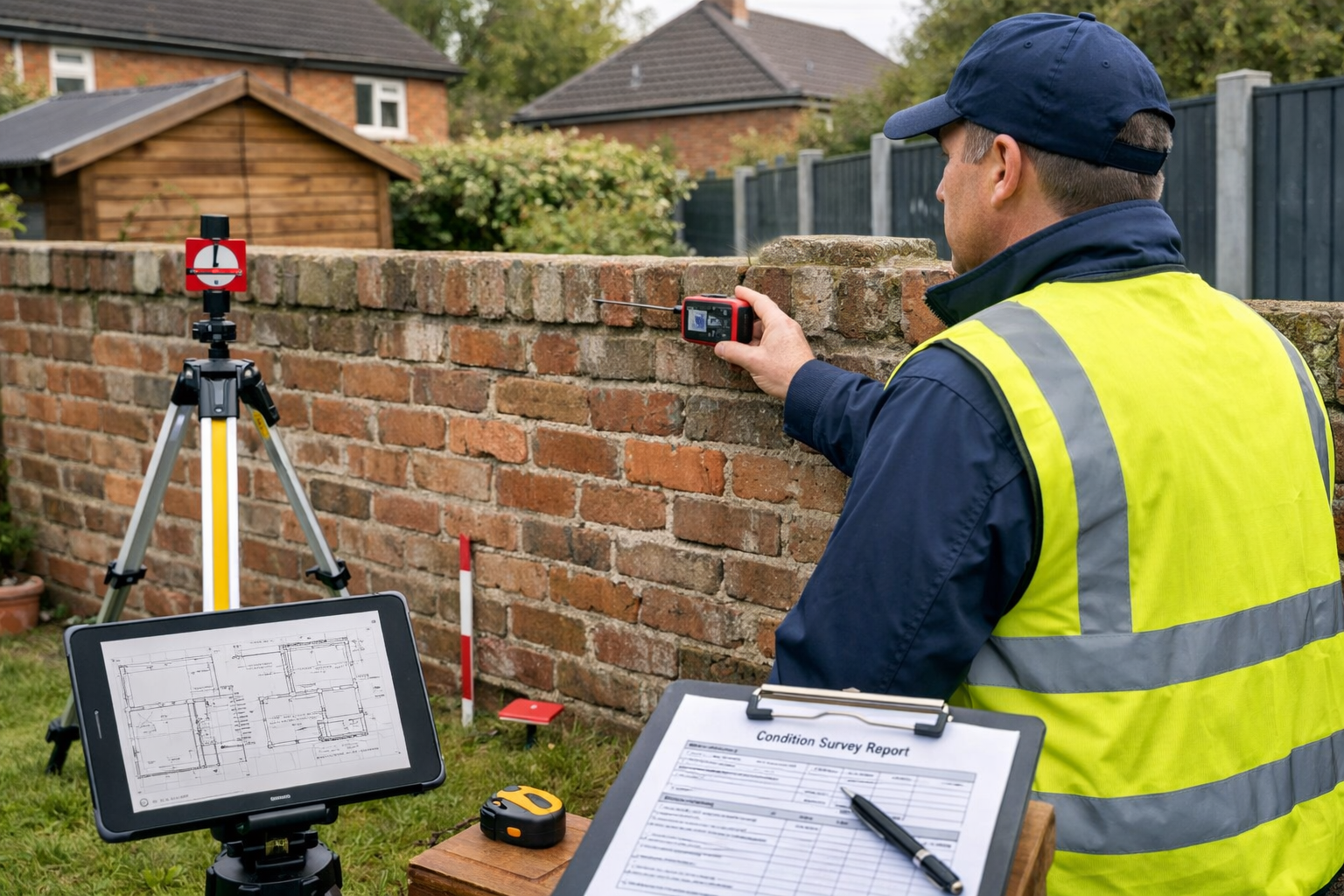
Threshold verification: Surveyors measure distances from foundations, assess excavation depths, and confirm whether proposed work triggers notice requirements. Their technical expertise resolves ambiguous situations where homeowners struggle to determine compliance [3].
Condition surveys: Before work commences, surveyors document the existing condition of neighboring properties through photographs, measurements, and detailed reports. These baseline records prove invaluable if disputes arise about construction damage [4].
Award preparation: When formal agreements become necessary, surveyors prepare Party Wall Awards—legal documents specifying work parameters, protective measures, access arrangements, and dispute resolution procedures. These awards provide enforceable frameworks for construction projects [4].
Dispute resolution: Surveyors mediate disagreements about construction methods, working hours, access requirements, and damage compensation. Their professional judgment helps neighbors reach acceptable compromises without court intervention.
The Three Response Options for Neighbors
When served with a Party Wall notice, neighbors have three options, each with different implications for surveyor involvement [8]:
-
Consent in writing: The neighbor agrees to the proposed work, and no surveyor appointment becomes necessary. Work proceeds according to the notice specifications.
-
Dissent or fail to respond: The neighbor objects or doesn't respond within 14 days, automatically triggering the surveyor appointment process. The building owner and neighbor each appoint surveyors (or agree to a single Agreed Surveyor).
-
Consent with conditions: The neighbor agrees but requests specific protective measures, working hour restrictions, or access provisions. Surveyors formalize these conditions in a Party Wall Award.
Understanding these options helps building owners anticipate potential surveyor costs and project timelines. For comprehensive guidance on Party Wall Awards and their contents, consult specialized resources.
Cost Implications and Payment Responsibilities
The building owner (person initiating the work) typically bears all Party Wall surveyor costs, including fees for both their own surveyor and the neighbor's appointed surveyor [2]. This financial responsibility covers:
- Initial threshold assessments and measurements
- Condition survey preparation
- Party Wall Award drafting
- Follow-up inspections during construction
- Final completion assessments
Surveyor fees for garden wall projects typically range from £500 to £1,500 depending on project complexity, though costs can increase for extensive excavation or multiple adjoining properties. Obtaining quotes from multiple surveyors helps control expenses while ensuring professional service.
Regional specialists, such as those offering Party Wall surveyor services in South London or West London, understand local construction patterns and typical garden wall configurations.
Practical Steps for Compliance with Party Wall Act Thresholds
Navigating Party Wall requirements for garden walls and outbuildings becomes manageable with a systematic approach. Following these steps ensures legal compliance while minimizing delays and costs.
Step 1: Assess Your Project Against Thresholds
Before finalizing garden wall or outbuilding plans, conduct a thorough threshold assessment:
Measure distances: Use a tape measure or laser measuring device to determine exact distances from your proposed excavation to neighboring foundations. Document these measurements with photographs and sketches.
Check wall positions: Identify whether your garden wall will straddle the boundary line, sit entirely on your property, or replace an existing structure. Review property deeds and boundary surveys to confirm legal boundary locations.
Calculate excavation depths: Determine how deep your foundations must extend and whether this depth triggers the 3-meter or 6-meter thresholds relative to neighboring structures.
Identify wall types: Confirm whether you're working with masonry structures (covered by the Act) or wooden/metal boundaries (exempt from requirements).
Step 2: Determine Notice Requirements
Based on your threshold assessment, identify which notices apply:
- Building a new wall on the boundary → Line of Junction Notice (1 month)
- Modifying an existing party fence wall → Party Structure Notice (2 months)
- Excavating within threshold distances → Section 6 Notice (1 month)
- Work entirely on your property, outside thresholds → No notice required
Multiple notice types may apply to a single project. For example, building a new party fence wall with deep foundations might require both a Line of Junction Notice and a Section 6 Notice [3].
Step 3: Prepare and Serve Notices
Formal Party Wall notices must include specific information:
- Your details: Name, address, and contact information as the building owner
- Work description: Detailed explanation of proposed construction, including dimensions, materials, and methods
- Drawings and plans: Scaled diagrams showing wall positions, excavation depths, and distances from boundaries
- Proposed start date: Intended commencement date (respecting required notice periods)
- Surveyor information: Details of any surveyors already appointed
Serve notices via recorded delivery or hand delivery with signed receipt to create proof of service. The notice period begins when the neighbor receives the document, not when you send it [2].
For templates and guidance, explore resources on Party Wall notices and serving procedures.
Step 4: Respond to Neighbor Feedback
After serving notices, neighbors have 14 days to respond. Prepare for three possible outcomes:
Consent received: Proceed with your project according to the notice specifications. Retain written consent documentation for future reference.
Dissent or no response: Initiate the surveyor appointment process. Contact a qualified Party Wall surveyor to begin preparing a Party Wall Award. Your neighbor will appoint their own surveyor or agree to use your surveyor as an Agreed Surveyor [8].
Questions or concerns: Address neighbor inquiries promptly and professionally. Many disputes arise from misunderstandings that clear communication can resolve. Consider offering condition surveys or protective measures to alleviate concerns.
Step 5: Arrange Condition Surveys
Even when neighbors consent, arranging a condition survey before work commences protects both parties. These surveys:
- Document the pre-construction state of neighboring properties
- Provide evidence if damage claims arise later
- Demonstrate your commitment to responsible construction
- Typically cost £200-£400 for residential properties
Professional surveyors photograph walls, ceilings, floors, and exterior features, creating comprehensive baseline records. This small investment prevents costly disputes about whether construction caused specific damage.
Step 6: Comply with Award Provisions
If a Party Wall Award becomes necessary, strictly adhere to its provisions:
- Follow specified construction methods and protective measures
- Respect designated working hours and access arrangements
- Allow surveyor inspections at agreed intervals
- Notify neighbors of construction milestones
- Complete work within stipulated timeframes
Award violations can result in court injunctions halting construction and requiring expensive remedial work. Compliance protects your investment and legal position.
Step 7: Conduct Post-Completion Assessments
After finishing garden wall or outbuilding construction:
- Arrange final inspections with appointed surveyors to confirm compliance with Award terms
- Address any damage identified during construction, following Award provisions for repairs or compensation
- Obtain completion certificates from surveyors documenting satisfactory project completion
- Retain all documentation including notices, Awards, condition surveys, and completion certificates for future property transactions
These records prove Party Wall compliance to future buyers and provide evidence if disputes arise years later.
Common Mistakes to Avoid with Garden Wall Party Wall Thresholds
Even well-intentioned homeowners make errors when assessing Party Wall requirements for garden projects. Avoiding these common mistakes prevents legal complications and neighbor disputes.
Mistake 1: Assuming Wooden Fences Require Notices
Many homeowners incorrectly believe that replacing or raising wooden fences triggers Party Wall procedures. Timber boundaries remain exempt from the Act regardless of height or position, though planning permission height restrictions still apply [1][5].
This confusion often leads to unnecessary surveyor consultations and delayed projects. Confirm your boundary material before pursuing formal procedures.
Mistake 2: Measuring from Property Lines Instead of Foundations
The 3-meter and 6-meter excavation thresholds measure from neighboring foundations, not property boundaries. A common error involves measuring from the fence line or boundary marker, potentially underestimating the actual distance to structural elements [3].
Always measure from the neighbor's building foundation base, which may sit several meters inside their property line. When uncertain, request foundation location information from neighbors or consult building plans.
Mistake 3: Starting Work Before Notice Periods Expire
Party Wall notices require specific advance periods—one or two months depending on notice type. Starting construction prematurely constitutes a legal violation that can result in:
- Court injunctions halting work immediately
- Mandatory demolition of completed work
- Financial compensation to neighbors
- Legal costs for both parties
Mark notice expiration dates clearly and build buffer time into project schedules to accommodate potential delays [2].
Mistake 4: Ignoring Excavation Thresholds for "Small" Projects
Homeowners often assume that modest garden sheds or low walls don't trigger Party Wall requirements. However, excavation depth determines threshold compliance, not structure size. A small shed requiring 1-meter-deep foundations within 3 meters of a neighbor's building necessitates Section 6 Notice procedures [3].
Always assess excavation requirements before dismissing Party Wall obligations based on project scale.
Mistake 5: Proceeding Without Written Consent
Verbal neighbor agreements hold no legal weight under the Party Wall Act. Written consent provides the only valid authorization for notifiable work. Handshake agreements or casual conversations offer no protection if neighbors later claim they didn't consent to specific work details [2].
Request formal written consent specifying work descriptions, even from friendly neighbors. Relationships change, and properties transfer to new owners who weren't party to verbal agreements.
Mistake 6: Failing to Document Existing Conditions
Skipping pre-construction condition surveys creates vulnerability to unfounded damage claims. Without baseline documentation, proving that cracks or defects existed before your work becomes nearly impossible [4].
Invest in professional condition surveys or at minimum, take comprehensive photographs and videos of neighboring properties before construction begins. Date-stamp all documentation and store it securely.
Mistake 7: Confusing Party Wall and Planning Permission
The Party Wall Act and planning permission represent separate legal requirements with different thresholds, procedures, and authorities. Work requiring Party Wall notices may not need planning permission, and vice versa [5].
Common scenarios include:
- Garden walls under 2 meters high (no planning permission, but Party Wall notice may apply)
- Permitted development outbuildings (no planning permission, but excavation thresholds may trigger notices)
- Boundary wall height increases (Party Wall notice required, planning permission depends on final height)
Research both frameworks independently and comply with applicable requirements from each system.
Alternative Dispute Resolution and Consent Options
When neighbors express concerns about garden wall projects, several alternatives to formal Party Wall procedures can facilitate agreement while maintaining legal compliance.
Negotiated Modifications
Before initiating formal surveyor appointments, consider negotiating project modifications that address neighbor concerns:
- Reducing wall height to minimize visual impact
- Adjusting construction schedules to avoid inconvenient times
- Implementing additional protective measures during excavation
- Offering to repair or upgrade shared boundary features
- Providing access for neighbor inspections during construction
Many disputes resolve through reasonable compromises that satisfy both parties without expensive surveyor involvement. Document any negotiated modifications in writing and incorporate them into formal notices or Awards.
Agreed Surveyor Arrangements
Rather than each party appointing separate surveyors, neighbors can agree to a single Agreed Surveyor who acts impartially for both sides. This arrangement:
- Reduces overall surveyor costs substantially
- Streamlines the Award preparation process
- Minimizes administrative complexity
- Maintains professional oversight and protection
Agreed Surveyor arrangements work best when neighbors maintain cordial relations and share confidence in the selected professional's impartiality [8].
Informal Agreements for Minor Work
For garden wall projects that technically require notices but involve minimal risk, some neighbors accept informal written agreements as alternatives to full Party Wall procedures. These agreements should:
- Specify work details comprehensively
- Include condition survey provisions
- Address damage compensation mechanisms
- Acknowledge that formal Party Wall rights remain available
However, informal agreements provide less legal protection than formal Awards and may not satisfy future property buyers' solicitors. Consider long-term implications before pursuing this route.
For guidance on having Party Wall agreements without surveyors, explore available options and their limitations.
Mediation Services
When disputes escalate beyond direct negotiation, professional mediation offers an alternative to court proceedings. Mediators facilitate discussions between neighbors, helping identify mutually acceptable solutions without formal legal action.
Mediation costs typically range from £500 to £1,500—often less expensive than contested Party Wall procedures and significantly cheaper than court litigation. Many disputes resolve in single-day mediation sessions, allowing construction projects to proceed with minimal delay.
Regional Considerations and Local Variations
While the Party Wall Act applies uniformly across England and Wales, regional factors influence how thresholds affect garden wall projects in different areas.
Urban vs. Rural Applications
Urban properties with closely spaced buildings face more frequent Party Wall threshold triggers. Terraced houses, semi-detached properties, and urban gardens with limited space between structures commonly require notices for garden wall and outbuilding projects.
Rural properties with substantial separation between buildings less frequently trigger excavation thresholds, though boundary wall issues still arise when structures straddle property lines.
London-Specific Considerations
London properties present unique Party Wall challenges due to:
- Dense housing with shared walls and close proximity
- Victorian and Edwardian terraces with shallow foundations vulnerable to nearby excavation
- Higher property values increasing dispute stakes
- Greater surveyor availability and specialization
Homeowners in specific London areas benefit from regional expertise. Consider consulting specialists offering Party Wall surveyor services in North London, East London, or Central London depending on project location.
Scotland and Northern Ireland
The Party Wall etc. Act 1996 does not apply in Scotland or Northern Ireland, where different legal frameworks govern boundary disputes and construction near neighboring properties [5].
Scottish homeowners follow common law principles and local building regulations, while Northern Ireland maintains separate statutory provisions. Consult region-specific legal guidance when planning garden wall projects outside England and Wales.
Conclusion
Understanding Party Wall Act Thresholds for Garden Walls and Outbuildings: When Notices Are Required empowers homeowners to navigate construction projects confidently while maintaining positive neighbor relations. The Act's specific distance measurements—3 meters and 6 meters for excavation, boundary line positioning for new walls—provide clear guidance when formal procedures become necessary.
Key principles to remember:
- Solid masonry garden walls trigger Party Wall requirements when they straddle boundaries or when excavation approaches neighboring foundations
- Three notice types with different timeframes govern distinct scenarios: Line of Junction (1 month), Party Structure (2 months), and Section 6 excavation notices (1 month)
- Wooden fences and non-masonry boundaries remain exempt regardless of position or height
- Professional surveyors provide essential threshold assessments, condition documentation, and dispute resolution when neighbors dissent
- Careful planning, accurate measurements, and timely notice service prevent costly legal complications
Actionable Next Steps
For homeowners planning garden wall or outbuilding projects:
- Measure carefully: Document distances from proposed excavation to neighboring foundations using precise measuring tools
- Identify wall types: Confirm whether your project involves masonry structures requiring notices or exempt wooden boundaries
- Serve notices early: Respect required notice periods and build buffer time into project schedules
- Arrange condition surveys: Protect yourself and neighbors by documenting existing property conditions before construction
- Consult professionals: Engage qualified Party Wall surveyors when threshold assessments prove complex or neighbors express concerns
The Party Wall Act balances property owners' development rights with neighbors' protection from construction damage. By understanding when notices become required and following proper procedures, homeowners can complete garden improvements legally, efficiently, and harmoniously.
For comprehensive support throughout the Party Wall process, explore resources on types of Party Wall works and consider professional guidance tailored to your specific project requirements.
References
[1] Are Garden Walls Covered By The Party Wall Act A Comprehensive Guide – https://www.expresspartywall.com/are-garden-walls-covered-by-the-party-wall-act-a-comprehensive-guide/
[2] Party Wall Agreement – https://hoa.org.uk/advice/guides-for-homeowners/i-am-improving/party-wall-agreement/
[3] Party Wall Works Explained When Must You Notify The Adjoining Owner – https://arunassociates.co.uk/party-wall-works-explained-when-must-you-notify-the-adjoining-owner/
[4] Understanding The Party Structure Notice What It Is And When It Needs To Be Issued – https://www.adamjoseph.co.uk/understanding-the-party-structure-notice-what-it-is-and-when-it-needs-to-be-issued
[5] Party Walls Building Works – https://www.gov.uk/party-walls-building-works
[8] Your Options When Served A Party Wall Notice – https://www.kemptoncarr.co.uk/news-and-knowledge/your-options-when-served-a-party-wall-notice/