


Nearly one in three loft conversion disputes in England and Wales involves a failure to serve the correct party wall notice before structural beams are inserted — a costly oversight that can halt construction and trigger legal action. For homeowners planning a loft conversion in 2026, understanding the Party Wall Act for Loft Conversions: Structural Beam Insertions, Notices, and Award Enforcement is not optional. It is the legal foundation on which every safe, dispute-free conversion is built.
This guide examines the specific obligations triggered when steel beams are cut into shared walls, how to draft notices that hold up under scrutiny, and what enforcement options exist when a party wall award is ignored.
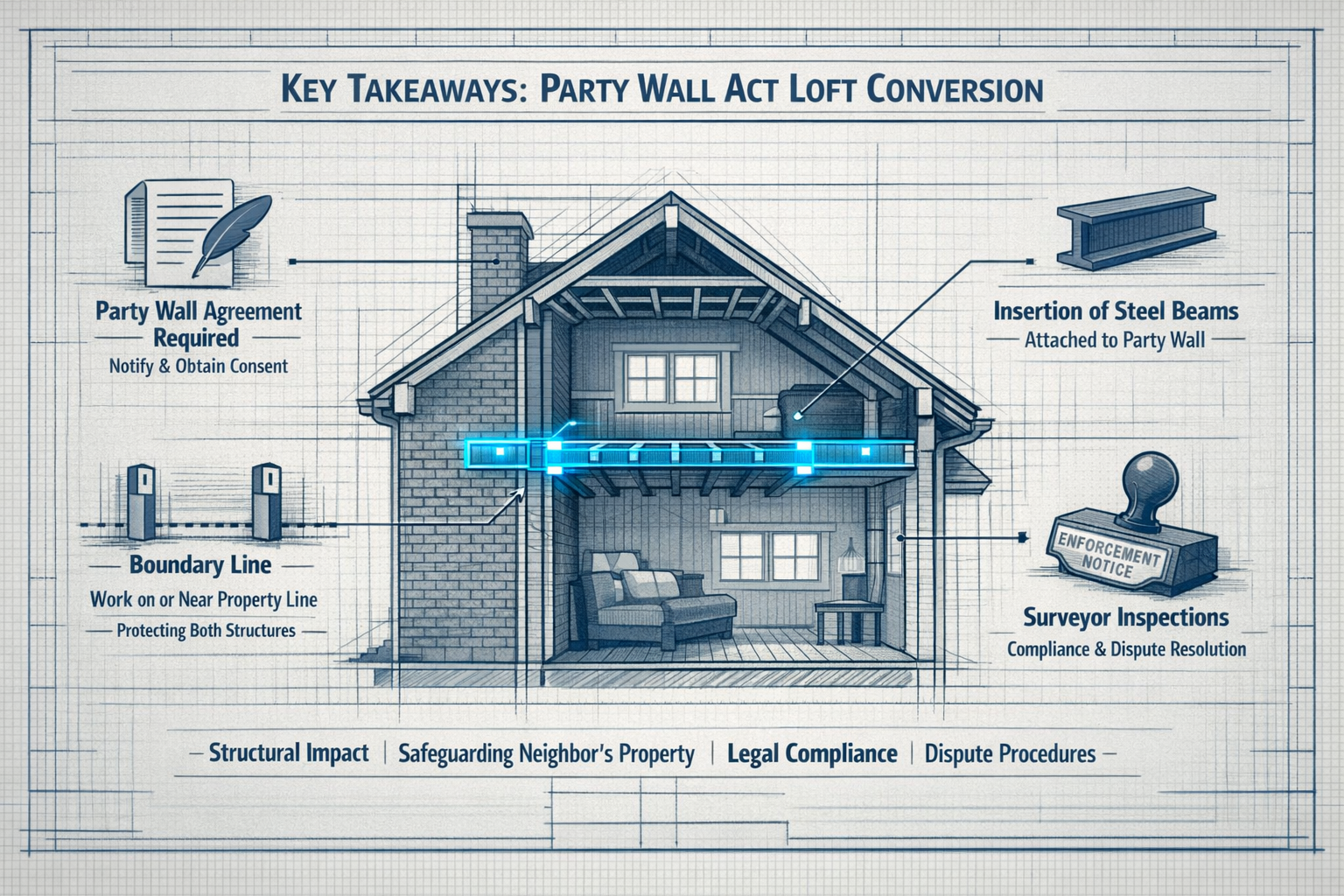
Key Takeaways 📋
- Steel beam insertion into a party wall triggers mandatory compliance under Section 2 of the Party Wall etc. Act 1996 — no exceptions for terraced or semi-detached homes.
- A Party Structure Notice must be served at least two months before work begins, giving adjoining owners time to consent or appoint a surveyor.
- A Schedule of Condition protects both parties by documenting the neighbour's property before any structural work starts.
- Party wall awards are legally binding and can be enforced through the County Court if either party fails to comply.
- Detached homes are generally exempt, but any shared or boundary wall element must still be carefully assessed.
What the Party Wall etc. Act 1996 Means for Loft Conversions
The Party Wall etc. Act 1996 is a piece of legislation that governs construction work affecting shared walls, boundary structures, and excavations near neighbouring properties. For loft conversions specifically, it becomes relevant the moment any structural work touches or penetrates a party wall — the wall shared between two adjoining properties.
Which Properties Are Affected?
Not every loft conversion triggers the Act. Property type matters significantly [4]:
| Property Type | Party Wall Act Applies? |
|---|---|
| Terraced house | ✅ Yes — shared walls on one or both sides |
| Semi-detached house | ✅ Yes — shared wall on one side |
| End-of-terrace | ✅ Possibly — depends on shared wall presence |
| Detached house | ❌ Generally no — no shared walls |
| Flat (upper floor) | ✅ Yes — floor/ceiling as party structure |
💡 Pull Quote: "If your loft conversion involves cutting into, building on, or loading a wall shared with a neighbour, the Party Wall Act almost certainly applies — regardless of how minor the work seems."
Works That Trigger the Act During a Loft Conversion
The types of party wall works that commonly arise during loft conversions include [1][2]:
- Inserting steel RSJ (Rolled Steel Joist) beams into or through a party wall
- Cutting pockets or openings into brick party walls to seat beam ends (Section 2(2)(f))
- Raising or thickening the party wall to gain headroom
- Cutting into the wall to place new floor joists or supports
- Modifying chimney breasts that form part of the party wall
- Roof works that structurally load or alter a shared gable wall
Each of these activities falls under Section 2 of the Act, which covers works to party structures. Inserting a steel beam is one of the most common triggers — and one of the most frequently mishandled [2].
Party Wall Act for Loft Conversions: Structural Beam Insertions and Notice Drafting
Why Steel Beam Insertions Demand Special Attention
When a structural engineer specifies a steel beam to carry new loft floor loads, that beam typically needs to bear on the party wall. This means cutting rectangular pockets into the brickwork — a process that physically alters the shared structure. Under Section 2(2)(f) of the Act, cutting into a party wall to insert a beam or to support a new structure is explicitly covered [4].
The structural implications are significant. A steel RSJ can weigh several hundred kilograms. The load it transfers into the party wall affects the neighbour's property just as much as the building owner's. This is precisely why the Act demands formal notification before a single brick is touched [2].
Drafting a Party Structure Notice: What Must Be Included
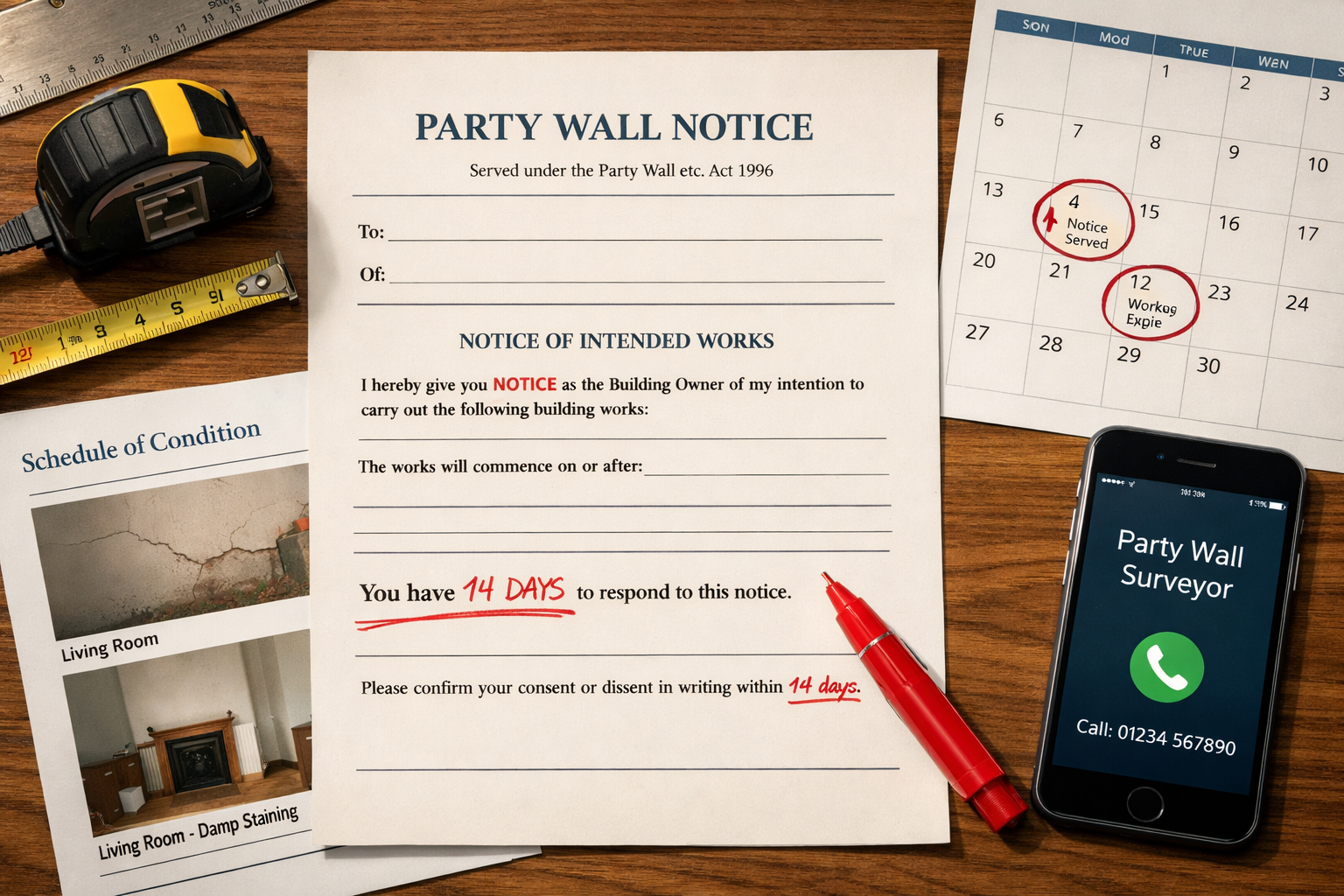
The correct notice for loft conversion beam work is a Party Structure Notice, served under Section 3 of the Act. Serving a proper notice is not just a formality — it is the legal trigger that activates the Act's protections for both parties. For a detailed walkthrough, see this guide on what a Party Structure Notice is and how to serve it.
A compliant Party Structure Notice must include:
- ✅ Full name and address of the building owner (the person doing the work)
- ✅ Full address of the property where work will take place
- ✅ Description of the proposed works — including beam dimensions, pocket sizes, and structural method
- ✅ Proposed start date (work cannot begin for at least two months after notice is served)
- ✅ Drawings and plans showing the extent of the work affecting the party wall
- ✅ Statement that the notice is served under the Party Wall etc. Act 1996
Common drafting errors that invalidate notices include:
- Vague descriptions ("some structural work") rather than specific beam specifications
- Missing or incorrect start dates
- Failure to include structural drawings
- Serving notice on the wrong person (tenant vs. freeholder)
⚠️ Critical Point: An invalid notice provides no legal protection. If damage occurs and the notice was defective, the building owner may face uncapped liability for repairs.
The Schedule of Condition: A Non-Negotiable Safeguard
Before any beam insertion begins, a Schedule of Condition should be prepared. This is a detailed photographic and written record of the adjoining property's condition — ceilings, walls, floors, and any existing cracks — taken before construction starts.
Why does this matter? If the neighbour later claims that a crack in their bedroom ceiling was caused by the beam installation, the Schedule of Condition is the definitive evidence. Without it, the building owner has no baseline to dispute the claim. Surveyors in 2026 routinely recommend this as standard practice for all terraced house loft conversions in dense urban markets [5].
Surveyor Strategies for Terraced House Conversions in 2026
In London's high-density housing market, party wall disputes have become increasingly sophisticated. Experienced surveyors working on terraced house loft conversions now adopt several proactive strategies:
- Pre-notice consultation — Meeting informally with neighbours before serving formal notice to explain the works and reduce anxiety
- Structural drawings included with notice — Going beyond minimum requirements to show beam positions, pocket dimensions, and temporary support arrangements
- Early Schedule of Condition — Commissioning this before any preliminary works, not just before main construction
- Agreed surveyor appointments — Where both parties trust a single surveyor, costs are significantly reduced; learn more about keeping party wall costs down
- Digital notice delivery — While physical delivery remains standard, many surveyors now use tracked email with read receipts as supplementary evidence
Party Wall Awards: Drafting, Disputes, and Enforcement

What Is a Party Wall Award?
When an adjoining owner does not consent to the proposed works within 14 days of receiving a Party Wall Notice, a dispute is deemed to have arisen. At this point, surveyors are appointed and a Party Wall Award is prepared. This is a legally binding document — sometimes called a party wall agreement — that sets out:
- The scope of permitted works and how they must be carried out
- Working hours and access arrangements
- Protection measures for the adjoining property
- Liability provisions if damage occurs
- Compensation terms if applicable
For a comprehensive understanding of what these documents contain, the guide on party wall awards covers the key elements in detail.
The Award Drafting Process
The award is prepared by the appointed surveyor(s). There are three possible surveyor arrangements:
| Arrangement | Description | Typical Cost |
|---|---|---|
| Agreed surveyor | One surveyor acts for both parties | Lower — single fee |
| Two surveyors | Each party appoints their own | Moderate — two fees |
| Three surveyors | Two appointed + a third agreed surveyor for disputes | Higher — three fees |
The award must be served on both parties and becomes effective immediately unless appealed. Either party has 14 days from service to appeal to the County Court. After that window closes, the award is final and enforceable.
For building owners who want to understand costs before committing, reviewing the costs of party wall process is a useful first step.
Enforcement of Party Wall Awards
This is where many homeowners are caught off guard. A party wall award is not merely advisory — it carries the force of law. If either party breaches its terms, the other has clear legal remedies.
Common breaches include:
- Starting work before the award is served
- Exceeding permitted working hours
- Failing to implement protection measures
- Refusing to allow access for inspection
- Not making good damage within agreed timeframes
Enforcement options available in 2026:
- County Court injunction — To stop work immediately if it is proceeding in breach of the award
- Damages claim — For losses suffered as a result of the breach
- Third surveyor referral — If the dispute is between the two appointed surveyors, the third surveyor can make a binding determination
- Section 7(2) claim — The Act specifically provides that building owners are liable for damage caused to adjoining owners' property
💡 Pull Quote: "A party wall award without enforcement teeth is just paper. The County Court has consistently upheld awards where building owners have ignored their obligations — and costs orders against the defaulting party can be substantial."
What Adjoining Owners Should Know
If a neighbour is carrying out a loft conversion and has served a notice, adjoining owners have important rights. They can:
- Consent to the works in writing within 14 days (no surveyor needed)
- Dissent and appoint their own surveyor (costs typically paid by the building owner)
- Request a Schedule of Condition before work begins
- Appeal the award within 14 days if they believe it is unjust
Adjoining owners should not ignore notices. Doing so does not make the problem go away — it simply means the building owner may proceed after the statutory period expires. For those on the receiving end of a notice, understanding how to respond to party wall notices is essential reading.
When No Notice Was Served: Retrospective Situations
A surprisingly common scenario in 2026: construction has already begun, beams have been inserted, and no notice was ever served. This creates a serious legal problem. The Act does not provide for retrospective notices — once work has started without compliance, the building owner is exposed to:
- Injunctions requiring work to stop or be undone
- Damages claims from neighbours
- Difficulty selling the property (solicitors will flag the absence of party wall documentation)
The only practical remedy is to appoint a surveyor immediately, attempt to negotiate a retrospective agreement (which has no formal legal standing but can resolve disputes practically), and document the current condition of both properties thoroughly [3].
Conclusion: Actionable Next Steps for 2026 Loft Conversions
The Party Wall Act for Loft Conversions: Structural Beam Insertions, Notices, and Award Enforcement framework exists to protect everyone involved — building owners, neighbours, and the structural integrity of shared buildings. In 2026's competitive and legally aware property market, cutting corners on party wall compliance is a risk no homeowner can afford.
Your Action Plan 🔑
-
Confirm applicability early — Before instructing an architect or structural engineer, establish whether your property has a party wall and whether the proposed works will affect it.
-
Instruct a party wall surveyor before design is finalised — A surveyor can flag notice requirements and help shape the structural design to minimise neighbour impact. Whether you are in North London, South London, or elsewhere, local expertise matters.
-
Serve notice at least two months before the planned start date — Factor this into your project timeline from day one.
-
Commission a Schedule of Condition — Do this before any preliminary works begin, not just before main construction.
-
Keep copies of everything — Notices, acknowledgements, awards, and correspondence form a legal paper trail that protects you if disputes arise later.
-
If in doubt, seek professional advice — The party wall notices guidance and building owners' resources provide a strong starting point.
The legal framework is clear, the process is manageable, and the protection it offers is genuine. Serve the right notices, commission a thorough award, and enforce it if necessary — that is the formula for a loft conversion that adds value without adding conflict.
References
[1] Party Wall Act And Loft Conversion Projects – https://charrettelaw.co.uk/party-wall-act-and-loft-conversion-projects/
[2] Steel Beam Into Party Wall – https://mosaicpw.co.uk/steel-beam-into-party-wall
[3] Loft Conversion Party Wall Advice – https://stokemont.com/advice/loft-conversion-party-wall-advice/
[4] Loft Conversions And The Party Wall Act – https://www.peterbarry.co.uk/blog/loft-conversions-and-the-party-wall-act/
[5] Party Wall Surveyor Loft Conversion – https://biggerlivinglofts.com/blog/party-wall-surveyor-loft-conversion