


Nearly one in three party wall disputes escalates into a formal compensation claim — and a significant proportion of those claims involve damage that existed long before any construction work began. Without documented evidence of a property's pre-work state, both building owners and adjoining owners are left arguing over cracks, subsidence marks, and plaster defects with nothing but memory and hearsay to rely on.
That is precisely why Schedule of Condition best practices: protecting adjoining owners from wrongful damage claims in party wall works has become one of the most important procedural safeguards in modern construction law. This article examines how rigorous pre-work condition documentation — including photography standards, structured written records, and legally defensible baseline metrics — prevents costly disputes before they start.
Whether a homeowner is planning a loft conversion, a basement dig, or a rear extension, understanding the role of a Schedule of Condition is essential for everyone involved.
Key Takeaways 📋
- A Schedule of Condition is not legally required under the Party Wall etc. Act 1996, but it is widely regarded as essential best practice for protecting all parties.
- The document creates a factual, timestamped record of a property's condition before works begin, making it far easier to determine whether damage is pre-existing or newly caused.
- Both building owners and adjoining owners benefit — it shields building owners from false claims and gives adjoining owners documented proof if genuine damage occurs.
- Effective schedules combine structured written records, photographic evidence, and crack-width references aligned with BRE Digest 251 guidance.
- When appended to a Party Wall Award, a Schedule of Condition carries significant legal weight in dispute resolution.
What Is a Schedule of Condition and Why Does It Matter?
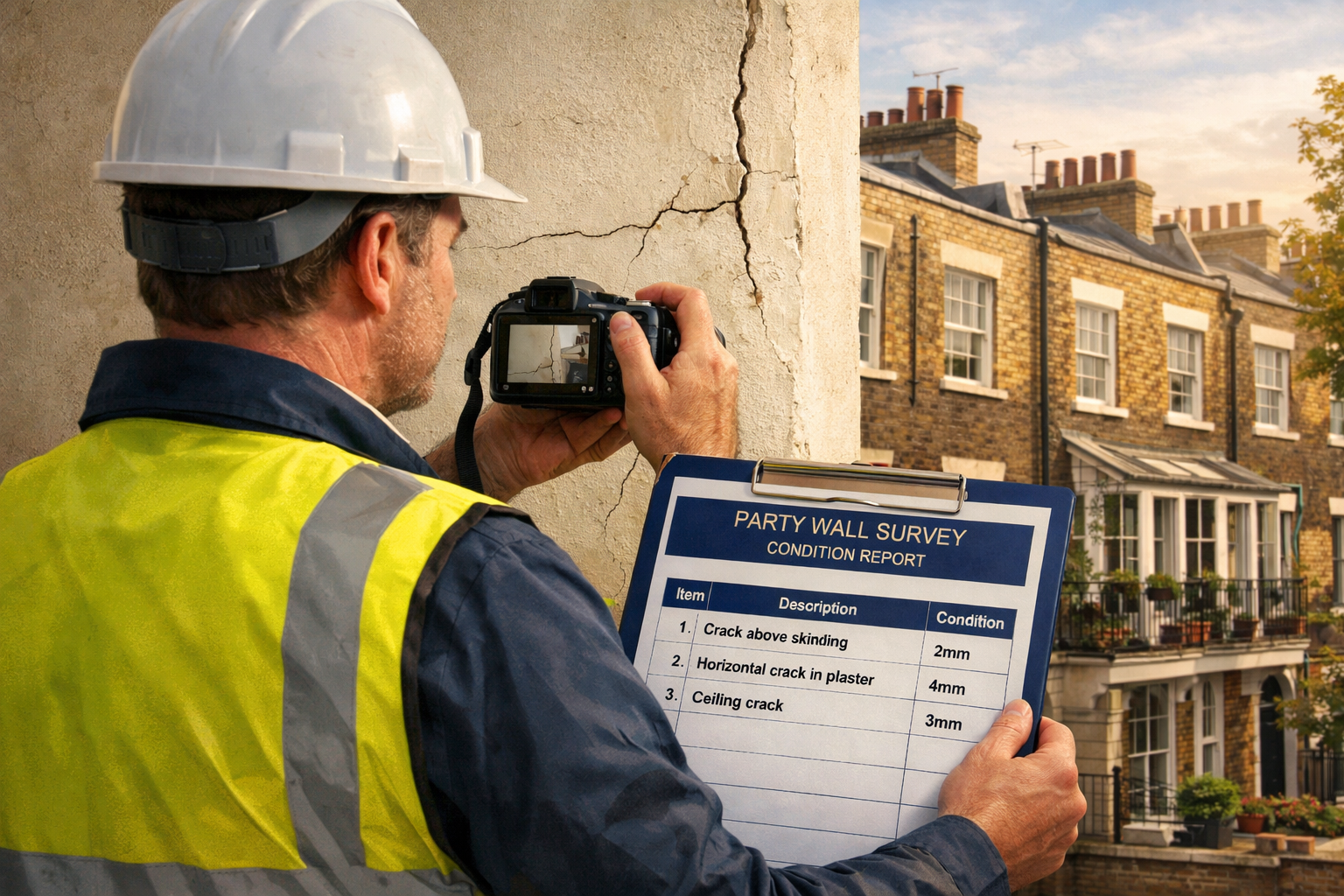
A Schedule of Condition is an expert-prepared document that records the precise state of a property — typically an adjoining owner's property — immediately before construction or renovation works commence. It uses detailed written descriptions, structured tabular records, and photographic evidence to create a factual baseline [1].
Critically, it is not a survey that recommends remedial action. It simply records what is there. This distinction matters enormously in dispute scenarios, because the document acts as neutral, objective evidence rather than a professional opinion on liability [1].
The Legal Framework: Party Wall etc. Act 1996
Under the Party Wall etc. Act 1996, a Schedule of Condition is not a statutory requirement. Either the adjoining owner or the building owner can decline to have one prepared [5]. However, party wall surveyors almost universally recommend it as a matter of best practice — and for good reason.
💬 "A Schedule of Condition protects building owners from false or unscrupulous damage claims by neighbouring property owners, which could otherwise result in thousands of pounds in unwarranted compensation." [1]
When a Party Wall Award is issued, the Schedule of Condition is typically appended to it, giving the document formal legal standing and making it directly enforceable as part of the award process [1].
Who Pays for It?
The cost question depends on whether the adjoining owner has consented to the initial notice:
| Scenario | Who Pays? |
|---|---|
| Adjoining owner dissents → Award issued | Costs included in overall award process (usually paid by building owner) |
| Adjoining owner consents → No award | Building owner must agree to pay separately for the inspection [3] |
Even when consent is given and no formal award is made, carrying out a Schedule of Condition remains strongly advisable to protect the building owner against claims for pre-existing damage [3].
For a full breakdown of costs involved, see this guide on party wall costs and the process.
Core Best Practices for Preparing a Schedule of Condition

The effectiveness of a Schedule of Condition depends entirely on its quality. A poorly prepared document — with blurry photographs, vague descriptions, or incomplete coverage — provides little protection to anyone. The following best practices reflect the current professional standard for schedule preparation in 2026.
1. 📸 Photography Standards: What Good Documentation Looks Like
Photographs form the backbone of any Schedule of Condition. They provide timestamped, visual evidence that is difficult to dispute. Key photography standards include:
- Wide-angle establishing shots to show the overall room or elevation
- Mid-range shots showing specific walls, ceilings, and floor areas
- Close-up detail shots of individual cracks, stains, or defects
- Scale references — a ruler or coin placed beside cracks to indicate size
- Consistent lighting to avoid shadows obscuring defects
- Geotagged and timestamped metadata embedded in image files [7]
Every photograph should be cross-referenced to the written schedule using a numbering system. This allows surveyors and, if necessary, courts to match each written description to its corresponding visual evidence instantly [5].
2. 📝 Structured Written Records: The Three-Column Format
The written component of a Schedule of Condition is typically organised in a table with three columns: 'Item', 'Description', and 'Condition' [5]. A fourth column is sometimes added to reference the relevant photograph numbers.
This format ensures:
- Systematic coverage of every room, wall, ceiling, and floor
- Consistent terminology across the document
- Easy cross-referencing during post-work inspections
Following BRE Digest 251 guidance, crack descriptors are used to classify defects by width and severity — for example, distinguishing hairline cracks (less than 0.1mm) from fine cracks (up to 1mm) and wider structural cracks. This is particularly important because hairline cracks may not be clearly visible in photographs alone, making written description essential [5].
3. 🗺️ Handling Extensive or Complex Defect Areas
In older properties — particularly Victorian and Edwardian terraces common across London — walls may display extensive cracking due to age, settlement, or shrinkage. When individual crack descriptions become impractical, the best approach combines:
- Annotated sketches of the affected area
- General area notes describing the nature and distribution of defects
- Quantity descriptions (e.g., "multiple hairline cracks distributed across approximately 60% of the ceiling surface")
- Additional photographs taken from multiple angles [5]
This layered approach ensures that even complex defect patterns are documented comprehensively, leaving no room for ambiguity in post-work comparisons.
4. 🔍 Scope of Coverage: What to Include
A thorough Schedule of Condition should cover:
- All rooms and spaces in the adjoining property that could be affected by the proposed works
- External elevations facing the construction zone
- The party wall itself, including both faces where accessible
- Existing structural conditions — cracks, bowing, dampness, spalling
- Visible defects in plaster, render, brickwork, and joinery
- Floors, ceilings, and staircases within the zone of influence [4]
The "zone of influence" is determined by the nature of the works. Deep basement excavations, for example, carry a wider zone of influence than a straightforward loft conversion. Understanding types of party wall works helps surveyors calibrate the scope of their inspection appropriately.
5. ⏰ Timing: When to Carry Out the Schedule
The Schedule of Condition must be completed before any works commence — ideally within days of the Party Wall Award being agreed, or immediately after the notice period if consent has been given. Any delay risks the condition of the property changing due to unrelated causes, which undermines the document's reliability as a baseline [6].
How Schedule of Condition Best Practices Protect Adjoining Owners from Wrongful Damage Claims in Party Wall Works
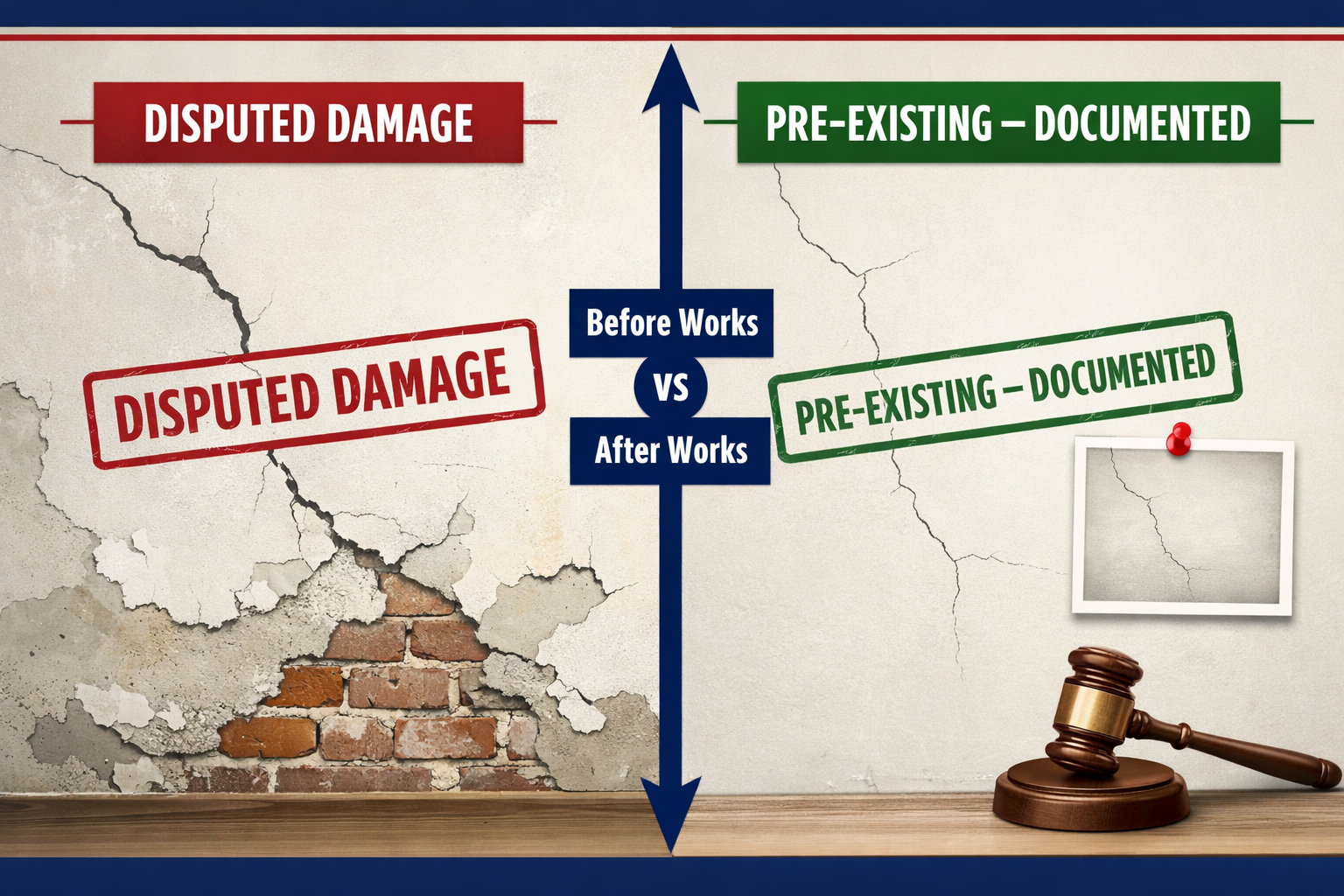
The dual protective function of a Schedule of Condition is one of its most important characteristics. It is not simply a tool for building owners to defend themselves — it is equally valuable for adjoining owners seeking fair compensation when genuine damage occurs.
Protecting Building Owners from False Claims
Without a pre-work record, a building owner faces a significant vulnerability. An adjoining owner may — whether deliberately or in good faith — attribute pre-existing damage to the construction works. This can result in claims for thousands of pounds in compensation for cracks, subsidence, or structural issues that were present long before the first shovel broke ground [1].
A well-prepared Schedule of Condition provides direct, timestamped evidence to disprove such claims. When a surveyor conducts a post-work inspection and compares findings against the pre-work schedule, any alleged "new" damage that was already documented is immediately identifiable as pre-existing [2].
Protecting Adjoining Owners When Genuine Damage Occurs
Conversely, the same document empowers adjoining owners. If construction works cause genuine new damage — a crack that was not present before, a wall that has shifted, a ceiling that has cracked — the Schedule of Condition provides the baseline evidence needed to support a legitimate claim [2].
Without this baseline, an adjoining owner's claim rests on their word against the building owner's. With it, the evidence speaks for itself.
For adjoining owners who are unsure of their rights or next steps, consulting an adjoining owner's surveyor is strongly recommended.
The Role of Party Wall Surveyors in Dispute Resolution
When disputes do arise, party wall surveyors use the Schedule of Condition as a primary reference tool. By cross-referencing pre-work photographs and written descriptions with post-work observations, they can determine with reasonable certainty whether alleged damage is:
- Pre-existing — documented in the schedule, therefore not attributable to the works
- New and potentially caused by the works — absent from the schedule, warranting further investigation
- Ambiguous — requiring additional expert analysis [3]
This structured approach dramatically reduces the time, cost, and acrimony involved in resolving party wall damage disputes.
💬 "Before starting any construction or renovation work, the party performing the work should arrange for a Schedule of Condition report to document the current state of the party wall and adjoining property." [6]
Consent Scenarios and Their Implications
It is worth noting that even when an adjoining owner consents to the party wall notice — meaning no formal award is issued — the protective value of a Schedule of Condition remains fully intact. Many building owners mistakenly assume that consent removes the need for documentation. In fact, consent simply means the formal dispute resolution mechanism is not triggered; it does not eliminate the risk of a damage claim arising later [3].
For those navigating the consent process, this guide on having a party wall agreement without a surveyor provides useful context on the risks involved.
Common Mistakes That Undermine a Schedule of Condition
Even experienced practitioners can fall into traps that reduce a schedule's legal defensibility. The most common errors include:
| ❌ Common Mistake | ✅ Best Practice Alternative |
|---|---|
| Blurry or poorly lit photographs | Use consistent lighting; retake unclear images |
| No scale reference in crack photos | Always include a ruler or coin for scale |
| Incomplete room coverage | Document every room within the zone of influence |
| No cross-referencing between photos and written records | Number all photos and reference them in the written schedule |
| Delayed preparation (after works start) | Complete the schedule before any works commence |
| Vague descriptions ("some cracks visible") | Use BRE Digest 251 crack classifications with measurements |
| Failure to cover external elevations | Include all external faces within the zone of influence |
Integrating the Schedule of Condition into the Party Wall Process
A Schedule of Condition does not exist in isolation. It is one component of a broader party wall process that includes serving party wall notices, negotiating or issuing a Party Wall Award, and managing the works through to completion.
The schedule is most effective when:
- It is commissioned early — as soon as the party wall process is initiated
- It is prepared by a qualified party wall surveyor with experience in condition documentation
- It is formally appended to the Party Wall Award where one is issued [1]
- A post-work inspection is carried out using the same structured methodology, enabling direct comparison
For building owners who are planning works and want to understand their full obligations, the resource on carrying out party wall works is an excellent starting point.
Conclusion: Actionable Next Steps for 2026
The evidence is clear: Schedule of Condition best practices: protecting adjoining owners from wrongful damage claims in party wall works is not a bureaucratic formality — it is a practical, legally defensible safeguard that benefits every party involved in construction near a shared boundary.
Here are the actionable steps to take before any party wall works begin:
- Engage a qualified party wall surveyor as early as possible in the planning process.
- Commission a Schedule of Condition covering all areas within the zone of influence of the proposed works.
- Ensure photography meets professional standards — timestamped, scaled, well-lit, and systematically cross-referenced.
- Use BRE Digest 251 crack classifications in all written descriptions to ensure precision.
- Append the completed schedule to the Party Wall Award where one is issued, or retain it as a standalone document where consent has been given.
- Arrange a post-work inspection using the same surveyor and methodology for direct comparison.
Taking these steps costs a fraction of what a contested damage claim can cost — in money, time, and neighbourly goodwill. In 2026, there is simply no good reason to begin party wall works without this protection in place.
For expert guidance on your specific situation, contact a party wall surveyor to discuss your needs before works commence.
References
[1] Schedule Of Condition – https://westvilleassociates.com/party-wall-surveyor/schedule-of-condition
[2] Schedule Of Condition For Party Wall – https://thepartywallguru.com/schedule-of-condition-for-party-wall/
[3] Schedule Of Condition – https://www.partywall.expert/party-wall-blog/schedule-of-condition/
[4] Schedules Of Condition For Tenants Why They Matter – https://www.adamjoseph.co.uk/schedules-of-condition-for-tenants-why-they-matter
[5] Schedule Of Condition – https://partywall.pro/schedule-of-condition/
[6] Common Party Wall Disputes And How To Resolve Them Effectively – https://www.partywallslimited.com/blog/common-party-wall-disputes-and-how-to-resolve-them-effectively
[7] Schedules Of Condition In Party Wall Disputes Photography Documentation And Evidence Standards For Surveyors – https://nottinghillsurveyors.com/blog/schedules-of-condition-in-party-wall-disputes-photography-documentation-and-evidence-standards-for-surveyors