


Nearly one in three party wall disputes escalates because of a defective notice — not because of the construction work itself. A single missing detail, a wrong date, or an incorrectly identified property can render an entire notice void, expose a building owner to injunction proceedings, and delay a project by months. With RICS launching its draft 8th edition consultation in April 2026 [1], the rules of the game are being sharpened. Understanding drafting flawless party wall notices: avoiding invalidity and injunction risks post-RICS updates has never been more commercially critical.
This guide breaks down the most common notice errors under the Party Wall etc. Act 1996, explains what the 8th edition changes mean in practice, and provides checklists and template guidance to help building owners, surveyors, and legal professionals serve notices that hold up under scrutiny.
Key Takeaways 📋
- Invalid notices carry serious consequences — including injunctions, project delays, and cost overruns.
- RICS's draft 8th edition (consultation launched April 2026) strengthens guidance on notice service, competence, and Third Surveyor procedures. [1][2]
- Three notice types exist under the Act — each with distinct content, timing, and service requirements.
- A surveyor checklist is the most reliable tool for ensuring notice validity before service.
- Post-RICS updates, practitioners must align their letters of appointment and notice templates with revised conduct standards. [2]
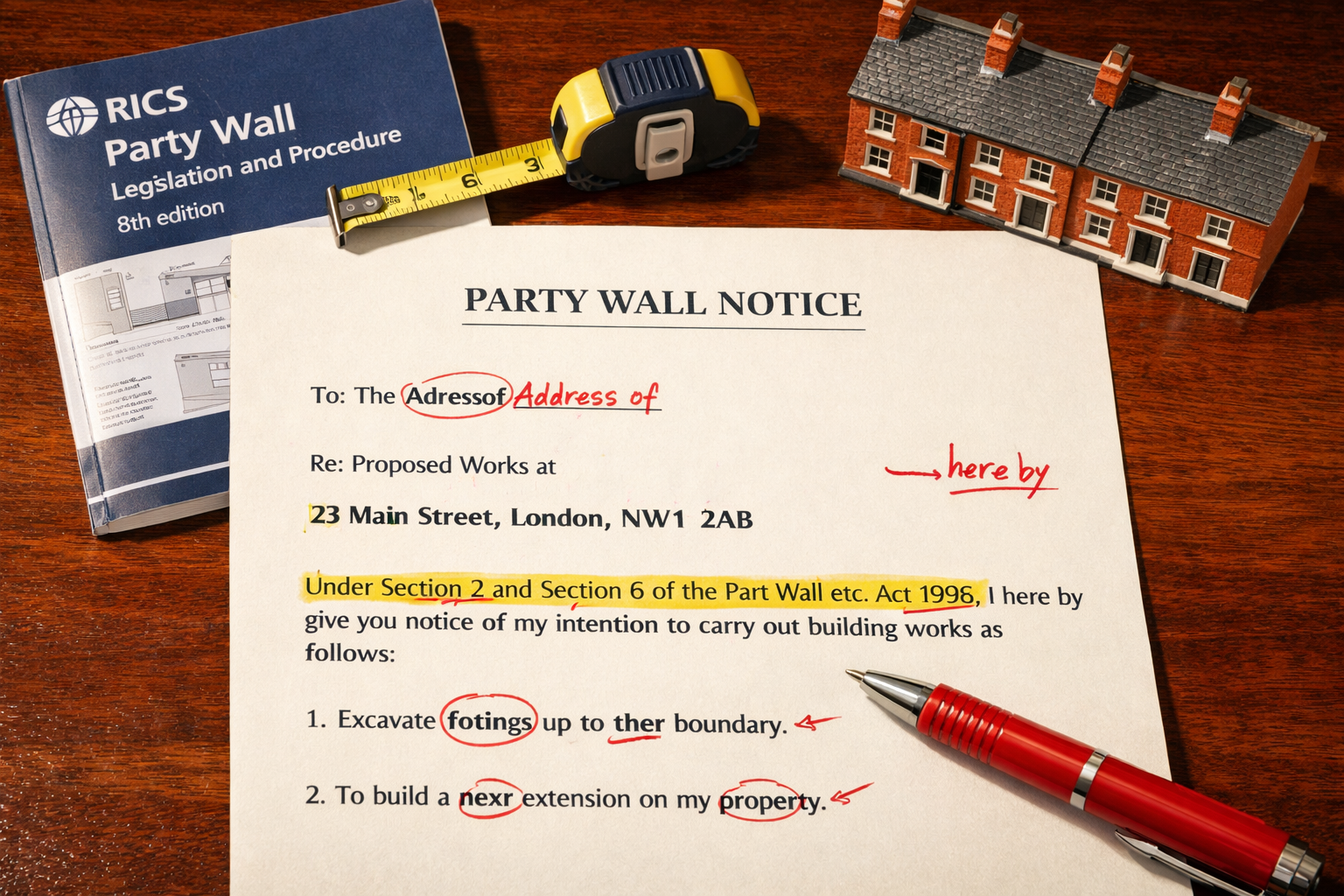
What Makes a Party Wall Notice Invalid? The Core Risks Explained
Before exploring the post-RICS landscape, it is essential to understand the foundational reasons why notices fail. A notice under the Party Wall etc. Act 1996 is a statutory document. Courts treat defective notices seriously — and adjoining owners can challenge them at any stage.
The Three Notice Types and Their Requirements
There are three distinct notice types, each governed by specific statutory requirements:
| Notice Type | Trigger | Minimum Notice Period |
|---|---|---|
| Party Structure Notice | Works to a shared wall or structure | 2 months |
| Line of Junction Notice | Building a new wall at or astride the boundary | 1 month |
| Three-Metre / Six-Metre Notice | Excavation near a neighbouring building | 1 month |
Each notice must contain:
- ✅ Full name and address of the building owner
- ✅ Full name and address of the adjoining owner
- ✅ A clear description of the proposed works
- ✅ The intended start date of works
- ✅ Reference to the Party Wall etc. Act 1996
- ✅ Correct service method (personal delivery, recorded post, or affixing to the property)
Missing any of these elements can invalidate the notice entirely. For a deeper look at what each notice covers, see this guide to party wall notices and how to respond.
The Most Common Drafting Errors 🚨
Based on case law and surveyor practice, the following errors appear most frequently:
- Wrong adjoining owner named — particularly in leasehold properties where both freeholder and leaseholder may need to be served.
- Vague description of works — phrases like "general building works" are insufficient; the notice must describe the specific nature of the works.
- Incorrect start date — the notice period must be calculated correctly from the date of service, not the date of drafting.
- Failure to serve all affected parties — where multiple adjoining owners exist, each must receive a separate notice.
- Wrong notice type used — serving a Party Structure Notice for excavation works, for example, creates a statutory gap.
- Defective service method — email is not a valid service method unless the adjoining owner has explicitly consented in writing.
💬 "A notice that is technically served but legally defective is arguably worse than no notice at all — it creates a false sense of compliance while leaving the building owner fully exposed."
How the RICS Draft 8th Edition Changes the Drafting Landscape
In April 2026, RICS launched a formal consultation on the draft 8th edition of Party Wall Legislation and Procedure, replacing the 7th edition that has guided practitioners for years. [1] The consultation ran for approximately eight weeks, targeting surveyors, legal professionals, and dispute resolution practitioners — precisely the people who deal with invalid notices and injunction risks daily. [1]
What the 8th Edition Introduces
The draft 8th edition is not a minor revision. Key changes relevant to notice drafting include:
1. Strengthened Guidance on Service of Notices [2]
The updated guidance specifically tightens the rules around how notices are served, to whom, and in what form. This directly addresses the grey areas that have historically allowed defective notices to slip through.
2. Revised Letters of Appointment and Terms [2]
New template letters of appointment are designed to support competence and consistency. For practitioners, this means notice templates must now align with updated appointment terms — a disconnect between the two can create procedural vulnerabilities.
3. Enhanced Third Surveyor Procedures [2]
The draft includes updated guidance on Third Surveyor use, which is relevant because disputes arising from defective notices often escalate to Third Surveyor referral. Better-defined procedures reduce ambiguity at this stage.
4. Regulatory and Conduct Matters [2]
A revised section on regulatory conduct raises the bar for how surveyors demonstrate competence. Post-update, a surveyor who serves a defective notice may face professional conduct scrutiny, not just civil liability.
What This Means for Building Owners
For building owners, the 8th edition signals that the tolerance for procedural shortcuts is shrinking. Surveyors operating under updated RICS guidance will be expected to apply higher standards — which benefits compliant building owners but creates greater exposure for those who attempt DIY notice service without professional support.
Understanding the types of party wall works that trigger notice obligations is the essential first step before any notice is drafted.
The Injunction Risk: When a Bad Notice Becomes a Legal Crisis
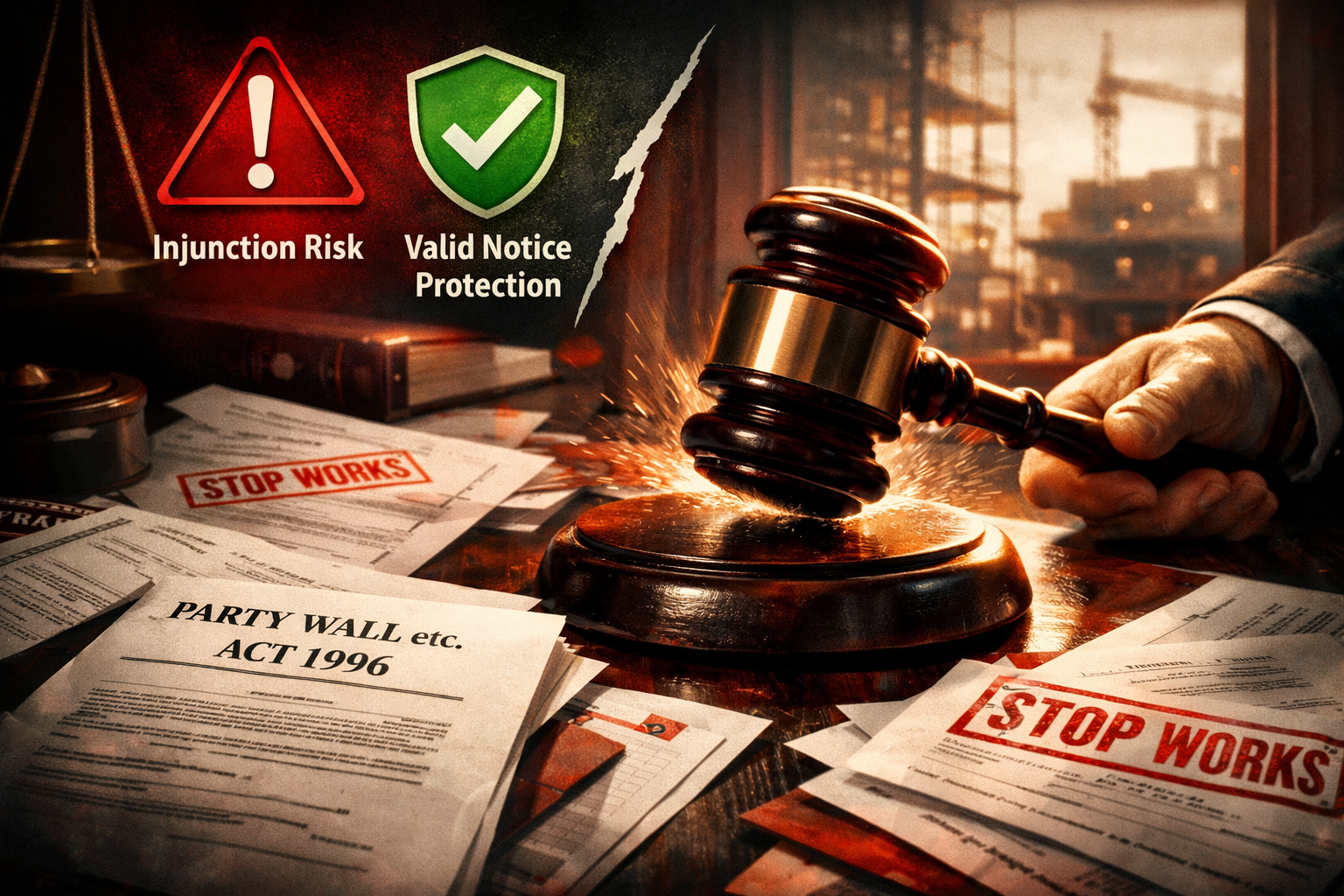
The consequences of serving an invalid party wall notice extend far beyond a simple administrative correction. An adjoining owner who discovers a defective notice has legal standing to seek an injunction to halt works — and courts have granted such orders even after construction has begun.
How Injunctions Arise from Notice Defects
The sequence typically unfolds as follows:
- Building owner serves a defective notice (or no notice at all).
- Works commence, either during or after the notice period.
- Adjoining owner discovers the defect — often through a surveyor they appoint.
- Adjoining owner applies to court for an injunction to stop works.
- Court grants interim injunction pending resolution.
- Building owner faces legal costs, contractor standing-time costs, and project delays — often running to tens of thousands of pounds.
The key legal principle is that the Act creates a statutory right for adjoining owners. Courts take breaches seriously precisely because Parliament designed the Act to protect both parties. A defective notice is treated as a failure to engage the statutory process at all.
The Three-Metre and Six-Metre Excavation Trap
One of the most frequently overlooked notice obligations involves excavation. Under Section 6 of the Act, if works involve excavating within 3 metres of an adjoining structure to a depth lower than its foundations, or within 6 metres under a 45-degree line, a notice is required. Many building owners — and some less experienced surveyors — miss this entirely when planning basement extensions or deep drainage works.
For adjoining owners who believe works are being carried out without proper notice, this resource on what to do when a neighbour is carrying out works explains the available options clearly.
A Surveyor's Checklist for Drafting Flawless Party Wall Notices Post-RICS Updates
Drafting flawless party wall notices and avoiding invalidity and injunction risks post-RICS updates requires a systematic approach. The checklist below reflects both the statutory requirements of the Act and the updated standards signalled by the RICS draft 8th edition.
Pre-Drafting Checklist ✅
- Confirm the correct notice type required for the proposed works
- Identify all adjoining owners — check Land Registry for freeholders and leaseholders
- Confirm the correct legal name of each adjoining owner
- Verify the property address matches the Land Registry title
- Calculate the correct notice period from the intended service date
- Confirm the intended start date is realistic and compliant
Drafting Checklist ✅
- Include the full name and address of the building owner
- Include the full name and address of each adjoining owner
- Provide a specific, detailed description of the works (reference drawings where possible)
- State the intended start date clearly
- Reference the Party Wall etc. Act 1996 explicitly
- Use the correct statutory form where prescribed by the Act
- Attach or reference any drawings or plans that clarify the scope of works
Service Checklist ✅
- Serve by hand delivery, recorded post, or affixing to the property (if owner cannot be found)
- Do not rely on email unless written consent to electronic service has been obtained
- Keep a proof of service record — signed receipt, postal tracking, or witnessed affixing
- Note the date of service accurately for calculating the response period
- Serve separate notices to each adjoining owner where multiple parties are affected
For building owners managing this process themselves, a sample party wall agreement template can provide a useful starting point — though professional review is strongly recommended.
Consent, Dissent, and What Happens Next
Once a valid notice is served, the adjoining owner has 14 days to respond. Three outcomes are possible:
| Response | Outcome |
|---|---|
| Consent in writing | Works may proceed under agreed conditions |
| Dissent — appointing a surveyor | Dispute resolution process begins; a Party Wall Award is produced |
| No response within 14 days | Deemed dissent; surveyor appointment process is triggered |
A deemed dissent — where the adjoining owner simply ignores the notice — is one of the most misunderstood outcomes. Building owners sometimes interpret silence as consent. It is not. Proceeding on that basis risks the same injunction exposure as serving no notice at all.
The Role of the Party Wall Award
Where dissent occurs, the surveyors appointed by each party (or a single agreed surveyor) produce a Party Wall Award. This document governs how the works are carried out, protects both parties, and is legally binding. Understanding the party wall award process in advance helps building owners plan realistic project timelines.
A Schedule of Condition is typically prepared before works begin, recording the pre-existing state of the adjoining property. This protects the building owner from inflated damage claims later. Learn more about the schedule of condition process and why it matters.
Practical Template Guidance: What a Valid Notice Looks Like
While every notice must be tailored to the specific works and parties involved, a valid Party Structure Notice will typically follow this structure:
PARTY STRUCTURE NOTICE
(Party Wall etc. Act 1996 — Section 3)
To: [Full name of Adjoining Owner]
Of: [Full address of adjoining property]
From: [Full name of Building Owner]
Of: [Full address of building owner]
Property where works are proposed: [Full address]
Description of proposed works:
[Specific, detailed description — e.g., "Removal and rebuilding of the party wall between [address] and [address] to a height of [X] metres, including insertion of steel beam at first-floor level as shown on the attached drawings prepared by [architect name], dated [date]."]
Intended start date of works: [Date — must be at least 2 months from service of this notice]
This notice is served pursuant to Section 3 of the Party Wall etc. Act 1996.
Signed: ___________________
Date of service: [Date]
This structure ensures all statutory requirements are met. For works involving excavation near boundaries, a different form is required — and the Party Structure Notice guide for London properties provides jurisdiction-specific detail.
Conclusion: Act Now to Protect Your Project
The cost of getting a party wall notice wrong is not abstract — it is measured in injunctions, legal fees, contractor delays, and damaged neighbour relationships. With RICS tightening its guidance through the draft 8th edition consultation in 2026 [1][2], the professional standard for notice drafting and service is rising. Building owners and surveyors who align their practice with these updated standards will be better protected; those who do not face growing exposure.
Actionable Next Steps 🚀
- Audit your current notice templates against the checklist in this article before serving any new notices.
- Identify all adjoining owners via Land Registry — do not assume one notice covers all affected parties.
- Engage a qualified party wall surveyor early in the project planning phase, not as an afterthought.
- Monitor the RICS 8th edition finalisation and update your practice templates when the final guidance is published.
- Never rely on email service unless written consent to electronic service is confirmed in advance.
- Commission a Schedule of Condition before works begin to protect against future damage claims.
Whether planning a loft conversion, basement extension, or structural alteration to a shared wall, the foundation of a smooth project is a notice that is served correctly, on time, and in full compliance with the Act. There are no shortcuts worth taking.
References
[1] Rics Launches Consultation On Updated Party Wall Practice Guidance – https://www.rics.org/news-insights/rics-launches-consultation-on-updated-party-wall-practice-guidance
[2] Rics Launches Consultation On Party Wall Guidance – https://thenegotiator.co.uk/news/regulation-law-news/rics-launches-consultation-on-party-wall-guidance/
