
Nearly one in three party wall awards challenged in recent years has involved a defect traceable back to the original notice — a flawed description of works, a missed service deadline, or a surveyor acting without proper jurisdiction. With RICS now consulting on its Draft 8th Edition Party Wall Practice Guidance through April and May 2026 [1], building owners, surveyors, and legal professionals face a pivotal moment: update your notice procedures now, or risk invalidity on live projects.
This article breaks down what the RICS Draft 8th Edition changes mean for updating party wall notices for RICS Draft 8th Edition: avoiding invalidity in 2026 projects — covering revised templates, common pitfalls, and surveyor-vetted wording that keeps your project on solid legal ground.
Key Takeaways 📋
- The RICS Draft 8th Edition replaces the 7th Edition and is currently open for stakeholder consultation through May 2026 [1]
- Updated guidance strengthens rules on notice service procedures, fee practices, and surveyor independence [1]
- Awards can be challenged — and invalidated — when no genuine dispute existed or when surveyors lacked proper jurisdiction [2]
- Revised appendices include updated notice templates, letters of appointment, and a new draft award template [2]
- Building owners should review and update their notice wording before serving on adjoining owners to avoid costly delays
What the RICS Draft 8th Edition Actually Changes
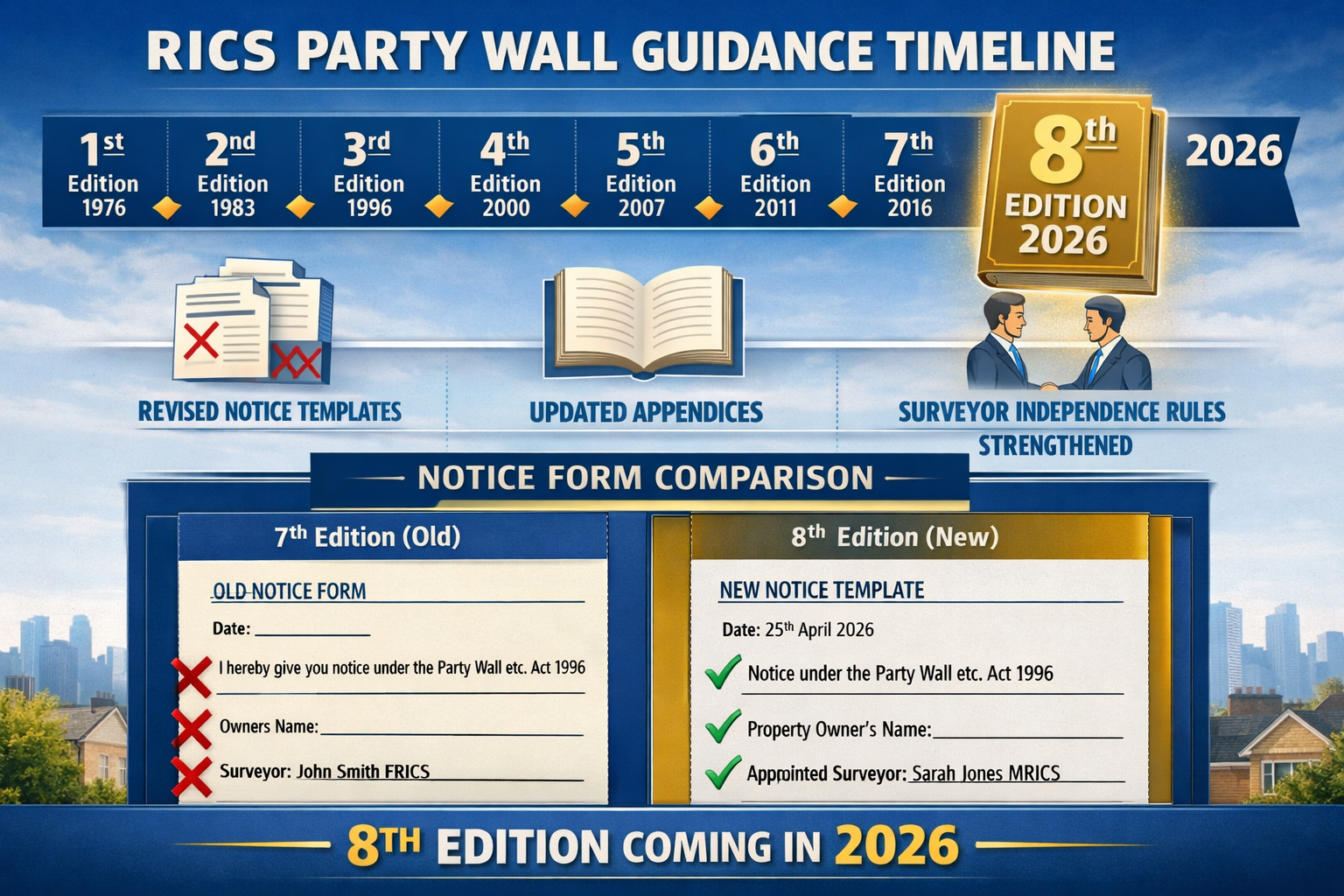
From 7th to 8th Edition: A Necessary Evolution
The RICS Party Wall Practice Guidance has been the professional benchmark for surveyors accepting instructions under the Party Wall etc. Act 1996 since its first publication. The forthcoming 8th Edition is not a minor refresh — it is a substantive rewrite designed to address real-world failures that have emerged over years of practice [1].
The consultation, running through April and May 2026, invites feedback from surveyors, legal professionals, dispute resolution practitioners, and other stakeholders across England and Wales [1][3]. This broad input signals that the final guidance will reflect genuine industry consensus rather than a top-down revision.
💡 Pull Quote: "The draft 8th edition provides updated best-practice support for RICS members accepting instructions where the Party Wall etc. Act 1996 may apply." — RICS [1]
Key structural changes in the draft include:
| Area of Change | 7th Edition | Draft 8th Edition |
|---|---|---|
| Notice templates | Basic appendices | Enhanced appendices with revised wording |
| Letters of appointment | Standard format | Revised terms and conditions |
| Award template | Existing format | Updated draft award template [2] |
| Surveyor independence | Guidance only | Strengthened statutory clarity [2] |
| Fee practices | Limited guidance | Explicit regulatory provisions [1] |
| Third Surveyor use | Referenced | Strengthened procedural guidance [1] |
Strengthened Surveyor Independence: Why It Matters for Notice Validity
One of the most consequential changes in the draft concerns surveyor independence. The new guidance makes explicit that party wall surveyors' appointments are personal and statutory — meaning they must act independently of client instruction [2].
This matters directly for notice validity. When a surveyor acts outside their jurisdiction, or when an award is made in the absence of a genuine dispute, the entire process — including the underlying notice — becomes vulnerable to legal challenge [2]. Building owners who assume their surveyor will "sort it out" are exposed if that surveyor has been directed rather than instructed.
For those carrying out works as building owners, understanding this distinction is essential before the first notice is even drafted.
Common Notice Pitfalls Fixed by the Draft 8th Edition Updates
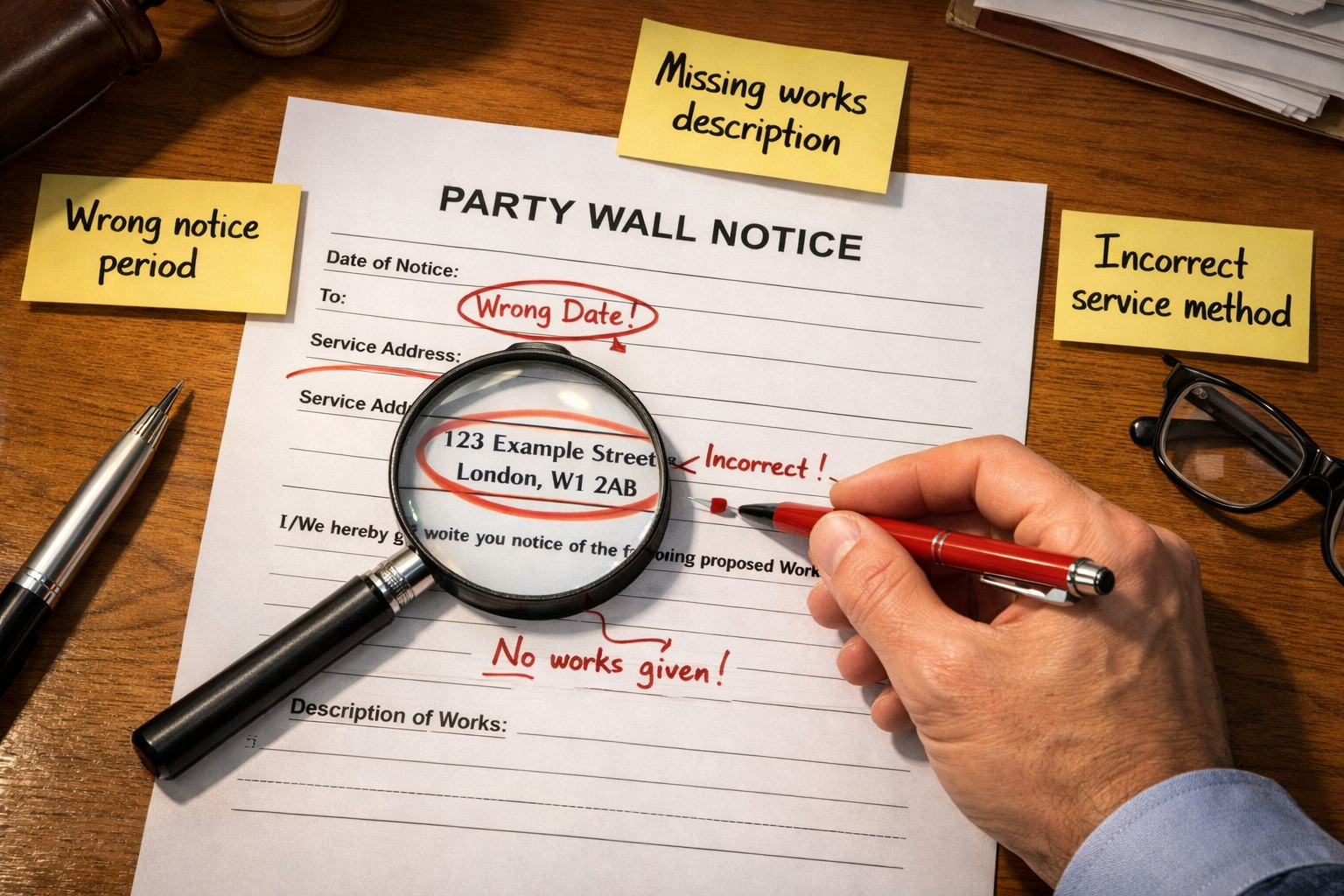
The Five Most Frequent Causes of Notice Invalidity
Before examining what the updated guidance fixes, it helps to understand what breaks notices in practice. Based on case law and professional experience, these are the most common invalidity triggers:
1. Inadequate Description of Proposed Works ⚠️
A notice that describes works vaguely — "general building works" or "loft conversion" — fails to give the adjoining owner sufficient information to assess the impact. The Act requires enough detail for a reasonable person to understand what is proposed.
2. Incorrect Notice Period ⏰
- Party Structure Notice: Minimum 2 months before works begin
- Line of Junction Notice: Minimum 1 month before works begin
- Three-Metre / Six-Metre Notice: Minimum 1 month before works begin
Serving a notice with the wrong lead time is a procedural defect that can invalidate the entire process. Learn more about what party wall notices are and how to respond to understand the full service framework.
3. Wrong Service Method 📬
The Act permits service by hand, by post (recorded or otherwise), or by leaving at the last known address. Serving by email alone — without prior written agreement — has been held insufficient in several disputes. The Draft 8th Edition's strengthened guidance on service of notices as a key regulatory matter [1] is expected to provide clearer rules here.
4. Missing or Incorrect Party Details
Notices must correctly identify both the building owner and the adjoining owner. Errors in ownership details — particularly common where properties are held in trust, by companies, or through recent conveyancing — can render a notice defective.
5. No Genuine Dispute Preceding the Award
The Draft 8th Edition specifically addresses awards challenged when no genuine dispute existed between parties [2]. If an adjoining owner consents but a surveyor proceeds to make an award regardless, that award is vulnerable. The notice process must reflect the actual procedural posture of the parties.
Surveyor-Vetted Wording: What Good Notice Language Looks Like
The following examples illustrate the difference between weak and robust notice wording, aligned with the principles emerging from the Draft 8th Edition:
❌ Weak wording (common pitfall):
"The building owner intends to carry out works to the party wall including structural alterations."
✅ Stronger wording (Draft 8th Edition aligned):
"The building owner intends to carry out works pursuant to Section 2(2)(a) of the Party Wall etc. Act 1996, namely: cutting into the party wall at first floor level to insert a steel beam measuring approximately [X]mm, at a height of approximately [X]mm above finished floor level, to support the proposed rear extension as shown on the attached drawings [Drawing Ref: XX/XX/XX]."
The difference is specificity. The adjoining owner needs to understand what, where, and at what level the works will occur. Attaching drawings — and referencing them explicitly in the notice — is best practice under both current guidance and the emerging 8th Edition standards.
For a Party Structure Notice specifically, the description must also reference the relevant section of the Act under which the notice is served.
Updated Appendices: What to Expect in the Final Guidance
The Draft 8th Edition includes enhanced appendices with revised letters of appointment, updated terms, and a new draft award template [2]. While the full text remains in consultation, practitioners should anticipate:
- Revised notice pro-forma templates with clearer fields for works description, drawings references, and service details
- Updated consent and dissent response forms aligned with the revised notice templates
- New appointment letters that reinforce the surveyor's statutory independence from the outset
Building owners and surveyors should not wait for the final publication to begin updating their internal templates. The direction of travel is clear, and notices served in 2026 should already reflect these principles.
Practical Steps for Avoiding Invalidity in 2026 Projects
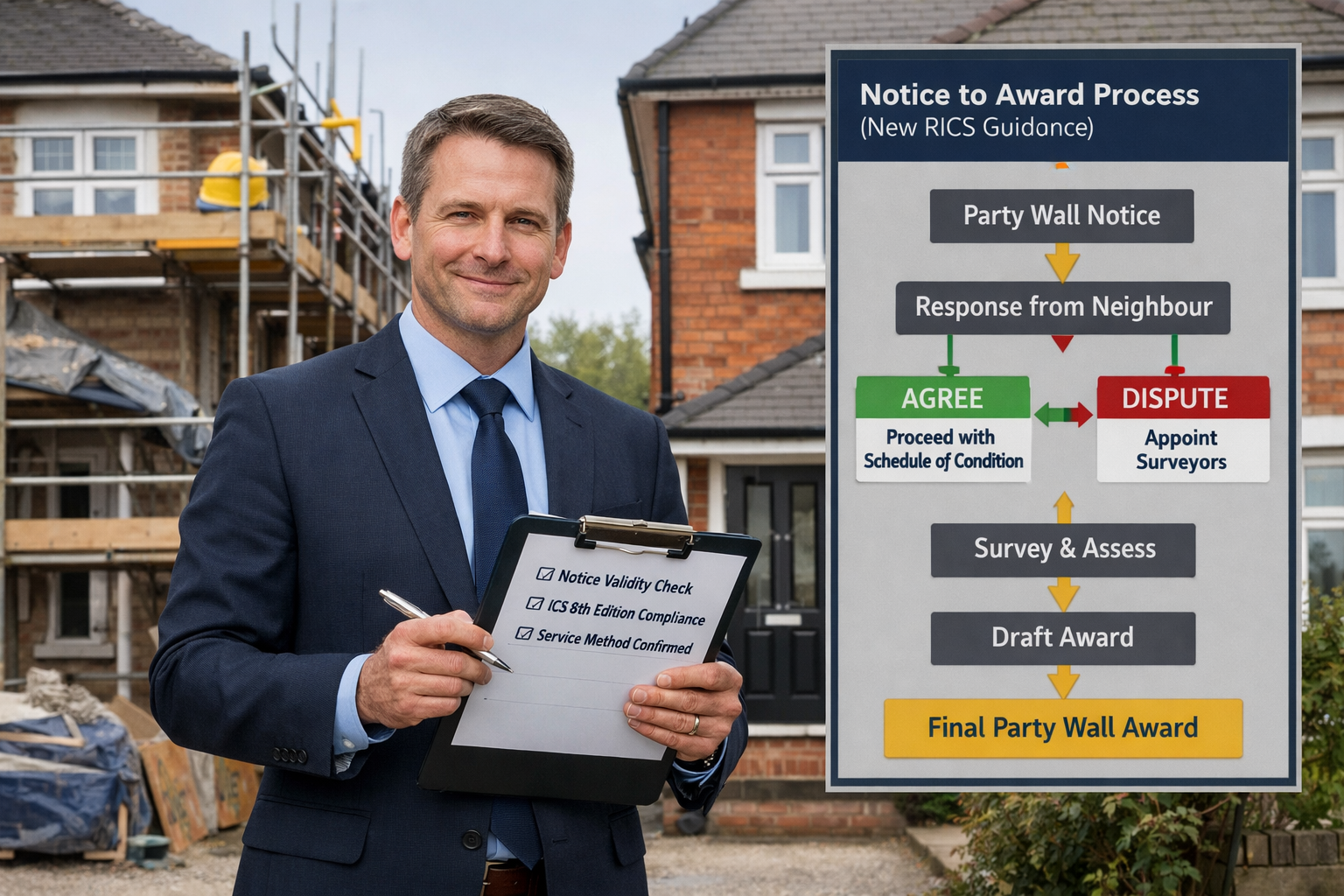
Updating Party Wall Notices for RICS Draft 8th Edition: A 2026 Compliance Checklist
Whether managing a single residential extension or a complex mixed-use development, the following checklist helps ensure notices align with the Draft 8th Edition's emerging standards:
Before Drafting the Notice:
- Confirm ownership details for all adjoining properties (Land Registry search recommended)
- Identify the correct notice type(s) required — explore the types of party wall works to confirm which sections of the Act apply
- Prepare scaled drawings showing the proposed works in sufficient detail
- Confirm the correct notice period for each notice type
When Drafting the Notice:
- Reference the specific section(s) of the Act under which the notice is served
- Describe works with precision: location, method, materials, dimensions
- Attach and reference all relevant drawings
- Include the building owner's full name, address, and contact details
- Include the adjoining owner's correct full name and service address
When Serving the Notice:
- Use a permitted service method (hand delivery, post, or agreed electronic means)
- Retain proof of service (recorded delivery receipt, signed acknowledgement)
- Diarise the response deadline (14 days from service)
- Note the works commencement date to confirm the notice period is satisfied
After Service:
- If consent is given, confirm in writing and retain documentation
- If dissent is given or no response received, appoint surveyors promptly
- Ensure appointed surveyor(s) understand their statutory independence obligations [2]
The Invalidity Risk: When Awards Get Challenged
Understanding the invalidity risk is not scaremongering — it is risk management. Courts have set aside party wall awards on multiple grounds, including:
- Jurisdictional defect: The surveyor acted without a valid notice triggering their appointment
- No genuine dispute: An award was made when the adjoining owner had in fact consented [2]
- Procedural irregularity: The Third Surveyor was not properly appointed or consulted
The Draft 8th Edition's strengthened provisions on the use of the Third Surveyor [1] are particularly relevant here. Where disputes arise between the two appointed surveyors, the Third Surveyor's role is critical — and any procedural misstep in their appointment can cascade back to invalidate the award itself.
For adjoining owners concerned about a neighbour's works, understanding your rights as an adjoining owner is equally important.
Cost Implications of Getting Notices Wrong
Invalid notices do not just cause legal headaches — they cost money. A notice that must be re-served restarts the clock on the minimum notice period, potentially delaying a project by two months or more. Where a contractor is already mobilised, that delay can translate directly into abortive costs, extended preliminaries, and contractual penalties.
The costs of the party wall process are already significant; adding avoidable invalidity costs is a poor return on what is often a straightforward administrative step.
💡 Pull Quote: "A two-month delay caused by a defective notice can cost more than the entire party wall surveyor's fee — and it is entirely avoidable with correct drafting."
What the Consultation Process Means for 2026 Projects
The consultation running through May 2026 invites input from surveyors, legal professionals, and dispute resolution practitioners [3]. The final 8th Edition guidance will incorporate this feedback before publication.
For building owners and project managers with works planned for late 2026 or early 2027, this creates a practical window:
- Serve notices now using principles already established in the draft — do not wait for final publication
- Engage a surveyor who is actively following the consultation and updating their practice accordingly
- Review existing notice templates against the draft's enhanced appendix framework [2]
- Document everything — the draft's emphasis on public engagement and transparency [1] signals that procedural records will matter more, not less
For projects in specific London areas, local expertise matters. Whether working in North London, South London, or Central London, the density of party wall situations means that notice errors surface quickly and disputes escalate fast.
A Note on Party Wall Awards and the Notice Foundation
Every party wall award rests on the foundation of a valid notice. If that foundation is cracked, the award built on top of it is at risk. The Draft 8th Edition's focus on notice service procedures as a key regulatory matter [1] reflects an industry-wide recognition that this foundational step has been treated too casually.
The revised award template included in the enhanced appendices [2] is expected to include clearer recitals of the notice served, the parties' responses, and the basis of the surveyors' jurisdiction — all of which reinforce the importance of getting the notice right from the start.
Conclusion: Act Now, Not After Publication
The RICS Draft 8th Edition Party Wall Practice Guidance is not yet final, but its direction is clear. Updating party wall notices for RICS Draft 8th Edition: avoiding invalidity in 2026 projects is not a future task — it is an immediate priority for anyone serving notices or advising clients on party wall matters this year.
Actionable Next Steps ✅
- Audit your current notice templates against the five invalidity triggers identified above — fix deficient descriptions, check notice periods, and confirm service methods
- Brief your appointed surveyor on the Draft 8th Edition's emphasis on statutory independence and jurisdictional clarity [2]
- Download and review the RICS consultation draft directly from the RICS website to understand the enhanced appendices before they are finalised [1]
- Serve notices with precision — attach drawings, reference Act sections, and retain proof of service
- Engage early with adjoining owners to establish whether genuine consent or dissent exists, avoiding the invalidity trap of awards made without a real dispute [2]
- Consult a qualified party wall surveyor familiar with the Draft 8th Edition principles before serving any notice on a complex or high-value project
The window between now and the final publication of the 8th Edition is an opportunity, not a reason to wait. Projects served with notices that already reflect the draft's principles will be better protected — and better positioned — when the final guidance lands.
References
[1] RICS Launches Consultation on Updated Party Wall Practice Guidance – https://www.rics.org/news-insights/rics-launches-consultation-on-updated-party-wall-practice-guidance
[2] RICS Opens Consultation on Party Wall Guidance Update – https://www.propertywire.com/news/uk/rics-opens-consultation-on-party-wall-guidance-update/
[3] RICS Launches Consultation on Party Wall Guidance – https://thenegotiator.co.uk/news/regulation-law-news/rics-launches-consultation-on-party-wall-guidance/