


Nearly one in three party wall disputes that escalate to formal compensation claims in the UK could be avoided entirely with a properly prepared Schedule of Condition — yet thousands of property owners still proceed without one. In 2026, with RICS actively consulting on the draft 8th edition of its Party Wall Legislation and Procedure guidance [1], the standards for Schedules of Condition in Party Wall Awards: RICS-Updated Templates for 2026 Damage Defense have never been more relevant or more rigorously defined. Whether carrying out a basement excavation, a loft conversion, or a rear extension, understanding how these documents work — and how the latest RICS templates strengthen damage defense — is essential for both building owners and their neighbours.
Key Takeaways 📋
- A Schedule of Condition is the single most powerful document for defending against false or exaggerated post-construction damage claims.
- RICS launched a consultation in April–May 2026 on the draft 8th edition of its party wall practice guidance, introducing enhanced appendices for digital schedules and photography best practices [1].
- The current published standard (May 2023) already sets a high bar for photographic evidence, written condition records, and surveyor methodology [2].
- A well-executed schedule delivers measurable ROI by eliminating unsubstantiated claims that can cost property owners tens of thousands of pounds.
- Digital templates with geo-tagged photography and timestamped metadata are rapidly becoming the professional standard in 2026.
What Is a Schedule of Condition and Why Does It Matter?
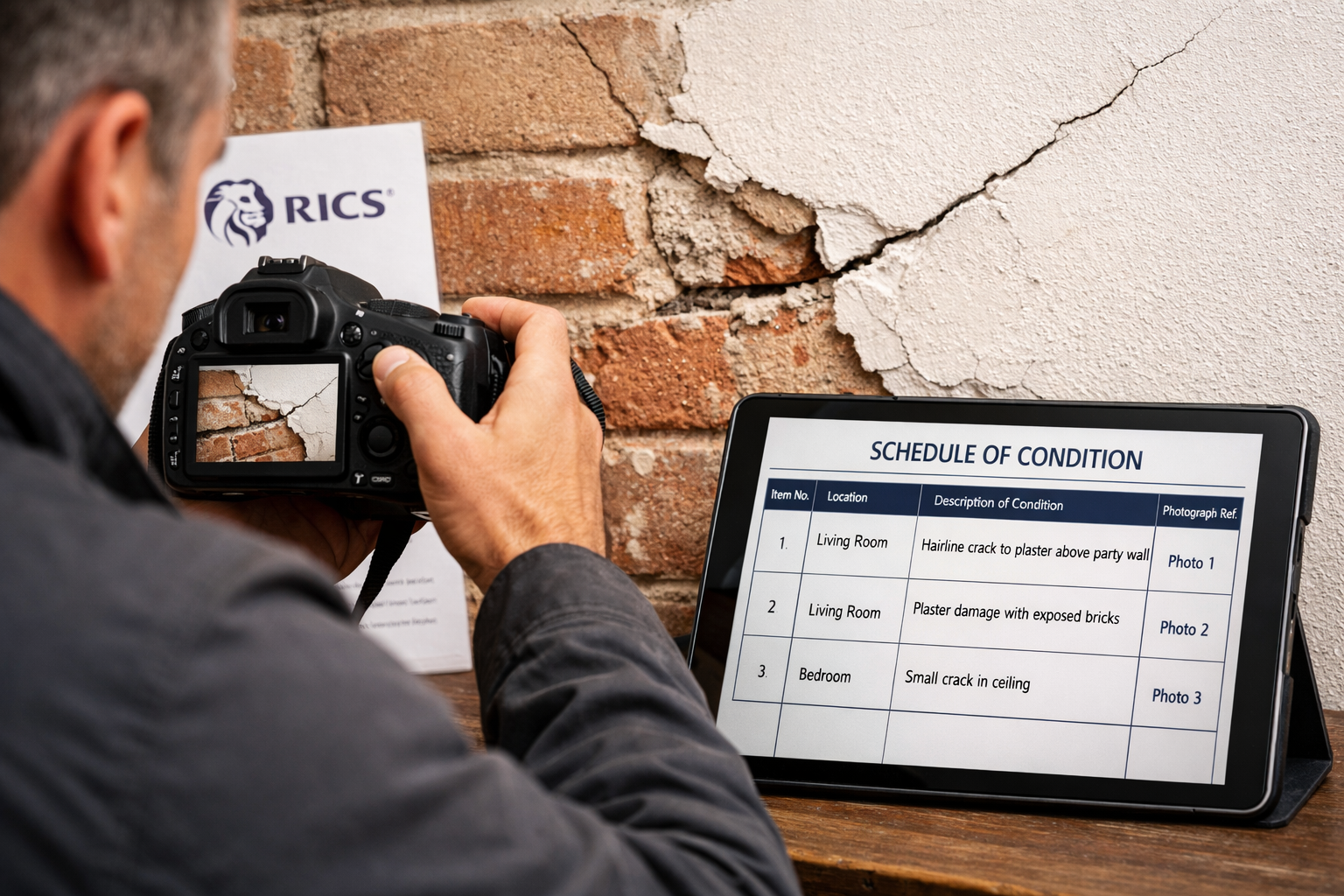
A Schedule of Condition is a formal, surveyor-prepared record of the existing state of an adjoining owner's property before any notifiable works begin under the Party Wall etc. Act 1996. It typically forms an appendix to the Party Wall Award — the legally binding document that governs how construction works must be carried out.
The schedule captures:
- Structural condition: cracks, settlement, subsidence, bulging
- Decorative condition: plaster finishes, paintwork, wallpaper, tiling
- External condition: brickwork, pointing, render, guttering
- Drainage and ground-level features: paths, patios, garden walls
Without this baseline record, any crack or defect that appears after construction — whether caused by the works or pre-existing — becomes a matter of dispute. The neighbour may claim compensation; the building owner has no evidence to refute it. That is an expensive position to be in.
💬 "A Schedule of Condition is not a formality — it is an insurance policy written in photographs and words."
The RICS Framework: From the 2023 Standard to the 2026 Draft Consultation
The Current Professional Standard (May 2023)
The RICS Party Wall Legislation and Procedure professional standard, reissued in May 2023, sets out mandatory and recommended practice for surveyors operating under the Party Wall etc. Act 1996 [2]. This standard establishes the methodological baseline that all RICS-registered surveyors must follow when preparing schedules, including:
- Systematic room-by-room inspection methodology
- Photographic evidence requirements
- Written condition descriptions using standardised language
- Appending schedules to Awards as binding documents
The 2023 standard represented a significant step forward from previous guidance, particularly in clarifying the surveyor's duty of impartiality and the evidential weight that schedules carry in subsequent disputes [2].
What the 2026 Draft Consultation Adds 🔍
In April and May 2026, RICS launched a consultation on the draft 8th edition of its party wall practice guidance, inviting feedback from surveyors, legal professionals, and dispute resolution practitioners [1]. The draft introduces several notable enhancements directly relevant to schedules of condition:
1. Enhanced Digital Schedule Appendices
The draft 8th edition includes new appendices specifically designed for digital schedule formats. These templates accommodate embedded high-resolution photographs, hyperlinked condition notes, and structured data fields that can be exported for use in dispute resolution proceedings.
2. Photography Best Practices Guidance
For the first time, the RICS guidance is expected to include dedicated photography protocols, covering:
| Photography Requirement | Detail |
|---|---|
| Resolution | Minimum 12 megapixels per image |
| Geo-tagging | GPS coordinates embedded in EXIF metadata |
| Timestamps | Automatic date/time stamping mandatory |
| Lighting | Supplemental lighting required for internal cracks |
| Scale reference | Measurement scale visible in all crack photographs |
| Panoramic context | Wide-angle room shots before close-up detail |
3. Standardised Condition Rating Scales
The draft introduces a colour-coded, five-tier condition rating system (from Condition 1: Good through to Condition 5: Critical), replacing the previously inconsistent narrative-only descriptions.
4. Digital Signature and Chain of Custody
Digital schedules prepared under the new templates must include a verifiable digital signature trail, ensuring the document cannot be altered after the inspection date [1].
These updates reflect the broader shift in the UK construction sector towards digital record-keeping, particularly as the 2026 construction boom drives higher volumes of party wall activity in high-demand housing markets [3].
How Schedules of Condition Integrate Into Party Wall Awards
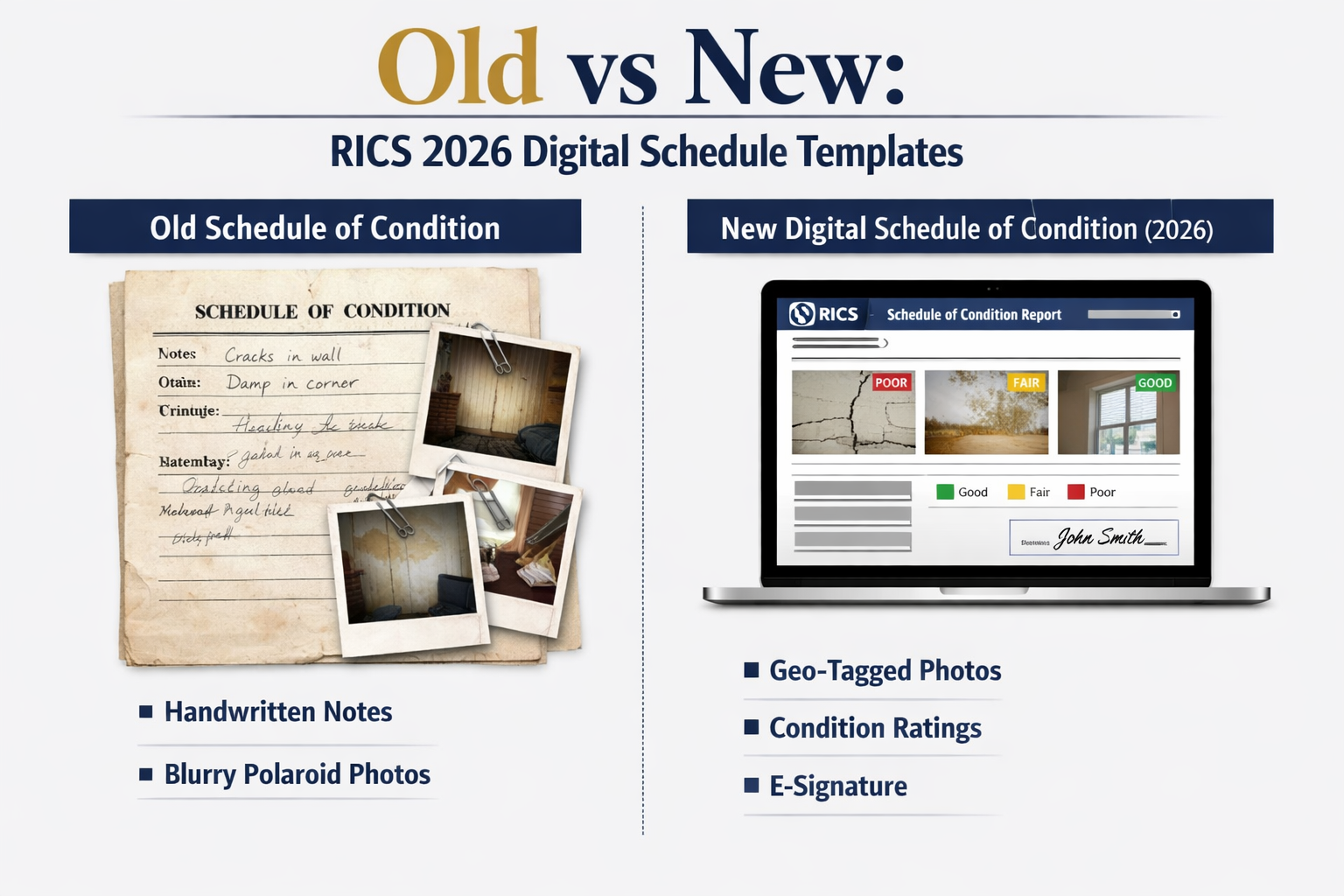
Understanding the procedural context is essential. A Schedule of Condition does not exist in isolation — it is embedded within the party wall award process as a formal appendix.
The Procedural Pathway
- Party Wall Notice served — The building owner serves notice under the Act. Learn more about party wall notices and how to respond.
- Dispute or dissent — If the adjoining owner dissents or fails to respond, surveyors are appointed [4].
- Schedule of Condition prepared — The appointed surveyor(s) inspect the adjoining property and prepare the schedule.
- Award issued — The schedule is appended to the Award as a binding record.
- Works commence — Construction proceeds within the terms of the Award.
- Post-works inspection — A follow-up inspection compares current condition against the schedule.
- Damage assessed — Any new damage is identified by direct comparison; compensation is calculated only for demonstrably new defects.
This process protects both parties: the adjoining owner is assured that genuine new damage will be compensated; the building owner is protected from paying for pre-existing defects they did not cause.
Who Pays for the Schedule?
Under the Party Wall etc. Act 1996, the building owner bears the cost of the schedule as part of the overall party wall process. For a detailed breakdown of party wall costs and the process, including surveyor fees, it is worth reviewing the full cost structure before works begin.
The ROI Case: Why a Thorough Schedule Pays for Itself
This is where the financial argument becomes compelling. A professionally prepared Schedule of Condition typically costs between £300 and £800 as part of a party wall surveyor's fee. The alternative — defending a disputed damage claim without one — can cost significantly more.
Real-World Cost Comparison
| Scenario | Estimated Cost |
|---|---|
| Schedule of Condition prepared | £300–£800 |
| Disputed claim resolved with schedule | Minimal — claim disproved by evidence |
| Disputed claim without schedule (legal costs) | £2,000–£15,000+ |
| Compensation paid for unproven pre-existing defects | £500–£50,000+ |
| Surveyor-mediated dispute without schedule | £1,500–£5,000 |
💡 Key insight: In cases where no schedule exists, surveyors and courts must assess damage on the balance of probabilities — a far less reliable (and more expensive) process than direct photographic comparison.
The RICS 2026 digital templates amplify this ROI further. Geo-tagged, timestamped, high-resolution photographs are extremely difficult to challenge in dispute proceedings. A claim that a crack was caused by construction works is far harder to sustain when the schedule clearly shows that crack — at the same width — existed three months before works began.
For adjoining owners concerned about protecting their property, understanding the rights and protections available to adjoining owners is an important first step.
Best Practice for Preparing RICS-Compliant Schedules in 2026
Schedules of Condition in Party Wall Awards: RICS-Updated Templates for 2026 Damage Defense — Practical Checklist ✅
The following checklist reflects both the current May 2023 RICS standard [2] and the anticipated requirements of the draft 8th edition [1]:
Pre-Inspection Preparation
- Confirm appointment of surveyor(s) under the Act
- Obtain access agreement from adjoining owner
- Prepare digital template with property address, date, and surveyor credentials
- Charge camera batteries; confirm geo-tagging is enabled
During Inspection
- Photograph every room systematically (wide-angle first, then detail)
- Use a crack gauge or scale card in all defect photographs
- Record condition ratings using the five-tier RICS scale
- Note all pre-existing cracks with width measurements in millimetres
- Document external elevations, roof, drainage, and garden structures
- Record any areas where access was denied (with reason)
Post-Inspection
- Compile digital schedule with embedded photographs
- Apply digital signature and lock document against alteration
- Append schedule to the draft Award for both parties' review
- Retain original digital files with full EXIF metadata intact
Common Mistakes to Avoid ⚠️
- Inadequate photography: Blurry, poorly lit, or unscaled crack photographs are routinely challenged in disputes.
- Incomplete room coverage: Omitting a room that later sustains damage creates a presumption of liability.
- Delayed inspection: Schedules prepared after works have commenced lose their evidential value.
- Paper-only records: Paper schedules without digital backup are vulnerable to loss, damage, or alteration claims.
- Generic descriptions: Phrases like "minor cracking noted" without dimensions or photographs are legally weak.
Digital Schedules: The 2026 Standard in Practice
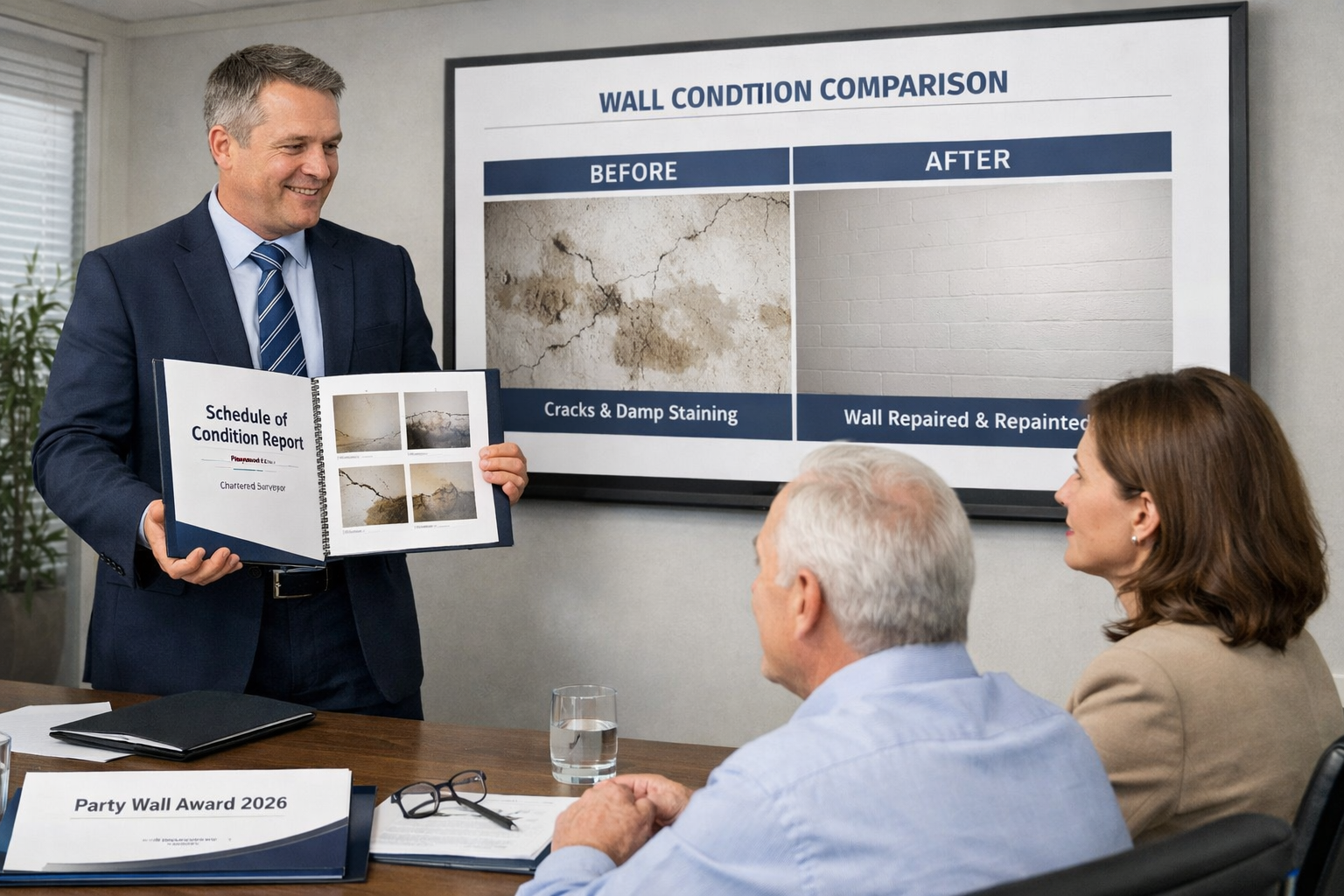
The shift to digital schedules of condition is one of the most significant practical developments in party wall practice in 2026. The RICS draft 8th edition consultation [1] reflects what many leading surveyors have already adopted in practice: a fully digital workflow that creates an unimpeachable evidential record.
Key Features of RICS-Updated Digital Templates
Structured Data Fields
Modern digital templates use structured fields rather than free-text boxes, ensuring consistency across all inspections. Each room or area has standardised entries for:
- Condition rating (1–5)
- Defect type (crack, damp, settlement, etc.)
- Dimensions
- Photograph reference numbers
- Surveyor notes
Embedded Photographic Evidence
Photographs are embedded directly within the document at the relevant condition entry, rather than appended as a separate bundle. This eliminates the risk of photographs becoming separated from their written descriptions — a common problem with traditional paper schedules [4].
Cloud Storage and Audit Trails
Digital schedules stored in cloud platforms with version control provide a complete audit trail. Any attempt to alter the document after signing is automatically recorded, providing additional protection in contested proceedings.
Integration with Party Wall Award Templates
The RICS draft appendices are designed to integrate directly with standard party wall award templates, allowing surveyors to cross-reference schedule entries within the Award's conditions and restrictions.
For those carrying out various types of party wall works — from underpinning to beam insertions — the digital schedule format ensures that the specific risks associated with each work type are documented against the relevant structural elements of the adjoining property.
Schedules of Condition in Party Wall Awards: RICS-Updated Templates for 2026 Damage Defense — Frequently Asked Questions
Q: Is a Schedule of Condition legally mandatory?
The Party Wall etc. Act 1996 does not explicitly mandate a schedule, but RICS professional standards [2] and established practice make it effectively obligatory for any competent surveyor. An Award issued without one is likely to be challenged.
Q: Can the adjoining owner refuse access for the schedule inspection?
The Act provides rights of access for the purpose of preparing schedules. Refusal of access should be documented in the schedule itself, which limits the adjoining owner's ability to make subsequent claims for areas they refused to allow inspection of.
Q: How long should a digital schedule be retained?
Best practice, and the anticipated RICS 2026 guidance, recommends retention for a minimum of six years after completion of works — in line with standard limitation periods for property damage claims.
Q: What happens if damage is found after works but no schedule was prepared?
Without a schedule, liability is assessed on the balance of probabilities. The building owner may be required to pay compensation for defects that pre-existed the works, simply because there is no evidence to the contrary. This is the core financial risk that schedules of condition eliminate.
Conclusion: Actionable Next Steps for 2026
The evolution of Schedules of Condition in Party Wall Awards: RICS-Updated Templates for 2026 Damage Defense from paper-based afterthoughts to rigorous, digitally verified evidential documents represents a genuine step forward for the entire party wall sector. The RICS consultation on the draft 8th edition [1] signals that these standards will only become more demanding — and more protective of all parties involved.
Actionable Next Steps 🎯
-
If planning construction works in 2026: Engage a qualified party wall surveyor early. Ensure the Schedule of Condition is prepared using RICS-compliant digital templates before works commence.
-
If you are an adjoining owner: Request confirmation that the appointed surveyor will prepare a full digital schedule. Understand your rights as an adjoining owner under the Act.
-
If you are a surveyor: Review the RICS draft 8th edition consultation documents [1] and begin transitioning to digital schedule formats with embedded geo-tagged photography now.
-
For all parties: Treat the Schedule of Condition as a priority investment, not an optional add-on. The ROI — measured in avoided disputes, legal costs, and compensation payments — is unambiguous.
-
Seek professional guidance: Whether in North London, South London, or anywhere across the capital, working with an experienced party wall surveyor who understands the 2026 RICS standards is the single most effective way to protect your property and your finances.
A well-prepared Schedule of Condition does not just document bricks and mortar — it documents peace of mind.
References
[1] Rics Launches Consultation On Updated Party Wall Practice Guidance – https://www.rics.org/news-insights/rics-launches-consultation-on-updated-party-wall-practice-guidance
[2] Party Wall Legislation And Procedure – https://www.rics.org/profession-standards/rics-standards-and-guidance/sector-standards/building-surveying-standards/party-wall-legislation-and-procedure
[3] Party Wall Surveys Amid 2026 Construction Boom Handling Disputes In High Demand Uk Housing Markets – https://nottinghillsurveyors.com/blog/party-wall-surveys-amid-2026-construction-boom-handling-disputes-in-high-demand-uk-housing-markets
[4] Party Wall Documents Templates – https://copelandyussuf.com/party-wall/party-wall-documents-templates/