


{"cover":"Professional landscape format (1536×1024) hero image with bold text overlay: 'Party Wall Awards in Matrimonial Disputes: Surveyor Roles & RICS Valuation Protocols 2026', extra large 72pt white bold sans-serif font with dark semi-transparent overlay box, centered upper-third composition. Background shows split-scene imagery: left side a brick shared party wall between two terraced houses, right side a courtroom/legal setting with documents and a surveyor's measuring tools. Color palette: deep navy blue, white, gold accents. High contrast, editorial magazine cover quality, professional lighting.","content":["Wide-angle editorial illustration showing a professional party wall surveyor in a hard hat examining a shared brick wall between two semi-detached houses, holding a clipboard with survey documents and RICS logo visible. In the foreground, legal documents labeled 'Party Wall Award' and 'Matrimonial Proceedings' are spread on a table. Warm professional lighting, architectural photography style, 1536×1024 landscape format, color palette of slate grey, brick red, and white, conveying the intersection of construction surveying and family law.","Overhead flat-lay composition on a dark oak desk showing RICS valuation protocol documents, a property valuation report, a divorce petition paperwork, a surveyor's measuring tape, pen, and reading glasses. A small architectural model of terraced housing sits in the corner. Subtle gold and navy color accents. Clean, editorial product-style photography, 1536×1024 landscape format, sharp focus on document headings including 'Expert Witness Report' and 'RICS Red Book Valuation 2026', professional legal and surveying aesthetic.","Split-panel infographic-style editorial image: left panel shows a timeline flowchart of the party wall award process with icons for Notice, Surveyor Appointment, Award, and Court steps in navy and gold. Right panel depicts two opposing solicitors and a neutral surveyor figure at a round table with a shared property blueprint between them, symbolizing dispute resolution. Clean modern design, 1536×1024 landscape format, professional sans-serif typography, color scheme of deep blue, white, and amber, conveying impartiality and structured legal process."}

Fewer than 30% of divorcing couples in England and Wales who co-own a property with a shared wall ever seek specialist party wall advice — yet the condition, legal status, and outstanding awards attached to that wall can directly affect how a court divides the matrimonial estate. Understanding Party Wall Awards in Matrimonial Disputes: Surveyor Roles and RICS Valuation Protocols for 2026 is no longer a niche concern; it sits at the crossroads of construction law, property valuation, and family proceedings.
When a marriage breaks down and the family home shares a structural wall with a neighbour's property, the existence of a live party wall award — or the absence of one where works have already been carried out — can complicate asset division, affect property value, and even introduce expert witness obligations into court proceedings.
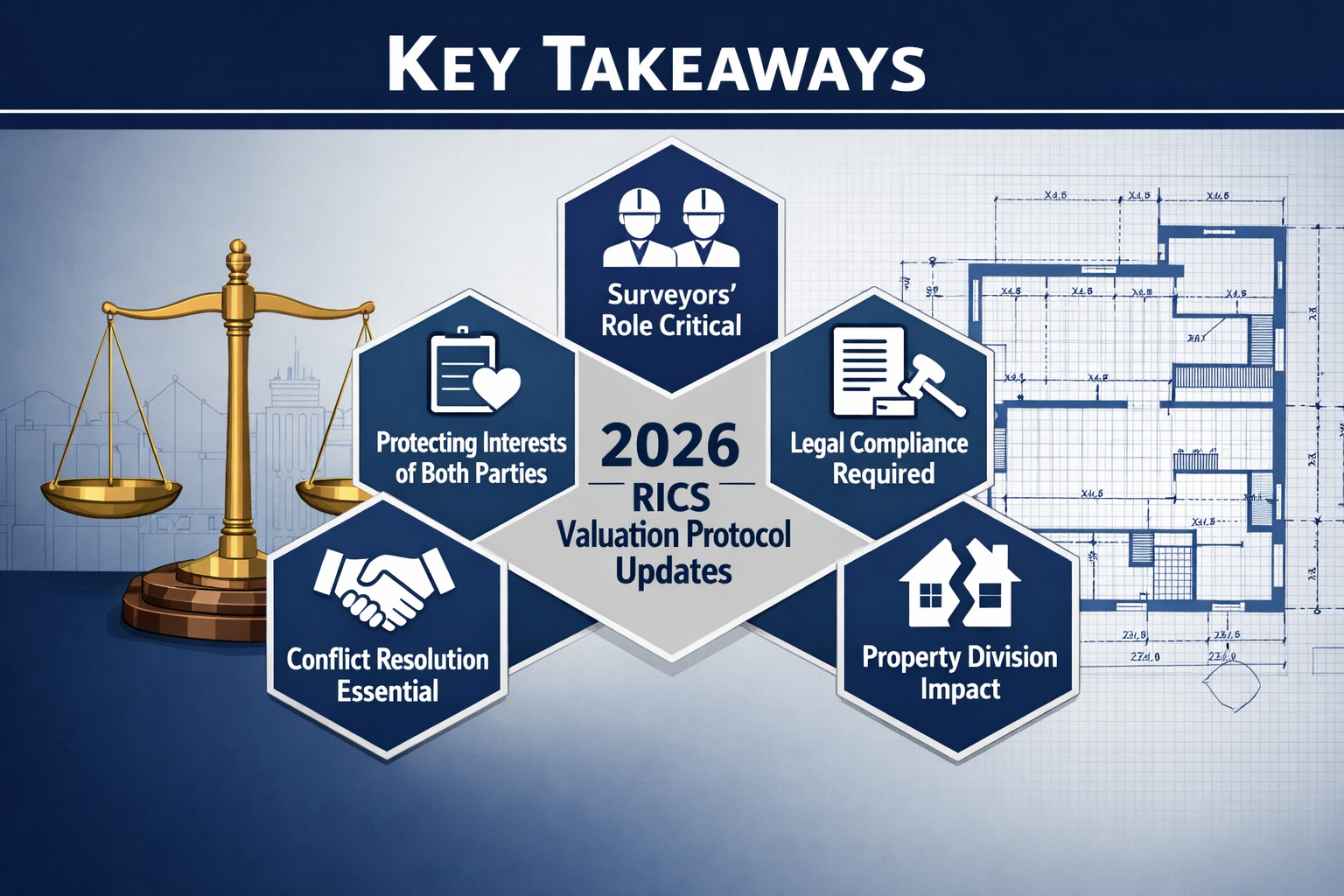
Key Takeaways 📌
- Party wall awards are legally binding documents that can affect the market value of a matrimonial property and must be disclosed during financial remedy proceedings.
- RICS-accredited surveyors play a dual role in matrimonial disputes: as party wall surveyors under the Party Wall etc. Act 1996 and as expert witnesses providing impartial valuations.
- Updated RICS protocols for 2026 require greater transparency around conflicts of interest when a surveyor is appointed in proceedings involving estranged co-owners.
- Outstanding or disputed awards can delay property sales and affect settlement negotiations between divorcing parties.
- Early specialist advice — from both a party wall surveyor and a family law solicitor — is essential when shared-wall properties are involved in divorce.
What Is a Party Wall Award and Why Does It Matter in Divorce?
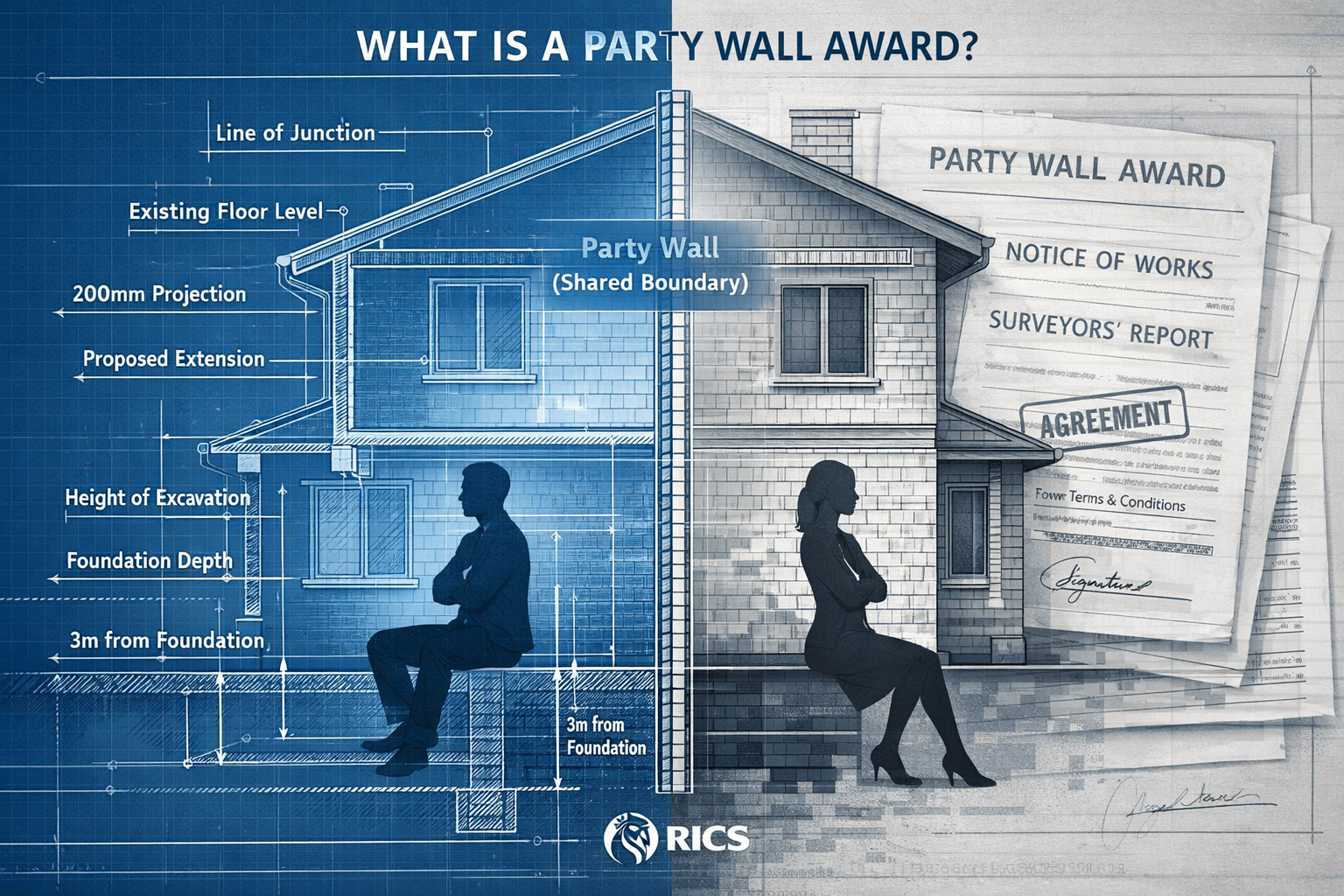
A party wall award is a formal legal document produced under the Party Wall etc. Act 1996. It sets out the rights and responsibilities of both the building owner (the party carrying out works) and the adjoining owner (the neighbour) when construction affects a shared wall, boundary, or excavation near a neighbouring property [2].
In a matrimonial context, this document becomes significant for several reasons:
How Awards Affect Property Value
"An unresolved party wall dispute or an outstanding award with unpaid costs can reduce a property's marketability and its assessed value — a factor courts must consider when dividing assets."
When a couple separates, any property they own is subject to financial remedy proceedings. If that property has:
- An active party wall award with ongoing obligations
- Unpaid surveyor fees attached to a previous award
- Damage claims arising from notified works
- A schedule of condition dispute with the adjoining owner
…then the property's net value for division purposes may be lower than its headline market price. Solicitors and family courts increasingly rely on RICS-accredited surveyors to clarify these liabilities [4].
The Party Wall Act and Co-Ownership Complications
When both spouses are registered as co-owners of a property, they are jointly considered the "building owner" or "adjoining owner" under the Act. Separation creates an immediate problem: one party may want to proceed with notified works while the other does not. This disagreement can trigger the dispute resolution mechanism under the Act, requiring the appointment of surveyors — even between estranged spouses.
Understanding party wall notices and how to respond to them is a critical first step for any divorcing homeowner with shared-wall obligations.
Surveyor Roles in Matrimonial Proceedings: Party Wall Awards in Matrimonial Disputes
The role of a surveyor in matrimonial disputes involving party wall matters is multifaceted. In 2026, RICS guidance has sharpened the distinction between three distinct functions a surveyor may perform [5]:
1. 🏗️ The Party Wall Surveyor
Appointed under Section 10 of the Party Wall etc. Act 1996, this surveyor's primary duty is to the award itself — not to either party. Even in matrimonial disputes, the surveyor's statutory obligation is to act impartially and resolve the dispute between building and adjoining owners.
Key responsibilities include:
- Serving or receiving party wall notices
- Preparing and agreeing the award document
- Producing a schedule of condition to record the pre-works state of the adjoining property
- Determining costs and who bears them
2. 📋 The Expert Witness
When party wall matters become contested within financial remedy proceedings, a court may direct that a single joint expert (SJE) be appointed. This expert — typically a chartered surveyor — must comply with:
- Civil Procedure Rules (CPR) Part 35 on expert evidence
- RICS Practice Statement: Surveyors Acting as Expert Witnesses (4th edition, updated guidance 2026)
- The overriding duty to the court, which supersedes any duty to the instructing party
The expert witness role is distinct from the party wall surveyor role. A surveyor who has already acted as party wall surveyor in a dispute should not then act as expert witness in related matrimonial proceedings, as this creates a conflict of interest that RICS guidance now explicitly addresses [5].
3. 💷 The Valuation Surveyor
Separate from both roles above, a RICS Red Book valuation may be commissioned to establish the market value of the matrimonial property, taking into account:
| Factor | Impact on Valuation |
|---|---|
| Active party wall award | May reduce value if obligations are onerous |
| Unpaid party wall costs | Deducted from net equity |
| Damage from notified works | Reduces value; may generate claim |
| Completed works with valid award | Neutral or positive (if works improved property) |
| No award where one was required | Potential legal liability; negative impact |
For divorcing couples in London, specialist local knowledge is essential. Whether the property is in East London, South London, or North London, the density of terraced and semi-detached housing means party wall issues are extremely common in matrimonial property cases.
RICS Valuation Protocols for 2026: Key Updates for Matrimonial Cases
The RICS Red Book Global Standards (2022, updated 2026) and the UK National Supplement contain specific provisions for matrimonial and litigation valuations. These are distinct from standard market valuations and carry additional requirements for impartiality and disclosure [5].
What Makes a Matrimonial Valuation Different?
A standard market valuation answers: "What would this property sell for on the open market today?"
A matrimonial valuation must also answer:
- What liabilities (including party wall obligations) are attached to the property?
- Are there any outstanding awards, notices, or disputes that affect value?
- What is the impact of any works carried out without a valid award?
- Are there any third-party rights over the shared wall that affect the property's use?
"In 2026, RICS guidance requires surveyors accepting matrimonial instructions to confirm in writing that they have no prior involvement with either party in a party wall capacity — a safeguard that protects the integrity of the valuation." [5]
The Conflict of Interest Problem
One of the most significant updates in 2026 RICS protocols relates to conflict of interest disclosure. When a surveyor has previously acted as the building owner's surveyor or the adjoining owner's surveyor in a party wall matter, they must:
- Disclose this prior involvement to the court or instructing solicitors
- Confirm whether the prior role affects their ability to provide an impartial valuation
- Stand aside if a conflict cannot be adequately managed
This is particularly relevant in London, where the same surveying firms often handle both party wall and valuation work in the same neighbourhoods.
Practical Steps for Solicitors and Parties in 2026
Family law solicitors handling matrimonial property cases in 2026 should routinely:
- ✅ Request copies of all party wall notices and awards from both parties
- ✅ Commission a RICS-compliant matrimonial valuation that explicitly addresses party wall liabilities
- ✅ Instruct a party wall surveyor to review any outstanding awards before settlement
- ✅ Check whether works were carried out without proper notice — a common issue that creates hidden liabilities [3]
- ✅ Consider whether the party wall award affects the property's saleability for the purposes of a clean-break settlement
Navigating the Process: A Step-by-Step Guide
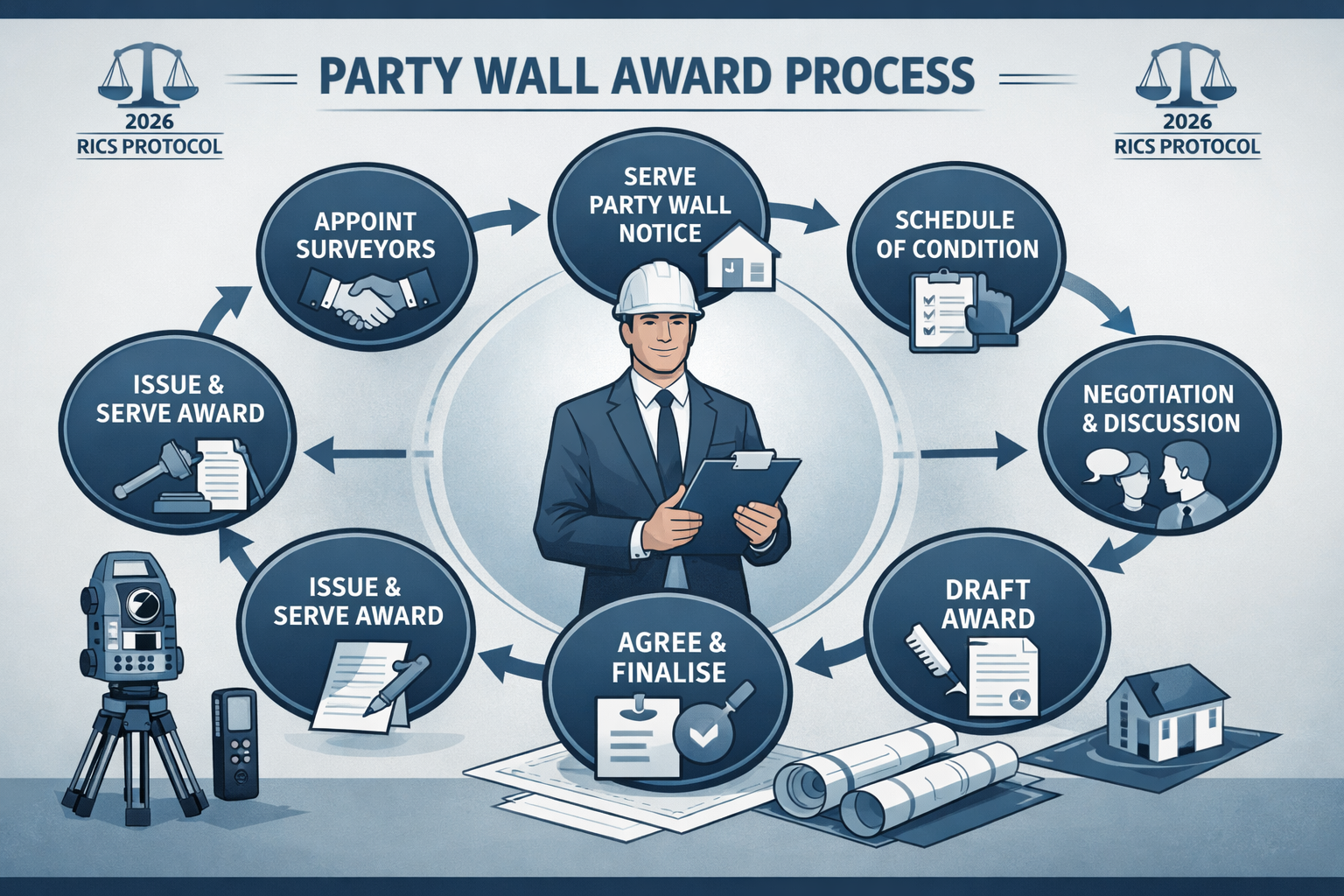
Understanding the practical workflow helps both divorcing parties and their legal advisers manage party wall issues efficiently within matrimonial proceedings.
Step 1: Identify All Party Wall Matters
Before any financial settlement is reached, both parties should disclose:
- Any party wall notices served or received
- Existing party wall awards (see a detailed guide on party wall awards)
- Any ongoing disputes with adjoining owners
- Schedules of condition prepared for the property
Step 2: Appoint the Right Surveyor
The surveyor appointed must be:
- RICS-accredited and experienced in both party wall work and matrimonial valuations
- Free from conflicts of interest with either party or their legal representatives
- Willing to act as a single joint expert if directed by the court
For properties in Central London or West London, where high-value properties with complex party wall histories are common, specialist expertise is especially important.
Step 3: Commission the Award Review and Valuation
The surveyor should:
- Review all existing party wall documentation
- Inspect the shared wall and any works carried out
- Identify any outstanding liabilities or unresolved disputes
- Produce a written report suitable for use in financial remedy proceedings
Step 4: Factor Costs Into the Settlement
Party wall surveyor fees and any outstanding award costs must be accounted for in the financial settlement [3]. Understanding how party wall costs are structured helps solicitors ensure that these liabilities are properly reflected in any proposed division of assets.
Common Pitfalls and How to Avoid Them ⚠️
Several recurring mistakes arise when party wall matters intersect with matrimonial proceedings:
1. Failing to disclose existing awards
An award is a legal document that runs with the land. Failing to disclose it during financial remedy proceedings can amount to non-disclosure of a material fact.
2. Proceeding with works during separation
One spouse instructing building works on a shared property during separation — without the other's agreement and without proper party wall notices — can create significant legal and financial complications [2].
3. Confusing the surveyor's roles
Using the same surveyor as both party wall surveyor and expert witness in the same proceedings is a conflict of interest that can undermine both the award and the court's reliance on the evidence [5].
4. Ignoring the impact on sale proceeds
If the matrimonial home is to be sold as part of the settlement, any unresolved party wall disputes can delay the sale or reduce the achievable price — directly affecting both parties' financial outcomes [4].
5. Not seeking specialist advice early
The earlier a party wall surveyor is involved in matrimonial proceedings, the more efficiently issues can be resolved. Late disclosure of party wall liabilities has derailed otherwise agreed financial settlements.
Conclusion: Actionable Next Steps for 2026
Party Wall Awards in Matrimonial Disputes: Surveyor Roles and RICS Valuation Protocols for 2026 represent a genuinely specialist area where property law, construction law, and family law converge. The stakes are high: unresolved party wall matters can reduce property values, delay settlements, and introduce expert witness complications into already difficult proceedings.
Here are the most important actions to take right now:
-
Instruct a RICS-accredited party wall surveyor immediately if there is any shared wall, boundary, or excavation issue connected to the matrimonial property — do not wait until settlement negotiations are advanced.
-
Disclose all party wall notices and awards to your family law solicitor at the earliest opportunity. These are material documents in financial remedy proceedings.
-
Commission a matrimonial-specific RICS valuation that explicitly addresses party wall liabilities, not just a standard market appraisal.
-
Ensure your surveyor confirms no conflict of interest in writing before accepting instructions, in line with updated 2026 RICS protocols.
-
Seek specialist family law advice from solicitors experienced in matrimonial property disputes, particularly those familiar with the Party Wall etc. Act 1996 and its interaction with financial remedy proceedings.
The intersection of party wall law and matrimonial proceedings is complex — but with the right expert guidance, it is entirely manageable. Early action protects both parties' interests and keeps the path to settlement as clear as possible.
References
[1] Party Wall Agreement – https://www.contractscounsel.com/t/us/party-wall-agreement
[2] Party Wall Agreement – https://hoa.org.uk/advice/guides-for-homeowners/i-am-improving/party-wall-agreement/
[3] Party Wall Disputes – https://collyerbristow.com/real-estate/real-estate-disputes/party-wall-disputes/
[4] Buying Property Party Wall Award – https://osborneslaw.com/blog/buying-property-party-wall-award/
[5] Party Wall Surveys And Neighbour Disputes During 2026s Construction Uptick Rics Compliance Framework – https://nottinghillsurveyors.com/blog/party-wall-surveys-and-neighbour-disputes-during-2026s-construction-uptick-rics-compliance-framework
[6] Nysba Family Law Section Update January 2026 – https://nysba.org/wp-content/uploads/2026/01/NYSBA-Family-Law-Section-Update-January-2026.docx
