


{"cover":"Professional landscape format (1536×1024) hero image with bold text overlay: 'Party Wall Awards for 5G & Fibre Optic Installations: Notice Requirements & Safeguards' in extra large 72pt white bold sans-serif font with dark semi-transparent overlay box, centered upper-third composition. Background shows a dramatic split-scene: left half depicts a modern brick terraced house party wall with drilling equipment and fibre optic cables being installed, right half shows a 5G mast rising beside a residential building. Color palette: deep navy blue, white text, electric teal accents representing connectivity. Magazine cover aesthetic, editorial quality, high contrast, photorealistic style.","content":["Detailed landscape format (1536×1024) editorial illustration showing a cross-section diagram of a shared party wall between two terraced houses, with a 5G mast foundation excavation reaching 2-4 metres depth on the left side and fibre optic cables being threaded through the wall on the right. A surveyor in a hard hat holds official Party Wall Act notice documents. Overlaid infographic elements show Section 6 and Section 2(2) notice triggers with arrows and labels. Color scheme: architectural blueprint blue and white with orange highlight accents. Technical, professional, informative visual style.","Detailed landscape format (1536×1024) flat-lay style image of a professional desk showing a Party Wall Award legal document with highlighted clauses, a surveyor's schedule of condition report with photographs clipped to it, a pen, and a smartphone displaying a 5G signal strength diagram. Beside these sits a printed timeline chart showing notice periods: 1 month, 2 months, 60 days. Soft warm office lighting, top-down bird's-eye perspective, clean minimal composition. Color palette: cream, charcoal, gold accents. Editorial quality, professional property law aesthetic.","Detailed landscape format (1536×1024) conceptual illustration showing two neighbouring property owners shaking hands across a shared garden fence, with a party wall surveyor standing between them holding a bound Party Wall Award document. In the background, a telecom engineer installs fibre optic cable along the roofline of a semi-detached house. Speech bubbles show key safeguard terms: 'Schedule of Condition', 'Damage Liability', 'Working Hours'. Color palette: forest green, white, slate grey. Friendly yet professional editorial style, moderate depth of field, community-focused composition."]

Britain's 5G rollout is accelerating at a pace that most homeowners never anticipated — and with it comes a largely overlooked legal obligation. Most 5G mast foundations require excavations of 2 to 4 metres in depth, a range that frequently triggers formal notice requirements under the Party Wall etc. Act 1996 in residential areas [2]. When that excavation happens near a shared wall, the legal and structural stakes rise sharply for both building owners and their neighbours.
Party Wall Awards for 5G and Fibre Optic Installations: Emerging Notice Requirements and Safeguards sit at the intersection of telecommunications law, property rights, and structural surveying — a combination that is catching many property owners off guard in 2026. This article unpacks exactly when telecom upgrades trigger Party Wall Act obligations, what a properly drafted Party Wall Award must include, and how adjoining owners can protect their homes from drilling, cabling, and excavation works.
Key Takeaways 📋
- Excavation depth matters: 5G mast foundations at 2–4 metres depth routinely trigger Section 6 notice requirements under the Party Wall etc. Act 1996.
- Fibre optic drilling through shared walls can constitute notifiable party structure works, requiring a formal Party Wall Notice before works begin.
- A Party Wall Award is the legal document that governs how telecom works near shared structures must proceed, including working hours, damage liability, and reinstatement.
- Adjoining owners have the right to appoint their own surveyor, request a Schedule of Condition, and challenge works that risk structural harm.
- Failing to serve notice before telecom installations can expose building owners to injunctions, compensation claims, and costly delays.
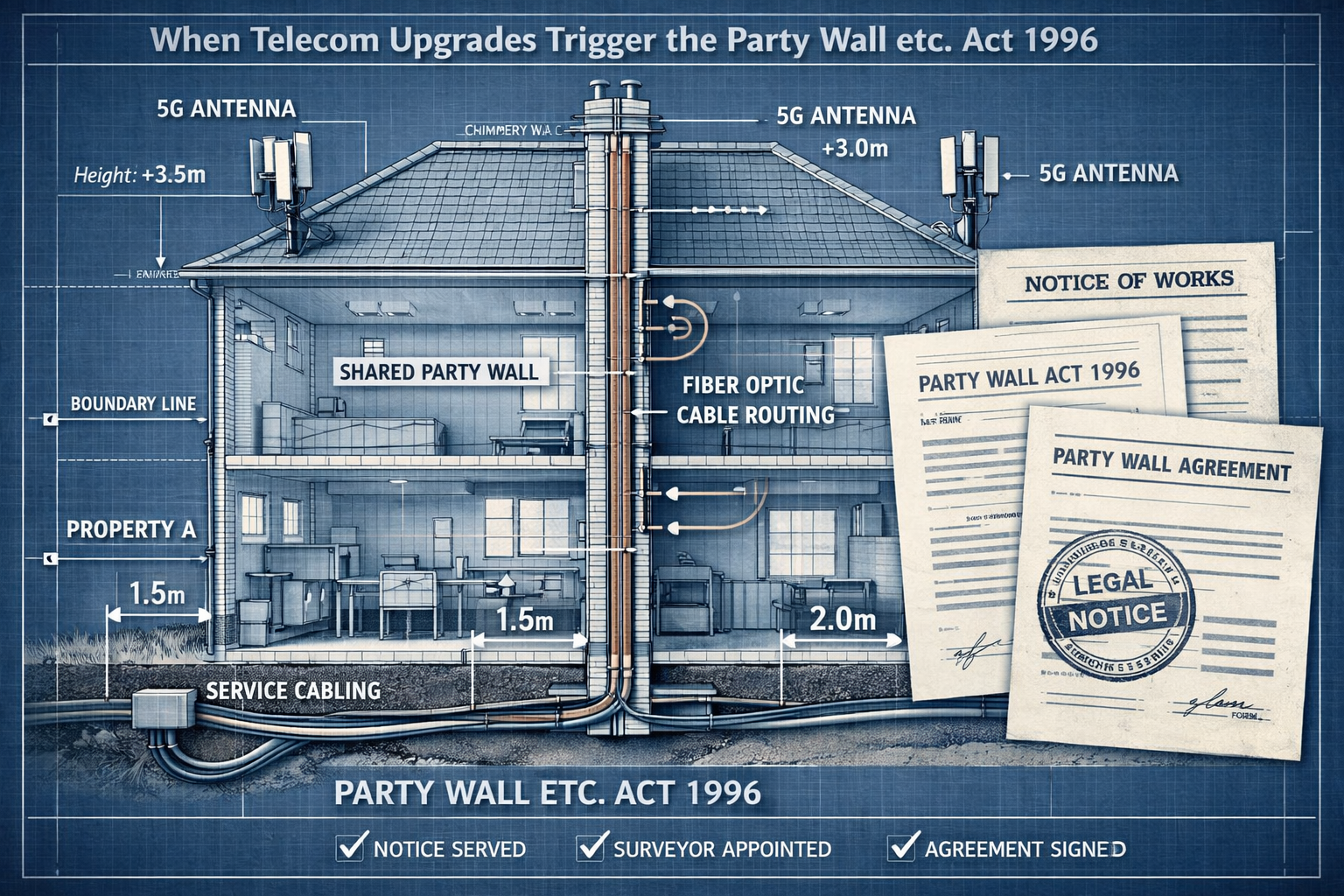
When Telecom Upgrades Trigger the Party Wall etc. Act 1996
The Party Wall etc. Act 1996 was drafted long before 5G existed, yet its provisions are broad enough to capture a wide range of modern telecom works. Understanding precisely when the Act applies is the first step for any building owner or telecoms contractor.
Section 2: Works to an Existing Party Wall or Structure
Section 2 of the Act covers works carried out directly to a party wall or party structure. Fibre optic installations frequently fall into this category when:
- Cables are drilled through a shared wall to connect properties to a street-level distribution point.
- Conduits or trunking are fixed to the face of a party wall, altering its structural integrity.
- Equipment housings or junction boxes are mounted on shared structures.
Under Section 2(2), a building owner must serve a Party Structure Notice at least one month before works begin. You can learn more about what a Party Structure Notice is and how to serve it in the context of London properties specifically.
Section 6: Excavations Near Adjoining Properties
Section 6 is the provision most relevant to 5G mast installations. It applies when:
- Excavation is planned within 3 metres of an adjoining owner's building and the excavation will go deeper than the neighbour's foundations.
- Excavation is planned within 6 metres of an adjoining structure and the works will cut a line drawn downward at 45 degrees from the bottom of the neighbour's foundations.
Given that 5G mast foundations commonly reach 2–4 metres [2], Section 6 notices are not a theoretical concern — they are a practical necessity on most urban and suburban installations near residential buildings.
💡 Pull Quote: "A 5G mast sited three metres from a terraced house boundary is not just a planning matter — it is a party wall matter. Failing to serve notice is not an option."
For a broader understanding of the types of party wall works that trigger these obligations, reviewing the full spectrum of notifiable activities is strongly recommended.
Understanding Party Wall Awards for 5G and Fibre Optic Installations: Emerging Notice Requirements and Safeguards
When a neighbour disputes a telecom installation — or simply does not consent in writing — the process moves to the appointment of surveyors and the drafting of a Party Wall Award. This legally binding document is the cornerstone of protection for both parties.
What Is a Party Wall Award?
A Party Wall Award (sometimes called a Party Wall Agreement) is a formal document drawn up by one or more appointed surveyors. It sets out:
| Award Component | Purpose |
|---|---|
| Description of works | Defines exactly what telecom works are permitted |
| Method of working | Specifies drilling methods, vibration limits, and access routes |
| Working hours | Restricts noisy or disruptive works to agreed times |
| Schedule of Condition | Records the pre-works state of the adjoining property |
| Damage liability | Confirms the building owner's responsibility for any damage caused |
| Reinstatement obligations | Requires the building owner to make good any damage |
| Security for expenses | May require a financial deposit before works begin |
For a detailed breakdown of how these documents are structured, the Party Wall Awards guide provides practical insight into the process.
The Schedule of Condition: A Critical Safeguard
One of the most important protections for an adjoining owner facing nearby telecom works is the Schedule of Condition. This is a photographic and written record of the property's state before any drilling, excavation, or cable installation begins.
Without this record, proving that a crack in a party wall was caused by a 5G mast excavation — rather than pre-existing settlement — becomes extremely difficult. A properly compiled schedule of condition is therefore not optional; it is essential.
Notice Periods for Telecom Works
The Act specifies minimum notice periods that cannot be waived unilaterally:
- Party Structure Notice (Section 2): Minimum 1 month before works begin.
- Line of Junction Notice (Section 1): Minimum 1 month before works begin.
- Notice of Adjacent Excavation (Section 6): Minimum 1 month before works begin.
These timelines are separate from any planning permission or permitted development rights that may apply to 5G infrastructure under the Electronic Communications Code. Telecom operators must satisfy both planning and party wall requirements independently.
For reference, US telecommunications regulators have adopted similarly structured advance notice frameworks — the FCC now requires written advance notice at least 60 days before submitting mid-sized or large broadband attachment orders, with a mandatory meet-and-confer period within 30 days [1]. While these rules apply in a different jurisdiction, they reflect a global recognition that structured notice periods protect all parties in infrastructure rollouts.
Practical Safeguards: Protecting Shared Walls from Drilling and Cabling Works
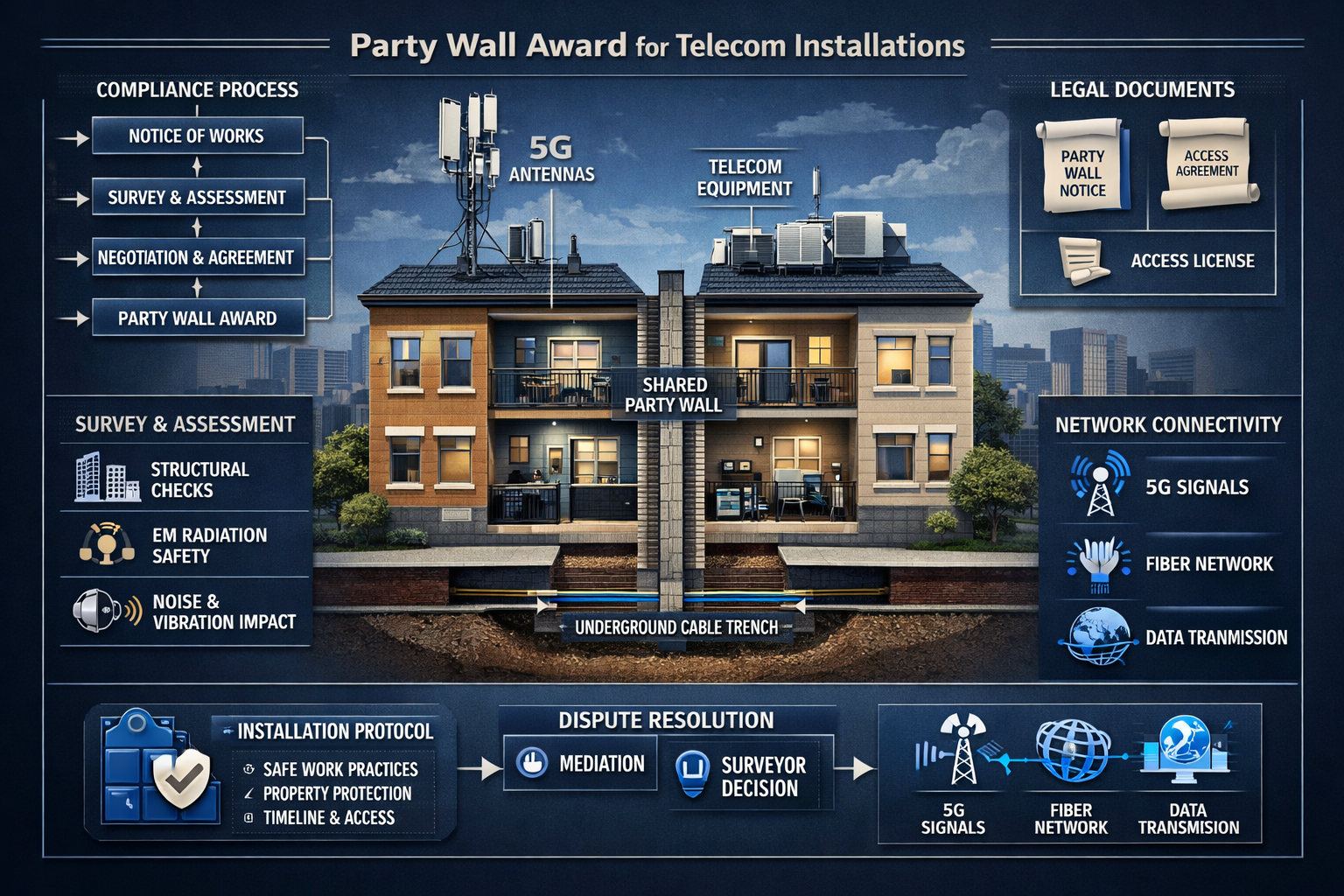
Understanding the legal framework is one thing; knowing how to use it effectively is another. The following safeguards are available to both building owners carrying out telecom works and adjoining owners who need protection.
For Adjoining Owners: Your Rights Under the Act
If a telecoms contractor or neighbouring property owner serves a Party Wall Notice, an adjoining owner has several options:
- Consent in writing — Works can proceed under agreed conditions without a formal Award.
- Dissent and appoint a surveyor — Triggers the Award process, ensuring independent oversight.
- Dissent and agree to a single agreed surveyor — A cost-effective middle ground.
Adjoining owners should never ignore a notice. Silence does not equal consent — after 14 days without a response, a dispute is deemed to have arisen automatically, and the surveyor appointment process begins regardless. Learn more about party wall notices and how to respond to avoid missing critical deadlines.
Key Clauses to Include in a Telecom-Related Party Wall Award
A well-drafted Award for fibre optic or 5G-related works should contain specific clauses that standard residential Awards may not always address:
- Vibration monitoring requirements — Particularly important for percussive drilling near older masonry walls.
- Cable routing restrictions — Specifying that cables must not pass through structural elements without prior structural engineer sign-off.
- Electromagnetic interference provisions — While rare, high-frequency installations near sensitive equipment may warrant mention.
- Reinstatement to match existing finishes — Ensuring that any wall penetrations are made good to the same standard as the surrounding surface.
- Ongoing access rights — Clarifying whether telecoms engineers can return for maintenance without serving fresh notices.
Fibre Optic Installations: Consent Requests and the Party Wall Process
Fibre optic cable installations present a slightly different challenge. Tower companies and wireless carriers typically send consent request letters when seeking to add fibre optic cable to existing infrastructure [3]. In a residential context, this consent process can run parallel to — but must not replace — the formal Party Wall Notice process.
Where fibre optic cables pass through or along a party wall, the building owner must assess whether the works constitute notifiable party structure works. Factors to consider include:
- Depth of any associated trenching relative to neighbouring foundations.
- Whether drilling penetrates the full thickness of a shared wall.
- The structural significance of the wall being accessed.
Regulatory compliance in telecom projects increasingly demands that operators understand not just federal or national frameworks but also the granular local property law obligations that apply at each installation site [5].
For Building Owners: Managing Compliance and Costs
Building owners commissioning telecom installations on or near party walls carry the primary legal responsibility for compliance. Key steps include:
✅ Appoint a qualified party wall surveyor early — Before any contractor mobilises on site.
✅ Serve notices with the correct lead time — Rushing notice periods is a common and costly mistake.
✅ Commission a structural engineer's report for any excavation exceeding 1.5 metres near shared structures.
✅ Keep records of all correspondence with adjoining owners and surveyors.
✅ Budget for the Award process — Understanding the costs of the party wall process upfront prevents project delays.
For those looking to manage expenditure, there are also practical tips on how to keep party wall costs down without compromising on legal protection.
The Evolving Legal Landscape in 2026: What's Changing
The intersection of telecommunications law and property law is not static. Several developments in 2026 are reshaping how Party Wall Awards for 5G and Fibre Optic Installations: Emerging Notice Requirements and Safeguards are being approached by surveyors and legal professionals.
RICS Protocols and Professional Guidance
The Royal Institution of Chartered Surveyors (RICS) has been developing clearer protocols for party wall surveyors dealing with telecom infrastructure. These protocols acknowledge that standard residential party wall procedures need adaptation when:
- Works are commissioned by telecoms operators rather than individual property owners.
- Multiple adjoining owners are affected simultaneously by a single installation.
- The building owner is a corporate entity rather than a private individual.
RICS protocols now emphasise the importance of early structural assessment for any 5G mast installation near residential party walls [2], reflecting the profession's recognition that this is a genuinely specialist area.
The Electronic Communications Code and Its Limits
The Electronic Communications Code (as amended by the Product Security and Telecommunications Infrastructure Act 2022) grants telecoms operators significant rights to install equipment on and near properties. However, these rights do not override the Party Wall etc. Act 1996. The two frameworks operate independently, and operators who rely solely on Code rights without serving party wall notices remain legally exposed.
⚠️ Important: Electronic Communications Code rights and Party Wall Act obligations are not mutually exclusive. Both must be satisfied for a legally compliant installation.
Conclusion: Actionable Next Steps for Property Owners and Telecoms Operators
The rapid expansion of 5G and fibre optic infrastructure across the UK is creating a new category of party wall dispute — one that neither the Act's original drafters nor most property owners anticipated. Yet the legal framework is clear, and the protections it offers are robust when used correctly.
Here are the actionable next steps for each party involved:
If You Are a Building Owner or Telecoms Operator:
- Identify all party walls and shared structures within 3–6 metres of any planned excavation or installation.
- Serve the correct notice under the appropriate section of the Act, with the full statutory notice period.
- Appoint a party wall surveyor experienced in telecoms-related works before mobilising contractors.
- Ensure the Party Wall Award contains specific clauses for vibration, cable routing, and reinstatement.
If You Are an Adjoining Owner:
- Do not ignore any notice — respond within 14 days to preserve your rights.
- Appoint your own surveyor to ensure the Award genuinely protects your property.
- Request a Schedule of Condition before any works begin — this is your primary evidence tool.
- Seek specialist advice if you are unsure whether works near your property require a notice.
The Party Wall etc. Act 1996 overview remains the definitive starting point for understanding your rights and obligations. For those in London, specialist surveyors are available across all London locations to provide tailored guidance on telecoms-related party wall matters.
The digital infrastructure of tomorrow is being built through the walls of today's homes. Getting the legal framework right is not a bureaucratic inconvenience — it is the foundation of a fair and damage-free installation for everyone involved.
References
[1] FCC Adopts New Pole Attachment Rules to Speed Broadband Deployment – https://www.benton.org/blog/fcc-adopts-new-pole-attachment-rules-speed-broadband-deployment
[2] Party Wall Surveys for 5G Mast Installations: RICS Protocols Amid 2026 Telecom Infrastructure Expansion – https://nottinghillsurveyors.com/blog/party-wall-surveys-for-5g-mast-installations-rics-protocols-amid-2026-telecom-infrastructure-expansion
[3] Consent Requests for Fiber Optic Cable – https://www.steelintheair.com/blog/consent-requests-for-fiber-optic-cable/
[4] BEAD Obligations for Subgrantees Deploying Network Guidance – https://broadbandusa.ntia.gov/sites/default/files/2024-08/BEAD_Obligations_for_Subgrantees_Deploying_Network_Guidance.pdf
[5] Regulatory Compliance in Telecom: Understanding the Federal, State and Local Laws Impacting Resident Choice at Your Property – https://realtycompartners.com/regulatory-compliance-in-telecom-understanding-the-federal-state-and-local-laws-impacting-resident-choice-at-your-property/
