

Nearly 60% of homeowners who contact party wall surveyors discover their planned project didn't require a notice in the first place — yet they've already lost weeks of time and hundreds of pounds in unnecessary fees. Understanding Party Wall Act exemptions for minor works in 2026: when you can skip notices and surveyors entirely could save significant money and stress before a single brick is touched.
The Party Wall etc. Act 1996 is frequently misunderstood as applying to every home improvement project near a shared wall. In reality, the Act contains meaningful exemptions for small-scale, non-structural work. This guide breaks down exactly which projects qualify, which don't, and how to check your own project against a clear, practical checklist.
Key Takeaways
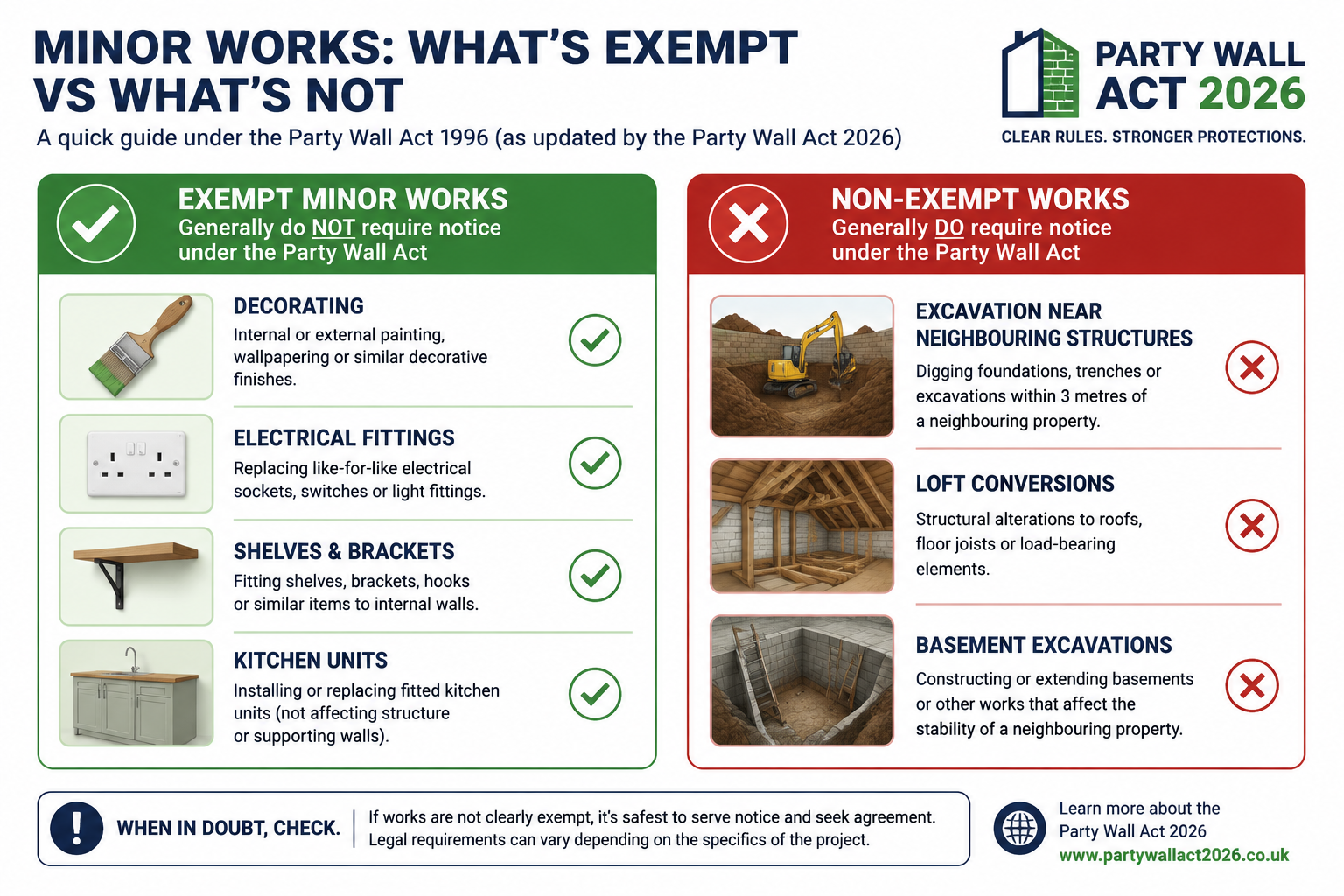
- 🟢 Many minor internal works are fully exempt — plastering, electrical work, and fitting shelves or kitchen units do not trigger Party Wall Act requirements.
- 🔴 Excavation within 3 metres of a neighbour's building almost always requires a formal notice, even for seemingly modest extensions.
- 📋 Notice periods differ — party wall modifications need 2 months' notice; excavations and boundary work need 1 month.
- 💷 Skipping a surveyor is legal when exempt — but getting it wrong can result in injunctions, legal costs, and neighbour disputes.
- ✅ A simple checklist approach helps homeowners confirm exemption status before committing to any project.
What the Party Wall Act Actually Covers (And What It Doesn't)
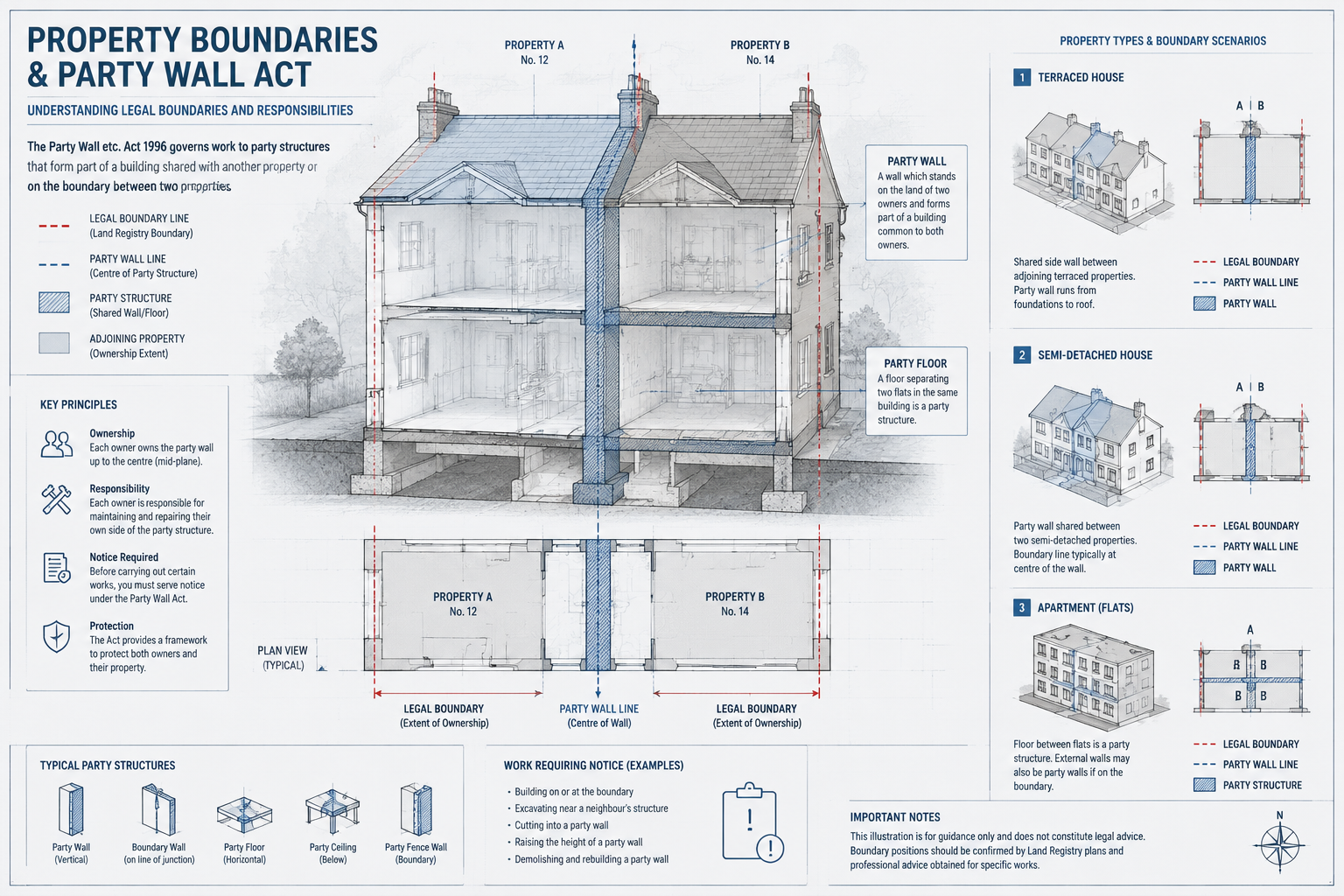
The Party Wall etc. Act 1996 was designed to regulate work that could structurally affect shared walls, boundaries, or neighbouring foundations. It is not a blanket law covering all home renovation.
The Act applies to three main categories of work:
- Work directly to a party wall or party structure — such as cutting into, raising, or underpinning a shared wall between two properties.
- New building at or near a boundary — constructing a new wall astride or adjacent to the property line.
- Excavation near neighbouring foundations — digging within defined distances of an adjoining owner's building.
Everything outside these categories is, broadly speaking, outside the Act's reach. That's where the exemptions live — and where many homeowners can proceed confidently without notices or surveyors.
Understanding what types of party wall works fall under the Act is the first step toward identifying what doesn't.
Party Wall Act Exemptions for Minor Works in 2026: The Complete Breakdown
✅ Interior Decorative Work
Plastering, painting, and decorating interior walls — including party walls — are fully exempt from the Act. These are surface-level activities that carry no structural risk to the shared structure. A homeowner in Hackney who replastered their entire ground-floor party wall in early 2026 needed zero notices and zero surveyors. The work was completed in three days without any formal process [1][4].
✅ Electrical and Wiring Work on Internal Walls
Adding sockets, replacing wiring, or installing electrical installations on internal walls does not require a party wall agreement. Even when the wall in question is a shared party wall, electrical work that doesn't structurally alter the wall is exempt [1][4].
💡 Pull Quote: "Fitting a new socket on a party wall is no different legally than fitting one on any other internal wall — the Act simply doesn't apply."
✅ Kitchen Units and Shelf Installation
Drilling into walls to mount shelves, kitchen units, or bathroom fittings is exempt, provided the drilling is internal and non-structural. A homeowner in Islington fitted an entire new kitchen in 2026, drilling into a party wall for cabinet fixings, without serving a single notice — entirely within the law [1][4].
✅ Like-for-Like Repairs on Your Own Side
Repairing or replacing materials on your own side of a party wall — such as patching plaster, replacing tiles, or fixing skirting boards — does not engage the Act. The key test is whether the work affects the structure or the adjoining owner's side.
✅ Timber Floors and Internal Partitions
Installing new timber floors or erecting non-structural internal partition walls within your own property does not require party wall procedures, even if adjacent to a shared wall.
🔴 What Is NOT Exempt: Common Triggers in 2026
Understanding exemptions also means knowing where the line is crossed. These are the most common triggers homeowners encounter:
| Work Type | Exempt? | Notice Required |
|---|---|---|
| Plastering interior walls | ✅ Yes | None |
| Fitting kitchen units (drilling) | ✅ Yes | None |
| Electrical wiring on party wall | ✅ Yes | None |
| Loft conversion (structural beam) | ❌ No | 2-month Party Structure Notice |
| Rear extension (new foundations) | ❌ No | Section 6 Notice (1–2 months) |
| Basement excavation | ❌ No | Section 6 Notice |
| Raising or underpinning party wall | ❌ No | 2-month Party Structure Notice |
| Garden boundary wall work | ❌ No | 1-month notice |
| Shared floor between flats | ❌ No | 2-month Party Structure Notice |
Loft conversions and basement works are among the most common projects that appear minor but are not exempt [2][6]. Work to shared party structures, such as floors between flats in multi-unit properties, also triggers full Act compliance [4].
For those unsure whether their project crosses the threshold, party wall notices explained in detail can help clarify the process if a notice turns out to be necessary.
The 3-Metre and 6-Metre Excavation Rules: A 2026 Reality Check
One of the most misunderstood areas of the Act involves excavation near neighbouring foundations. This is where the Party Wall Act exemptions for minor works in 2026 — specifically what qualifies as "minor" — become critically important.
The 3-Metre Rule
Under Section 6 of the Act, if excavation work is planned within 3 metres of a neighbouring building AND the new foundation will be deeper than the neighbour's existing foundation, a formal notice must be served [3].
This rule is described as "the most common trigger for a Party Wall Notice when building a standard rear or side extension" [3]. A homeowner in South London who planned a modest single-storey rear extension in 2026 discovered their new footings sat 2.8 metres from their neighbour's wall — well within the trigger zone, requiring a Section 6 Notice before work could begin.
The 6-Metre Rule
Distance requirements expand to 6 metres when the excavation is particularly deep or involves a specific angular relationship with the neighbour's foundations — specifically, where a line drawn downward at 45 degrees from the bottom of the proposed excavation would intersect with the neighbour's foundation [1][3].
Special Foundations: An Extra Layer
If a project requires special foundations — reinforced concrete, steel pins, or piles — the adjoining owner's specific written consent is required beyond the standard notice procedure [3]. This is a higher bar than most homeowners anticipate.
⚠️ Important: The 1-month notice period applies to excavation and boundary work; the 2-month notice period applies to direct party wall modifications [1][6].
How to Confirm Your Project Is Exempt: A 2026 Checklist
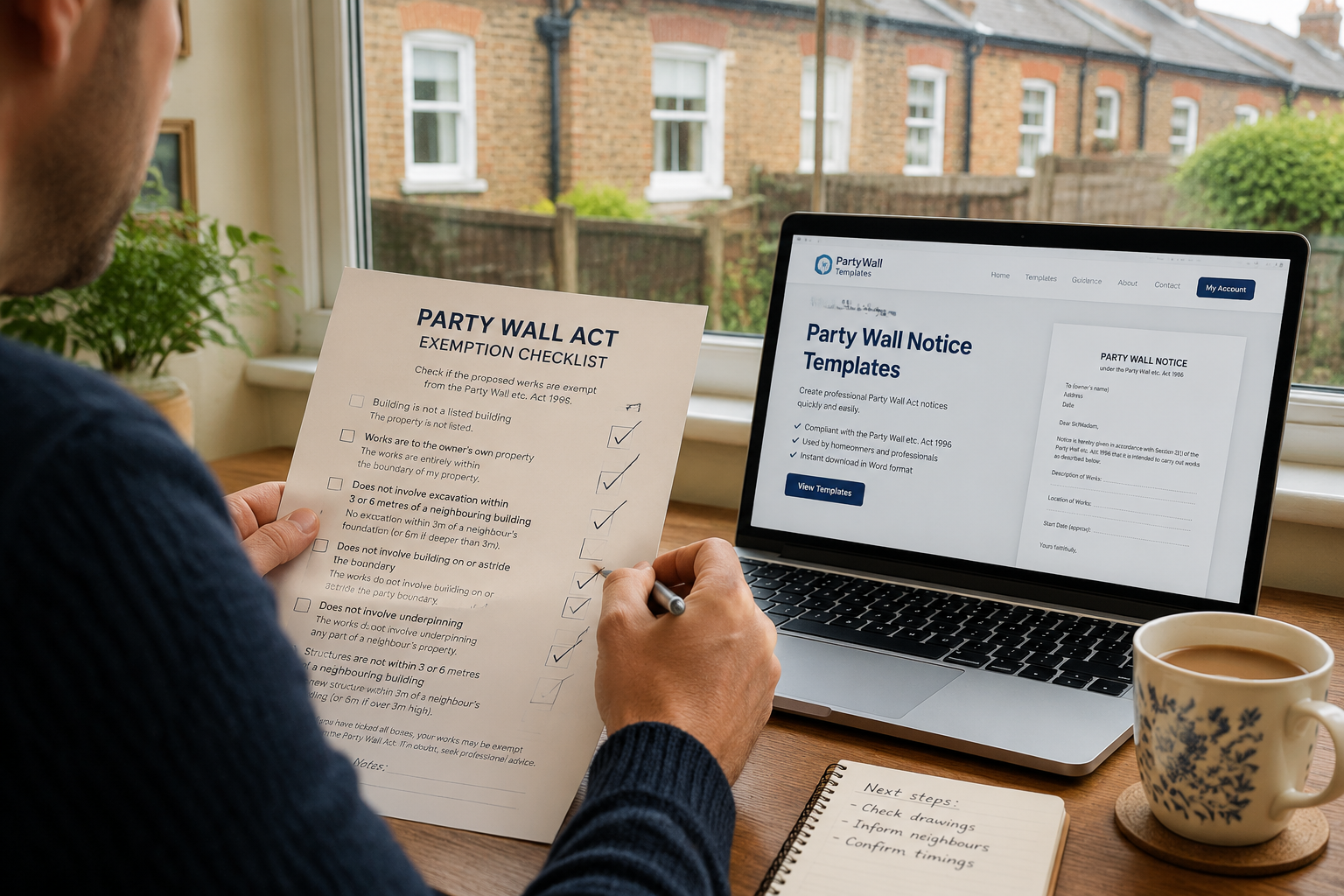
Use this checklist before starting any work near a shared wall or boundary. If the answer to all questions is "No," the project is likely exempt from the Party Wall Act.
🗒️ Party Wall Act Exemption Checklist
Structural Impact
- Does the work cut into, raise, lower, or underpin a party wall?
- Does it involve removing a chimney breast from a party wall?
- Does it insert a damp-proof course into a party wall?
Excavation Proximity
- Is any excavation planned within 3 metres of a neighbouring building?
- Is any excavation planned within 6 metres where deep foundations are involved?
- Will new foundations be deeper than the neighbour's existing foundations?
Boundary and Shared Structures
- Does the work involve building on or astride the boundary line?
- Does it affect a shared floor between flats or a garden boundary wall?
- Does it involve special foundations (reinforced concrete, steel piles)?
Scope of Work
- Is the work anything beyond surface decoration, wiring, or minor fixings?
If any box is ticked, a party wall notice is likely required. For those who need to serve a notice, understanding what a Party Structure Notice is and how to serve it is the logical next step.
Can You Ever Have a Party Wall Agreement Without a Surveyor?
Even when a notice is required, it's worth knowing that the formal surveyor process isn't always mandatory. If both the building owner and the adjoining owner consent in writing within 14 days of receiving a notice, work can proceed without appointing surveyors or producing a formal party wall award.
This is sometimes called a "friendly agreement" or written consent, and it's entirely legal under the Act. For smaller projects where neighbours have a good relationship, this route can eliminate surveyor fees entirely.
Learn more about having a party wall agreement without a surveyor to understand when this approach is viable and what written consent should include.
However, this only works when the adjoining owner actively consents. If they don't respond within 14 days, a dispute is deemed to have arisen — and surveyors must be appointed.
2026 Context: Why Getting This Right Matters More Than Ever
Construction activity in the UK has seen a notable uptick in 2026, with more homeowners undertaking renovation projects following years of pent-up demand [5]. This surge means party wall disputes are also on the rise, and local authorities and surveyors are seeing more cases where work began without proper notices — or, conversely, where unnecessary notices caused costly delays.
The financial stakes are real. A homeowner who proceeds without a required notice risks:
- Injunctions halting work mid-project
- Legal costs that dwarf the original surveyor fee
- Liability for damage to the adjoining property without the protection of a schedule of condition
Conversely, a homeowner who serves an unnecessary notice wastes time and potentially triggers a dispute process that didn't need to exist.
For those planning work in specific areas of London, local expertise matters. Whether the project is in East London, North London, South London, or West London, local surveyors understand the specific property types and boundary configurations common to each area.
Party Wall Act Exemptions for Minor Works in 2026: Grey Areas to Watch
Some projects sit in genuinely ambiguous territory. These are the scenarios where professional advice — even a brief consultation — is worth the cost:
🔶 Removing a Non-Structural Internal Wall
If the wall being removed is entirely within your property and not a party wall, it's generally exempt. But confirming whether a wall is truly a party wall or a purely internal one sometimes requires checking title deeds or getting a surveyor's opinion.
🔶 Installing a Wood Burning Stove or Fireplace
Connecting to a shared chimney stack can engage the Act. Purely internal flue installations that don't affect the shared structure are typically exempt, but the line can be thin.
🔶 Damp Proofing Near a Boundary
Internal damp-proofing treatments on your own side of a party wall are usually exempt. However, if the treatment involves injecting into the wall itself or affects the shared structure, it may cross into notifiable territory.
🔶 Roof Work on a Semi-Detached Property
Replacing roof tiles on your own side is generally exempt. But work involving shared roof structures, party walls at gable ends, or flashings that cross the boundary may require a notice.
Conclusion: Know Before You Build
The Party Wall Act exemptions for minor works in 2026 offer a genuine, legal route for homeowners to proceed with small-scale projects without notices or surveyors — but only when the work truly qualifies. The exemptions are real and meaningful, covering a wide range of interior decorative, electrical, and minor fixing work. The risks of misidentifying exempt work, however, are significant.
Actionable next steps:
- Run the checklist above before any work near a shared wall or boundary begins.
- Check excavation distances if any foundation, footing, or digging is involved — the 3-metre rule catches more projects than most homeowners expect.
- Talk to your neighbour first — even for exempt work, a friendly conversation prevents disputes before they start.
- If in doubt, get a free consultation — many party wall surveyors offer initial advice at no charge, and a 15-minute call can confirm exemption status definitively.
- If a notice is required, explore whether written consent from your neighbour can replace the formal surveyor process and keep party wall costs down.
The goal is never to avoid compliance — it's to avoid unnecessary compliance that wastes time and money on projects that were never within the Act's scope in the first place.
References
[1] Party Wall Act And Building Near A Boundary – https://charrettelaw.co.uk/party-wall-act-and-building-near-a-boundary/
[2] Do I Need Party Wall Agreement Uk 2026 – https://www.sharedwalls.co.uk/post/do-i-need-party-wall-agreement-uk-2026
[3] Excavation And The Party Wall Act Navigating The 3 And 6 Metre Rules For Foundations – https://www.partywallslimited.com/blog/excavation-and-the-party-wall-act-navigating-the-3–and-6-metre-rules-for-foundations
[4] Party Wall Agreements What You Need To Know – https://www.fmb.org.uk/find-a-builder/ultimate-guides-to-home-renovation/party-wall-agreements-what-you-need-to-know.html
[5] Party Wall Surveys And Neighbour Disputes During 2026s Construction Uptick Rics Compliance Framework – https://nottinghillsurveyors.com/blog/party-wall-surveys-and-neighbour-disputes-during-2026s-construction-uptick-rics-compliance-framework
[6] Understanding Party Wall Act What Homeowners Need Know Before Renovating – https://www.partywallslimited.com/blog/understanding-party-wall-act-what-homeowners-need-know-before-renovating